The centenary of the birth of Svetozar Gligoric celebrated in Belgrade

By Milan Dinic A hundred years since the birth of one of the greatest names in the history of chess, friends, players, officials and lovers of the game gathered in the Serbian capital to remember Svetozar Gligoric Grandmaster Svetozar Gligoric, who died in 2012, would have turned 100 today. Gligoric was born on 2nd February 1923 in Belgrade and rose to fame in the 1950s and 1960s as one of the strongest chess players of that time. He was instrumental in helping Yugoslavia become the second chess nation in the world, after the USSR – the place it firmly held for three decades. In honour of Gligoric’s 100th birthday, over a hundred guests, including FIDE President Arkady Dvorkovich and Grandmaster Aleksandar Matanovic, attended the chess ceremony in Belgrade’s Veterans’ Club where once Gligoric’s chess club – Partizan – was based. FIDE President Arkady Dvorkovich, who is in Serbia for the first Chess Olympiad for people with disabilities, praised Gligoric for his contribution to the game. “When we discussed the organisation of this Olympiad, it was quite natural for us to have it coincide with the centenary of the birth of the Great Svetozar Gligoric”, Dvorkovich said. Speaking at the event was Grandmaster Aleksandar Matanovic, another great name of Yugoslav and Serbian chess from the second part of the 20th century, a chess author and one of the founders of Chess Informant. At the age of 92, Matanovic is the world’s oldest living Grandmaster. Matanovic spoke about his 64-year-long friendship with Gligoric, from the early days of youth competitions to chess Olympiads, matches and tournaments. “We were mischievous opponents on the chess board, friends, for 64 years. These 64 black and white squares brought us together and decided both his and my life path”. Matanovic reminded those present about Gligoric’s motto – embedded in the title of one of his books – “I play against the pieces”. The original sentence reads: “Chess, that is a struggle with oneself. I never play against the opponent; I play against his pieces”. Matanovic evoked the memory of a game he witnessed between Gligoric and the then-rising US chess star, Bobby Fischer, in the early 1960s. “After some thirty moves, Fischer said to Gliga – ‘draw’. Head in his hands, deeply focused on the position, without even raising his look, Gligoric just responded ‘no’ and went on to win the game”. The guests were shown an inspiring 13-minute video by the journalist Marko Maksimovic featuring clips from Gligoric’s interviews, appearances at events (including the famous photo of Che Guevarra watching Gligoric play at the 1966 Olympiad in Havana), radio talk shows (he was also a radio journalist), and photos from his private archive. When he turned 80, Svetozar Gligoric decided to give up competitive chess and – unlike most people well before that age – he didn’t retire. Instead – he decided to dedicate the rest of his life to music. In his final years, Gligoric composed music ranging from jazz, funk and soul to rap. Some of his published work was played at the event, and you can listen to one of his tunes here. A memory: The day Gligoric died (A memory by Vladan Dinic, a Serbian journalist and author) I knew Gliga for many decades, and our wives used to play cards as we would travel and meet in tournaments – he, a great player and me, a reporter for a national newspaper covering politics and chess. It was a Tuesday, 14th August 2012, and I was sitting in a café in the centre of Belgrade with Ljubomir Ljubojevic, another household chess name in Yugoslavia and the world. We were discussing some old names from the Yugoslav chess scene – Andrija Fuderer, Milan Matulovic, Dragoljub Velimirovic, Bora Ivkov, Beka – Aleksandar Matanovic, Milunka Lazarevic, dr Petar Trifunovic… At one point, my phone rang – it was someone from the Serbian chess federation. The voice told me: “Just to let you know that Gliga has died. Please pass this on to Ljubo (Ljubojevic)”. I’m not sure how I reacted or looked, but Ljubojevic overheard me saying “Gliga” in a surprised tone and probably noticed my reaction. As I hung up, I looked at Ljubojevic, who responded with a teary voice – “Gliga has died?! Is that possible” as I noticed his eyes going red. The news spread around quickly, and the disbelief. An old person dying is not a surprise, of course, but living legends and heroes – especially if you had a chance to know them or even live in their time – they never die! Suddenly, I remembered what Gliga told me about a sad but telling event from 2003, when a burglar broke into his home while he was there! The masked burglar tied Gligoric up to the chair and started ransacking his home until, at one point, he turned around and said – “are you Gligoric, the chess player”? Gliga confirmed and, as he told me, the burglar all of a sudden showed uneasiness, as if he was almost embarrassed and quickly left, taking a few belongings but giving up on ransacking the whole house. But not even that horrible experience deterred Gligoric. That was the year he started dedicating himself to music. One night he invited me to his home to give me a CD with his songs and compositions. We discussed co-authoring a book, “Gliga against the Russian chess school”. He even gave me some initial ideas written on paper. I asked him: “How do you find the time to do all of this?” He said: “Dinja, music is my passion nowadays, not chess. But, I planned on living until I’m 102, so we’ll see”. When I heard those words, I was sure Gliga would go on to live to see his 100th birthday. But he didn’t. That is life. When he gave me one of his books – “Playing against the pieces”, he wrote: “To Vladan Dinic, my younger colleague…”. I used to tease other
Abdusattorov enters top 20 Open in February 2023 rating list

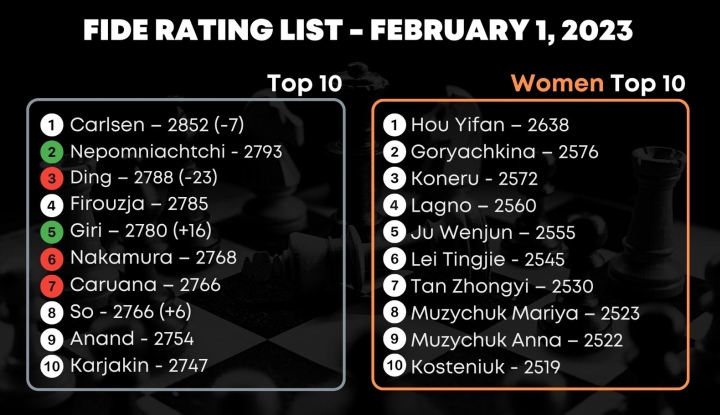
The 2023 Tata Steel Chess festival was the major event in the previous month that brought about significant changes at the top. The champion, Anish Giri (pictured below) picked up 16 points and climbed to #5 (the last time he mounted that high was back in November 2019), while Ian Nepomniachtchi, who was inactive in January, reached #2 for the first time in his career, after Ding Liren‘s lackluster performance in Wijk ann Zee that cost him 23 rating points. Magnus Carlsen also dropped 7 points in Tata Steel Masters, but his top position remains uncontested. Photo: tatasteelchess.com | Maaike Brink There were no changes at the top of the Women’s list, but not for long, as 12 of the top female players are taking part in the second leg of the FIDE Women Grand Prix in Munich, Germany, which opened yesterday and will last until February 14. Biggest gains in Top 100 Open and Women Donchenko, Alexander GER 2654 (+27) Abdusattorov, Nodirbek UZB 2734 (+21) Vantika Agrawal IND 2370 (+18) Giri, Anish NED 2780 (+16) Divya Deshmukh IND 2363 (+14) Yip, Carissa USA 2369 (+12) Sargsyan, Anna ARM 2371 (+10) Maghsoodloo, Parham IRI 2728 (+9) Guichard, Pauline FRA 2379 (+9) Alexander Donchenko lost some rating points in November and December of 2022, but he turned things around in the first month of 2023, convincingly winning Tata Steel Challengers. This success translates into +27 rating points and his debut in the top 100 Open. Photo: tatasteelchess.com | Lennart Ootes Nodirbek Abdusattorov (pictured above) also made a huge leap following his solid performance in Tata Steel Masters. Despite losing in the final round and missing the title, the Uzbek youngster netted 21 rating points and broke into the top 20 Open for the first time in his career. Parham Maghsoodloo demonstrated his fighting spirit in Wijk aan Zee and, after a strong finish, earned 9 rating points. The winner of the 48th Edition of the Indian Women’s National Championship Divya Deshmukh (pictured below), got 14 rating points, but the bronze-winner, Vantika Agrawal, did even better in this domain, increasing her rating by 18 points. Photo: All India Chess Federation Carissa Yip steamrolled the competition at the 2023 Pan-American Intercollegiate Team Championship, gaining 12 rating points, while Anna Sargsyan also did a great job in this competition and picked up 10 points.
Dana Reizniece-Ozola welcomes the chess queens to Munich

The opening ceremony of the 2022-2023 Munich leg of the Women’s Grand Prix was held this evening at the centrally located five-star luxury Vier Jahreszeiten Kempinski hotel, situated directly in the city centre of Munich. The twelve participants, authorities, arbiters and officials, enjoyed a 45-minute series of activities, national anthems, speeches and videos, culminating in a family group photo. Representing Fide, Dana Reizniece-Ozola, Deputy Chair of the management board, welcomed the “chess queens” to Munich and congratulated them on their participation in the Women’s Grand Prix. She also extended her thanks to all the main sponsors of the event: the Krulich Immobilien Group, a real estate company based in Munich, and Motiva, a long-term sponsor of FIDE that empowers women in chess. Hugely appreciative of the importance of the organizing team, Dana stated: “The beauty of a chess game is mainly set by the number of sacrifices in it, but organizing chess tournaments is more about the investment of time, energy and resources so that the event is a success”. After the anthems, the main tournament sponsor, Roman Krulich of the Krulich Immobilien Group, took the floor. After thanking Emil Sutovsky for the idea of organizing the event, Krulich welcomed everyone to Munich. “Together with Stefan Kindermann and Gerald Hertneck, we have been supporting chess here in Munich for more than twenty years, bringing the game closer to children who can’t afford the lessons”, were Krulich’s opening words. He also thanked the Director of the luxury Vier Jahreszeiten Kempinski hotel, Holger Schroth, for their help as the venue of the exciting tournament. The participants enjoyed a movie clip featuring most of the players in the recent Astana event, after which GM Stefan Kindermann, founder of the Munich Chess Academy and one of the commentators of the event, gave a short speech in which he broke down the impressive chess history of the city of Munich, highlighting the 1908 Lasker-Tarrasch World Championship Match and the 1958 Chess Olympiad. Finally, all the players were invited on to the stage for a photo opportunity and drinks were served. Round 1 pairings: Harika Dronavalli vs Koneru HumpyMaria Muzychuk vs Anna MuzychukAlexandra Kosteniuk vs Alina KashlinskayaTan Zhongyi vs Zhu JinerElisabeth Paehtz vs Dinara WagnerZhansaya Abdumalik vs Nana Dzagnidze Text: IM Michael Rahal Photos: David Llada Official website: womengrandprix.fide.com/
Olympiad for People with Disabilities R3: The halfway point

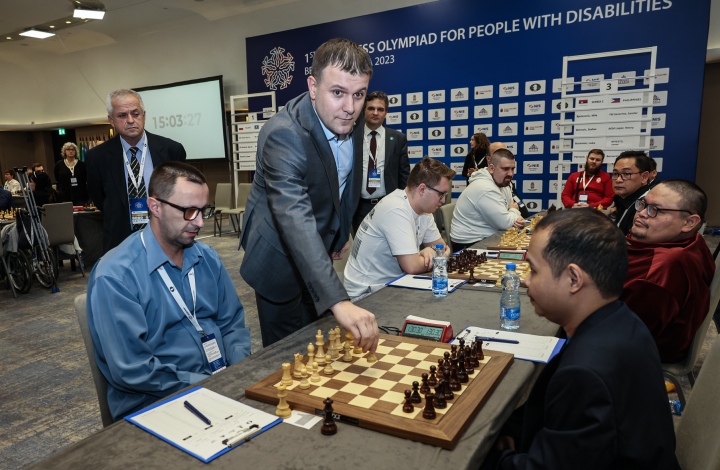
Following three rounds of play, India, the Philippines and Poland are in the lead at the first Chess Olympiad for People with Disabilities. The third round was opened by the Serbian Minister of Trade, Tourism and Telecommunications, Husein Memic. Despite a very friendly and warm atmosphere at the tournament, the battles over the chessboard are becoming tougher, and the games are lasting longer. Despite the extended ‘work hours’, many of the players continued to spend time outside of the playing hall, waiting for their other teammates and analyzing the games, often with members of other teams. This is rarely seen in other chess events. One of the guests at the event is Bharat Singh Chauhan – secretary of the All India Chess Federation and the tournament director of the 44th Chess Olympiad in Chennai. Speaking about the inaugural Olympiad for people with disabilities, Singh complemented FIDE and local organizers on putting this event together. “It’s a very difficult tournament, and it’s a great initiative by FIDE to bring disabled people together”, Singh noted. Singh believes that people with disabilities should have their own Olympiad: “It’s a right decision for FIDE to have a separate event for people with disabilities. It’s a right for them to have their own, separate Olympiad.” Asked to summarize what it takes to organize a chess Olympiad, Singh singled out one thing – courage. “We had three months to organize a huge event [the 44th Olympiad in Chennai], and it was right after the peak of Covid. Singh also compared the Olympiad for people with disabilities to other events: “Every tournament has different challenges. Here even – every player is different. It’s really difficult to say that this is an easy tournament to organize.” Top games and results of the third round: Tough at the top The rating favourite Poland continued their hot run as they defeated the international squad of FIDE by 3.5:0.5. FIDE team’s Andrei Obodchuk and Natasha Morales Santos missed their chances to save the balanced endings. The most exciting match of the round was played by the teams of India and Israel. Until the last seconds, it looked like the battle would finish 2:2. Darpan Inani from India regretted he had missed an opportunity to make a big surprise. However, the chess Goddess Caissa gave Indian players a hand in the following position: While the experienced GM Yehuda Gruenfeld was looking for the fastest road to win with black pieces, the time on his clock expired, and Shashikant Kutwal won the last game of the round and the whole match – 3:1! The Philippines scored an impressive victory over the second team of Serbia (3.5:0.5). On board four, Darry Bernardo extended his material advantage with a small combination: 34.Qe7 Nf6 35.Rxe6! fxe6 36.Qxe6+ Qf7 37.Qxc8+ and Vladan Petrovic resigned on the 42nd move. As a consolation for domestic fans, the first team of Serbia won in the ex-Yugoslav derby against Montenegro – 3:1. The Cuban team quickly came to a 2:0 lead, and the draws on lower boards were enough for a 3:1 win against Romania. Pedro Morales Romero found an elegant way to break into the black king’s fortress: 25.Rxf4! Qxf4 26.Bxe6! and Mihai Bursuc immediately resigned. After 26…fxe6 white queen penetrates the “seventh heaven”: 27.Qd4+ e5 28.Qa7, with an inevitable mate on the 7th rank. The rise of the Uzbekistan team continued with a 2.5:1.5 win over Germany. It was interesting to see how Axadxson Kimsanboev created two different mating threats to Manuela Mekus. White sacrificed a piece to escape from the first one but fell to another one: 40….Re8 41.g4 h4 42.Ng3 hxg3 43.Kxg3 Bc7+ 44.Kh4 Kf7 45.Rxd3 Rh8# The 4th-seed Croatian team recovered from surprising losses in the first two rounds. The maximal result of 4:0 against Panama came with some luck since Jesus Camilo Osorio lost a completely winning position on the 2nd board. The African derby ended with a convincing win by Zambia over Kenya – 3.5:0.5. The full list of results from the second round can be found – here. The pairings of the third round can be found – here. The centenary of the birth of Svetozar Gligoric To celebrate the centenary of the birth of one of the greatest chess players in history, Svetozar Gligoric (who was born in Belgrade on 2nd of February 1923 – died in Belgrade, on 14th August 2012), the Serbian chess federation will host a reception at the prestigious Veterans’ Club Building in Belgrade on Thursday, at noon. The event will feature a short movie dedicated to the great Yugoslav and Serbian chess legend, accompanied by an exhibition of photos from Gligoric’s life and career. Chess players, FIDE President Arkady Dvorkovich, as well as high-ranking officials of the Serbian government, will attend the event. In honour of the great Gliga, a Blitz tournament will be held in Belgrade on the 5th of February, followed by a two-day Rapid event featuring strong international players. Text: Milan Dinic (FIDE Press Officer) and Marjan Kovacevic (DIS reporter) Photos: Mark Livshitz About the event The Chess Olympiad for People with Disabilities, a six-round Swiss tournaemnt is played at the Crowne Plaza Hotel in Belgrade, Serbia. The time control is 90 minutes for the first 40 moves, followed by 30 minutes for the rest of the game, with an addition of 30 seconds per move starting from move one. The default time is 15 minutes. The second round starts on Tuesday, January 31, at 3 PM CET time. For more about chess for people with disabilities, you can go to the official website of the Players with Disabilities Commission: dis.fide.com/ You can find more information on the official website: dis-olympiad.fide.com/ About NIS NIS (Petroleum Industry of Serbia) is one of the largest vertically integrated energy companies in Southeast Europe. Its core business includes exploration, production and refining of crude oil and natural gas, sales and distribution of a wide range of petroleum products, as well as implementing projects related to petrochemical operations and power generation. One of the NIS’ strategic commitments and fundamental practices is continuous improvement of the living standard of communities of the company’s operation.