

World Cup Round 5 Game 1: Sindarov strikes as giants battle to a standstill in Goa
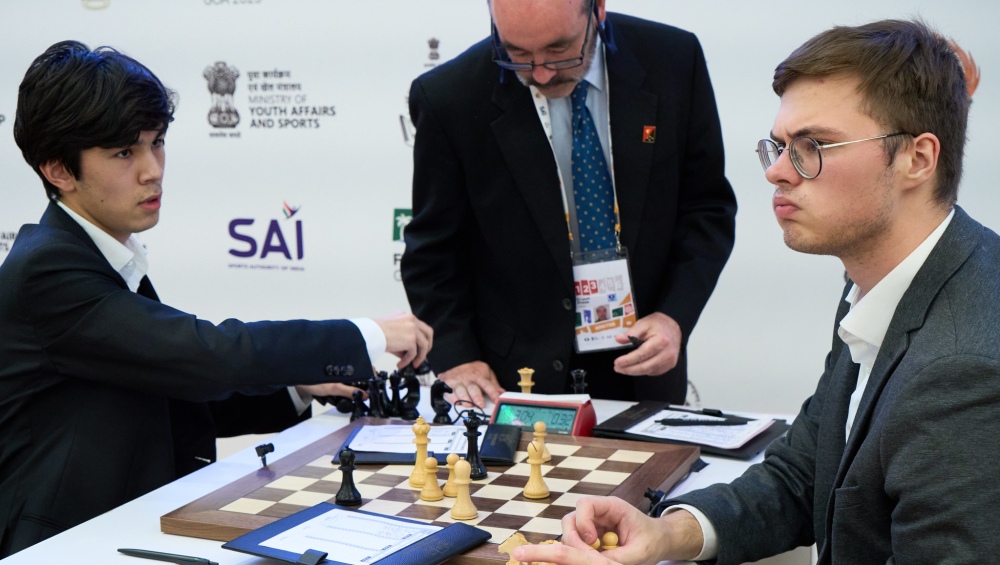
The atmosphere at the Rio Resort in Goa was electric this afternoon as players returned to the boards for another round of top-level action. The spotlight quickly shifted to Board 2, where Levon Aronian and Arjun Erigaisi delivered one of the most engaging and dynamic games of the day, drawing considerable attention from spectators and commentators alike. The ceremonial first moves were executed by two distinguished guests from the European chess community: Gunnar Björnsson, CEO of the Icelandic Chess Federation and Vice President of the European Chess Union, and Alojzije Janković, also a Vice President of the European Chess Union. Their presence underscored the strong international support and camaraderie surrounding the event. As the pieces were set in motion, anticipation built around whether the sharp tactical exchange between Aronian and Erigaisi would set the tone for the rest of the afternoon. It certainly did – capturing the spirit of competition that has defined this year’s battles in Goa. After around ninety minutes of play, the first result of the afternoon arrived. The Peruvian-Mexican phenomenon, GM José Eduardo Martínez Alcántara (2644), continued his remarkable run by securing a solid draw against India’s GM Pentala Harikrishna (2697). Martínez Alcántara has been producing the tournament of his life. In the previous two rounds, both times with the black pieces, he claimed impressive victories over GMs Nodirbek Abdusattorov and Alexey Sarana, winning the opening game of each match. Today, armed with the white pieces, he entered a deeply theoretical line of the Two Knights Defence, in which White typically gains a pawn at the cost of structural weaknesses and falling behind in development. Play followed established theory up to move twenty-five, with at least sixteen moves matching top-level over-the-board or correspondence encounters found in current databases. All known predecessors have ended in draws, including one by GM Javokhir Sindarov, also competing in this Round of 16. Given the speed and confidence with which both players executed their moves, it was evident they were well-prepared and content with a balanced outcome. Harikrishna will enjoy the white pieces in tomorrow’s game, while Martínez Alcántara has already demonstrated lethal form with black, having defeated both his previous opponents from that side of the board. With both players registering 99% accuracy, a peaceful result was practically inevitable, and fully justified. About an hour later, a short burst of activity swept through the playing hall as three games concluded within ten minutes, all ending in solid, uneventful draws. One of these results came from GM Andrey Esipenko (2693), who, after yesterday’s exhausting tiebreak elimination of tournament favourite Vincent Keymer, opted for a calm and risk-free approach against Aleksey Grebnev (2611). Grebnev himself had just survived a taxing tiebreak against Maxime Vachier-Lagrave, making a peaceful outcome mutually understandable. Drawing inspiration from a 2019 encounter in which Esipenko faced GM Rakhmanov (2638), Grebnev arrived fully equipped with home preparation in one of the most solid and respected continuations of the Petrov Defence. Esipenko attempted to sidestep prior theory with a small refinement – 12.Nb5 instead of the more common 12.Bf4 – but Grebnev remained completely unfazed. He rattled off his first twenty moves with confidence, showing no sign of discomfort. With a fully symmetrical pawn structure on the board and no practical prospects for either side to create winning chances, the players agreed to a draw on move thirty-one. Accuracy scores hovering around 95% reflected the clean and disciplined play delivered by both competitors. What awaits tomorrow remains to be seen, but based on today’s balance of power, this match appears a strong candidate to head for tiebreaks, a scenario in which both Esipenko and Grebnev may feel they have realistic chances to outplay the other. In a symmetrical variation of the English Opening, GM Alexander Donchenko (2641) and GM Lê Quang Liêm (2729) contested a strategically rich, though ultimately balanced, encounter. While the final accuracy scores, an impressive 98% for both players, might suggest a quiet affair, the game was anything but effortless. Both grandmasters invested significant time at key moments, carefully navigating the subtle nuances of the position. One of the most intriguing moments arose just out of the opening. Holding an extra pawn, Donchenko had the tempting option of 18.axb6 axb6 19.Rfc1, but this line allowed Black dynamic possibilities such as 19…Nc4, granting Lê Quang Liêm sufficient counterplay to maintain equilibrium. Recognizing the latent danger, and after deliberating for just over ten minutes, Donchenko chose the prudent path with 18.Qc2, returning the pawn and steering the game toward safety. From that moment, the position began to simplify naturally. Forced sequences followed, exchanges swept pieces off the board, and the game peacefully concluded with a draw on move thirty-one. A clean and professional display from both sides, the game exemplified the high level of precision that has come to define this stage of the tournament. Before the round began, I found myself—as I often do—chatting with fellow specialists while surveying the match-ups from a distance. Theo from Lichess and Shahid from ChessBase India are two of my usual companions in these pre-game exchanges. As we compared notes, Shahid and I agreed that the encounter between GM Gabriel Sargissian (2624) and GM Nodirbek Yakubboev (2689) was as close to a 50/50 toss-up as one could get. Although Yakubboev holds the higher rating on paper, Sargissian’s reputation as a rock-solid competitor, especially with the White pieces, made the prediction far from straightforward. Today’s clash, a pristine 99% accuracy effort by both players, once again highlighted the immense depth and technical discipline of these two grandmasters: no mistakes, no inaccuracies, simply a flawless game. Sargissian repeated his trusted Catalan, but was unable to carve out any meaningful edge from the opening. He ventured into a line that momentarily sacrifices a pawn in pursuit of active piece play, yet Yakubboev calmly returned the material, opting instead to secure a superior pawn structure. Subsequent simplifications flowed naturally, and with the position fully equalized, and both players still holding more than twenty-five minutes on
Winners crowned at FIDE World Amateur Championship 2025

The FIDE World Amateur Chess Championship 2025 concluded yesterday in Vrnjačka Banja, the Serbian capital of tourism. The event attracted 284 players from 51 national federations, culminating in the crowning of winners across all six sections. The best female chess players in the U1700 event are Mouza Nasser Alshamsi, (UAE) scoring 7/9 followed by Ayala Kuanyshbay (Kazakhstan) and Disha U A from India. The open section U1700 saw the triumph of Medet Dyahaparov (Kyrgyzstan) who claimed gold with an excellent score of 8/9. Pathak Anshu Kr (India) and Dulguunjargal Dashdavaa (Mongolia) tied for second place on 7.5/9, with the former clinching silver on tiebreaks. The top female finishers in the U2000 tournament are Khuslenzaya Baldanjantsan from Mongolia (8/9), Wang Minging of Germany (7/9), and Karina Daniela Ferreira Kanzler from Brazil (5.5/9). In the open section U2000, the first place was won by Dejan Jakovljević from Serbia with 8/9. Vo Hoang Quan from Vietnam (7.5/9) took silver, while Arlan Abuzyarov from Kazakhstan completed the podium with 7/9. Tsogtsaikhan Saikhanchimeg from Mongolia (5.5 points), Anna Ivaschenko (4.5 points) and Nadezhda Antonova from Tajikistan (4 points) became the best female chess players in the U2300 competition. The most tightly contested tournament was the U2300 Open section, which ended in a three-way tie for first. Ivan Kudrin (FIDE), Sergei Krivenko, and Sergei Pogorelskikh (both Serbia) all scored 7/9, with Kudrin claiming gold, Krivenko silver, and Pogorelskikh bronze based on tiebreak scores. The closing ceremony featured a performance by a local chorus and the presentation of trophies and diplomas. It was attended by Saša Jevtić, Tournament Director; Ozgur Solakoglu, a representative of the International Chess Federation (FIDE); Andrija Jorgić, President of the Chess Federation of Serbia; and Boban Đurović, President of the Vrnjačka Banja municipality, who officially declared the competition closed. In his address, Solakoglu thanked the organizers for the exceptional level of organization and announced that Vrnjačka Banja will host two more FIDE championships in 2026. “Over these nine days, we witnessed extraordinary glory in honor of chess. From the first move to the last round, players from around the world showed not only skill and determination, but also the true spirit of amateur competition — where passion and respect for the game shines above all else. Congratulations to our winners. Thank you to every participant. You have made this championship lively, competitive and memorable. Whether you won or learned something new, you contributed something truly special. To our hosts — the Chess Federation of Serbia, the city and people of Vrnjačka Banja, arbiters, volunteers and staff — you created an atmosphere in which chess could flourish and friendships could be established,” said Solakoglu. Andrija Jorgić, President of the Chess Federation of Serbia, expressed his pride in hosting the event. “Do not forget that chess is a knight’s game,” he said, “and that the one sitting across from you is not an enemy, but an opponent at the chessboard.” Photos: Savo Tufegszic Official website: worldamateur2025.fide.com
2025 FIDE World Corporate Chess Championship opens in Goa
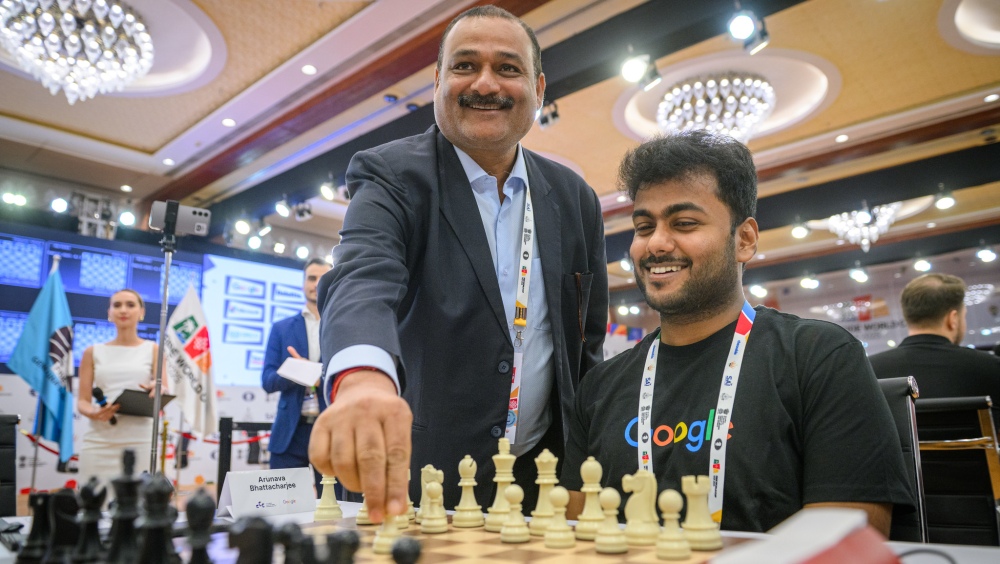
The second edition of the FIDE World Corporate Chess Championship began today in Goa, alongside the FIDE World Cup, bringing together leading international companies to compete for a World Championship title. The event highlights how chess is becoming part of modern workplaces and offers employee teams a global stage to represent their organisations. This year’s finals feature 11 teams, selected from hundreds of companies through online qualifiers and joined by a few invited wild cards. The field spans technology, finance, consulting, engineering, and fast-growing firms from emerging markets. The FWCCC has a clear identity: only true corporate teams take part. Every player is a full-time employee, manager, or board member, and organisations directly connected to chess are not eligible. At the opening ceremony, FIDE Secretary General Lukasz Turlej welcomed participants, saying: “On behalf of the International Chess Federation, I am happy to welcome everyone to Goa. This championship connects the corporate world with the universal language of chess in a special way. We appreciate the All India Chess Federation, the Goa Chess Federation, the Government of Goa, and the Prime Minister of India for enabling us to hold this event here. The corporate chess community is growing quickly, and I am confident we will keep developing these initiatives together in the future. I wish all the teams great games in this unique place, the home of the World Cup and many of the world’s top players this month.” FormatThe 11 teams play a two-day group stage followed by knockout playoffs on Sunday. All matches use a rapid time control of 10 minutes plus a 3-second increment across four boards. The group stage is a round-robin, with match points deciding the standings and game points as the secondary tiebreak. After Saturday’s group stage, the top two teams from each group advance to the semifinals. POOL A — Morgan Stanley sets the pacePool A completed the first half of its double round-robin today. Standings after Day 1: Morgan Stanley — 10 MP / 17 GP Deloitte 1 — 7 MP / 13.5 GP Microsoft — 7 MP / 12 GP UBS — 4 MP / 10 GP Tech Mahindra — 2 MP / 7 GP Equity Bank Kenya — 0 MP / 0.5 GP Morgan Stanley swept all five matches, scoring 4–0 against Tech Mahindra and Equity Bank Kenya and earning decisive wins over Microsoft, Deloitte 1, and UBS. GM Peter Acs, GM Joshua Sheng, IM Peter Lizak, and FM Gabor Szamoskozi collected 17 gamepoints, the highest of the day. Deloitte 1 and Microsoft remain close in the race for second, drawing their head-to-head match. UBS secured an important victory over Tech Mahindra, while the wild-card teams from India and Kenya fought hard throughout the round. POOL B — GRECO perfect, Google and J.P. Morgan close behindWith five teams, Pool B played four rounds today. Standings after Day 1: GRECO — 10 MP / 15 GP Google — 8 MP / 10.5 GP J. P. Morgan — 6 MP / 6.5 GP Deloitte 2 — 4 MP / 6 GP ERG — 2 MP / 2 GP GRECO delivered a flawless day, winning all four matches and conceding only half a gamepoint across the entire pool. GM Volodymyr Onyshchuk led the team on board one, supported by three International Masters who ensured stability on every board. Google secured second place with a 4–0 win over J.P. Morgan in the last round. J.P. Morgan, featuring FM Agustin Ambrogi and FM Ramon Lorente Pupo, finished third after solid results against Deloitte 2 and ERG. Although none of the players are professionals, the level of play was high, with experienced club players and titled competitors representing some of the world’s most recognisable companies. The games were sharp, the atmosphere focused, and the engagement evident. The group stage concludes on Saturday morning with the second half of the double round-robin. With Morgan Stanley and GRECO leading their pools and several challengers still within reach, the race for the title of The Smartest Company in the World remains wide open. Written by Charlize van Zyl, FIDE Press Officer (Goa, India) Photos: Michal Walusza
2025 World Women’s Team Championship: Pools announced

2025 FIDE World Women’s Team Championship pools announced ahead of opening in Linares, Spain With just three days remaining until the official opening ceremony of the 2025 FIDE World Women’s Team Championship, the International Chess Federation (FIDE) has confirmed the composition of the two competitive pools. The championship will be held in Linares, Spain, from November 17 to 24, 2025, in one of the most iconic cities in world chess. Already on site in Linares, Javier Ochoa de Echaguen, President of the Spanish Chess Federation, welcomed the first arriving delegations: “The Spanish Chess Federation is delighted to welcome all delegations attending the Women’s World Team Championship in the historic city of Linares.” Pool A: A clash of heavyweights Team FIDE, led by GM Aleksandra Goryachkina, tops Pool A with an impressive 2496 average rating. Close behind is Team USA, averaging 2406, spearheaded by rising star IM Carissa Yip. Photo: Michal Walusza Team Kazakhstan enters with a 2381 average rating and GM Bibisara Assaubayeva on board one. Following the late withdrawal of Team Algeria due to visa issues, Team Azerbaijan has been nominated as the replacement. With an average rating of 2366, Azerbaijan—led by IM Ulviyya Fataliyeva—significantly elevates the competitive depth of Pool A. Host nation Spain fields a 2339 average rating team, featuring IM Sarasadat Khademalsharieh on top board. Team Peru rounds out the pool with a 2207 average rating, led by IM Deysi Cori T., supported by several of the country’s most promising young talents. Pool B: Hou Yifan returns Pool B is headlined by the return of GM Hou Yifan, four-time Women’s World Champion, who leads Team China to the event with a strong 2473 average rating. Widely recognized as the second-highest-rated female player in history, Hou’s participation adds exceptional prestige to the championship. Photo: Rafal Oleksiewicz Team Georgia (2430), led by GM Nino Batsiashvili, brings a seasoned and balanced roster, while Team Ukraine enters with a 2399 average rating under the leadership of IM Yuliia Osmak. Three evenly matched teams—France, Uzbekistan, and India—each average around 2350. Packed with International Masters and Women Grandmasters, they bring a blend of experience and rising youth. Both Uzbekistan and India are fielding notably young squads, expected to capitalize on the opportunity to gain high-level international exposure. A Championship steeped in tradition Looking ahead to a week of intense competition, Ochoa de Echaguen added:“It is an honour for us to host this prestigious event in a venue that holds such a special place in the history of world chess. We trust that the players, coaches, and accompanying teams will enjoy an excellent stay, dedicated organization, and a competitive atmosphere that reflects the values of respect, excellence, and sportsmanship that define our sport.” Full list of teams with average rating Pool A: FIDE (2496) USA (2406) Kazakhstan (2381) Azerbaijan (2366) Spain (2339) Peru (2207) Pool B: China (2473) Georgia (2430) Ukraine (2399) France (2353) Uzbekistan (2336) India (2334) The full rosters of each team can be consulted [HERE]. For more information about the 2025 FIDE World Women’s Team Championship, media accreditation, or event logistics, please contact FIDE or the Spanish Chess Federation.