

Rising stars and surprises: Highlights from Rounds 1–2 of the FIDE Women’s World Team Championship
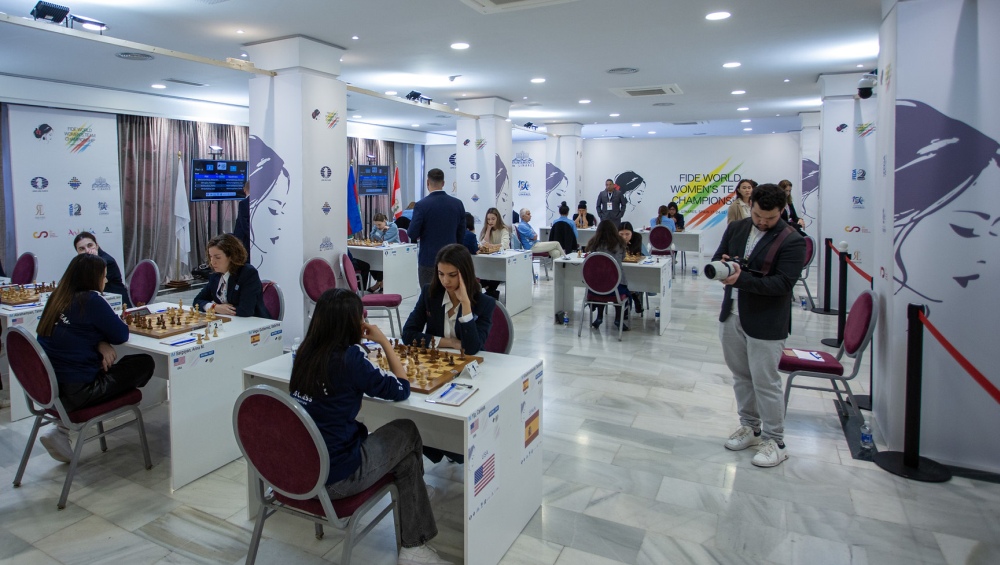
Savitha Shri B and Zhai Mo Shine with tactical brilliance while fast classical debut sparks excitement. Linares was one of the strongest chess tournaments in the world from the late 1980s through the 2000s, attracting Garry Kasparov, Anatoly Karpov, and many other elite players. At the start of each round of the Super-Tournament a large ceremonial gong was struck by a guest of honour to officially begin play. This ritual became one of Linares’s most memorable trademarks. It originated as part of the organizers’ effort to give the event a distinctive identity and elevate it to true world-class status. FIDE President Arkady Dvorkovich and FIDE Deputy President – and former five-time World Champion – Viswanathan Anand opened both rounds of the 2025 FIDE Women’s World Team Championship, reviving one of the most recognisable symbols of that earlier era. Each of the two pools in the event, A and B, features six teams that face one another in a round-robin format over five rounds. The top four teams from each pool will advance to the knockout stage, beginning with the quarterfinals. Most of today’s matches – played with the debuting 45 + 30 “fast classical” time control – were dominated by the rating favourites, though several encounters were decided by narrow 2.5–1.5 margins. After the first two rounds, Team FIDE has taken a commanding lead in Pool A, scoring convincing victories over the USA and Kazakhstan, while four teams sit just behind on 50%. Peru currently trails the group after losing both of today’s matches, against Azerbaijan and Spain, though not without putting up a resilient fight. On the other side of the hall, Pool B is led by China – playing without GM Hou Yifan – and Georgia, with India and Ukraine close behind. Great excitement is expected on day two, as rounds three and four are likely to determine the fate of several teams. One of the relative surprises of the day came in round one, where India defeated Ukraine despite being outrated by nearly 100 points. Although the current Olympic champions did not travel with their top lineup, they still field a young, cohesive, and ambitious team capable of challenging any opponent. On board three, IM Savitha Shri B (2319), playing White, controlled her game against GM Natalia Zhukova (2322) from early on, steadily building pressure on the kingside. Savitha is one of the brightest rising stars in Indian women’s chess, already progressing rapidly through high-level norms. Although White had several winning continuations, the Indian player struck decisively with 34.Rxf6!, tearing apart Black’s defensive structure. Zhukova replied with 34…Bc6+ (as 34…Qxf6 loses immediately to 35.Qxd7), but after 35.Qxc6! Rxc6 36.Rxf7, the former two-time European Women’s Champion had no choice but to resign. A clean and elegant tactical finish. Team captain GM Swayams Mishra and two of the players from the match later joined me in the interview area for a brief post-game assessment of their performance and of the new “fast classical” time control making its debut at this event. https://www.youtube.com/watch?v=d6R0GDyJOKk Meanwhile, the Chinese squad secured two convincing wins and, alongside Georgia, now leads their pool. On board four in their second-round match, WGM Zhai Mo (2384) delivered a spectacular miniature against WCM Madinabonu Khalilova (2228). Zhai Mo is a former Girls U12 World Champion and the 2018 Chinese Women’s Chess Champion. Black had just played 15…Bg7-f8, attacking the rook on d6 and attempting to provoke exchanges that might relieve the pressure. However, Zhai Mo responded aggressively with 16.Ng5!, sacrificing the exchange. After 16…Bxd6 17.exd6 Qd7 18.Ne4!, the weaknesses around the black king quickly became apparent. The decisive threat 19.Nf6+ was temporarily parried by 18…Kg7, but 19.Bb5! highlighted another vulnerability on e5. After 19…Bb7, White unleashed the final tactic: 20.Nf6!!, attacking the queen. Black resigned, as 20…Kxf6 21.Bxc6! Qxc6 22.Qe5 leads to an inevitable checkmate. A brilliant and clean finish from Zhai Mo. After the first two rounds of the tournament, the standings in both pools are as follows: Round three tomorrow at 1:30 pm promises some exciting encounters. In Pool A, the most intriguing match will be USA vs. Azerbaijan, as both teams vie for second place in the group. Close behind, Spain will aim to secure at least a draw against the formidable Team FIDE. https://youtu.be/nb8LA9s-K48?si=TA6AHrw7JvAJQ35Z In Pool B, the dramatic clash between France and Uzbekistan will provide both teams with a final chance to avoid elimination and potentially catch up with the leading teams. Round 3 begins on November 19 at 1:30 PM local time. The action can be followed live on the FIDE YouTube Channel, featuring expert commentary by GMs Antoaneta Stefanova and Ivan Cheparinov. Official website: worldwomenteams2025.fide.com/ Written by IM Michael Rahal (Linares, España) Photos: Raúl Martínez / Pavel Dvorkovich
FIDE World Cup: Three quarterfinals poised for decisive tiebreak battles
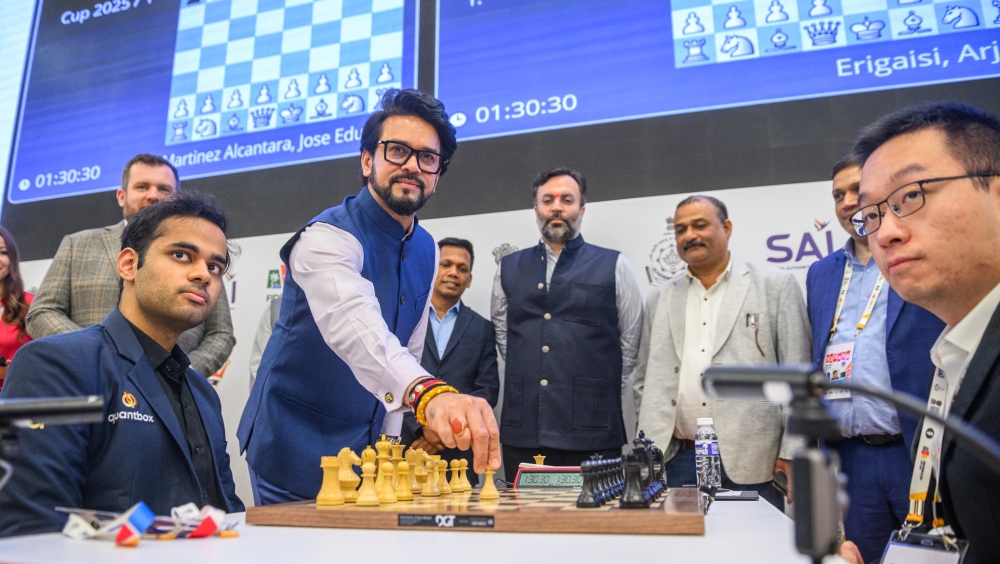
The tension was evident as players entered into the playing hall today, several arriving just minutes before the clocks were started, a sure sign of the pressure mounting at this decisive stage of the World Cup. The air in the playing hall was quiet and concentrated, yet packed with spectators eager to witness the eight remaining players in action. With only four spots in the semifinals, chess fans were treated to a blend of high-stakes precision and tightly controlled risk. The outcome was draws across all boards, meaning tiebreaks in three of them, and GM Nodirbek Yakkuboev advancing as the first semi-finalist after his victory over Alexander Donchenko yesterday. Before play began, the ceremonial first move was made by Mr. Anurag Singh Thakur, former Sports Minister of India, Member of Parliament, and Chairman of the Parliamentary Standing Committee on Coal and Mines on Board 2, for Erigaisi vs. Wei Yi. Quarterfinals Game 2 results: José Eduardo Martínez Alcántara ½-½ Javokhir Sindarov Arjun Erigaisi ½-½ Wei Yi Andrey Esipenko ½-½ Sam Shankland Alexander Donchenko ½-½ Nodirbek Yakubboev With the semifinal lineup still very much undecided, here’s a closer look at how each game unfolded today. Nodirbek Yakkuboev (2689) vs Alexander Donchenko (2641) Alexander Donchenko had a great deal at stake today. After fighting hard to survive the Round 5 tiebreaks, his classical loss yesterday left him in a must-win situation. He certainly tried, pushing until the very end, creating an imbalanced structure that forced Yakubboev to stay alert. The game followed the Exchange Variation of the Queen’s Gambit Declined, and Donchenko appeared well-prepared, gaining a 30-minute time advantage early on. However, despite his confident opening, his pace slowed and a series of imprecise choices led to a position where his winning chances faded. Black has just played the thematic 21…Bb1, aiming for a Ba2–c4 maneuver. While White has no obvious plan here, Donchenko chose one of the weakest options with 22.f3?, a move our commentators called “strange” as it gave Black easy counterplay. Yakkuboev responded with 22…f5 and followed through with his intended bishop maneuver, fully seizing the initiative. The critical moment came soon: White’s pieces were poorly coordinated, and the pawns on the third rank were vulnerable. Here, the powerful 26…Re8 could have posed major problems for White, especially with the threat of …Nb5 looming. If White tries passive defense with 27.Re1 Black builds up pressure with 27…Rb5 28.Rc2 Rb3. For instance, the natural-looking 29.Ng2 to guard the e-pawn is met by 29…Bd3 30.Rf2 (or 30.Rc3, also losing) 30…Bxb1 31.Rxb1 Nc4, leaving Black in full control. Instead, Yakkuboev started with 26…Rb5, allowing 27.Rg2. Though Donchenko escaped immediate danger, Black still held a comfortable edge. After further exchanges, the game entered a tense endgame where White appeared to retain some chances. However, Yakkuboev maintained accuracy and steered the game to a dead-even draw. With this result, he became the first player to qualify for the semifinals of the 2025 World Cup. Wei Yi (2752) vs Arjun Erigaisi (2773)As the only remaining Indian player in the field, Grandmaster Arjun Erigaisi carries significant expectations. Yet he has remained composed throughout the event, arriving calm at the board each day and greeting enthusiastic fans waiting (and chanting his name) outside. After a quick draw yesterday, today’s strategy was different – with the White pieces, Arjun prepared a fresh idea in the Queen’s Gambit Declined. Wei Yi, however, played confidently and quickly as well. The game soon left known theory and entered territory in which both players could just play chess. Tension started when Wei Yi chose to complicate with 18…c5, accepting an isolated queen’s pawn but gaining activity. The position suddenly became sharp: Arjun played the quiet-looking 20.Qe2 instead of the more natural 20.Qb1. Commentators GMs Jan Gustafsson and Peter Leko praised it as “strong and unexpected,” as it unpins the queen while provocatively placing it opposite Black’s rook and hinting at Na4 ideas. It posed psychological pressure. Wei Yi spent over 30 minutes here, visibly unsettled and shifting in his chair, before deciding on 20…Qc6. After 21.Nd2, however, Black 21…Nd7? (21…Nh5 was the better choice – we will get into that mess later, so bear with me if you want to get into deep analysis) allowing a tactical sequence: 22.Nb3 Bxc3 23.bxc3 Rxc3 Here Arjun had a golden opportunity – 24.Bxd5! and after 24…Qc8 25.Rxc3 Qxc3 White simply captures a free pawn with 26.Bxb7. Black also can choose 24…Qxd5 – and here is why the earlier mistake of 21…Nd7 matters. 25.Rxc3 Ng5 26.e4 (only move to keep the advantage and stop …Nf3), 26…Rxe4 27.Rd1! And the d7-knight is ill-placed and hanging. Instead, Erigaisi played 24.Qd2? and after 24…Rxc1 25.Rxc1 Qa6 26.Bxd5 Nf6! Wei Yi equalized and the game was drawn on move 32. Now let’s go back to the better 21…Nh5 which makes the difference. Now 22.Nb3 Bxc3 23.bxc3 Rxc3 24.Bxd5 does not hold the same venom after 24…Qxd5 25.Rxc3 Ng5 26.e4 Rxe4 and Black’s pieces, particularly the knights, are very active. The same idea we saw in the previous line of 27.Rd1 is a big blunder because of the desperado 27…Qxb3! And suddenly Black would be winning. This tactic would not be the same with the knight on d7. All of this analysis just goes to show how small nuances of a position can affect the evaluation but only surface moves later, and it’s curious to know whether all of this was seen. After intense days like these, we don’t corner the players for interviews, but after tomorrow I will definitely find out from the match’s victor how much was calculated here. Javokhir Sindarov (2721) vs José Eduardo Martínez Alcántara (2644)The draw between Sindarov and Martínez was the most curious result of the day, not for the score, but for how swiftly it was achieved. The players entered a known drawing line in the Four Knights Spanish and followed the theory to a peaceful result in just 20 minutes. For Martínez, who had the White pieces and momentum from previous rounds, it