

Women’s World Team Championship quarter-finals: Team FIDE and China set to clash in anticipated semi-final
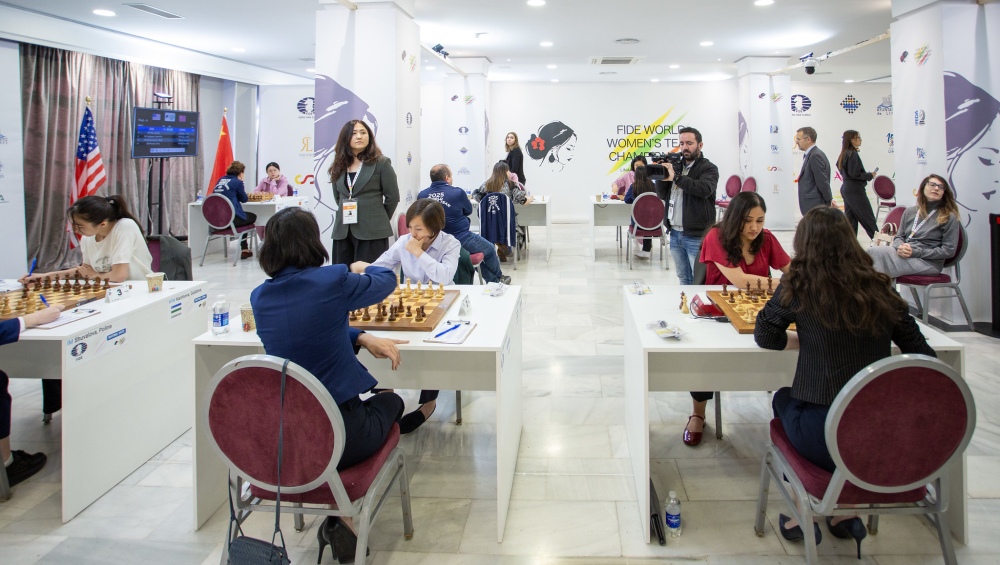
Azerbaijan and Kazakhstan join them after dramatic victories on one of the most thrilling knockout days yet As the knockout stage began in Linares, the Women’s World Team Championship entered its most thrilling phase. The quarterfinals brought with them a blend of precise preparation, fighting spirit, and bold creativity, producing a memorable day in which favourites were tested, rising stars shone, and several duels remained undecided until the very last move. China survived a nail-biter against the USA, Team FIDE swept past Uzbekistan with authority, Azerbaijan stunned the higher-rated Georgians, and Kazakhstan edged India in a heart-stopping blitz finish. By sunset, four teams had emerged from the chaos, each carrying a story worthy of the semi-final stage. Let’s look at how the afternoon unfolded in greater detail in each pool. The gong ceremony to open each of the rounds was performed María Auxiliadora del Olmo Ruíz (Mayor of Linares) and Raúl Caro-Accino (Deputy Mayor of Linares). Duel 1: Team FIDE vs. Team Uzbekistan The most lopsided quarterfinal duel ended decisively in favour of team FIDE, who not only fielded considerably stronger players on every board but also made effective use of their deep bench by bringing in one of their elite reserves. With this victory, they advanced to face China tomorrow in what could easily be described as an anticipated final. A double 3.5–0.5 sweep left no doubt about their superiority: FIDE has issued a clear statement that they are the team to beat for anyone hoping to claim the title in Linares. All five players performed superbly this afternoon, but if one had to be singled out, the standout was unquestionably GM Kateryna Lagno (2517), who defeated rising Uzbek talent WIM Umida Omonova (2289) in impressive technical fashion. Omonova, one of Uzbekistan’s brightest young prospects, is already decorated with multiple medals from Asian Youth and World Youth Championships. In Linares, she further cemented her ascent by crossing the rating threshold to earn her WGM title, a major milestone despite today’s tough pairing. Duel 2: Team USA vs. Team China Team China advanced to the semi-finals, where they will face team FIDE, after defeating team USA in a hard-fought and dramatic duel. On paper, China held a slight rating edge thanks to GM Hou Yifan’s towering presence on board one, but team USA brought significantly more experience, especially given the youthful composition of the Chinese squad. The first classical match ended 3–1 in favour of the USA, putting them in a strong position heading into the second set. Although China was leading the second match overall, a major twist occurred: IM Carissa Yip (2459) scored a stunning win with Black over GM Hou Yifan (2620), while simultaneously IM Anna M. Sargsyan (2377) had IM Song Yuxin (2448) under severe pressure. A 2–2 draw in the second classical set would have sent the USA to the semi-finals, but it wasn’t to be. Song engineered a resourceful and tricky comeback, saving the game and forcing a tiebreak. In the deciding 3+2 blitz match, China dominated completely, delivering a crushing 3.5–0.5 victory to clinch their spot in the final four. A key moment in the classical portion came from board three, where Bent Larsen’s famous maxim “Long variation, wrong variation” proved prophetic, as overcalculation in a complicated line turned the tide at a critical moment. Playing with Black, IM Lu Miaoyi (2440) was gradually outplaying her opponent, IM Tatev Abrahamyan (2391), on board three. In the diagrammed position, both the solid 22…Rd8 and the more ambitious 22…e5 would have been excellent choices. Instead, the Chinese prodigy erred with 22…Nxd4? The idea behind the move is clear: if 23.Nxd4, then 23…Rxf2 gives Black strong counterplay. However, Abrahamyan found the much stronger resource 23.Ne5!, a powerful fork hitting both the queen and the rook. After 23…dxe4 24.Rxe4 Qh5, Lu Miaoyi was relying on the pressure against the rook on d1 to keep the position balanced. But Tatev, well known for her sharp, fighting style, pressed forward with the brilliant 25.Nxf7! After 25…Qxd1, White had just one winning move, but it was spectacular: 26.Nxh6+! gxh6 27.Rg4+ Kf7 28.Qh7+ Kf6 29.Qg7#, an elegant checkmate that concluded one of the most memorable tactical sequences of the round. Even though the match finished quite late, I was able to gather the full team and their coaches for a quick post-match interview. https://www.youtube.com/watch?v=VEq8RbTMYl4 Duel 3: Team Azerbaijan vs Team Georgia Although Georgia appeared to be the clear favourite on paper, Azerbaijan produced the upset of the afternoon by defeating one of the top contenders for the title. With this remarkable victory, the Azerbaijani team earned their spot in the semi-finals, where they will face Kazakhstan for a place in the championship match. The first match was a thrilling affair, ending in a lively 2–2 scoreline, with all four boards producing decisive results. The fighting spirit on both sides set the tone for what would become one of the most dramatic duels of the day, as neither team showed any interest in quiet, risk-free play. The game appeared roughly balanced, with no immediate signs that anything could go seriously wrong for Black. However, IM Khanim Balajayeva (2350) demonstrated excellent tactical alertness and produced one of the biggest surprises of the round: an upset that allowed Azerbaijan to tie the first match of the duel against Georgia. Balajayeva struck with 27.cxd5, and the experienced GM Bella Khotenashvili (2424) faltered by replying with 27…Rxd5? (the simple 27…exd5 would have held the balance). This oversight allowed White to unveil the powerful resource 28.Rc1!, simultaneously attacking the queen and—more importantly—exploiting the loose knight behind it. After 28…Qd6 29.Ne4!, Black’s position collapsed: the knight on c6 under attack, and if it moves, a decisive fork on f6 ends the game immediately. A crisp tactical finish by Balajayeva at a critical moment of the match. In the second set, a single win by WGM Govhar Beydullayeva (2358) ultimately sealed the deal for Azerbaijan, who secured a 2.5–0.5 victory and advanced to the semi-finals. Even though IM
FIDE World Rapid and Blitz Championship: Dress code requirements
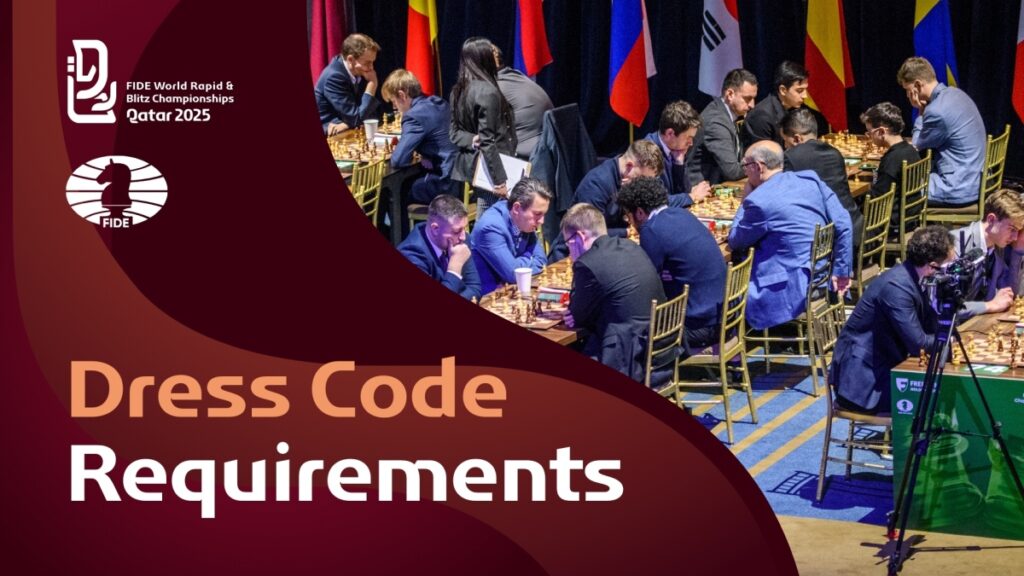
FIDE is pleased to publish the dress code for the FIDE World Rapid and Blitz Championships 2025 in Doha, Qatar: Dress code requirements The dress code is strictly observed for the tournament and all the official events and press-conferences. Clothing allowed for men: Suit Dark business casual trousers, including classic, non-distressed jeans (blue, black, and grey) Unicoloured shirt (with minor deviations allowed, e.g. checkered or striped) Dress shoes and loafers with closed toes Unicoloured sneakers (soles can be a different colour) Clothing allowed for women: Skirt suit, pantsuit, dress suit Dress Dark business casual trousers, including classic, non-distressed jeans (dark blue, black and grey) Shirt/blouse Dress shoes and loafers Unicoloured sneakers (soles can be a different colour) The clothes and shoes shall be neat and free of offensive slogans, tears, or rips. No players with t-shirts, shorts, baseball caps or inappropriate dress are allowed in the playing venue. Any requests to wear national or traditional dress shall be approved by GSC. Sanctions for dress code violations Minor Infringements Minor infringements are those committed without specific intent. Examples include a sloppy or unkempt appearance, wrinkled clothing, or other minor deviations from the standard. First Infringement will result in a financial penalty of 5% of the player’s total prize money earned in the two events, but not less than €300 for open events and €150 for women’s events. The player is allowed to complete the current day and is not obliged to change immediately. Further InfringementsSubsequent infringements will result in exclusion from the pairings for the next round. Major Infringements Major infringements are those demonstrating disregard for or denial of the dress code rules as a whole, or showing disrespect toward FIDE, the opponent, or their countries and national symbols. Examples include, but are not limited to, wearing shorts, beachwear, sleeveless shirts (for men), or clothing/footwear with offensive content or logos of prohibited sponsors (e.g., betting companies, alcohol, tobacco). Each infringement will result in a financial penalty of 10% of the player’s total prize money earned in the two events, but not less than €1,000 for open events and €500 for women’s events.The player will also be excluded from the pairings for the next round. Official website: worldrapidandblitz2025.fide.com/
FIDE World Cup semifinals open with hard-fought draws
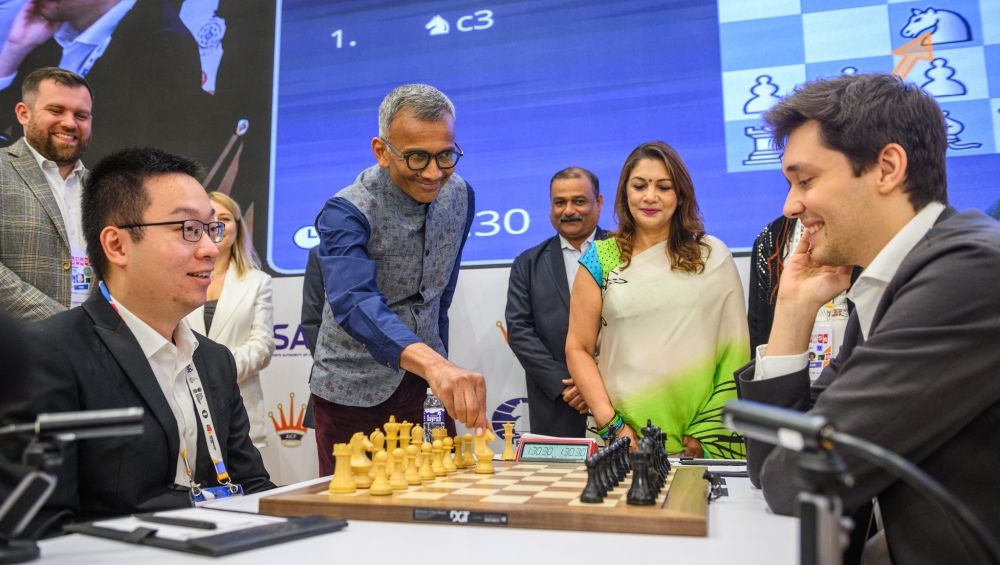
After a quiet rest day yesterday, the players returned to the hall where they have been competing for the last twenty days. A new stage setup elevated the boards, symbolic and fitting for the spectacle that the final rounds of the FIDE World Cup promise to bring. Today marked game one of the semifinals, and although both matches, Wei Yi vs Andrey Esipenko and Nodirbek Yakubboev vs Javokhir Sindarov, ended in draws, they were anything but uneventful. Deep preparation, opening surprises, time pressure and several only-move moments defined the day. Grandmaster Wei Yi, as has become routine, was the first to arrive, followed shortly by his opponent Grandmaster Andrey Esipenko. With a few minutes to spare before the round began, both sat quietly at the board, focused and still. Grandmaster Nodirbek Yakubboev arrived next, carrying his usual five bottles of water. Just before the clocks were started, the ceremonial first move took place, and moments later a slightly flustered and narrowly on-time Javokhir Sindarov entered the hall and took his seat opposite his Uzbek teammate. Today’s first move on the board between Wei Yi and Esipenko was made by Mr. Anup Shah, Managing Director of Resort Rio Goa, and Mrs. Alpa Shah, Director of Resort Rio Goa, two people who have led the wonderful hospitality provided to us throughout the last month. This month of remarkable chess has brought us to these intense final stages. As Grandmaster Fabiano Caruana, the first qualifier to the 2026 FIDE Candidates, stated online, the World Cup is an incredibly difficult tournament and regardless of how well one performs, only three participants leave truly happy: the three Candidates qualifiers. Watching the field shrink after every round has been bittersweet. With players departing every few days, the dining hall has grown quieter. And knowing that one of these four semifinalists, after fighting so hard to reach this point, will soon join the list of 202 eliminated players feels equally, if not more, bittersweet. Still, this is the nature of the event. Success here demands skill, stamina and a measure of luck. Semifinals Game 1 results: Wei Yi ½ – ½ Andrey Esipenko Nodirbek Yakubboev ½ – ½ Javokhir Sindarov Wei Yi (2752) vs Andrey Esipenko (2693) The first surprise of the day came immediately when Esipenko met Wei Yi’s 1.e4 with 1…e6. It was the same French Defense that the Chinese number one had successfully employed in his first quarterfinal game against Arjun Erigaisi. With a rest day available for preparation, unexpected choices made strategic sense, and Esipenko’s decision became even more logical when it became clear that he was not heading into a main line, but the Rubinstein Variation: 1.e4 e6 2.d4 d5 3.Nc3 dxe4 followed by 4.Nxe4 Nd7. It was reasonable to assume that Wei Yi may not have deep practical experience here. Although initially caught off guard after anticipating what he considered a guaranteed Italian, our commentators Grandmasters Peter Leko and Jan Gustafsson quickly agreed that this was a clever and well-timed choice by Black. Wei Yi appeared taken aback by the opening and took his time before committing to a structure and a plan. Esipenko essentially won the opening phase, reaching a slightly better position with two bishops and holding a significant time advantage. Wei Yi, on the other hand, found himself struggling to find chances for activity while also feeling the growing pressure of the clock. Then, suddenly, everything turned. A critical nuance required Black to play 27…Qf5 to remove White’s queen from the center before taking the pawn on h5. That line would have left White with an inferior but holdable position – requiring accuracy. Instead, Esipenko played the immediate 27…Qxh5, and after several minutes of calculation, Wei Yi unleashed the stunning 28.Bxa6! The bishop cannot be taken because the Black king would be exposed to decisive threats. The game continued 28…e5 29.Rd8 Rxd8 30.Rxd8 Ka7. Black attacked the bishop and threatened with 31…Bf5 but another incredible only-move followed instantly: 31.Qa4! which drew applause in the studio from Peter Leko. The game then concluded with 31…bxa6 32.Rd7+ Bxd7 33.Qxd7+ Kb6, after which the players agreed to a draw due to an unavoidable three-fold repetition. Being caught in deep preparation and finding yourself worse as White in a World Cup semifinal is never easy, but Wei Yi once again showed why he is one of the strongest performers of the event. He held his nerve, calculated with precision under extreme pressure, and found the correct moment to strike. Esipenko has previously said that luck is a necessary ingredient for success in the World Cup, and today it was his opponent who had that combination of accuracy and good fortune. Nodirbek Yakubboev (2689) vs Javokhir Sindarov (2721) Despite arriving slightly late, Sindarov seemed relaxed and confident. This was evident not only from his quick early moves and usual pacing around the hall, but also from the enthusiastic high-five he exchanged with his board neighbour Andrey Esipenko as they crossed paths in the opening minutes. Yakubboev, who arrived with the benefit of two consecutive rest days after avoiding quarterfinal tiebreaks, came armed with strong preparation against Sindarov’s Semi-Slav, the same opening they had played in their last two classical encounters. White opted for a sideline with 5.Qd3, but Black appeared completely prepared and unfazed, blitzing out correct theory as if he had predicted it. Soon, in fact, it was Yakkuboev who seemed surprised, spending 23 minutes on his 11th move despite Black having played only natural, expected moves. Despite this sharp start, nothing complicated emerged. Once both players were out of theory, the position settled, and they navigated it with great accuracy. After trading down to an even endgame, where only White could really push for something, Black offered a draw on move 30, which Yakubboev accepted. It was a calm and unsurprising beginning for two players who know each other deeply and have faced each other many times. Notably, both played with great accuracy, with respective scores of 99% and 100%. Tomorrow
A Move for Freedom and Redemption in El Salvador

A powerful and emotional moment unfolded at the Estadio Nacional Jorge “El Mágico” González, where inmates participating in El Salvador’s Plan Cero Ocio were brought out of the prison system to receive public recognition for their achievements in the 5th FIDE Intercontinental Online Chess Championship for Prisoners. The ceremony brought together leaders from FIDE, FIDE America, INDES, and the national prison authorities — a testament to the strength of this collaborative rehabilitation effort. Among the distinguished guests were: José Carrillo Pujol, President of FIDE Americas Dana Reizniece, Deputy Chair of FIDE Management Board Dinora Acevedo, INDES (National Institute of Sports of El Salvador) Samuel Diaz, Director of the Santa Ana Penitentiary Industrial Complex Erick Hernandez, Treasurer of FIDE Americas Saul Montoya, Vice President of Salvadoran Chess Federation Their presence underscored both national and international commitment to the transformative power of chess. Plan Cero Ocio: Building skills and discipline As part of Plan Cero Ocio, participants receive chess training five times a week, providing structure, focus, emotional control, and the opportunity to develop skills that support reintegration. Their dedication led to extraordinary success at the 5th Intercontinental Chess Championship for Prisoners: Gold — Women’s Team Silver — Men’s Team These achievements are supported by the tireless work of INDES’ Inclusive Sports Department which coordinates technical support with the Salvadoran Chess Federation. Special mention goes to International Master Roberto Calderin, who coached the teams for four months, guiding and advising the players daily. Regional coordination and long-term development are further strengthened by the support of FIDE Americas. Voices from the inside The most powerful words came from the participants themselves: “Chess gives me structure. Training every day helps me stay focused and calm. It’s the first time in years I feel like I’m improving at something.” “When I play, I feel free. It reminds me that my mind still belongs to me — and that I can make better decisions, one move at a time.” These reflections capture the essence of what Chess for Freedom aims to achieve: discipline, dignity, hope, and the ability to think forward — on the board and in life. FIDE’s commitment in the 2025 Year of Social Chess As part of the 2025 Year of Social Chess, FIDE is proud to stand with El Salvador in advancing programs that use chess as a bridge to education, rehabilitation, and social inclusion. This ceremony was not just about medals — it was about human transformation. Chess changes lives. And on this occasion, these players proved it on a national and global stage.