

I am woman, I am president: Women at the helm of national federations

Out of 201 FIDE members, only 13 have women presidents. In a slow but steady shift, more women are taking executive roles in chess and business. FIDE spoke to four women who run national chess federations. Here is what they say about the role women can play in chess away from the board. In 1971 the Australian singer Helen Reddy came out with the song “I am woman” which by 1972 reached the number one spot on the U.S. Billboard Hot 100 chart. The famous chorus “I am strong, I am invincible, I am woman,” went on to become an anthem of the rising feminist movement. At the same time, another story of women’s voices was taking shape: in 1971 FIDE organised the first Women’s Interzonal in Ohrid (which was Yugoslavia, at the time), a step towards bringing it in line with the competing system for men. The following year, Nona Gaprindashvili defended her world title against Alla Kushnir by the narrowest margin, eight and a half to seven and a half. In Skopje, the Soviet team with Gaprindashvili and Kushnir on the top two boards dominated the Women’s Olympiad. Also that year, Olga Rubtsova quietly became the first ever women’s world correspondence champion, and the only person in history to hold both over the board and correspondence world titles. For the first time since Vera Menchik, it became more common to talk about women in chess. On the board, women were already making a breakthrough in chess. But away from the board, they were almost absent from the rooms where chess was governed. Nona Gaprindashvili – who is the first woman in history to earn the title of Grandmaster – was also faced with dismissal by many of her male colleagues or men in positions of power. Turning back to the U.S. where the global feminist movement from the 1970s was most prominent, it took another three decades before the U.S. Chess Federation elected its first woman president – Beatriz Marinello (pictured below), in 2003. Today the picture of women in chess looks quite different, but it is far from transformed. At the moment, according to FIDE data, out of 201 member federations, only 13 have a woman president. That is still a small percentage, yet – it would have been unthinkable when Helen Reddy first recorded her song and Gaprindashvili faced Kushnir across the board in Riga. Things are changing. The changing times Recent years have seen more emphasis and support not just for getting women into chess, but for using chess to help them improve their own careers. FIDE has not only increased the number, scope and support for women’s events, but has made women’s chess one of its top priorities, with the Commission for Women’s Chess and the appointment of Dana Reizniece as the Deputy Chair of the organisation’s Management Board. For years, FIDE’s finances have been looked after by Zhu Chen – a former Women’s World Champion, who is the treasurer of the International Chess Federation and is tasked with overseeing revenue flow and ensuring financial transparency. The Commission for Women’s Chess has supported programmes that help countries build women’s national teams from scratch. A 2024 initiative helped nine federations to send a women’s team to the Chess Olympiad for the first time. A conference on chess and life balance discussed the impact motherhood has on a woman’s chess career. Development projects such as the Queen’s Gambit Challenge have brought together more than five hundred eighty women from over eighty countries for training and support. The struggles women face in chess – be it as players or decision-makers in organisations – are the same as those faced in business. A recent Global Gender Report by the World Economic Forum notes that women are a large share of the workforce but a much smaller share of senior leadership. Deloitte’s Women in the Boardroom report, published in March 2024, notes that “women hold less than one-quarter (23.3%) of the world’s board seats”. Like companies, chess federations exist in that same world. They are sports bodies, but they are also employers, event organisers and public facing institutions. When women take the chair in those organisations, they are not only symbols. They are also decision makers in a sector that shapes how millions of children and young people first meet the game. FIDE spoke to several women who are presidents of national chess federations and asked them to share their views and tips on women looking to make a career in chess which is not strictly tied to the performance on the chessboard. From Women’s World Champion to federation President Few stories link together a path from “I am woman” to “I am president” better than that of Xie Jun. She began in Chinese chess at six. At ten, she switched to what people in China call “international chess” and by sixteen she was already in the national team. In 1991, she became Women’s World Champion, the first world champion from outside Europe. She recalls that moment in simple terms, saying that nothing compares to seeing your national flag raised for the first time at a world title match. In parallel with her chess career, Xie Jun pursued a doctorate in psychology – an extremely rare combination in the chess world. Her transition from the board to the boardroom was gradual: After playing she started coaching, then taught at university and worked as a sports administrator, and in 2024 she became the President of the Chinese Chess Association. “Every promotion felt like a logical ‘next move’ on a larger board, if you want to change the rules, you have to help write them,” notes Xie Jun. Xie Jun making the first ceremonial move in the 2025 FIDE Women’s World Championship Match On the evergreen question of work-life balance, Xie gives a simple answer: “I treat life like a long game with two clocks: family and career. If you work hard enough and put your heart into it, you
GCL Day 5: PBG finally break through, claiming first win of the season
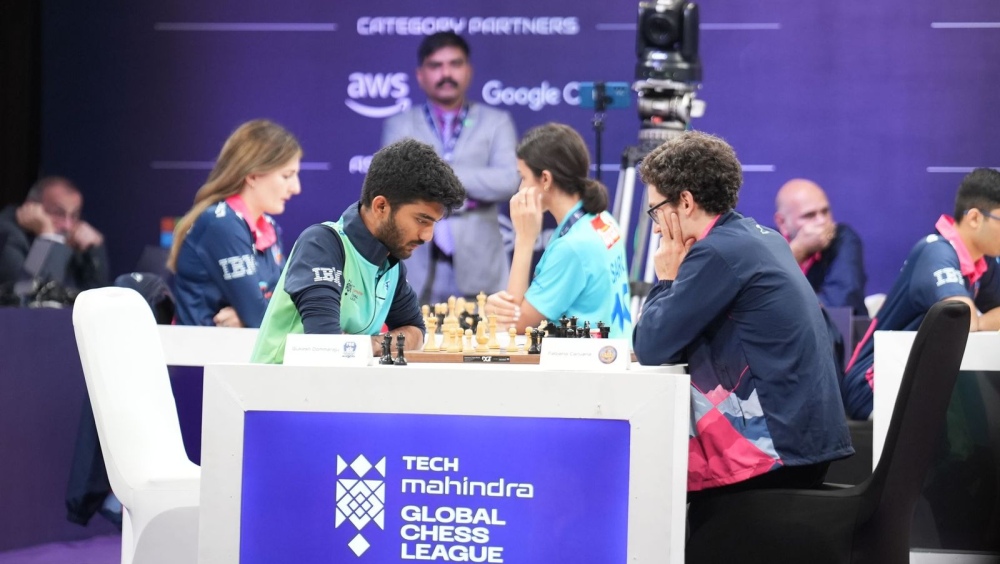
PBG Alaskan Knights finally came to life on Day5 of the Global Chess League in Mumbai. They defeated the team of Alpine SG Pipers 12 – 8, scoring their first win of the season. On the top boards, Triveni Continental Kings beat upGrad Mumba Masters 9 – 5 and Ganges Grandmasters edged Fyers American Gambits 8 – 7 keeping the title race tight. Day five of the Global Chess League in Mumbai brought a dramatic breakthrough for the PBG Alaskan Knights, who defeated the Alpine SG Pipers 12–8 to claim their first victory of the season. Meanwhile, at the top of the table, the Triveni Continental Kings beat the upGrad Mumbai Masters 9–5, and the Ganges Grandmasters edged the Fyers American Gambits 8–7, keeping the title race wide open. The day marked a turning point for the Knights, who entered with four consecutive defeats. Playing with nothing to lose, PBG went all-out against Alpine, with Arjun Erigaisi, Kateryna Lagno, Leinier Dominguez, and a resurgent Gukesh all scoring victories. Standings after Day 5 The reigning champions, Triveni, now stand alone at the top with 12 Match Points after defeating Mumbai in their direct duel. Ganges joined Mumbai on 9 Match Points, thanks to another strong performance from Javokhir Sindarov, who scored a quick win over Richard Rapport. The Fyers American Gambits and Alpine SG Pipers remain on 6 Match Points each, with PBG closing the gap to 3 points as the final rounds approach. Match 13: upGrad Mumbai Masters vs Triveni Continental Kings (5–9) Day five opened with a clash of leaders. The upGrad Mumbai Masters and Triveni Continental Kings both came into the round on 9 Match Points. Their rivalry dates to the first season in Dubai, where Mumbai won both round-robin matches, but Triveni took the title in a sudden-death final. In Season 2, the champions struck back twice. Meeting again at the top of the table in Season 3, both sides knew this match could shape the rest of the league. From the start, the play was tight and tense. Mumbai had the White pieces, but Triveni were often ahead on the clock and, at times, slightly better on the board. The first result came on the Superstar board, where Shakhriyar Mamedyarov faced Vidit Gujrathi. In a sharp English, Vidit twice seized the initiative, but Mamedyarov held firm. With both players short of time and no clear path forward, they repeated moves and agreed to a draw. Soon after, Wesley So and Wei Yi also split the point in a game where both pushed but failed to create decisive chances. The early draws set the tone for the match. The outcome hinged on the Icon board. Maxime Vachier-Lagrave and Alireza Firouzja rattled out their moves in a Scheveningen Sicilian, a fast-paced duel between two of the world’s best blitz players. With Black, Firouzja solved all the opening problems and gained an edge thanks to a superior pawn structure. MVL defended well for a long time, but small inaccuracies crept in. The critical moment came with 34.Nf1, a natural-looking move that was in fact a serious mistake. Firouzja did not find the best continuation but did enough to seize the advantage. The final phase was riddled with mutual errors in a time scramble, but MVL was the last to slip. Triveni earned four Game Points and a commanding lead on the top board. On the women’s boards, Mumbai searched for a way back. Humpy Koneru and Zhu Jiner played a controlled game that never strayed from equality, ending in a quiet draw. The other women’s game was more tense. Alexandra Kosteniuk and Harika Dronavalli reached an opposite-coloured bishops endgame, known for its drawing tendencies. With no way to break through, the players agreed to another draw. The final word belonged to the prodigy board. Following sharp exchanges, Marc’Andria Maurizzi emerged with an extra rook but could not escape a perpetual check, leading to yet another draw. This confirmed that the match would be decided by Firouzja’s win alone. When the dust settled, Triveni Continental Kings had won 9–5 in Game Points, with one victory and five draws. The defending champions moved into sole first place, while Mumbai slipped back into the chasing pack—still very much in contention but no longer alone at the top. Match 14: Alpine SG Pipers vs PBG Alaskan Knights (8–12) This duel was a must-win for both sides. Alpine SG Pipers came in on the back of two straight victories and 6 Match Points. PBG Alaskan Knights were still on zero after four rounds and had not won a single individual game. After the coin toss, PBG chose to play with White. Their captain promised “fireworks on the boards,” and his team delivered from the first moves. The Knights adopted sharp, aggressive play across all boards. The first breakthrough came on the Superstar board, where Arjun Erigaisi faced Anish Giri in a Queen’s Gambit Declined. Arjun seized the initiative early, and by move 18 his attack was nearly decisive. On move 21, he sacrificed a piece, tearing open the black king’s shelter. PBG took a 3–0 lead in Game Points. Almost simultaneously, Kateryna Lagno struck on the women’s board. Facing Hou Yifan in a Sicilian, she punished an early mistake, trapping Black’s queen in the centre. Two moves later, Hou was forced to give up her queen for a rook. Lagno converted smoothly, giving the Knights another three Game Points and a 6–0 lead. Alpine hit back through their most reliable player of the season. On the second women’s board, Nino Batsiashvili outplayed Sara Khadem in an Indian setup. Khadem was worse from the early middlegame and never recovered. Batsiashvili kept control, adding another win to her impressive Mumbai record and closing the gap to 6–4. The momentum seemed to shift completely on the prodigy board. Leon Luke Mendonca, the hero of Alpine’s last two matches, delivered another strong performance. Facing Daniel Dardha in an English Opening, he outplayed his opponent in the middlegame and
Kirill Chukavin and Margareth Olde triumph at 2025 Estonian Championship
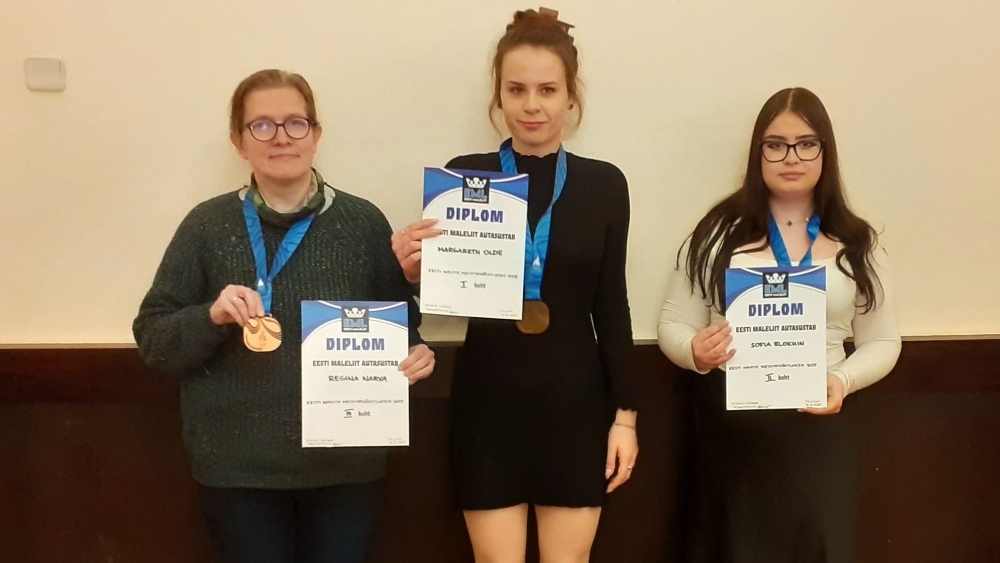
FM Kirill Chukavin and WIM Margareth Olde emerged victorious the 2025 Estonian Championship finals held from December 11–18 at the Paul Keres Chess House in Tallinn. For the second consecutive year, both the Open and Women’s championships were contested in a knockout format, featuring 16 players in the Open section and 8 in the Women’s section. In the Open section, 23-year-old FM Kirill Chukavin captured his first senior national title by defeating three-time champion GM Meelis Kanep (last year’s bronze medallist) in the final match. IM Ilja Sirosh completed the podium, winning the match for bronze. Final Standings – Open Section FM Kirill Chukavin GM Meelis Kanep IM Ilja Sirosh In the Women’s section, WIM Margareth Olde successfully defended her title. The final match against WFM Sofia Blokhin was an extremely tense battle, with classical games rapid and blitz tie-breaks all ending in 1-1 draws. Olde ultimately prevailed in the decisive Armageddon game. Final Standings – Women’s Section WIM Margareth Olde WFM Sofia Blokhin WFM Regina Narva Complete results (both Open and Women’s) Photos: Estonian Chess Federation (www.maleliit.ee)
Africa’s rising stars shine at 16th African Youth Chess Championship in Harare

The 16th African Youth Chess Championship (AYCC) 2025, organised by the Zimbabwe Chess Federation under the patronage of the African Chess Confederation (ACC), concluded on Saturday, 13 December 2025, in Harare, Zimbabwe. Contested over nine rounds in the Swiss system, the championship attracted over 500 budding chess talents from 18 African countries, making it one of the largest editions in the history of the event. The championship showcased Africa’s rising chess stars across multiple age categories, delivering high-quality competition marked by fighting spirit, discipline, and exemplary sportsmanship. After intense and closely contested nine rounds played in a spirit of fair play, the champions emerged in all categories as follows: Under 8 Girls Under 8 Girls🥇 Gold: Saishanvi Nalamalpu (Botswana) – 9🥈 Silver: Tariro Nota (Zimbabwe) – 7🥉 Bronze: Awuor Jayne (Kenya) – 6 Under 8 Open 🥇 Gold: Adam Djerroud (Algeria) – 8🥈 Silver: Nathan Rehse (South Africa) – 7🥉 Bronze: Gene Mukhwana (Kenya) – 7 Under 10 Girls 🥇 Gold: Amanda Breetalizah (Kenya) – 8🥈 Silver: Nikhil Vankhedekar (Zambia) – 7½🥉 Bronze: Adaeze Agusionu (Nigeria) – 7½ Under 10 Open 🥇 Gold: Nathaniel Manyeki (Kenya) – 8½🥈 Silver: Ngwao Keoletile (Botswana) – 7🥉 Bronze: Elvis Tumusiime (Uganda) – 7 Under 12 Girls 🥇 Gold: Michelle Nwankwo (Nigeria) – 8½🥈 Silver: Winnie Kaburo (Kenya) – 8🥉 Bronze: Anil Suhana (Uganda) – 7½ Under 12 Open 🥇 Gold: Rannveer Tak (South Africa) – 7½🥈 Silver: Apollo Ahumuza (Uganda) – 7🥉 Bronze: Ryan Danson (Kenya) – 7 Under 14 Girls 🥇 Gold: Cassidy Elizabeth (Kenya) – 8🥈 Silver: Juliet Asaba (Uganda) – 7🥉 Bronze: Lucy Fantalis (Kenya) – 6½ Under 14 Open 🥇 Gold: Abdelmalek Bensidi (Algeria) – 7½🥈 Silver: Davidson Waweru (Kenya) – 7🥉 Bronze: Michael Schwartz (South Africa) – 7 Under 16 Girls 🥇 Gold: Zaki Mohamed (Egypt) – 8🥈 Silver: Oudhia Ait (Algeria) – 7🥉 Bronze: Correia Monteiro (South Africa) – 6½ Under 16 Open🥇 Gold: Cyprian Mbaabu (Kenya) – 7½🥈 Silver: Zhengfei Li (South Africa) – 7🥉 Bronze: Omprakash Shoubhith (Uganda) – 6½ Under 18 Girls🥇 Gold: Sana Omprakash (Uganda) – 8🥈 Silver: Deborah Quickpen (Nigeria) – 7🥉 Bronze: Natalie Banda (Botswana) – 7 Under 18 Open🥇 Gold: Rafael Sharon (Zambia) – 8🥈 Silver: Ahmed Kandil (Egypt) – 8🥉 Bronze: Raphael Felix (South Africa) – 7 Complete final standings (all categories) In addition to the competitive awards, twenty-five players were honoured with Fair Play Medals, sponsored by Amor Sport Consultancy. These medals were awarded to players who consistently demonstrated exemplary sportsmanship, respect for opponents and arbiters, adherence to the Laws of Chess, and positive conduct both on and off the board throughout the championship. Speaking at the closing ceremony, ACC President Tshepiso Lopang expressed her sincere gratitude to the players for their outstanding performances and commitment to fair play, to parents and coaches for their cooperation and support, to the arbiters for ensuring the smooth and professional running of the tournament, and to all partners and sponsors whose contributions made the championship a resounding success. The 16th African Youth Chess Championship once again reaffirmed Africa’s growing strength in youth chess and the continent’s bright future on the global chess stage. Written by African Chess Confederation Photo Credit: Ally Chess Academy