

GCL Day 6: Triveni stay in front as Mumba chase and pack closes behind
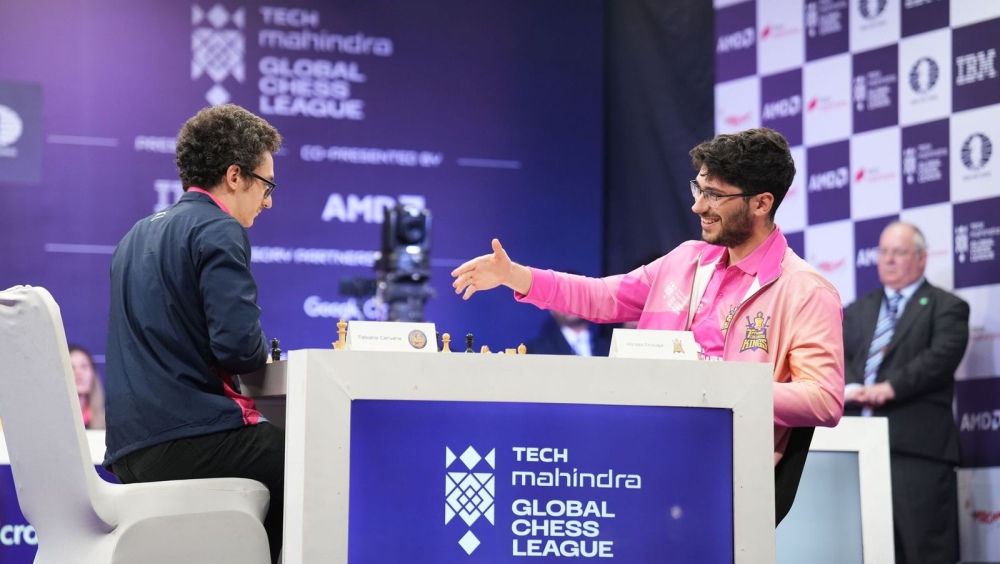
Day six opened the return round with four tense matches and dramatic swings at both ends of the table. The Triveni Continental Kings remain alone at the top after playing twice – losing to the Pipers but making a comeback against PBG – to stay in front with 15 Match Points. The upGrad Mumbai Masters are a close second with 12 Match Points after defeating the Ganges Grandmasters 11–6. The Alpine SG Pipers and Ganges Grandmasters share third place with 9 points, while the Fyers American Gambits and PBG Alaskan Knights are level on 6 Match Points. With the league now in the return round, four matches are played each day, and every result has a direct impact on the title race and the fight at the bottom. Standings after Day 6 Match 16: Fyers American Gambits vs PBG Alaskan Knights (8–9) The Fyers American Gambits started the day on six Match Points after a narrow loss to Ganges. The PBG Alaskan Knights, fresh from their first victory of the season against Alpine, were trying to climb away from last place. In their first encounter, the Gambits had won 8–5, and PBG came into the rematch looking for payback. PBG had the White pieces and started the match with clear intent. The first game to finish was on the Superstar board. Leinier Dominguez tested Richard Rapport in the Open Sicilian and obtained a small edge but fell behind on the clock. With no clear way to increase his advantage and the whole match ahead, Dominguez decided not to force the issue, and the players agreed to a draw. On one of the women’s boards, things soon went PBG’s way. European champion Teodora Injac reached a promising position against Sara Khadem but lost control. Khadem traded her h3-pawn for the opponent’s d3-pawn, took control of the c-file, and put the black king under pressure. In her search for counterplay, Injac fell into serious time trouble and ultimately blundered her queen. This was the first win of the match—and Khadem’s first victory of the tournament. Almost simultaneously, on the other women’s board, Kateryna Lagno let a sizable advantage slip away against Bibisara Assaubayeva and agreed to a draw. After three games, the score stood at 5–3 for PBG. Then came a huge moment on the first men’s board. In an equal bishop endgame, Vladislav Artemiev made a terrible mistake and allowed Arjun Erigaisi to push his pawn through to promotion. Artemiev had to give up his bishop for the new queen and could only hope for a miracle in time trouble, but it never came. Erigaisi calculated everything to the end and secured the win. With that result, the Knights increased their lead to 8–3 in Game Points. In the remaining games, the Gambits had little counterplay, and PBG seemed close to a smooth match victory. Then fortune swung sharply on the Icon board. World Champion Gukesh D reached a completely winning position against Hikaru Nakamura and was also ahead on the clock. However, he relaxed too early and blundered. Nakamura seized his chance and turned a hopeless position into a victory—a huge escape for the Gambits and a painful blow for Gukesh. The score narrowed to 8–7. Everything now depended on the prodigy board, where Daniel Dardha sacrificed a pawn against Rapid World Champion Volodar Murzin but did not get sufficient compensation. After sharp play in the centre and a series of tactical exchanges, Dardha managed to equalise and even put some pressure on Murzin. By then, he knew his team had already secured at least a draw in the match and that his opponent still needed to be careful. With that in mind, Dardha chose the practical solution: he offered a draw, and Murzin accepted. The final score was 9–8 in Game Points for the PBG Alaskan Knights. They took their second win in a row and moved level with the Gambits on six Match Points, keeping their season alive and tightening the middle of the table even further. Match 17: Alpine SG Pipers vs Triveni Continental Kings (12–8) The second match of Day 6 brought a repeat of the opening-round pairing between the Alpine SG Pipers and the defending champions, the Triveni Continental Kings. Triveni had won the first encounter 9–7 and started this match as sole leaders on 12 Match Points. Alpine were on six, boosted by recent wins and knowing they needed another big result to stay in the race. After the coin toss, the Pipers took White and came out fighting. From the first moves, it was clear this would be a tense, emotional match. The first breakthrough came on the women’s board. Nino Batsiashvili, Alpine’s most reliable player this season, scored her fifth win in six games. In the London System against former women’s world champion Alexandra Kosteniuk, Nino chose a sharp piece sacrifice. The idea looked risky and was not fully correct, but Kosteniuk failed to find the best defence. White’s attack grew menacing with every move, and the black king was driven into a net of checks and threats. With her position collapsing, Kosteniuk had to resign. Almost simultaneously, Anish Giri delivered another blow for Alpine on the Superstar board. Facing Wei Yi with White in a Queen’s Pawn Opening, he played aggressively from the start, brought all his pieces into the attack, and offered a rook sacrifice. Wei initially declined correctly but accepted a few moves later with catastrophic consequences. Giri broke through and forced resignation. After these two wins, the Pipers led the match 6–0 in Game Points. The champions then began their comeback. On the prodigy board, Marc’Andria Maurizzi secured an extra pawn in the middlegame against Leon Luke Mendonca and gradually took control. Leon tried to create counterplay but could not hold the endgame. Triveni cut the deficit to 6–4. The turning point seemed to come on the second women’s board. In a very sharp middlegame, Zhu Jiner outplayed Hou Yifan. The former Women’s World Champion missed an
Gleb Dudin and Szidonia Lazarne Vajda crowned 2025 Hungarian Champions
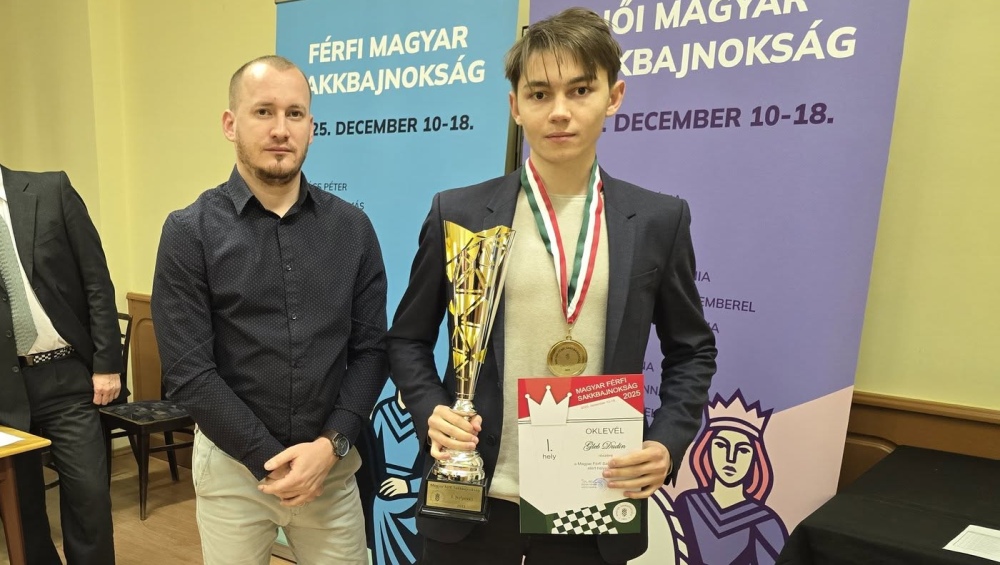
GM Gleb Dudin and IM Szidónia Lázárné Vajda triumphed at the 2025 Hungarian Chess Championships. Dudin captured his first national title, while Lázárné Vajda claimed her third Hungarian women’s crown, repeating her successes of 2004 and 2015. The Hungarian Individual Championship, featuring simultaneous open and women’s competitions, was held in Budapest from December 10–18. Both events were 10-player round-robins under classical time controls. Legendary Lajos Portisch making the first ceremonial move The open section turned into an exciting race between GMs Gleb Dudin and Tamás Bánusz. Dudin seized the lead early, but Bánusz caught up after Round 6. Their direct clash in the next round ended in a draw, and the two preserved their shared lead. Dudin pulled ahead in the penultimate round by defeating Ágoston Juhász, while his main rival could only draw. Trailing Dudin by half a point going into the final round, both Bánusz and top seed Benjamin Gledura (who finished strongly) were held to draws. Dudin, meanwhile, achieved a much better position against Sergey Grigoriants but decided to play it safe, settling for a draw to secure the title with a score of 6.5/9. Gledura and Bánusz finished half a point behind on 6/9 and tied for second place, with Gledura claiming silver thanks to a superior Sonneborn–Berger score. Notably, all three top finishers completed the tournament undefeated. Final standings – Open The Women’s Championship was even more tightly contested. IM Szidonia Lázár–Vajda and WFM Kata Karácsonyi tied for first with 6.5/9, with Lázár–Vajda winning the title by a mere 0.5 Sonneborn–Berger points. IM Nomin-Erdene Davaademberel scored 6/9 to take the bronze medal. Final standings – Women Photos: Magyar Sakkszövetség FaceBook
FIDE Global Conference on chess in society and education announced
Marking the launch of the FIDE Year of Chess in Education 2026, FIDE, in partnership with KIIT and the All India Chess Federation, is proud to announce the Social and Educational Chess Conference. The conference will take place from January 14 to 16, 2026 in Bhubaneswar, India. It aims to bring together experts from the fields of education, academic research, social development, public policy, and chess to critically examine and advance the use of chess as a structured instrument for learning and social impact on a global scale. “Chess has a unique ability to bring together education, social programmes, and public institutions. When it is organised well and supported by strong partners, it can reach people globally and create real opportunities for learning and participation. This conference is about sharing what works, learning from each other, and building stronger cooperation so that chess can play a meaningful role in education and social projects around the world,” said Arkady Dvorkovich, FIDE President. The event will take place at the Kalinga Institute of Industrial Technology (KIIT), one of India’s leading educational institutions, and will focus on two core pillars of FIDE’s global strategy: Social Chess and Chess in Education. “Education must go beyond textbooks and classrooms to nurture character, values, and the ability to think independently. Chess is a powerful tool in this journey, as it cultivates discipline, critical thinking, patience, and ethical decision-making. We are honoured that KIIT and KISS will host this global conference and partner with FIDE and the All India Chess Federation in advancing chess as an instrument for social transformation and inclusive education worldwide,” said Dr. Achyuta Samanta, Founder, KIIT, KISS & KIMS. Over the course of the conference, participants will examine how chess can support inclusion, education, rehabilitation, and personal development across different communities and age groups. The programme combines strategic discussions, academic research, practical case studies, and on-the-ground experiences. The first day of the conference, titled “Every Move Matters: Social Chess in Action”, will focus on social impact initiatives. Sessions will highlight the outcomes of FIDE’s Social Chess Year 2025 and present priorities for 2026. Speakers and project leaders from around the world will share experiences from initiatives working with refugees, prison populations, children in underserved communities, elderly participants, and individuals facing addiction and social exclusion. The programme will also address institutional models, partnerships, CSR engagement, volunteer management, and sustainable project development. As part of the Every Move Matters theme, the first day of the conference will conclude with the presentation of the FIDE Social Chess Storytelling Challenge. Short films submitted through the global initiative will be screened, showcasing real stories of how chess supports education, inclusion, and social change across communities worldwide. The evening programme will culminate in the announcement of the winning films, followed by a networking reception hosted by KIIT and the All India Chess Federation. The second day, “Every Lesson Counts: The Present and Future of Chess in Education”, will focus on chess in formal and non-formal education systems. Discussions will include current research on the cognitive and academic impact of chess, national and regional implementation models, teacher training, curriculum integration, and policy development. Digital tools and platforms supporting chess in education will also be showcased, alongside case studies from established programmes around the world. Beyond the main conference sessions, the programme includes exhibitions of social chess projects, educational workshops, networking activities, and presentations from digital and educational partners. Interactive formats such as audience Q&A, project showcases, and short film screenings will encourage dialogue and exchange between participants. The final days of the programme will be dedicated to site visits at KIIT and KISS facilities, local social chess initiatives, school activities, and Chess in Education teacher training courses, reinforcing the conference’s emphasis on practical application and long-term capacity building. The Social and Educational Chess Conference reflects FIDE’s ongoing commitment to developing chess as a tool for education, inclusion, and social development, while strengthening collaboration between institutions, educators, researchers, and federations worldwide. Registration detalis, speakers, and programme are published at https://soc.fide.com/global-chess-conference
Winners emerge from FIDE U9–U17 Rapid Championship; Blitz up next
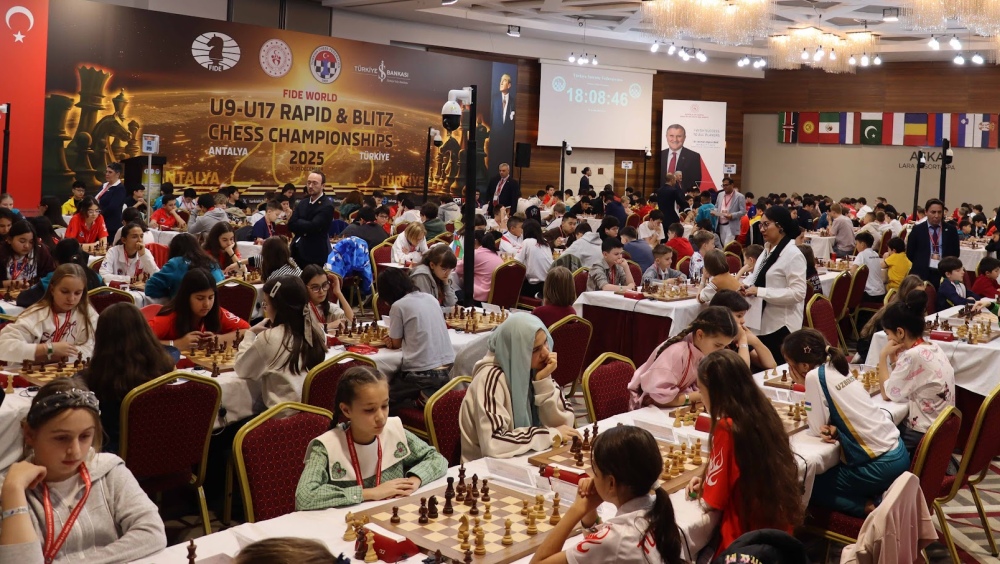
The rapid section of the FIDE U9–U17 Rapid & Blitz Chess Championship concluded on December 19 after nine exciting rounds played over three days in Antalya. Players now turn to the blitz portion of the event, which begins on December 20 and will be held over two days at an even faster pace. The Blitz championships will again be contested in Open and Girls sections across five age categories: U9, U11, U13, U15, and U17. A total of 310 players, including 98 titled players and 2 Grandmasters, have registered for the Blitz event. Those two Grandmasters are the Turkish youngsters Yağız Kaan Erdoğmuş and Ediz Gürel, both World Top 100 players. Erdoğmuş, who claimed a silver medal in the U15 rapid section, and Gürel, competing in the U17 blitz, are among the top contenders. Below are the newly crowned Rapid Champions in both Open and Girls categories: Rapid Champions – Open Category Title Name Federation Rating Points U17 IM Asrorjon Omonov UZB 2233 7 U15 IM Khumoyun Begmuratov UZB 2435 7½ U13 FM Ali Gür TUR 2073 7 U11 FM Marc Llari FRA 2135 7½ U9 CM Luca Protopopescu FRA 2096 7½ U13 Rapid Open Champion FM Ali Gür Rapid Champions – Girls Category Title Name Federation Rating Points G17 WIM Binh Vy Nguyen VIE 1950 7½ G15 WFM Rukiya Olimova UZB 1913 7 G13 WCM Kristina Zavivaeva FID 1956 6½ G11 WFM Alisa Genrietta Yunker FID 2128 8½ G9 Elif Defne Özer TUR 1529 7 U15 Rapid Girls Champion WFM Rukiya Olimova Pairing and results: s2.chess-results.com/tnr1318937.aspx?lan=1&SNode=S0 Official website: youthrapidblitz2025.tsf.org.tr/ Photo gallery: photos.app.goo.gl/8haNV29TMiGgSNvm8 The International School Chess Federation (ISCF) has launched a series of educational master classes to support young participants of the FIDE World U9–U17 Rapid & Blitz Championships 2025. Designed to enrich the championship experience, these sessions offer players, coaches, and parents practical insights into long-term development and high-level training methodology. Two master classes were held at the Aska Lara Hotel in Antalya, Türkiye. On December 17, GM Rustam Kasimdzhanov, FIDE World Champion 2004 and one of the world’s most respected chess trainers, led an online session based on his extensive coaching experience. Kasimdzhanov has served as second to Viswanathan Anand in three World Championship matches, worked with Fabiano Caruana during the Candidates and the 2018 World Championship cycle, coached national teams including Germany (European Team Champions, 2011), and in 2025 was appointed Head Coach of the Uzbekistan Men’s National Team. His work with elite players provides invaluable perspective on sustained, long-term improvement. The following day, December 18, FM/FT Alper Efe Ataman, Board Member of the Turkish Chess Federation, founder of Analiz Satranç publishing house, and author of Instructive Chess Miniatures, delivered a clear and structured in-person presentation on developing young talent, focusing on priority-setting, consistency, and sustainable progress. For more information, visit ISCF social media @ischoolchess or the official website. Written by Özgür Akman Photos: Ozan Koşar