

FIDE Global Conference on Chess in Society and Education opens in Bhubaneswar
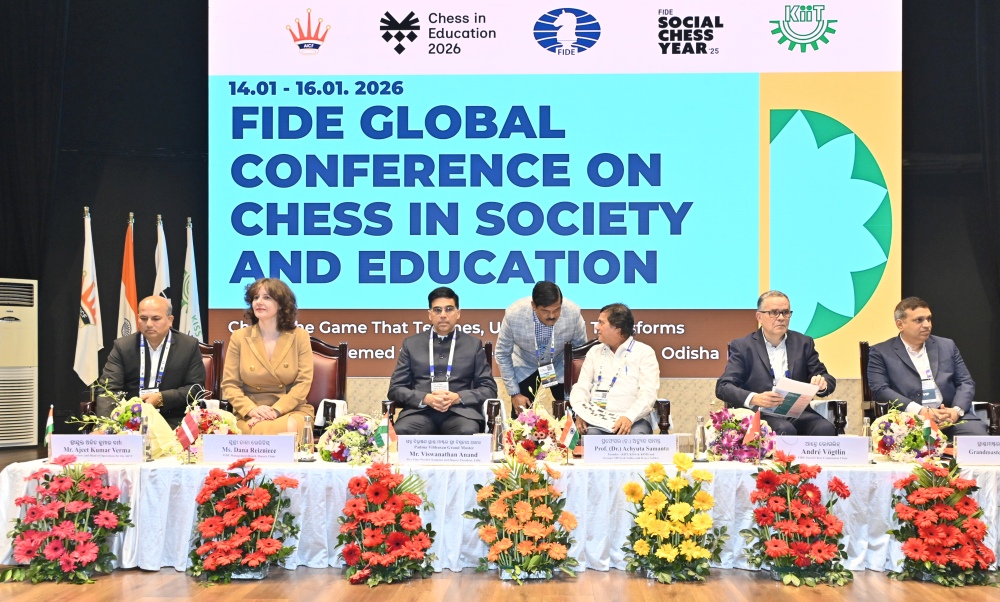
The FIDE Global Conference on Chess in Society and Education opened at KIIT University in Bhubaneswar on 14 January 2026, bringing together education leaders, researchers, social impact practitioners, and chess organisers for a three-day programme that also marks the launch of the FIDE Year of Chess in Education 2026. During the opening session, the moderator highlighted the role of Kalinga Institute of Industrial Technology (KIIT) as host of the conference and a long-standing centre for chess and education initiatives. KIIT has been organising international chess festivals for over 18 years, with the most recent edition featuring a total prize fund of INR 1.30 crore. The institution has produced 46 international chess players and hosted more than 30 international events, including World Junior Championships. Chess has also been integrated into KIIT’s broader educational framework, reflecting a sustained commitment to using the game as a tool for learning and development. The conference then formally opened with a ceremonial lamp-lighting, marking the inauguration of the event, followed by opening addresses from senior officials and partners, including Dana Reizniece, Deputy Chair of the FIDE Management Board, Viswanathan Anand, FIDE Deputy President, and Achyuta Samanta, Founder of KIIT, alongside André Vögtlin, Chair of the FIDE Social Chess Commission, Abhijit Kunte, Grandmaster, and Mukesh Ranjan Das, Executive Director (HR) of IndianOil. The opening ceremony and remarks set the tone for the conference’s two linked themes: chess as a social tool with measurable impact, and chess as a structured support for learning. “Education is about turning mirrors into windows,” said Dana Reizniece in her address to the audience, linking the idea to FIDE’s mission of using chess as a tool for empowerment and expanded ways of thinking. Anand emphasised that chess in education is “not to produce professional players,” but to help students “learn habits that improve performance in class,” pointing to focus, discipline, and decision-making as skills that transfer beyond the board. The conference then turned to the speakers and their presentations, with the day organised in thematic sections. FIDE Social Chess 2025 highlights and priorities for 2026 Vögtlin opened the conference programme with a review of the FIDE Social Chess Year 2025 and a forward look to 2026. He highlighted flagship campaigns across the year, including a month-by-month rhythm of themed initiatives, and the Social Chess Day tournament “Every Move Counts”, organised with Lichess.org, which drew 20,078 players worldwide. “Chess is more than a game. It is a tool to empower, include, educate, and transform communities worldwide,” said Vögtlin. “Following the success of the FIDE Social Chess Year 2025, 2026 will focus on scaling, professionalising, and globally embedding social chess as a measurable, evidence-based social impact framework.” The amplified connectome of the brain: Chess, the best scientific tool Dr. Cristóbal Blanco Acevedo followed with a neuroscience-focused presentation on how chess engages the brain across multiple systems rather than in a single “chess area”. “The most important question is not whether the brain will change, but into what it will change,” he said, pointing to the impact of environment and habits in a world of constant information overload. He explained that chess activates multiple areas of the brain simultaneously, particularly those linked to memory, calculation, and emotional control, while cautioning that not all forms of cognitive training translate effectively into real-life performance. How to build a big international social chess ecosystem for various social groups A core mid-morning session focused on how chess can be built into social ecosystems across different communities, with speakers from humanitarian, grassroots, and club-based backgrounds. Joining from Geneva, Francesca Bonelli, Head of Partnership and Coordination at UNHCR, outlined the scale of global displacement and the role sport can play in wellbeing and opportunity. UNHCR reports that 123.2 million people were forcibly displaced by the end of 2024. She also highlighted the FIDE and UNHCR collaboration that began in 2021 with a pilot “Chess for Protection” project in Kakuma, Kenya, and has since expanded to additional locations. Russell Makofsky, Founding Board Member of The Gift of Chess, spoke online about a practical, distribution-led approach to access, tracing the organisation’s origins to community initiatives during the Covid-19 pandemic and outlining its goal of distributing one million chess sets globally by 2030. “We saw how something as simple as a chess set could open doors,” Makofsky said. “When communities have access, opportunities begin to grow.” The session also included contributions from Rodrigo Barbeiton, who shared experiences from Club Magic Extremadura in Spain and the role clubs can play in long-term engagement. FIDE Social Chess programme updates After the networking break, the conference shifted into project-level updates from the FIDE Social Chess portfolio. Anastasia Sorokina (online) presented Chess for Protection, focusing on expanding safe, structured chess activities in refugee settings, particularly for girls and schools. Mikhail Korenman presented updates on Chess for Freedom, outlining developments in prison chess and upcoming continental and intercontinental competitions. Prabitha Urwyler presented Chess for Hope and Recovery, describing chess as a tool that provides structure, routine, and reflection in rehabilitation contexts. April Yunwei Zhong, via recorded video, highlighted how Chess for the Elderly supports both cognitive activity and social connection. Maryia Tamkovic presented Infinite Chess, focusing on adaptive learning models designed to meet players where they are. Social chess in India The afternoon returned to regional practice with a focus on India. In a standout contribution, Neelaya, Secretary of the Andaman and Nicobar Chess Association, presented initiatives shaped by geographic isolation and limited recreational infrastructure. He described projects spanning schools, orphanages, prisons, beach clean-ups linked to “Checkmate to Plastic”, culturally sensitive outreach to Indigenous communities, and onboard chess championships during long inter-island ship journeys. “The story of chess in Andaman and Nicobar islands is ultimately a story of belief in people, in potential, and in the power of thoughtful engagement.” he said, “Each move played on the chess board represents a larger life decision to think before acting, respect others, and to persevere despite setbacks” ending with, “Sometimes the strongest waves of change begin with a single move.” IndianOil