

Every Lesson Counts: The Present and Future of Chess in Education
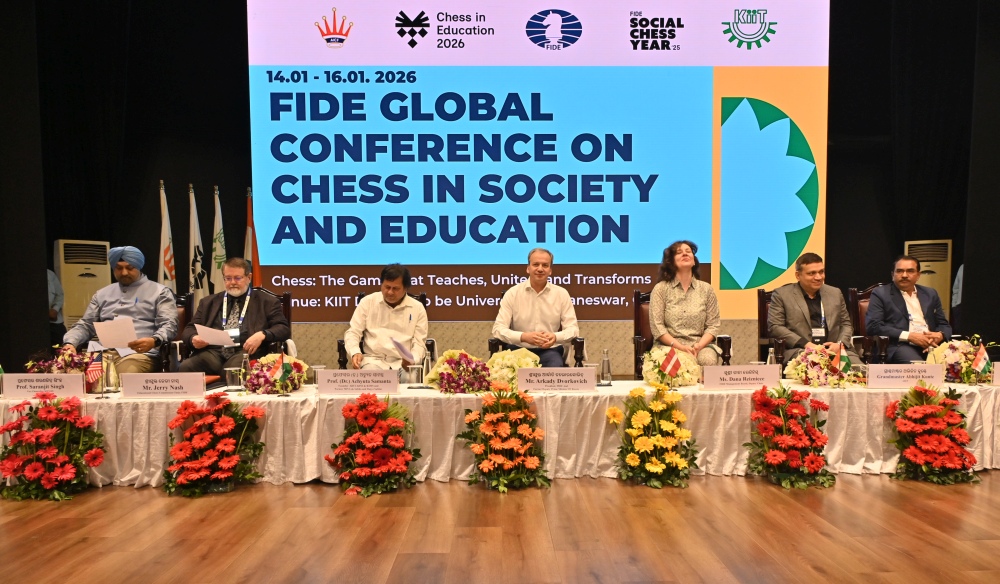
The second day of the FIDE Global Conference on Chess in Society and Education at KIIT University in Bhubaneswar was dedicated to chess in education, with a clear focus on how the game can be integrated into formal and non-formal learning systems. Building on the social impact discussions of the opening day, EDU Day brought together education leaders, researchers, federation officials, and practitioners to examine policy frameworks, research evidence, and real-world implementation models for Chess in Education (CIE). Welcome and opening The day began with a formal welcome and ceremonial lamp lighting, marking the start of proceedings. Senior representatives from FIDE and KIIT were invited to the stage, followed by the presentation of flower bouquets to the guests. Dr Saranjit Singh, Vice-Chancellor of KIIT, delivered the opening address, welcoming participants and outlining KIIT’s commitment to education and chess as part of its institutional ecosystem. He was followed by Jerry Nash, Chair of the FIDE Chess in Education Commission, who introduced the educational focus of the day and framed chess as a tool for learning rather than an end in itself. Dana Reizniece, Deputy Chair of the FIDE Management Board, linked the discussions to the broader objectives of the FIDE Year of Chess in Education 2026, stressing the need for quality, consistency, and alignment with education systems. She underlined that the purpose of chess in schools goes beyond performance, noting that “chess in education is not about creating champions. It is about creating better thinkers, better learners, and more confident young people who are prepared to make decisions and take responsibility.” Dr Achyuta Samanta, Founder of KIIT, spoke about education as a transformative force and the role institutions can play in creating opportunities through innovative and inclusive approaches. The opening concluded with remarks from Arkady Dvorkovich, FIDE President, followed by closing thanks from Dr Jnyana Ranjan Mohanty, who acknowledged the speakers, organisers, and partners involved in the conference. Geopolitics of a changing world: balancing cooperation and competition in the 21st century Arkady Dvorkovich opened the programme with a keynote titled Geopolitics of a Changing World: Balancing Cooperation and Competition in the 21st Century. Drawing on his background in economic policy and academia, he placed chess and education within a broader global context, describing a world marked by uncertainty, competition, and shifting power dynamics. Using chess as an illustrative lens, he explained that patterns within the chess world often mirror wider economic and social realities. “I start my lectures normally with one picture – a picture about chess and the current ratings of the top players,” he said, noting that the distribution of elite players reflects deeper structural factors. “What it shows is which countries dominate the chess world. And it is not by coincidence. There is some correlation between economic power and chess power.” Dvorkovich went on to describe how different chess cultures emerge from distinct education systems, opportunities, and approaches to talent development, arguing that education remains one of the few forces capable of fostering cooperation alongside competition in a divided world. Year of Chess in Education 2026 The strategic framework for EDU Day was set through presentations by Dana Reizniece and Jerry Nash. Reizniece outlined the objectives of the FIDE Year of Chess in Education 2026, focusing on strengthening cooperation with education authorities, supporting teachers, and ensuring that chess programmes are delivered with consistent quality across regions. Particular emphasis was placed on evidence-based approaches that allow Chess in Education initiatives to be evaluated, refined, and scaled. Jerry Nash followed with an overview of the FIDE EDU framework, explaining how chess can be embedded into learning environments as a structured educational tool. His presentation addressed governance, programme design, and the central role of teachers, highlighting the need for clear methodologies, training pathways, and accessible resources to support effective classroom delivery. How chess builds academic and life skills at the Overseas Family School Practical school-based implementation was illustrated by Dijana Dengler, Head of Chess at the Overseas Family School in Singapore. Her presentation provided insight into how chess is integrated into the school’s curriculum and daily activities, supporting both academic development and life skills such as problem-solving, focus, and resilience. The case study demonstrated how chess can be embedded within an international school environment as part of a holistic educational approach. Creating Chess in Education resources for teachers Anzel Laubscher focused on the practical foundations of Chess in Education, presenting the development of teacher-centred resources designed to support classroom delivery. She addressed curriculum design, lesson structure, and methodology, emphasising that effective chess education begins with understanding learners’ needs. “In chess education, we need to meet our learners where they’re at,” she explained. “If your learner cannot read and write yet, you need to meet them there. If they have special needs, you need to meet them there. The classroom must be inclusive.” Laubscher highlighted the importance of teacher training and follow-up support, describing how initial training alone is not sufficient. “Teachers walk into the session and they don’t know how many squares there are on a chessboard. Four days later, they walk out knowing all the basic rules of chess, how the pieces move, including special moves. But then they realise they still need support to implement this in the classroom, and that’s why we designed the starter kit.” World Schools Team Championship The role of school competitions was explored by Nadzeya Krauchuk, Director of International Relations at the International School Chess Federation (ISCF), through a presentation on the World Schools Team Championship. She explained how structured school tournaments can motivate students, support teamwork, and create international connections, while remaining firmly rooted within an educational framework rather than elite competitive pathways. Research: Measuring the impact of Chess in Education A dedicated research block examined how the impact of chess in education can be measured and communicated. Moderated by Jerry Nash, the session featured contributions from Dr George Chitiyo of TTU, Martin Labollita of the National University of Tres de Febrero (UNTREF), and Jonathon Quest of Webster University. Reflecting on comparative
Nodirbek Abdusattorov secures final spot at FIDE Freestyle Chess World Championship
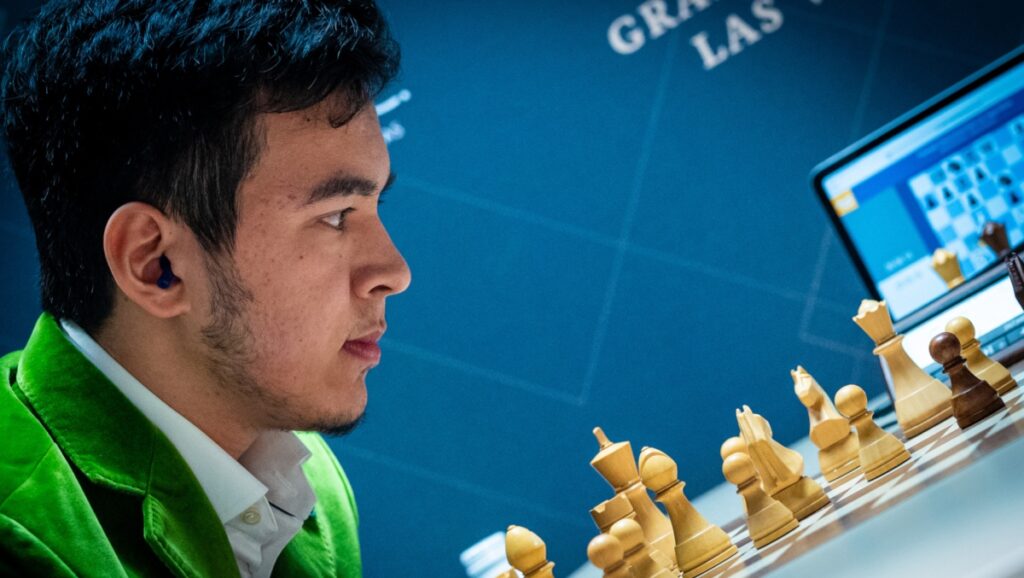
Nodirbek Abdusattorov has secured the eighth and final spot in the FIDE Freestyle Chess World Championship, to be held in Weissenhaus, Germany, from February 13–15, 2026. Abdusattorov won the official Play-In qualifier hosted by Chess.com, defeating Pranav Venkatesh 2–0 in the final. The qualifier attracted more than 100 titled players from around the world and culminated in a four-player knockout stage on January 15. With this victory, Abdusattorov joins the seven players already qualified for the championship:Magnus Carlsen, Levon Aronian, Fabiano Caruana, Vincent Keymer, Arjun Erigaisi, Javokhir Sindarov, and Hans Niemann. Abdusattorov brings extensive experience in Freestyle Chess and Chess960, having previously reached the semifinals of the FIDE Fischer Random World Championship. In 2025, he competed in multiple events on the Freestyle Chess Grand Slam Tour. During the World Championship in Weissenhaus, an exhibition Freestyle Chess match between Hou Yifan and Bibisara Assaubayeva will take place on February 14 and 15. The FIDE Freestyle Chess World Championship marks the first World Championship jointly staged by FIDE and Freestyle Chess, concluding the 2025 Freestyle Chess season and crowning the first World Champion under this new framework. Photo: Lennart Ootes