

New competition format for the 2026 World Schools Team Championship
The World Schools Team Championship (WSTC) will adopt a new tournament structure for its 2026 edition, featuring four continental qualifying stages followed by a four-team Grand Final in December. First held in 2023 in Kazakhstan and then in 2025 in the US, the World Schools Team Championship is the primary global scholastic chess competition, jointly organised by FIDE and the International School Chess Federation (ISCF) in cooperation with Continental bodies. The 2026 edition will take place during the Year of Chess in Education, a joint FIDE and ISCF initiative to promote the role and value of chess as part of education, supporting both cognitive and social development among schoolchildren. In October 2025, FIDE and ISCF signed a Memorandum of Cooperation, which announced a series of international school team tournaments for 2026. The WSTC will serve as a flagship circuit of the “Chess in Education 2026” programme. It was then announced that the tournaments would unfold in two stages: Continental Championships for Africa, the Americas, Asia and Europe and the Grand Final, featuring the winners of the respective Continental Championships. FIDE and ISCF now announce the structure of the new format and the regulations for the event. The 2026 cycle will consist of four continental stages: Africa, the Americas, Asia and Europe, all held throughout 2026. Each continental championship will produce one champion school team that will directly qualify for the Grand Final, which will take place in December 2026 as a four-team tournament. The WSTC 2026 will kick off with the Asian Continental stage in Almaty, Kazakhstan in early April. Exact dates and locations for all stages will be announced at a later date. Only teams representing a single general educational institution (such as a school) may take part in the event. Each team must include at least one boy and at least one girl, with possible exceptions for single-gender schools. Eligible players must have been born between January 1, 2012 and December 31, 2018 (inclusive). The regulations explicitly provide for substantial organiser support for participating teams. “Everyone has something they can learn from someone or teach someone. By bringing together children from different countries and cultures to play chess, we are sowing the seeds of knowledge, creativity and multiculturalism, which are essential for a thriving life and society. The ISCF is excited to be partnering with FIDE on this project, and we are looking forward to a successful series of events in the Year of Chess in Education,” ISCF President Timur Turlov said. “FIDE has consistently championed education and learning, and we have always believed that chess is a powerful tool for education, whether among children or adults. After the successful Year of Social Chess in 2025, we have dedicated 2026 to education and to children in school. The four continental championships, as well as the Grand Final, will not only further promote chess in schools, but will be an impulse for many schoolchildren to take up the game, spreading the wonder of our sport further. We are exceptionally grateful to ISCF for their work on this project, which has the full backing of FIDE,” said Dana Reizniece, Deputy Chair of the FIDE Management Board. The regulations for the FIDE ISCF World Schools Team Championship 2026 can be found [HERE]. Official email: worldschoolteam@fide.com Official website (coming soon): https://worldschoolteam2026.fide.com/ About ISCF: The International School Chess Federation (ISCF) is dedicated to the promotion and integration of chess within the educational system globally. Launched in September 2024 as a FIDE affiliated organisation, the ISCF operates as a main institutional platform for advancing chess in schools, developing educational programmes, supporting national federations and fostering cognitive and social growth among students through the game of chess. Official website: https://ischoolchess.com/
From local vision to European stage: The New Zagreb Classic’s remarkable rise
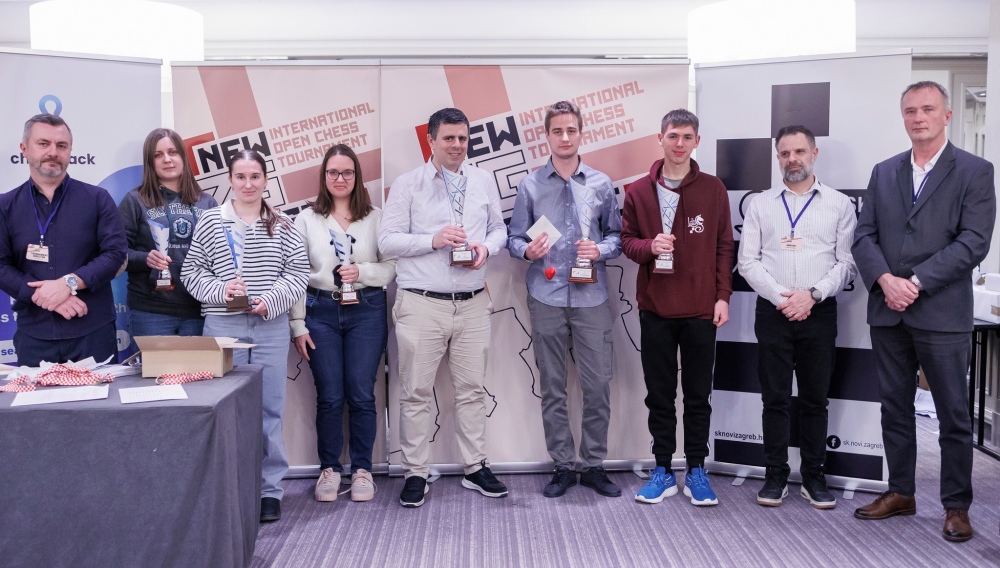
Launched two years ago the New Zagreb Classic has grown into one of the biggest open tournaments in Europe. Here’s what makes it special. When, in 2024, a group of four people, colloquially known as Chess Dads, set out to build an international tournament from scratch, their main motivation was giving their children, talented players from SK Novi Zagreb, a taste of chess on the “big stage”: a well-organized, ‘proper’ competition where they could face not only peers but also adults at comparable skill levels – something that previously required traveling outside Zagreb and Croatia. They envisioned a tournament where everyone – regardless of their age, gender, nationality or rating – would feel welcome and valued. They called it the New Zagreb Classic, reflecting not only their club’s name but also their aspiration to set new standards while respecting the local rich tradition. Two years later, the New Zagreb Classic 2026, held from January 30 to February 1 in one of the city’s best hotels, the Sheraton, brought together 506 players from 36 federations compete on the chess board. That makes it not only the biggest Open tournament with classic time control (90+30) in Croatia, but now also one of top 10 in Europe by participation. The compact format proved a big hit: players were divided into five rating‑based sections of approximately 100 participants each, with all five rounds condensed into a single weekend (Friday afternoon through Sunday evening). This structure made the event accessible to players who could not take extended time away from work or school. The New Zagreb Classic 2026 had it all – from beginners and pure enthusiasts to FIDE Masters, International Masters and even Grandmasters. Rather than aiming for elite players, the organizers made an extra effort to attract Croatia’s strongest cadets, talents from neighboring countries, and promising juniors from across Europe. These young players provided some of the tournament’s most memorable moments. Samuel Bro Jacobsen, a player from Denmark (born in 2014), scored the biggest upset in the top-tier group, defeating the Croatian-French veteran GM Darko Anic, while CM Andras Ilko-Toth (also born in 2014) of Hungary held Avinash Ramesh, a strong, up-and-coming Indian IM, to a draw and completed the event unbeaten. Ilko-Toth tied on points with 14-year-old Erik Golubovic, Croatia’s youngest FIDE Master, who came fifth in the final ranking as the highest-placed among these stars of the future. IM Vladyslav Larkin of Ukraine won the Open A tournament, ahead of FM Vinko Malada (Croatia) and FM Nicolas Perossa (Italy). WFM Elizaveta Dorokhina, competing under FIDE flag, was the top-scoring female player, followed by WFM Barbara Skuhala and WFM Petra Kejzar, both from Slovenia. Every group and every player had their own unique story – be it a breakthrough achievement, a crushing disappointment or just pure joy of play. The tournament’s growing significance in the local chess community was evident in the roughly 30 unrated adults who chose the New Zagreb Classic for their competitive debuts – many playing in their first official tournament or returning to competitive chess after years away. And probably the most heartening sight came after the final round: players of vastly different ages, backgrounds, and strengths mingled freely and, while awaiting the awards ceremony, spontaneously launched into friendly blitz games. It is exactly this kind of diversity and the instant bond chess can provide that embody the ‘Gens una sumus’ motto and make the New Zagreb Classic truly special. Complete results (chess-results) Official tournament website: newzgclassic.com/