

FIDE Circuit 2026-2027: Nodirbek Abdusattorov pulls away
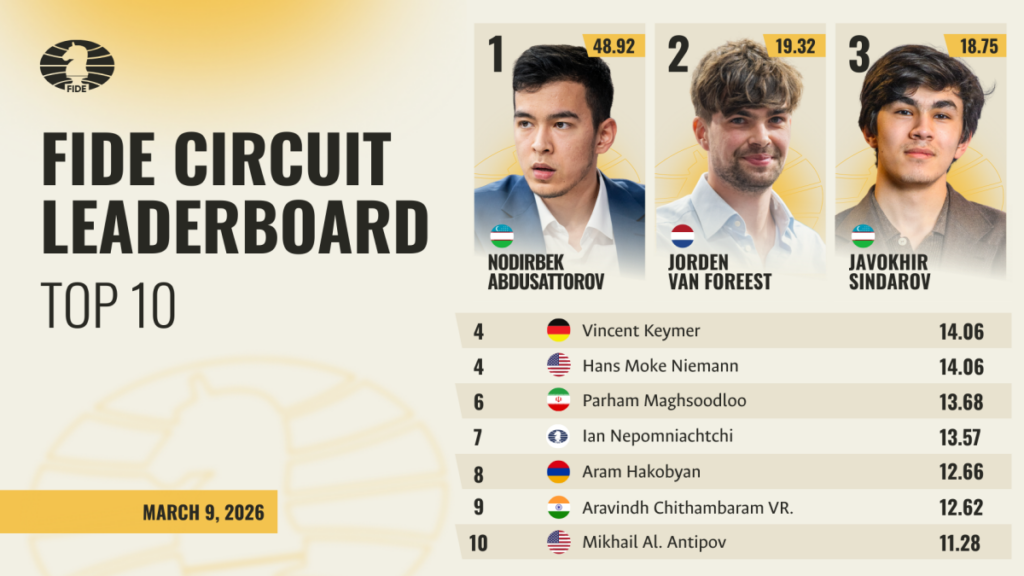
Nodirbek Abdusattorov extended his lead in FIDE Circuit 2026-27 following his triumph in the Prague International Chess Festival Masters netting him 23.14 circuit points. The GM from Uzbekistan claimed his second major title of 2026 and now holds nearly 20-point advantage over second-placed Jorden Van Foreest who also gained points in both Wejk-an-Zee and Prague. Parham Maghsoodloo and Chithambaram Aravindh had strong runs in Prague making the podium and entering the top ten in the circuit race. Ian Nepomiachtchi got on the scoreboard by winning the Aeroflot Open – his second consecutive title in this event. Aram Hakobyan emerged victorious at the Al-Beruniy 3rd International chess tournament – Masters and shared 9th place in the Aeroflot open, translating to 12.66 circuit points and eighth position in the standings. Finally, Mikhail Antipov rounds out the top ten following his victory in the 2026 Saint Louis Masters. We maintain a dedicated page on our website for the FIDE Circuit 2026-27 featuring the latest information on eligible tournaments, current standings, and regulations. Visit: FIDE Circuit 2026-27
FIDE releases Gender Equality in Chess Index 2026
Second edition of the GECI ranks 119 federations, with all regions showing improvement since 2023 Brisbane, Queensland – On International Women’s Day, the FIDE Women in Chess Commission (WOM) and The University of Queensland published the second edition of the Gender Equality in Chess Index (GECI), a comprehensive measure of female participation, performance, and progress across 119 chess federations worldwide. The GECI uses a geometric mean of three indicators – Participation (percentage of female players), Performance (female rating levels relative to male), and Progress (female representation in youth championships) — to produce a single score between 0 and 100 for each federation. The Commission intends to continue updating the rankings every two years. The 2026 GECI reveals broad-based improvement since the first edition in 2023. Average scores rose in every region, with Africa leading at 67.6, followed by Asia (64.5), the Americas (63.1), and Europe (56.7). Seventeen federations — including China, Turkmenistan, and Trinidad & Tobago – have been ranked for the first time. Mongolia retains the top position with a score of 89.26, followed by Sri Lanka (86.99) and Uganda (84.62). The largest rise comes from the United Arab Emirates, which rose 73 places from 77th to 4th. The Maldives climbed 50 places to 13th. The report’s interview section includes interviews with three federations that illustrate different paths toward stronger female participation in chess. The UAE’s rise was driven by institutional coordination between the federation, government ministries, and the national Olympic committee, including the mandatory inclusion of girls in all youth championship delegations. In the Maldives, the chess association equalized prize money between the Women’s and Open categories and is launching a project called “Checkmate Geography” to extend training across its archipelago of over 1,000 islands. And in Sri Lanka, we hear the story of the Wijesuriya family — led by ten-time Women’s National Champion Suneetha Wijesuriya, who, unable to afford her own set, drew a chessboard on the floor with chalk — showing how grassroots development can help build a national chess culture. “When we created the GECI in 2023, we wanted to give federations a clear, evidence-based picture of where they stand on gender equality. You can’t improve what you don’t measure,” said GM David Smerdon, Associate Professor at The University of Queensland and lead author of the report. “Two years later, we’re seeing that this approach is working — federations are using the index to identify gaps and take action, and scores are improving across every region. International Women’s Day is about recognizing both how far we have come and how far we still need to go. In chess, we now have the data to do both.” “The stories in this report remind us that gender equality in chess is not just a policy question, it is a human one,” said Dana Reizniece, Deputy Chair of the FIDE Management Board. “A woman in Sri Lanka drawing a chessboard with chalk, a federation in the Maldives ensuring girls on remote islands can access training, a country in the Gulf mandating that every youth delegation includes girls. These are the decisions that change the game.” “The improvement we see in the 2026 rankings is a strong signal, but our work is far from done,” said Anastasia Sorokina, Chair of the FIDE Women in Chess Commission. “We call on every federation to use the GECI as a starting point for meaningful action.” The full report is available at https://doi.org/10.14264/9ec1c7e