FIDE Candidates: Javokhir Sindarov records third win as Anna Muzychuk moves into joint lead

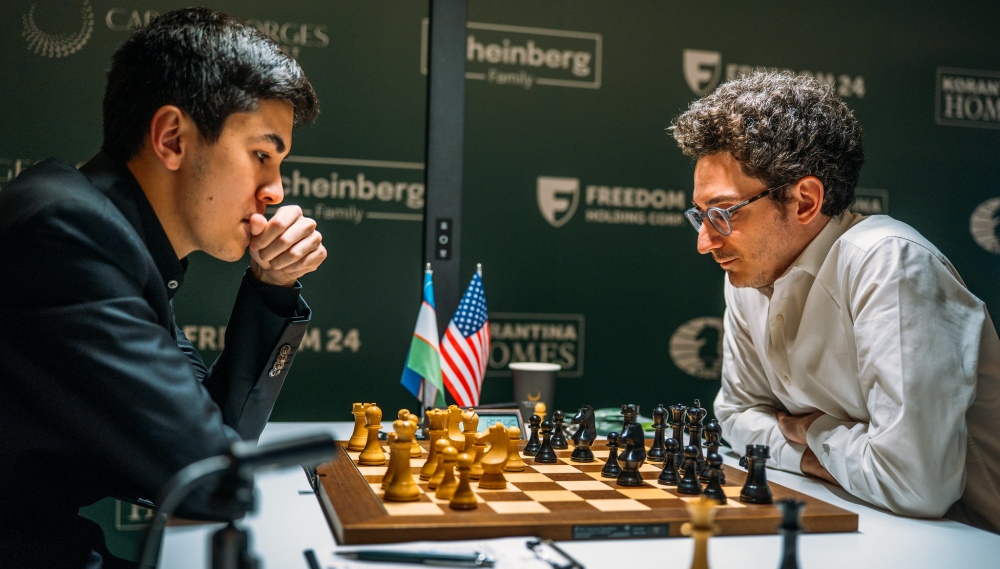
Javokhir Sindarov scored his third win of the tournament this afternoon, taking a major step toward winning the FIDE Candidates after defeating Fabiano Caruana with impressive opening preparation. In the FIDE Women’s Candidates, Zhu Jiner and Anna Muzychuk regained momentum with important victories. Muzychuk now shares the tournament lead with Bibisara Assaubayeva. Let’s take a closer look on how the action unfolded this afternoon at the Cap St Georges Hotel & Resort Roman Dubov, Chairman of Total Sports Investments, opened the game this afternoon for Sindarov in his game against Caruana while Tshepiso Lopang, Continental FIDE President for Africa played the ceremonial first move for Assaubayeva in her game against Tan Zhongyi. The game between the two tournament leaders was, as expected, the highlight of the round. Playing with the black pieces, Fabiano Caruana opted for the solid Queen’s Gambit Accepted, but was caught off guard by Javokhir Sindarov’s move order and emerged from the opening with a slightly inferior position. Playing at a brisk pace – Sindarov notably spending much of his time pacing along the playing hall – the Uzbek prodigy confidently followed his home preparation, quickly building a significant advantage on the clock. The critical moment came on move 17, when Caruana played 17…f5. Reflecting in the post-game press conference, Sindarov explained: “I remembered that in my opening files the pawn on d4 had to be taken, but I wasn’t sure about the exact lines. After 18.Bc4, Black’s position is already very unpleasant.” By around move 20, Caruana was already under serious pressure. “I kind of got caught in the opening with 16…Rg8, and I went wrong,” he admitted. Commentator Jan Gustafsson added: “He is in serious time trouble and also has a bad position.” Sindarov continued energetically, converting his advantage with a direct attacking approach. He expressed satisfaction with his play afterward: “Maybe I made some mistakes in the middlegame, I’m not sure, but I think I played a very good game. I was lucky to get this opening,” he said, before leaving to sign autographs for the many fans in attendance. In his game against Anish Giri, Andrey Esipenko adopted an uncompromising approach, choosing a secondary line against the Najdorf Sicilian, perhaps in an attempt to catch his opponent off guard. However, Giri proved well prepared and responded with an ambitious king march across the board following Esipenko’s striking 10.Nf5. In the commentary booth, Peter Svidler praised the concept: “Esipenko is using the geometry of the board to continue the attack.” Giri later explained the idea behind his opening choice: “Black has a million ways to handle this line, but I was hoping no opponent would think I am bold enough to go for this variation. My king is in greater danger, but I have some long-term assets.” Although Esipenko appeared to be playing in the right spirit, he went astray with 18.Qxd3. Instead, 18.Rxd3 would have preserved dynamic chances and likely led to a more balanced position with attacking possibilities. Reflecting on this moment, Esipenko was candid: “I saw 18…Ba4, but I thought I would find something, as 18.Qd3 looks more logical than 18.Rd3. I didn’t think it was a critical moment, and I was surprised that I couldn’t find anything afterward.” Giri did not take long to consolidate his advantage and ultimately converted with his extra material. He expressed satisfaction after the game: “I am happy to win today and to reach 50% after four rounds–lately I haven’t been starting very well.” https://www.youtube.com/watch?v=hTivLbanAXA The contrast in Hikaru Nakamura’s time management is striking: a player renowned for completing high-accuracy games in a matter of minutes spent nearly forty-five minutes on the opening phase. The game against Wei Yi ultimately featured the offbeat Dragondorf Sicilian, a variation that neither player likely anticipated in their pre-game preparation. Nakamura appeared satisfied with the outcome of the opening, obtaining a sound position with the black pieces while maintaining a time advantage heading into the middlegame. The game remained relatively balanced until the critical moment on move 40, when Wei Yi committed what could have been a decisive error. However, Nakamura was unable to find the most precise continuation in a double-rook endgame despite being a pawn up, allowing the game to eventually simplify into a draw. In his post-game interview with Charlize van Zyl, Nakamura reflected on the missed opportunity: “It was a very interesting game. I took some liberties in the opening, and around the time control it should have been a draw, but it seems that there was a winning opportunity which I missed.” The fourth game of the round was a solid and uneventful affair. Playing with the black pieces, R Praggnanandhaa opted for the reliable Semi-Slav Defence, which soon transposed into an isolated queen’s pawn structure. Matthias Bluebaum responded by simplifying along the c-file, initiating a series of exchanges. Although he carried the bishop pair into the endgame, Praggnanandhaa’s well-placed knight on e4 ensured that the position remained comfortably balanced. Following further simplifications, the players agreed to a draw by threefold repetition on move 37. In the Women’s Candidates, two games ended decisively. Anna Muzychuk defeated Kateryna Lagno in a finely played positional game that ultimately culminated in tactical complications. “I chose this line to avoid some concrete variations,” Muzychuk explained after the game. Lagno defended resourcefully under pressure for much of the encounter but faltered on move 28. At this point, Muzychuk had sacrificed a piece for two pawns and a strong initiative. Lagno could have opted to exchange queens, entering a slightly worse but defensible endgame, even if it required returning the extra material. Instead, she chose to continue with 28…exd4, after which 29.Qxd4 left White with a decisive attack, and the game concluded just three moves later. The other decisive result saw Zhu Jiner prevail with the black pieces over Divya Deshmukh – an important victory that keeps her within reach of the tournament leaders. It is difficult to pinpoint a single decisive mistake, but Divya’s position gradually deteriorated from

Qualifiers confirmed for FIDE Women’s Grand Prix 2026-2027

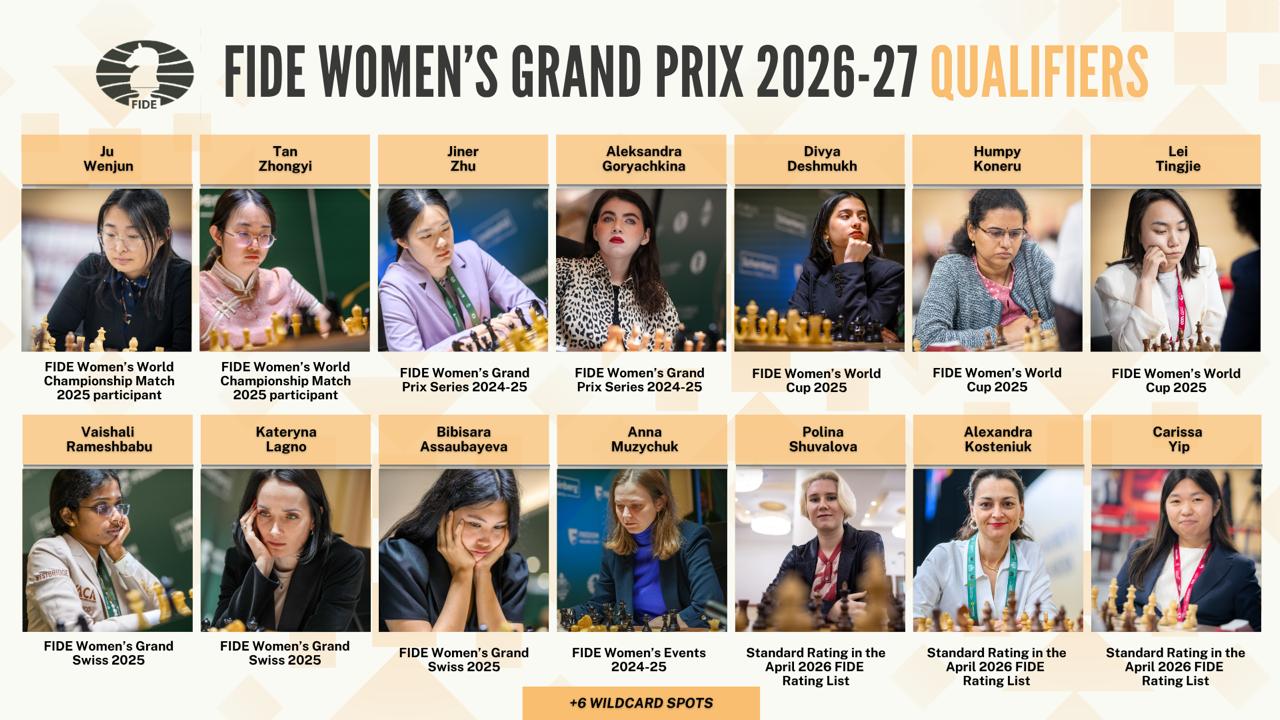
The new FIDE Women’s Grand Prix season will see 20 top women players, each playing in three out of six tournaments, each featuring a 10-player round robin, fighting for the top two places leading to the 2028 Women’s Candidates Tournament. With final standings determined on cumulative series of points and not just raw scores, the qualification model mixes merit and consistency. The 20 players are selected via several routes, with many names already known: – FIDE Women’s World Championship Match 2025 participants: GMs Ju Wenjun and Tan Zhongyi – Top two from the FIDE Women’s Grand Prix Series 2024-25: GMs Zhu Jiner and Aleksandra Goryachkina –  Top three from the FIDE Women’s World Cup 2025: GMs Divya Deshmukh, Humpy Koneru, Lei Tingjie. – Top three from the FIDE Women’s Grand Swiss 2025: GMs Vaishali R, Kateryna Lagno, and Bibissara Assaubayeva. – One spot for the FIDE Women’s Events 2024-25 (the highest ranked player excluding those who have qualified for WGP Series via other paths): GM Anna Muzychuk – Three spots via Standard Rating in the April 2026 FIDE Rating List: IM Polina Shuvalova, GM Alexandra Kosteniuk, and IM Carissa Yip – Six nominations by organisers of each of the events in the series (to be determined) Polina Shuvalova, Alexandra Kosteniuk, and Carissa Yip are the newest qualifiers, based on the FIDE April rating list. The three rating qualifiers reached the spots not just by having the highest rating available, but by playing in at least three events, including at least two individual, from a specified series of competitions between May 2025 and April 2026. Changes compared to the 2024-2025 edition The most significant change in the new circuit compared to the 2024-2025 edition is in qualification pathways: event-based performance is given more prominence than pure rating. While the 2024-2025 cycle saw four rating spots, the new edition has three and includes a stricter and more structured event-performance pathway than before.  Consistency with the prize fund The tournament prize table and WGP points are unchanged. Each tournament features a minimum prize fund of 80,000 EUR, with a series-end pot of 120,000 EUR, funded by 20,000 EUR from each of the six organisers. The winner of each tournament gets 130 WGP points as well as 18,000 EUR, followed by 13,000 EUR for second and down to 3,500 EUR for 10th place.  FIDE President Dvorkovich: A flagship project promoting women’s chess “The Women’s Grand Prix is very popular with women players as it gives them more opportunities to play in serious competitive events and promote themselves. The Grand Prix series has been one of the flagship projects for FIDE in promoting top-level women’s chess,” FIDE President Arkady Dvorkovich said. “With six tournaments taking place around the world, this helps spread the word about women’s chess and its importance, and we’re very proud of the work we’ve done on this and plan to do more in the future,” Dvorkovich added. The FIDE Women’s Grand Prix began in 2009 as one of the most significant events in the world championship qualification cycle. Initially launched as a six-tournament circuit, the number of tournaments was later reduced to five and then four before returning to six events in 2024–2025. China’s Hou Yifan dominated the first three seasons, before being succeeded by Ju Wenjun (the current women’s world champion), then Aleksandra Goryachkina and Kateryna Lagno. The 2024–2025 edition was again won by a Chinese player, with Zhu Jiner taking the crown. The dates and venues for the 2026-2027 tournaments will be announced in due course. Regulations for FIDE Women’s Grand Prix 2026-2027 (PDF)

FIDE April 2026 rating list published

The April 2026 rating list was primarily shaped by the Prague International Chess Festival, Aeroflot Open, Agzamov Memorial, KazChess Masters and team competitions across Europe. The top 10 Open and Women sections saw a couple of notable changes: Nodirbek Abdusattorov gained 9 rating points and climbed to fourth position following his triumph at the Prague International Festival – Masters, while Divya Deshmukh earned 13 points in the Challengers section and returned to the top 10 Women. Biggest gains in top 100 Open and Women Sivanandan, Bodhana FM ENG 2366 (+98) Nurman, Alua WGM KAZ 2443 (+65) Klek, Hanna Marie WGM GER 2360 (+47) Atwell, Rose FM USA 2390 (+36) Eljanov, Pavel GM UKR 2682 (+23) Kulon, Klaudia IM POL 2372 (+22) Navara, David GM CZE 2643 (+17) Pranav, V GM IND 2657 (+16) Lee, Alice IM USA 2415 (+16) Divya Deshmukh GM IND 2510 (+13) British chess phenom Bodhana Sivanandan tops the list following her excellent performance (+98 rating points) at the 39th Festival International des Jeux de Cannes. The 11-year-old from London broke into the top 100 Women and rocketed to the number one English female spot. Photo: Rafal Oleksiewicz Alua Nurman delivered strong results in both the Prague International Chess Festival Open and Agzamov Memorial, earning her 65 rating points and a career-high 25th position. Hanna Marie Klek and Pavel Eljanov overperformed in various team competitions in Germany, both significantly boosting their ratings, while Klaudia Kulon (pictured below) shone in the Schachturnier zum Weltfrauentag 2026 women’s tournament, gaining 17 points. Photo: Michal Walusza Rose Atwell continues her rapid ascent in the rankings, adding another 36 rating points to her tally in March following her strong showing in the 2026 Saint Louis Masters. Pranav V lifted the trophy at the KazChess Masters and reached a career-high rating of 2657, while David Navara delivered a solid performance on home turf, earning 17 points. Alice Lee triumphed in the American Cup, achieving a career-high rating of 2415.