FIDE Candidates: Sindarov shines, Caruana keeps pace; Drama builds in Women’s Candidates

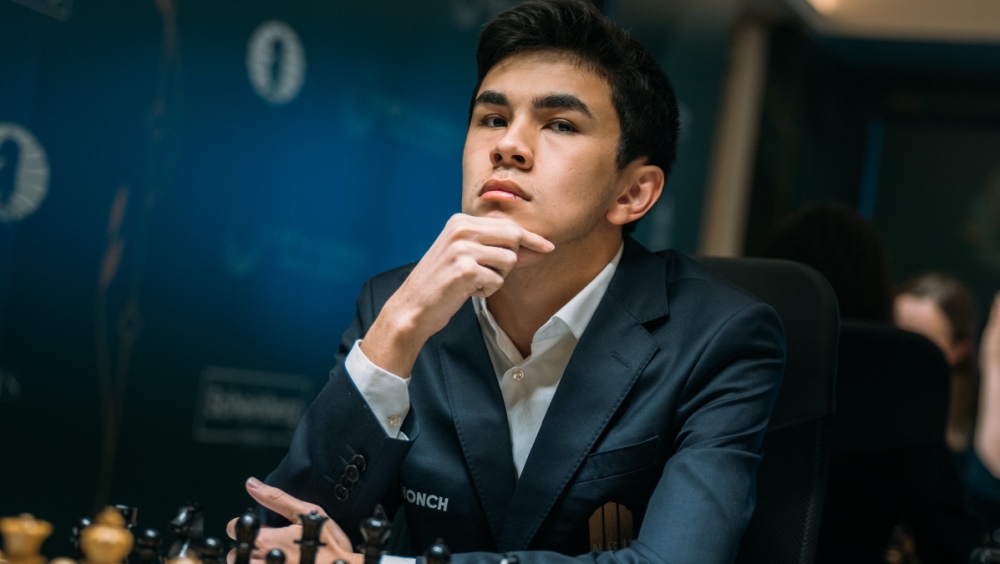
Javokhir Sindarov defeated Hikaru Nakamura this afternoon in the fifth round of the FIDE Candidates, reaching a score of +4 after five rounds. Fabiano Caruana also secured a win against Matthias Bluebaum, keeping the pressure on. In the FIDE Women’s Candidates, Kateryna Lagno won over the leader Bibisara Assaubayeva and is back in contention, while Zhu Jiner scored a brilliant victory against Vaishali and now shares the lead. Let’s take a closer look at how the action unfolded this afternoon. The ceremonial first move was played on the board between Nakamura and Sindarov by José Carrillo Pujol, FIDE Continental President for the Americas.  After yesterday’s rest day, most expected the players to arrive with fresh ideas, theoretical novelties, and plenty of energy – and the round did not disappoint. In his pre-game conversation with GM Peter Svidler, commentator GM Jan Gustafsson joked, “I just hope they won’t ‘hallouminate’ on the chessboard today,” a clear reference to yesterday’s Halloumi cheese workshop. Without a doubt, the most important game of the day was Hikaru Nakamura, playing White, against tournament leader Javokhir Sindarov. Nakamura had expressed the view that this was his last real chance to fight for first place. “It might be an overstatement, but it’s less absurd than you might think,” opined Svidler on the broadcast. Sindarov opted for the Triangle System, but Nakamura came well prepared, entering the main line that ultimately involves sacrificing two pawns. “The compensation is self-evident, even two pawns down, White is very much in the game here,” explained Svidler. “Yesterday I had a lot of time to prepare due to the rest day,” said Sindarov. “This gambit is very tricky, and you can lose immediately if you forget one of your lines, but I checked it thoroughly yesterday.” Both players blitzed out their opening moves, following a high-level game between Nodirbek Abdusattorov (2716) and Arjun Erigaisi (2712). Notably, Abdusattorov is Sindarov’s teammate on the Uzbekistan national team. It is difficult to pinpoint exactly when Hikaru Nakamura left known theory, but before long he was forced to give up another pawn to maintain the initiative. In this position, Nakamura, already very low on time, chose 20.Kh1, and after 20…Nd4! the end was near. Instead, his best chance would have been 20.Bxc6 bxc6, followed by 21.Qg3, with ideas such as Be5, h5–h6, and Kh2/Rg1, keeping the fight alive. However, Javokhir Sindarov remained in full control of the defence. With precise calculation, he neutralized all of Nakamura’s attacking chances and simplified into a completely winning opposite-coloured bishop endgame. Reflecting on his score, Sindarov attributed it to both preparation and form: “I am just lucky to get into lines that I have prepared beforehand. Also, I am really playing well.” https://www.youtube.com/watch?v=qr8LV1aS5b8 Today’s game against Matthias Bluebaum was a key encounter for Fabiano Caruana, who needed to raise his level to stay within striking distance of the leader. He prepared a sideline in the Petroff Defence that proved highly effective. “The fact that Caruana goes for 4.Nc4 is a pretty clear illustration of how devoid of ideas people are in the main line these days. I think Caruana is simply trying to reach a position that Bluebaum hasn’t examined in detail and then just play chess,” explained Peter Svidler. In the game itself, Caruana obtained a promising position out of the opening, and Bluebaum eventually collapsed under sustained pressure. “The win is very important, it felt like I had the initiative throughout,” said Caruana in his post-game interview. Bluebaum, on the other hand, was clearly dissatisfied with his performance: “I didn’t really know the line. I feel like every move I played in the game was terrible today.” Asked whether he had saved this opening idea specifically for this matchup, Caruana offered insight into elite-level Candidates preparation: “It wasn’t something specific. I was considering several options for both games and decided to switch back to 1.e4 and play more directly. Usually, I don’t try to save ideas: if I think I have something playable, I go for it, because you never know if you’ll get another chance. Also, I don’t know if the idea will work, so I try not to overthink these things.” https://www.youtube.com/watch?v=GN2wyrqJO24 The final two games in the FIDE Candidates ended in draws, with neither side managing to obtain a tangible advantage. The encounter between R Praggnanandhaa and Andrey Esipenko featured a solid Zukertort System, nothing ground-breaking from a theoretical standpoint, but safe and reliable. A draw by repetition was agreed with most of the pieces still on the board. Meanwhile, Wei Yi introduced a highly unusual novelty (9…c5) in a well-known position of the Catalan Opening against Anish Giri. The Chinese grandmaster sacrificed a pawn based on deep home preparation. “A fresh and completely new approach – somewhat of a gamble, though,” remarked Peter Svidler. A few moves later, Wei Yi had already regained the pawn and reached a completely satisfactory position: his preparation proved accurate, and a draw was soon agreed. In the FIDE Women’s Candidates, two decisive outcomes in this round have kept the standings tight, with three players now tied for first place. Kateryna Lagno scored a crucial victory against Bibisara Assaubayeva in a sideline of the Classical Sicilian Dragon. On move 14, Assaubayeva made a questionable positional decision (14…e5?!) and soon embarked on a risky plan, sacrificing both a pawn and the exchange in search of tactical compensation. Although she generated some chances, Lagno ultimately converted her material advantage with confidence. https://www.youtube.com/watch?v=N8HDPNYRlJ8 Also joining Anna Muzychuk at the top of the standings is Zhu Jiner, who produced a positional masterpiece against R Vaishali. Handling an Italian Opening with great finesse, Zhu outplayed her opponent on both wings and secured a superior middlegame pawn structure. Vaishali did her best to contain her weaknesses, but as the game approached the second time control, mounting time pressure and a deteriorating position proved decisive. “I was under pressure for a long time and it became very unpleasant. Even so, I was trying to find a

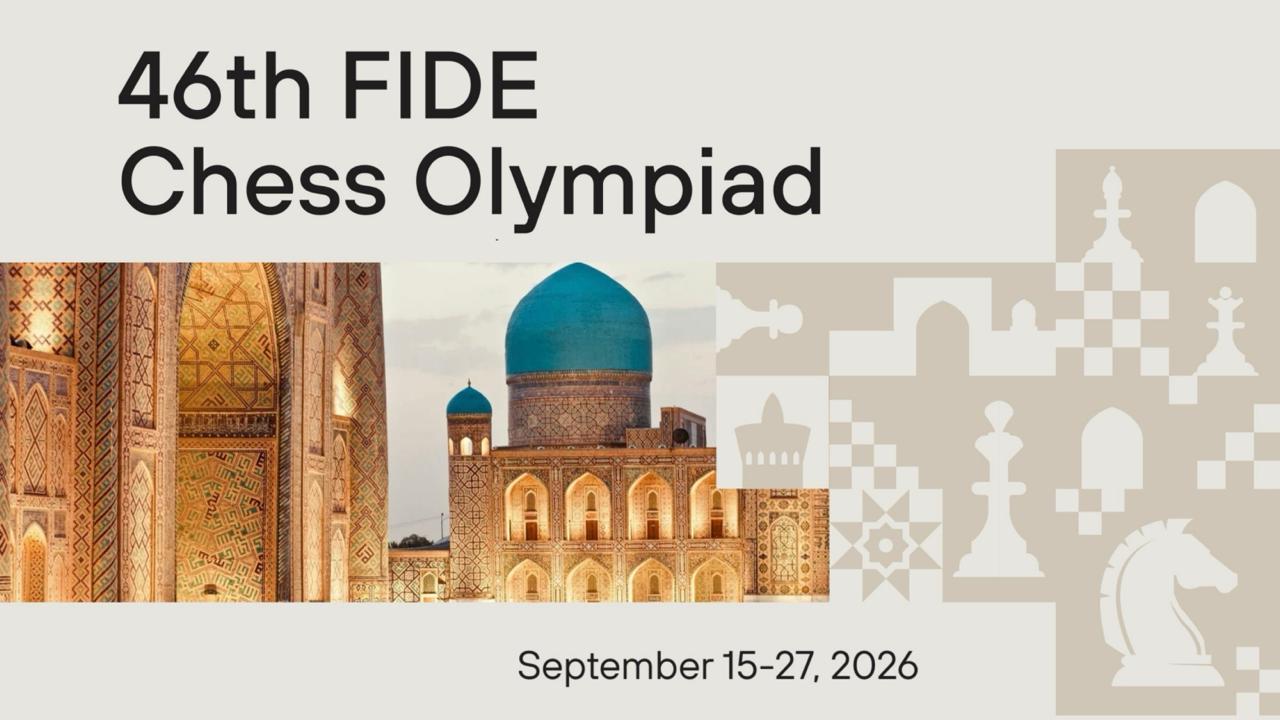
Travel subsidies for participants of Olympiad and delegates of FIDE Congress 2026

Travel Subsidies – Eligibility FIDE will subsidize travel to Samarkand, Uzbekistan for eligible federations as follows. Olympiad – Main Event Development Levels 3, 4 and 5 federations are eligible for travel subsidies up to the following limits:– for federations in Africa – 1,200 euros per person (14,400 euros for full team*)– for federations in Americas – 1,800 euros per person (21,600 euros for full team*)– for federations in Asia – 700 euros per person (8,400 euros for full team*)– for federations in Europe – 900 euros per person (10,800 euros for full team*)– for federations in Oceania – 1,800 euros per person (21,600 euros for full team*)FIDE Treasurer may at her sole discretion decide to increase the amount of travel subsidy for certain federations taking into account their particular circumstances.* Note: Full teams means 12 persons – Open and Women teams each comprised 5 players and a captain. In exceptional circumstances, Development Level 1 and 2 federations may apply for travel subsidies. Valid reasons for such applications may be remote location (and therefore very expensive tickets), poor economic situation in a country (as evidenced by per capita GDP significantly lower than the world’s average and other relevant economic indicators), etc. FIDE Treasurer will review such applications on a case-by-case basis taking into consideration particular circumstances of the federations in question, and decide on the amount of travel subsidy (if any) at her sole discretion. Chess Olympiad for People with Disabilities All invited teams are eligible for travel subsidies. Each team comprises up to 7 invited participants (4 players, 1 reserve player / captain and up to 2 accompanying persons). The limits per person by continents are the same as stipulated in paragraph 1 of the “Olympiad – Main Competition” section. Congress Delegates of FIDE Congress are eligible for travel subsidy on the same principles as described in paragraphs 1 and 2 of the “Olympiad – Main Competition” section. Travel Subsidies – Procedural Issues Expenses covered by travel subsidy: economy class air tickets and other essential expenses related to international travel (visas, etc.). Discretionary expenses (including meals) will not be reimbursed. FIDE may buy tickets for eligible national chess federations in lieu of paying travel subsidy. Prior to making any travel arrangements, national chess federations shall consult with FIDE. If FIDE advises that national chess federations make travel arrangements on their own, requests for the travel subsidy payments together with relevant supporting documents (tickets / receipts / invoices / etc.) shall be sent to FIDE Office no later than 31 October 2026. Applications for travel subsidy received by FIDE Office after 31 October 2026 will not be accepted. Travel subsidy will be paid within 6 weeks after the Olympiad completion taking into account the actual number of persons who attended the Olympiad. Expenses incurred with respect to persons who did not attend the Olympiad will not be reimbursed. For the avoidance of doubt, if actual travel expenses are lower than the limits stated above, only actual expenses will be reimbursed. In exceptional cases, federations may apply to receive travel subsidy prior to the event. FIDE Treasurer will review such applications and decide on the amount of prepayment (if any) on a case-by-case basis. All communications on this matter (applications for travel subsidies, expense reports, etc.) shall be sent to the FIDE Office email.