European Individual Chess Championship 2026 begins in Katowice, Poland

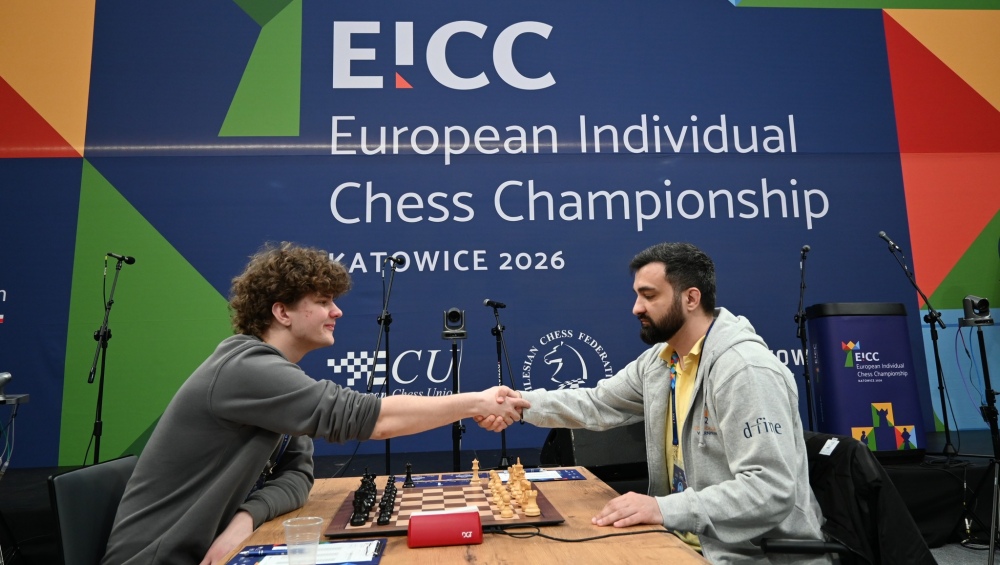
The 2026 European Individual Chess Championship commenced today in Katowice, Poland, hosting 501 chess players over the next two weeks. The event set a new participation record with 501 players from 43 European federations competing over 11 rounds for a €100,000 prize fund and qualification spots for the next FIDE World Chess Cup. The opening ceremony of the event took place shortly before the first round and was attended by the ECU President, Zurab Azmaiparashvili, Mayor of city of Katowice Marcin Krupa, the President of the Polish Chess Federation Radoslaw Jedynak, ECU Vice Presidents Gunnar Bjornsson and Alojzije Jankovic, FIDE Secretary General Lukasz Turlej, President of the Silesian Chess Association Michal Pazdziora, the President of MOKATE Adam Mokrysz and other distinguished guests. The ceremony was inaugurated with the renditions of the ECU anthem and the anthem of the hosting country – Poland. The Mayor of the city of Katowice, Marcin Krupa then took the floor, and warmly welcomed all the players and guests to Poland. He expressed his eagerness that Katowice would host one of the most important European tournaments of the year, and wished the players best of luck in the tournament and pleasant time in the town. The ECU President Zurab Azmaiparashvili then addressed the gathering extending his sincere gratitude to the Polish Chess Federation led by President Radoslaw Jedynek and the Silesian Chess Federation and Michal Pazdziora for the organisation of the event. “Thanks to you, the European chess continues to grow stronger and more united”, added Azmaiparashvili. The ECU President then warmly addressed the players, wished them the best of luck, fair play, and brilliant achievements in the game. The speech finished with the ECU moto: “Play chess – Chess makes you smarter”. The President of MOKATE, Adam Mokrysz, was invited to the stage and wished a great and successful tournament to the tournament participants. He invited them to enjoy the venue, the town, and MOKATE products which are the main part of the players’ refreshments areas. FIDE Secretary General Lukasz Turlej welcomed the players and guests to Katowice, “European capital of chess”. He wished the contenders the best of luck, great games, and nice stay in Poland. The President of the Polish Chess Federation Radoslaw Jedynak, then took the floor. He emphasized his federation’s pride in hosting the 2026 European Individual Championship and wished players a strong and successful competition. The event was officially declared opened by the Mayor of Katowice, Marcin Krupa, who – with the ECU President Zurab Azmaiparashvili – made the first ceremonial move on the top board game between GMs Igor Kovalenko and Reinis Paikens. The players were eagerly anticipating the start of the clocks, and the beginning of the tournament. Most of the favourites convincingly sealed the first-round victories, but there were also a few surprising draws on the top boards. GM David Navara (CZE, 2643) drew his game against Yehonatan Azoulay (ISR, 2298) with the black pieces, GM Maxime Lagarde (FRA, 2621) didn’t manage to prevail against David Martirosyan (CZE, 2281), GM Daniil Yuffa (ESP, 2595) drew with whites against Daniil Yasmo (GER, 2271), GM Constantin Lupulescu (ROU, 2587) was held to a draw by WIM Manon Schippke (FRA, 2269), and there were a few more interesting upsets on the remaining boards. All results, pairings and rankings after first round can be found [HERE] Text and photos: European Chess Union Official website: https://eicc2026.eu/
Five-way tie keeps FIDE Women’s Candidates wide open; Sindarov increases his lead

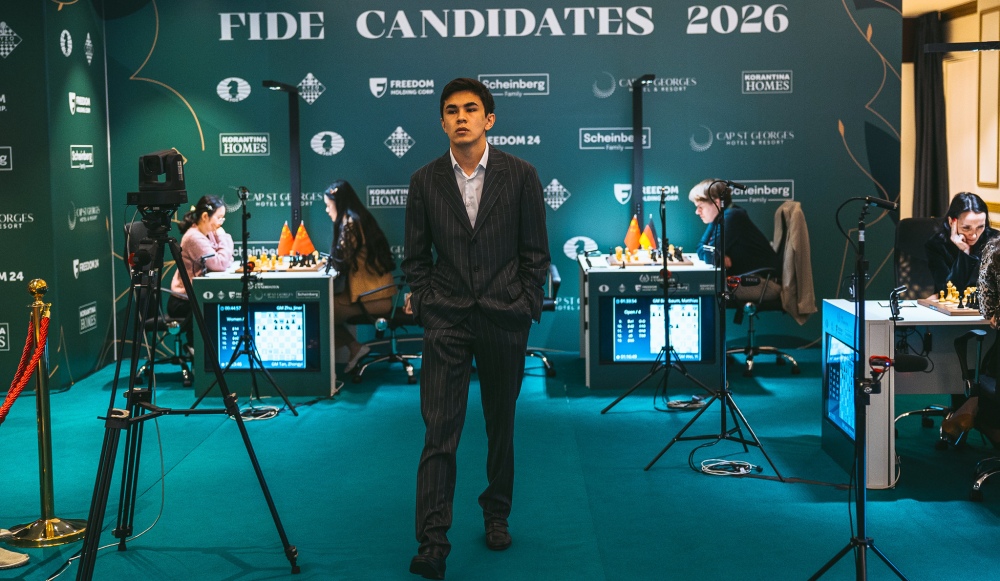
Reinvigorated after the second rest day, the sixteen contenders returned to the playing hall for the first of seven rounds in the second half of the event. Playing with Black, FIDE Candidates tournament leader Javokhir Sindarov held his opponent to a draw this afternoon. Combined with Fabiano Caruana’s loss against Hikaru Nakamura, the result leaves Sindarov two full points clear of the field. Meanwhile, Anish Giri narrowed the gap by defeating Praggnanandhaa R in a finely played technical game. In the FIDE Women’s Candidates, Anna Muzychuk lost to Divya Deshmukh, leaving five players tied for the lead and the tournament wide open. Three decisive outcomes in Round 8 highlight the remarkable balance and competitiveness of the women’s field. Let’s take a closer look at the action this afternoon in the Cap St. Georges Hotel & Resort in Cyprus. David Luiz, player of Pafos FC and former player for the Brazil national team, Arsenal, Chelsea and PSG, UEFA Champions League winner, made the ceremonial first move in the game between Andrey Esipenko and Javokhir Sindarov, while Moshe Slav, FIDE Delegate representing Israel and member of the European Chess Union Board opened the Muzychuk vs Divya game. Even before the key game of the round began, commentator GM Peter Svidler predicted that Andrey Episenko would push for a win against tournament leader Javokhir Sindarov. “He can’t fight for first place, obviously, but he will still want to do something—what could be more memorable than beating the runaway leader?” As usual, Sindarov blitzed out his moves in a main-line Catalan, building up more than a 30-minute advantage on the clock. “I prepared very well. I expected a Catalan and a long game, and after the opening I reached a position from my preparation,” he explained afterward. On move 20, he made a well-judged pawn sacrifice to seize complete control of the light squares. “I understood that if I didn’t sacrifice a pawn, I would be slightly worse.” Andrey Episenko spent nearly half an hour searching for a better continuation but ultimately found nothing more than a threefold repetition – an evaluation even the engines confirm. https://www.youtube.com/watch?v=TBvtVBITC8w Meanwhile, on the other board, the tournament pursuers were in need of points. Hikaru Nakamura has traditionally enjoyed a strong record against Fabiano Caruana, but he has not been performing at his usual level in Cyprus. Still, in his recaps he continues to stress a “game-by-game” approach, ready to seize any opportunity that arises. This afternoon, his opening preparation paid off. “I played this same line against Oparin, Caruana’s second!” noted Jan Gustafsson during the live broadcast. Caruana soon found himself significantly behind on the clock, down nearly an hour. Nonetheless, Fabiano’s solid play kept him well in the game, as he gradually simplified into a double-rook endgame, positions that are notoriously tricky to handle. Position of the day With around fourteen minutes on his clock to make twelve moves, Fabiano Caruana played 28…h5? Although he was already slightly worse in the endgame, Caruana still had solid drawing chances with 28…Ra-b2!, conceding the a5-pawn but activating his rook along the second rank and heading for a defensible rook ending a pawn down. The problem with 28…h5 is that after 29.Rd1! Rb-b2 30.Rd8+ Kh7 31.Rd7! Rxf2 32.Rxg7+, White’s rooks penetrate decisively to the seventh rank. In such positions, their activity becomes overwhelming. Even though Hikaru Nakamura had to work until move 67 to convert the advantage, the outcome was no longer seriously in doubt. You can also check out Hikaru Nakamura’s post-game press conference, where he goes through the critical moments in detail. https://www.youtube.com/watch?v=qiyG64Dlg2w&t=1s Praggnanandhaa R opted for one of the sharp and unbalanced lines in the Queen’s Gambit Accepted that he enjoys so much, but once again Anish Giri’s opening preparation proved excellent, with the Dutchman only beginning to think seriously around move thirteen. Capitalizing on a couple of inaccuracies, Giri steered the game into a position featuring a strong knight against a weak bishop, along with a slightly superior pawn structure. From there, the grind began: the Dutch grandmaster methodically created a passed pawn, which ultimately decided the game in his favor. Both players later joined the press conference to share their thoughts on the game and their overall performance. https://www.youtube.com/watch?v=lUHXtdov89A Wei Yi once again returned to his favorite Vienna Game–Bishop’s Opening, a surprising choice after the rest day, when his opponent would have had ample time to prepare. He offered an early pawn sacrifice, which Matthias Bluebaum declined in favor of a more solid approach with Black: a sensible strategy against such an aggressive opponent. Still, Wei Yi is always looking to complicate matters, and he soon found a way to sacrifice an entire rook to expose Black’s castled king. Although the engines suggested nothing more than a perpetual check, Wei Yi spent over half an hour searching for winning chances before ultimately having to settle for a draw. In the FIDE Women’s Candidates, this afternoon’s results have dramatically reshaped the standings, with five players now tied for first place and six rounds remaining. The most important encounter featured Anna Muzychuk against Divya Deshmukh. “Probably the pairing of the day. Divya has had a bit of resurgence and was very close to winning her last two games,” noted Peter Svidler during the live stream. Around move twenty, Muzychuk was already enjoying a clear spatial advantage, with no weaknesses and promising attacking prospects on the kingside. “I’m impressed with Anna’s opening preparation, considering she is the only player who hasn’t been preparing for the last few months,” reflected Svidler. “Divya does like her …c5 structures, but this time she allowed the Maroczy Bind, and Anna, as a classical player, is very comfortable controlling the centre. The engine generally prefers White’s grip, so it’s difficult to keep the balance,” added Jan Gustafsson. Muzychuk gradually pressed her advantage and at one point reached a completely winning position, but she faltered in time trouble. The position eventually simplified to a draw, but in an attempt to play for
Asia makes its move: Asian Stage of the World Schools Team Championship 2026 kicks off in Almaty

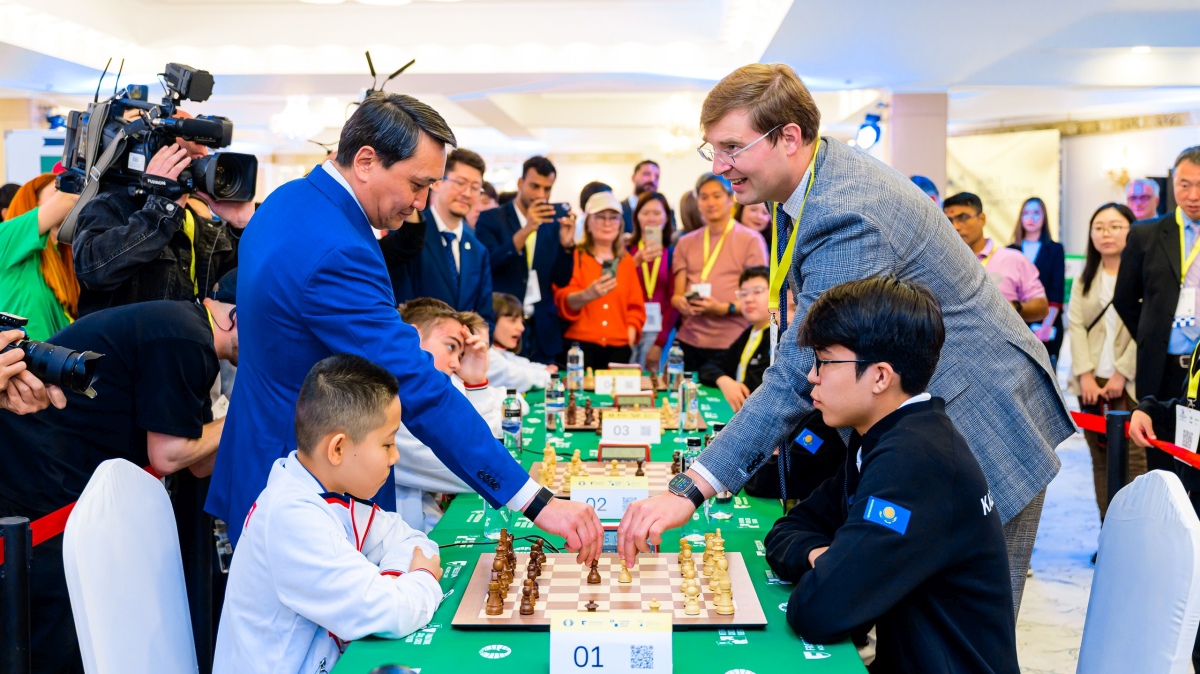
From April 7 to 10, 2026, Almaty hosts Asia’s premier school chess event. The Asian Continental Stage of the World Schools Team Championship 2026 has officially begun – the first tournament of its kind, organized by FIDE and the International School Chess Federation (ISCF) with the support of its general partner Freedom Holding Corp. This marks the launch of a new global cycle. Four continents will host their own stages, with winners earning direct qualification to the Grand Final in December 2026. There, the strongest school teams in the world will compete for the world championship title. The Asian stage opens the cycle and sets the tone for the season. The year 2026 has been declared by FIDE and ISCF as the Year of Chess in Education – a global initiative highlighting the role of chess in developing critical thinking, strategy, concentration, memory, discipline, and teamwork. President of the International Chess Federation (FIDE) Arkady Dvorkovich addressed participants in a video message: “Our goal is simple: we want to integrate chess into school systems around the world. We engage with governments, collaborate with international organizations, and organize school tournaments and conferences to demonstrate that chess is not just a game, but a powerful educational tool. The competition is not just a tournament stage – it also includes educational workshops and masterclasses. I hope you take full advantage of these opportunities.” At the same time, Arkady Dvorkovich is in Cyprus attending one of the most prestigious events in the global chess calendar – the Candidates Tournament 2026, where the world’s top players compete for the right to challenge the World Champion. Among them is Bibisara Assaubayeva. Meanwhile, in Almaty, Timur Turlov opened the Asian Stage of the World Schools Team Championship – a tournament where future stars of world chess are born. Symbolically, the event takes place on the eve of Cosmonautics Day (April 12). The theme is truly “cosmic”: young players from different countries are making their first strategic moves that, like space exploration, open new horizons of thinking, teamwork, and intellectual growth. Chess teaches you to think several moves ahead – just as dreams of space inspire generations to achieve breakthroughs. The organizers of the Asian stage include the International Chess Federation (FIDE), the Ministry of Tourism and Sports of the Republic of Kazakhstan, the Akimat of Almaty, the International School Chess Federation (ISCF), and the Kazakhstan Chess Federation led by its President Timur Turlov. He noted: “Kazakhstan is not opening the global season of school chess by chance. Over the past three years, we have built a system that has turned chess into a full-fledged element of the national educational environment — with its own methodology, trained teachers, and a strong regional network. The pace of development of school chess here is among the fastest in the region. With the support of the President, we have not only launched the initiative but expanded it nationwide. Today, more than 60,000 children are systematically engaged in chess in schools, and this number continues to grow. We see real interest from students and parents, which confirms strong social demand and long-term potential. It is therefore natural that the Asian Stage of the World Schools Team Championship is held in Almaty.” The official opening ceremony took place today, followed by the first two rounds of play. The tournament consists of eight rounds played under the Swiss system, with two rounds per day. The time control is 45+10 (45 minutes per game with a 10-second increment per move starting from move one). Teams earn 2 points for a win and 1 point for a draw. A total of 26 school teams from 19 countries are participating, including Australia, India, China, New Zealand, Singapore, Malaysia, and countries from Central and South Asia, among others. All participants are students aged 8–14. Teams represent general education schools only — chess academies, specialized clubs, and mixed teams are not allowed. Each team consists of four main players and one reserve. The tournament features some of the strongest school teams, including prize-winners of previous world competitions, ensuring a highly competitive field. In addition to the main competition, organizers have prepared an extensive side program. Children will take part in interactive workshops and entertainment activities, while parents and local chess enthusiasts can attend masterclasses led by leading coaches and grandmasters. Dedicated educational sessions are also organized for teachers and parents, reinforcing the tournament’s educational mission. A special highlight is a social initiative in partnership with Duolingo India: ISCF has granted a Wild Card to a girls’ team from underprivileged communities, for whom this tournament represents a meaningful step beyond their usual environment. The program also includes exhibition matches and interactive experiences such as Quantum Chess. On April 9, a joint event with QJ League and Footlab will take place, featuring a tour of a football center, joint training sessions, and friendly challenges between football players and chess players. Participants will also be introduced to the traditional Kazakh game “Asyk Atu,” learning its history and trying it themselves. A culinary masterclass will allow children to prepare traditional Kazakh sweets. In partnership with FIDE, ISCF is also launching the international “Chess in Education” grant program aimed at scaling proven educational models with measurable impact. The selection process will take place in two stages, with winners to be announced at the Grand Final in December 2026. Today, chess in schools is more than just a game – it is a powerful tool for developing future-ready skills. It teaches children to make decisions under pressure, work as a team, and think strategically. The iconic Hotel Kazakhstan, overlooking the snow-capped Zailiyskiy Alatau mountains, provides a unique setting for the tournament. Here, children not only compete but also connect, share cultures, and become part of a global community. The tournament brings together sport, education, and culture, demonstrating that chess can serve as a bridge between continents. The hosting of the tournament in Almaty has been made possible thanks to the support of the Ministry of Tourism and
World University Team Chess Championship to be held in Kazakhstan

Best university teams will meet in Almaty this August to compete for the title of FIDE World University Team Chess Champion. The event is governed by FIDE and organised by the Kazakhstan Chess Federation, together with Almaty city administration and support from Kazakhstan’s Ministry of Sports and Tourism. The competition has three stages. It begins with Online Swiss Qualifiers, followed by an Online Knockout stage. The over-the-board finals will then take place in Almaty from 3 to 10 August 2026. There will be two online Swiss Qualifiers. The registration deadlines are 27 April 2026 at 11:59 PM UTC for teams participating in Online Swiss Qualifier 1, and 4 May 2026 at 11:59 PM UTC for teams participating in Online Swiss Qualifier 2. The finals will feature 16 teams – eight that have qualified from the knockout, and eight wild cards, invited by FIDE and the organiser. The tournament features an inclusive team concept – each match will be played on four boards and lineups must include at least one female and at least one male player. Participation is open to university teams, with players born between 1 January 2001 and 31 December 2008 and currently enrolled in at least one class at the university. The winning team will become the FIDE World University Team Champion and receive a prize of €25,000. The team finishing second will be awarded €15,000, while third-place will receive €10,000. “In the year which FIDE has dedicated to chess in education, the first University World Team Championship is a significant milestone in promoting our sport. We have seen chess enjoy a sharp rise in popularity among younger audiences and this is an opportunity for the game to get more people involved. FIDE is fortunate to have the Kazakhstan Chess Federation as our partners and we are looking forward to a successful event,” said Arkady Dvorkovich, FIDE President. “Kazakhstan has already established itself as a reliable venue for international FIDE tournaments. Hosting the first-ever World University Team Chess Championship will be a special honour and responsibility for us. Events of this kind open new horizons for inter-university cooperation: they create a platform for dialogue, knowledge exchange, and the development of long-term partnerships between leading universities around the world,” said Timur Turlov, President of the Kazakhstan Chess Federation. In recent years, Kazakhstan has become a regional hub for education and science, and staging a championship of this scale is yet another confirmation of that progress. “We are grateful to our President for creating all the conditions necessary for tournaments of this level in Kazakhstan, and to the Akimat of Almaty for its unwavering support of the national chess movement. For our part, we will make every effort to ensure that the upcoming tournament is organised at the highest level,” Turlov added. Team registration is held here: https://worlduniversities2026.fide.com For more information, please email worlduniversity@fide.com. Official website: https://worlduniversities2026.fide.com