FIDE Candidates: Sindarov stumbles, Giri strikes as race tightens

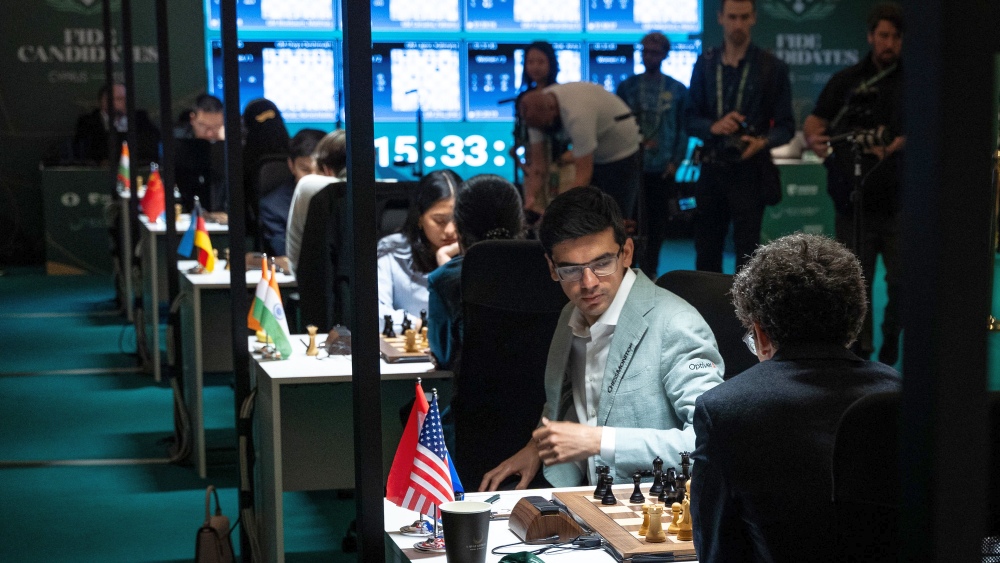
Javokhir Sindarov missed a clear opportunity to secure victory this afternoon against Matthias Bluebaum, allowing Anish Giri to narrow the gap after defeating Fabiano Caruana with the black pieces. With five rounds remaining, Sindarov still leads by 1.5 points. Vaishali and Zhu Jiner share the lead at the FIDE Women’s Candidates with 5.5/9, following victories over Divya Deshmukh and Kateryna Lagno, respectively. Meanwhile, Anna Muzychuk squandered a highly promising endgame, slipping behind the leaders. Let’s take a closer look at how the afternoon unfolded. The ceremonial opening move was played by Paris Klerides, General Secretary of the Cyprus Chess Federation and FIDE Delegate for Cyprus, who made the symbolic 1.e4 on behalf of Matthias Bluebaum. However, Bluebaum opted for 1.d4 instead. Javokhir Sindarov replied with a very rare line – the Harrwitz Attack in the Queen’s Gambit Declined. Commentator Jan Gustafsson was surprised: “I have never seen this move order before, so I suspect that maybe Bluebaum hasn’t either.” Very soon, both players found themselves in uncharted territory, reaching a position with opposite-side castling and no significant master games for reference. Position of the day The critical moment arose after White played 24.bxa4. In this position, Sindarov would have had excellent winning chances with 24…Qb7 or even 24…Qa5, keeping the queens on the board and continuing the attack. Instead, he chose 24…Bxa4?, allowing a queen exchange and easing the pressure. In the post-game press conference, Sindarov admitted his miscalculation: “It was an interesting game. I had a big advantage, but I missed his resource 29.f5 in the endgame. I thought I was winning a pawn, but I should have kept the queens on the board; I would have had a very strong attack.” Bluebaum, for his part, acknowledged his good fortune: “I played like a clown and wanted to resign after 22…a4, but he let me escape into the endgame and secure a draw.” https://www.youtube.com/watch?v=ESfOEFV_Nsg During the afternoon an unexpected visitor made an appearance in the playing hall and then did a spot of commentary in the analysis booth. With this result, both Fabiano Caruana and Anish Giri had a chance to close the gap, and they didn’t disappoint. Having competed in elite tournaments for over fifteen years, it is no surprise that they have faced each other many times, with a narrow 7–4 edge in favor of the Dutch number one. In a classical Italian Game, with Giri leaving his trusted Najdorf in the “drawing box” for this encounter, both players followed well-established theoretical lines, reaching a complex middlegame with a closed pawn structure and roughly an hour remaining on the clock for each. The position remained approximately balanced, though slightly easier to handle for Giri, when Caruana committed a serious blunder on move 37, very near the time control and under mounting pressure. As he transitioned toward the endgame, he activated his king, inadvertently allowing a subtle tactical shot that Giri spotted immediately. Giri uncorked the fantastic 42…f5+! and after 43.exf5 Kh6!! threatening 44…Bh5 mate. Caruana resigned as 44.fxg6 fails to 44…e4! followed by 45…Qg5 mate or 44.Kf3 e4!+ 45.Qxe4 Bh5+ 46.Kf4 Qg5 checkmate. https://www.youtube.com/watch?v=WmdMT3ajOBs The other two games also ended in draws, although R Praggnanandhaa let a winning position slip against Wei Yi and was clearly disappointed after the game. The last game to finish, between Hikaru Nakamura and Andrey Esipenko, was a 92-move draw. The position remained balanced for most of the game, although Nakamura eventually managed to win a pawn. Peter Svidler quickly captured the essence of Black’s opening choice: “It’s a pretty dry position in which Andrey is basically saying that he doesn’t mind being strategically slightly worse because he will make a draw.” In the end, Esipenko demonstrated excellent rook endgame technique, holding the draw without any real difficulty using the method of frontal checks. It is a must-see game for anyone looking to improve their technique in this type of ending. In the Women’s FIDE Women’s Candidates Tournament, R Vaishali and Zhu Jiner broke away from the five-way tie with important victories. Vaishali, now scoring 3.5 out of her last four games, defeated Divya Deshmukh, who blundered a tactical sequence in the middlegame that left her without adequate defense. In her post-game interview, Vaishali said she was very happy with her performance, while Divya admitted that her middlegame play had been inaccurate, pointing in particular to 17…Nd7, where she overlooked the ensuing ideas involving Qd4. https://www.youtube.com/watch?v=VwHeH05QaP8 Meanwhile, Zhu Jiner employed the fashionable setup with 1.Nf3, 2.e3, and 3.b3 with White. Kateryna Lagno responded in classical style, seizing central space with pawns and the bishop pair in exchange for a long-term weakness around her castled king. After the queens were exchanged, Lagno blundered a pawn in the endgame, and Zhu Jiner converted her advantage with excellent technique. FIDE’s presenter Charlize van Zyl caught up with the winner after the game. https://www.youtube.com/watch?v=HxFBuzoXndQ The other two games ended peacefully. Bibisara Assaubayeva introduced a very interesting idea on move three in the Rossolimo Attack against Aleksandra Goryachkina with 3…Nd4. Peter Svidler was surprised: “This is a move that, honestly, I did not think was playable in this particular setup, but I guess everything is these days.” However, the surprise value of a move, combined with a few focused hours of engine preparation, can work wonders in a single game. Jan Gustafsson noted: “Goryachkina did look very shaky yesterday (against Kateryna Lagno) when faced with a surprise.” In this afternoon’s encounter, however, Goryachkina chose not to take risks, opting instead for a solid approach with mass exchanges leading to an equal endgame. In the final game, both players – Tan Zhongyi and Anna Muzychuk – were coming off losses the previous day and needed a win, albeit for different reasons. Facing a sharp and tactical Grünfeld Defence, Tan opted for an early queen exchange, aiming to capitalize on the bishop pair in the endgame. Muzychuk, however, established an excellent blockade with her knight and maintained a superior pawn structure, eventually achieving a significant advantage in the

Media accreditation open for the FIDE World Rapid and Blitz Teams 2026

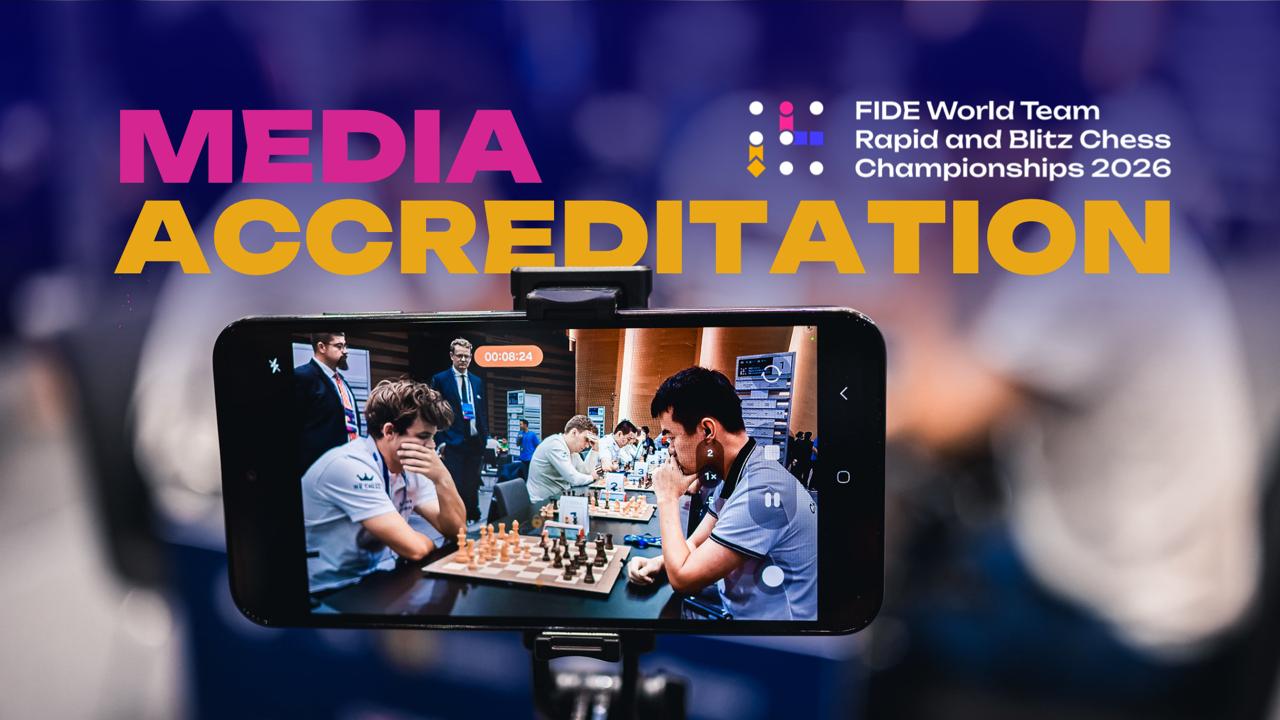
FIDE is pleased to announce the opening of media accreditation to for the FIDE World Team Rapid and Blitz Chess Championships 2026. Dates: June 16 – 20, 2026 Location: Hong Kong, China The World Rapid and Blitz Teams, which FIDE launched in 2023, is a unique chess competition where elite professionals, recreational players – both men and women – compete on the same team in a serious world event. With the knockout format and rapid and blitz games, the event is naturally built for spectators. The tournament is also growing at remarkable pace, drawing global chess spotlight as well as top world players such as Magnus Carlsen, Hikaru Nakamura, Alireza Firouzja, Hou Yifan, and others. The FIDE World Team Rapid Chess Championship will be played as a 12-round Swiss tournament across three days (June 17-19), with four rounds per day and a time control of 15 minutes for the whole game plus a 10-second increment per move. The FIDE World Team Blitz Chess Championship follows on June 20 and 21, beginning with pool stages before moving to a knockout format for the top 16 teams, with a time control of 3 minutes plus a 2-second increment per move. Media registration form: https://worldrapidblitzteams2026.fide.com/mediaregistration Official website: http://worldrapidblitzteams2026.fide.com/  We invite all media representatives wishing to cover the tournaments to submit their accreditation applications via the media registration form above. Accreditation is open for all members of the written press, photographic press, online media, and writers and photographers working for publications and/or websites of the FIDE National Member Federations. Accredited event media will collect their badges onsite at the events. A valid travel document containing a photo must be presented to receive media accreditation. The event organisers will ensure a comfortable working environment for all Accredited Media, providing a range of facilities and services at the level established at major FIDE events. We look forward to your coverage of the FIDE World Team Rapid and Blitz Chess Championships 2026!