

Queen’s Online Chess Festival 2026 sets new participation record

The sixth edition of the Queen’s Online Chess Festival, organized by the FIDE Commission for Women’s Chess, successfully concluded after a month of exciting competition from March 1 to March 29, 2026. Held as part of the global Chess Women’s Day Celebration, this year’s festival marked a historic milestone, becoming the largest edition ever, with a remarkable 991 participants from all over the world. The festival once again demonstrated the power of online chess to connect players across continents, offering competitive opportunities, visibility, and inspiration for women and girls at different stages of their chess journey. We are thankful to Lichess for our new partnership, which made it possible on such a level. A unique format connecting continents The Queen’s Online Chess Festival featured two parallel competitions: Queens’ Festival, designed for all female players, including the titled and experienced players Princesses’ Section, aimed at youth players The Queens’ Festival followed a multi-stage format: Continental Qualifiers (Africa, Americas, Asia, Europe), played in a 9-round Swiss (3+2) Semi-Finals (9 rounds, 3+2) Finals (7 rounds, 5+5) The Princesses’ Section included two large qualification groups, attracting 189 participants in Group A and 109 participants in Group B, highlighting the strong global interest among young players. Continental Champions The qualification stage saw strong participation across all regions: Africa – 117 players Europe – 129 players Asia – 313 players Americas – 134 players In highly competitive events, the following players emerged as continental winners: Africa: Sandra Osarugue Omoruyi (Nigeria)Asia: WFM Sachi Jain (India)Europe: WCM Khadija Khalilova (Azerbaijan)Americas: IM Deysi Cori (Peru) Their performances secured qualification to the later stages and set the tone for a very strong knockout phase. Deysi Cori wins the Queens’ Festival for the 3rd time! The final stage brought together the top performers in a closely contested event. After seven rounds of rapid play, the podium was determined as follows: IM Deysi Cori (Peru) WCM Khadija Khalilova (Azerbaijan) WFM Sachi Jain (India) IM Deysi Cori delivered an outstanding performance throughout the event, adding another significant achievement to her already impressive career – it is in fact her 3rd time claiming victory in the Queens’ Online Festival. Congratulations! Final standings Princesses’ Festival: Emerging talents shine The Princesses’ Festival once again highlighted the remarkable potential of the next generation, with young players demonstrating impressive skill, determination, and fighting spirit throughout the competition. After a hard-fought final, the top three places were secured by Joana Maria Pinholi Martins de Souza (Brazil), Sarah Qiu (USA), and Modi Janis (India). Their performances stood out in a highly competitive field, reflecting both the growing global depth of girls’ chess and the bright future ahead for women in the game. Final standings A successful first-time partnership with Lichess A key highlight of the 2026 edition was the first-ever collaboration with Lichess, which proved to be highly successful. Meaningful prizes and opportunities Beyond competition, the festival offered valuable incentives and development opportunities: 1st place (Queens’ Final): Invitation to the FIDE Chess Olympiad 2026 USD 300 2nd place: USD 200 3rd place: USD 100 At the qualification stage, top performers received: Training sessions with a former Women’s World Champion – GM Antoaneta Stefanova Diplomas and vouchers to the official FIDE shop The Princesses’ Festival also provided trophies, vouchers, and training opportunities, reinforcing the festival’s commitment to nurturing the next generation of players. Lessons with a former Women’s World Champion – GM Antoaneta Stefanova – will be a special prize for the top performances Supporting the next generation: Partnership with DGT The FIDE Commission for Women’s Chess was also proud to continue its growing partnership with DGT, whose support was dedicated to the youngest participants in the Princesses’ Festival. Through this collaboration, DGT provided meaningful prizes aimed at encouraging and inspiring young talents: 1st place: DGT Pegasus + Pegasus travel bag 2nd and 3rd place: DGT 1500 chess clocks These prizes represent more than just equipment – they serve as motivation for young players as they develop their skills, confidence, and passion for the game. This partnership builds on previous successful collaborations, including initiatives such as the DGT Seminar and the Pia Cramling Cup held earlier this year in Stockholm. The continued involvement of committed partners like DGT plays an important role in advancing women’s chess, helping to create opportunities, recognition, and a more inclusive future for the next generation. Inclusion and impact: Participation of the girls from the Kakuma Refugee Camp A particularly meaningful aspect of this year’s festival was the participation of girls from the Kakuma Refugee Camp, who joined the Princesses’ section and competed alongside players from around the world in a celebration of chess, connection, and opportunity. As part of the FIDE Commission for Women’s Chess Girls’ Club project, these young players meet weekly online to learn and grow together under the guidance of experienced coaches IM Salome Melia and WGM Anastasiya Karlovych, with invaluable on-the-ground support from their dedicated coach Alaak Daniel Pager. Their participation in the Queen’s Online Chess Festival marked an important step – bringing together months of learning and preparation, and giving the girls a chance not only to compete, but also to connect and share their passion for chess with peers across the globe. A global celebration of women’s chess As part of the Chess Women’s Day Celebration, the Queen’s Online Chess Festival continues to play an important role in promoting women’s participation in chess. By combining competitive opportunities with inclusivity and global outreach, the event reflects the ongoing mission of the FIDE Commission for Women’s Chess. The atmosphere throughout the festival was widely praised, with participants expressing appreciation for the organization, fair play standards, and overall experience. Acknowledgements Special thanks are extended to the dedicated team whose efforts ensured the smooth organization and fair conduct of the event: Event Director: Ozgur Solakoglu (TUR) Tournament Director: Ulkar Umudova (AZE) Fair Play Specialist: Andy Howie (SCO) Chief Arbiter: Kaussar Bauyrzhan (KAZ) Technical Support: Yilmaz Kartal (TUR) Deputy Chief Arbiter: Melih Cicek (TUR) and many more who worked tirelessly to ensure the event runds smoothly. We would also
FIDE Candidates: Sindarov inches closer as all games are drawn; Zhu Jiner joins Vaishali in the lead
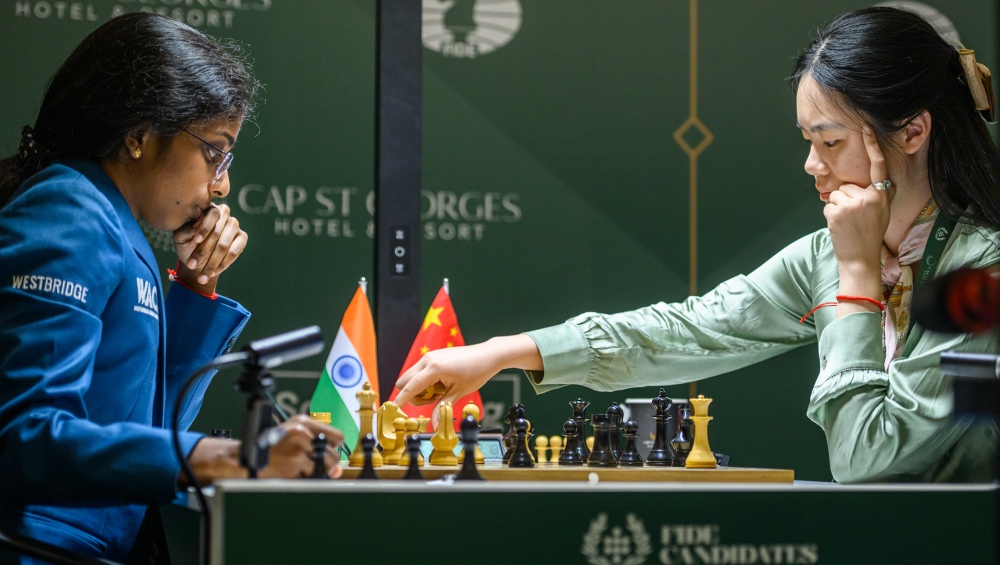
Javokhir Sindarov chose a cautious approach, drawing his game against Hikaru Nakamura this afternoon. With two rounds remaining, he moves one step closer to winning the Candidates and earning the right to challenge Gukesh for the title. The rest of the games also ended in draws, although Anish Giri came very close to defeating Wei Yi. In the women’s section, Zhu Jiner made a strong statement by winning over Vaishali with the black pieces in an impressive game, moving into a tie for the lead. Bibisara Assaubayeva also secured a victory over Kateryna Lagno, narrowing the gap, while Anna Muzychuk missed a major opportunity against Aleksandra Goryachkina. With just two rounds to go, the tournament remains wide open. Let’s take a closer look at the action. The ceremonial first move was performed by Mr. Manish, High commissioner of India, who opened the game for Vaishali. Before the round began, all eyes were on the pairing between Javokhir Sindarov, leading the tournament with a two-point advantage, and Hikaru Nakamura. Would Sindarov push for a win? “Every draw gets him miles nearer to the end goal,” noted commentator Peter Svidler during the live broadcast. The eight-time national champion, drawing on his vast elite experience, correctly anticipated that a cautious approach would prevail. After trading all the pieces and signing the scoresheets, while the rest of the field were still deep in their openings, Sindarov and Nakamura headed to the media centre to explain their swift and strategically sound draw. https://www.youtube.com/watch?v=0KeVjzNc6_c Sindarov was explicit about his strategy: “Yesterday’s game was very important, and today I needed a quick draw to rest and prepare well for tomorrow’s game against Anish Giri during the rest day. I was aiming for forcing draw lines; a fast draw is ideal for my situation. In fact, if I had the chance, I would have offered a draw immediately, but we have to play 40 moves.” Nakamura also adopted a pragmatic stance: “If the scores were closer, I would have gone for a King’s Indian Defence, but I didn’t see any reason to take risks. I’ve stabilized my performance, but it hasn’t been my best tournament and, realistically, I was never going to win it. I’m just looking forward to the end.” Still, Sindarov had a contingency plan: “If Hikaru had played something unusual, I was well prepared and ready to fight. But before the game, my coach advised me not to go for a long battle if he stuck to his usual lines. Against Anish, though, I’m ready for a long fight if he wants to push for a win: we’ll see.” The remaining three games also ended in draws, underlining the remarkably high level of play among all the contenders. In their encounter, Andrey Esipenko and Praggnanandhaa R entered a sharp and dynamic opening that both players had deeply analysed in their home preparation. Unsurprisingly, the game was handled with near-perfect precision and ultimately steered to a draw, with accuracy levels approaching 99%. Matthias Bluebaum, meanwhile, stuck to his preferred Carlsbad structure in his game against Fabiano Caruana, introducing a subtle twist with 6.Qc2. As commentator Jan Gustafsson described it, it was “a cunning little waiting move.” The game was another model of precision, reaching an accuracy of 97–98%, with virtually no mistakes from either side. However, Anish Giri missed a significant opportunity to close the gap with Javokhir Sindarov in his game against Wei Yi. Wei Yi remained faithful to his Candidates preparation with the 2.Nc3 and 3.Bc4 setup, but on this occasion, he was outprepared. Giri seized the initiative early, winning a pawn and transitioning into a favorable middlegame featuring a strong knight against a weak bishop, yet ultimately was unable to convert the advantage into a full point. The key moment of the game arose on move 32. With nearly 20 minutes remaining to make eight moves, Anish Giri spent 15 minutes searching for a winning continuation. The position is extremely tricky. Although Giri has extra material, his king is exposed and White’s passed c-pawn carries significant counterplay. The winning move was, perhaps unsurprisingly, 32…Qe3!. A queen exchange would have effectively decided the game in Black’s favour. If 33.Qd5+ followed, then 33…Kh8! and after 34.Bg7+ Kxg7 35.Qxg5+ Kf7 36.Qf5+ Ke7 37.Qxh7+ Kd6 38.Qd7+ Kc5!, Black escapes the checks with a decisive advantage. Instead, Giri chose a different continuation, namely 32…Qc5? which failed to 33.c7! Although Anish retained some chances later in the game, he was ultimately unable to convert. His final opportunity will come in the next round, where he faces a must-win situation with the white pieces against tournament leader Javokhir Sindarov. With three decisive outcomes and just one draw, the round in the FIDE Women’s Candidates proved even more exciting. Zhu Jiner scored an impressive victory with the black pieces against Vaishali Rameshbabu in a rich and complex game, joining the tournament lead with only two rounds remaining. Both players joined Zach for the press conference after the game. https://www.youtube.com/watch?v=yRW5ImwBTmM Meanwhile, Bibisara Assaubayeva also scored a crucial win over Kateryna Lagno, moving to within half a point of the leaders. Assaubayeva opted for a fashionable line in the Greco Gambit – generally considered equal for Black – but one she had analyzed deeply in preparation. The game quickly turned highly tactical, and at one stage it seemed as though Lagno might come out on top. However, the momentum eventually shifted, and the full point went to the Kazakh grandmaster. In her press conference, Assaubayeva expressed both relief and gratitude, particularly for her mother’s support: “I am happy that I won today. It’s my first win against Lagno in classical chess, although it wasn’t my best game. It was a difficult position to play because there were many weaknesses, and it wasn’t easy to understand what to do. I missed some tactics, but I had time to think and found some practical ideas to keep fighting. At some point it was at least a draw, and then I found a way to