Chess for Inclusion: A powerful educational transformation in Catalonia

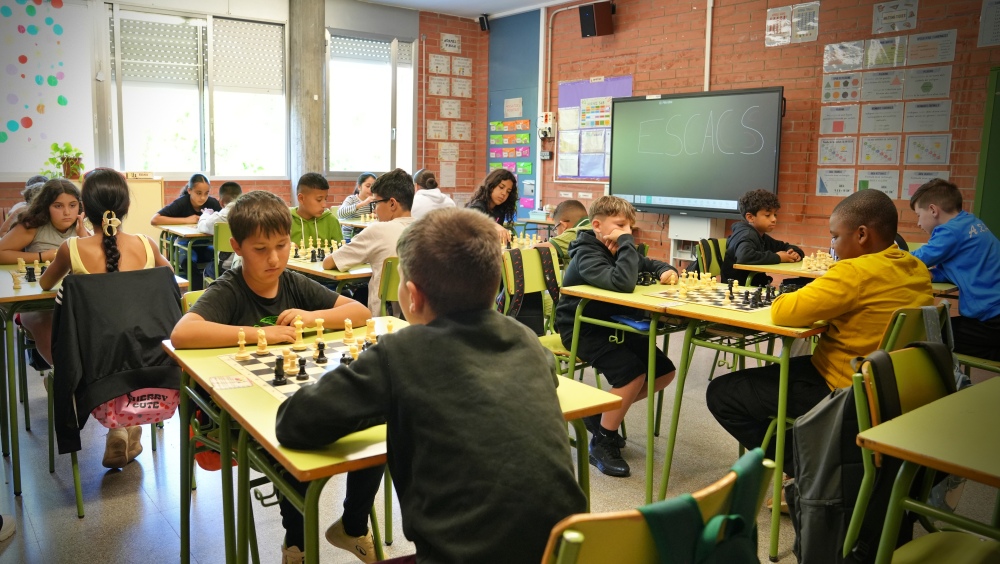
Barcelona, Spain – In Catalonia, chess is no longer just a game played after school. In public classrooms, it has become a powerful tool for learning, inclusion, and personal growth. Since the 2012 resolution by the European Parliament recognizing chess as a powerful educational tool, schools across the region have been building something truly innovative. With teacher training starting in 2014 and new methods developing since 2016, chess has become part of how children learn, not just what they learn. This transformation did not happen by chance. It is the result of years of dedication, training, and the hard work of many teachers, trainers, and chess advocates who strongly believe in the value of chess in education. At two public primary schools (children from 3 to 12 years old): Escola Jaume Balmes and Escola Ramon y Cajal, this vision is now a daily reality. Learning through chess at Escola Jaume Balmes At Escola Jaume Balmes, around 280 students aged 5 to 12 use chess as part of their everyday learning. Here, chess is not taught as a separate subject; it is used to teach other subjects. Teachers of all disciplines are trained to use chess as a learning tool in their classes. On the chessboard, certain squares include images such as cities or countries. When a student lands on one of these squares, they must answer a question. A correct answer allows them to continue and earn points. Subjects like mathematics, science, Spanish, and Catalan are all integrated into the game. Each subject has a color, turning learning into an interactive and engaging experience. In mathematics, for example, students use the movement of pieces, like the knight, to solve problems. The game itself becomes a way of thinking. A tool for inclusion In schools with many students from non-Spanish-speaking families, inclusion can be a challenge. Language barriers often make it hard for children to participate and connect. Chess changes that. Because it doesn’t rely on words, it gives every child a way to join in and feel part of the class. Zoya, a girl from Pakistan who arrived just three weeks ago, didn’t want to communicate with anyone except her sister. Through chess, she slowly began to connect with her classmates. Kimi from China spoke very little Spanish when he arrived in September. Chess helped him make friends, become more involved. Today he is a happy, fully engaged student. According to the teachers at school, chess creates a simple but powerful bridge: it helps every child feel included. A long tradition at Escola Ramon y Cajal In Terrassa, Escola Ramon y Cajal has been developing chess in education for many years. With over 400 students, starting from the age of three to twelve, the school has built a strong and lasting chess culture. A key figure behind this work is Toni Arboles, a primary school teacher and chess expert who has played an important role in shaping the program. His experience and dedication have helped bring structure, resources, and a long-term vision to chess at the school. He actively involves other teachers, encouraging them to be present during chess lessons so they can learn how to use chess as a teaching tool themselves. In classes where chess is integrated into learning, there are always two teachers: the subject teacher and Toni, working together to guide the students and support each other. Learning by moving and playing For younger children, chess is integrated with physical activity. Using a giant chessboard in the gym, even children as young as three years old: Move between black and white squares Learn colors and spatial awareness Name squares and understand positions Set up the board and identify missing pieces They learn by moving, exploring, and playing. Chess competition The school has a long tradition of chess tournaments, running for more than 20 years. In recent years, they have become extremely popular among pupils. Participation is optional, yet many children choose to play during their breakfast break at 11a.m. They sit with their snacks and play chess in a relaxed, social atmosphere; it’s not a tense competition, but a shared moment. Students from different grades are paired together, for example, grades 2 and 3, or 4 and 5. Older pupils take on important roles: sixth graders act as referees and help explain the rules when needed. It is especially encouraging to see that at least 40% of the pupils taking part are girls, showing strong and growing female participation in the school’s chess activities. This is a great example of a school community, where everyone is involved and learning from each other. Rita Atkins, Secretary of the FIDE Chess in Education Commission and Lead Developer of FIDE’s training programs, visited schools in Catalonia, where she met with teachers and education officials. During her visit, she also delivered seminars and workshops for local teachers, sharing knowledge, ideas, and practical approaches to using chess in education. A key role in the visit was played by Marta Amigó Vilalta, who guided the FIDE team through the schools and introduced them to the Catalan approach to chess in education. The program itself is coordinated by two key figures: Eva Zamarreño from the Catalan Chess Federation, and Marta Amigó Vilalta from the Department of Education of Catalonia – the two institutions leading and promoting the initiative. What is happening in Catalonia shows that chess in schools truly works. In schools like Escola Jaume Balmes and Escola Ramon y Cajal, chess is helping children learn subjects, connect with others, and feel included, no matter their background, age, social status, or gender. This success comes from strong commitment and the hard work of dedicated teachers and leaders like Toni Arboles. His message to other schools is clear: even if introducing chess feels challenging at first, it’s worth taking the step. It requires effort and commitment, but the impact on students makes it truly worthwhile. Photos: KNZO Photography