FIDE Council issues reminder on pre-election conduct

The FIDE Council has issued a formal reminder regarding electoral regulations ahead of the 2026 General Assembly, which will take place at the end of September. FIDE reminds all federations, officials, and potential candidates that the FIDE elections are set for 26 and 27 September 2026. According to FIDE rules, the official electoral period starts three months before the elections, which in this case would be 26 June 2026. Candidates are reminded that they should not campaign or promote their candidacy before the official start of the electoral period. The Council notes that, according to the Electoral Rules, election campaigning is only allowed during the electoral period: Electoral Rules Art. 7 Electoral campaign: 7.1 Electoral campaigning and promotion of candidatures are allowed only to the extent permitted under the Electoral Rules and during the electoral period. The electoral period starts three (3) months before elections. Promotion means any act or action that may enhance the level of awareness of a particular candidature. It includes advertising, campaigns or any organised or planned action for the election of a candidate. Electoral campaigning shall be understood as any activity undertaken by candidates or those acting or working for them with the aim of canvassing votes. The Council also highlighted rules regarding undue advantage, such as providing money, services, gifts, jobs, debt forgiveness, tickets, hospitality, or similar. Article 9 clearly outlines sanctioned behaviours: 9.1 Offering, either directly or through an accomplice, any undue advantage to a Member Federation, which is any ascertainable enhancement in the beneficiary’s situation, legal or economical, is a prohibited practice. An undue advantage shall mean anything of more than nominal value in any form, including in particular but not limited to a payment, a benefit in kind, money, property, a service, a loan, forbearance or forgiveness of indebtedness, promise of future, employment or promotion, a favour, gratuity, honoraria, tickets or passes to an entertainment, social or sporting event, without consideration of equal or greater value in return. Advantages are not undue if they are of minor value in conformity with social customs. Thus, the following are excluded from the definition of undue advantage: complimentary attendance, including food and beverage, at charitable or campaign events, complimentary attendance, food and beverage offered by the sponsor of a widely attended event, awards, plaques, and other ceremonial items customarily presented in recognition of service in chess or within FIDE, promotional items having no substantial resale value, gifts from a family or household member, food and/or beverage of limited value, chess materials distributed freely to all Member Federations and to the members of their delegations. Article 9.9 notes that Candidates should refrain from campaigning before the official electoral period starts, in full respect of the Electoral Rules. Certain customary items of nominal value, such as limited hospitality or low-value promotional materials, may be permissible under the Electoral Rules. FIDE Electoral Rules and the FIDE Ethics and Disciplinary Code provide for substantial penalties for violations of the aforementioned rules. FIDE will monitor compliance with these regulations under the Ethics and Disciplinary Code. Violations may result in immediate proceedings before the FIDE Ethics and Electoral Commissions. The Council noted that these rules are in place to ensure a fair and transparent election process for all member federations.
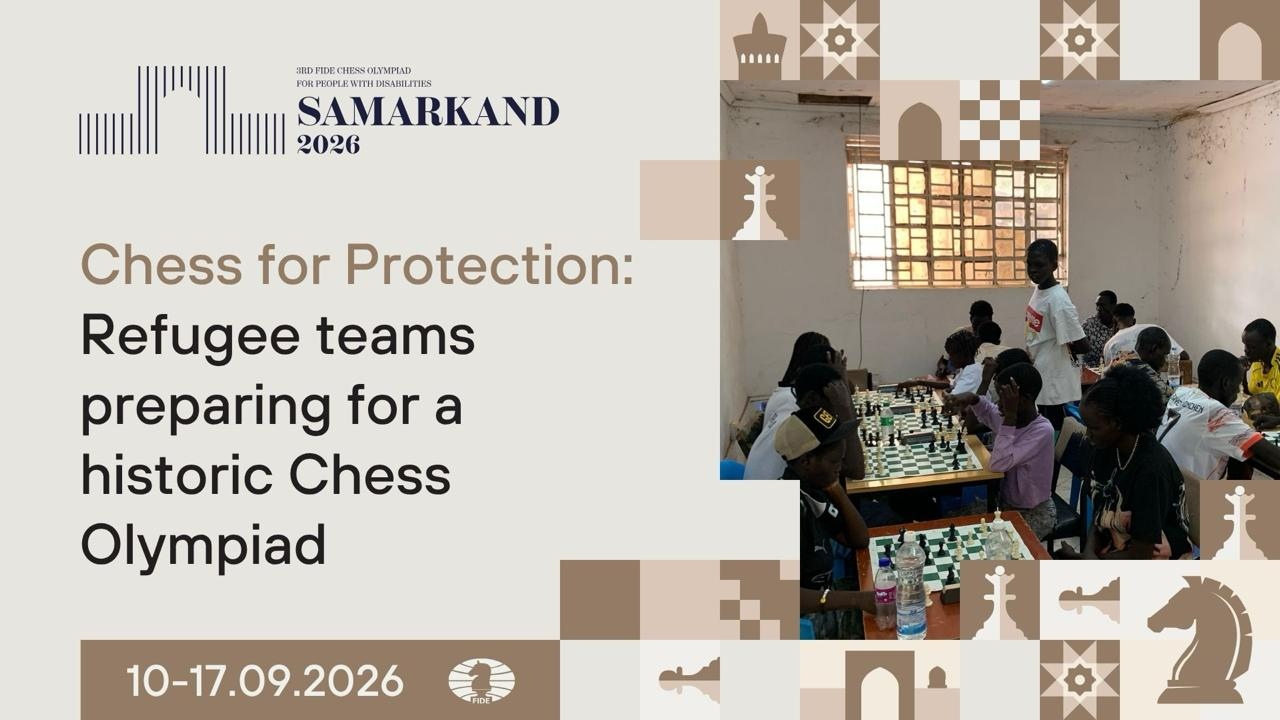
Chess for Protection: Refugee teams preparing for a historic Chess Olympiad

As the global chess community looks ahead to the 46th Chess Olympiad, set to take place in Samarkand, Uzbekistan, in September 2026, a powerful and historic initiative is gaining momentum. For the first time, refugee players are set to compete as organized teams at the Olympiad – marking a significant step not only for chess, but for international sport. At the heart of this effort is the Chess for Protection project, a joint initiative led by FIDE – through its Social Commission – in cooperation with UNHCR, the UN Refugee Agency. Launched in August 2021 and headed by Anastasia Sorokina, Chair of the FIDE Commission for Women’s Chess, the project supports displaced communities through chess by creating safe, structured spaces where children and adults can learn, connect, and develop valuable skills through chess. Reflecting on the broader meaning of the initiative, Dana Reizniece, Project Supervisor and Deputy Chair of the FIDE Management Board, noted: “This is not a Cinderella story waiting for a prince. It is a story of kids showing discipline and motivation and chess opening doors. For some of them – to the World Chess Olympiad, for all of them – to a better life.” Within this broader framework, the Girls Club represents the initiative led by the FIDE Commission for Women’s Chess, focusing specifically on empowering girls. Through regular training and targeted activities, it promotes confidence, inclusion, and long-term personal development – values that extend far beyond the chessboard. Photo: Stev Bonhage From community to competition: Building the teams Today, thousands of players are actively involved in the Chess for Protection programme, working consistently with coaches across different locations. From this growing community, two teams – men’s and women’s – have been carefully selected and are now preparing for the Olympiad. A defining strength of the programme is its coaching team. The Girls Club participants benefit from weekly training sessions led by highly experienced, world-class women coaches – International Master Salome Melia and Woman Grandmaster Anastasiya Karlovich. Their involvement provides not only top-level chess instruction, but also strong role models for the young players. At the same time, on-site training plays a crucial role. Latvian coach Sergey Klimakovs has travelled multiple times to Kakuma Refugee Camp in Kenya to work directly with the players, most recently in April. A training camp for 10 players – Olympiad team candidates – was held in Kakuma from April 4 to 15. During the camp, players worked on key aspects of practical play, including general positional principles, positional pawn sacrifices to seize the initiative, and transitions from defense to counterattack. Special attention was also given to learning how to use ChessBase and databases – important tools that will help them prepare for specific opponents during the Olympiad. Over the course of the camp, players demonstrated clear progress compared to previous training sessions, along with a strong motivation to continue improving. The experience not only strengthened their chess understanding, but also reinforced their readiness to compete as a team. Strengthening partnerships: Meeting with UNHCR A productive meeting took place on April 13 in Almaty between UNHCR, represented by Mahir Safarli (UNHCR Representative for Central Asia), and FIDE, represented by Gulmira Dauletova, Executive Director of the Kazakhstan Chess Federation and member of FIDE Commission for Women’s Chess, and Nadzeya Krauchuk, Director of International Relations of the International School Chess Federation and FIDE Social Projects Coordinator, together with the Kazakhstan Chess Federation. The meeting focused specifically on support for the refugee teams. Discussions centered on players from Kakuma Refugee Camp in Kenya, who, through the Chess for Protection programme, have demonstrated resilience and talent. Through chess, they have strengthened critical thinking, fostered inclusion, and built meaningful connections within their community. Efforts are currently underway to facilitate the participation of both the men’s and women’s refugee teams in the upcoming Olympiad in Samarkand. This collaboration reflects a shared commitment to supporting these players – not only in their chess development, but also in their journey toward international representation. Targeted support for Olympiad preparation As preparations intensify, targeted support has become essential in enabling the teams to train effectively. A key role in this effort has been played by long-standing partners, in particular The Gift of Chess and DGT (Digital Solutions), whose continued support has been instrumental for the development of the Chess for Protection programme. Equally important has been the provision of chess sets to the participating communities. These were made possible through the generous support of The Gift of Chess, in collaboration with Kijiji Solutions. What makes this contribution especially meaningful is the story behind it. The sets were produced by Kijiji Solutions, a Kenyan nonprofit that tackles plastic waste by recycling it into high-quality chess sets. Beyond their practical value for training, these sets carry a deeper message of sustainability, local impact, and community-driven change. Further strengthening the preparation process, a donation of a computer has significantly enhanced training possibilities. Thanks to the University of Magdeburg in Germany, which provided a powerful laptop for the project, players in Kakuma now have access to professional-level tools. As coach Sergey Klimakovs noted: “Thanks to the University of Magdeburg in Germany, which donated a powerful laptop with ChessBase installed for the project, the Kakuma players now have the opportunity to work on chess like professionals.” Donation of the laptop and a ChessBase program accepted by coach Klimakovs Together, these contributions ensure that players can train consistently and in structured conditions, supporting both their daily practice and long-term development as they prepare for the Olympiad. A historic opportunity At the heart of the project, and of the refugee teams’ journey toward the Olympiad, lies a deeply human mission. Reflecting on its impact, Anastasia Sorokina, who leads the initiative, shared: “Our project began in 2021 in partnership with UNHCR. Over the past five years, it has grown into one of the most meaningful social FIDE initiatives within the global chess community. For me, this project is first and foremost about people – those who have lost their