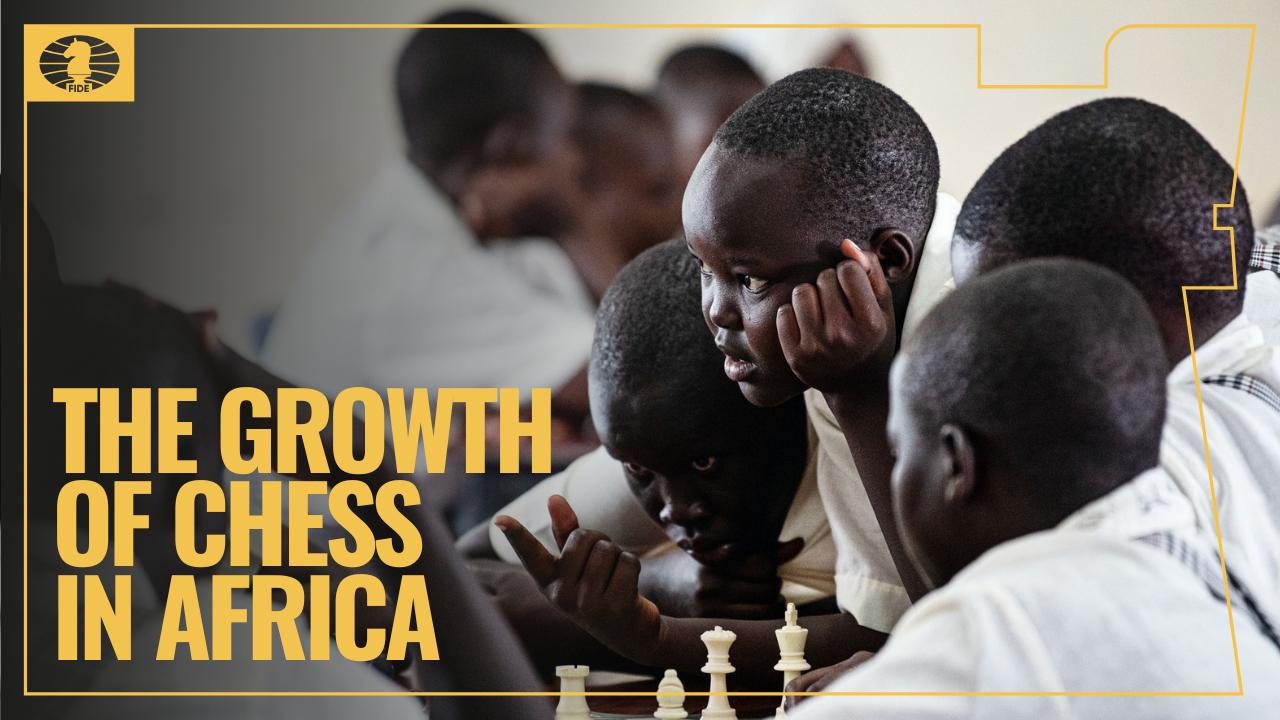
The growth of chess in Africa

Since 1963, 25 May has been celebrated as Africa Day. It marks the founding of the Organisation of African Unity, when heads of state from 32 independent African states met in Addis Ababa, Ethiopia, to sign the OAU Charter. For chess, it is also a chance to look at a continent where the game is growing fast. Chess in Africa has expanded considerably since the 1960s. Out of 54 countries, 51 are members of FIDE. It is no longer about a few strong federations, but about systematic projects in schools, youth events, national and international tournaments, as well as projects for prisons, refugee camps, and women’s chess. The shift towards a greater emphasis on chess in Africa was noted by FIDE’s decision in April 2026, to approve a rotation principle for the Chess Olympiad, giving Africa priority for hosting the 2032 event. “With its cultural diversity and heritage, as well as having a growing young population, Africa has the greatest potential for chess growth in the world, and this is what we are trying to nurture,” FIDE President Arkady Dvorkovich said. “Over the years, FIDE has worked closely with African federations and international organisations on promoting chess at club and national levels, but also as a tool for social development and inclusion. Our vision is to help Africa host the Chess Olympiad in 2032 and use this as a catalyst for chess development in the continent,” Dvorkovich added. The growing chess landscape Since 1960, Africa has hosted two Interzonals (Sousse in 1967 and Tunis in 1985) as well as the FIDE World Chess Championship 2004, where Rustam Kasimdzhanov won the title. In 2011 the Commonwealth Chess Championship was held in Africa for the first time. In recent years the number of international events has grown, showing a clear shift. In 2023, the FIDE World Cadet Championships U8, U10 and U12 were held in Sharm El Sheikh, Egypt. The event had six sections, Open and Girls in U8, U10 and U12. The 13th African Games A major milestone was crossed at the 13th African Games, which took place in Accra, Ghana, from 8 to 23 March 2024, where chess was included among 23 sports. The chess programme began with a Mixed Team Rapid event, which attracted teams from 18 countries. That year Morocco hosted the Casablanca Chess event, as part of Morocco Chess Week. It brought together Magnus Carlsen, Hikaru Nakamura, Viswanathan Anand and Bassem Amin in an event where play was based on positions from historic games. In 2025, Freestyle Chess Grand Slam Finals were held at Grootbos, South Africa, with many of the world’s elite players taking part. Levon Aronian won the South Africa final, defeating Magnus Carlsen 1.5 to 0.5, while Carlsen secured the overall 2025 Freestyle Chess Grand Slam Tour title. This year at least two significant international events will take place in Africa. The African Continental Stage of the FIDE ISCF World Schools Team Championship 2026 will be held in the Cape Town area, from 6 to 11 July 2026. Also, in August, Nigeria is set to host the FIDE World Amateur Rapid and Blitz Championships. Popularising chess in African societies Africa is becoming an important centre for social chess initiatives. Federations from the continent are the top beneficiaries of FIDE’s Development programs and are actively engaged with FIDE on projects to promote the sport across society. Since 2021, FIDE has been running the Chess for Protection programme at the Kakuma and Kalobeyei refugee camps in Kenya. Conducted in partnership with the UNHCR, the project gives children regular access to chess lessons, chess clubs, training materials, tournaments and mentors, in an effort to improve psychosocial wellbeing, support social integration, empower girls and connect talented players with the wider chess world. Kakuma Girls Chess Club In June 2025, more than 330 girls took part in an in-person training camp at the Kakuma Girls Chess Club. The same year Malawi hosted the Chess for Freedom Continental Championship and Workshop for Africa in Lilongwe, the first in-person project conference for the continent. Many correctional facilities in Africa also took part in the FIDE competitions for prisoners. In 2025 Zimbabwe won the African Continental Championship for Prisoners in both the Open and Women’s sections, building on the 2021 success where they finished second. African players on the global scene The continent is fielding a growing number of players in international events, including among the elite. Bassem Amin of Egypt (pictured above) became the first African player to cross the 2700 ELO barrier. His peak rating was 2712 in January 2019 and he remains one of the symbols of African elite chess. In 2007 another Egyptian player, Ahmed Adly, won the World Junior Chess Championship in Armenia. In 2025, Tunde Onakoya from Nigeria, together with Shawn Martinez from the U.S., set the official Guinness World Record for the longest chess marathon. They played for 64 hours in Times Square, New York, from 17 to 20 April 2025. Tunde Onakoya sets an official Guinness World Record for the longest chess marathon A promising road ahead Chess in Africa is moving in the right direction. More federations are active, there are more social initiatives, and there is greater interest in supporting the game. With more events coming and with Africa given priority for the 2032 Olympiad, there is now a real chance to build a stronger chess infrastructure. But the work ahead is not small. Many players face high barriers – from limited access to chess boards and equipment to coaching, availability of rated events, and high travel costs. Some federations need more support with organisation, funding, and long-term planning. Girls and young players need clear paths from school chess to serious competition. FIDE recognises this and plans to increase support. If the growing chess momentum in the continent is matched by investment and support, Africa can become the biggest growth region in world chess. Written by Milan Dinic Photos: Stev Bonhage, James Keivom, Michal Walusza, and Niki Riga