World Refugee Day: How chess is changing lives

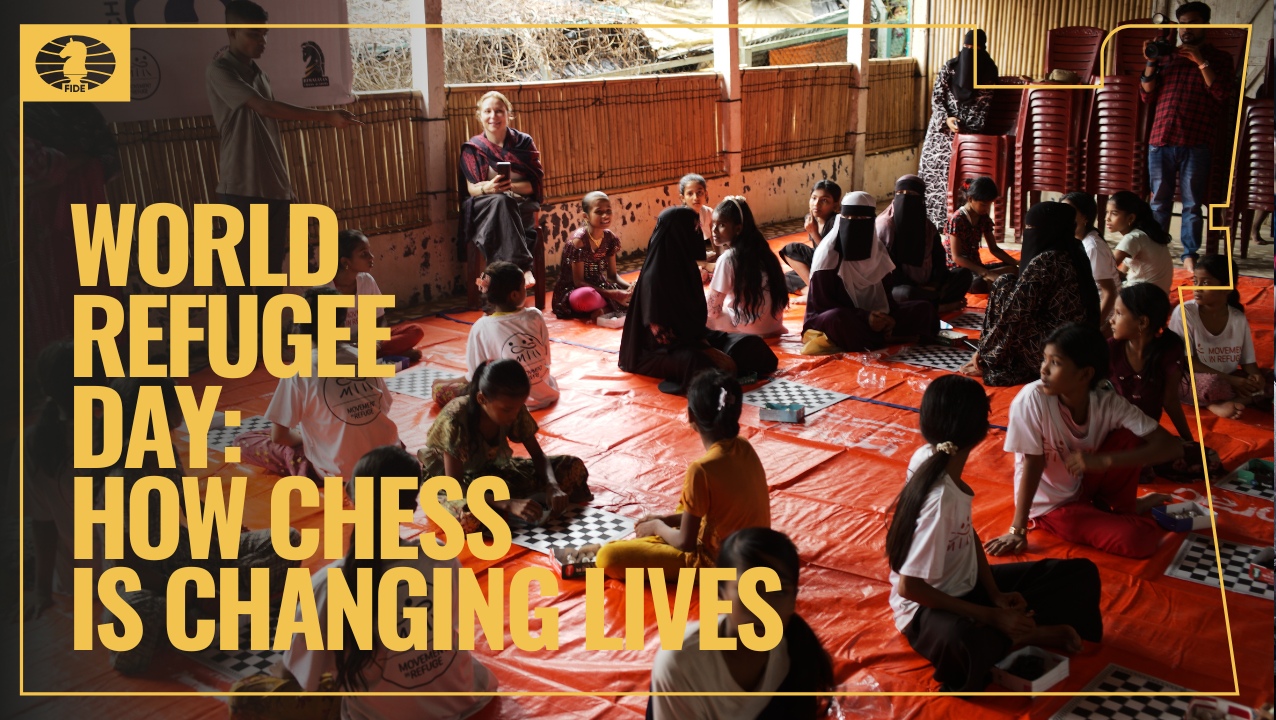
World Refugee Day, initiated by the United Nations in 2001 to recognize the resilience and struggle of refugees in finding sanctuary and a better life, occurs in 2026 at a time when conflicts across the globe continue to intensify, bringing more threats and disasters to people worldwide. FIDE and the entire global chess community have always sought to highlight the role chess can play in bringing people together, regardless of their backgrounds. This mission is perfectly encapsulated by FIDE’s simple yet powerful motto: Gens una Sumus – “We are one family.” As we mark World Refugee Day, FIDE reaffirms its ongoing commitment to supporting displaced communities. The Chess for Protection Project Launched in August 2021 by FIDE in partnership with the UN Refugee Agency (UNHCR), the Lutheran World Federation (LWF), Chess Kenya, and the Kakuma Chess Club, the Chess for Protection project aims to promote chess as a vital sport and highlight the opportunities it offers. The program provides training to enhance players’ chess knowledge and life skills, empowering them to pass these lessons on to others. The initiative is also building strong networks with the broader chess community in Kenya and globally to further develop the game within the camp and settlement, while creating external opportunities for the players’ professional growth. Ultimately, the program contributes to the protection and well-being of refugee youth and adolescents, establishing chess as a key activity for their engagement and development. Recognizing that many young women and girls find it difficult to engage meaningfully in education and extracurricular activities due to negative cultural norms, the project features a dedicated Girls Club. This initiative offers various activities, such as meeting and communicating with successful women, reading and discussing books, painting workshops, and many others. As of the end of 2025, more than 2,500 children had been trained in chess in Kakuma Camp and the Kalobeyei Settlement. Twenty-five facilitators continue training children in various schools and youth centers, and tournaments are held. Thanks to a dedicated team of international coaches, the project and the Girls Club continue to grow. WGM Anastasiya Karlovich and IM/WGM Salome Melia lead regular online workshops and training sessions for the girls in Kakuma boarding schools, while FM Sergey Klimakovs has conducted two in-person coaching sessions in Kakuma. He is planning one more in August–September to prepare the refugee team for the Olympiad. A historic debut in Samarkand In accordance with an agreement between FIDE and UNHCR, FIDE will field Refugee Olympic Teams for the first time at the 46th FIDE Chess Olympiad in Samarkand, Uzbekistan, taking place from 15 to 28 September 2026. The Olympiad team selection, organized in February 2025, was made competitive and focused on the four main segments covered by the Chess for Protection project in Kakuma Refugee Camp: community chess played at different youth centers, chess in 26 primary schools, chess in 9 secondary schools, and the Girls Club project (across 3 schools). Following the team selection, five men and five women qualified for participation in the 46th FIDE Chess Olympiad in Samarkand. FIDE is going to cover all travel, visa, accommodation, and logistical costs for the team and the project leader. UNHCR plans to have an officer from the Protection Unit to accompany the delegation. To celebrate World Refugee Day 2026, FIDE, in cooperation with Chess Kenya and UNHCR, will organize chess tournaments on 20–21 June for the Girls Club and the entire Kakuma Refugee Camp and Kalobeyei Settlement chess community. Expansion to Bangladesh From June 11-16, the FIDE Chess for Protection team visited Bangladesh to start the new stage of the project in the Cox’s Bazar refugee camp, in cooperation with the NGO Movement in Refuge. The visit was intense and deeply impactful. Two days, two IOM/UN land cruisers, roughly 300 students – and what felt, unambiguously, like the most significant moment in MiR’s story to date. The FIDE delegation – Dana Reizniece, Deputy Chair of the FIDE Management Board; Anastasia Sorokina, FIDE WOM Chairperson, ACF Social Commission Chairperson and the Leader of FIDE Social projects; and Monalisha Khamboo, Founder of Himalayan Chess Academy and Secretary and a member of the Nepal Chess Federation – brought a rare combination of institutional authority, personal conviction, and field energy. The pace was relentless: camps, shelters, schools, meetings, and a lunch on the floor of Sadeka’s house. The caliber of the delegation opened doors that would have taken MiR years to open alone – from the Minister of Youth and Sports in Dhaka to the RRRC and the CICs in the field. Every institution expressed strong enthusiasm for the launch of the Chess for Protection initiative in Bangladesh. The program included training camps, visits to Sonarpara High School and Cox’s Bazar Chess Academy, as well as high-level meetings with Mohammad Mizanur Rahman, Refugee Relief and Repatriation Commissioner (RRRC), Government of Bangladesh; Aminul Hoque, Minister for Youth and Sports, Government of Bangladesh; Juliette Murekeyisoni, Deputy Representative, UNHCR Bangladesh; Peter Kern, Head of Office, Cox’s Bazar; and Mohammed Sala Uddin, IOM Protection Officer. The Gift of Chess project, an active participant of the initiative, plans to provide 100 chess sets to the Cox Bazar refugee community.  “Chess teaches you to take responsibility. To handle losses with resilience. To know you are not the only one in the room – to think of others’ plans and aspirations. In chess you learn to manage your pieces, your decisions. And this gives you the strength to not be manipulated by others – to manage the pieces and moves of your life,” Dana Reizniece shared. Anastasia Sorokina added: “The whole world is on the chessboard. You have to act calm. Take decisions. It helps girls to empower themselves. If you touch a piece, you have to move it – subtle things that help girls lead their future careers.” Photos: Stev Bonhage, Denis Burko and Rawful Alam

2026 African Individual Chess Championships kick off in Botswana

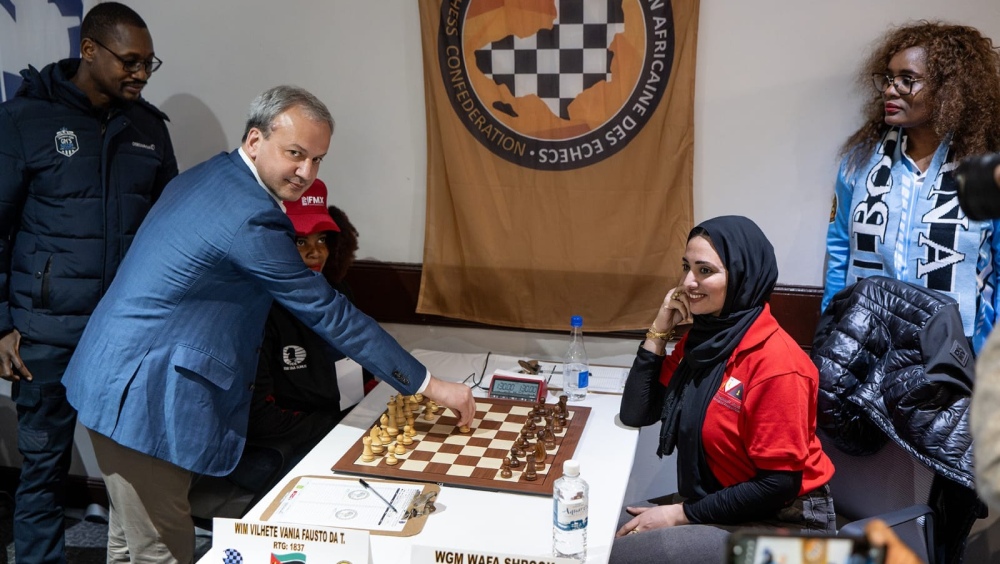
More than 100 players are taking part in the Open and Women’s sections in a nine-round Swiss tournament. The event was opened by FIDE President Arkady Dvorkovich together with leaders of several African chess federations. The most important African championship is taking place at the Cresta Hotel in Jwaneng, Botswana. The time control is 90 minutes for 40 moves, followed by 30 minutes until the end of the game, with a 30-second increment from move one. Egypt’s star player Bassem Amin headlines the field in the Open section, while the Women’s event includes a strong group of under-18 players from across the continent. With direct qualification to the FIDE World Cup at stake, Presiden of the African Chess Confederation (ACC), Tshepiso Lopang urged the players to make the most of the opportunity. “Bring it all. Play safe. Defend. Attack! I’m really excited to see you all here and for making this event a reality,” Lopang said. FIDE President Arkady Dvorkovich attended the opening ceremony, which also marked the 50th anniversary of the founding of the African Chess Confederation at the Chess Olympiad in Tripoli in 1976. From its initial 11 founding nations, the ACC has grown to 48 member federations. Dvorkovich congratulated the ACC on the milestone and praised the work of Lopang and Botswana Chess Federation President Kutlwano Tatolo in organising the championship. “This signals that Botswana wants to be one of the leaders of chess development in Africa,” Dvorkovich said. Turning to the players, Dvorkovich reminded them that they are role models for many children who will follow their games. He noted that FIDE has dedicated 2026 to promoting chess in education, which remains one of the organisation’s key priorities. Dvorkovich added that players and organisers in Africa have an important place in this endeavour. “You are going to play the key role, together with us. I hope we will do this together and make it a success,” Dvorkovich said. “Since my first year as FIDE President, we have focused on developing chess in this region, which has huge potential. We have done some good things, and much more will follow. We are relying on all of you to help us promote this cause further.” The FIDE President and officials from national federations then made the first ceremonial moves in the Women’s event, marking the official start of the 2026 African Individual Chess Championships. Written by Milan Dinic