

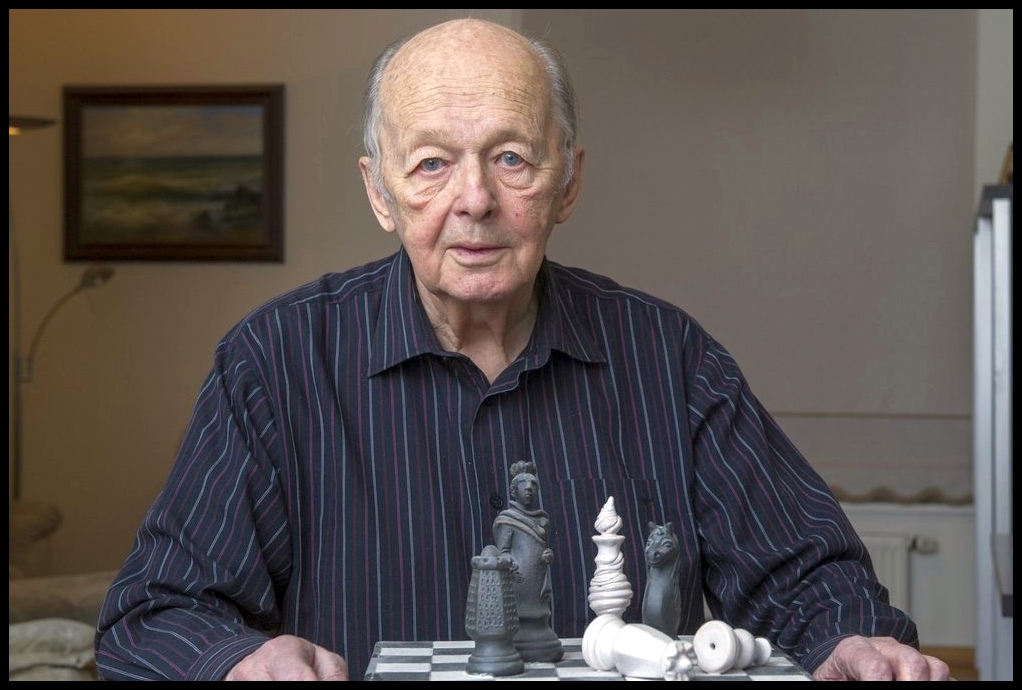
The chess world mourns the passing of Estonian Honorary Grandmaster Iivo Nei, who passed away at the age of 94.
Born on 31 October 1931 in Tartu, Estonia, Nei enjoyed an illustrious chess career spanning over eight decades. Showing early promise, he recorded his first notable result in 1948, tying for first place at the Soviet Union Junior Championship.
An eight-time Estonian Champion (1951, 1952, 1956, 1960–1962, 1971, and 1974), Nei won the Baltic Republics Championships in 1961 (Palanga), 1962 (Tartu), 1963 (Estonia), and 1964 (Pärnu). He also competed in the prestigious Soviet Championships on four occasions.
At the peak of his career, Nei achieved the International Master title in 1964. That same year, he tied for first with Paul Keres at the Hoogovens tournament in Beverwijk (later known as Corus, and now Tata Steel), finishing ahead of Lajos Portisch, Borislav Ivkov, Bent Larsen, and Bruno Parma. He later secured solid results in Beverwijk 1966 (5th), Zinnowitz 1966 (4th–6th), and Tallinn 1969 (2nd–3rd).
In recognition of his consistently strong results from the 1950s through the 1970s, the FIDE Council awarded Nei the title of Honorary Grandmaster in February 2024.
Nei’s legacy extends far beyond his own playing achievements. He served as a highly productive trainer for Women’s World Champions Nona Gaprindashvili and Maia Chiburdanidze, and most notably, he was one of Boris Spassky’s seconds in the legendary 1972 World Championship match against Bobby Fischer in Reykjavik. He co-authored the seminal book Both Sides of the Chessboard with American Grandmaster Robert Byrne, offering an unparalleled, intimate perspective on the drama and tension of the 1972 match.
For over 25 years, Nei was one of the leading chess coaches in Estonia, mentoring generations of strong players. He also served for many years as the FIDE Representative for Zone 1.7 (Estonia, Latvia, and Lithuania).
Through his writing, commentary, and role as a trainer, Iivo Nei acted as a vital bridge between the Soviet chess school and the rest of the world. Even during the height of the Cold War, his collaborations with Western players and journalists helped foster mutual respect across the Iron Curtain.
FIDE, alongside the global chess community, extends its deepest condolences to Iivo Nei’s family, his friends, and the Estonian Chess Federation.
Photo: Vallo Kruuser | Delfi Meedia