
The opening round produced dominant victories for the favourites, colourful scenes around the venue and an unexpected defeat for India’s Arjun Erigaisi.
The 46th Chess Olympiad got underway this afternoon in Samarkand, Uzbekistan, with 207 teams registered in the Open section and 191 in the Women’s section. As is often the case in a Swiss-system event, most of the higher-rated teams started their campaigns with victories, although the opening round also produced a few surprises.
Let’s take a closer look at the action from the playing hall.
Following a brief introduction by the tournament’s Chief Arbiter, Ivan Syrovy, the action began punctually at 3 p.m. local time with two ceremonial first moves.
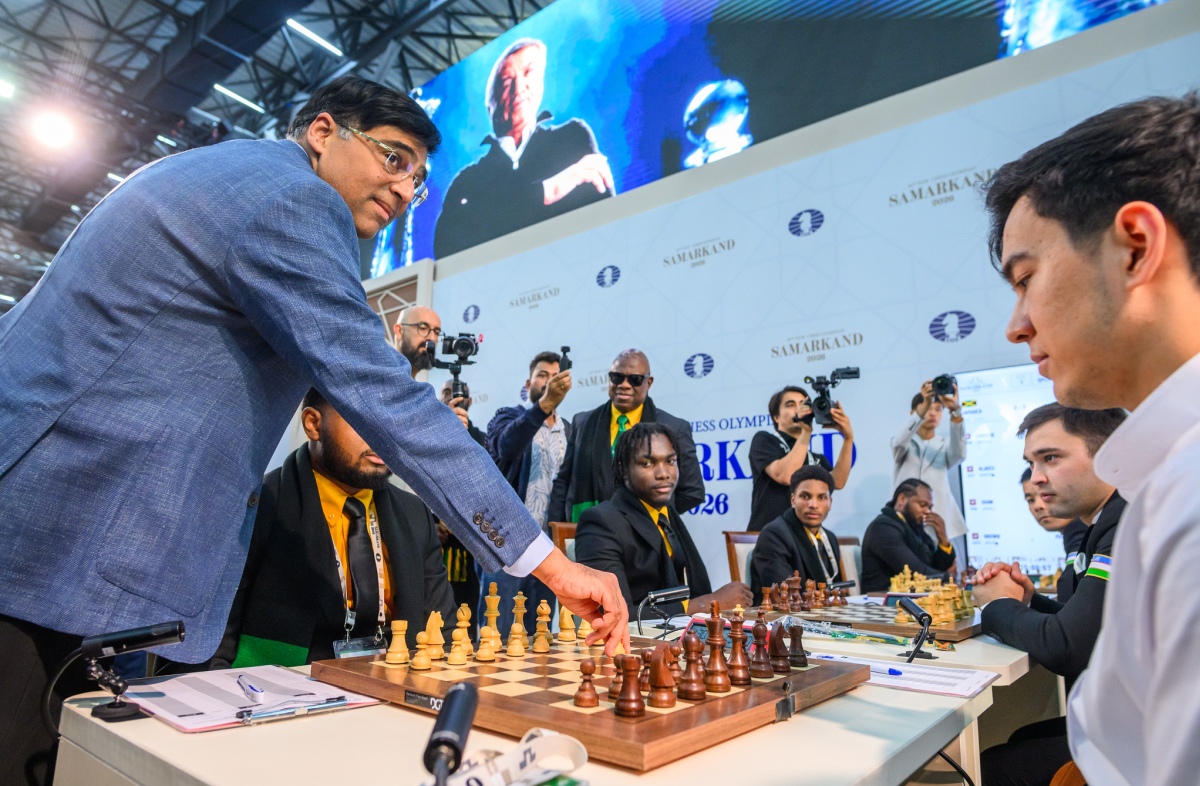
First, Viswanathan Anand, five-time World Champion and FIDE Interim President, opened with 1.c4 on board one for Jamaica’s Joshua Christie, who faced Uzbekistan’s top player, Nodirbek Abdusattorov.
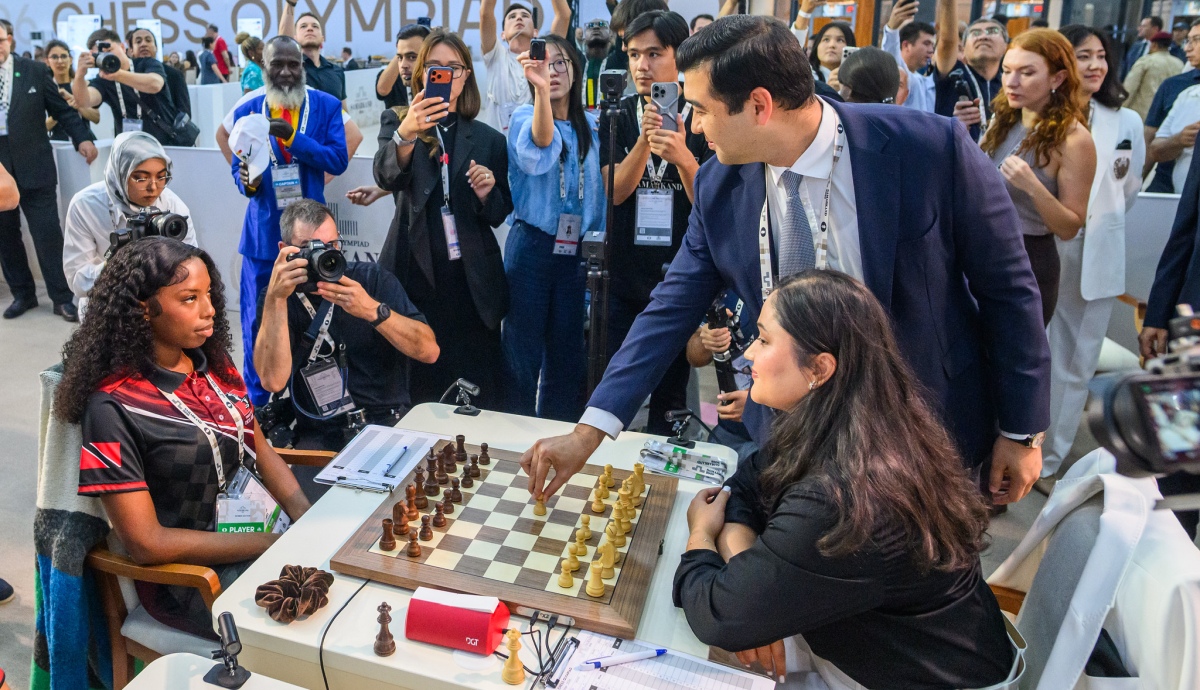
Immediately afterwards, officials and media moved a few meters to board one in the Women’s section, where hosts Uzbekistan faced Trinidad & Tobago. On this occasion, Alisher Sadullaev, First Vice President of the Uzbekistan Chess Federation, played 1.e4 as his ceremonial first move for Uzbekistan’s Gulrukhbegim Tokhirjonova, who faced Shemilah James.
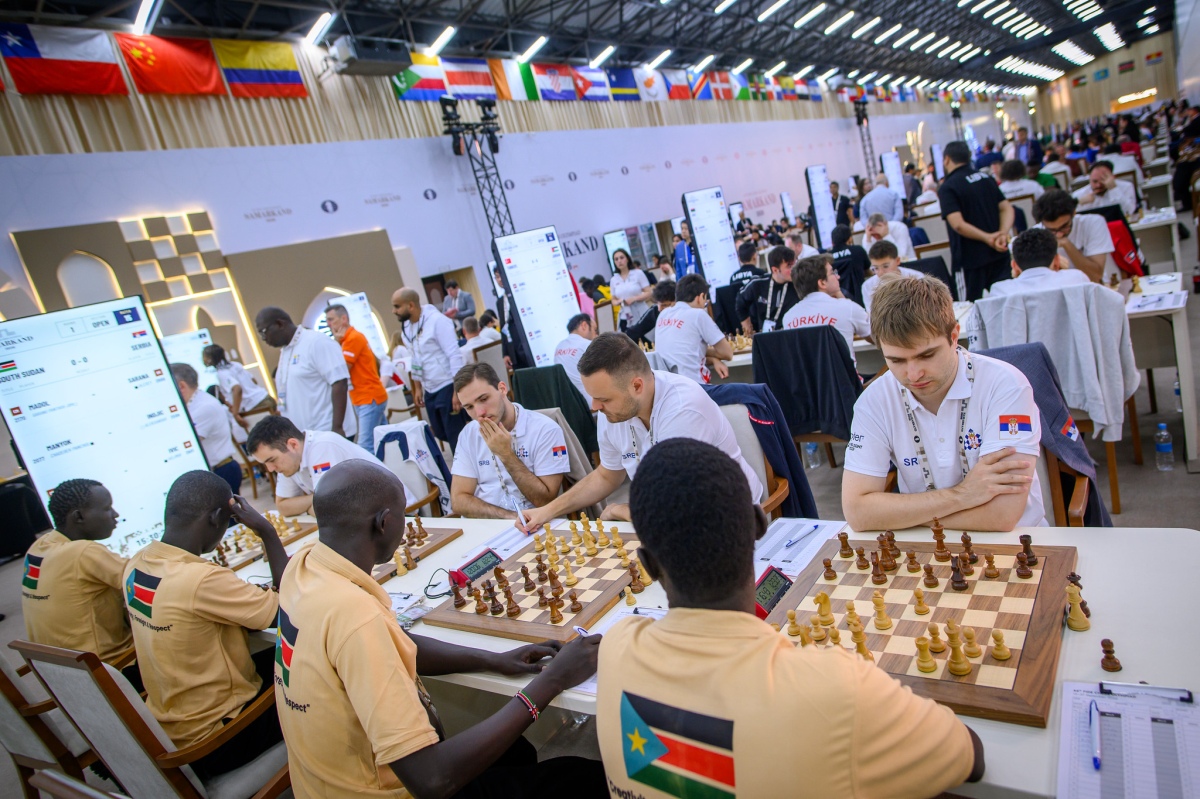
With the round officially underway, the players shook hands, and the games began. With almost 200 four-board matches taking place simultaneously, there was certainly no shortage of action to follow.
A walk through the playing hall allowed me to exchange a brief head nod with World Champion Gukesh (!), reacquaint myself with many players, coaches, and arbiters and, perhaps most importantly, admire the colourful outfits being sported by teams from around the world.
It is customary for teams to wear a T-shirt, polo shirt, or tracksuit top featuring the name and colours of their country, but some have taken things a step further, with players’ names printed on the back.
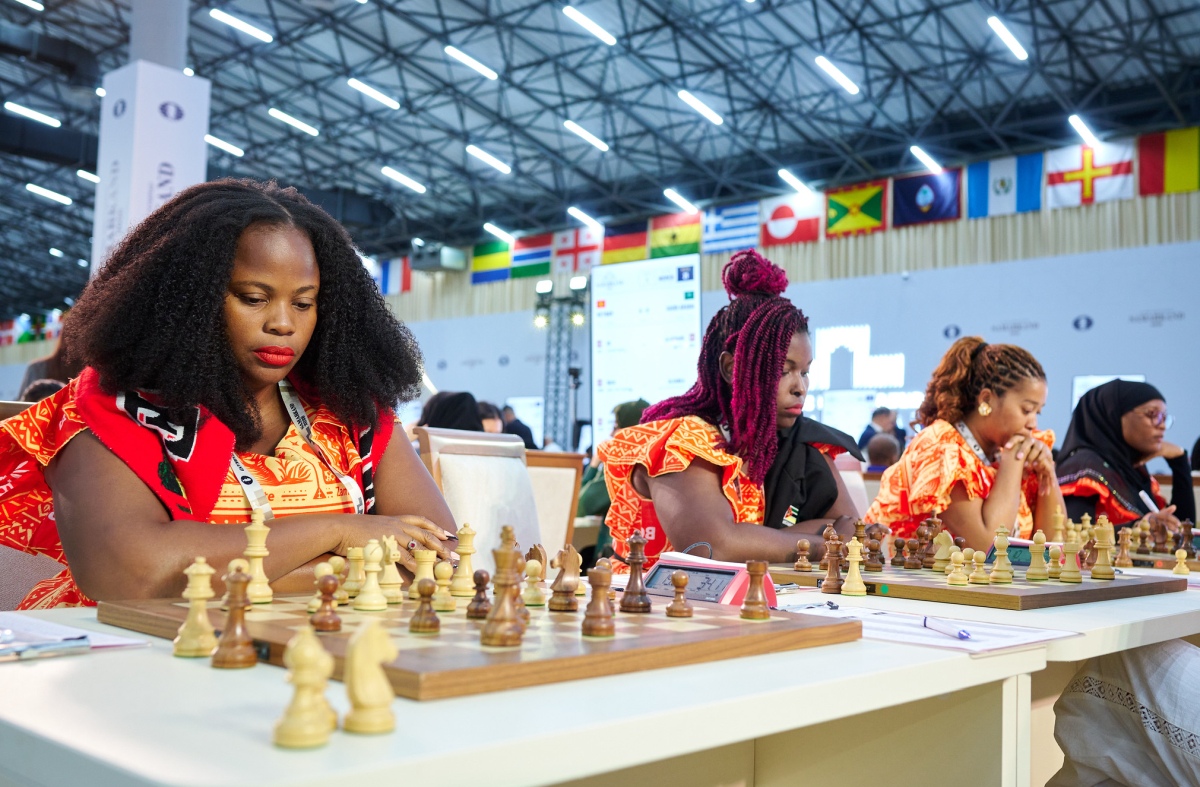
The Women’s section offered an even greater variety of designs and traditional attire – and, fittingly, a special prize will be awarded for the best-dressed team.
I was particularly impressed by the Mozambique team’s outfits, which will surely make them strong contenders for this particular prize. After all, the Olympiad is not only about chess; it is also about bringing together players, traditions and cultures from all corners of the world.
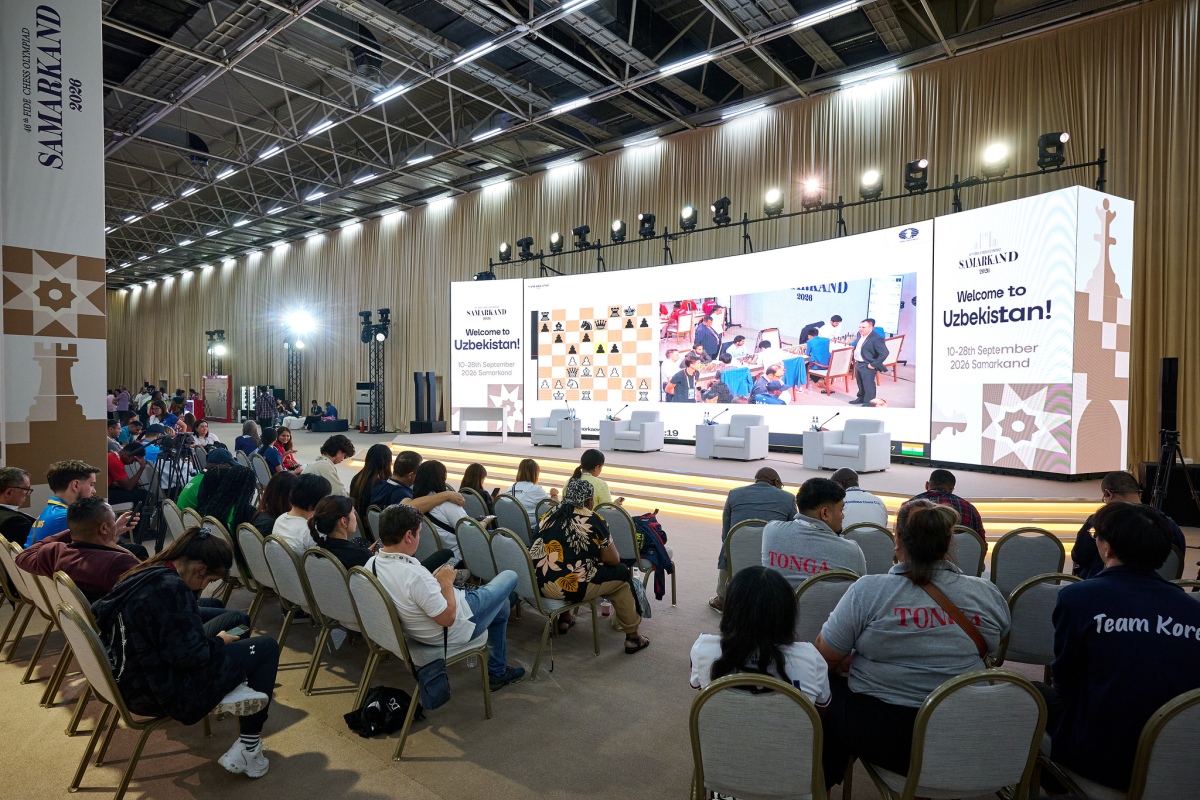
Hundreds of spectators have been arriving from all over Uzbekistan to follow the games. The organisers have created a huge space known as the EXPO, cleverly connected to the exit of the playing hall.
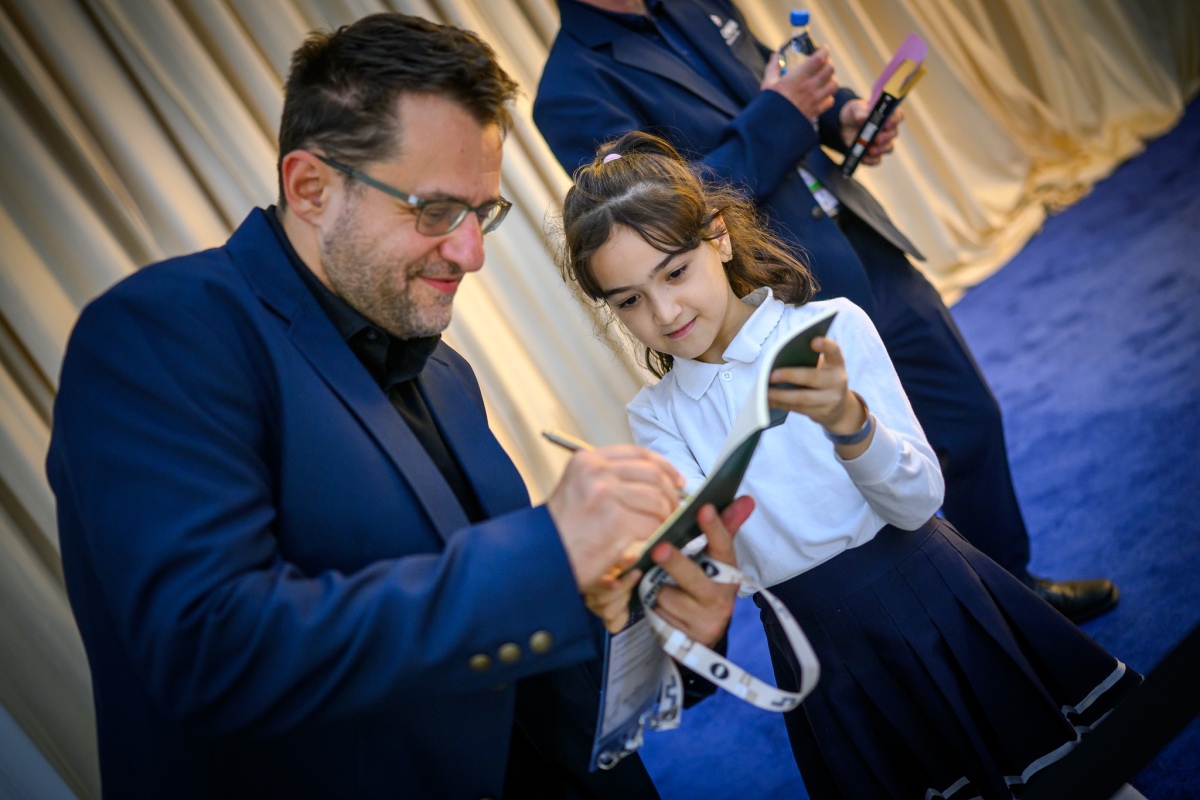
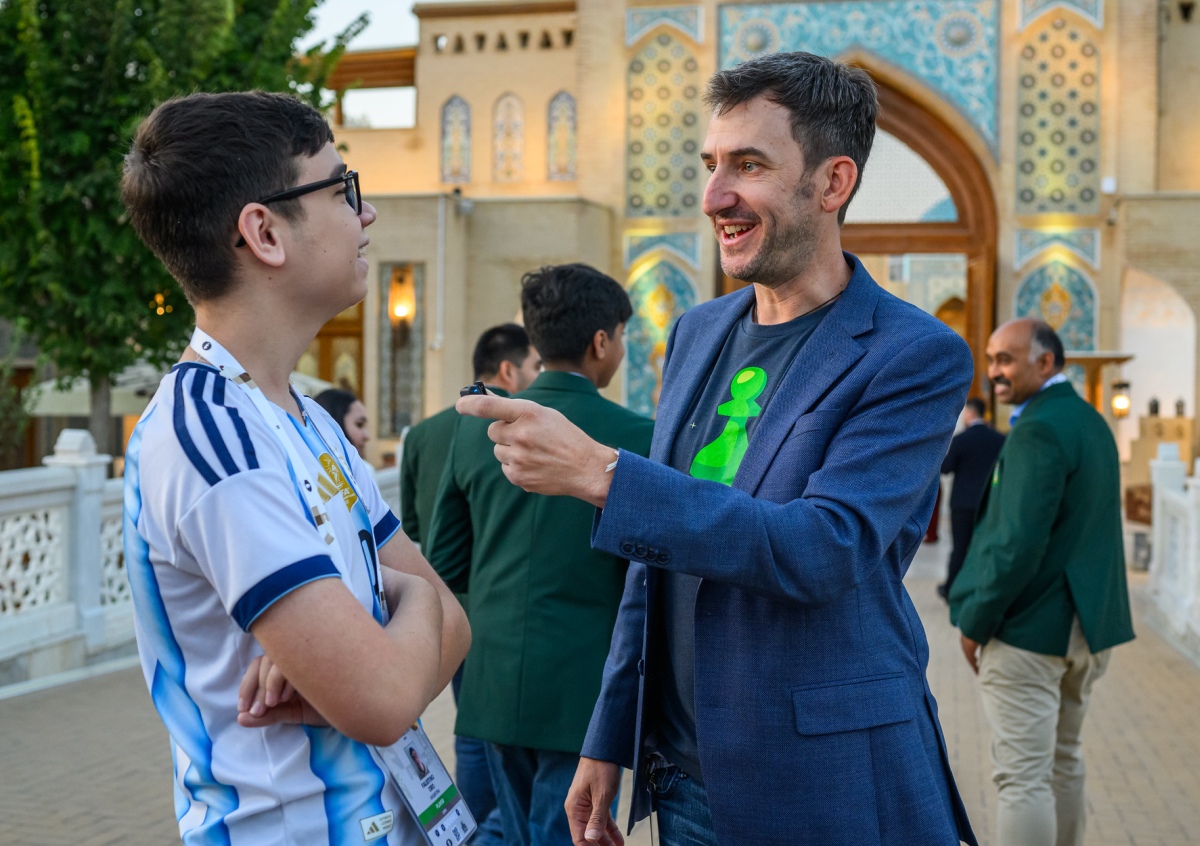
Once their games are finished, players can mingle with spectators, sign autographs and pose for photographs, while fans can follow the remaining games with Grandmaster commentary on a giant screen.
This creates a natural meeting point between players and fans and adds another dimension to the Olympiad experience beyond the playing hall.
Returning to the games, most of the top teams won their opening matches comfortably, with several recording convincing 4–0 victories. Interestingly, a number of teams chose to rest one of their top boards: a decision that can have various explanations, from travel and health considerations to tournament strategy.
Top seeds, the United States were among them. Fabiano Caruana sat out the opening round, leaving Wesley So to lead the team to a convincing 3½–½ victory over Iraq. The only half-point dropped by the Americans came on board three, where Levon Aronian was held to a draw.
Making his debut for the United States at an Olympiad, Hans Niemann produced a crushing 23-move victory on board two. Afterwards, he joined Charlize van Zyl for a brief interview, where he revealed a new team-building activity that has apparently become part of the American squad’s routine.
When asked who the best player was, Niemann had a typically confident answer: “Padel will speak for itself!”
Other teams chose to field their top stars from the outset. Argentina, for example, opted for a fascinating strategy, with 12-year-old Faustino Oro leading the team despite being the lowest-rated member of the squad.
So far, the decision has paid off handsomely. Argentina defeated Kenya 4–0, with Oro producing a convincing 22-move victory on the top board.
Even though most of the rating favorites went through the round comfortably, Botswana played a fantastic match against Brazil, achieving a 2-2 final score. A major upset, given that the African country was outrated by more than 400 points per board.
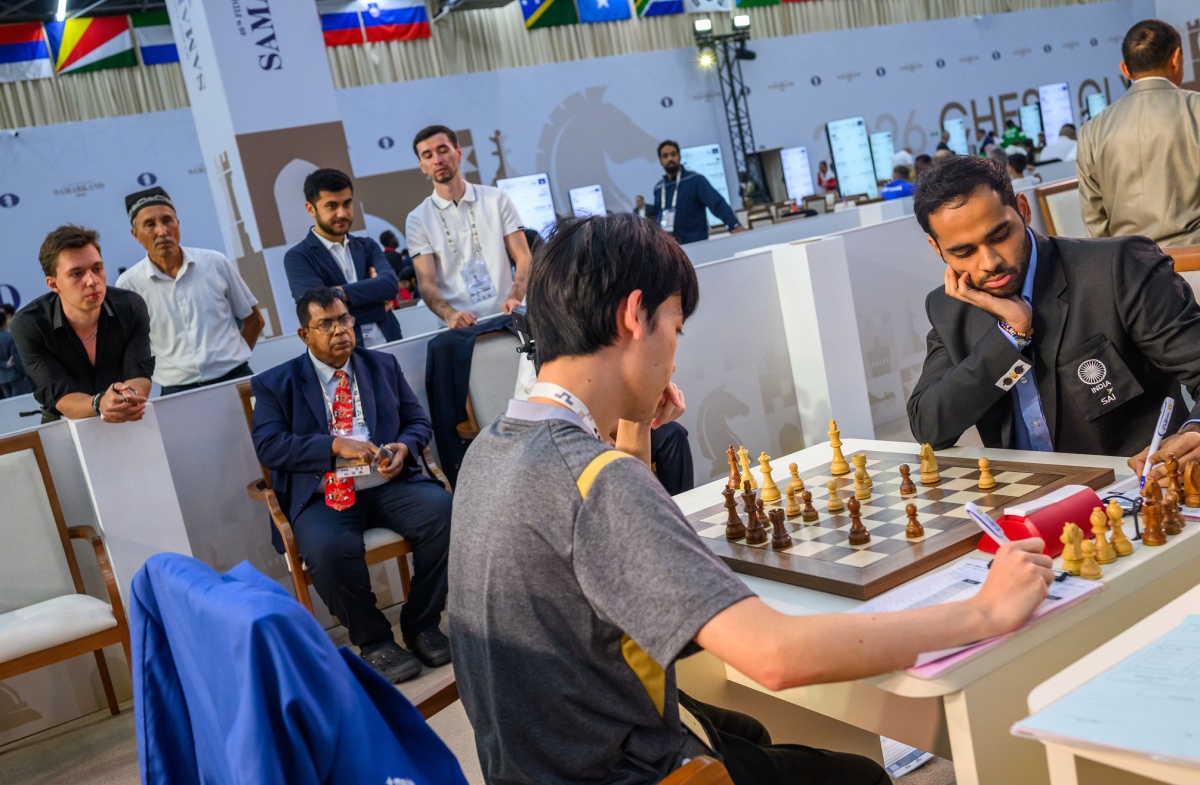
The biggest upset of the day came on board one, where Thailand’s Prin Laohawirapap scored a stunning victory with the Black pieces against India’s top board, Arjun Erigaisi. The result meant that the defending champions had to settle for a 3–1 victory over Thailand.
Erigaisi had enjoyed the better position for much of the game, but a tactical oversight towards the end allowed Laohawirapap to turn the tables and secure a memorable win.
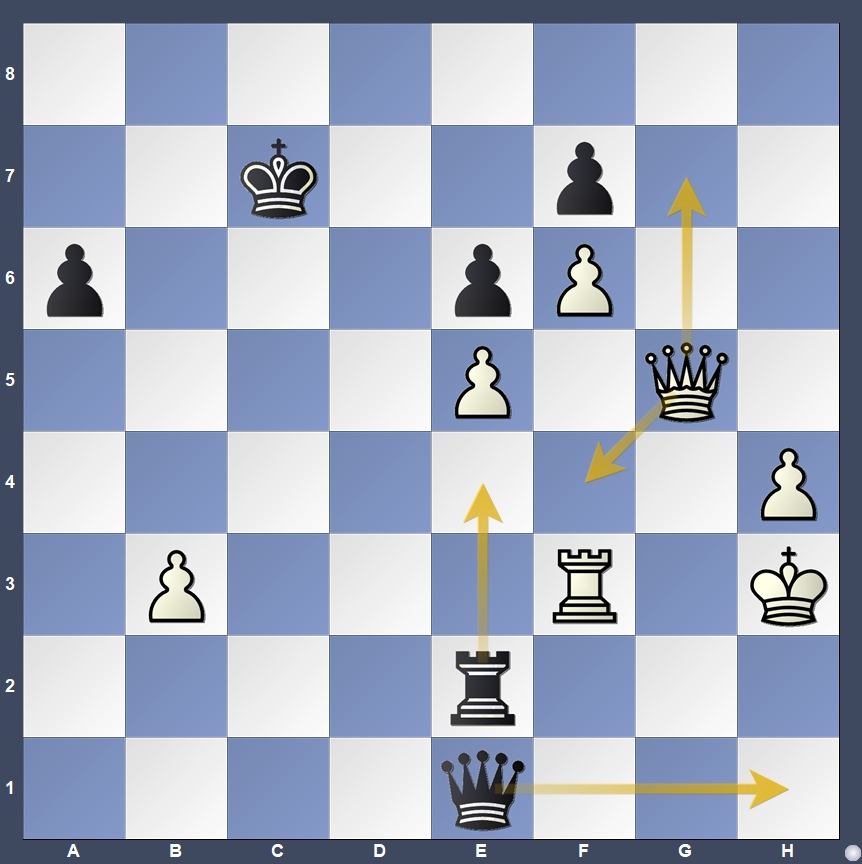
With both players running short of time, Erigaisi faced an extremely tricky position. He needed to find 50.Qf4!, defending against Black’s numerous threats around his exposed king while keeping his extra pawn and some winning chances.
Instead, Erigaisi blundered with 50.Qg7??, allowing the decisive sequence 50…Qh1+ 51.Kg4 Re4+ 52.Rf4 Qd1+, when his king was caught in a dangerous crossfire between the black queen and rook.
The game continued 53.Kg3 Qg1+ 54.Kh3 Re3+, and Erigaisi resigned.
A remarkable turnaround: after being in control for much of the game, the Indian star was suddenly unable to escape the combined attack of the queen and rook.
Charlize van Zyl caught up with the delighted winner in the interview area shortly afterwards.
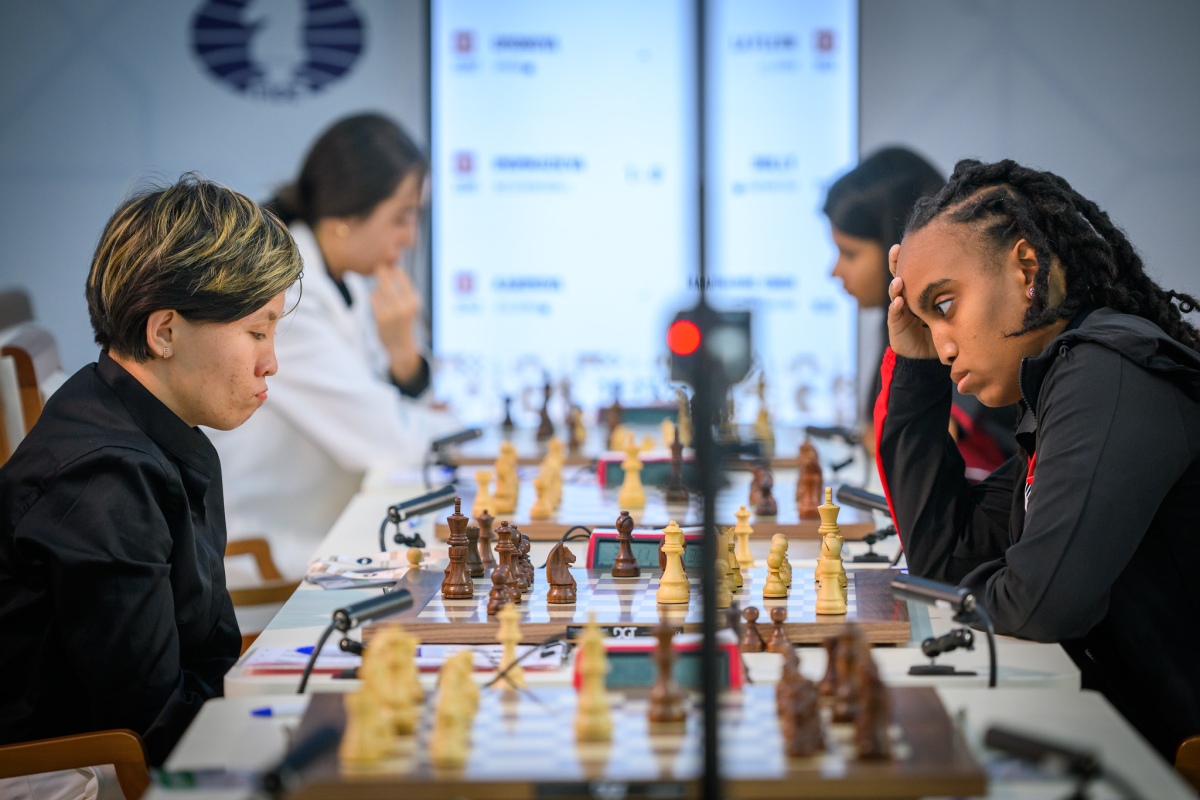
In the Women’s section, the rating gap between some of the teams was even more pronounced than in the Open, and Round 1 produced a large number of clean sweeps. Among them were all five top seeds: India, Georgia, Kazakhstan, China, and the United States.
Even so, converting an advantage into a point is never straightforward, as Uzbekistan’s Umida Omonova discovered in her game against Trinidad & Tobago’s Zara La Fleur.
Playing White, La Fleur obtained a clearly winning position, but a combination of missed opportunities and unfortunate decisions allowed Omonova to fight her way back into the game and eventually secure the full point for Uzbekistan.
Results of the five top matches in the Open section:
Iraq 3.5-0.5 United States of America
India 3-1 Thailand
Jamaica 0-4 Uzbekistan
China 4-0 Uganda
Faroe Islands 0-4 Germany
Results of the five top matches in the Women’s section:
India 4-0 Dominican Republic
Tunisia 0-4 Georgia
Kazakhstan 4-0 Botswana
Zambia 0-4 China
United States of America 4-0 Andorra
Full results 46th Chess Olympiad
Written by IM Michael Rahal, FIDE Press Officer
Photos: Michal Walusza, Rafal Oleksiewicz
Official website: https://chessolympiad2026.fide.com/