

2022 African Chess Championship: Bassem Amin and Shahenda Wafa claim titles
Egyptian players dominated the 2022 African Individual Chess Championship winning gold in both open and women’s sections. The competition took place in Lagos, the largest city in Nigeria, from September 18-27 and brought together 93 participants from 27 African countries. Both championships were 9-round Swiss tournaments with classical time control. FIDE President Arkady Dvorkovich opened the 2022 African Individual championship and made the first ceremonial move in the competition. The open event turned into an exciting race of two rating favourites and compatriots, GMs Bassem Amin (pictured below) and Ahmed Adly, who were in the lead from start to finish. Coming into the final round a half-point ahead of Amin, Aldy managed only a draw against Dante Beukes. His main competitor jumped on the opportunity and caught up with Aldy after defeating Kenny Solomon. Photo by Madelene Belinki Just like a year before, the two Egyptian GMs tied for first place with an excellent score of 8/9, but this time around, the tiebreaks (rating average of the opponents) favoured Bassem Amin, who won his sixth title of African champion. Another Egyptian GM, Hesham Abdelrahman, finished third. Final standings Open: 1 GM Amin Bassem EGY 2663 8 2 GM Adly Ahmed EGY 2578 8 3 GM Hesham Abdelrahman EGY 2374 7 4 IM Silva David ANG 2315 6 5 IM Rakotomaharo Fy Antenaina MAD 2492 6 6 IM Ortega Amarelle Mariano CPV 2474 6 7 IM Beukes Dante M NAM 2295 6 8 FM Adebayo Adegboyega Joel NGR 2267 6 9 Eyetonghan Denyefa Callistus NGR 2079 5½ 10 IM Okeke Isaac Chukwudalu NGR 2180 5½ In the women’s section, the top-seed Shahenda Wafa (pictured below) of Egypt lived up to the expectations and took gold after netting 7/9. The champion finished a half-point ahead of Charlize Van Zyl (South African Republic) and Bridget Michael (Nigeria), who scored critical final-round victories and tied for second place on 6.5/9. The silver medal goes to Charlize by dint of the higher rating average of her opponents. Photo by Lennart Ootes Final standings Women: 1 WGM Wafa Shahenda EGY 2110 7 2 WIM Van Zyl Charlize RSA 1710 6½ 3 Michael Bridget NGR 1800 6½ 4 WFM Luzia Pires ANG 1839 6 5 WCM Ampaire Shakira UGA 1657 5½ 6 Onoja Iyefu Joy NGR 1762 5½ 7 Paulo Jemima ANG 1886 5½ 8 Ofowino Toritsemuwa NGR 1857 5½ 9 WFM Oloruntola Oluwatobiloba NGR 1918 5½ 10 WFM Mbatha Constance ZAM 1613 5
Huge excitement in Astana WGP
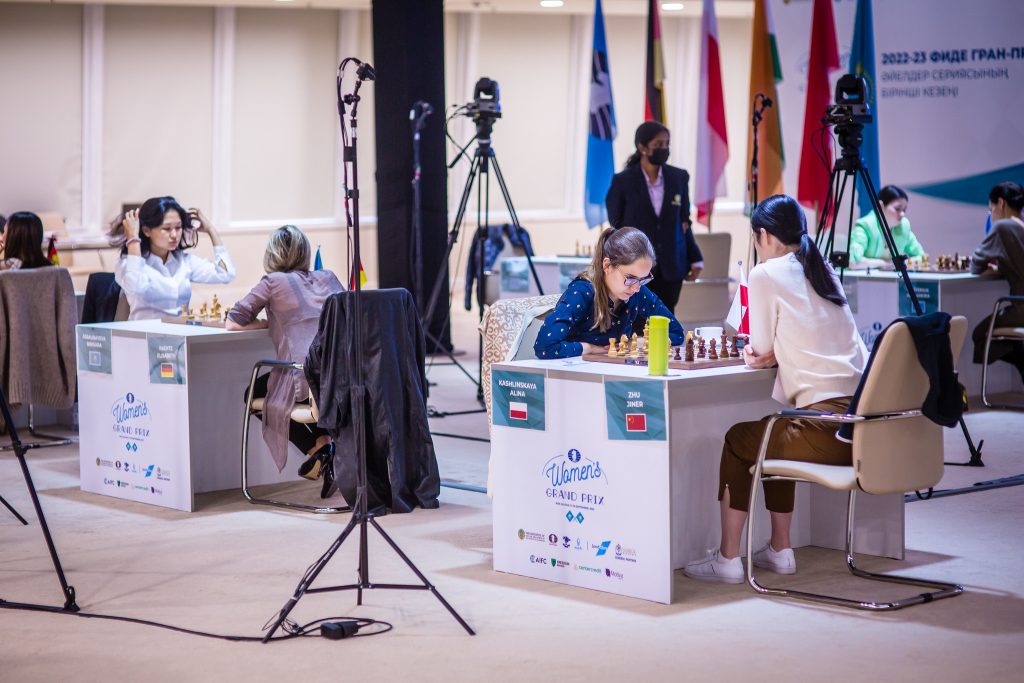
Kateryna Lagno leads the tournament with one round to go The tenth round of the Astana Women’s Grand Prix started off with two very quick draws by three-fold repetition. One of them seemed like an intelligent strategic decision by Kateryna Lagno in an effort to retain her top position in the standings and pile the pressure on her main rival, Aleksandra Goryachkina. With one round to go, Kateryna Lagno leads with 7½/10, Aleksandra Goryachkina is second with 7, and Zhu Jiner is third, sitting on 6 points. Tomorrow’s round will start at 1 pm instead of 3 pm and features several interesting match-ups. Kosteniuk vs Lagno and Vaishali vs Goryachkina will be the two main games of the day in the fight for clear first, while Zhu Jiner will be playing with White for second place and possibly a GM norm. Lagno, Kateryna — Abdumalik, Zhansaya (0.5-0.5) The round had practically just begun, and the first game ended in a draw. Playing with Black, Zhansaya Abdumalik, who already made a quick draw against Goryachkina yesterday, proposed the Zaitsev system in the closed Ruy Lopez. Half a point ahead of her rivals in the standings, Kateryna Lagno probably thought it was a good idea to go for a well-known theoretical move repetition, forcing a draw and extending her lead to a full point with a round to go. As a side note, the clocks showed 1:32,59 for Lagno and 1:34,18 for Abdumalik – players start with 1:30,30 with a 30-second increment. Shuvalova, Polina — Vaishali, Rameshbabu (0.5-0.5) The second game to finish in a draw was also a quick one. Saved by the bell and arriving just on time to the venue, Polina Shuvalova went for a side-line against Vaishali’s Sicilian Sveshnikov, which leads to a forced perpetual check for Black. Both players blitzed out their moves, which makes me think that they were content with the decision, making a draw in less than twenty moves. Goryachkina, Aleksandra — Kosteniuk, Alexandra (0.5-0.5) Undoubtedly the most important game of the round. Pressured from the start by Lagno’s draw, Goryachkina, who turns 24 today, needed a win to tie for first and go into the last round with options to win the tournament. According to my database, previous encounters between both of them produced a head-to-head record of 9-7 for Kosteniuk, although a few of the games were played when Goryachkina was still a junior. Nonetheless, Kosteniuk eliminated Goryachkina in the 2021 World Cup final last year, a huge result for her. Kosteniuk went for the very solid Slav Defence main line and, slightly surprised, Goryachkina spent 8 minutes and chose the side-line 12.e5 – there are several more popular options such as 12.Bf4 or 12.Rd1. The second key moment of the game occurred on the move fourteen when Goryachkina refrained from exchanging bishops on g6, weakening Black’s kingside. Kosteniuk seized her chance, exchanged most of the pieces on the c1 square and headed for an equal queen + knight ending in which both players agreed on a draw by three-fold repetition on the move thirty. Alexandra Kosteniuk gave us her thoughts on the game in a short interview. Kashlinskaya, Alina — Zhu, Jiner (0-1) Poland’s number one female player Alina Kashlinskaya started off the Grand Prix in great shape, but she has been struggling to find her form in the last few rounds. According to my database, she had played twice against Zhu Jiner previously, a draw in the Chinese Team Championship in 2017 and a loss last year in the 2021 Grand Swiss. In today’s game, by move transposition, the position resembled a classical isolated d-pawn structure. While Zhu Jiner was preparing to blockade the d5 square and finish her development, Kashlinskaya uncorked a seemingly promising bishop sacrifice, destroying the kingside of her opponent. She followed it up with a clean rook sacrifice that couldn’t be accepted because of mating threats. However, as Zhu Jiner explained in her post-game interview, she had it under control: although she was slightly worried, she didn’t think it was correct. The continuation of the game proved her point. With precise 17…Qf4! the Chinese player cold-bloodedly repelled White’s threats and forced Kashlinskaya’s resignation on move 24. Assaubayeva, Bibisara — Paehtz, Elisabeth (0-1) Although German’s number one female player hasn’t been in top form in Astana, she played a very nice positional game in the Carlsbad structure today with Black against Bibisara Assaubayeva. Her plan based on 26…b5 followed up by the kingside attack worked perfectly and netted her the full point in a key moment of the tournament. In her post-game interview, Paehtz reflected on her opponent’s playing style and experience when deciding her game strategy. She also discussed some of the issues that top women players have faced since the end of the pandemic. Tan Zhongyi — Wagner, Dinara (1-0) With her third win in the last four games, Tan Zhongyi made a huge step today to fight for fifth place in the tournament. Playing fast and confidently, she prevailed over Dinara Wagner in a masterfully played two bishops against a two-knight endgame. In fact, as FIDE’s General Director GM Emil Sutovsky shared on Twitter, the ending has a striking similarity to game 23 of the 1951 Botvinnik vs Bronstein World Championship Match. In her post-game interview, Tan Zhongyi discussed with Press Officer IM Michael Rahal her style of play and handling of the clock. Round 11 (final round) | Astana | 29.09.2022 Wagner, Dinara — Shuvalova, Polina Paehtz, Elisabeth — Tan, Zhongyi Zhu, Jiner — Assaubayeva, Bibisara Abdumalik, Zhansaya — Kashlinskaya, Alina Kosteniuk, Alexandra — Lagno, Kateryna Vaishali, Rameshbabu — Goryachkina, Aleksandra Text and interviews: IM Michael Rahal, FIDE Press Officer, Astana Photos: Anna Shtourman
Fifth Chess in Education Lecturer course announced

The International Chess Federation, together with its Chess in Education Commission (EDU) and “Chess” Scientific Research Institute (CSRI), is pleased to announce the 5th Chess in Education Lecturer course. The course will be held 28-30 October, in English, online 15:00-20:00 CET. The objectives of the course: To develop and enhance the skills of effective teaching of chess basics To enhance the ability of using active and interactive teaching methods To improve positive professional communication skills The target audience of the course is professionals with experience in chess and education. Duration and content: 3 days – 15 hours (including breaks) + Project. Day 1 Introduction (100 minutes); Fear – both teachers’ fear and your fear of exam! Teaching the chessboard. (130 minutes) Project assignment (10 minutes)
Second Intercontinental Online Chess Championship for Prisoners: Registration deadline approaches
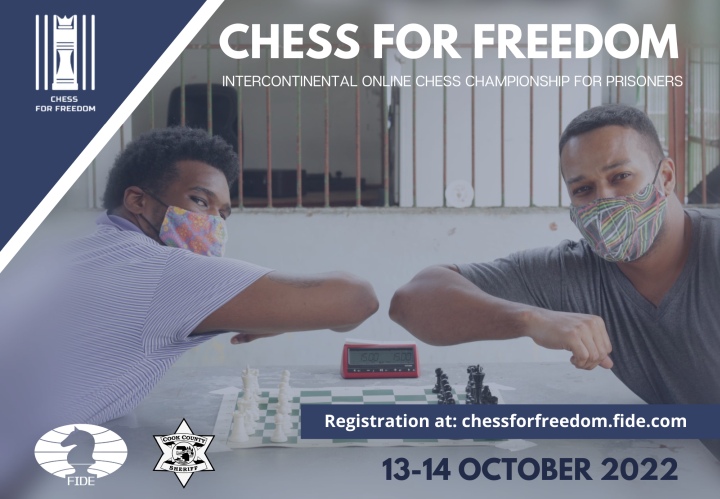
58 teams representing 32 countries have already registered for the second Intercontinental Online Chess Championship for Prisoners, scheduled for October 13-14, 2022, on the International Day of Education in Prison. Correctional facilities for male, female and youth inmates from Argentina, Armenia, Australia, Bosnia and Herzegovina, Bulgaria, Canada, Colombia, Croatia, Czech Republic, Ecuador, El Salvador, England, Georgia, Germany, India, Italy, Kyrgyzstan, Latvia, Mexico, Mongolia, the Netherlands, North Macedonia, Norway, the Philippines, Portugal, Serbia, Slovenia, South Sudan, Spain, Trinidad and Tobago, Turks and Caicos Islands and the USA field their teams made of amateur chess players for whom the game became not just a hobby but strong motivation to change for the better. In some prisons teaching inmates to play chess has been done for many years, in others, the first Intercontinental tournament for prisoners held by FIDE, jointly with Cook County (Chicago) Sheriff’s office in October 2021, gave an impetus to bring chess classes to correctional facilities. The Argentina chess federation (FADA) started its cooperation with SENAF (National Secretariat for Children, Adolescents and Family) in 2021, bringing chess classes to prisons and correctional institutions for children under 18 years of age. Currently, the initiative is implemented in 20 schools for troubled youth throughout the country. “We have noticed that the behaviour of prisoners changed. Sometimes instead of solving their problems and conflicts through violence, they decide to have a game of chess to resolve a dispute,” says Hector Flori, General Coordinator of the project, FADA Secretary. “With a view to this tournament, a national qualifying event was held on September 14, and the winners will receive, in addition to the weekly formal classes of the project, a special training by the teachers of the school of high performance of FADA. It is a great challenge for us to play in this event again.” In addition to the tournament itself, the live broadcast of the championship will include many guests – ambassadors of Chess in Prisons initiatives from different countries, chess teachers for inmates and at-risk communities, ex-convicts whose lives changed after being introduced to chess. One of them is Simosakhe Ngwane from South Africa, an ex-prisoner who learned to play chess while in jail. He came back to normal life and became a role model for many at-risk children in his country. “I hope the program expands into schools as well because that’s where our kids start making mistakes. Even myself. If I’ve learned how to play chess in school, I wouldn’t have made some mistakes in my life,” he says. To make his dream to help youngsters come true, Ngwane organized chess classes for kids in his hometown Molweni. Even though sometimes there are not enough chess boards, clocks and tables for students, the number of kind who want to start playing chess keeps growing. “Crime is easy when you are young. That’s the reality. You don’t think of consequences until it’s too late. Playing chess develops a positive attitude. The simple rule of chess “Touch is a move” brings discipline and calmness. It teaches you to wait, to think, and to prepare before you make a decision,” Ngwane adds. The registration for the second Intercontinental Online Chess Championship for Prisoners is open until September 21, 2022. Participation is free of charge. Tournament regulations (pdf) Registration form
Serbia prepares for second Intercontinental Online Chess Championship for Prisoners
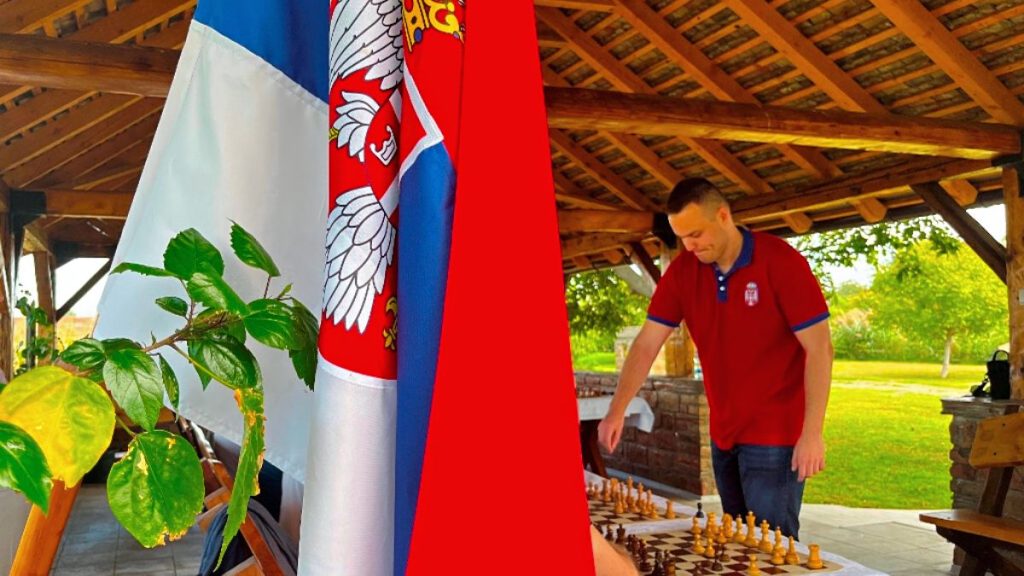
Convicts from Belgrade prison Padinska Skela played a simultaneous exhibition with GM Aleksandar Indjic. Last year, the International Chess Federation, jointly with Cook County (Chicago) Sheriff’s office, launched the project “Chess for Freedom”, which is dedicated to convicted and detained persons worldwide. As a part of it, the Intercontinental Online Chess Championship for Prisoners was organised. Its first edition was supported by 17 national federations, including the Chess Federation of Serbia. The Administration for the Enforcement of Penal Sanctions of the Ministry of Justice of the Republic of Serbia established strong cooperation with several Penal Correctional Facilities in Serbia. Last year, a team of Serbian convicts from the Penal Correctional Facility in Belgrade (Padinska Skela) participated in the very first Intercontinental Online Chess Championship for Prisoners. This year, Serbia will field four teams in the competition: men’s teams from Penal Correctional Facility in Padinska Skela and Zabela Pozarevac, a women’s team representing Penal Correctional Facility for women in Pozarevac and a youth team from Juvenile Reformatory in Krusevac. As part of the preparatory activities, tournaments were held in several penitentiary institutions, and the first board of the Serbian national team, grandmaster Aleksandar Indjic, played a simultaneous exhibition on the premises of the Penal Correctional Facility in Padinska Skela on September 7 2022. The warden of the Penal Correctional Facility, Vladimir Bukvic, wished the simultaneous game participants to give the most vigorous possible resistance to Grandmaster Indjic and use this opportunity to improve their chess skills. On behalf of the Chess Federation of Serbia, Nebojsa Baralic, Chief Advisor to the President of the Serbian Chess Federation and Director of the FIDE Intercontinental Online Chess Championship for Prisoners, expressed his gratitude for the hospitality. He told the attendees about all the activities that have been carried out since the beginning of the project. He also introduced them to the plans of FIDE and Serbia Chess Federation in this field, as well as the organisation of the upcoming Intercontinental Championship. The country’s four largest Penal Correctional Facility – Sremska Mitrovica, Pozarevac (Zabela), Nis and Belgrade have been having chess sections for many years, and all prisons regularly organise tournaments with more than 100 convicts participating. Chess tournaments and numerous sports activities have been regularly organised in the Penal Correctional Facility in Padinska Skela (Belgrade) since last year. The Intercontinental Online Chess Championship for prisoners is open for teams representing any correctional facility. Currently, 45 teams from 23 countries have already registered for the tournament. The registration deadline is September 21, 2022. Participation is free of charge. Tournament regulations (pdf) Registration form
Chess for Refugees project enters its second year
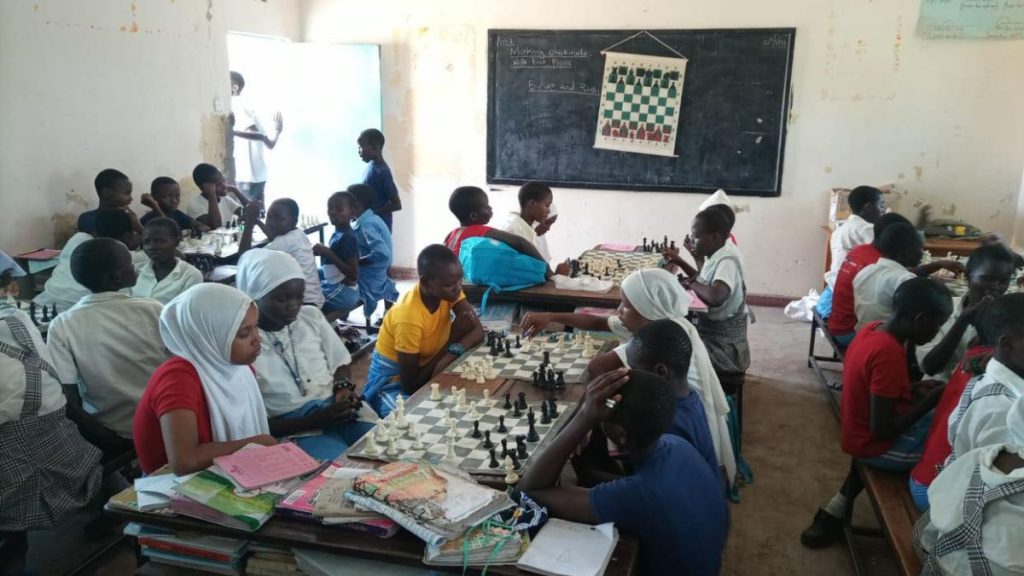
Chess for Refugees — an ongoing FIDE project run in the Northwestern region of Kenia — kicked off in August 2021. Its main activities are located in Kalobeyei refugee settlement, some 15 kilometres west of the main Kakuma camp, established to host unaccompanied minors who had fled the war in Sudan and from camps in Ethiopia. The camp is situated in one of the poorest counties in Kenya. Eight Kalobeyei primary schools participate in the project with 50 learners each, of whom the majority are girls. The Girls Club “Chess for protection” was launched by FIDE and UNHCR as part of the Chess for Refugees programme. Its goal was to offer valuable educational activities to refugee girls who would typically have stayed home to carry out daily chores like cooking and cleaning. The project started in Angelina Jolie primary school in Kakuma with an attendance of 40 students. Now it is run in 3 girls boarding schools in the region, with 150 refugee schoolgirls participating. “The idea of the Girls Club “Chess for protection” was born around two years ago. It is very important for girls in difficult life situations to meet role models and professional chess players and understand how important chess could be in their lives. Through chess, they can learn a lot of interesting things, find new friends, develop their logical thinking and other skills that can be very useful in their lives,” says the leader of the Girls Club “Chess for protection”, WIM Anastasia Sorokina. Female students attend online lessons by WGM Anastasiya Karlovich (UKR) and IM Salome Melia (GEO). Held once a week, these meetings are not only about chess. The vision is not just to improve the chess skills of refugee students but to spur creativity and broaden their horizons. The most important goal is a possibility for these girls to see, communicate and get support from inspiring role models. Through live communication, the project participants have a chance to develop personally and improve their problem-solving and decision-making skills. “They were super excited to be exposed to chess, as they know they will benefit greatly from this game. And they have already experienced these benefits. Some of them were not doing well in mathematics, and after they started attending chess classes, they improved their calculation skills,” says Kong’or Deng Maketh, the leader of chess for Kakuma and Kalobeyei refugee youth project. Another ten schools in Kakuma will join the project later this year. By then, some 1600 children living in refugee camps will have participated and learned to play chess. “The Kakuma and Kalobeyei project is FIDE at its best, with chess at the core of a very meaningful project affecting many young learners, of which a majority are actually girls. It has been great to work with partners like UNHCR, Chess Kenya and the Lutheran World Federation. We are currently working to make the positive impacts sustainable, with chess activity in Kakuma and Kalobeyei to continue also in the years to come,” adds FIDE Social Commission Chairman Geir Nesheim. FIDE believes that education is a key for younger generations to obtain sustainable livelihoods and plan more similar projects in refugee settlements around the world to be launched in the years to come.
Monaco to host Pool A of Women’s Candidates

The glamorous Hôtel Hermitage Monte-Carlo will host the Pool A of the Women’s Candidates tournament, organised by the Monaco Chess Federation, from October 24 to November 6. This bracket will see the clash between Humpy Koneru and Anna Muzychuk (first Quarter-Final), and Lei Tingjie and Mariya Muzychuk in the second Quarter-Final. Under the new knock-out format, players in each of the two brackets or “pools” will play a four-game match (plus tie-breaks, if needed) in order to advance to the next stage, with the final match being played over the distance of six games. The prize fund for this pool is €70,000, while another €110,000 will be at stake in the Women’s Candidates Final, raising the total to a record-breaking amount of €250,000. The main sponsor for the event will be The Société des Bains de Mer (SBM), a company that owns and manages the Monte Carlo Casino, the Opéra de Monte-Carlo, and the Hôtel de Paris in Monte Carlo. Originally founded in 1863 by Charles III, Prince of Monaco, and previously owned by Aristotle Onassis, SBM is now a publicly traded company registered in the Principality of Monaco, with the Government of Monaco as the main shareholder. Photo: Håkan Dahlström The games venue will add a touch of distinction to the event, as the Hôtel Hermitage is one of the most emblematic hotels in Europe. Set in a palace in Monaco listed as a historical monument, this luxurious five-star hotel features Belle-Époque décor, a winter garden, and a 7,000 m² spa. Among other recognitions, it received the “Best spa in a hotel in Europe” Prix by Villégiature Award in 2016 and the Gold Award in the “Event Hotel of the Year” category by Eventia in 2012. Pool B of the Women’s Candidates will be staged under the same conditions, and the host city will be confirmed in the coming days. The Final that will determine the challenger to Ju Wenju’s throne, played over the distance of 6 games, will take place in the first quarter of 2023, and two different European cities have already expressed their interest in organising it.
Nikolai Krogius (1930-2022)

Nikolai Vladimirovich Krogius passed away in New York at the age of 91. A strong grandmaster, International Arbiter, coach, and former FIDE Vice-President, he was also known as a pioneer in chess psychology and a talented author. Born in 1930 in Saratov, Krogius picked up chess during World War II. A late boomer by Soviet standards, he progressed slowly but surely and reached his first USSR final in 1958. He made his international debut in 1960, tying for first place with Nikola Padevsky in Varna (1960). Following his excellent performance in Sochi (1963 – 3-4th and 1964 – 1st place) Krogius was awarded a grandmaster title. Nikolai Vladimirovich earned his doctorate in psychology and specialized in sports psychology. From the late 1960s, Krogius combined active tournament play with coaching and helped Boris Spassky in his duels with Tigran Petrosian and Robert Fischer. From 1970 to 1980, he worked at Saratov State University as a senior lecturer, associate professor, and, since 1978, as head of the psychology department. By the mid-1970s, Krogius shifted away from active tournament play (participating only in occasional lower-level events) and switched to writing and administrative work. He was the captain of the USSR team for the USSR vs Rest of the World match in London (1984) and served as Vice-President of the USSR Chess Federation. Krogius returned to active tournament play at the senior level in the 1990s and tied for the title at the World Senior Championship at Bad Wildbad (1993), scoring 8.5/11. A prolific author, Krogius thoroughly researched the psychology of the chess game in his books and articles. Penned with Lev Alburt, his book “Just the Facts! Winning Endgame Knowledge in One Volume” (2001) won a prestigious CJA award. FIDE extends its sincere condolences to Nikolai Krogius’ family, friends, and loved ones. Photo: Boris Dolmatovsky and 64 – Chess Review magazine archive
Alexander Nikitin (1935-2022)

Alexander Nikitin passed away. We will remember him as an outstanding coach, without whom Kasparov might not have become the great Kasparov. A strong International Master himself, Nikitin retired from chess at some point, concentrating on scientific research, but returned to the game he loved and became one of the most distinguished chess coaches in history. He met a very young Candidate Master Garik Kasparov back in 1974, and it became a turning point for both of them. Nikitin and Kasparov came a long way together and separated only at the beginning of the 1990s. Photo: RIA Novosti / V. Kalinin But there were great achievements after that as well. Dmitry Jakovenko, who was blessed to work with Nikitin from a very young age, made his way up to the world’s top-5. Nikitin also productively worked with the then-strongest junior in the world Etienne Bacrot. I remember playing a match with Etienne: after the final game was over, Nikitin came up on the stage and joined our postmortem analysis. I was the European Champion at the time; Bacrot was an up-and-coming young star rated 2650+, but this quiet elderly gent, aged 66, was on par with us. Alexander Nikitin was a good, worthy person. A man of principle, he was sometimes adamant but always correct. And, of course, he was a great coach. His students will tell you better about that. Rest in peace, Alexander Sergeyevich. Emil Sutovsky, FIDE Director General Top photo: Courtesy of Nikitin’s publisher Ilan Rubin
Yuri Averbakh (1922-2022)
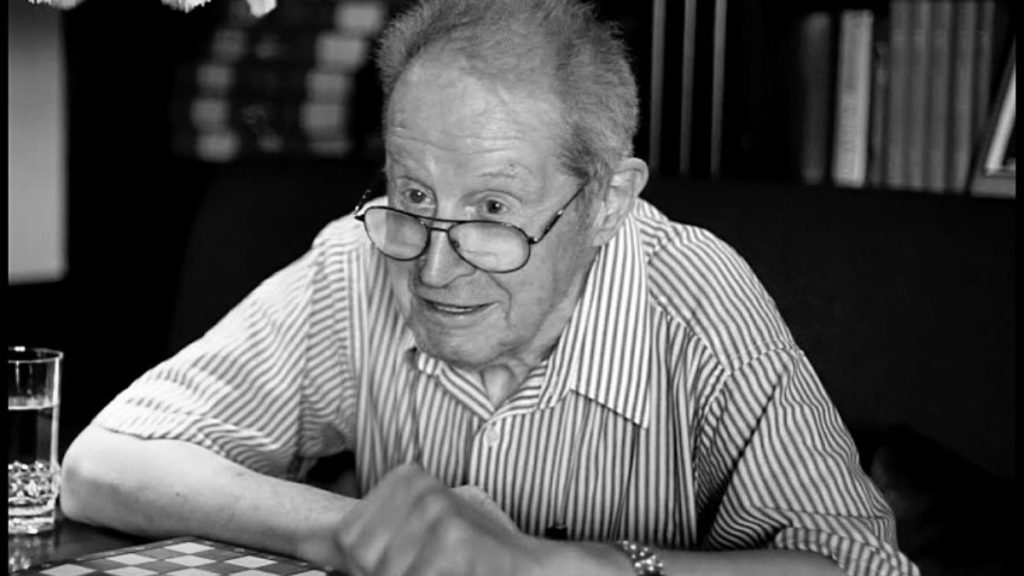
The legendary Grandmaster Yuri Averbakh, who had celebrated his centenary in February, passed away in Moscow. Averbakh started to play chess at the age of seven, but it was just one more hobby for him during his first years, and he didn’t really take it seriously, with volleyball being his main interest. Then, in February 1935, he had the chance to meet the famous chess composer Nikolai Grigoriev, at a time when Moscow was hosting its second international chess tournament, with Capablanca, Lasker, Botvinnik, and many others. “Grigoriev gave a lecture in the club, showing some of his famous pawn studies. They made an enormous impression on me, and that was the first time I sensed that chess wasn’t simply a game but was something more, that it was an art. And I also had the urge to master that field. That’s how I got involved in chess.” Finally hooked on chess at the age of 13, his first great success came three years later when he won the Soviet Union’s championship for schoolchildren. However, his incipient career would come to a halt, along with most chess organized activity, due to the World War II. He was evacuated with all his school from Moscow to Izhevsk, barely avoided being recruited himself when he reached the required age, and he would only return to Moscow in 1943. Yuri Averbakh at the tournament in Ivanovo (1944) It was then that his career took off, gaining in strength until he won the Moscow Championship of 1949, ahead of a strong field that included Andor Lilienthal and Vladimir Simagin, among many others. This was his first major success and the beginning of a decade in which he became one of the top players in the world, probably one of the top-10 at his peak. He won the Moscow Championship again the next year, and in 1952 he earned the Grandmaster title – a title he has borne for almost 70 years! Averbakh finished 5th at the Stockholm Interzonal Tournament in 1952, qualifying for the legendary Zurich 1953 Candidates Tournament, where he finished in 10th place. The next year, in 1954, he became champion of the USSR, and in 1956 he was very close to repeating this feat, sharing 1st-3rd places with Taimanov and Spassky, and ending up in second place after a tie-break stage. In his collection of selected games, published by Cadogan, Averbakh says that he learned chess “the wrong way round”, becoming a strategist before he learned properly about tactics and combinations. A very solid player, pure attack players would often feel uncomfortable when playing against him: Rashid Nezhmetdinov, for instance, was only able to get one draw in the nine games they played. Photo: ERIC KOCH @ANEFO Averbakh reduced his competitive activities when he reached his forties, leaving behind numerous victories in international events all over the world, like Jakarta, Rio de Janeiro, Adelaide, and Vienna. His latest international success was the Rubinstein Memorial held in Polanica-Zdroj in 1975. He shifted then his interest from playing the game to studying the game. And in that, he was as successful, or even more, as he was as a player. “My investigative character forced me to make a serious study of the endgame, that phase of the game where individual pieces battle against each other. Initially, I published several articles and then thought about a book devoted to various types of endings.” His endeavour turned into a monumental work, the first systematic study of the endgame in history, published in five volumes. “So many generations grew up with Averbach that we stopped feeling the importance of what he did for chess,” said Emil Sutovsky, FIDE’s Director General. “Averbakhs’s Five Books have been studied by chess players of all levels for decades. And the wonderful book “Journey to the Chess Kingdom” co-authored by Michael Beilin has been read by hundreds of thousands of children, including many future strongest players in the world.” Tall and athletic, Averbakh was physically gifted from his youth, and he cultivated his body as much as his mind. Volleyball was the first sports activity he took up seriously, taking advantage of his height. He also loved hockey and skiing – two national passions in Russia. Not so well known is the fact that, for a short period, he was also a regular at the boxing ring. “In our yard, there was a club which was turned into a dormitory for workers. It was a real rabble, where a cult of strength reigned. Therefore, if you wanted to be equal in the yard, you had to be able to give as good as you got. That’s why I took up boxing for a year,” Averbakh said in an interview with Vladimir Barsky and Eteri Kublashvili on the occasion of his 90th birthday. He was already a middle-aged man when he took swimming as a way to stay in shape. “I swam until very recently, having gone to the swimming pool from 1964 to 1996”. He would swim almost daily when he was already in his seventies and continued to do so until the doctors, worried about his pacemaker, told him to stop when he was already in his late eighties. “A healthy lifestyle with plenty of physical exercises is very important.” Photo: Boris Dolmatovsky While all this explains his longevity, it is very likely that keeping mentally active also played a huge role. He was one of those people who basically never retired and kept working as much as his health allowed. As late as 2016, he would still visit the Central Chess Club at Gogolevsky boulevard every Wednesday to meet with young talents and offer them advice. Averbakh was very fond of working with young people, but he also kept in mind the seniors and, with that intention, he found a chess centre in a library. “We were looking to attract older people to the game,” he explained in an interview with Dagobert Kohlmeyer. “They should not play in tough tournaments but rather spend their