

Media accreditation opens for FIDE World Cup and FIDE Rapid and Blitz Championships

FIDE is pleased to announce the opening of media accreditation to its two major upcoming events: the FIDE World Cup 2025 (India, Goa) and the FIDE Rapid and Blitz Championships (Doha, Qatar). FIDE World Cup 2025 Dates: October 30 to November 27, 2025 Location: Goa, India This knockout spectacle will feature 206 players fighting for a share of USD 2,000,000 and three coveted places in the 2026 Candidates Tournament. Every round is win-or-go-home, making the World Cup one of the most dramatic tournaments on the calendar. Media registration form: worldcup2025.fide.com/media-registration/ FIDE Rapid and Blitz Championships Dates: December 25 to 31, 2025 Location: Doha, Qatar The FIDE World Rapid & Blitz Championships 2025 bring together the world’s elite chess talent for a thrilling end-of-year showdown. The tournaments are among the most exciting and popular events in the chess calendar, attracting top players and fans worldwide. The faster time controls and dynamic gameplay lead to thrilling and unpredictable matches, captivating audiences and keeping them on the edge of their seats. Media registration form: worldrapidandblitz2025.fide.com/media-registration/ Official website: worldrapidandblitz2025.fide.com/ We invite all media representatives wishing to cover the FIDE World Cup 2025 and the FIDE Rapid and Blitz Championships 2025 to submit their accreditation applications individually for each tournament via the media registration forms above. Accreditation is open for all members of the written press, photographic press, online media, and writers and photographers working for publications and/or websites of the FIDE National Member Federations. Accredited event media will collect their badges onsite at the events. A valid travel document containing a photo must be presented to receive media accreditation. The event organisers will ensure a comfortable working environment for all Accredited Media, providing a range of facilities and services at the level established at major FIDE events. We look forward to your coverage of the FIDE World Cup 2025 and the FIDE Rapid and Blitz Championships 2025!
From Norway to North Africa: Johan-Sebastian wins inaugural Sahel Chess Festival in Tunisia
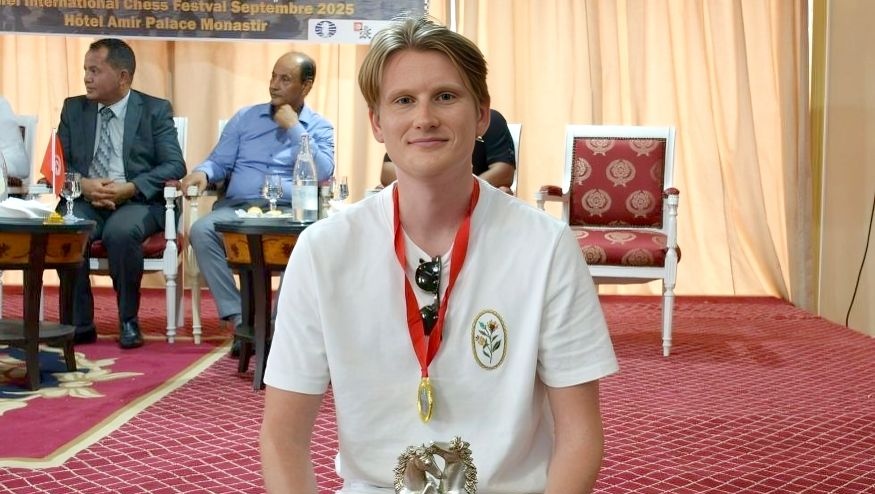
Norwegian GM Johan-Sebastian Christiansen emerged victorious at the inaugural Sahel Chess Festival, held in Monastir, Tunisia, from September 1–9, 2025. The event attracted 263 players from 11 federations. The tournament was hosted at the 4-star Amir Palace Hotel, a seaside resort that provided ideal professional chess conditions alongside a relaxing holiday atmosphere for players and their families. Christiansen, Norway’s second-highest-rated player, delivered a dominant performance, winning both the Open A and Blitz tournaments with a commanding 8.5/9 score. His only draw in the main event was against Algeria’s reigning champion, Boulmes Ala Eddine, who ultimately secured fourth place and achieved a Candidate Master (CM) norm. The festival featured four sections: Open A for players rated 2000+, Open B (1700-2000), Open C (under 1700), and a unique Open D for seniors aged 50 and above—a rare inclusion in open tournaments. Standout Local PerformancesThe event highlighted the potential of local talent, with several Tunisian players delivering impressive results: Bilel Ben Hamida, 13, won the C Open with 8.5/9, gaining 184 rating points. Sadok Zenaidi (pictured below), the 20th seed in Open A, scored 5/9, climbed to 7th place, earned 38 Elo points, and broke the 2000-rating barrier. These impressive results underscore how African players can significantly benefit from international competitions held on their home turf. It is widely recognized that players from the region are often underrated. They are eager for international events to test their skills, improve their ratings, and, for many, gain an official FIDE rating. In this context, festivals like the Sahel are of great importance. A remarkable number of young players, including many girls, entered the tournament unrated and earned their first FIDE rating—an opportunity unavailable if they only compete domestically. WFM Amen Miladi (pictured above), a member of the national women’s team, was the top female performer in the B Open. While most participants were Tunisians traveling from across the country, the festival also drew strong regional interest. Twenty players arrived from Libya, and the Algerian Chess Federation organized a bus bringing over 70 players and arbiters (pictured below), led by Federation Secretary Mrs. Karima Belkhedra. Tunisia’s leading players, including GM Amir Zaibi (the country’s only Grandmaster), IM Achraf Hbacha, FM Hamed Ben Ghanem, and CMs Ahmed Bouzidi, Yacine Barbaria, and Sahbi Taieb, were also among the participants. The international field was bolstered by IM Aleksandr Domalchuk-Jonasson, who traveled from Iceland to place second in both the Open and Blitz tournaments. The festival also included a FIDE Arbiters Seminar from September 3–5, allowing participants to earn norms and titles in accordance with official regulations. The seminar was led by lecturer IA Adnan Nesla (ALG), assisted by IA Mohamed Ali Baktach (TUN). The organizational core of the festival consisted of two dynamic local establishments: Chess Mall, a high-quality chess equipment boutique, and the Smart Chess Academy, a rapidly growing training center in Sousse. This partnership will continue, as they are already scheduled to organize the 2nd Sahel Chess Festival from September 3–10, 2026, with Sousse expected to be the next host city. Johan-Sebastian Christiansen Hassen Abdelali As the official sponsor, Chess Mall—with additional support from local and international backers—provided crucial support. The festival has the potential to grow into a significant event that promotes chess while showcasing the beauty and culture of the Sahel region. The 1st Sahel Chess Festival marked a significant step for international chess in North Africa. Its successful debut positions it as a major new event on the African chess calendar, offering vital opportunities to underrated regional players and drawing well-deserved attention to Tunisia’s vibrant chess scene. Sahel Chess Festival full results
A new generation of chess players gets an invite for the FIDE World Cup
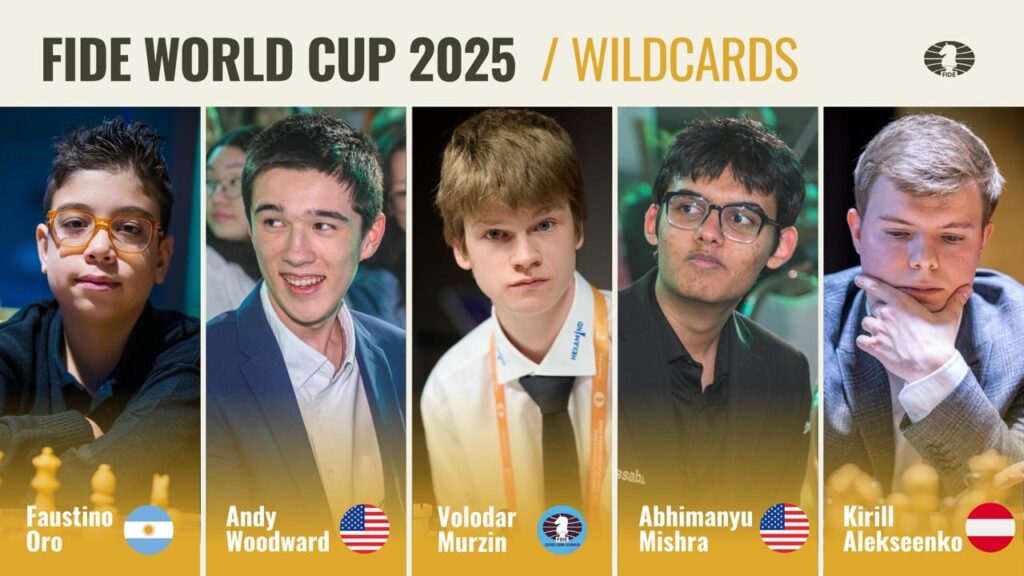
Rising stars and top performers Faustino Oro, Andy Woodward, Abhimanyu Mishra and Volodar Murzin will join well-known GM Kirill Alekseenko at the FIDE World Cup this November in India. FIDE President Arkady Dvorkovich has officially granted the invitations for this year’s FIDE World Cup, which will take place in Goa from 30th October to 27th November. The World Cup will be a unique chance for these top talents to compete in one of the most prestigious tournaments on the chess calendar. Among the players are Americans Abhimanyu Mishra (the youngest player in history to become a Grandmaster) and Andy Woodward (this year’s winner of the Junior’s Closed US Championship) who had a spectacular run at the recent FIDE Grand Swiss in Samarkand, finishing 5th and 7th respectively. World Rapid Champion, 19-year-old Volodar Murzin, who is on the path of reaching 2700 ELO (currently at 2670), also got an invite, alongside 28-year-old Kirill Alekseenko (representing Austria), a participant of the 2020/21 Candidates tournament and a well-known player at strong individual and team events. The youngest joiner is 11-year-old Faustino Oro, the Argentinian prodigy often called the “Messi of Chess” and considered one of the most promising young talents in the game. “FIDE always works hard to find ways to give talented players a chance to improve and make their mark. The decision to award invites to these five players is based on a mix of recent performance, high-level potential and their contribution to the sport,” FIDE President Arkady Dvorkovich said. “The World Cup is one of the most difficult and most exciting chess events, given its knockout format, and will be a great opportunity for these players to show their best facing the best,” Dvorkovich added. There is one more invitation place to be decided before the World Cup starts in November. The FIDE World Cup takes place every two years, lasts for three weeks, and is one of the hardest chess tournaments to win. It features 206 top world players competing in a knock-out format consisting of mini-matches. At stakes are not just the title or the prizes but, crucially, three top spots leading to the Candidates tournament where the challenger for the title of World Champion will be determined.
World Cadet Chess Championship 2025 commences in Almaty, Kazakhstan
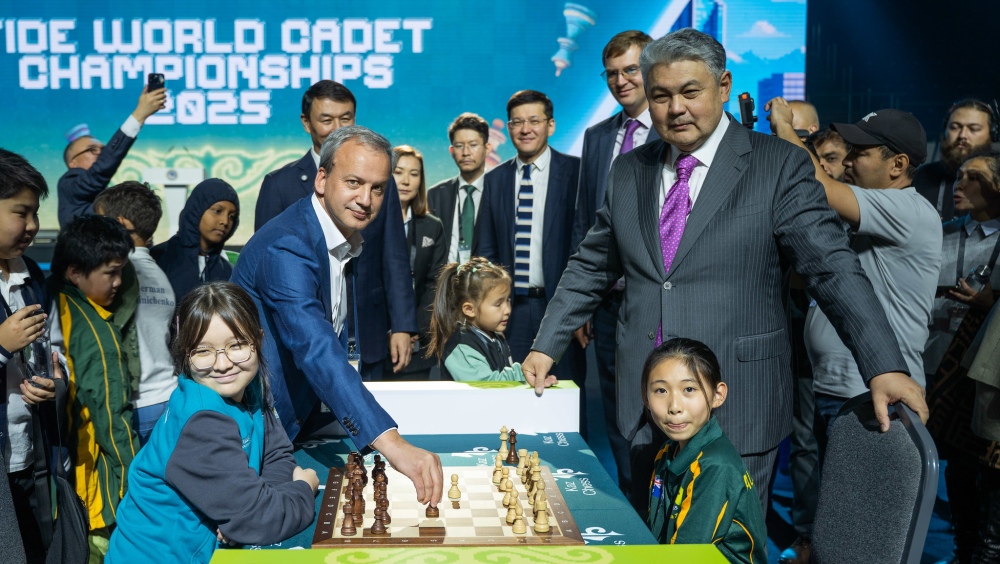
The World Cadet Chess Championship 2025 has officially started in Almaty, Kazakhstan. From September 19–30, more than 850 young chess players from 88 countries will compete for the titles across the U8, U10, and U12 categories. Kazakhstan, as the proud host, is represented by over 200 players. Such impressive representation is further evidence of the strong governmental support for chess. A few days prior to the championship, President of Kazakhstan Kassym-Jomart Tokayev visited the national Chess House. The building, located on the picturesque shore of Lake Kopa, was previously a presidential residence. It was repurposed for the benefit of children and opened its doors as the Chess House last December. During the conversation with young athletes and members of the national team, Kassym-Jomart Tokayev stressed that the state pays special attention to the development of chess, as well as to the promotion of children and youth. The glittering opening ceremony of the World Cadet Championship featured several distinguished guests: • Yerzhan Kosherbayev, Deputy Prime Minister of Kazakhstan• Darkhan Satybaldy, Akim of Almaty• Arkady Dvorkovich, FIDE President• Timur Turlov, President of KazChess Greeting the participants and guests of the championship, the president of KazChess/KFSH (Kazakhstan Chess Federation), Timur Turlov, emphasized: “No chess tournament, and perhaps no sporting event in our country’s history, has ever gathered such an extensive lineup of participants. This is a truly historic moment for Kazakh chess and our country. But we are welcoming guests not only as hosts but also in our status as one of the world’s strongest chess nations and the tournament’s main favorite.” Following musical and dance performances by popular Kazakh artists, the State Anthem of the Republic of Kazakhstan and the FIDE anthem were rendered. After Yerzhan Kosherbayev, Darkhan Satybaldy, Arkady Dvorkovich, and Timur Turlov made the first ceremonial moves on the top boards in the U12 Open and U12 Girls sections, the event was declared officially open. The rounds are played daily, except for September 25, which is a rest day. On this day, the young players will have the opportunity to take an excursion to the Shymbulak mountain resort, participate in the World Problem-Solving Championship, and compete in a blitz tournament with a prize fund of $2,000 USD. Photos: KazChess
Praggnanandhaa leads FIDE Circuit 2025; Eighth spot in Women’s Candidates wide open
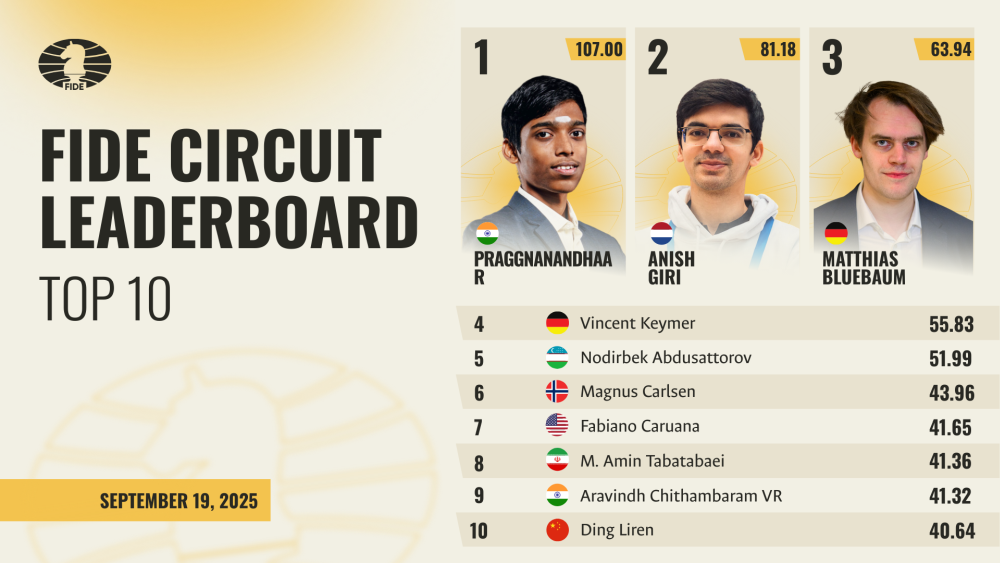
The recently concluded 2025 FIDE Grand Swiss and Women’s Grand Swiss in Samarkand have significantly reshaped the standings for both the FIDE Circuit 2025 and the Women’s Events 2024-2025. Despite earning no circuit points in Samarkand, Praggnanandhaa Rameshbabu preserved his dominant position in the FIDE Circuit 2025 standings. Crucially, his two main competitors—Anish Giri (winner of the 2025 Grand Swiss and currently second in the race) and runner-up Matthias Bluebaum—qualified for the 2026 Candidates Tournament through this event and are therefore no longer in the circuit race. As a result, the young Indian’s closest rival is now Vincent Keymer. The German GM gained 16.79 points in Samarkand and climbed to fourth position, but he still trails the leader by 51 points. Notably, Keymer has played just three tournaments counting toward the FIDE Circuit 2025, but there are few point-heavy events remaining in the next three months. The same applies to Nodirbek Abdusattorov (currently fifth, with four tournaments), as well as Magnus Carlsen and Chithambaram Aravindh, who have played only two events each. In summary, Praggnanandhaa’s lead looks virtually insurmountable. Even a brilliant performance in the remaining events by one of his competitors is unlikely to prevent him from qualifying for the 2026 Candidates via the FIDE Circuit 2025. The situation in the Women’s Events 2024-2025, however, is far more intriguing. Following the triumphs of Vaishali R and Kateryna Lagno in the Women’s Grand Swiss, all seven leading players in the Women’s Events race have qualified for the Women’s Candidates via various paths. The eighth and final spot in the competition—which will determine the challenger for the women’s world title—is still up for grabs. Currently leading the battle for that last berth is Bibisara Assaubayeva (99.4), who earned 60 points for her third-place finish in Samarkand and now sits eighth, just behind the already-qualified players. Chasing her are Song Yuxin (who tied for third place in Samarkand), Anna Muzychuk (both on 80 points), the winner of the 2022–23 Women’s Candidates Lei Tingjie (62 points), and the experienced Harika Dronavalli (58.5). Young Afruza Khamdamova, former Women’s World Champion Alexandra Kosteniuk (both on 38.5), Mariya Muzychuk (26.40), Nana Dzagnidze (25), Ulviyya Fataliyeva (20), and Irina Krush (20) also have a shot. With the large number of points available at the upcoming Women’s Rapid and Blitz Championships, all remain mathematically in the race. Each of these contenders faces the formidable challenge of outperforming the rest in the season’s final events to secure the last coveted spot in the Women’s Candidates 2026. We maintain dedicated pages on our website for the FIDE Circuit 2025 and FIDE Women’s Events 2024-2025, featuring the latest information on eligible tournaments, current standings, and regulations. Visit: FIDE Circuit 2025 and FIDE Women’s Events 2024-2025
Record number of teams to participate in 5th Intercontinental Championship for Prisoners

The 5th FIDE Intercontinental Online Chess Championship for Prisoners will be held October 14–16, 2025, bringing together incarcerated players from around the world in a unique celebration of the rehabilitative power of chess. Organized as part of the Chess for Freedom program, a joint initiative by FIDE and the Cook County Sheriff’s Office (Chicago, USA), this annual event highlights the role of chess in education, inclusion, and reintegration. This year’s championship sets a new record with 135 teams representing 57 countries, including 89 men’s teams, 26 women’s teams, and 20 youth teams. Six countries — Eswatini, Guyana, St. Kitts and Nevis, Lesotho, Poland, and Aruba — are making their debut, further expanding the global scope of the initiative. Examples from new participants show the impact of chess behind bars. In Guyana, the Prison Service launched a training and development program at Lusignan Prison with the support of FM Anthony Drayton and the Guyana Chess Federation. Donated chess sets are helping extend the program across the country’s correctional facilities, giving participants valuable skills in problem-solving and critical thinking. In Aruba, the national federation’s Chess for Freedom program recently inspired incarcerated individuals through competition, focus, and creativity, demonstrating that chess can serve as a tool for empowerment and unity. The championship will be played on Chess.com with a time control of 10 minutes + 5 seconds increment. The round-robin stage and the finals will be broadcast live on the FIDE YouTube channel, featuring guest appearances from chess officials, prison authorities, coaches, and correctional officers sharing their experiences of teaching chess in prisons. Now in its fifth edition, the Intercontinental Online Chess Championship for Prisoners has become one of the flagships of FIDE Social Year activities. Alongside annual conferences and expanding national programs, growing research continues to confirm the positive outcomes of teaching chess in correctional settings — from improving concentration and discipline to strengthening social inclusion and rehabilitation prospects. With record participation, inspiring stories, and a truly global reach, the 2025 Championship promises to once again showcase the unifying power of chess — proving that the 64 squares can change lives, no matter the circumstances.
FIDE World Rapid & Blitz Championships 2025: 100 days to go
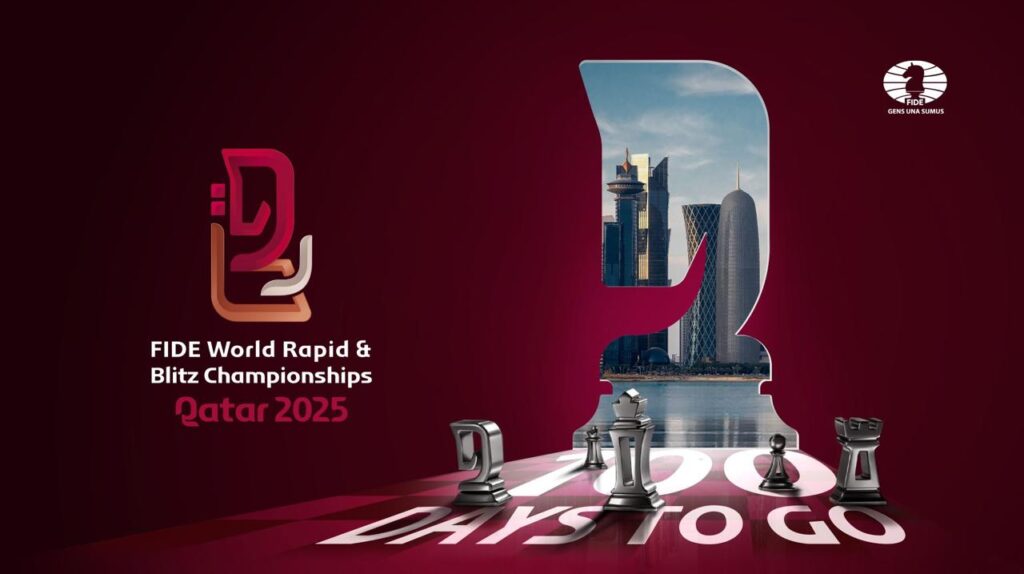
Doha gets ready to welcome the participants of the world’s fastest chess tournament for a spectacular end to the year. FIDE today announced the regulations for the 2025 World Rapid and Blitz, which will be held from 25 to 30 December and feature a one million euro prize fund. The World Rapid and Blitz traditionally take place in late December, offering a spectacular finale to the calendar year. Often referred to as the most exciting chess event closing the year, the tournament crowns the kings and queens of the game in its fastest formats. Top men and women from across the globe will gather for what promises to be a great chess spectacle hosted by Qatar – a nation which plays an increasingly prominent role on the global chess scene. “The World Rapid & Blitz has traditionally been one of FIDE’s most closely followed events globally, playing a key role in promoting chess to a broader audience,” FIDE President Arkady Dvorkovich said. “We’re planning every detail to make it a world-class event. We are very fortunate to have support from the Qatar Chess Association, which is working hard with FIDE to put on a great chess show at the end of this year, and we’re looking forward to it,” Dvorkovich added. Doha hosted the WRB Championships in 2016. With the World Rapid and Blitz returning to Qatar after nine years, expectations are high for a nation which has in recent years made significant strides in supporting and promoting chess, including the famous Qatar Masters and the most recent Qatar Rail Chess Open. “We are delighted to welcome the World Rapid and Blitz back to Doha. With the strong support we enjoy in Qatar and the excellent cooperation with FIDE, we have been able to move quickly on key preparations – ensuring the venue, hotels, and all organisational details are set to provide players and spectators alike, both onsite and online, with the highest level of comfort and an unforgettable experience. We believe this edition of the World Rapid and Blitz will serve as a cornerstone in further strengthening chess in Qatar and across the region, while also contributing to the game’s growing global popularity. This is only the beginning of greater achievements to come, and I am confident this will be an event to remember,” said Mohammed Al-Mudhahka, President of the Qatar Chess Association. The regulations for the 2025 World Rapid & Blitz, outlining all the necessary details regarding the most anticipated fast-paced chess tournament on the planet, can be found here: Open (PDF) Women’s (PDF) Key highlights from the regulations: The format The format remains largely unchanged from 2024. The Rapid Championships will include 13 rounds in the Open and 11 in the Women’s tournament, played under the Swiss system and with the time control of 15 minutes and a 10-second increment per move. In the case of a tie for first place even after all tie-break criteria have been applied, the players will play a Blitz match to determine the champion, which can end in a sudden death game in case of further draws. If there are more than two players tied for first place after all tiebreak criteria have been applied, a knockout Blitz tournament will take place. The World Blitz Championship will feature two stages. In the first stage a large Swiss system tournament will take place (19 rounds in the Open and 15 in the Women’s event). Then, in stage two, the top four players will advance to the knockouts which will consist of four game matches. The knockout format in the Blitz was first introduced in the 2024 event, when it featured eight players. The change from last year is that the number of players who qualify for the knockouts is four instead of eight. If the score is even after four blitz games, one sudden death game shall be played to determine the winner of the match. Who can take part? The World Rapid & Blitz traditionally bring together all the best players in the world, in both the Open and the Women’s category. Traditionally, FIDE sets a threshold for players to be eligible to participate. This year, the threshold for the Open event is 2550 ELO points on any 2025 FIDE rating list. In the Women’s competition, the threshold sits at 2250 ELO points. Also, national champions (in any format – Standard, Rapid or Blitz) are eligible to take part. The regulations also include provisions for a “reasonable number” of players outside the qualifying criteria, who can be nominated by the FIDE President and the Organiser. The prize fund The total prize fund for the event is one million euros, split across the Open and the Women’s tournaments. The prize fund for the Open event is 700,000 euros, split equally between Rapid and Blitz (350,000 euros each). The winner of the Open Rapid and the Open Blitz will get 70,000 euros each. The Women’s event features a total prize fund of 300,000 euros (150,000 euros each for the Rapid and the Blitz). The winner of the Women’s Rapid and the Women’s Blitz will get 40,000 euros each. Player support The costs of travel and accommodation will be covered for all players in the Open section rated 2750 points and above, and players rated at least 2500 in the Women’s section. Also, gold, silver and bronze medallists from the 2024 World Rapid & Blitz will have their full accommodation covered, and they will be provided with a daily spending allowance. Event schedule The opening ceremony and technical meeting will take place on 25th December. The World Rapid Championships will take place on the 26th, 27th and 28th December. The World Blitz Championships will take place on the 29th and 30th December. The games are scheduled to start each day at the same time – 2 PM. The Semi-finals in the Blitz are scheduled for 30th December at 5.30 PM, while the Finals will start at 7.15 PM. The closing ceremony will start
The magic of chess comes to the National Gallery – 11th Judit Polgár’s Global Chess Festival
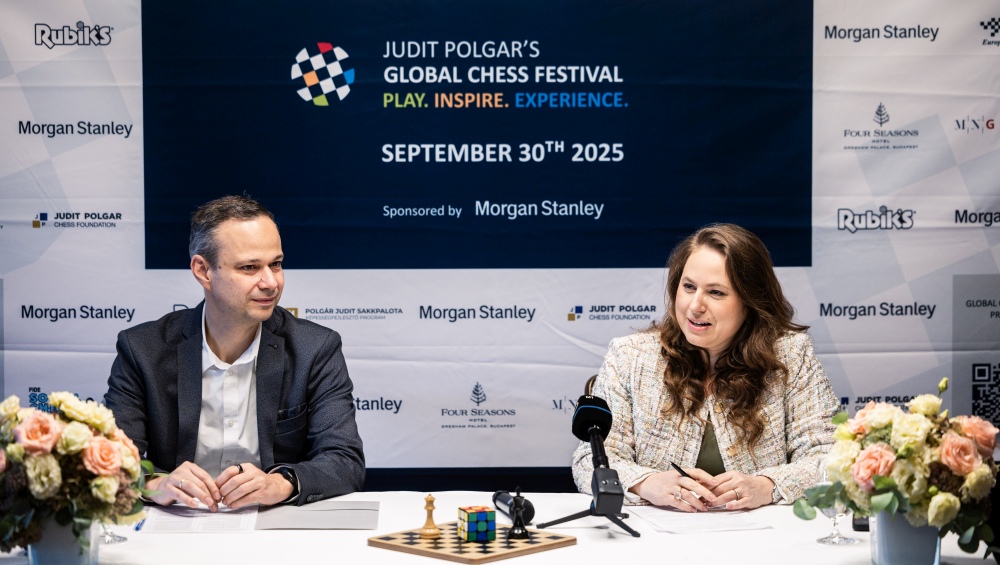
Budapest, September 16, 2025 – Chess is not just a sport, but a way of thinking, a creative adventure, and a shared experience. This is the message once again carried forward by the Judit Polgár’s Global Chess Festival, which will welcome visitors for the eleventh time on September 30, in the impressive halls of the Hungarian National Gallery. At this large-scale, all-day event, thousands of visitors will have the chance to meet the world-famous Polgár sisters in person while discovering the many faces of chess. This year’s festival highlight is RubikChess, a unique mixed-pair team game that combines the strategic elements of chess with the logical challenges of the Rubik’s Cube. Judit Polgár, founder and chief organizer of the Global Chess Festival, emphasized about this year’s program:“The Global Chess Festival is a special experience for me every year. I personally take part in both designing and organizing the programs. This year, I’m especially looking forward to the community simul, where I’ll be playing simultaneously on six boards, each against a different community. There will be Spanish and Hungarian teams, a former chessboxing world champion, and the world’s largest chess platforms will also join the game. It’s all very exciting! Visitors can also try the world’s first AI-powered chess robot, while the Momentán Theatre group will engage the audience in interactive improvisation games. Every program element represents value for us – our goal is to convey these in an enjoyable way for all generations. I believe that play and thinking together are inspiring, and this inspiration is what we want to share in every moment of the festival.” Norbert Fogarasi, representing Morgan Stanley, the festival’s main sponsor, added:“Chess is a perfect example of how play can evolve into a source of deep thinking, strategy, and innovation. At Morgan Stanley’s Budapest office, we have spent years building initiatives that nurture creativity, perseverance, and collaboration in playful ways – from team-building challenges and internal chess tournaments to our global online competition that now brings together more than a thousand players from over 40 cities worldwide. We have seen firsthand how play encourages colleagues to think more openly, explore new solutions with greater confidence, and excel at the highest levels of the financial world – whether in technology or quantitative financial modeling. This is why it is both important and a true honor for us to support Judit Polgár’s Global Chess Festival for the seventh consecutive year, an event that so powerfully demonstrates the role of play as a source of inspiration across society.” The festival will also host a RubikChess tournament with 50 teams, the lineup filling up quickly after the event was announced. In this special-format competition, one member of the mixed pair battles on the chessboard while the partner solves a Rubik’s Cube puzzle – their solution directly influencing the progress of the chess game. The RubikChess Tournament is supported by the FIDE Commission for Women’s Chess. Anastasia Sorokina, Chair of the FIDE Women’s Commission, will attend the festival in person. As every year, the festival promises plenty of new experiences, exciting encounters, and unforgettable moments – whether for beginners, aspiring masters, children, or adults. The 11th Judit Polgár’s Global Chess Festival invites everyone to step into the magical universe of chess! Programmes: globalchessfestival.com/index.php/en/
Final round drama at Grand Swiss in Samarkand: Giri triumphs, Vaishali makes history
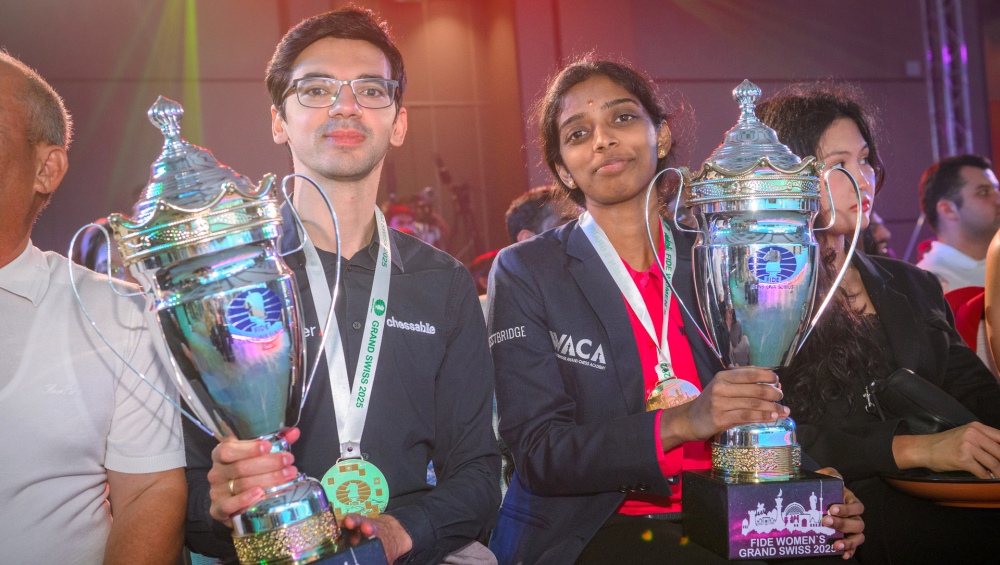
With 8/11, Anish Giri won the Open tournament outright, defeating Hans Niemann in the final round. Just half a point back, Matthias Bluebaum, Alireza Firouzja and Vincent Keymer shared second place. Thanks to a better tiebreak, it was Bluebaum who secured the second qualifying spot for the 2026 Candidates. In the Women’s event, on 8/11, Vaishali Rameshbabu and Kateryna Lagno tied for first and both qualified for the Candidates, but Vaishali took top spot on tiebreak. It was her second consecutive Grand Swiss victory – something never achieved before in either section. Apart from qualifying for the Candidates for the third time in his career, being the sole winner meant Giri also pocketed $90,000. In his first reaction to the victory, speaking in FIDE’s live broadcast, Giri said that the previous night he “visualised” a victory against Niemann: “There is this technique and… I saw myself win. Then I went a bit too far and started to think who will be in my team for the Candidates and I said I needed to stop at that point, as it was too far”. The second place went to European Champion Matthias Bluebaum, who drew a tense game with Alireza Firouzja today. Firouzja finished third. The most unfortunate of the frontrunners was Vincent Keymer, who ended up fourth. He missed a chance to beat Bluebaum in round ten and went into the final day as sole leader only to fail to convert a better position against Erigaisi. In the Women’s event, leaders Vaishali Rameshbabu and Kateryna Lagno both drew, sharing first place. The bronze went to Bibisara Assaubayeva, who missed a chance to tie for first after spoiling a winning position against Anna Muzychuk. She finished on 7.5/11, alongside Tan Zhongyi and Yuxin Song. How the last day in Samarkand unfolded Tension was palpable in the playing hall of the EXPO Centre in Samarkand, as players gathered for the final round of the 2025 FIDE Grand Swiss. On previous days, players often paused for photos with waiting fans. On the final day, the favourites rushed straight inside, razor-focused on their games. The games started at 2 PM, an hour earlier than in the previous 10 rounds, to accommodate the closing ceremony and prize giving scheduled for 9 PM local time in Samarkand. At stake were two places leading to the 2026 Candidates as well as a hefty prize fund of $855,000. In the Open section, with 7/10, five players were in the race for the top two places – Bluebaum, Firouzja, Giri, Niemann and Keymer. In theory, tiebreaks kept three more players in contention on 6.5/10 – Mishra, Erigaisi and Woodward. In the Women’s Grand Swiss – Vaishali and Lagno as the two leaders, as well as Assaubayeva, Tan and Song were in the race to be the winner. Out of the five, Tan – a former Women’s World Champion – has already qualified for the 2026 Candidates, thanks to finishing third in the Grand Prix. Continuing the tournament’s departure from the tradition of making ceremonial moves only on the top board, FIDE President Arkady Dvorkovich made the first move on board 57 in the Open, in the game between Divya Deshmukh and Ivan Cheparinov. The Open The first to qualify for the Candidates from the Open section was the seasoned player Anish Giri. In one of the most anticipated duels of the final round, he defeated the American Hans Niemann in just over four hours and fifteen minutes. Both players were under pressure to win if they wanted to secure a spot in the Candidates. For Niemann, the game unfolded in the worst possible way. Playing the English Opening as White, Giri obtained the lasting two-bishop advantage and gradually gained command by advancing pawns on the kingside and then breaking through on the opposite wing. The critical moment of the game came on move 32. Choosing between 32…bxc5? and 32…Nxc5 (which offered some chances for a long resistance) Niemann opted for the former, which was a serious mistake. Analysing this position in the FIDE tournament broadcast after the game, Giri said: “I had a difficult choice – I could just move the bishop or take [with the rook] on b3. My logic was that, if moving the bishop wins, it’s OK. But if taking on b3 wins and I don’t do it and don’t qualify for the Candidates, I will never forgive myself. And that’s why I took [the knight on b3, with the rook]”. 33.Rxb3! Bxb3 34.Bxc5 Kd7 35.Bxd6 Kxd6 36.g5! This bishop endgame with an extra pawn is winning for White and Giri sealed the deal nine moves later. Despite the win there was a very small chance that Giri would not qualify given the poor tiebreak. However, soon after his win the result on board one came in – Bluebaum and Firouzja split a point in the Dutch Defence. Although the position is even, there is a lot of tension on the board. 26…Nxg2 27.Qxb6! Bluebaum counters any idea from Black to get more tactical. After 27…Qxb6 28.Qxb6 Nf4 29.Ne4 an even endgame emerged on the board. With both opponents playing precisely, a draw on move 56 came as a logical outcome. Not long after this game, the duel between Arjun Erigaisi and Vincent Keymer also finished in a draw. Arjun correctly sacrificed an exchange in a rare line of the Queen’s Indian and obtained a sufficient compensation. After several imprecisions on his part, White’s initiative petered out and Vincent got a real chance to convert his advantage. To achieve this task, Vincent had to find a fantastic move in the following position: This was the high point of Keymer’s advantage. He had a straightforward win here, but it was very difficult to spot. The winning move is paradoxical 31…Be6!! placing his bishop under a double attack. The idea behind this fantastic move is to trade the queens transposing into a winning endgame, thanks to a5-a4 idea. Surprisingly White has no sufficient defence. But it is hard
FIDE Grand Swiss 2025, Round 10: A five-way race in the Open ahead of the final round
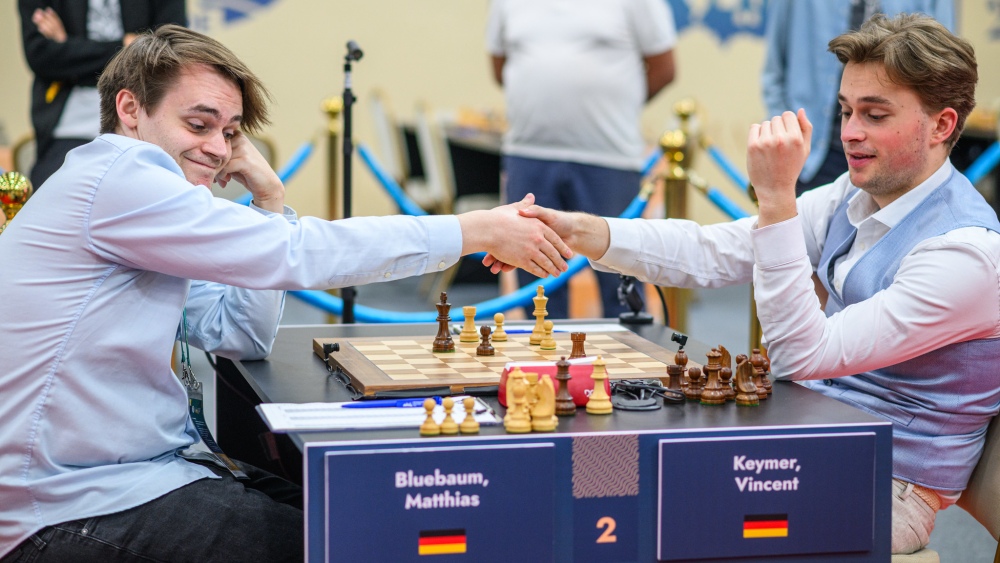
With draws on the top five boards in the Open, five players enter the final day in shared first place on 7/10. Vincent Keymer missed a chance against Bluebaum to take the sole lead, while Vaishali Rameshbabu staged a remarkable comeback in the Women’s tournament to reach the top. With just one more round to go, the race for the top two places leading to the 2026 Candidates is wide open in both tournaments. Of the five in contention in the Open – Firouzja and Giri have previously played in the Candidates, while Keymer, Bluebaum and Nimann have not. The penultimate round in an open Swiss System tournament is always tricky – while playing for a win is always the goal, a loss can cost you dearly and eject you from the top positions. That is why some players opt for a cautious approach, avoiding too much risk. However, the five draws on the top boards were not all uneventful and none was quick. The board one duel between two classical heavyweights, Alireza Firouzja and Anish Giri, ended in a draw. Playing the French line of the Sicilian, the two made just 17 moves in two hours, agreeing to split a point after a threefold repetition. Both likely calculated it was better not to force but, instead, see how things pan out on other boards, leaving tomorrow’s final round for a decisive push. Things were dramatically different on board two, where European Champion Matthias Bluebaum found himself in serious trouble against Vincent Keymer, who had the white pieces. Playing a rare line on the black side of the Reti, Bluebaum soon came under serious pressure. The opponents reached the first critical position as early as on move 21. One of White’s pieces should jump to g5, but which one? Keymer made a wrong choice here playing 21.Bg5?! Instead – after 21.Ng5! Bxg5 22.Bxg5 f5 23.Qxe8 Rfxe8 24.Be3 the resulting endgame is virtually winning for White. As played, Black avoided the worst with 21…f6 22.Qxe8 Rxe8. The endgame saw both sides go through ups and downs, but eventually Keymer achieved the decisive advantage, only to let it slip away with just one move. Instead of the solid 54.Ne4, Keymer went for the hasty 54.Rh7??, missing an important tactical subtlety. 54…Nxg3!! If 55.Kxg3 then 55…Rd3+. Keymer tried 55.Rh6+ Kf7 56.Nb1 Rb2 57.Kxg3 Rxb1 and now it’s a draw. A lucky escape for Bluebaum, who enters the final day as one of the leaders. On board three, Chinese Grandmaster Yu Yangyi had a better position as White against Arjun Erigaisi at some point, but the game ended in a draw. Abhimanyu Mishra drew as White against Maxime Vachier-Lagrave, with neither side getting much going in the game. Playing on board four, Uzbekistan’s Nodirbek Abdusatorrov was in trouble against Nihal Sarin on the black side of the Sicilian Rossolimo. The situation is extremely dangerous for Black, as his bishops have limited space while White’s pieces are very well coordinated. White had an almost straightforward win here with 18.exf6 Bxf6 19.Be3 Qb5 20.Nc5 e5 21.Ne4 Be7 22.b4 Be6 23.Rxd8+ Bxd8 24.Nd6 Qd5 25.Nxf7 Kxf7. Instead, Sarin played 18.Be3 first but after 18…Qc7 19.Bc5 Bd8 20.Bxe7 Qxe7 21.Rxd8 Qxd8 22.exf6 Rxf6 Black’s position is no fun, but he is out of the woods. Eventually, Abdusatorrov reached a draw on move 53. All six players finished the day on 6.5/10. The tournament’s top-rated player, R Praggnanandhaa, had his chances of reaching some of the top places, but his hopes were completely shattered today. He lost to Hans Niemann following time trouble in a very sharp game. Playing the Sicilian, Praggnanandhaa started to lose control in the middlegame and by move 33, he was in serious trouble. According to Niemann, who analysed the game in the FIDE broadcast, this was the critical moment of the game. Black played the reactive 25…Rc7. Instead, according to the US Grandmaster, he should have proceeded with 25…Rc1+ and after 26.Qxc1 Qxb4 27.a3 with an unclear position. Chess engines, however, question this recommendation as after the simple 27.Rxe8+! Bxe8 28.Qc8 Black is completely lost. A couple of moves later, the two had reached the following position: White is winning, but he has to avoid many pitfalls. However, after 34…Qf1?? played by Pragg, Black is doomed. 34…Qc5 offered more hope. The rest was smooth sailing for Hans. 35.Qe3 Bb5 36.Re4! After doubling along the e-file White penetrates to Black’s camp. 36…Kh8 37.Qd4 Kg7 38.Rf4 and Praggnanandhaa resigned. The victory propelled Niemann to a shared 2-4th place, a step away from reaching the Candidates for the first time in his career. Praggnanandhaa is on 5.5/10. Asked about his expectations for the final game, Niemann said he hoped to play “someone who needs a win as well”, alluding to the view that if White plays for a draw from the opening, at this level, it is difficult for the other side to get much more. In the final round Niemann will be up against Anish Giri and a draw might leave both of them without one of the two spots leading in the Candidates. Ukrainian Vasyl Ivanchuk was declared the player of the day in the Open following a tactical finish against Jonas Bjerre. 45…Qf4+! 46.Kg2 Qe4+ 47.Kh2 Rxe3 48.fxe3 Qxe3 49.Qb1 e4 50.Ng2 Qf2 After a few more moves in which White just delayed the inevitable, Bjerre resigned. World Champion Gukesh D finally ended his six-game-long winless run. Playing as White, he defeated Armenia’s Gabriel Sargissian in the Italian Game. With one round remaining, Gukesh is only on 5/10. The Women’s event Vaishali Rameshbabu struck back today to reach the lead again. She was the only winner among the top boards in round ten. Playing with the white pieces against former Women’s World Champion Mariya Muzychuk, Vaishali recovered from a lost position, following time trouble. Black is a pawn up, has more active pieces and initiative across the board. But Muzychuk squandered her advantage and allowed Vaishali to equalise. 30…Bxc2? Giving up one of