

World Senior Championships 2025: Four-way tie in 50+; England leads 65+
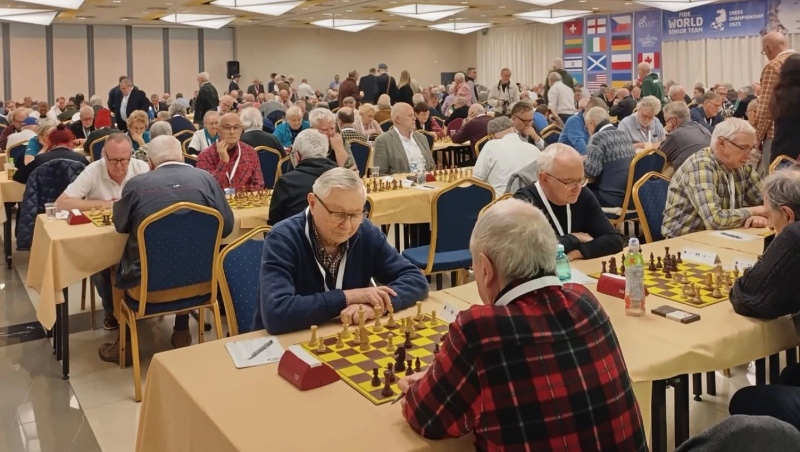
The 2025 World Seniors Team Chess Championship in Prague is entering its final stages. With just three rounds to go, both the 50+ and 65+ competitions remain wide open, setting the stage for an exciting finish. After six rounds in the 50+ section four teams–England 1, USA, Slovakia and Italy– share the lead on 10/12 points with England 1 holding the top spot due to a greater number of points. Round 7 will feature key matchups between the leaders, as USA faces Italy while Slovakia takes on England 1. In the women’s standings, China leads with 8/12 points, closely followed by Czech Women and the USA. 50+ standings after Round 6 In the 65+ category, England 1 leads with 11/12 points, having won five matches and drawn just one against Lasker Schachstiftung GK, which trails by a single point on 10/12. Five teams—France, England 2, Israel, Hungary, and Norge – OSS—are tied for third place. Round 7 will see England 1 tested by France, while Lasker Schachstiftung GK faces Norge – OSS, and England 2 plays Israel. 65+ standings after Round 6 The tournament has already produced many remarkable encounters, with the best game of each round being awarded a special prize. GM Lexy Ortega from Italy won the first-round award (a small chess horse), followed by English GM Michael Adams, Swedish IM Nils-Gustaf Renman, Dutch FM Prakken Gerrit and Moshe Gal of Israel (pictured below). On the rest day, February 22, participants had the opportunity to take a guided tour of Prague, the stunning capital of the Czech Republic. Additionally, a blitz tournament was held, with Jaan Ehlvest emerging as the winner. Photos: Ave Chess
Midway through FIDE WGP Monaco: All draws in Round 5
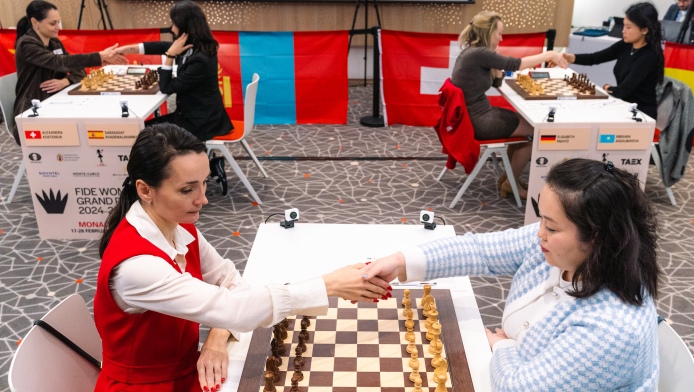
As the third leg of the 2024/25 FIDE Women’s Grand Prix series reaches its halfway mark, Round 5 saw all five games end in draws—yet the results hardly tell the full story. Despite the peaceful outcomes, the battles were anything but uneventful, with players pushing hard, missing key opportunities, and ultimately splitting the points in tense encounters. With the only rest day ahead, the tournament remains wide open, and the second half promises even more excitement. Round 5 results: Harika Dronavalli 1/2-1/2 Aleksandra GoryachkinaElisabeth Paehtz 1/2-1/2 Bibisara AssaubayevaBatkhuyag Munguntuul 1/2-1/2 Kateryna LagnoAlexandra Kosteniuk 1/2-1/2 Sarasadat KhademalshariehZhongyi Tan 1/2-1/2 Humpy Koneru Harika Dronavalli – Aleksandra Goryachkina Starting off with a Ruy Lopez Berlin, one of the most solid systems in chess, a draw was not a surprising result, although the game did offer excitement regardless of the opening’s reputation. A slow game unfolded, with multiple trades in the middlegame, leading to a roughly equal position. After inaccurate play by White, Black obtained an advantage, with the chance to press for a win. At this point, Black had an opportunity to exert real pressure with 26…Na6 with the idea of 27…Nc5, which is the best square knight in this structure (26… Rd6 was also a very strong option). However, Goryachkina should have weighted the consequences of the line 27. Qb7 Nc5 28.Qxc7, in which Black sacrifices a pawn for positional compensation. Aleksandra opted for 26…Qd6 and after 27.h5 Qf6, White gave Black another chance to grab initiative with 28.Re1? by simply capturing on h5, as Qh4 was no longer a threat. Instead, 28…Qg5 balanced the game again. After further exchanges, a draw was agreed. Goryachkina missed a few chances, but given the grueling pace of the tournament, fatigue is a factor. With the rest day ahead, both Harika and Aleksandra will look to recharge before the crucial second half. Elisabeth Paehtz – Bibisara Assaubayeva After suffering a dramatic loss in the previous round, Paehtz chose not to retreat into a cautious approach, but instead opted for an aggressive response to Assaubayeva’s Najdorf. White emerged from the opening with a dominant position: Here, Paehtz played 17.Ba4?, allowing Black to escape via queenside castling. A stronger alternative would have been a queen move, followed by placing the bishop on e6, where it would dominate the board. After 17…0-0-0 18.0-0-0 Qc7 19.Bb3? Na5, White’s advantage evaporated. Our commentators analyzed the fascinating move 19.Rd5!, a practical shot that could have led to an imbalanced fight. After 19…Ne7 20.Qb3, White would allow Black to capture the rook, gaining a dangerous initiative in return. Instead, the game equalized and ended in a threefold repetition. Despite the missed opportunity, Paehtz’s combative approach is a promising sign for the second half. Meanwhile, Assaubayeva, who stabilized after her third-round loss to Goryachkina, will look to regain momentum. Batkhuyag Munguntuul – Kateryna Lagno Munguntuul has been one of the tournament’s surprises, delivering a strong performance with an undefeated streak so far. She tested the Caro-Kann Defense, which is part of her regular repertoire, in her game against Lagno. Black managed to win a pawn, but at the cost of compromising her pawn structure. This positional imbalance allowed White to generate sufficient counterplay, ultimately leading to a draw. For Munguntuul, this is an impressive result. She was not only the rating underdog by 184 points, but she also endured a tough previous Grand Prix leg, losing all her games with White. Now, she stands within reach of a potential GM norm, should she continue this solid run. Meanwhile, Lagno retains her tournament lead, thanks to an all-draw round. Alexandra Kosteniuk – Sarasadat Khademalsharieh The first game of the day to finish was the encounter between Kosteniuk and Khadem that ended in a draw. What started as an interesting line in the Queen’s Gambit Declined Exchange Variation reached this fresh position after Black’s 11…Bb4: Commentators noted that 12.Kd2 was a slightly more accurate, whereas 12.Bd3 played by Alexandra allowed Black to get counterplay after exchanging on c3 and eventually bringing the knight to the c4 outpost. Despite the seemingly vulnerable kingside pawn structure, Black’s position remained stable, supported by the king and the open g-file. After multiple trades, the game ended in a threefold repetition. Zhongyi Tan – Humpy Koneru Tan, one of the pre-tournament favorites, has faced unexpected difficulties in Monaco. She entered today’s game with solid preparation in the Neo-Catalan Defense Declined, often employed by her compatriot Ding Liren. Initially, White achieved a comfortable position, but mishandled it shifting focus between the queenside and kingside, giving Koneru to arrange her pieces on optimal squares and reach a winning position. White had already gone with the incorrect plan of pushing her kingside pawns, but here the 27.f6 does not amount to any attack as the natural 27…g6 stops everything and suddenly the white king is exposed and in danger. However, Humpy incorrectly played 27…Ng4? picking the f6-pawn but letting White off the hook. Instead, maintaining control and launching an attack on the white king was much more dangerous for White. In a post-game interview, Humpy noted that she thought she must have been better and did in fact calculate the 27…g6 variation, but was not sure about it. The game instead continued with multiple trades where Black managed to hold onto the extra pawn, resulting in a drawn knight endgame where both sides had passed pawns that did not offer any real danger. The final handshake came after 4.5 hours of play, bringing an intense game to a peaceful conclusion. With the first half of the event behind us, the tournament heads into its only rest day, when players will enjoy an excursion in Monaco. This break comes at an ideal moment, offering a mental reset before the decisive second half of the competition. Standings after Round 5: 1 GM Kateryna Lagno 2515 3½ 2 GM Humpy Koneru 2523 3 3 IM Sarasadat Khademalsharieh 2458 3 4 IM Batkhuyag Munguntuul 2331 3 5 GM Alexandra Kosteniuk 2484 2½ 6 GM Aleksandra Goryachkina 2546
Third leg of FIDE WGP 2024–2025 kicks off in Monaco
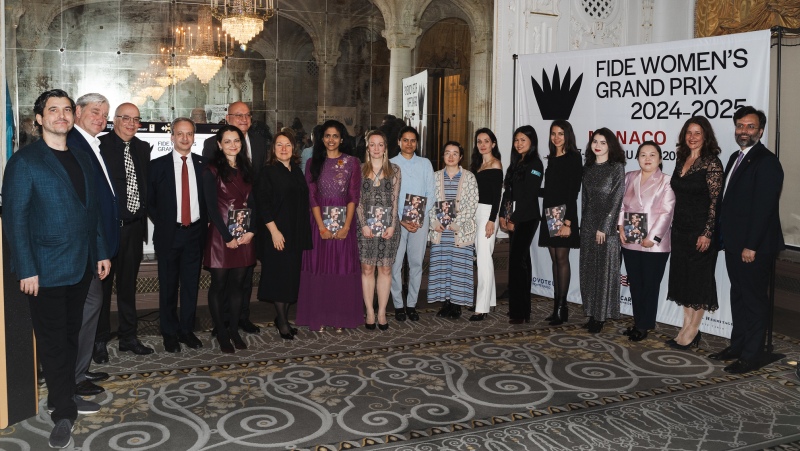
The opening ceremony of the third leg of the FIDE Women’s Grand Prix 2024-25 took place on February 17 at the Salon Excelsior of the Hotel Hermitage Monte-Carlo. Welcoming players, officials, and guests in a refined and elegant setting, the event marked the start of this important stage in the FIDE Grand Prix series. The official program began at 18:00 with a welcome video introducing the tournament and its host city, Monaco. Moderator (and commentator for the event) Almira Skripchenko then welcomed everyone stating that she “didn’t know how to introduce Monaco, but that in fact, it needs no introduction” as it has served as a hub for women’s chess. A series of brief speeches followed. FIDE President Arkady Dvorkovich opened by reflecting on the continued growth of women’s chess and the significance of this tournament within the wider chess calendar. Stéphane Valeri, CEO of the Société des Bains de Mer, spoke about Monaco’s connection to chess and the honor of hosting the event. Tournament Director Jean-Michel Rapaire highlighted the preparations that went into organizing the event, while Irina Bazhenova from TAEX expressed her company’s support for chess as a platform for education and development. Saxophonist Maria Zvereva performed a musical piece, providing a brief interlude before the presentation of the players. Each of the ten participants was called to the front to receive a copy of the FIDE100 book “Chess Players” where they were warmly welcomed as the superstars of the event. The players remained on stage for an official group photograph with the tournament’s sponsors and organizers. Following the player presentation, FIDE President Arkady Dvorkovich presented commemorative FIDE100 medals to Stéphane Valeri and Virginie Cotta of SBM, in recognition of their support for the event. The President then officially declared the tournament open. The evening concluded with a second musical performance and a cocktail reception, where guests had the chance to speak with the players, take photos, and enjoy the elegant surroundings of the venue. The tournament now moves into the competitive stage, with the first round scheduled for February 18. The third leg of the FIDE Women’s Grand Prix 2024–25 runs until February 28, with rounds starting at 3:00 p.m. local time each day. You can follow the games live and watch the action with our wonderful commentators GM Alojzije Jankovic & IM Almira Skripchenko on YouTube. Written by Chalize Van Zyl Photos: Niki Riga
Prague welcomes 2025 World Senior Team Championship
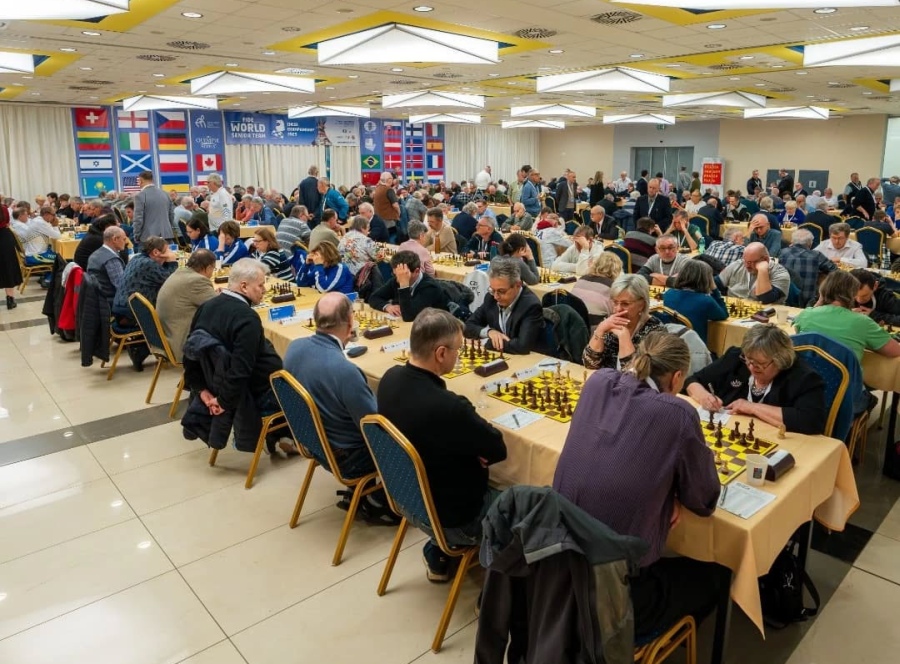
The capital of the Czech Republic, Prague, has become a hub of chess activity this February, hosting the 2025 World Senior Team Championship. Running from February 16–27, the event has brought together the world’s top senior chess teams, competing in two categories—Open and Women—across two age groups: 50+ and 65+. The championship is organized by AVE CHESS, in collaboration with the Czech Republic Chess Federation and the International Chess Federation (FIDE). The 9-round tournaments, played under classical time control, are being held at the Olympik Hotel complex, where participants are also accommodated. Photo: https://www.olympik.cz/ The winning teams will be crowned world champions in their respective categories and awarded trophies, diplomas, and financial prizes. In addition to the main event, players will have the opportunity to participate in rapid and blitz tournaments, as well as a guided tour of Prague’s historic center. To uphold fair play, only accredited individuals have access to the playing areas. However, chess fans worldwide can follow the games online, with 50 boards broadcasted in each category. The organizers look forward to an exciting tournament and wish all participants the best of luck! For additional information, visit the official website, and don’t forget to follow the event on Facebook and Instagram for updates.
Gligoric Trophy 2024: Call for Nominations
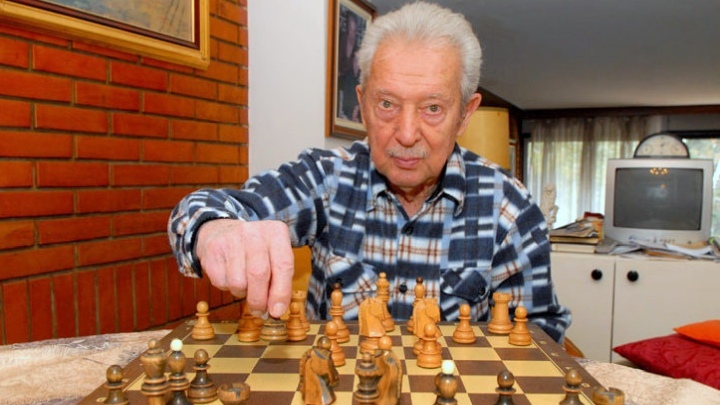
The FIDE Award Commission reminds about Gligoric Trophy call for nominations. Svetozar Gligoric Trophy is an award given by FIDE to the individual who display exemplary behaviour promoting the spirit of fair play and sportsmanship in chess. Candidates to win the Svetozar Gligoric Trophy 2024 shall have demonstrated the following accomplishments during the period August 10, 2022 to August 10, 2024: – Outstanding gesture or action of sportsmanship during the sport event. – Outstanding contribution to the popularization of values and principles of Fair Play. – Outstanding initiatives on enforcement of integrity and high ethical values. The Svetozar Gligoric Trophy is a recognition of sportsmen who exercise the fundamental values of Fair Play both during and beyond the game. It is a way of thinking rather than a mere behaviour and is based on the concepts of: Fairness – To enjoy the victory is not enough. Triumph must include fairness and honesty. Respect – Written rules are mandatory. Unwritten rules of respect to all are obligatory. Friendship – Rivalry in sports does not exclude friendship Team Spirit – A genuine consideration for team-mates Equality – Competing on equal terms is essential Tolerance – The willingness and ability to accept what you may not agree with Care – True champions care about each other Nomination Procedures The winner of the Svetozar Gligoric Trophy is selected annually by the FIDE Award Commission, comprised of Mr Mahir Mammedov (chairman) and members of the Commission GM Mrs Judit Polgar and GM Mr Eugenio Torre. Proposals for Nominations (Nomination Letter) from Continental Federations, National Federations, and FIDE Commissions shall be submitted to the Gligoric Trophy Award Commission of FIDE (gligorictrophy@fide.com) no later than August 10, 2024. Nominations from individuals, including self-nominations, are also allowed, but they should be channelled through the Federation associated with the nominee. Please note that this award is for the nominee’s accomplishments during the preceding year, NOT a recognition of a lifelong career. The Commission’s decision is final and not open to discussion. The members of the Commission shall not give justification unless they wish so. The Award Ceremony will be held during the 45th FIDE Olympiad in Budapest in September 2024. About the award The Fair Play Award, named after Svetozar Gligoric, was established by FIDE in 2019. It honors the figure of Svetozar Gligoric, one of the top players in the world in the 1950s and 1960s and also one of the most prominent, owing to his particularly engaging personality. At the chessboard, Gligoric was an uncompromising fighter and, at the same time, a symbol of gentlemanhood and correctness. His impeccable reputation has been a deserved result of his success in chess games and fair-play manners. Gligoric’s trademark was high respect for his chess opponents. His main principle was: “It’s chess pieces, not a man I play against!” It is no coincidence that the book of Gligoric’s selected games is titled “I play against pieces!” The first recipient of the Svetozar Gligorich Award was the world champion Magnus Carlsen, who received the trophy just minutes before his debut game at the FIDE World Cup 2021 in Sochi. In 2020, when all chess activities and competitions were moved to the online arena, Magnus Carlsen reached the semi-finals in the $150,000 online “Chessable Masters” against Ding Liren. Ding, playing from China, struggled with connection problems throughout the whole event, and in the final moments of his first game against Carlsen, he suffered an unfortunate disconnection at a vital moment. Unable to reconnect on time, the Chinese Grandmaster lost the game. Minutes later, in the second game between them, the World Champion gave up his queen and resigned after just four moves to restore parity in the match. Despite the high stakes and being a ruthless competitor, Magnus Carlsen demonstrated that winning fairly was far more important to him than winning at any cost. Next year, 2021, the Svetozar Gligoric trophy went to GM Jerguš Pecháč for his exemplary behaviour and fair play spirit. The 21-year-old Slovak GM made the headlines in the second round of the European Qualification Tournament when his over-the-board rival Boris Gelfand, Israel, blundered the queen due to a mouse slip. That game was a qualifier for the FIDE World Cup in Sochi. Despite the high risk of failing to reach the next round, Pecháč graciously offered a draw to his opponent, not taking advantage of Gelfand’s unfortunate mistake. With his action, Jerguš risked not reaching the third round, but luckily for him, he advanced anyway by winning the Armageddon. The Slovak GM again demonstrated that winning at all costs is not a priority – a noble gesture that Svetozar Gligoric himself would have undoubtedly applauded. Jerguš Pecháč was awarded Gligorich Prize during the 44th World Chess Olympiad in Chennai, India, in 2022, and, symbolically enough, the awared was handed out right before his game against the first winner of the Trophy, Magnus Carlsen. The third awardee of the Gligoric Trophy is Jaden Shaw, 15, Jamaica’s Absolute Junior Champion (U20), and FIDE Candidate Master (CM). Jaden received the prize during the closing ceremony of the 44th World Chess Olympiad in Chennai, India, 2022. His opponent, GM Meelis Kanep from Estonia, got sick during the Jamaica – Estonia match and thus could not finish the game. Jaden, who debuted at the Chess Olympiad, could have rightfully insisted on such a landmark victory but agreed to a draw. This act of true sportsmanship, lauded by many, including the president of FIDE and the chief minister of Chennai, compelled the FIDE Award Commission to make an exception to the rules and to hand out the second, off-the-schedule award in the same year.
African Championship 2024: Bassem Amin and Jesse February win titles

Bassem Amin (Egypt) and Jesse Nikki February (South Africa) are the new African Chess Champions. The top-seeded Egyptian GM, who clinched the title yesterday, continued his domination in the final round, defeating IM Andrew Kayonde (Zambia) with the black pieces. The champion scored an impressive 8.5/9, conceding his opponents just a half-point. The second seed, GM Bilel Bellahcene (pictured below, left), beat IM Mariano Ortega Amarelle of Cape Verde and finished second with 7/9. IM Chitumbo Mwali (Zambia; pictured above, right) pulled off a crucial victory over IM Fy Antenaina Rakotomaharo (Madagascar) and took bronze, netting 6.5/9. The sixth seed Zambian had a great tournament and picked up 39 rating points. Final standings Open: 1 GM Bassem Amin EGY 2670 8½ 2 GM Bilel Bellahcene ALG 2522 7 3 IM Chitumbo Mwali ZAM 2340 6½ 4 IM David Silva ANG 2358 6 5 FM Banele Mhango RSA 2193 6 6 Nicolas Cogan CIV 2070 6 7 IM Andrew Kayonde ZAM 2321 6 8 IM Odion Aikhoje NGR 2215 6 9 IM Fy Antenaina Rakotomaharo MAD 2454 5½ 10 FM Abdulrahman Abdulraheem NGR 2229 5½ Complete final standings In the women’s section, WIM Jesse Nikki February (RSA) needed just a draw against Lidet Abate Haile of Ephiopia to win the title, but it was not an easy task. The South African had a lost position at some point but eventually escaped with a draw and took gold with an impressive score of 7.5/9. The top and second seeds, WGM Shahenda Wafa (pictured above, left) of Egypt and WIM Lina Nassr from Algeria (both defeated by the champion with the black pieces), tied for second place on 6.5/9, with the latter winning silver thanks to a better opponents’ average rating. Final standings Women: 1 WIM Jesse Nikki February RSA 1920 7½ 2 WIM Lina Nassr ALG 2080 6½ 3 WGM Shahenda Wafa EGY 2083 6½ 4 Deborah Quickpen NGR 1945 6 5 Peninah Nakabo UGA 1836 5½ 6 Jemima Paulo ANG 1946 5½ 7 WIM Vania Fausto Da T. Vilhete MOZ 1829 5½ 8 Lidet Abate Haile ETH 1786 5½ 9 WFM Constance Mbatha ZAM 1799 5½ 10 WFM Ednasia Junior ANG 1915 5 Complete final standings Photos: Niki Riga and Ogunsiku Babatunde UPDATE March 20, 2024 Bassem Amin emerged as the winner of the African Championship 2024, clinching the title in the open section with a round to spare. GM from Egypt beat IM David Silva of Angola in the penultimate round to score 7.5/8 and became out-of-reach for all his competitors. GM Bilel Bellahcene (Algeria) and IM Andrew Kayonde (Zambia) are going into the final round, sharing second place on 6/8. Standings after Round 8 Open In the women’s section, the leader Jesse Nikki February (RSA) bounced back after yesterday’s loss, defeating Toritsemuwa Ofowino of Nigeria. IM from South Africa has an excellent chance for the African crown heading to the final round on 7/8, a full point ahead of Lina Nassr of Algeria (who scored a crucial victory over Peninah Nakabo of Uganda in Round 8). Deborah Ebimobo-Ere Quickpen (Nigeria) and Sharenda Wafa (Egypt) are tied for third place on 5.5/8. Standings after Round 8 Women UPDATE March 19, 2024 After seven rounds at the 2024 African Championship, Bassem Amin and Jesse Nikki February remained on top, with a one-point lead over their closest competitors. In Round 7 Amin defeated Jemusse Zhemba of Zambia to consolidate his leading position in the standings with 6.5/7. Bilel Bellahcene (Algeria) and David Silva (Angola) are tied for second place, trailing the leader by a full point. Jesse Nikki February suffered her first defeat in the competition at the hands of Deborah Ebimobo-Ere Quickpen of Nigeria. Still, she comfortably leads with 6/7, one point ahead of four players sharing second place. Standings after Round 7 Open Standings after Round 7 Women UPDATE March 18, 2024 After six rounds of exciting battles at the African Individual Championships 2024, Bassem Amin (Egypt) and Jesse Nikki February (South Africa) have emerged as the sole leaders in the open and women’s sections, respectively. The top seed GM Bassem Amin scored a crucial victory over one of his main rivals, GM Bilel Bellahcene of Algeria in Round 6, and grabbed the lead with 5/6. IM Chitumbo Mwali from Zambia had a chance to catch up with the Egyptian, but after drawing his game with David Silva (Angola), he trails the leader by a half-point (4.5/6). A group of four players is a full point behind Amin. Standings after Round 6 Open Jesse Nikki February (pictured above) has dominated the women’s section so far. The South African WIM notched up six straight wins, including victories over her main rivals, the top and second seeds WGM Shahenda Nafa (Egypt) and WIM Lina Nassr (Algeria), who are in second (5/6) and third (4/6) positions, respectively. Standings after Round 6 Women The African Individual Championships 2024 kicked off on March 13 in Accra, Ghana, the city that recently hosted the chess competition of the 13th African Games. Both open and women’s championships, 9-round Swiss events with classical time control, will stretch from March 13-20, 2024. Top African players, including Grandmasters Bassem Amin (EGY) and Bilel Bellahcene (ALG), International Masters Mariano Ortega Amarelle (CPV), Fy Antenaina Rakotomaharo (MAD), David Silva (ANG), Chitumbo Mwali (ZAM), Women’s Grandmaster Shahenda Wafa (EGY), and Women’s International Masters Lina Nassr (ALG) and Jesse Nikki February (RSA), have converged for this prestigious event. FIDE President Arkady Dvorkovich participated in the opening ceremony and made the first ceremonial move in the women’s competition. In his short speech he thanked the organizers, greeted all the participants and touched on social aspect of chess competitions in Africa. “I hope everyone will show their best in this event. I also wish luck to all of you… Chess in African Games was more than just a sports event. We connected local chess communities with national governments and commissions so they can help you in your countries.” FIDE President also announced that in just a few
World Junior U20 Championship 2024: Registration is open

FIDE and the Gujarat State Chess Association, on behalf of the All India Chess Federation, with the support of the Government of Indian Ministry of Youth Affairs & Sports, invite all FIDE Member Federations and eligible players to participate in the FIDE World Junior Chess Championship Under 20 in Gandhinagar, state Gujarat. The competition will take place from June 1-14th, 2024. Each National Federation can field one player born on or after January 1, 2004 in each of two categories – Open and Girls, with a maximum of two invited players and send as many additional players as they wish. Players with personal rights, according to FIDE rules, will also be accepted as invited players: Top 3 players of the previous edition of FIDE World Junior Championships. The Continental Junior Champions of the year preceding this edition. If a Continent did not organize a Continental Junior Championship, then the Continental Under 18 Champions of the year preceding this edition. The first three players in the starting list of both the Open and Girls tournaments, using the current rating list when the tournament starts. World Youth U18 and U16 champions of the year preceding this edition. The registration deadline for the players with personal rights, additional players and accompanying persons is May 1, 2024. FIDE World Junior Chess Championships 2024 official website is coming up soon: worldjunior2024.fide.com Email: worldjunior@fide.com Invitation letter and Regulations (pdf)
FIDE World School Championship 2024: Registration is open

FIDE and the Peruvian Chess Sports Federation (FDPA) invite all FIDE Member Federations and eligible players to participate in the FIDE World School Chess Championship in the Constitutional Province of Callao in Lima, Peru, from April 30 to May 10, 2024. The competition will be held in six age groups U7, U9, U11, U13, U15 and U17, with separate events in open and girls’ categories. Each National Federation can field as many players as they wish. The champions of the previous World School Championship and the Continental School Champions of the year preceding this edition will receive free accommodation and meals for ten (10) nights, sharing a double room. The deadline for the registration is April 6, 2024. To register for the event, national federations shall fill out the corresponding forms in English and Spanish provided in the Invitation letter, paragraph 10.1. Email: worldschool@fide.com Regulations and Invitation Letter Regulations and Invitation Letter (Spanish)
VAR and idChess broadcast debut in women’s tournament
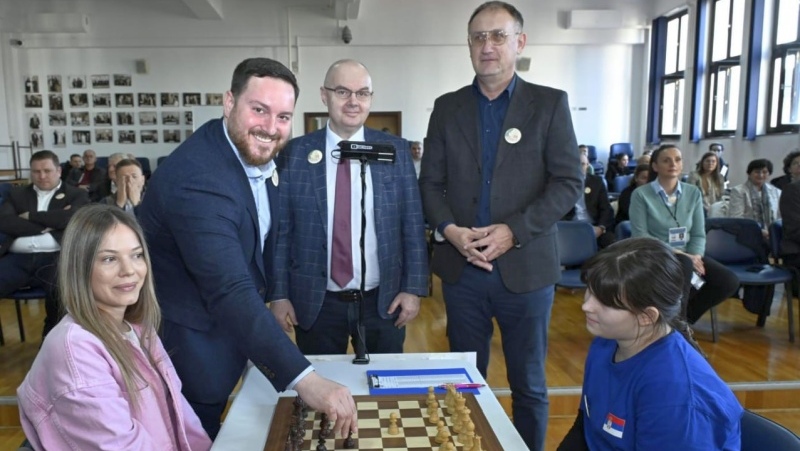
The 55th edition of a popular ladies’ tournament in Serbia brought together strong female players from different countries. Video Assistant Referee (VAR) and idChess broadcast were used in the competition for the first time. The round robin with classical time control in Belgrade featured players from five countries: Lu Miaoyi and Xu Yuanyuan from China, Sandra Djukic, Elif Mehmed, Vera Vujovic and Sofia Pogorelskikh from Serbia, Aleksandra Maltsevskaya and Anna Kubicka from Poland, Evgeniya Doluhanova from Ukraine, and Bhakti Kulkarni from India. VAR was used in the competition for the first time. Video Assistant Referee (VAR) is the idChess technology that helps chess arbiters to make the right decisions in controversial situations. Through video recording and artificial intelligence, VAR shows which moves were made, allowing the arbiter to analyze controversial moments quickly. The arbiter can scrutinize the controversial episode using VAR and if necessary pause the video, rewind using the navigation on the timeline with the marks. The game broadcast is suspended until the circumstances are clarified. After the game, organizers and arbiters have a recording of chess notation (also broadcast and saved on the platform live.idchess.com) and a video recording of the game. The game is securely recorded in two ways, making any errors impossible. “I am happy to see VAR, Video Assistant Referee, for the first time in Serbia. This technology brings a guarantee of a fair game to chess. The decisions of arbiters will be objective since they are based on facts and the game records with VAR,” said Vladimir Sakotic, organizer of the tournament. “In addition to VAR, idChess helps us with broadcasting. People can watch games, both in real time and recorded.” The last round and award ceremony were held on March 10. Aleksandra Maltsevskaya (Poland) emerged as the winner with an excellent score of 7.5/9. Elif Mehmed (Serbia) and Lu Miaoyi (China) finished just a half-point behind the champion with the former taking second place thanks a greater number of victories.
Lesotho Championship: Motlomelo Lihloela and Ngatane Lieketseng win titles
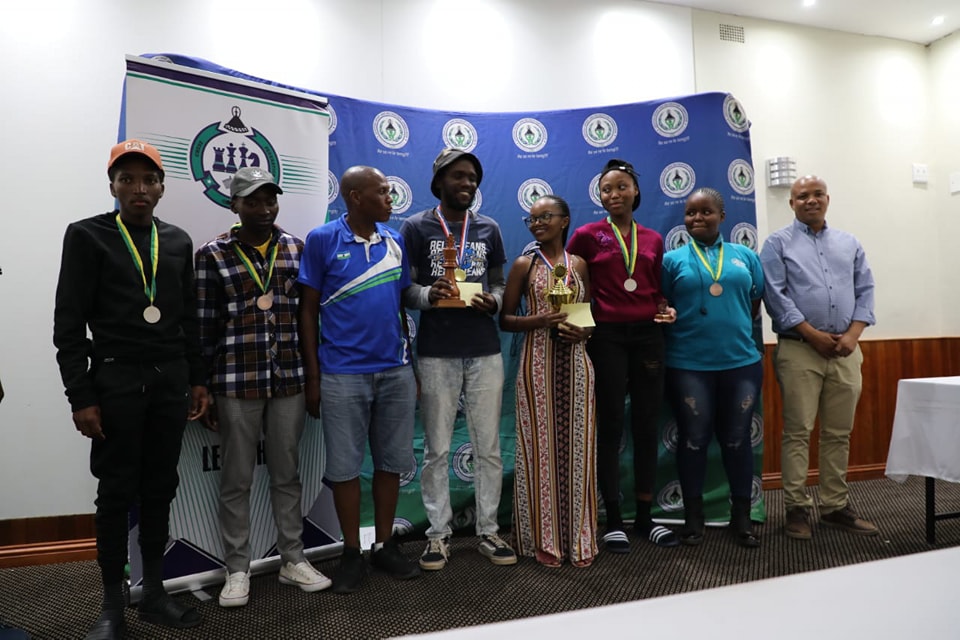
Motlomelo Lihloela and WFM Ngatane Lieketseng emerged as the winners of the 2024 Lesotho Championship. Both champions qualified for the national teams to represent the country in the 45th Chess Olympiad in Budapest. Both open and women’s events were 7-round Swiss tournaments running over three days. The 20th seed untitled Motlomelo Lihloela made a splash in the open tournament, taking the title with an impressive score of 6.5/7. Motlomelo won six straight games and made his only draw in the final round to secure the title. Ntsielo Bonolo and Taioe Reitumetse finished a full point behind the champion and tied for second place with the former taking silver thanks to a slightly better Buchholz. Final standings open: 1 Motlomelo, Lihloela 1590 6½ 2 Tsephe, Lebajoa 1859 5½ 3 Mahommed, George 1686 5½ 4 Sibeko, Siabonga 1642 5 5 Motsamai, Bokang 1783 5 6 CM Klaas, Tokelo 1869 5 7 Nkalimeng, Kananelo 1654 4½ 8 Ramakabane, Refuoe 1689 4 9 Phakisi, Katleho 1701 4 10 CM Molapo, Joang 1735 4 The women’s event was a very close race of two top seed players, WFM Ngatane Lieketseng and Ntsielo Bonolo, who scored 6/7 and tied for first place. The title goes to Ngatane thanks to a slightly better Buchholz. As many as three players shared third place with Taioe Reitumetse claiming bronze, scoring 1.5 points in the direct encounters. Final standings Women 1 Ngatane, Lieketseng 1673 6 2 Ntsielo, Bonolo 1654 6 3 Taioe, Reitumetse 1558 4½ 4 Sethabathaba, Boitumelo 1575 4½ 5 Thetsane, Nteboheleng 1531 4½ 6 Leboela, Maboloko 1572 4 7 Makhalemele, Lieketseng 1472 4 8 Molise, Lintle 3½ 9 Shao, Karabo 3½ 10 Makhebesela, Ponts’o 3 Photos: Chess Federation of Lesotho Facebook