

FIDE WGP Monaco Round 4: Kateryna Lagno takes the lead with a spectacular victory

Round 4 of the FIDE Women’s Grand Prix in Monaco delivered high-level chess, with four games ending in draws and one spectacular victory. Kateryna Lagno, playing a breathtaking attacking game, defeated Elisabeth Paehtz to seize the sole lead in the tournament. The day began on a lighthearted note as Michael Stoettinger, President of the Austrian Chess Federation and host of the final WGP leg, made the ceremonial first move for Lagno—perhaps bringing her a touch of good fortune. Meanwhile, tournament director Jean-Michel Rapaire outlined plans for the upcoming rest day on February 23, which will feature an exciting excursion. Stoettinger added a humorous remark about the Austrian rest day including schnitzel and Vishy Anand, drawing smiles from the players. As for the games – despite the draws on most boards, the games were far from dull. Sara Khadem misplayed a significant advantage, while Humpy Koneru and Aleksandra Goryachkina also had opportunities to press for more. Round 4 results: Aleksandra Goryachkina ½-½ Zhongyi TanHumpy Koneru ½-½ Alexandra KosteniukSarasadat Khademalsharieh ½-½ Batkhuyag MunguntuulKateryna Lagno 1-0 Elisabeth PaehtzBibisara Assaubayeva ½-½ Harika Dronavalli Kateryna Lagno – Elisabeth Paehtz The sole victory of the round was a dazzling display of creativity and fighting spirit, making it an early frontrunner for the tournament’s brilliancy prize. The game began at an unusually slow pace, with only eight moves played in the first hour and a half. By move six, the players had entered an unexplored variation of the Queen’s Gambit Declined. Lagno, with the white pieces, gained an edge out of the opening and soon shook things up with a pawn sacrifice: In the post-game interview, Lagno explained her reasoning behind the sacrifice, aiming to delay Black’s ideas of 12…Nc5 and 12…Bf5. Paehtz responded with 12…Nc5 instead of the stronger 12…Bxe6, allowing the game to spiral into chaos, ultimately favoring White. I implore you to really assess the intricacies of this position – there is so much going on from both sides. White’s last move, 16.g4! (the best in the position), gives up a pawn to distract what Lagno considered to be Black’s strongest piece – the light-squared bishop. However, after 16…Bxg4 White erred with 17.Ne5? Allowing Black to come back into the game with 17…Bxd1 although practically, and in the spirit of the game, White’s decision made sense to target the g6-pawn. A key moment came after move 19, where Paehtz missed a crucial defensive resource: Here 19…Bg5 (or the fancier 19…Qxd2 achieving the same) was the only way for Black to continue. This would force a series of trades where White would end up with only a slightly better position – which Lagno noted she had calculated and was happy with. Nevertheless, Paehtz opted for 19…e3 which closed the important diagonal and did not achieve much. 20.fxe3 Kxg6 21.Rg1 Bg5 22.h4! The exposed black king was in trouble, and after picking off the bishop, White brought her pieces to the party. Playing under time pressure, both sides exchanged inaccuracies where Black had one last opportunity to prolong her resistance after 27.e4: Here 27.Rd1 instead was important to insert before e4, setting up a discovery on the black queen where e4 becomes even stronger with the threat of Bxg5 (in all fairness, Black’s position was already beyond repair). 27…Qd4 was played in the game, to which White responded with 28.Rf1 and now 28…Ncd7?? was Black’s final major blunder as she incorrectly defended her f6-knight. There is a lot of tricky analysis here to look into, but instead I will leave you with the remainder of the beautiful game: 29.Bxg5 Rhf8 30.Be6 Rad8 31.Bxd7 Rxd7 32.e5 Kd8 33.Bxf6 Kc7 34.e6 Qd2 35.Kb1 Rd6 36.e7 Re8 37.Be5 Rxe7 38.Rd1 and Black resigned. With this victory, Lagno emerged as the tournament leader. As she left the hall, she remarked with a smile that this was the best game she had played in a long time. Aleksandra Goryachkina – Tan Zhongyi For the second consecutive day, Goryachkina was the last player to leave the board, battling for nearly five hours. Both players blitzed through the opening in Petroff Defence and entered a slow, positional struggle. Much like her previous game against Assaubayeva, Goryachkina attempted to squeeze out a win from a seemingly equal position. Several moments arose where a threefold repetition seemed imminent, but each time, one player deviated to continue the fight. Tan, however, handled the clock better, maintaining a significant time edge—42 minutes against Goryachkina’s mere 3 minutes. Time trouble has led to several blunders in this event, but today, both players held firm, agreeing to a draw after 93 moves. Humpy Koneru – Alexandra Kosteniuk A Semi-Slav set the tone for a long positional game, and this is what occurred in the game between Koneru and Kosteniuk, with the opponents performing at 98% accuracy. This stat makes a draw between two chess titans the logical outcome. White obtained a more comfortable position out of the opening and had a 20-minute time advantage by the ninth move. However, this was soon balanced, as became the position. Play unfolded on the queenside, where both sides made the best moves, leading the game to a natural draw – even though Humpy had chances to push for more. Although we did not see fireworks in this game, it was a display of the high-quality chess that we are witnessing in this event. Sarasadat Khademalsharieh – Batkhuyag Munguntuul Another incredibly instructive game was played in which White got a desirable position out of the opening but could not convert it, leading to a draw. Black did not make any obvious error in an Exchange Slav but allowed White to dominate the queenside by controlling the backward c6-pawn without any counterplay. White solidified her strong position with a3 and b4, eventually activating her queen and taking advantage of Black’s passivity, picking up a pawn: The h5-pawn is under attack, while White threatens Rxd5 as the c7-rook is hanging. Despite this material and positional advantage, it was still not that easy to breakthrough – something Khadem
FIDE WGP in Monaco: Four in the lead after Round 3

The third round of the FIDE Women’s Grand Prix 2024-25 in Monaco saw intense battles on the boards, with three draws and two decisive outcomes. Alexandra Kosteniuk secured a crucial victory against Tan Zhongyi in a clash of former World Champions, while Aleksandra Goryachkina outlasted Bibisara Assaubayeva in a tough five-and-a-half-hour struggle. The round began with a special guest making the ceremonial first move—Monaco basketball star Donatas Motiejūnas and his son played 1.a3 on the board of Alexandra Kosteniuk vs. Tan Zhongyi, a move that sparked smiles and set a lighthearted tone before the intense battles unfolded. Round 3 results: Bibisara Assaubayeva 0-1 Aleksandra GoryachkinaHarika Dronavalli 1/2-1/2 Kateryna LagnoElisabeth Paehtz 1/2-1/2 Sarasadat KhademalshariehBatkhuyag Munguntuul 1/2-1/2 Humpy KoneruAlexandra Kosteniuk 1-0 Zhongyi Tan Alexandra Kosteniuk – Zhongyi Tan A clash of two former Women’s World Champions saw an exciting battle! Kosteniuk had a rough start to the event, facing critical time trouble in the first game, and not feeling too happy with her decisions in the second. However, she achieved a good position out of the opening. The middlegame became quite complex, with Black playing all the best moves up until a critical point. 19…Rf5? This seemingly active move turned out to be a serious inaccuracy, that handed White considerable advantage. After reserved 19…a6 or 19…Rc6 Black would have kept the position in balance. Kosteniuk remarked after the game that she was confused by her opponent’s decisions. More errors by Black led to a position where White was suddenly much better. Even though Tan made multiple attempts to complicate things and make them as difficult as possible for her opponent, particularly in mutual time trouble, Kosteniuk responded accurately to every threat, transitioning into a position with a queen and two extra pawns, against Black’s knight and rook. In an endgame that ensued, Kosteniuk showcased her great technique, crashing all Black’s hopes to build a fortress. In an interview yesterday, Kosteniuk noted that she plays tournaments to enjoy chess and play her best, as she already has so many titles under her belt. This healthy mindset coupled with her vast experience always makes her an interesting player to watch, particularly in this event, as she has picked herself up to score an important victory. Bibisara Assaubayeva – Aleksandra Goryachkina The highly anticipated clash between Grand Prix leader Assaubayeva and Leg 2 winner Goryachkina delivered an intense, strategic battle. The game followef an English Opening, with both players navigating unfamiliar territory. White advanced on the kingside while Black countered on the queenside. Despite Assaubayeva securing a protected passed pawn in the middlegame, the position remained closed and difficult to break through. Assaubayeva missed the strong 21.Ba3, which would have significantly improved her worst-placed piece by activating the bishop and exerting pressure on Black’s position. Instead, 21.Bd2 was played, resulting in a prolonged maneuvering battle where neither side could make immediate progress. As the game evolved and the queenside began to open up, Goryachkina gradually took control. Even though the engine assesses this as -3, it is still not easy, a fact that is compounded when you take into consideration that both sides were playing with under two minutes left on their clock. For this reason, both sides exchanged inaccuracies as tension was extremely high. Goryachkina, with experience on her side, remained calm and composed, picking up important pawns to execute a victory. After her first-round loss to Kateryna Lagno, this win puts her back in the running to have a successful tournament. I want to note that this game was played over five and a half hours! Harika Dronavalli – Kateryna Lagno A solid line of the King’s Indian Defense led to a comfortable position for White. While Dronavalli had a chance to press for an edge, she missed a good opportunity to build up pressure on move 20 and opted for a seemingly active but wrong continuation, which lead to multiple trades and an equal position. A threefold repetition sealed the draw. This result was significant for Dronavalli, as it ended her two-game losing streak. After yesterday’s tough loss, stabilizing against one of the tournament leaders was a confidence-boosting result. For Lagno, a draw with Black is a solid outcome, allowing her to conserve energy for upcoming rounds. Elisabeth Paehtz – Sarasadat Khademalsharieh The opponents tested the Exchange Variation of Ruy Lopez that quickly led to a queenless game in which neither side pushed hard. Black had an opportunity to gain a slight advantage, but it was hardly enough to make further progress. The only winner in Round 2, Sara has performed much better than her first Grand Prix leg in Tbilisi, whilst Elisabeth is also in better form compared to her Shymkent showing. Batkhuyag Munguntuul – Humpy Koneru While this game ended in a draw, it was full of exciting tactical opportunities. The key moment came in the early middlegame: In this position, after thinking for 16 minutes, Munguntuul played a timid 14.Be2? instead of launching a dangerous kingside attack with 14.Ng5! In the line 14…g6 15.Qf4 White has a great attacking opportunities, whereas 14…h6 15.Nh7 Re8 16.Qf4 is equally unpleasant for Black. White has ideas of bringing the rook to the chaos with Rae1-e3 and Nf6+! ripping black kingside open. In a post-game interview, Munguntuul admitted she had considered Ng5 but decided against it, fearing excessive risk. Choosing the safer Be2, she steered the game toward a balanced endgame, and a draw was eventually agreed upon. Standings after Round 3 1 GM Humpy Koneru IND 2523 2 2 IM Sarasadat Khademalsharieh ESP 2458 2 3 IM Batkhuyag Munguntuul MGL 2331 2 4 GM Kateryna Lagno FID 2515 2 5 GM Alexandra Kosteniuk SUI 2484 1½ GM Aleksandra Goryachkina FID 2546 1½ 7 GM Elisabeth Paehtz GER 2427 1½ 8 GM Zhongyi Tan CHN 2561 1 9 IM Bibisara Assaubayeva KAZ 2492 1 10 GM Harika Dronavalli IND 2489 ½ Round 4 pairings and dates The fourth round of the third leg in the 2024/25 Women’s Grand Prix series starts on Friday, February 21st
Join Global Celebration of Women and Girls in Chess!

March is a time to celebrate women, and what better way to do so than through chess? The FIDE Commission for Women’s Chess invites federations, clubs, and organizers worldwide to be part of the Chess Women’s Day Celebration: Community, Strength, Empowerment – our initiative to connect chess community on this special occasion for women and show how many incredible projects happen worldwide. Are you planning a chess event in March to honor and inspire women and girls in the game? Whether it’s a tournament, a simultaneous exhibition, a workshop, or a special gathering, we want to hear about it! By joining this global initiative, your event will be part of a worldwide network of activities that showcase how community empowers us as individuals, and how each of us contributes to uplifting the community. Each of your events will empower this global celebration! Together we will create a movement that highlights the role of women, chess and communities in creating a better space for us all, inspiring even more to join through the power of shared experiences and celebrations. How to Get Involved: Plan a chess event dedicated to celebrating women and girls. Let us know about it by reaching out to us! Join a global movement to promote and empower women in chess. Contact us to be part of this special celebration! Together, we can create a powerful impact and inspire the next generation of women and girls in chess. For more details and to share your event with us, contact us here: anna.kantane@gmail.com
FIDE School Award winners celebrated at 2nd cycle webinar

The FIDE Chess in Education Committee recently hosted an online seminar to honor the recipients of the second cycle of the FIDE School Awards. This award recognizes excellence in school chess programs that have a dedicated focus on chess as an educational tool, have a demonstrable impact on their local communities, and maintain a sustainable model for engaging community and promote the educational and social/emotional benefits of chess. The awards are presented in gold, silver, and bronze categories based on a dozen assessment components. The evaluation focuses on three key aspects: chess an educational tool, the school’s impact on community and culture, and innovation. There are several ways chess programs can make a difference, but the ultimate goal remains the same: to raise awareness about the power of educational chess in schools to transform lives. One of the highlights of the webinar was the presentation of school programs, offering participants a glimpse into the diverse ways different schools go about integrating chess into education. These presentations also showcased the variety of methods different cultures approach the idea of chess as a means of enhancing education in many other subjects. Here is a quick overview of two of the award-winning schools that presented during the seminar: Overseas Family School (Singapore) The chess program at Overseas Family School (OFS) was a recipient of the FIDE Gold School award. Their program features a robust teaching component that has chess as a mandatory subject for grades K-5. They support kids learning at their own pace and developing a love for the game and incorporate innovative learning tools to assist children in learning, including chess yoga and songs. The school also engages the local and international chess community by organizing events that raise social awareness, such as their Checkmate to Racism initiative. Click HERE to learn more. Colegio Kender (Durango, Mexico) A recipient of the FIDE Gold School Award, Colegio Kender integrates both over-the-board and digital learning tools in a dedicated chess space on campus, to tell children about the transformative lessons chess can offer. The school organizes competitive tournaments and fun in-school events, such as Halloween Chess Night. Colegio Kender also promotes chess beyond the classroom by hosting public chess activities in community spaces. Chess is deeply embedded in the school’s culture, with students actively participating from early education through high school. Click HERE to learn more. Benefits of the award Beyond the prestige of recognition by FIDE, award-winning schools receive tangible benefits to further enhance their chess programs and introduce new tools including: ChessKid memberships – up to 500 Gold memberships (for 4 months) for their school. One-year Premium membership for your school on LearningChess.net One-year Premium LogiqBoard license for up to five teachers. Six months’ free Notationary.app membership for teachers. Discount for teachers of your school to attend an online Preparation of Teachers (PoT) Course. 20% for Bronze, 30% for Silver and 50% for Gold Award-winning schools. Collaboration and communication is key Of fundamental importance in keeping the momentum of the movement of educational chess is spreading the message through the collaboration of programs. FSA award winners were encouraged to connect with each other and find ways to create international partnerships and cultural exchanges to share ideas and open opportunities for kids to engage with each other. These collaborations do not have to be purely competitive, though a combination of friendly competition with cultural exchanges can be very fruitful. For example, two schools from the first cycle of awards, Hamilton K-8 School from the USA and G C School of Careers from Cyprus, played an online friendly match with. The kids from both sides had a great deal of fun and the event was celebrated in their communities. Promoting such international collaborations helps reinforce chess’s educational, social, and cultural benefits, extending beyond critical thinking into the social and cultural realms. Applications are open for the 3rd Cycle! Applications for the third cycle of the FIDE School Awards are now open and will close on April 30, 2025. We encourage schools committed to use chess as a tool for uplifting and enhancing the educational journey of a child to apply. There is no single approach to intergrading chess into education-different schools and communities do it in unique ways. Competitive chess is not a requirement for eligibility, what matters is demonstrating meaningful impact through chess. FIDE EDU invites you to share your stories with us so that we can all learn and help educate our communities about the transformative power of chess. Congratulations to the winners of the second cycle! Clink HERE for more information about the application. Written by Abel Talamantez
Social Chess Research Conference announced

FIDE is thrilled to invite you to the Social Chess Research Conference, an online event bringing together researchers, educators, practitioners, and chess enthusiasts to explore how chess contributes to improving quality of life, fostering social development, inclusion, empowerment, and rehabilitation. Date: Saturday, February 22, 2025Time: 15:00-19:30 CETLocation: Online (Zoom) This unique conference serves as a platform to highlight innovative applications of chess, from research breakthroughs to real-world stories of empowerment and hope. Program Structure 15:00–15:15 | Welcome Address by Dana Reizniece, Deputy Chair of the FIDE Management Board and Andre Vögtlin, FIDE Social Commission Chair 15:15–15:20 | FIDE Social Chess Videos 15:30–17:45 | Chess Research Presentations Prof. Filip Kobiela, “Chess as a challenge for the traditional definition of sport” (20 min) Dr. Giovanni Sala, “Chess and Mathematics in Primary School” (20 min) Juan Antonio Montero Aleu, “Cognitive Training of the Mind Through Chess: ECAM and Gymchess” (20 min) Prof. Dr. Sabine Vollstaedt-Klein, “Why chess is good for the brain and can be helpful against addiction” + “Introducing the International Society for Applied Chess (ISAC)” (45 min) Prof. Dr. Peter Hersics, “Learnings from EEG Neurofeedback System” (20 min) 17:45–18:00 | Chess Research Project Pitches Rodrigo Barbeito, “Social and Therapeutic Chess: A New Look from the Social Sciences” Dr. Uvencio Blanco Hernández, “Green Boards for Peace: bridges between chess and education to raise awareness about biodiversity and environmental sustainability” 18:00–18:20 | Breakout Sessions – Participants can join breakout rooms, each representing one of our social chess projects: Chess for Freedom Chess for Protection Infinite Chess – Autism Chess4Longevity – Elderly Chess4Hope – Underserved communities Chess4Recovery – Addiction/Cancer In these breakout sessions, scientific and operative questions can be raised and discussed among participants. Moderators will document the discussions and present a summary in the main session once the rooms close. 18:20–19:00 | Reporting from the Breakout Sessions 19:00–19:30 | Closing Remarks & Future Collaboration Opportunities Why Attend? This conference offers an inspiring blend of keynote presentations, interactive discussions, and thought-provoking panels, connecting a diverse community of individuals dedicated to leveraging chess as a tool for social transformation. Registration Register here: https://forms.gle/6quumvjkrAxadBWG8 Zoom link will only be sent to registered participants.
FIDE WGP Monaco R02: Positional battles on all boards
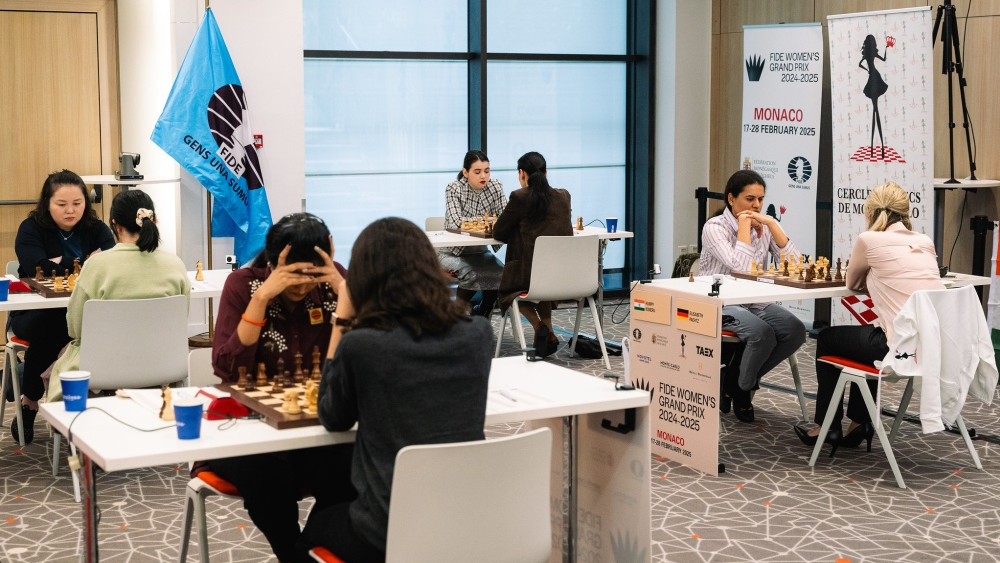
The second round of the FIDE Women’s Grand Prix featured tense positional battles across the boards, with most games concluding in calm draws. However, a dramatic turn of events unfolded in the game between Sarasadat Khademalsharieh and Harika Dronavalli, where a single blunder cost Black a crucial half-point. As this is still the early phase of the tournament and the first major FIDE event of the year, players are gradually finding their footing in the intense competition. Despite this, today’s round showcased exciting chess, unpredictable moments, and hard-fought games. Aleksandra Goryachkina – Alexandra Kosteniuk: ½-½ After suffering losses in the first round, both players entered this game under pressure, as a second defeat could significantly impact their confidence. Determined to improve on her previous game, Kosteniuk came well-prepared in a French Winawer, blitzing out her opening moves and entering a position she had previously played with White. However, Goryachkina deviated from known theory by move 10, leading to an imbalanced position with White saddled with doubled isolated pawns on the queenside. This structural weakness was compensated by a safe king and active piece play. After sacrificing a pawn, which was soon returned, White suddenly seized the initiative and launched a dangerous attack. At this moment, White needed to undermine Black’s pawn structure with 26.c4, but instead, 26.Re5 was played. This allowed Black to neutralize all danger by simplifying into a rook-and-pawn endgame. Despite White’s continued efforts, the game ended in a draw after 69 moves. Zhongyi Tan – Batkhuyag Munguntuul: ½-½ An intense battle filled with sacrifices unfolded in the game between Zhongyi Tan and Batkhuyag Munguntuul. The players tested a solid King’s Indian Attack in the Keres Variation, which gradually evolved into a strategic battle. After sacrificing a pawn, Tan demonstrated excellent piece maneuvering, obtaining a dominant position with a decisive material advantage. With two pawns up, White’s victory seemed inevitable, but an error in judgment cost her dearly. Munguntuul seized the opportunity to equalize immediately. Here, White had two good options, 44.Ng7 and less strong 44.f5, both maintaining the winning edge. Instead, 44.Nc7? allowed 44…Kd7, forcing White to give up the knight. With Black’s knight counterbalancing White’s three extra pawns, the game was eventually drawn on move 68. Humpy Koneru – Elisabeth Paehtz: ½-½ Elite round-robin tournaments often feature long-standing rivalries, and this was the case for Humpy Koneru and Elisabeth Paehtz, who have faced each other numerous times. Humpy entered the round with a slim historical edge (+1). Paehtz, playing Black, opted for a rare line of the Queen’s Gambit Accepted instead of her more usual King’s Indian. Playing with confidence, the German GM solved all her opening problems and then grabbed the initiative in the ending. Although Black dictated play for most of the game, precise conversion was required to capitalize on the advantage. Humpy defended resourcefully, simplifying the position and steering the game toward a draw. Sarasadat Khademalsharieh – Harika Dronavalli: 1-0 One decisive mistake, played with just 30 seconds left on the clock, determined the outcome of today’s clash between Sarasadat Khademalsharieh and Harika Dronavalli. The game was predominantly a positional battle, which appeared to be heading for a draw. However, Sara held a practical advantage—more time on the clock in an equal but tricky position, with a rook and bishop against a rook and knight. Despite being a pawn down, White had a dangerous passed pawn on the a-file that would eventually secure victory. Here, Black had multiple defensive resources, including the simple 38…Rxa7, neutralizing White’s threats. Instead, Dronavalli hurriedly played 38…Nxe5??, allowing 39.Rd8+!, forcing immediate resignation. Black was compelled to capture the rook, after which White’s pawn would promote unhindered. This unfortunate second consecutive loss for Dronavalli means the next round will be crucial for her to reverse the trend. Fortunately, the tournament is still in its early stages, leaving ample opportunity for a comeback. Kateryna Lagno – Bibisara Assaubayeva: ½-½ The encounter between the experienced Lagno and the young Grand Prix leader Assaubayeva featured a King’s Indian Defense, known for its dynamic and complex positions. However, Black misplayed early by advancing her f-pawn prematurely—an idea common in the KID but ill-timed in this instance. Lagno however, shifted focus to the queenside but lost her earlier advantage with a premature b3-b4 push. With multiple trades simplifying the position, the game reached a dead-drawn endgame featuring opposite-colored bishops, concluding in a natural draw. The third round of the Women’s Grand Prix continues with players looking to solidify their positions in the standings. Will Harika Dronavalli bounce back from two losses? Can Sarasadat Khademalsharieh continue her strong form? Stay tuned for more high-level action. Standings after Round 2: 1-4. Humpy Koneru, Kateryna Lagno, Sarasadat Khademalsharieh and Batkhuyag Munguntuul – 1.5; 5-7. Bibisara Assaubayeva, Elisabeth Paehtz and Tan Zhongyi – 1; 8-9. Alexandra Kosteniuk and Aleksandra Goryachkina – 0.5; 10. Harika Dronavalli – 0. Round 3 pairings and dates The third round of the third leg in the 2024/25 Women’s Grand Prix series starts on Thursday, February 20th at 15:00 CET local time in Monte-Carlo, Monaco. Round 3 pairings: Bibisara Assaubayeva – Aleksandra GoryachkinaHarika Dronavalli – Kateryna LagnoElisabeth Paehtz – Sarasadat KhademalshariehBatkhuyag Munguntuul – Humpy KoneruAlexandra Kosteniuk – Tan Zhongyi More information about the event, including the regulations and details of the pairings, as well as live games can be found on the official website: womengrandprix.fide.com. You can follow the games live and watch the action with our wonderful commentators GM Alojzije Jankovic & IM Almira Skripchenko on YouTube. Written by Charlize van Zyl Photos: Niki Riga
FIDE World Senior Championship 2025: Registration now open

All FIDE member federations are invited to participate in the 2025 World Senior Individual Chess Championships, which will take place in Gallipoli, Puglia, Italy, from October 20 (arrival) to November 2 (departure). The championships will feature four categories: Open and Women’s sections for 50+ and 65+ age groups. Players must have reached the respective age of 50 or 65 by December 31, 2025. The top three players from each category of the previous World Senior Championships have a personal right to participate. Additionally, the top three players from each category of the previous year’s Continental Senior Individual Championships are also qualified. Their places cannot be substituted. The total prize fund for all categories is €43,000. The registration deadline is September 1, 2025. As part of the event, several side activities will be organized, including two FIDE-rated blitz tournaments. Invitation letter, regulations, accommodation, prizes (PDF) The official website for the FIDE World Senior Chess Championships will be launched soon: worldsenior2025.fide.com E-mail: worldsenior@fide.com
Three victories mark Round 1 of FIDE Women’s Grand Prix in Monaco
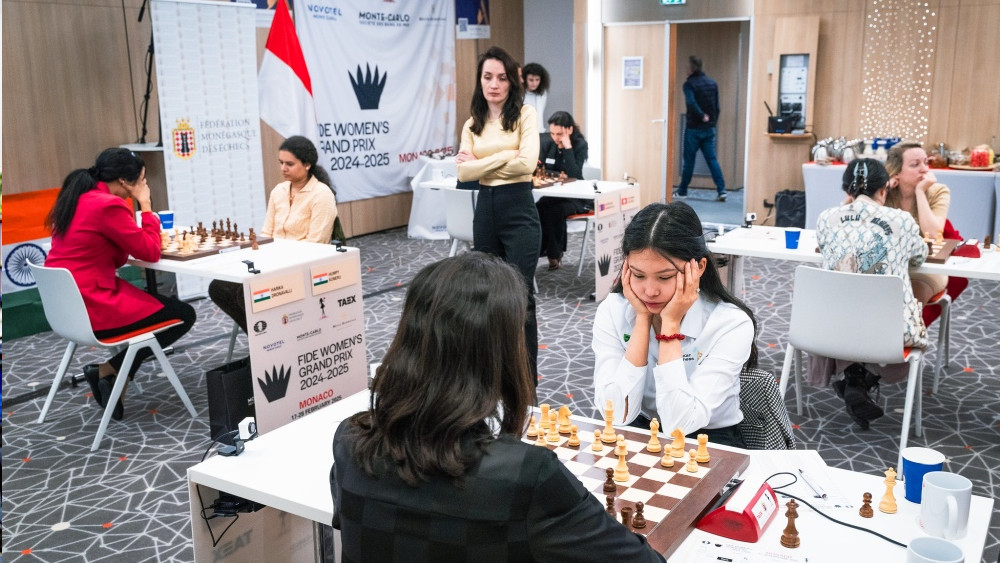
Sparks flew across all five boards in the first round of the third leg of the Women’s Grand Prix in Monaco, with three players—Kateryna Lagno, Humpy Koneru, and Batkhuyag Munguntuul—emerging victorious. Their strong performances set the tone for what promises to be a fiercely competitive event. The third leg of the FIDE Women’s Grand Prix 2024-25 kicked off at 15:00in the elegant Novotel Monte-Carlo. This event is one of the strongest in the series, with titans of women’s chess battling it out – including leg 2 winner Aleksandra Goryachkina, and the overall leader in the standings, Bibisara Assaubayeva. Unsurprisingly, the level of play in the first round was noted by commentators GM Alojzije Jankovic & IM Almira Skripchenko as being “extremely high” with complex position emerging across all five boards. Time trouble became a common thread throughout the games, where blunders were made in critical positions, leading to upsets and three decisive outcomes. Let’s take a closer look. Round 1 results: Kateryna Lagno 1-0 Aleksandra GoryachkinaBibisara Assaubayeva 1/2-1/2 Sarasadat KhademalshariehHarika Dronavalli 0-1 Humpy KoneruElisabeth Paehtz 1/2-1/2 Zhongyi TanBatkhuyag Munguntuul 1-0 Alexandra Kosteniuk Kateryna Lagno 1-0 Aleksandra Goryachkina Fresh off her undefeated victory in the second leg of the Grand Prix in Shymkent, Goryachkina entered the event as a tournament favorite. However, her opponent, Kateryna Lagno, came out swinging right off the bat and played a brilliant game, outplaying her opponent to score a full point. Lagno was well-prepared in a Two Knight Defense sideline, putting Black in a 30minute time deficit by move 8. Despite not seeming too comfortable out of the opening, Goryachkina held her own, navigating through unchartered waters. By move 12, multiple exchanges, including that of the queens, had taken place, leaving Black with an isolated e-pawn and slightly inferior position. Nevertheless, the few pieces on the board did not mean that play was over, in fact, a positional battle ensued which revolved around Black’s weak pawn structure. Eventually, White obtained an advantage thanks to her more active rooks, but this quickly subsided as Black managed to steady her position to reach equality. But then, as we saw a few times this round, Goryachkina fell victim to time trouble and erred on move 39 – playing a seemingly practical move capturing White’s f-pawn when it was important to instead find a clever maneuver – something that could easily be overlooked in time trouble. Lagno capitalized on this mistake and executed the endgame flawlessly, taking down the tournament favorite. Bibisara Assaubayeva 1/2-1/2 Sarasadat Khademalsharieh As the current leader of the Grand Prix standings, Bibisara has the toughest task in this event – to extend her lead as much as possible, as this is her third and final leg. Her first game against Spain’s Sara Khadem started as a timid English, which quickly departed from known theory after move 9. In a joint interview, both players admitted that they were unsure about the opening, where Bibisara expressed dissatisfaction with her play. Staying true to her style, Assaubayeva created an imbalanced position which gave Black a slight advantage according to the engine, but practically it was not easy to navigate but rather quite scary in fact. Both players made a few dubious decisions, which led to a complicated position where Black held a sizable advantage. But after an incorrect trade in which she exchanged her strongest piece the light-squared bishop for the knight, Black lost the advantage and after multiple trades, the game ended in a draw. The result could have been better for both players, particularly for Sara, as she lost the opportunity to take down a very strong opponent. However, she remained in high spirits it was a day of celebration as her son, who is with her in Monaco, turned three today! Harika Dronavalli 0-1 Humpy Koneru The all-India clash was one of the most exciting boards to watch, with both players coming off their incredible 2024 successes surely full of confidence. Harika was part of the gold-medal-winning Indian team at the 2024 Chess Olympiad, and this is her first leg in the WGP series. Her compatriot, Humpy, on the other hand, ended off the year by winning the FIDE Women’s Rapid World Championship. Humpy has been a fixture in the WGP series, winning gold and silver in various legs. The game started as a Four Knights Ruy Lopez and all seemed calm for the most part, particularly after multiple trades steering the game to a balanced endgame. But Harika was clearly pushing, even refusing a three-fold repetition, finding herself in a position with an isolated e-passer and more piece activity. Both players were playing with minutes left in their clock as they approached move 40, but interestingly, it was on the 41st move that Harika opted for the incorrect plan after spending 13 minutes. In the situation of coming out of a time scramble, it is often difficult to compose one’s thoughts and remain calm. The advice is usually to relax after the additional time is granted and to take time to reassess the position. But there is always a danger of spending too much time on a move, which could lead to clouded thought and misjudgments. Perhaps this was Harika’s case, as Humpy grabbed a sizable advantage. This advantage soon dissipated as Humpy opted for a passive continuation instead of pushing for attack with her active rooks, king blocking White’s passer and pawn majority on the kingside. Both players found themselves in time trouble again, exchanging inaccuracies, though it was Black who held the superior position. Harika, likely believing in her position with the passed pawn, once again refused a repetition – a critical error that Humpy responded to by finding the correct plan and eventually picking up White’s passer. After five hours of play, Humpy finally emerged victorious. Elisabeth Paehtz 1/2-1/2 Tan Zhongyi The first Petroff of the day was seen on board 4, quickly becoming a dynamic game after opposite-sides castling. White opted for a structure in which Black had an isolated
FIDE Director for Chess Development visits Burkina Faso to promote chess growth

Ouagadougou, Burkina Faso — GM Nigel Short, the FIDE Director for Chess Development, continued his mission to expand chess across Africa with a recent visit to Burkina Faso. Upon arriving in Ouagadougou, he was warmly welcomed by the President of the Chess Federation of Burkina Faso, Nicolas Carbonell. Short’s visit focused on promoting chess among young people and showcasing its educational value. On the first day, he visited three schools where chess classes have recently been introduced. His first stop was Bouli School, located in an informal settlement with many internally displaced persons (IDPs) due to regional conflicts. Despite the challenges, chess has found a place in the hearts of these students. The next stop was the PMK Military School, where young cadets are trained to become future officers. Short had an informal meeting with the students and took a photo with the chess sets used in their classes, which began in November. The final school visit was to the American School of Ouagadougou. In the afternoon, GM Nigel Short held a conference at Chez Simon Restaurant, where he shared insights and strategies from his chess career. The conference was well-received by local chess enthusiasts eager to learn from the 1993 World Chess Championship challenger. During his visit, Short met with government officials, including the Minister of Sports, Youth, and Employment, Anûuyirtole Roland Somda, and the Minister of Secondary and Technical Education, Boubakar Savadogo. The discussions focused on expanding chess in Burkina Faso. The Sports General Director of the Primary Education Ministry, Kassoum Compaoré, confirmed that the Ministry would issue a letter encouraging the introduction of chess in primary schools nationwide. A highlight of the visit was a simultaneous exhibition at Princess Yenenga Restaurant, where GM Short played against 22 players from Burkina Faso. This event gave local chess enthusiasts the chance to compete against a world-class player. The Chess Federation of Burkina Faso has made significant progress in growing chess in the country. Since July 2021, the “Gift of Chess” program has donated over 1,000 chess sets to schools and organizations across the nation. According to Nicolas Carbonell, “Without the support of Gift of Chess, we wouldn’t have accomplished half of what we have. Their donations have allowed us to distribute sets to schools, restaurants, and clubs. We need more sets to reach every school in Burkina Faso.” Currently, around 300 adults and many children are actively playing chess across Burkina Faso. The Chess Federation has been instrumental in placing chess teachers in schools, providing sets, and creating spaces in local restaurants and clubs for adults to play. Burkina Faso’s players have also competed in international events, including the 2024 Francophony tournaments (both online and in Canada) and the Budapest Chess Olympiad. The country’s chess community participates in online events like the “Tournoi des Nations” and the “World Chess League” on chess.com. “We played Paraguay in the first round of the World Chess League, and our next opponent is Japan,” said Carbonell. “We’re also planning to compete in the African Chess Games in the West Africa zone.” Additionally, the Chess Federation has created the AES team (Burkina Faso, Niger, and Mali) on Lichess and will soon host an arena tournament between the three countries. GM Nigel Short’s visit to Burkina Faso has left a lasting impact, reinforcing chess’s value as an educational tool and helping to further its popularity across Africa.
Azerbaijani Championship: Mamedov and Mammadzada capture titles

Rauf Mamedov and Gunay Mammadzada triumphed in the 2025 Azerbaijani championships, claiming their seventh and third national titles, respectively. The 2025 Azerbaijan Championships took place in the country’s capital, Baku, from February 1-14. Both open and women’s competitions were knockout tournaments (2-game matches with a tiebreaker if needed) with classical time control. The total prize fund was 60,000 AZN (~$35,000 USD) for the open section and 30,000 AZN (~$17,500 USD) for the women’s section, with the champions receiving 20,000 AZN and 10,000 AZN, respectively. Unlike in previous editions, the 2025 Open Championship boasted the strongest possible lineup, with all of Azerbaijan’s top players—including national team members—participating. The top three seeds lived up to expectations, advancing to the semifinals, while Misratdin Iskandarov, ranked #12 at the start, caused an upset by eliminating Nijat Abasov and Aydin Suleymanli to reach the final four. In the first semifinal, Shakhriyar Mamedyarov, the tournament’s rating favorite, dominated Iskandarov to secure his spot in the final. The second semifinal was a much tighter contest, with Rauf Mamedov narrowly defeating Teimour Radjabov in an Armageddon game. The final was a match of two worthy opponents that saw a real drama at the finish. After two classical and the first tiebreaker games were drawn, Mamedyarov blundered a rook in an equal endgame, handing the title to Mamedov. In the bronze medal match, Iskandarov defeated Radjabov to complete the podium. The rating favorites dominated the women’s event with the top, second, third and fifth seed advancing to the semifinals. Both matches were very close and came down to tiebreaks where Govhar Beydullayeva edged out Ulviyya Fataliyeva, while Gunay Mammadzada overcame Gulnar Mammadova. The women’s final was equally tense–after the opponents traded blows in classical games, a tiebreaker was needed to determine the champion. Gunay Mammadzada drew the first game with black and then instructively converted her advantage in the second-game ending to clinch the title. In the match for third place, Gulnar Mammadova outplayed Ulviyya Fataliyeva to claim bronze. At the closing ceremony, held shortly afterward, Chief Arbiter Lutfiyar Rustamov announced the final results. The champions were awarded medals, cups, flower bouquets, and certificates in recognition of their achievements. Photos: Azerbaijan Chess Federation