

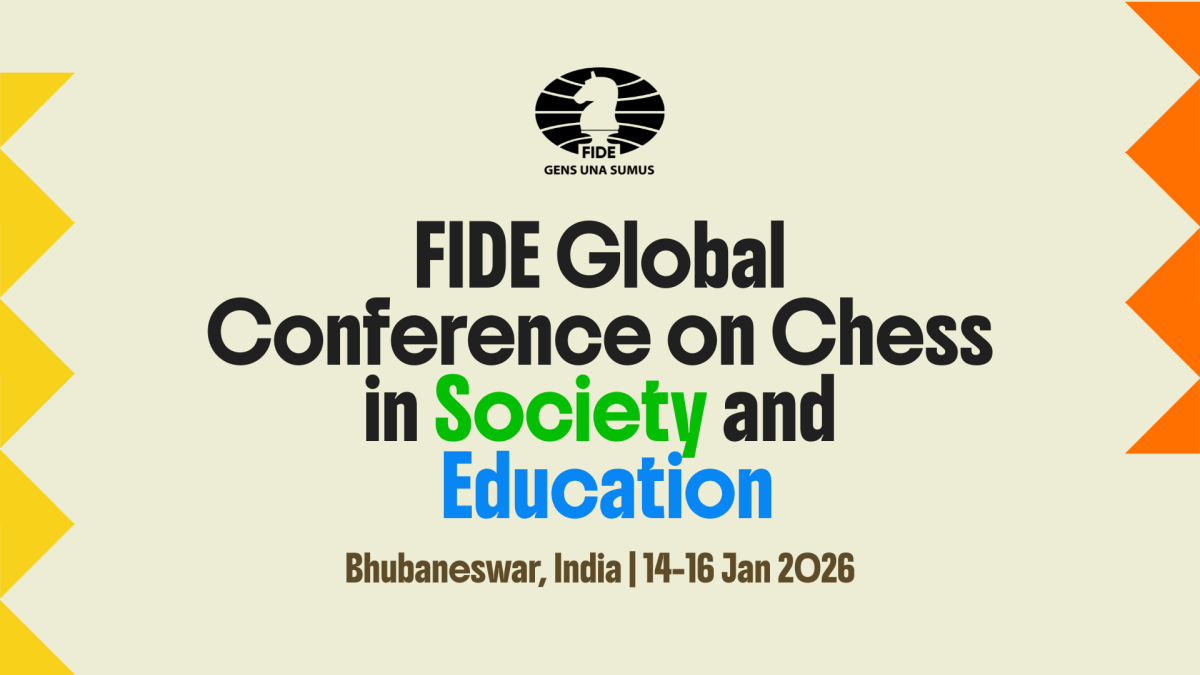
The Social and Educational Chess Conference, marking the launch of the FIDE Year of Chess in Education 2026, is fast approaching. Organized by FIDE, in partnership with KIIT and the All India Chess Federation the conference will take place from January 14 to 16, 2026 in Bhubaneswar, India. It aims to bring together experts from the fields of education, academic research, social development, public policy, and chess to critically examine and advance the use of chess as a structured instrument for learning and social impact on a global scale.
“Chess has a unique ability to bring together education, social programmes, and public institutions. When it is organised well and supported by strong partners, it can reach people globally and create real opportunities for learning and participation. This conference is about sharing what works, learning from each other, and building stronger cooperation so that chess can play a meaningful role in education and social projects around the world,” said Arkady Dvorkovich, FIDE President.
The event will be held at the Kalinga Institute of Industrial Technology (KIIT), one of India’s leading educational institutions, and will focus on two core pillars of FIDE’s global strategy: Social Chess and Chess in Education.
“Education must go beyond textbooks and classrooms to nurture character, values, and the ability to think independently. Chess is a powerful tool in this journey, as it cultivates discipline, critical thinking, patience, and ethical decision-making. We are honoured that KIIT and KISS will host this global conference and partner with FIDE and the All India Chess Federation in advancing chess as an instrument for social transformation and inclusive education worldwide,” said Dr. Achyuta Samanta, Founder, KIIT, KISS & KIMS.
Over the course of the conference, participants will examine how chess can support inclusion, education, rehabilitation, and personal development across different communities and age groups. The programme combines strategic discussions, academic research, practical case studies, and on-the-ground experiences.
The list of speakers includes:
- Achyuta Samanta, a globally respected educationist, social reformer, and sports visionary, and the founder of KIIT, KISS & KIMS
- Rodrigo Barbeito, a sociologist and international project manager at Club Magic Extremadura
- Mukesh Ranjan Das, Executive Director (HR), Indian Oil Corp (IOC)
- Professor Sabine Vollstädt-Klein, who leads the Neuroimaging of Addictive Behaviour group in the Central Institute of Mental Health at Heidelberg University.
- Tunde Onakoya, a Nigerian National Chess Master and founder of a nonprofit Chess in Slums Africa.
- Cristóbal Blanco Acevedo, a neurosurgeon, neuroscientist, and International Chess Master. His work uniquely bridges elite chess and brain science using the game as a model to study advanced cognition
- Jerry Nash, Chair of FIDE Chess in Education Commission, a National consultant for educational chess in the US.
- André Vögtlin, FIDE Social Chess Commission Chair
- Anastasia Sorokina, Chair of the FIDE Commission for Women’s Chess
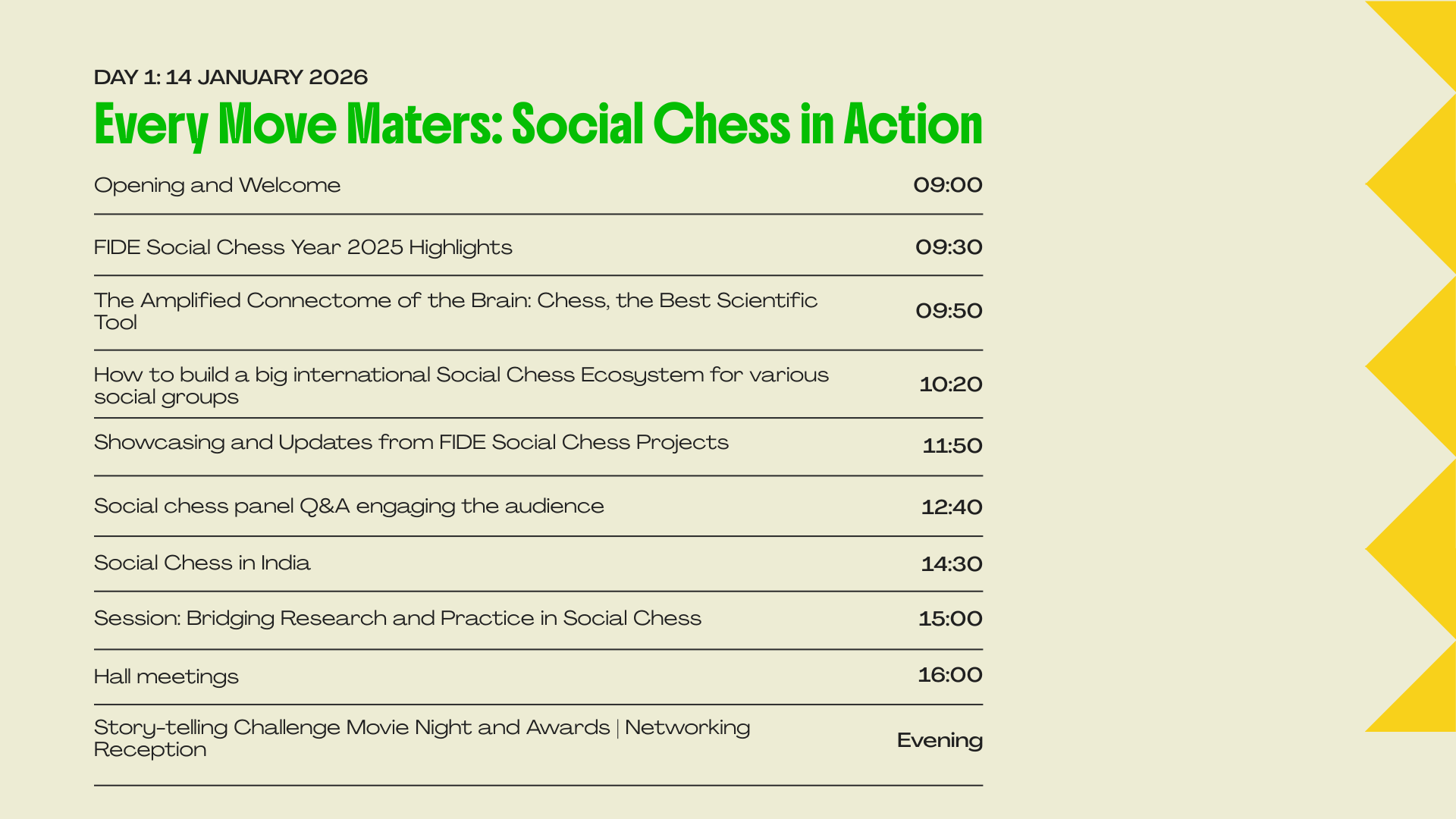
The first day of the conference, titled “Every Move Matters: Social Chess in Action”, will focus on social impact initiatives. Sessions will highlight the outcomes of FIDE’s Social Chess Year 2025 and present priorities for 2026. Speakers and project leaders from around the world will share experiences from initiatives working with refugees, prison populations, children in underserved communities, elderly participants, and individuals facing addiction and social exclusion. The programme will also address institutional models, partnerships, CSR engagement, volunteer management, and sustainable project development.
As part of the Every Move Matters theme, the first day of the conference will conclude with the presentation of the FIDE Social Chess Storytelling Challenge. Short films submitted through the global initiative will be screened, showcasing real stories of how chess supports education, inclusion, and social change across communities worldwide. The evening programme will culminate in the announcement of the winning films, followed by a networking reception hosted by KIIT and the All India Chess Federation.
The second day, “Every Lesson Counts: The Present and Future of Chess in Education”, will focus on chess in formal and non-formal education systems. Discussions will include current research on the cognitive and academic impact of chess, national and regional implementation models, teacher training, curriculum integration, and policy development. Digital tools and platforms supporting chess in education will also be showcased, alongside case studies from established programmes around the world.
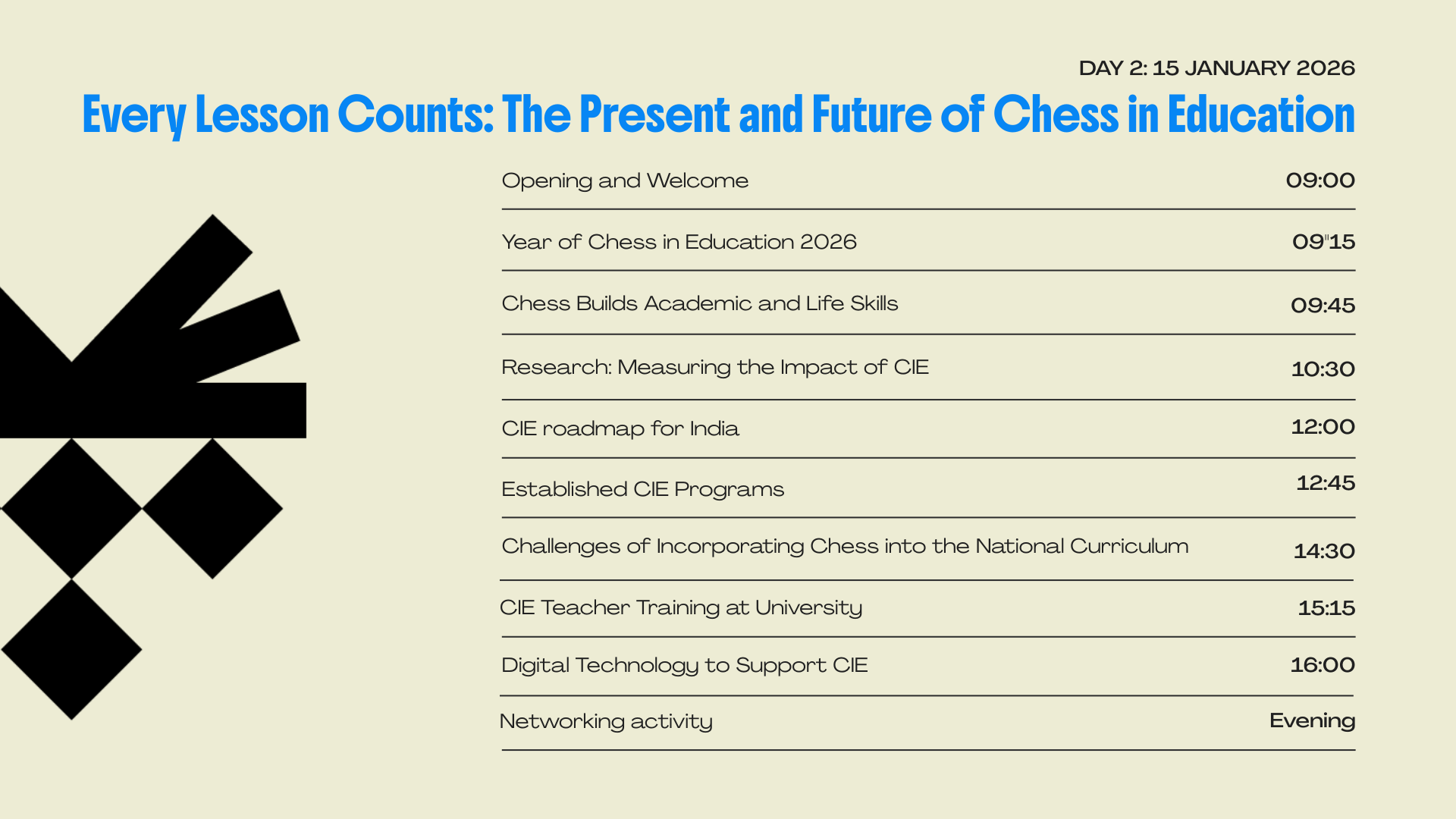
Beyond the main conference sessions, the programme includes exhibitions of social chess projects, educational workshops, networking activities, and presentations from digital and educational partners. Interactive formats such as audience Q&A, project showcases, and short film screenings will encourage dialogue and exchange between participants.
The final days of the programme will be dedicated to site visits at KIIT and KISS facilities, local social chess initiatives, school activities, and Chess in Education teacher training courses, reinforcing the conference’s emphasis on practical application and long-term capacity building.
The Social and Educational Chess Conference reflects FIDE’s ongoing commitment to developing chess as a tool for education, inclusion, and social development, while strengthening collaboration between institutions, educators, researchers, and federations worldwide.
The conference will be streamed live on the FIDE YouTube Channel.
Registration details, speakers, and the program are available at soc.fide.com/global-chess-conference.