

One move can change everything in the World Championships U7-U17
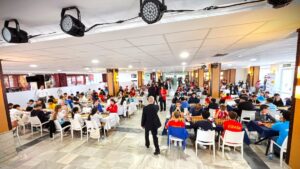
With six rounds completed and five to go, every half-point counts as the race for the world titles intensifies in Roquetas de Mar, Spain. As the 2026 World U7-U17 Chess Championships reaches the halfway point, the tension is mounting across all age categories. With six rounds completed and five still to play, every half-point matters, and the pressure is becoming increasingly evident as young players face the challenge of balancing ambition with nerves. Some have established commanding leads, while others find themselves in tightly packed groups where a single mistake could dramatically change the standings. Rating favourites are fighting to stay in contention, and emerging talents are seizing their opportunities on the world stage. With Round 7 approaching after a well-deserved rest day, the players will return to the boards knowing that the final stretch is drawing closer and that the margin for error is shrinking with every move. Let’s take a closer look at each age group. Under 7 (53 players in the open section and 28 players in the girls’ section) A three-way tie at the top of the Under-7 girls’ standings sees Margad Bayasgalan of Mongolia, Leila Aldazharova of Kazakhstan, and Echo Heming Fang, representing Canada, all on 5/6, with five rounds still to play. Two of the three leaders have already suffered a defeat, while Aldazharova has drawn twice – a relatively rare occurrence in the Under-7 section, where decisive games are the norm. In the Open section, Poland’s Ignacy Mongay Miland (pictured above) is setting the pace with a perfect six out of six. He holds a full-point lead over Egypt’s Mohab Ahmed Assem, with a further seven players just behind on 4.5/6. The seventh round will see the two leaders face each other in a potentially pivotal encounter. There is still a long way to go, but a positive result for Mongay Miland would strengthen his position considerably as he looks to maintain his perfect score. Standings after Round 6 – Open U7 Standings after Round 6 – Girls U7 Under 9 (82 players in the open section and 40 players in the girls’ section) Kazakhstan’s Amaliya Yedresheva leads the Girls’ section with 5.5/6, half a point ahead of New Zealand’s Vera Jintian Xu. Top seed Stella Zhu of Finland is among three players on 4.5/6, keeping the pressure on the leaders as the tournament progresses. Mate of the day Symbat Otargali – Varvara Volkova One of the most striking tactical moments came in the third round, when Varvara Volkova found a neat three-move forced checkmate. Her combination began with the spectacular 28…Rf1+!, followed by 29.Rxf1 Qxf1+ 30.Qxf1 Rxf1#. Black’s precise execution secured an important point. The Open section has two co-leaders on 5.5/6, with a third player just half a point behind. Latvia’s Akims Jefimovs holds a slight tiebreak advantage over Uzbekistan’s Sayfuddin Erkinboev, while Estonia’s Lev Jevglevski remains firmly in contention on 5/6. With the leaders separated by such narrow margins, the next rounds could prove decisive in shaping the race for the title. Standings after Round 6 – Open U9 Standings after Round 6 – Girls U9 Under 11 (99 players in the open section and 47 players in the girls’ section) Uzbekistan’s Akbar Mustafakulov leads the Under-11 Open section with an impressive 5.5/6, half a point ahead of a group of five players on 5/6. The 2026 Asian Champion has displayed solid fundamentals throughout the opening six rounds, dropping just half a point so far. Among his closest pursuers is top seed Amirzhan Anetov of Kazakhstan, a Candidate Master who remains firmly in the title race. In the Girls’ section, Kazakhstan’s Women Candidate Master Milana Filippova (pictured below) is setting the pace with a perfect six out of six. She holds a full-point lead over Georgia’s Sara Saltkhutsishvili, whom she has already defeated, giving her a valuable advantage in the race for the title. Filippova has already demonstrated her strength at continental level, winning the Under-10 Asian Championship in 2025. She will now look to maintain her winning streak as the tournament enters its next phase. Standings after Round 6 – Open U11 Standings after Round 6 – Girls U11 Under 13 (75 players in the open section and 43 players in the girls’ section) Women Candidate Master Lilian Schirmbeck of Germany leads the Under-13 Girls’ section with 5/6, having recorded four wins and two draws. She holds a half-point advantage over a group of six players on 4.5/6, including several of the other rating favourites. With the standings still tightly packed, the battle for the title remains wide open. In the Open section, Egypt’s International Master Abdalrahman Sameh Mohamed (pictured below) has made a perfect start, winning all six of his games. His next challenge promises to be a major test, as he faces Kazakhstan’s International Master Danis Kuandykuly, the rating favourite, who has dropped just one draw so far. Sameh arrives at this crucial encounter with an impressive recent achievement to his name: victory in the 2025 FIDE World Cup in the Under-12 category. With both players among the strongest competitors in the field, their meeting could prove a pivotal moment in the race for the title. Standings after Round 6 – Open U13 Standings after Round 6 – Girls U13 Under 15 (85 players in the open section and 43 players in the girls’ section) The Under-15 Open section is proving to be one of the most competitive categories in the championship. Kazakhstan’s FIDE Master Aldiyar Zharas currently leads with 5.5/6, but the pressure is mounting, with no fewer than five titled players just half a point behind on 5/6. Among them is Spain’s FIDE Master Martin Krauchi Romero, who remains firmly in contention as the battle for the top places intensifies. The Girls’ section is equally competitive, with three players sharing the lead on 5/6. Women FIDE Master Aiaru Altynbek of Kazakhstan, Vietnam’s Vu Nguyen Bao Linh and Mongolia’s Women Candidate Master Batkhishigt Enkhnamuun are level at the top. With several rounds still to play, the race
Olympiad qualification spots for 2027 World Cup and Women’s World Cup announced
FIDE announces the allocation of qualification spots for the 2027 FIDE World Cup and Women’s World Cup, based on the results of the Chess Olympiad held in Samarkand, Uzbekistan. FIDE is pleased to announce the allocation of qualification spots for the 2027 FIDE World Cup and Women’s World Cup, based on the results of the Chess Olympiad held in Samarkand, Uzbekistan. These prestigious tournaments will showcase top players who have earned their places through exceptional performances at the Olympiad, alongside those who qualify via other pathways. Spot transfers to continental events FIDE World Cup and Women’s World Cup regulations allow each continent to transfer allocated Olympiad spots to their respective continental events. This provision grants continental federations greater flexibility in offering World Cup qualification through local competitions. Prior to the Olympiad, the federations of Europe, Africa, and the Americas chose to exercise this option, transferring a portion of their Olympiad-earned spots to upcoming continental tournaments. This adjustment provides additional opportunities for players to qualify regionally and encourages stronger competition at the continental level. Olympiad spots transferred to Continental Events in accordance with decisions of Continental federations Final Olympiad qualification spots After transferring 17 open and 5 women’s Olympiad spots, as indicated above, 83 national federations from the Open section and 45 federations from the Women’s section have secured places in the 2027 World Cup and Women’s World Cup, respectively. These Olympiad-based slots are awarded to the top-performing national teams, ensuring that the highest-level performers from the Olympiad will compete on chess’s biggest stage. FIDE World Cup 2027 Rk. FED TEAM 1 UZB Uzbekistan 2 IND India 3 GER Germany 4 USA United States of America 5 AZE Azerbaijan 6 ARM Armenia 7 HUN Hungary 8 CHN China 9 FRA France 10 ESP Spain 11 UKR Ukraine 12 ENG England 13 TUR Turkiye 14 POL Poland 15 IRI Iran 16 NED Netherlands 17 ROU Romania 18 VIE Vietnam 19 CRO Croatia 20 CZE Czech Republic 21 SRB Serbia 22 ARG Argentina 23 ISR Israel 24 KAZ Kazakhstan 25 MGL Mongolia 26 BLR Belarus 27 GEO Georgia 28 ITA Italy 29 GRE Greece 30 SLO Slovenia 31 PHI Philippines 32 PER Peru 33 BUL Bulgaria 34 INA Indonesia 35 MKD NorthMacedonia 36 SGP Singapore 37 MDA Moldova 38 DEN Denmark 39 BEL Belgium 40 CHI Chile 41 CAN Canada 42 POR Portugal 43 BRA Brazil 44 MNE Montenegro 45 SUI Switzerland 46 LAT Latvia 47 COL Colombia 48 CUB Cuba 49 TJK Tajikistan 50 AUS Australia 51 NZL New Zealand 52 KGZ Kyrgyzstan 53 ECU Ecuador 54 TKM Turkmenistan 55 BAN Bangladesh 56 URU Uruguay 57 LBN Lebanon 58 KOR South Korea 59 TPE Chinese Taipei 60 CRC Costa Rica 61 BOL Bolivia 62 MEX Mexico 63 PAR Paraguay 64 MAS Malaysia 65 HKG Hong Kong, China 66 ALG Algeria 67 ANG Angola 68 RSA SouthAfrica 69 JOR Jordan 70 SRI Sri Lanka 71 UAE United Arab Emirates 72 MAD Madagascar 73 SYR Syria 74 LBA Libya 75 UGA Uganda 76 JPN Japan 77 MOZ Mozambique 78 TUN Tunisia 79 PAK Pakistan 80 THA Thailand 81 MYA Myanmar 82 NEP Nepal 83 OMA Oman FIDE Women’s World Cup 2027 Rk. FED TEAM 1 CHN China 2 KAZ Kazakhstan 3 IND India 4 USA United States of America 5 POL Poland 6 ARM Armenia 7 MGL Mongolia 8 GEO Georgia 9 VIE Vietnam 10 SLO Slovenia 11 TUR Turkiye 12 FRA France 13 UZB Uzbekistan 14 BUL Bulgaria 15 ENG England 16 AZE Azerbaijan 17 ROU Romania 18 SUI Switzerland 19 INA Indonesia 20 UKR Ukraine 21 SRB Serbia 22 ARG Argentina 23 GRE Greece 24 ESP Spain 25 HUN Hungary 26 CZE Czech Republic 27 CAN Canada 28 CUB Cuba 29 TKM Turkmenistan 30 SRI Sri Lanka 31 COL Colombia 32 IRI Iran 33 PER Peru 34 PHI Philippines 35 BRA Brazil 36 AUS Australia 37 ECU Ecuador 38 EGY Egypt 39 CHI Chile 40 CRC Costa Rica 41 PAN Panama 42 SYR Syria 43 KOR South Korea 44 SGP Singapore 45 MAS Malaysia What’s next for Federations? Each federation that has earned a spot must now decide which player will represent them, selecting one of their team members from the Chess Olympiad. However, if all team members have already qualified for the World Cup via another pathway or decline the opportunity, the federation retains the discretion to allocate the spot to another player of its choosing. Federations are expected to confirm their representatives between 1 and 15 July 2027. FIDE looks forward to seeing how these Olympiad qualifiers perform in the 2027 World Cup and Women’s World Cup and remains committed to supporting the continued global growth of chess talent. For further details, refer to the official qualification guidelines: World Cup 2027 Regulations Women’s World Cup 2027 Regulations For any questions or additional information, please contact the Global Strategy Commission at gsc@fide.com.

FIDE World Junior U20 Rapid and Blitz Championships: Registration deadline extended
FIDE, in cooperation with the United Arab Emirates Chess Federation and Al Ain Chess & Mind Games Club, invites all FIDE member federations to participate in the World Junior U20 Rapid and Blitz Championships 2026. Each federation can register an unlimited number of players. The championships will be held in Al Ain, United Arab Emirates, from November 1 (arrival) to November 7 (departure), 2026. The winners of the World Junior Rapid & Blitz Championships 2025 and the top 10 players on the starting list (5 Rapid + 5 Blitz for the open section and 5 Rapid + 5 Blitz for the girls’ section) are entitled to free full-board accommodation in a double room. FIDE member Federations should proceed with the registration of their participants. Please note that eligible players must be born on or after January 1, 2006. The official registration link: https://juniorrapidandblitz2026.fide.com Email: juniorrapidblitz@fide.com Invitation, regulations, schedule (PDF) The deadline for registration, hotel reservations and receipt of all applicable payments has been extended to October 27, 2026.

6th Intercontinental Online Chess Championship for Prisoners: India wins double gold, Mexico triumphs in men’s section
Mexico claimed title in the men’s category, while India earned double gold, winning women’s and youth sections. The 6th Intercontinental Online Chess Championship for Prisoners concluded on October 15 with tightly contested finals in all three categories. Each final match consisted of two sets with colors reversed. Let’s have a look at how the action unfolded on the final day of the competition. Men’s section final: Mexico – Armenia (2-2 and 3-1) In the first set Mexico had white pieces on all boards but did not manage to capitalize on the first move advantage. Mexico scored wins on boards two and three, but Armenia struck back on boards one and four, and the set ended in a hard-fought draw 2-2. Armenia had white in the second set, but somewhat surprisingly, it was all Mexico who prevailed on boards one, two and three in topsy-turvy games. Federal Social Rehabilitation Center number 18 (CEFERESO-18) Coahuila, Mexico, deservedly won the match and captured the title. Women’s section final: India – Mexico (4-0 and 4-0) It was a lopsided final as India (Government Children Home, Bhopal) swept Mexico (Federal Social Rehabilitation Center number 16 (CEFERESO-16) Morelos) in both sets to claim gold. Youth section final (2.5-1.5 and 2-2) The match was decided in the first set which India narrowly won by 2.5-1.5. In the second set Serbia pushed hard scoring victories on boards one and three, but Indian youngsters retaliated on boards two and four to draw the set and secure the title. This year’s championship, which allowed correctional facilities separated by thousands of kilometers to meet over the same chessboard, was a great success. The event established a new participation record, with 140 teams from 56 countries taking part. Organised by FIDE and the Cook County (Chicago, IL, USA) Sheriff’s Office, the championship once again demonstrated how chess can be used as an educational and social tool in correctional facilities. Since the first Intercontinental Championship in 2021, the initiative has expanded across six continents, promoting critical thinking, emotional control, teamwork, and skills that support reintegration into society.

Three Chess Houses open simultaneously in Shymkent, Kazakhstan
On October 15, the grand opening of three Chess Houses took place in Shymkent, the third largest city in Kazakhstan by population. The new spaces were established in Abay Park, Metallurgists Park, and the pedestrian alley in the 17th microdistrict. Here, city residents can play chess, train with coaches, and participate in tournaments. The opening ceremony was attended by Timur Turlov, President of the International Chess Federation (FIDE) and KazChess, and Gabit Syzdykbekov, Akim (Mayor) of Shymkent. The locations for the new Chess Houses were not chosen at random. All three facilities are situated in popular public areas where Shymkent residents frequently relax and spend their time. The main idea of the project is to make chess as accessible to the public as possible. There is no longer a need to visit specialized sports schools or chess clubs to play a game or meet fellow enthusiasts, as ideal conditions for this have now been created in parks and alleys. The largest Chess House, covering an area of 223 square meters, is located in Abay Park. Two additional pavilions, each with an area of 81 square meters, were built in Metallurgists Park and the alley in the 17th microdistrict. The latter facility also features a summer terrace. The halls are equipped with specialized chess tables, with capacities accommodating 96 and 48 people simultaneously, respectively. “I am delighted to see the growing interest in chess in our city year after year. In 2024, a Chess House dedicated to veterans and the older generation was opened in Central Park. Today, this noble initiative continues. The new facilities will provide residents with an opportunity to gather, practice chess regularly, and spend their free time productively. Moving forward, we will continue to pay special attention to the development of grassroot sports and the support of talented athletes,” said Gabit Syzdykbekov, Akim of Shymkent. The construction was sponsored by Freedom Holding Corp. through the “Freedom Shapagat” Corporate Fund. The Fund coordinated the project at every stage, from pre-design preparation to the handover of the facilities. Once the facilities are fully operational, Freedom Telecom plans to provide them with internet connectivity. “I clearly see the growing interest in chess in Shymkent year after year. The city has firmly joined the ranks of leaders in terms of the number of tournaments and talented players, especially among children and youth. However, champions do not appear out of nowhere: as global experience shows, major sporting success begin primarily with mass participation and public passion. Therefore, one of FIDE’s main objectives in the coming years is to attract as many people to chess as possible. I consider the simultaneous opening of three Chess Houses a significant step in this direction. I have great hope that in a short time, they will become an integral part of the city’s life. Most importantly, the chess-loving community and the number of champions will grow here, and Shymkent will continue to develop beyond the region as one of the strongest chess centers in Kazakhstan and Central Asia,” said Timur Turlov. Chess advocate and President of the Chess Players Union, Shyngys Nurgalimov, actively participated in developing the design of the central Chess House. The general contractor is “Orda-Stroy Capital” LLP. Immediately following the grand opening, the SHYMKENT CHESS HOUSE BLITZ Challenger 2026 children’s blitz tournament took place in the new Chess Houses, with over a hundred young players participating. The games were held simultaneously across three venues: 60 participants in Abay Park, and 20 chess players each in Metallurgists Park and the alley in the 17th microdistrict. The competition was a nine-round Swiss tournament (time control: 3 minutes + 2 seconds increment per move).

Chess in Schools Worldwide: Reach, Structure and Evidence in 100 countries
By George Chitiyo, Ph.D.Tennessee Technological University Chess has a long history in schools, yet the field has lacked a global account of how school chess programs are organized, supported and evaluated. The 2026 FIDE Global Chess in Schools Survey, conducted for the FIDE Chess in Education Commission, was designed to address that gap. This article summarizes the main findings from the global survey and highlights their implications for policy and practice. The Survey and the Scale of School Chess The survey builds on a 2021 FIDE and European Chess Union study of 196 respondents, mostly national federations and predominantly in Europe (Hall & Nash, 2021). Conducted online between October 2025 and June 2026, the 2026 survey asked 33 questions, both closed-ended and open-ended, about program structure, funding, benefits, barriers and evaluation. There were 239 respondents from 100 countries on all five continents, representing national federations, schools, chess-in-schools organizations and other groups. Because respondents chose to take part, the results describe the responding programs rather than all school chess worldwide. School chess reaches a very large number of children. Respondents estimate that close to 30 million children take part in the countries surveyed, about half of them in India. They are taught by more than 145,000 classroom teachers and about 22,500 outside or independent coaches. These figures rest mostly on respondents’ own estimates, so they give a sense of scale rather than an exact count. How Programs Are Structured Around the World Three markers offer a useful way to judge how established a program is: whether instructors need a formal qualification; whether there is a written curriculum that sets out what children should learn; and whether the program uses chess software or online platforms. Comparing these markers across continents reveals two clear patterns. First, technology use is more widespread than formal teaching structures such as a written curriculum. On every continent except Oceania, where the two respondents reported none of the three markers, software use was the most common (tied with qualifications in Asia), and a written curriculum was the least common. The gap was widest in Europe, where 69.2% of programs use software but only 35.9% have a written curriculum. Second, no continent leads on every measure. Asia had the highest share of programs requiring instructor qualifications (65.3%) and using a written curriculum (49.3%), while the Americas led on software use (71.9%). Africa’s results deserve particular attention. Africa had more countries in the survey than any other continent (26) and more respondents than Europe. Nearly half of African programs (47.3%) require instructor qualifications, close to the Americas (48.4%) and Europe (52.5%). The share with a written curriculum (36.4%) is on par with Europe’s (35.9%). More than half of African programs (54.5%) use software, and a quarter (25%) report that chess is part of the official school curriculum, nationally or in some regions. Africa also leads all continents in deliberate efforts to include girls: 42.2% of African programs run specific initiatives for girls, and only 4.4% report that they do not actively promote girls’ participation. Differences by type of organization were smaller. Between 51.8% and 55.8% of each group required instructor qualifications. Chess-in-schools organizations were the most likely to have a written curriculum (55.6%) and schools the least likely (35%). Program maturity, therefore, has several dimensions, and a program can be strong in one area while lagging in another. The results also suggest that easy access to digital tools has not yet been matched by shared, written plans for what children should learn. Without such plans, it is hard to say what success looks like, and harder still to measure it. The Chitiyo-Atkins Model of Chess Program Development When respondents described their programs in their own words, a consistent pattern emerged: programs tend to reach the same milestones and in the same order. The Chitiyo-Atkins Model organizes these milestones into four stages of development. The model was built from the data rather than imposed on it, and it draws on the accounts of close to 90 countries whose responses gave enough detail to be classified. First move. An individual teacher, a single school or a newly founded federation makes a start, often from nothing. A first club is formed, first lessons are taught, and awareness campaigns begin. Activity depends on one or a few committed champions, and there are no formal structures, trained instructors or dedicated resources yet. Building foundations. The program invests in its two basic foundations: people and equipment. Teacher training and certification courses begin, chess sets and kits are distributed to schools, the first structured classes appear and the first school competitions are organized. Reach grows, but delivery still depends on projects and can falter if key individuals or funding are lost. Scaling and systematizing. Chess becomes a system rather than a project. Programs adopt structured or age-based curricula, hold regular regional and national school competitions, use digital platforms and online teacher courses, and build networks of coordinators and certified instructors. The program is sustained by organizations and routines rather than individuals, but it still lacks formal government status. Policy integration. Chess gains formal status in the education system. Signs of this stage include a dedicated government budget line, a formal partnership with or endorsement from the education ministry, chess as a required or elective subject in the official curriculum, accredited teacher courses, and national coordination and monitoring. The program no longer depends on any single champion. The model describes where programs are; it does not judge them or rank countries against one another. Progress is also not guaranteed, as programs can stall or regress when support ends. The model is most useful as a guide, showing each country what the next step usually looks like and where help could make the biggest difference. Common Barriers to Growth Programs at every stage and on every continent face many of the same obstacles. Funding is the most common: 79% of respondents named it among the biggest barriers. Parents are the most common source of funding, and government funding