

Early-bird tickets now available for FIDE Candidates 2026

Tickets are now on sale for the FIDE Candidates Tournament 2026, one of the most prestigious events in the international chess calendar. From March 28 to April 16 2026, the world’s attention will turn to Cyprus as the FIDE Candidates Tournament and the FIDE Women’s Candidates Tournament are held side by side at the Cap St Georges Hotel & Resort. Set on the scenic coastline near Paphos, the venue offers a rare combination of top-level sport and an exceptional setting, making this a must-see event for chess followers from around the world. The Candidates Tournament is the final and most demanding step in the World Championship cycle. Over fourteen rounds of classical chess, eight elite players in each event compete in a double round-robin format, with only the winner earning the right to challenge for the World Chess Championship title. Every game matters, and the tension builds steadily as the tournament progresses, round by round. The 2026 edition brings together an outstanding field of players, including former challengers, established super-grandmasters, and rising stars. Watching these players compete in person offers a close-up view of chess at the highest level, where preparation, stamina, and nerves are tested every day for nearly three weeks. Tickets are available in Standard and VIP categories, with a range of day passes and full event passes on offer. Standard ticket holders can watch the games live from the viewing area inside the playing hall and enjoy access to the fan zone. VIP tickets provide an enhanced experience designed for those who want closer access and added comfort. VIP guests enjoy access to the VIP lounge, live viewing from VIP seats inside the playing hall, preferential seating in the fan zone, and all-day catering. Subject to availability and confirmation, VIP ticket holders may also have the opportunity to play a game with a Grandmaster and receive an autographed player card. VIP passes are strictly limited and are expected to be in high demand. Special early-bird prices are currently available for a limited time, valid until February 1. Multi-day discounts can be applied at checkout using the promo codes 2days10, 3days15, or 4days20 for bookings of two, three, or four or more days. Due to venue capacity, availability is limited, and prices will increase closer to the event. All tickets are sold exclusively through the official ticketing platform at tickets.fide.com. Spectators are encouraged to book early to secure their preferred dates and seating category. With world championship ambitions on the line, an exceptional venue, and a rare chance to see the very best players in classical chess up close, the FIDE Candidates Tournament 2026 promises an experience unlike any other on the chess calendar.
Every Lesson Counts: The Present and Future of Chess in Education
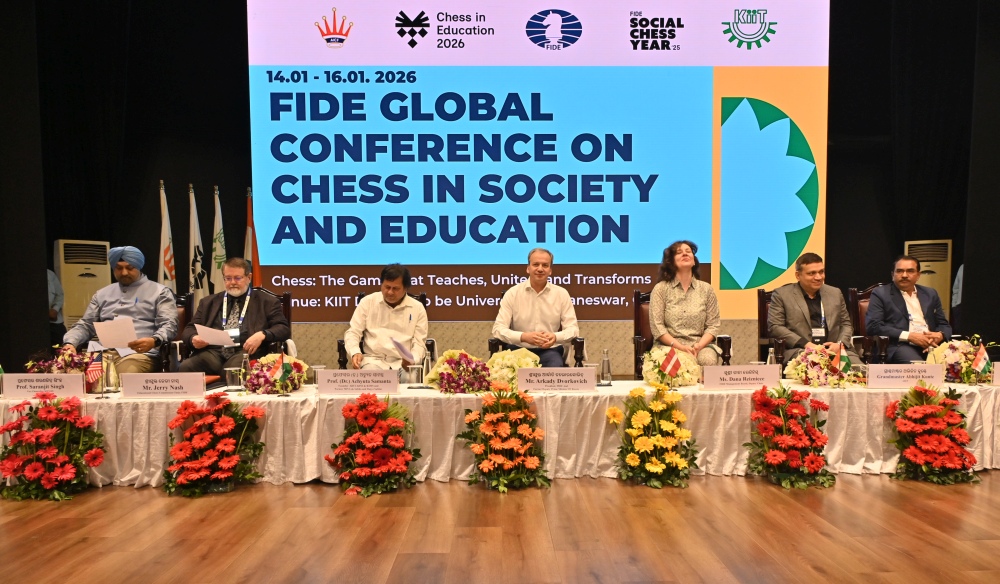
The second day of the FIDE Global Conference on Chess in Society and Education at KIIT University in Bhubaneswar was dedicated to chess in education, with a clear focus on how the game can be integrated into formal and non-formal learning systems. Building on the social impact discussions of the opening day, EDU Day brought together education leaders, researchers, federation officials, and practitioners to examine policy frameworks, research evidence, and real-world implementation models for Chess in Education (CIE). Welcome and opening The day began with a formal welcome and ceremonial lamp lighting, marking the start of proceedings. Senior representatives from FIDE and KIIT were invited to the stage, followed by the presentation of flower bouquets to the guests. Dr Saranjit Singh, Vice-Chancellor of KIIT, delivered the opening address, welcoming participants and outlining KIIT’s commitment to education and chess as part of its institutional ecosystem. He was followed by Jerry Nash, Chair of the FIDE Chess in Education Commission, who introduced the educational focus of the day and framed chess as a tool for learning rather than an end in itself. Dana Reizniece, Deputy Chair of the FIDE Management Board, linked the discussions to the broader objectives of the FIDE Year of Chess in Education 2026, stressing the need for quality, consistency, and alignment with education systems. She underlined that the purpose of chess in schools goes beyond performance, noting that “chess in education is not about creating champions. It is about creating better thinkers, better learners, and more confident young people who are prepared to make decisions and take responsibility.” Dr Achyuta Samanta, Founder of KIIT, spoke about education as a transformative force and the role institutions can play in creating opportunities through innovative and inclusive approaches. The opening concluded with remarks from Arkady Dvorkovich, FIDE President, followed by closing thanks from Dr Jnyana Ranjan Mohanty, who acknowledged the speakers, organisers, and partners involved in the conference. Geopolitics of a changing world: balancing cooperation and competition in the 21st century Arkady Dvorkovich opened the programme with a keynote titled Geopolitics of a Changing World: Balancing Cooperation and Competition in the 21st Century. Drawing on his background in economic policy and academia, he placed chess and education within a broader global context, describing a world marked by uncertainty, competition, and shifting power dynamics. Using chess as an illustrative lens, he explained that patterns within the chess world often mirror wider economic and social realities. “I start my lectures normally with one picture – a picture about chess and the current ratings of the top players,” he said, noting that the distribution of elite players reflects deeper structural factors. “What it shows is which countries dominate the chess world. And it is not by coincidence. There is some correlation between economic power and chess power.” Dvorkovich went on to describe how different chess cultures emerge from distinct education systems, opportunities, and approaches to talent development, arguing that education remains one of the few forces capable of fostering cooperation alongside competition in a divided world. Year of Chess in Education 2026 The strategic framework for EDU Day was set through presentations by Dana Reizniece and Jerry Nash. Reizniece outlined the objectives of the FIDE Year of Chess in Education 2026, focusing on strengthening cooperation with education authorities, supporting teachers, and ensuring that chess programmes are delivered with consistent quality across regions. Particular emphasis was placed on evidence-based approaches that allow Chess in Education initiatives to be evaluated, refined, and scaled. Jerry Nash followed with an overview of the FIDE EDU framework, explaining how chess can be embedded into learning environments as a structured educational tool. His presentation addressed governance, programme design, and the central role of teachers, highlighting the need for clear methodologies, training pathways, and accessible resources to support effective classroom delivery. How chess builds academic and life skills at the Overseas Family School Practical school-based implementation was illustrated by Dijana Dengler, Head of Chess at the Overseas Family School in Singapore. Her presentation provided insight into how chess is integrated into the school’s curriculum and daily activities, supporting both academic development and life skills such as problem-solving, focus, and resilience. The case study demonstrated how chess can be embedded within an international school environment as part of a holistic educational approach. Creating Chess in Education resources for teachers Anzel Laubscher focused on the practical foundations of Chess in Education, presenting the development of teacher-centred resources designed to support classroom delivery. She addressed curriculum design, lesson structure, and methodology, emphasising that effective chess education begins with understanding learners’ needs. “In chess education, we need to meet our learners where they’re at,” she explained. “If your learner cannot read and write yet, you need to meet them there. If they have special needs, you need to meet them there. The classroom must be inclusive.” Laubscher highlighted the importance of teacher training and follow-up support, describing how initial training alone is not sufficient. “Teachers walk into the session and they don’t know how many squares there are on a chessboard. Four days later, they walk out knowing all the basic rules of chess, how the pieces move, including special moves. But then they realise they still need support to implement this in the classroom, and that’s why we designed the starter kit.” World Schools Team Championship The role of school competitions was explored by Nadzeya Krauchuk, Director of International Relations at the International School Chess Federation (ISCF), through a presentation on the World Schools Team Championship. She explained how structured school tournaments can motivate students, support teamwork, and create international connections, while remaining firmly rooted within an educational framework rather than elite competitive pathways. Research: Measuring the impact of Chess in Education A dedicated research block examined how the impact of chess in education can be measured and communicated. Moderated by Jerry Nash, the session featured contributions from Dr George Chitiyo of TTU, Martin Labollita of the National University of Tres de Febrero (UNTREF), and Jonathon Quest of Webster University. Reflecting on comparative
Nodirbek Abdusattorov secures final spot at FIDE Freestyle Chess World Championship

Nodirbek Abdusattorov has secured the eighth and final spot in the FIDE Freestyle Chess World Championship, to be held in Weissenhaus, Germany, from February 13–15, 2026. Abdusattorov won the official Play-In qualifier hosted by Chess.com, defeating Pranav Venkatesh 2–0 in the final. The qualifier attracted more than 100 titled players from around the world and culminated in a four-player knockout stage on January 15. With this victory, Abdusattorov joins the seven players already qualified for the championship:Magnus Carlsen, Levon Aronian, Fabiano Caruana, Vincent Keymer, Arjun Erigaisi, Javokhir Sindarov, and Hans Niemann. Abdusattorov brings extensive experience in Freestyle Chess and Chess960, having previously reached the semifinals of the FIDE Fischer Random World Championship. In 2025, he competed in multiple events on the Freestyle Chess Grand Slam Tour. During the World Championship in Weissenhaus, an exhibition Freestyle Chess match between Hou Yifan and Bibisara Assaubayeva will take place on February 14 and 15. The FIDE Freestyle Chess World Championship marks the first World Championship jointly staged by FIDE and Freestyle Chess, concluding the 2025 Freestyle Chess season and crowning the first World Champion under this new framework. Photo: Lennart Ootes
FIDE Global Conference on Chess in Society and Education opens in Bhubaneswar
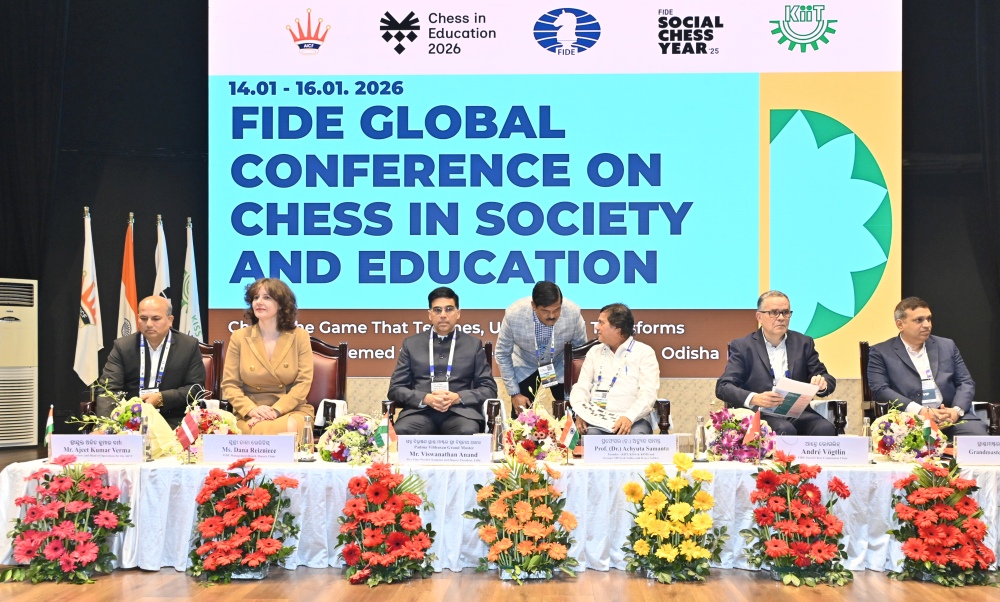
The FIDE Global Conference on Chess in Society and Education opened at KIIT University in Bhubaneswar on 14 January 2026, bringing together education leaders, researchers, social impact practitioners, and chess organisers for a three-day programme that also marks the launch of the FIDE Year of Chess in Education 2026. During the opening session, the moderator highlighted the role of Kalinga Institute of Industrial Technology (KIIT) as host of the conference and a long-standing centre for chess and education initiatives. KIIT has been organising international chess festivals for over 18 years, with the most recent edition featuring a total prize fund of INR 1.30 crore. The institution has produced 46 international chess players and hosted more than 30 international events, including World Junior Championships. Chess has also been integrated into KIIT’s broader educational framework, reflecting a sustained commitment to using the game as a tool for learning and development. The conference then formally opened with a ceremonial lamp-lighting, marking the inauguration of the event, followed by opening addresses from senior officials and partners, including Dana Reizniece, Deputy Chair of the FIDE Management Board, Viswanathan Anand, FIDE Deputy President, and Achyuta Samanta, Founder of KIIT, alongside André Vögtlin, Chair of the FIDE Social Chess Commission, Abhijit Kunte, Grandmaster, and Mukesh Ranjan Das, Executive Director (HR) of IndianOil. The opening ceremony and remarks set the tone for the conference’s two linked themes: chess as a social tool with measurable impact, and chess as a structured support for learning. “Education is about turning mirrors into windows,” said Dana Reizniece in her address to the audience, linking the idea to FIDE’s mission of using chess as a tool for empowerment and expanded ways of thinking. Anand emphasised that chess in education is “not to produce professional players,” but to help students “learn habits that improve performance in class,” pointing to focus, discipline, and decision-making as skills that transfer beyond the board. The conference then turned to the speakers and their presentations, with the day organised in thematic sections. FIDE Social Chess 2025 highlights and priorities for 2026 Vögtlin opened the conference programme with a review of the FIDE Social Chess Year 2025 and a forward look to 2026. He highlighted flagship campaigns across the year, including a month-by-month rhythm of themed initiatives, and the Social Chess Day tournament “Every Move Counts”, organised with Lichess.org, which drew 20,078 players worldwide. “Chess is more than a game. It is a tool to empower, include, educate, and transform communities worldwide,” said Vögtlin. “Following the success of the FIDE Social Chess Year 2025, 2026 will focus on scaling, professionalising, and globally embedding social chess as a measurable, evidence-based social impact framework.” The amplified connectome of the brain: Chess, the best scientific tool Dr. Cristóbal Blanco Acevedo followed with a neuroscience-focused presentation on how chess engages the brain across multiple systems rather than in a single “chess area”. “The most important question is not whether the brain will change, but into what it will change,” he said, pointing to the impact of environment and habits in a world of constant information overload. He explained that chess activates multiple areas of the brain simultaneously, particularly those linked to memory, calculation, and emotional control, while cautioning that not all forms of cognitive training translate effectively into real-life performance. How to build a big international social chess ecosystem for various social groups A core mid-morning session focused on how chess can be built into social ecosystems across different communities, with speakers from humanitarian, grassroots, and club-based backgrounds. Joining from Geneva, Francesca Bonelli, Head of Partnership and Coordination at UNHCR, outlined the scale of global displacement and the role sport can play in wellbeing and opportunity. UNHCR reports that 123.2 million people were forcibly displaced by the end of 2024. She also highlighted the FIDE and UNHCR collaboration that began in 2021 with a pilot “Chess for Protection” project in Kakuma, Kenya, and has since expanded to additional locations. Russell Makofsky, Founding Board Member of The Gift of Chess, spoke online about a practical, distribution-led approach to access, tracing the organisation’s origins to community initiatives during the Covid-19 pandemic and outlining its goal of distributing one million chess sets globally by 2030. “We saw how something as simple as a chess set could open doors,” Makofsky said. “When communities have access, opportunities begin to grow.” The session also included contributions from Rodrigo Barbeiton, who shared experiences from Club Magic Extremadura in Spain and the role clubs can play in long-term engagement. FIDE Social Chess programme updates After the networking break, the conference shifted into project-level updates from the FIDE Social Chess portfolio. Anastasia Sorokina (online) presented Chess for Protection, focusing on expanding safe, structured chess activities in refugee settings, particularly for girls and schools. Mikhail Korenman presented updates on Chess for Freedom, outlining developments in prison chess and upcoming continental and intercontinental competitions. Prabitha Urwyler presented Chess for Hope and Recovery, describing chess as a tool that provides structure, routine, and reflection in rehabilitation contexts. April Yunwei Zhong, via recorded video, highlighted how Chess for the Elderly supports both cognitive activity and social connection. Maryia Tamkovic presented Infinite Chess, focusing on adaptive learning models designed to meet players where they are. Social chess in India The afternoon returned to regional practice with a focus on India. In a standout contribution, Neelaya, Secretary of the Andaman and Nicobar Chess Association, presented initiatives shaped by geographic isolation and limited recreational infrastructure. He described projects spanning schools, orphanages, prisons, beach clean-ups linked to “Checkmate to Plastic”, culturally sensitive outreach to Indigenous communities, and onboard chess championships during long inter-island ship journeys. “The story of chess in Andaman and Nicobar islands is ultimately a story of belief in people, in potential, and in the power of thoughtful engagement.” he said, “Each move played on the chess board represents a larger life decision to think before acting, respect others, and to persevere despite setbacks” ending with, “Sometimes the strongest waves of change begin with a single move.” IndianOil
FIDE rating review 2025: The year’s biggest gains and breakthroughs

From 1971 to 1980, FIDE issued just one rating list per year. This gradually increased to the current standard of monthly updates—a change driven by obvious practical needs. Yet frequent rating lists can sometimes obscure the broader picture of yearly progress. In this piece, we highlight players who achieved significant rating gains over the past year. Biggest rating gains in the top 100 Open in 2025 All these players had an excellent 2025, but Vincent Keymer and Anish Giri stand out. Keymer started the year on the wrong foot, losing 12 points at both the Tata Steel Masters and in the Bundesliga. He then regained momentum with strong performances at the German Championship (+10), the Chennai Grandmasters (+21), the European Team Championship (+9), and the European Club Cup (+9). These results propelled him to fourth place on the January 2026 rating list—his highest ever. Anish Giri, meanwhile, strung together a series of strong results: he won the 8th Sharjah Masters (+10) and the FIDE Grand Swiss (+13), and overperformed at the European Club Cup (+7). Unsurprisingly, the Dutchman returned to the top 10 after a 15-month absence and finished the year ranked sixth. Matthias Bluebaum shone in the European Team Championship (+18), becoming the first-ever player to win double crown in this competition, and the FIDE Grand Swiss (+23). The winner of the FIDE Circuit 2025 Praggnanandhaa R took the Tata Steel Masters and Stepan Avagyan Memorial and tied for first place in the Sinquefield Cup. The other players listed above steadily increased their ratings through consistent performances throughout the year. Several players began 2025 outside the top 100 Open but earned their way into this elite group through strong results. In absolute terms, their rating gains appear even more impressive – but we must remember the “low base effect”: the lower a player’s starting rating, the easier it is to achieve large point gains. 48. Martinez Alcantara, Jose – 2667 (+61)49. Donchenko, Alexander – 2665 (+33)57. Erdogmus, Yagiz Kaan – 2658 (+59)71. Theodorou, Nikolas – 2648 (+37)76. Gurel, Ediz – 2645 – (+21)78. Safarli, Eltaj – 2644 (+35)80. Lu Shanglei – 2643 (+27)82. Pranav V – 2641 (+26)83. Ivic Velimir – 2638 (+18)91. L’Ami Erwin – 2633 (+20)96. Mishra, Abhimanyu – 2629 (+29)98. Pranesh M – 2628 (+42) Among these newcomers, two stand out. José Martínez Alcántara launched his surge in May, gaining 61 points over seven months to break into the top 50. Yağız Kaan Erdogmuş followed a different path: the Turkish prodigy accumulated rating points steadily throughout the year, reaching a career-high 57th place on the January 2026 list. Most overperformers on this list are very young, so their progress seems natural. One exception is Eltaj Safarli, who remarkably returned to the top 100 after a six-year hiatus. His strong showings in tournaments in Indonesia and Germany, plus the European Club Cup, earned him 35 rating points Now, let’s turn to the women’s list. Biggest rating gains in top 100 Women in 2025 Several female players had outstanding years in 2025. Zhu Jiner, winner of the 2024–2025 Women’s Grand Prix, gained an impressive 65 points, soaring to second place. Given the strength of her opposition throughout the year, this achievement is nothing short of remarkable. Carissa Yip shone in two summer tournaments – the Spring Classic and the Cairns Cup – adding 58 points to debut in the top 20. Song Yuxin (+73) and Anna Shukhman (+66) made the largest gains among players who began the year inside the top 100. Both entered 2025 as leading juniors and finished it in the top 30 Women. As on the Open list, several women started 2025 outside the top 100 but fought their way onto it: 56. Abrahamian, Tatev – 2389 (+79)70. Balabayeva, Xeniya – 2371 (+121)71. Mkrtchyan, Mariam – 2368 (+43)78. Nurman, Alua – 2363 (+27)80. Rakhmangulova, Anastasiya – 2358 (+35)82. Bodnaruk, Anastasia – 2357 (+23)83. Savitha Shri B – 2356 (+25)85. Tang, Zoey – 2356 (+58)96. Mungunzul, Bat-Erdene – 2347 (+79) Tatev Abrahamian triumphantly returned to the top 100 after a five-year absence, fueled by excellent results – particularly at the Budapest One Week in August (+62). Xeniya Balabayeva broke into the top 100 after her strong showing at the Grenke Open (+39), then backed it up with standout performances at the Asian Women’s Championship (+41) and the Oskemen Open Masters (+39), climbing to 70th place with a staggering 121(!) rating points gained over the year. Bat-Erdene Mungunzul delivered impressive performances in the girls section of FIDE World Junior Championship (+34 points), Asian Women’s Chamionship (+43) and emerged as the winner of the Mongolian Women’s Championship (+23) to make her debut in the top 100 Women. Maintaining momentum after a breakout year is notoriously difficult, as players then face a much stronger opposition. Whether the overperformers of 2025 can sustain their success remains to be seen. Photos: Michal Walusza and Lennart Ootes
FIDE Chess in Education Commission (EDU) courses & events January–March 2026

Dear Chess Friends, FIDE’s Chess in Education Commission continues to accelerate its provision of training for Lecturers and Teachers of Educational Chess, offering a series of high-level online and in-person opportunities in winter 2026. The Preparation of Lecturers (PoL) course leads to the FIDE titles of Lead School Instructor (LSI) and Senior Lead Instructor (SLI). It is intended primarily for those who will train teachers, helping to expand the global community of educators capable of teaching chess in an educational way. The Preparation of Teachers (PoT) course leads to the FIDE title of School Instructor (SI). This 3-day (15-hour) training equips participants with pedagogical methods, digital tools, and practical strategies for teaching chess as an educational tool. The schedule of the FIDE EDU upcoming courses and events is below: To join, please register via the following links: First Russian PoT online course – Jan 16-18Register: https://cloud.fide.com/s/NdsRj6BrJRLQjJkSecond Arabic PoT online course – Jan 16-18Register: https://cloud.fide.com/s/RPWQXpYoC5FxypP33rd PoT online course – Jan 23-25Register: https://cloud.fide.com/s/5yGF43ymNACkrkc7th French POT online course – Mar 6-8Register: https://cloud.fide.com/s/jcwxzpM4y6orHY7Our dedicated Chess in Education website has further details: edu.fide.com/
Olympic Beach Initiative launched in Argentina

The Argentine Olympic Committee’s “Olympic Beach” was officially inaugurated in Argentina—an initiative designed to bring sports and Olympic values to the country’s coastlines as a prelude to the Santa Fe 2026 South American Games. The formal opening took place on Thursday, January 8, 2026, at the Horizonte Beach Club in Mar del Plata. The event was attended by the President of the COA, Mario Moccia; the Governor of Santa Fe Province, Maximiliano Pullaro; Olympic athletes; and local authorities, including Javier Curilen, Vice President of the Argentine Chess Federation (FADA). Under the leadership of Mario Petrucci, Executive Director of FADA, member of the COA, and representative on FIDE’s Chess in Multinational Sports Games Committee, the Argentine Chess Federation has integrated chess into the Olympic Beach activies. The program runs from January 7 to February 1 across eight key locations: Mar del Plata, Chapadmalal, Miramar, Pinamar, Cariló, Villa Gesell, Rosario, and Concepción del Uruguay. It features beach sports competitions and exhibitions, free clinics, activities for children and youth, environmental cleanups, and more. During the opening event in Mar del Plata, the Mar del Plata Chess Federation organized a Blitz tournament at “Varese” Beach, along with open boards for casual play, simultaneous exhibitions, and inclusive activities for all ages. Summer chess in Argentina is moving at an Olympic pace!
FIDE updates rating regulations to include faster time controls for major events

The FIDE Council has approved a resolution allowing specific shortened time controls to count toward standard ratings and title norms in 2026. This decision follows a pilot phase that took place in late 2025, including the Women’s World Team Championship tournament in Linares. Based on feedback from participants, organisers, partners, and consultations with top-tier Grandmasters, FIDE has decided to adjust the regulations to reflect the evolving needs of the chess community. The new standard Effective immediately for the 2026 calendar, tournaments with a time control of 45 minutes plus a 30-second increment (45+30) or longer (60+30), may now be rated as standard chess. This change will not automatically apply to all events. It will strictly apply to major or traditional tournaments, approved by the FIDE Qualification Commission (QC). Modernising the circuit The adjustment aims to reduce logistical barriers for organisers and players. By allowing a 45+30 control, high-level Open tournaments can be concluded in five to six days rather than the traditional nine or ten. This format reduces financial strains on players and organisers, accommodation costs and time commitments, making professional chess more accessible to a wider pool of players and sponsors. “We are adapting the pace of modern sport, while preserving the quality and essence of the game,” said FIDE President Arkady Dvorkovich. “This format allows for more dynamic chess events without compromising the quality of play and the depth of the games,” he added. Protecting title integrity To ensure the value of FIDE titles remains consistent, strict safeguards are put in place: Vetting process: The Qualification Commission (QC) will evaluate requests submitted to qualification@fide.com by tournament organisers on a case-by-case basis, assessing the strength of the field, the history of the event, and support from National or Continental federations. Norm limitations: While players as well as arbiters and organisers will be able to earn norms in these events, a maximum of one such norm may count toward any single title (such as Grandmaster or International Master). Schedule limits: To prevent fatigue and maintain quality of play, approved tournaments may run no more than two rounds per day. The FIDE Council notes that this is a continuation of the pilot project. The QC will monitor the implementation and volume of requests throughout 2026, with the option to adjust criteria based on real-world results. The full text of the FIDE Council Resolution is available [HERE].
Call for Bids: FIDE Amateur World Championships 2026

FIDE Events Commission is pleased to announce “Call for Bids for FIDE Amateur World Championships 2026” and invite FIDE member Federations to participate. The deadline for submissions is January 26, 2026, 15:00 CET. Two competitions included in this call: World Amateur Chess Championships (in a new format) World Amateur Rapid and Blitz Chess Championships (a new event) Interested bidders can find detailed information about the bidding procedure – including the Bidding Form, Bid Form Annex, and applicable Bid and Deposit Fees – [HERE].
European Women’s Rapid & Blitz Championship 2025: Batsiashvili and Roebers capture titles
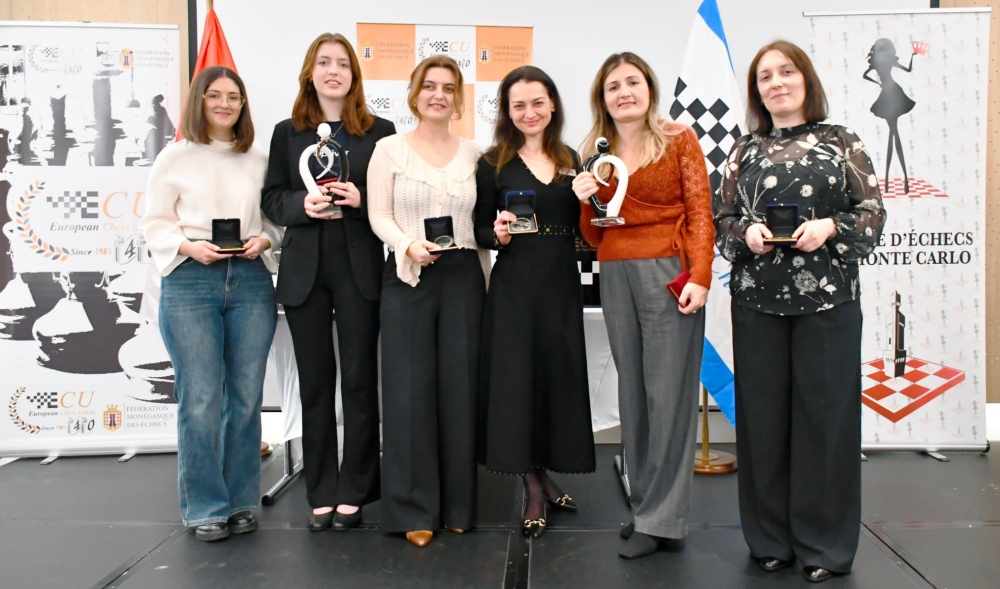
Nino Batsiashvili and Eline Roebers emerged as champions of the European Women’s Rapid and Blitz Championships, respectively, both securing decisive victories in the final round. The 2025 European Women’s Rapid & Blitz Chess Championships took place from January 8–12, 2026, in Monte Carlo, Monaco. The total prize fund for the two events was €46,500, with €15,200 allocated to the Blitz Championship and €31,300 to the Rapid Championship. The 2025 edition set a new participation record, with 154 players from 32 federations registered for the Rapid event and 145 players for the Blitz competition. The first event on the schedule was the European Women’s Blitz Chess Championship 2025, a 13-round Swiss-system tournament played on January 9 under a time control of 3 minutes per game plus a 2-second increment. The blitz event was fiercely contested and came down to the wire. IM Bella Khotenashvili of Georgia seized the lead after Round 7 and entered the final round with 10/12, a full point ahead of IMs Oliwia Kiolbasa (POL), Yuliia Osmak (UKR), and Eline Roebers (NED). Top seed Roebers rose to the occasion, defeating the leader in their direct encounter to clinch the title. Four players tied for third place with 9.5/12, and Oliwia Kiolbasa claimed the bronze medal on tiebreaks (superior Buchholz score). Complete final standings – Blitz The European Women’s Rapid Chess Championship 2025, an 11-round Swiss-system tournament with a 15+10 time control, was held from January 10–11 at the same venue – Hotel Novotel – and followed a similarly dramatic script. GM Alexandra Kosteniuk of Switzerland surged into sole lead after Round 7 and held that position through the penultimate round. In the final round, she faced GM Nino Batsiashvili (GEO), who trailed by a full point. Needing a win, Batsiashvili delivered brilliantly, securing the gold medal with a final score of 9/11. Kosteniuk finished second with the same score but had to settle for silver after losing their head-to-head encounter. Six players tied for third place with 8 points each, and IM Sofio Gvetadze earned the bronze medal based on a superior Buchholz tiebreak. Complete final standings – Rapid The сlosing ceremony of the event took place on Sunday night in the playing venue with the attendance of the ECU President Zurab Azmaiparashvili, ECU Vice President and President of the Monaco Chess Federation Jean-Michel Rapaire, ECU Vice President Malcolm Pein, ECU Vice President Gunnar Bjornsson, ECU Vice President Alojzije Jankovic, ECU CEO Erald Dervishi, ECU Commercial Chief Advisor Moshe Slav, event’s supporter Evren Ucok, and other distinguished guests. The ECU President addressed the players, congratulated the winners, and officially declared the event closed, and with the other distinguished attendees joined the awarding ceremony for the medalists of the European Women’s Rapid and Blitz Chess Championship 2025, and winners of the special awards – the best veteran 50+ players, the best Monaco players, the best players in different rating categories, the best PACA players, and the best Alpes Maritimes player. Photos: Patricia Claros Aguilar