

European Women’s Championship starts in Rhodes

UPDATE: April 22 Three rounds have been played at the European Women’s Chess Championship 2024 in Rhodes, Greece with six players sharing the lead with a perfect 3/3 score: IM Klaudia Kulon (POL, 2348), IM Mai Narva (EST, 2401), IM Marta Garcia Martin (ESP, 2349), WIM Natacha Benmesbah (FRA, 2306), WIM Martyna Wikar (POL, 2214) and IM Ulviyya Fataliyeva (AZE, 2377). Playing on the first board in Round 3, IM Klaudia Kulon toppled the top seed IM Yuliia Osmak (UKR, 2459). After Osmak failed to find a correct middlegame plan on the black side of Scotch Game, Kulon got a clear edge and converted it into a victory on move 37. IM Klaudia Kulon defeated the top seed IM Yuliia Osmak; Photo: ECU IM Mai Narva (EST, 2401) beat FM Nadya Toncheva (BUL, 2258), WIM Natacha Benmesbah (FRA, 2306) won her game against higher-rated IM Irina Bulmaga (ROU, 2394), IM Ulviyya Fataliyeva (AZE, 2377) outplayed WGM Beloslava Krasteva (BUL, 2220), WIM Martyna Wikar (POL, 2214) prevailed over IM Pauline Guichard (FRA, 2362) and IM Marta Garcia Martin (ESP, 2349) defeated WFM Ronit Levitan (ISR, 2187). IM Ulviyya Fataliyeva; Photo: ECU As many as 26 players are trailing the leaders by a half-point 2.5 points, including one of the top-seeds IM Dinara Wagner (GER, 2453) who yesterday delivered a beautiful mating attack against WIM Michalina Rudzinska (POL, 2302). Standings after Round 3 Round 4 is scheduled for April 22, starting at 14:00 CEST The European Women’s Chess Championship 2024 began this Friday in Rhodes, Greece with the drawing of lots. In the presence of the Chief Arbiter Aleksandra Dimitrijevic, former Women’s World Champion Antoaneta Stefanova picked a Black pawn. It means that the top-seeded player in the tournament will play as Black on the first board. Round 1 pairings The event taking place April 18-30 at the 5-star “Rodos Palace” Conference Hotel with the first round is scheduled for April 19. The 9-rond Swiss tournament with classical time control brought together 183 players coming from 35 European federations and is set to be the largest European Women’s Championship ever. It boasts of a very strong line-up headlined by IM Yuliia Osmak (UKR, 2459), IM Marsel Efroimski (ISR, 2457), GM Bella Khotenashvili (GEO, 2454), IM Dinara Wagner (GER, 2453), GM Antoaneta Stefanova (BUL, 2447), IM Lela Javakhishvili (GEO, 2446), GM Nino Batsiashvili (GEO, 2445), IM Gunay Mammadzada (AZE, 2436), GM Monika Socko (POL, 2428) and IM Stavroula Tsolakidou (GRE, 2424). Video preview of the event The European Individual Women’s Chess Championship 2024 is a qualification event for the FIDE Women’s World Cup. According to the decision of the European Chess Union, at least 10 players will qualify. The total prize fund of the Championship is 60,000 EUR with 10,000 EUR reserved for the champion. Live broadcast of the event can be exclusively followed through the ECU YouTube channel, with commentaries by GM Alojzije Jankovic and Dragana Nikolovska. Official regulations of the event and detailed information can be found on the official website. Starting list of players, results & pairings can be followed here. Photo: Official website
FIDE Candidates Round 13: The calm before the storm
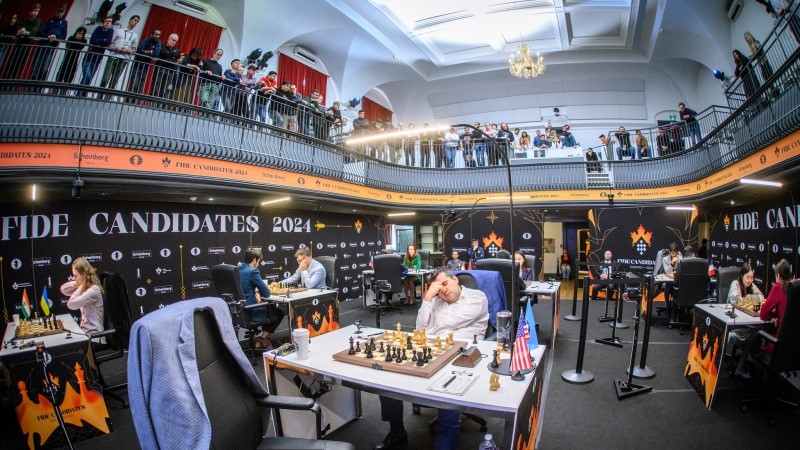
Nothing is clear in the FIDE Candidates! The penultimate round saw some important results but everything will be decided in the final round. Gukesh is in the clear lead after defeating Firouzja, with Caruana, Nakamura, and Nepomniachtchi trailing by half a point. In the last round, it’s Nakamura faces Gukesh and Caruana takes on Nepomniachtchi: it will be one of the most exciting final rounds of the Candidates ever. Mack Hollins, wide receiver for the Buffalo Bills of the National Football League (NFL), made the first ceremonial move for Ian Nepomniachtchi in Round 13. The game between Nepomniachtchi and Hikaru Nakamura ended in an uneventful draw, postponing the climax to the last round. Gukesh D started somewhat slow against Alireza Firouzja and did not gain an advantage from the opening in the Ruy Lopez as White. However, as the game progressed, Firouzja opened up his position, providing White with chances to play on. “After he played 17…Re8 I felt that the position is getting a bit messy,” commented Gukesh. “After 22. Bb3, I think he got over-optimistic and started pushing for more. Although my pieces looked passive, strategically, if I consolidate, I will be better.” This is exactly what happened in the game. “I was quite happy to see 27…f5 because I wanted to win, and I thought this move would give me some chances.” This is when Gukesh started to slowly outplay his opponent and obtained a promising position after the 40-move time control. A serious mistake 45…Qg6? (instead of 45…Ne6! with the idea of 46. Qxf5 Qg7) allowed White to trade queens and enter the technically winning endgame, which Gukesh smoothly converted. Fabiano Caruana won an excruciating 89-move game against Praggnanandhaa R while on the black side of Rosslimo Attack. White committed a serious mistake on move 15 (15. Qh3), which allowed Caruana to advance his kingside pawns with tempo and secure a solid advantage. He won an exchange, but for a time, it appeared that White had managed to build a fortress and maintain the balance. However, from a practical standpoint, it was challenging to defend, as Praggnanandhaa acknowledged post-game because White always had to anticipate potential queenside breakthroughs. Caruana exercised patience and gradually improved his position, eventually opting for the 54…b5 break, which conferred a clear advantage. Nonetheless, he mishandled the situation, and White gained reasonable drawing chances. It was then Praggnanandhaa’s turn to err. Instead of pursuing active play with 67. g5 or 67. Ra1, Pragg chose the passive 67. c3 and 68. Ba1, which ultimately led to a losing position. This crucial victory places Caruana on equal footing with Nakamura and Nepomniachtchi, with all three half a point (8) behind the leader, Gukesh (8.5). Vidit Santosh Gujrathi and Nijat Abasov made a draw, a game that had no influence on the outcome of the tournament. Chess fans will be glued to the screens during Round 14 of the FIDE Candidates. All the contenders for first face one another, and three of them are in a must-win situation. Nakamura is White against Gukesh and has to push for a win. Caruana is White against Nepomniachtchi, and both of them will be playing for a victory, too, as this is the only chance to catch up or overcome Gukesh. “It’s like some sort of a movie,” remarked Fabiano Caruana about this exciting finale. “I will try to play some decent chess. If I manage, then it’s already not bad,” was Nepomniachtchi’s comment. “I am Black, so I am a bit short on options. But Fabiano will only need a win so it will be an interesting game.” “I guess I’ll go with the same strategy and try to play a good game tomorrow,” said Gukesh. Who will emerge as the last man standing, and will we witness a tiebreak for first place? Should one or more players tie for the top spot, the champion will be determined in a rapid tiebreak on April 23. In Round 13 of the Women’s Candidates, the sole decisive outcome was Vaishali R securing her fourth consecutive victory, this time defeating Lei Tingjie. Consequently, Tan Zhongyi, who settled for a brief 29-move draw against Aleksandra Goryachkina, now leads Lei by a full point. With 8.5 points to Lei’s 7.5, Tan Zhongyi will face Anna Muzychuk with White in Round 14, where a draw will be sufficient for her to clinch the Challenger title. Kateryna Lagno was on the verge of victory against Nurgyul Salimova but failed to execute the most potent continuations, ultimately agreeing to a draw. This tournament has been a series of missed chances for Lagno. Nevertheless, she remains in contention for third place (and theoretically even second) alongside Goryachkina, Vaishali, and Humpy Koneru, who drew with Anna Muzychuk. The 14th and final round of the Candidates Tournament will commence on the 21th of April at 14:30 EDT (Toronto). Standings after Round 13: Open: 1. Gukesh – 8½2-4. Caruana, Nakamura, Nepomniachtchi – 85. Praggnanandhaa – 66. Vidit – 5½7. Firouzja – 4½8. Abasov – 3½ Women’s: 1. Tan – 8½2. Lei – 7½3-6. Goryachkina, Koneru, Lagno, Vaishali – 6½7-8. A. Muzychuk, Salimova – 5 Round 14 pairings: Open: Nakamura – GukeshFirouzja – ViditAbasov – PraggnanandhaaCaruana – Nepomniachtchi Women’s: Lagno – VaishaliLei – KoneruA. Muzychuk – TanGoryachkina – Salimova Written by WGM Anna Burtasova Photos: Michal Walusza and Maria Emelianova/Chess.com Official website: candidates2024.fide.com/ Partners:
Toronto exhibition celebrates rich history of Candidates Tournaments

The FIDE Candidates Tournaments and the Women’s Candidates Tournaments, currently underway in Toronto, feature an array of exciting activities and side events. One of them is an exhibition in the fan zone presenting the history of Candidates Tournaments. The Candidates Tournament, the final test that a player must pass to challenge the World Champion in chess, has a rich history dating back to 1950. This event emerged as a response to the need for a systematic approach to determine a world championship challenger. Prior to 1950, contenders had to navigate a maze of negotiations directly with the champion, secure funding, and organize a match – a process that lacked structure and consistency. The turning point came in 1950 when Budapest hosted the inaugural Candidates Tournament, a 10-player double round-robin to select the Challenger for the then World Champion, Mikhail Botvinnik. This tradition, set in Budapest, continued almost every third year until 1993, alternating between tournaments and matches. However, the early 1990s saw a disruption due to the split in the world championship structure. The Candidates Tournament returned to prominence in 2007 as part of the unified cycle, initially in the form of matches. The modern-day era has witnessed notable tournaments in London 2013, Khanty-Mansiysk 2014, Moscow 2016, Berlin 2018, Yekaterinburg 2020-21 and Madrid in 2022, each contributing to the glorious history of the championship qualification process. Toronto, the first such event in North America that combined both open and women’s competitions, is the next chapter in this great story of chess. “The exhibition is designed to show people how players qualified for World Championship matches under the aegis of FIDE. It is very special because FIDE is celebrating its centenary anniversary this year… After Alekhine’s untimely death, FIDE’s primary goal was to create a democratic system to determine the World Champion. Botvinnik won the crown in the 1948 match tournament, and since then, the Candidates Tournament has been the main path for a challenger to qualify for a title match,” he said. Visitors to the exhibition are in for a treat. They will have the rare opportunity to see unique pictures of all Candidates Tournaments, a visual journey through the history of chess. This is a chance to not just learn about the tournaments, but to truly sense the spirit of this unique competition.
Four in the race for first in FIDE Candidates; Tan solely on top in Women’s event
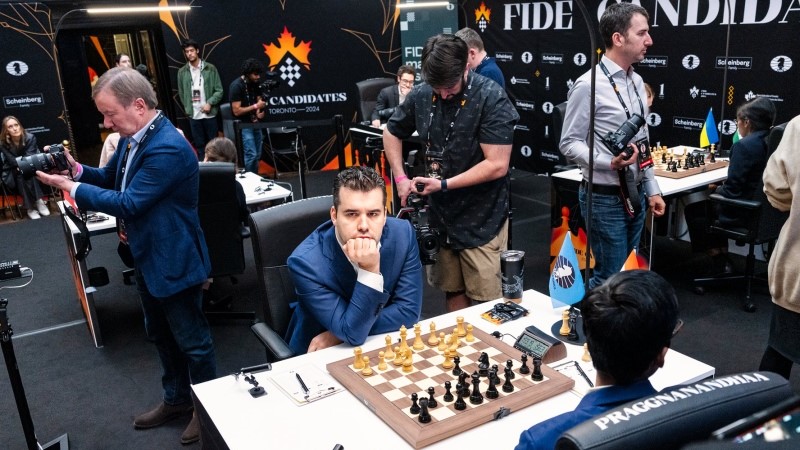
The FIDE Candidates Tournament is getting more and more exciting with each and every passing day. Round 12 once again brought us a myriad of decisive results and the race for first remains wide open. Ian Nepomniachtchi, the sole leader going into the 12th round, made a solid draw against Praggnanandhaa R. He did not get anything out of the Exchange Variation of the French Defence with White and had to settle for a draw, as Praggnanandhaa played a very clean game. Two of our three players on Nepomniachtchi’s tails going into this round, on the other hand, had a great day. Both Nakamura and Gukesh, against Firouzja and Abasov, respectively, won their games and are now tied for first with Nepomniachtchi going into the final rest day. Nakamura’s game was, once again, very messy and full of tactics. He surprised Firouzja in the opening and got an edge with White. Black’s counterplay relied on the passed pawn on the d-file and numerous chaotic tactical complications. However, Nakamura was better with his calculation in this game. On move 21, Firouzja missed a good chance, albeit a very computer-like one, to equalize: 21…Qd7. The lines that could follow are mind-blowing, for example: 22. Rg5 Rad8 23. h3 Ngxf2 24. Rxg7+ Kh8 25. Nbd4 Nxe1 26. Qxe1 Kxg7 27. Kxf2 Re4; Black would be doing fine in the resulting position. After 21…Nxe1, the move that appeared on the board, White obtained a serious advantage. Later on, Nakamura gave Black another chance with 34. Be1 (instead of 34. Rc7+), a move that he highly criticized himself for at the post-game press conference. When a draw was already in sight, Firouzja blundered with 41…g5, and the game was practically over. This is a very important win for the American player, who shows incredible fighting spirit with four wins out of five games in the latter half of the tournament! 17-year-old Gukesh D continues to demonstrate amazing composure; today, he played a smooth game against Abasov, slowly outplaying his opponent with the black pieces and not allowing counterplay for his opponent. “I thought it was a pretty good game,” said Gukesh. “I felt like I was outplaying but he still had some drawing chances in the endgame.” Should he win this tournament, Gukesh will be the youngest Challenger for the world championship ever. The three co-leaders – Gukesh, Nakamura, and Nepomniachtchi – are now on top with 7.5 points after 12 games. Fabiano Caruana won a solid game against Vidit, albeit not one free of mistakes. A few times Caruana let his advantage slip, but he then gradually gained it back and finally delivered. After Round 12, Caruana trails the leading pack by half a point. “I can’t control what happens in the other games. My fate is not in my hands entirely. If Hikaru or Gukesh wins both [of the] last games, no matter what I do, it’s impossible,” said Caruana after the game. “I messed up some things earlier in the tournament; I lost to Hikaru, and that’s something to regret. At this point I can only try to catch up and we’ll see. At least I won!” The race to be the next Challenger is wide open! When asked what would be the deciding factor to go the distance at this point, Nakamura said “experience,” Caruana “nerves,” and Gukesh? “A bit of everything, including luck.” In the FIDE Women’s Candidates Tournament, leader Tan Zhongyi saved a very difficult position against Nurgyul Salimova. She was losing for most of the game, and the computer evaluation was climbing as high as +5 for Salimova, who played with the white pieces. “At some point, I was close to resigning,” said Tan after the game. However, she managed to keep the game going and maintained material equilibrium in the lost endgame. Finally, she was rewarded with several mistakes from her opponent, who was getting low on time and managed to escape with a draw. Lei Tingjie was very close to winning against Kateryna Lagno with the black pieces but let her advantage slip away and had to settle for a draw. The critical moment was when Lei let go of her strong centralized knight with 26…Nf3. Instead, 26…Qb6, pressing White further, could keep a great advantage. Lagno immediately exchanged the knight with 27. Bxf3 and after that managed to keep the position balanced. Humpy Koneru had a superior position against Aleksandra Goryachkina, but she did not find the best continuation. After 22…Bd8! followed by Ra6 and c6 or c5, Black could have won the pinned bishop on a5. Instead, Humpy decided to go for a draw by repetition with 22…Qb8 23. Rdd1 Qa8 24. Rd7 Qb8. Koneru’s young compatriot, Vaishali R, defeated Anna Muzychuk with the black pieces – the only decisive result in the women’s tournament today. After Round 12, Tan Zhongyi is on top with 8 points, closely followed by Lei Tingjie on 7.5. Three players – Goryachkina, Koneru, and Lagno – are fighting for third with 6 points. The FIDE Candidates Tournament goes on the final rest day before the two ultimate rounds. The 13th round of the event will commence on the 20th of April at 14:30 EDT (Toronto). Standings after Round 12: Open: 1-3. Gukesh, Nakamura, Nepomniachtchi – 7½4. Caruana – 75. Praggnanandhaa – 66. Vidit – 57. Firouzja – 4½8. Abasov – 3 Women’s: 1. Tan – 82. Lei – 7½3-5. Goryachkina, Koneru, Lagno – 66. Vaishali – 5½7-8. A. Muzychuk, Salimova – 4½ Round 13 pairings: Open: Nepomniachtchi – NakamuraPraggnanandhaa – CaruanaVidit – AbasovGukesh – Firouzja Women’s: Salimova – LagnoTan – GoryachkinaKoneru – A. MuzychukVaishali – Lei Written by WGM Anna Burtasova Photos: Michal Walusza and Maria Emelianova/Chess.com Official website: candidates2024.fide.com/ Partners:
FIDE elevates chess standards improving regulations for arbiters
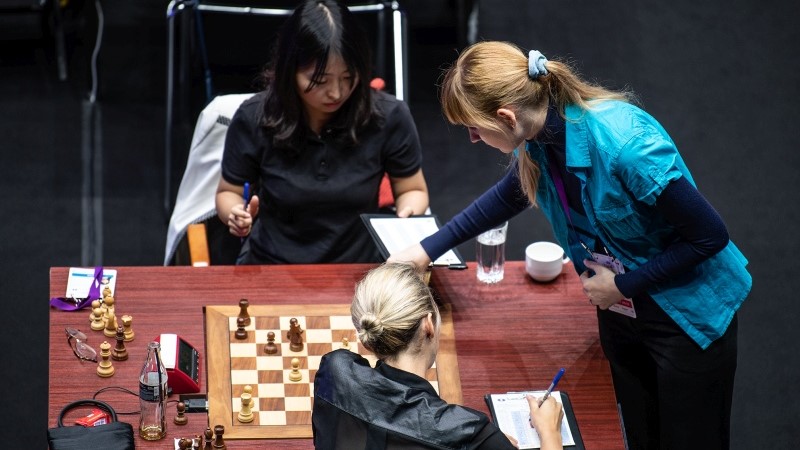
The FIDE Arbiters Commission announces significant advancements in the guidelines governing stipends for chess arbiters participating in flagship events This proactive initiative underscores FIDE’s long-term commitment to enhancing the standardization of the compensation process, ensuring fair remuneration and more favorable conditions for all arbiters. FIDE has outlined 28 key international events, detailing their duration, structure, and arbiters’ reimbursements based on multiple criteria, including, among others, tournament category, days and length of involvement. Roles covered by these regulations include the Chief Arbiter, their Deputy, the Pairings Officer, and other arbiters participating in an event, thereby ensuring clarity and consistency. A notable aspect of these regulations is the introduction of standardized reimbursement rates for local arbiters at the Grand Swiss and the World Championship Team tournament, where they will be reimbursed 1,200 euros and 800 euros, respectively. The improvements in the regulations also refer to the travel and full-board accommodation costs, ensuring arbiters’ seamless participation in tournaments worldwide. Ivan Syrovy, Chairman of the FIDE Arbiters Commission, emphasized the significance of these changes: “Arbiters play an essential role in the smooth execution of chess tournaments. One of the important areas for us was the role and conditions for match and local arbiters. With this in mind, the costs associated with their involvement have been meticulously outlined and made transparent to all. FIDE’s proactive measures are poised to establish an elevated standard for other chess organizations, adding even more transparency in criteria and reimbursements for chess arbiters.” You can find more details in the FIDE Handbook.
FIDE Candidates: Nepomniachtchi and Tan in the lead again
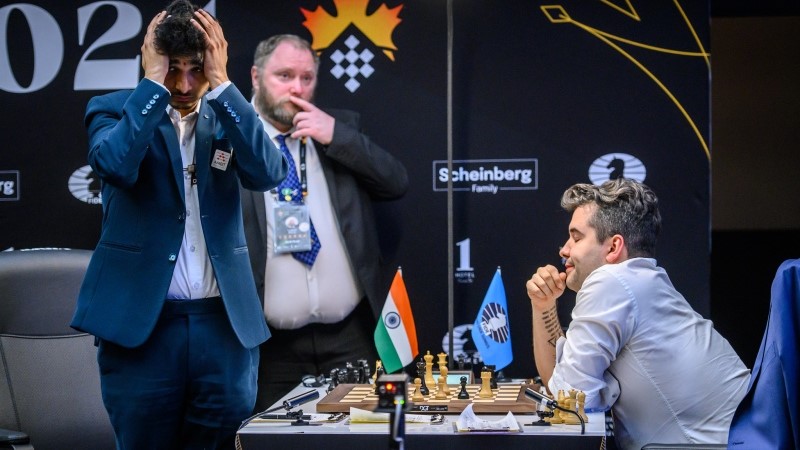
The FIDE Candidates is entering its final stages and the tension is palpable. Many games in Round 11 were double-edged, with players missing multiple chances. Ian Nepomniachtchi’s game against Vidit Santosh Gujrathi was the last to finish today. Playing with the black pieces, Nepomniachtchi had a dubious position. Instead of the defending move 34. Kd3, which led to Black’s overtaking the initiative, White could have opted to play 34. h5! clearing a pathway for the king to reach the f5 and g6 squares; White could also potentially push the pawn to h6. The h5-break was the first thing Vidit showed to Nepomniachtchi after the game finished, clearly disappointed that he did not go for it. Following this critical moment, the position was still balanced, but White made another grave mistake. Nepomniachtchi thought Vidit was in “sort of a panic,” in reference to 60. Nb2+ (instead of 60. Ne5+). After that, White was lost. This win is a very important result that made Nepomniachtchi the sole leader again on 7 points. Nepomniachtchi’s co-leader going into Round 11, Gukesh D, made a solid draw against Fabiano Caruana and is now trailing by half a point. Grandmaster Evgeny Bareev, Canada’s #1 chess player and a previous participant of several Candidates events, made the ceremonial move 1. d4 in the game between Praggnanandhaa R and Hikaru Nakamura. The American player controlled the game solidly with Black before capitalising on his opponent’s mistakes and adding an important win to his scoresheet. Praggnanandhaa could have gone for a draw several times in the game. Instead, he always chose more complex continuations and played on, which resulted in Nakamura’s position getting better and better. The American player was precise in converting his advantage, leaving no chances for counterplay for his opponent. Alireza Firouzja capitalised on Nijat Abasov’s blunder and won in just 24 moves. Black was doing fine in the Zukertort Opening, but on move 15, Abasov made a grave miscalculation. Instead of 15…e5, the move that cost Black the game, Abasov could have gone for 15…Qe6 and kept a balanced position. In the line that occurred in the game, Abasov missed that after 15…e5 16. Nc4 f6 17. Rd5, Black cannot play 17…Be6 because of 18. e4 Qg5 19. Be3 Bxd5 and White simply takes 20. exd5 trapping the black queen: 20…Qf5 21. Bg4 Qe4 22.f3. Abasov had to play 17…Rxd5, and Black’s position collapsed soon after. With three rounds to go, Ian Nepomniachtchi is a sole leader again on 7 points. He is followed by Gukesh and Nakamura on 6.5 points. It is important to note that Nakamura still has two white games and will meet Nepomniachtchi with Black in round 13 followed by Gukesh with White in the last round. In the FIDE Women’s Candidates Tournament, Tan Zhongyi won an important game against Kateryna Lagno. With Lagno low on time, Tan chose to play in a risky and aggressive manner, giving her opponent an amazing chance. 27…f4! would have cleared the way for the black queen to land on g4 (after Bxe5) or h3, and Black’s assault on the white king could have cost White a point. Unfortunately, Lagno missed this possibility and soon found herself in a lost position after 27…Bxb3? 28. Rxd8 Bxd8 29. Qxa7. Lei Tingjie, Tan’s compatriot, was also playing bold and aggressive chess today against Anna Muzychuk. Lei sacrificed a piece with 19. Bxh6 for a kingside attack and was on the verge of winning. The path to victory was a difficult one, and after the game, Lei said that she had not considered the right continuation. She should have played 22. Kh2 – a tricky move. The point is that after a logical continuation like 22…f6, White can play on the other side of the board with 23. b3. After 23…axb3 24. axb3 Qxb3 25. Rxa8 Rxa8, White proceeds with 26. Nh4 and Black does not have Rd7 defensive option, resulting in White having a winning position. Lei did not find this difficult path and instead went for a messy position with 22. Nxe5, hoping for a perpetual check. The tables then turned, with Black having a winning position objectively, but now it was Anna Muzychuk who missed her chance; Lei found the perpetual check she had sought after, and the game ended in a draw. After the game, Lei said she was lucky to escape. Vaishali R helped the Chinese duo by taking down Aleksandra Goryachkina in an intense battle of many mistakes. Vaishali surprised her opponent in the opening and gradually outplayed Goryachkina but let her advantage slip away one move before reaching the time control. After 39. Rf3! White was winning as 39…Qe4 fails to 40. Nb4, but Vaishali played 39. Bf6? instead. As a result, her enormous advantage evaporated. However, she was still the only one playing for a win in this game, as White’s queen and knight were chasing the black king. At some point, the position repeated three times, but not consecutively, so Goryachkina was checking her scoresheet. In the end, she decided not to claim the repetition, as she was not entirely sure. “She was probably thinking that I would repeat again,” explained Vaishali after the game. However, the young Indian player demonstrated a fighting mentality in this game as she continued playing, hoping to find more chances. She was duly rewarded in the queen and pawn endgame, where her experienced opponent finally blundered and had to resign. In the last game of the women’s event, Humpy Koneru defeated Nurgyul Salimova in a solid and straightforward game to come back to a 50% mark. The results of Round 11 were extremely important for the tournament standings. Tan Zhongyi is now the sole leader on 7.5 points, closely trailed by Lei Tingjie on 7. Goryachkina, Koneru, and Lagno are the three players two points behind the leader – a gap that is almost impossible to close in three rounds. It is now clear that the race for first in the FIDE Women’s Candidates Tournament will be between two Chinese players, Tan Zhongyi
World Junior U20 Championship: Registration deadline is May 1

The FIDE World Junior under 20 Championships Organizer reminds that the registration and visa application deadline is May 1. The competition will take place in Gandhinagar, state Gujarat, India, from June 1-14, 2024 Entry forms should be filled out by the National Federations and returned to the Organizing Committee no later than May 1. All federations must use the official registration form provided by the organizers. All participants applying for a visa must provide a copy of their passport by the same deadline, May 1. Each National Federation can field one player born on or after January 1, 2004, in each of two categories – Open and Girls, with a maximum of two invited players and send as many additional players as they wish. Players with personal rights, according to FIDE rules, will also be accepted as invited players: Top 3 players of the previous edition of FIDE World Junior Championships. The Continental Junior Champions of the year preceding this edition. If a Continent did not organize a Continental Junior Championship, then the Continental Under 18 Champions of the year preceding this edition. The first three players in the starting list of both the Open and Girls tournaments, using the current rating list when the tournament starts. World Youth U18 and U16 champions of the year preceding this edition. FIDE World Junior Chess Championships 2024 official website coming up soon: worldjunior2024.fide.com Official e-mail: worldjunior@fide.com Invitation letter and Regulations (pdf)
World School Championships: Registration deadline extended

The Organizing Committee announces that the registration deadline for the participants of the FIDE World School Chess Championships who don’t need visa to enter Peru is extended to April 20, 2024. The event will be held in six age categories, U7, U9, U11, U13, U15, and U17, with separate Open and Girl’s competitions in the Constitutional Province of Callao, Lima, Peru, from April 30 to May 10, 2024. The top ten (10) places in each category, both in the Open and Girls sections, along with trophies for top-3 and medals, will receive additional valuable prizes. To register for the event, National Federations shall fill out the corresponding forms in English and Spanish provided in the Invitation letter, paragraph 10.1. E-mail: worldschool@fide.com Regulations and Invitation Letter Regulations and Invitation Letter (Spanish)
FIDE Candidates: Two co-leaders in both tournaments going into third rest day
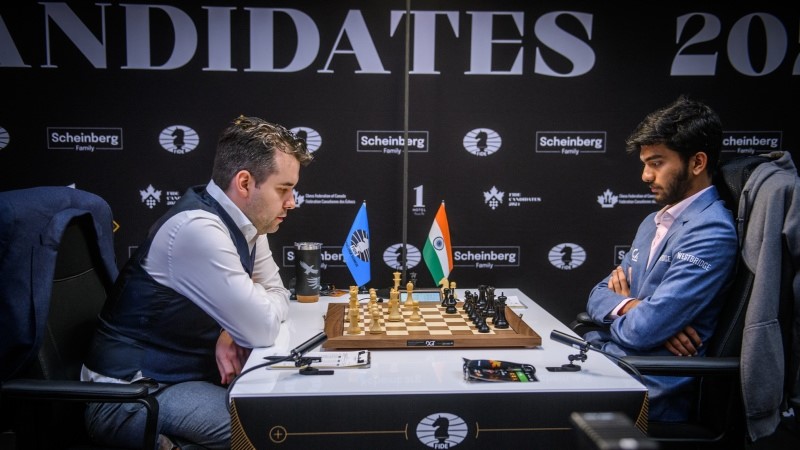
What a day of chess in the 10th round of the FIDE Candidates! It started at a slower pace but ended unexpectedly with four decisive results. In the FIDE Women’s Candidates Tournament, Lei Tingjie took down fellow chaser Aleksandra Goryachkina with the black pieces in a solid and calm Exchange Slav. After 26. a4 and 27. Nc8, the white knight became stuck in Black’s territory and could not find a way out. Lei managed to exchange the queens and got a winning position but then misplayed it. She spent more than 20 minutes on 41…e5, in a critical position after the time control, choosing the right way to victory. Shockingly, just two moves later, Lei erred with 43…Bc8. At the post-game press conference, Lei mentioned that she was not sure about the other riskier continuations but acknowledged that with this move, she let her advantage slip away. Nevertheless, later on, Lei was given another chance and this time, she did not miss it. In a seemingly drawn position, Goryachkina blundered with 61. Nxe5? (instead of 61. exf5 or 61. Kb3). “I just thought, oops, there may be some chances!” said Lei during the post-mortem analyses. “I calculated 61…Kf4 and I was also shocked [that it is winning].” Lei has won four out of her last five games and now finds herself at the top of the leaderboard. When asked what happened a week ago that led to her winning streak, Lei said: “I thought I did not have a chance anymore, and so there was no pressure.” Lei jointly leads with her compatriot Tan Zhongyi, who made a solid draw against Humpy Koneru today. Both Chinese players are going into a free day with 6.5 points out of 10. In the other games in the women’s tournament, Kateryna Lagno and Anna Muzychuk made a solid draw. Vaishali R broke her losing streak with a much-needed victory against Nurgyul Salimova. After losing four games in a row, Vaishali made a comeback from yet another bad position in this 88-move encounter, capitalising on Salimova’s mistakes in the sixth hour of play. A decisive result in today’s matchup between Ian Nepomniachtchi and Gukesh D could have potentially decided the outcome of the FIDE Candidates Tournament. But the two co-leaders played a calm game in the Ruy Lopez, which uneventfully ended in a draw. Both players continue their pursuit for the top spot but did not want to take risks in this game. “I was Black, and he played a solid game, so it was a fair result,” said Gukesh. The 17-year-old Indian prodigy is one of the participants who has impressively kept his composure, seemingly not affected by the pressure of the tournament’s status. “I am in good shape, and hopefully, it can continue in the last [few] games.” The tournament situation has been spiced up by the victories of the two American players. Fabiano Caruana defeated Alireza Firouzja, while Hikaru Nakamura won a rollercoaster game against Nijat Abasov. Both players are now in the pack of three candidates, trailing the co-leaders by half a point – a great day for our American chess fans! Alireza Firouzja chose to play a rarely seen line with 6…h5 in the Najdorf Sicilian, but Caruana was prepared. After 9…Qa5, however, he was on his own. “I thought the endgame [after 12. Qxg5] was slightly better, but I did not find the right path,” said Caruana after the game. At the post-game press conference, one of the journalists pointed out the possibility of 14. Bxe6 fxe6 and 15. e5! Both players did not see it during the game but agreed that this variation must be winning for White. The endgame was not an easy one for Firouzja with Black. He was defending well until he started to err in time trouble. “We were down to seconds, so it was very difficult,” said Caruana. He capitalised on his opponent’s mistakes and was precise until the end. The game between Nakamura and Abasov was similarly difficult for the eventual winner. Nakamura confessed that 7. Bd3 was one of the ideas in the Petroff that he prepared specifically for this tournament. Nakamura, with White, managed to obtain an edge from the opening; he was particularly happy with his 22. Ng4 move, which promised him an easy advantage without risk. Later on, Abasov found several tricky moves that caught Nakamura by surprise; 24…Ba5 being one of them. Nakamura was full of self-criticism after the game: “On 26. Rb7, I spent 18 minutes. [This move] was my first instinct; I could have played this move in three minutes, but I used so much time, which is stupid.” He continued: “And then I played 27. Bf4, a terrible move, after a seven-minute think.” After he also overlooked 30…Bg4 and 31…h5, the position became double-edged. Nakamura was low on time, and Abasov continued to make difficult, unexpected moves for the American player. But luckily for White, Black blundered with 36…Qe7. Nakamura immediately spotted the error and played 37. Be5!, grabbing the decisive advantage. On move 38, he won an exchange and managed to convert without any further difficulties. The first ceremonial move was made today by Raj Viswanathan, Chief Financial Officer of Scotiabank, one of Canada’s preeminent financial institutions. He played 1. e4 for Praggnanandhaa R. The move actually stayed on the board and served as a beginning of a calm and solid Berlin Defense against Vidit Santosh Gujrathi. The evaluation bar never deviated from equality and the players repeated the position before the time control. Along with Caruana and Nakamura, Praggnanandhaa is the third player in the trailing pack, half a point behind the leaders. With four rounds still to be played in the FIDE Candidates, the players head into the third rest day. The 11th round of the event will commence on the 17th of April at 14:30 EDT (Toronto). Standings after Round 10: Open: 1-2. Gukesh, Nepomniachtchi – 63-5. Caruana, Nakamura, Praggnanandhaa – 5½6. Vidit – 57. Firouzja – 3½8. Abasov – 3 Women’s: 1-2. Tan, Lei – 6½3-4. Goryachkina, Lagno – 5½5.
FIDE distributes €15,000 among six chess veterans

After carefully considering the numerous applications received, the special panel appointed by the FIDE Council decided that these will be the six chess players, coaches, promoters and arbiters to benefit from the first installment of FIDE’s support to chess veterans in 2024: Nona Gaprindshvili (GEO) Yuri Balashov (RUS) Anatoly Vaisser (FRA) Marta Litinskaya (UKR) Edvins Kengis (LAT) David Sedgwick (ENG) A total of €15,000 will be distributed among them, each receiving €2,500. As we did on previous occasions, we would pay tribute to these illustrious veterans with a few words about each one of them, summarizing their careers and achievements. Nona Gaprindashvili (GEO) Photo: livepress.ge/ Nona Gaprindashvili (GEO), born in 1941 in Zugdidi (USSR, now Georgia), became the first woman to be awarded the title of International Grandmaster (1978). Her brothers introduced her to chess at the age of five and became her first opponents. After turning 12, she honed her skills under the tutelage of a talented coach, Vakhtang Karseladze, in Tbilisi. At just fifteen, Nona won the Tbilisi and Georgian Championships. Four years later, she emerged victorious from the 1961 Candidates Tournament in dominant fashion, earning a title match against Elisaveta Bykova. Gaprindashvili seized the title from Bykova in a convincing manner (+7−0=4) and successfully defended it three times against Alla Kushnir (1965: +7-3=3; 1969: +6-2=5; 1972: +5-4=7) and once against Nana Alexandria (1975: +8-3=1). After fifteen years of reigning supreme, she lost the title match (Tbilisi, 1978) to another Georgian, 17-year-old star Maia Chiburdanidze (+2−4=9). Even after conceding the title, Gaprindashvili remained one of the strongest female players in the world for another twenty years and amassed a very impressive tournament record. Nona is still very active in veteran tournaments, winning the World Senior Championship and European Senior Championship multiple times. Yuri Balashov (RUS) Photo: Eteri Kublashvili Yuri Balashov (RUS), born in 1949 in Shadrinsk, Russia, learned chess from his older brother Alexander. By the age of 15, he had become the youngest master in the country. Balashov was one of the first students of the renowned Mikhail Botvinnik’s chess school, where he gained valuable insights into chess training. His rise in the chess ranks was steady and consistent. In 1970, Balashov won the Moscow championship for the first time and finished fourth in the USSR Championship. His most notable achievement came in 1976 when he finished runner-up to Karpov in the highly competitive USSR Championship, scoring an impressive 10.5/16 with a performance rating of 2773. He participated in 15 national championships throughout his career. A participant in four inter-zonal tournaments, a winner of the 1980 Olympiad and several European Championships with the Soviet team, Balashov proved himself not only as a very strong GM but also a great trainer. He served as Karpov’s second in three World Championship matches (1978, 1981, and 1984). Calm, reserved, collected, and with extensive knowledge of opening theory, Balashov was an integral part of Karpov’s team. Yuri Balashov has continued to excel in veteran events, winning the World Team and European Team Championships several times. In 2019, he tied for first place in the World Senior Championship but ultimately took bronze due to inferior tiebreaks. Anatoly Vaisser (FRA) Photo: David Llada Anatoly Vaisser (FRA), born in 1949 in Almaty, Kazakhstan (then USSR), demonstrated talent in junior and student chess competitions. However, for a long time, he viewed chess simply as a game. Moreover, he even abandoned chess completely for three years while pursuing his Ph.D., later becoming one of the few GMs with a science degree. After seconding Lev Psakhis at his victorious Soviet Championships in 1980 and 1981, Anatoly’a interest for chess rekindled and he took the game seriously. This hard work quickly paid off. In 1982, Vaisser won the RSFR championship, and in 1983, he completed his first GM norm in a tournament in Sochi. Two years later, Anatoly emerged as the winner of a strong tournament in Havana (1985) and became a Grandmaster. Vaisser continued to achieve success in various competitions, notably finishing second-third with Viswanathan Anand at New Delhi in 1987 and second behind Vladimir Malaniuk at Budapest in 1989. He also tied for first place twice in the Cappelle-la-Grande Open: in 1987 with Anthony Kosten and Jonny Hector and in 1991 with Matthew Sadler. In 1991, Vaisser moved to France and worked as a playing coach for the national team for several years. He won the French championship at Narbonne in 1997 and was twice runner-up (1996 and 2001). Anatoly played twice for France in the Chess Olympiads at Elista (1998) and Bled (2002). Vaisser has an excellent record in veteran competitions, winning the World Senior Chess Championship in 2010, 2013, 2014 and 2016. Anatoly also authored a popular book, “Beating the King’s Indian and Benoni” (1997). Marta Litinskaya (UKR) Marta Litinskaya (UKR), born Marta Shul in 1949 in Lviv, Ukraine (then USSR), learned chess at the age of ten thanks to her father. A year later, she joined a local chess club and became a student of the legendary chess specialist Viktor Kart. This marked the beginning of her successful career. Litinskaya won the Ukrainian Women’s Championship in 1967 (she would claim the title again in 1977 and 1995). In 1968, she qualified for the USSR championship, where she achieved the rank of master. Five years later, she won the national title and went on to become runner-up in 1971, 1973, and 1974. In the early 1970s, Marta balanced her career as a programmer with professional chess, but eventually chose to dedicate herself fully to the game. Litinskaya was awarded the FIDE titles of Woman International Master (WIM) in 1972 and Woman Grandmaster in 1976. In 1973, Marta participated in the 2nd Interzonal Tournament in Menorca, tying for second place and qualifying for the Women’s Candidates Tournament. She lost a semifinal match to Nana Alexandria in Riga that year. In her second attempt to become World Champion, Litinskaya reached the semifinals again in 1980 but fell short against Alexandria once more in a closely