

FIDE Candidates: Two co-leaders in both tournaments going into third rest day
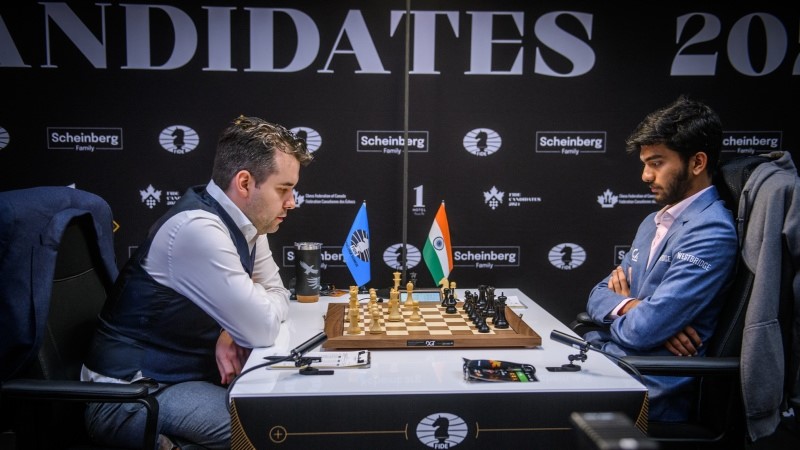
What a day of chess in the 10th round of the FIDE Candidates! It started at a slower pace but ended unexpectedly with four decisive results. In the FIDE Women’s Candidates Tournament, Lei Tingjie took down fellow chaser Aleksandra Goryachkina with the black pieces in a solid and calm Exchange Slav. After 26. a4 and 27. Nc8, the white knight became stuck in Black’s territory and could not find a way out. Lei managed to exchange the queens and got a winning position but then misplayed it. She spent more than 20 minutes on 41…e5, in a critical position after the time control, choosing the right way to victory. Shockingly, just two moves later, Lei erred with 43…Bc8. At the post-game press conference, Lei mentioned that she was not sure about the other riskier continuations but acknowledged that with this move, she let her advantage slip away. Nevertheless, later on, Lei was given another chance and this time, she did not miss it. In a seemingly drawn position, Goryachkina blundered with 61. Nxe5? (instead of 61. exf5 or 61. Kb3). “I just thought, oops, there may be some chances!” said Lei during the post-mortem analyses. “I calculated 61…Kf4 and I was also shocked [that it is winning].” Lei has won four out of her last five games and now finds herself at the top of the leaderboard. When asked what happened a week ago that led to her winning streak, Lei said: “I thought I did not have a chance anymore, and so there was no pressure.” Lei jointly leads with her compatriot Tan Zhongyi, who made a solid draw against Humpy Koneru today. Both Chinese players are going into a free day with 6.5 points out of 10. In the other games in the women’s tournament, Kateryna Lagno and Anna Muzychuk made a solid draw. Vaishali R broke her losing streak with a much-needed victory against Nurgyul Salimova. After losing four games in a row, Vaishali made a comeback from yet another bad position in this 88-move encounter, capitalising on Salimova’s mistakes in the sixth hour of play. A decisive result in today’s matchup between Ian Nepomniachtchi and Gukesh D could have potentially decided the outcome of the FIDE Candidates Tournament. But the two co-leaders played a calm game in the Ruy Lopez, which uneventfully ended in a draw. Both players continue their pursuit for the top spot but did not want to take risks in this game. “I was Black, and he played a solid game, so it was a fair result,” said Gukesh. The 17-year-old Indian prodigy is one of the participants who has impressively kept his composure, seemingly not affected by the pressure of the tournament’s status. “I am in good shape, and hopefully, it can continue in the last [few] games.” The tournament situation has been spiced up by the victories of the two American players. Fabiano Caruana defeated Alireza Firouzja, while Hikaru Nakamura won a rollercoaster game against Nijat Abasov. Both players are now in the pack of three candidates, trailing the co-leaders by half a point – a great day for our American chess fans! Alireza Firouzja chose to play a rarely seen line with 6…h5 in the Najdorf Sicilian, but Caruana was prepared. After 9…Qa5, however, he was on his own. “I thought the endgame [after 12. Qxg5] was slightly better, but I did not find the right path,” said Caruana after the game. At the post-game press conference, one of the journalists pointed out the possibility of 14. Bxe6 fxe6 and 15. e5! Both players did not see it during the game but agreed that this variation must be winning for White. The endgame was not an easy one for Firouzja with Black. He was defending well until he started to err in time trouble. “We were down to seconds, so it was very difficult,” said Caruana. He capitalised on his opponent’s mistakes and was precise until the end. The game between Nakamura and Abasov was similarly difficult for the eventual winner. Nakamura confessed that 7. Bd3 was one of the ideas in the Petroff that he prepared specifically for this tournament. Nakamura, with White, managed to obtain an edge from the opening; he was particularly happy with his 22. Ng4 move, which promised him an easy advantage without risk. Later on, Abasov found several tricky moves that caught Nakamura by surprise; 24…Ba5 being one of them. Nakamura was full of self-criticism after the game: “On 26. Rb7, I spent 18 minutes. [This move] was my first instinct; I could have played this move in three minutes, but I used so much time, which is stupid.” He continued: “And then I played 27. Bf4, a terrible move, after a seven-minute think.” After he also overlooked 30…Bg4 and 31…h5, the position became double-edged. Nakamura was low on time, and Abasov continued to make difficult, unexpected moves for the American player. But luckily for White, Black blundered with 36…Qe7. Nakamura immediately spotted the error and played 37. Be5!, grabbing the decisive advantage. On move 38, he won an exchange and managed to convert without any further difficulties. The first ceremonial move was made today by Raj Viswanathan, Chief Financial Officer of Scotiabank, one of Canada’s preeminent financial institutions. He played 1. e4 for Praggnanandhaa R. The move actually stayed on the board and served as a beginning of a calm and solid Berlin Defense against Vidit Santosh Gujrathi. The evaluation bar never deviated from equality and the players repeated the position before the time control. Along with Caruana and Nakamura, Praggnanandhaa is the third player in the trailing pack, half a point behind the leaders. With four rounds still to be played in the FIDE Candidates, the players head into the third rest day. The 11th round of the event will commence on the 17th of April at 14:30 EDT (Toronto). Standings after Round 10: Open: 1-2. Gukesh, Nepomniachtchi – 63-5. Caruana, Nakamura, Praggnanandhaa – 5½6. Vidit – 57. Firouzja – 3½8. Abasov – 3 Women’s: 1-2. Tan, Lei – 6½3-4. Goryachkina, Lagno – 5½5.
FIDE distributes €15,000 among six chess veterans

After carefully considering the numerous applications received, the special panel appointed by the FIDE Council decided that these will be the six chess players, coaches, promoters and arbiters to benefit from the first installment of FIDE’s support to chess veterans in 2024: Nona Gaprindshvili (GEO) Yuri Balashov (RUS) Anatoly Vaisser (FRA) Marta Litinskaya (UKR) Edvins Kengis (LAT) David Sedgwick (ENG) A total of €15,000 will be distributed among them, each receiving €2,500. As we did on previous occasions, we would pay tribute to these illustrious veterans with a few words about each one of them, summarizing their careers and achievements. Nona Gaprindashvili (GEO) Photo: livepress.ge/ Nona Gaprindashvili (GEO), born in 1941 in Zugdidi (USSR, now Georgia), became the first woman to be awarded the title of International Grandmaster (1978). Her brothers introduced her to chess at the age of five and became her first opponents. After turning 12, she honed her skills under the tutelage of a talented coach, Vakhtang Karseladze, in Tbilisi. At just fifteen, Nona won the Tbilisi and Georgian Championships. Four years later, she emerged victorious from the 1961 Candidates Tournament in dominant fashion, earning a title match against Elisaveta Bykova. Gaprindashvili seized the title from Bykova in a convincing manner (+7−0=4) and successfully defended it three times against Alla Kushnir (1965: +7-3=3; 1969: +6-2=5; 1972: +5-4=7) and once against Nana Alexandria (1975: +8-3=1). After fifteen years of reigning supreme, she lost the title match (Tbilisi, 1978) to another Georgian, 17-year-old star Maia Chiburdanidze (+2−4=9). Even after conceding the title, Gaprindashvili remained one of the strongest female players in the world for another twenty years and amassed a very impressive tournament record. Nona is still very active in veteran tournaments, winning the World Senior Championship and European Senior Championship multiple times. Yuri Balashov (RUS) Photo: Eteri Kublashvili Yuri Balashov (RUS), born in 1949 in Shadrinsk, Russia, learned chess from his older brother Alexander. By the age of 15, he had become the youngest master in the country. Balashov was one of the first students of the renowned Mikhail Botvinnik’s chess school, where he gained valuable insights into chess training. His rise in the chess ranks was steady and consistent. In 1970, Balashov won the Moscow championship for the first time and finished fourth in the USSR Championship. His most notable achievement came in 1976 when he finished runner-up to Karpov in the highly competitive USSR Championship, scoring an impressive 10.5/16 with a performance rating of 2773. He participated in 15 national championships throughout his career. A participant in four inter-zonal tournaments, a winner of the 1980 Olympiad and several European Championships with the Soviet team, Balashov proved himself not only as a very strong GM but also a great trainer. He served as Karpov’s second in three World Championship matches (1978, 1981, and 1984). Calm, reserved, collected, and with extensive knowledge of opening theory, Balashov was an integral part of Karpov’s team. Yuri Balashov has continued to excel in veteran events, winning the World Team and European Team Championships several times. In 2019, he tied for first place in the World Senior Championship but ultimately took bronze due to inferior tiebreaks. Anatoly Vaisser (FRA) Photo: David Llada Anatoly Vaisser (FRA), born in 1949 in Almaty, Kazakhstan (then USSR), demonstrated talent in junior and student chess competitions. However, for a long time, he viewed chess simply as a game. Moreover, he even abandoned chess completely for three years while pursuing his Ph.D., later becoming one of the few GMs with a science degree. After seconding Lev Psakhis at his victorious Soviet Championships in 1980 and 1981, Anatoly’a interest for chess rekindled and he took the game seriously. This hard work quickly paid off. In 1982, Vaisser won the RSFR championship, and in 1983, he completed his first GM norm in a tournament in Sochi. Two years later, Anatoly emerged as the winner of a strong tournament in Havana (1985) and became a Grandmaster. Vaisser continued to achieve success in various competitions, notably finishing second-third with Viswanathan Anand at New Delhi in 1987 and second behind Vladimir Malaniuk at Budapest in 1989. He also tied for first place twice in the Cappelle-la-Grande Open: in 1987 with Anthony Kosten and Jonny Hector and in 1991 with Matthew Sadler. In 1991, Vaisser moved to France and worked as a playing coach for the national team for several years. He won the French championship at Narbonne in 1997 and was twice runner-up (1996 and 2001). Anatoly played twice for France in the Chess Olympiads at Elista (1998) and Bled (2002). Vaisser has an excellent record in veteran competitions, winning the World Senior Chess Championship in 2010, 2013, 2014 and 2016. Anatoly also authored a popular book, “Beating the King’s Indian and Benoni” (1997). Marta Litinskaya (UKR) Marta Litinskaya (UKR), born Marta Shul in 1949 in Lviv, Ukraine (then USSR), learned chess at the age of ten thanks to her father. A year later, she joined a local chess club and became a student of the legendary chess specialist Viktor Kart. This marked the beginning of her successful career. Litinskaya won the Ukrainian Women’s Championship in 1967 (she would claim the title again in 1977 and 1995). In 1968, she qualified for the USSR championship, where she achieved the rank of master. Five years later, she won the national title and went on to become runner-up in 1971, 1973, and 1974. In the early 1970s, Marta balanced her career as a programmer with professional chess, but eventually chose to dedicate herself fully to the game. Litinskaya was awarded the FIDE titles of Woman International Master (WIM) in 1972 and Woman Grandmaster in 1976. In 1973, Marta participated in the 2nd Interzonal Tournament in Menorca, tying for second place and qualifying for the Women’s Candidates Tournament. She lost a semifinal match to Nana Alexandria in Riga that year. In her second attempt to become World Champion, Litinskaya reached the semifinals again in 1980 but fell short against Alexandria once more in a closely
FIDE Candidates: Tan Zhongyi takes sole lead again
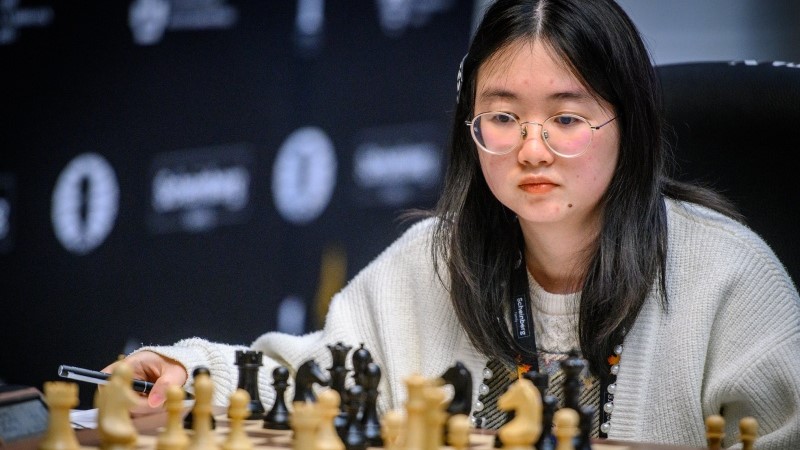
Round nine of the FIDE Candidates brought us two decisive results, one of which put Tan Zhongyi in the sole lead again. The ceremonial first moves today were made by Laksshana Deepak, Canadian Junior Chess Champion, for Humpy Koneru, and Aaron Reeve Mendes, current ChessKid Speed Chess Champion, for Alireza Firouzja. They were accompanied by Dana Reizniece-Ozola, Deputy Chair of the FIDE Management Board. The first game to finish was a quick win by Tan Zhongyi against Vaishali R. Playing with Black, Tan played solidly and “did not expect a chance to come her way” in this game. However, Vaishali misplayed her position after the opening, and by move 16, Black had a big advantage. A blunder by the Indian soon followed (18. c5), and on move 21, the game was over. Anna Muzychuk did not manage to get an advantage out of the Ruy Lopez against Aleksandra Goryachkina. By move 26, the players exchanged most of the pieces and entered an equal endgame, but one filled with double-edged play. On move 27 (27. g4), Muzychuk committed to giving up her bishop, but her active rook and three pawns promised solid compensation for the piece. The game ended in a draw. “It was difficult, given that I did not have much time to figure it out, and my opponent played very quickly,” shared Goryachkina after the game. “She had enough pawns [for a piece]. Maybe I missed some opportunities to capitalize, but so far, I don’t see it.” The other two games in the FIDE Women’s Candidates Tournament were rather anticlimactic. Playing with White against Nurgyul Salimova, Lei Tingjie went for 5. Rg1 in the Philidor Defence, followed by 6. g4 and 7. h4. This ambitious choice promised an interesting fight, but the players steered into an equal endgame fairly early on move 18 and soon found a threefold repetition. The game between Humpy Koneru and Kateryna Lagno was a long positional battle without any real chances for either side. Lagno, playing with Black, managed to win a pawn, but Koneru did not have a problem with defending her position in an easily drawn rook endgame. The results of round nine mean that in the FIDE Women’s Candidates, Tan Zhongyi is once again the sole leader with 6 points. She’s closely followed by Aleksandra Goryachkina and Lei Tingjie, who are both on 5.5 points. In the FIDE Candidates Tournament, the game between Vidit Santosh Gujrathi and Hikaru Nakamura was a showstopper. In the trendy Italian Game, Nakamura chose an ambitious line with an early 6…g5 and reached a fine position out of the opening. After the game, Vidit mentioned that the first move he found dubious was 15…Nh5, and remarked that he started to get optimistic from this moment onwards. After the position opened up a few moves later, Nakamura started to miscalculate, made a series of mistakes, and had to resign. “It’s hard to be unhappy about it, as this is what I was aiming for with the opening choice,” said Nakamura after the game. “Obviously, I did not find the right moves, but my time usage was absolutely horrible. It was a huge reason why I could not find decent ideas, especially around moves 24-25.” Ian Nepomniachtchi, playing with Black, found himself in a difficult position against Alireza Firouzja but stood his ground and found all of the right defensive ideas. The Frenchman chose the rarely-seen Nimzo-Larsen Attack to take Nepomniachtchi out of his preparation. His approach paid off as by move 20, White had a solid advantage and easy gameplay on the kingside. Nepomniachtchi decided to evacuate his king to the queenside with 23…Kf7, 24…Ke7, and 25…Kd6, hiding behind the long pawn chain. Firouzja sacrificed an exchange in an attempt to break through, but it was not enough, and the game ended in a draw. The Abasov – Caruana and Gukesh – Praggnanandhaa matchups were drawn as well. Both games were very solid and played exceptionally accurately. As a result, Gukesh and Nepomniachtchi continue to be the co-leaders of the FIDE Candidates Tournament with 5.5 points. The 10th round of the event will commence on the 15th of April at 14:30 EDT (Toronto). Standings after Round 9: Open: 1-2. Gukesh, Nepomniachtchi – 5½3. Praggnanandhaa – 54-6. Caruana, Nakamura, Vidit – 4½7. Firouzja – 3½8. Abasov – 3 Women’s: 1. Tan – 62-3. Goryachkina, Lei – 5½4. Lagno – 55-6. Koneru, Salimova – 47. A. Muzychuk – 3½8. Vaishali – 2½ Round 10 pairings: Open: Nakamura – AbasovCaruana – FirouzjaNepomniachtchi – GukeshPraggnanandhaa – Vidit Women’s: Lagno – A. MuzychukGoryachkina – LeiSalimova – VaishaliTan – Koneru Written by WGM Anna Burtasova Photos: Michal Walusza and Maria Emelianova/Chess.com Official website: candidates2024.fide.com/ Partners:
FIDE100 torch relay celebrated in Canada

Continuing its global journey from the Indian subcontinent to Africa and Europe, the FIDE100 Torch Relay, commemorating a century of FIDE, has now reached the shores of North America The ceremony was held on April 13, at the Nathan Phillips square in the center of Toronto, not far from the Great Hall where the strongest men and women players in the world are fighting in the Candidates tournament. Despite the cold weather, a sizeable crowd of chess enthusiasts gathered in the center of the city for the unique chess event. Against the urban backdrop, FIDE Deputy President and former World Champion, Vishy Anand, assumed the role of torchbearer, passing the flame to Vlad Drkulec, President of the Chess Federation of Canada. This symbolic exchange continued as the torch made its way to Jose Carillo Pujol, Continental President for the Americas, and FIDE Vice President Mario Ramirez Barajas, heralding the relay’s next leg in Colombia. Vishy Anand, who is doing the live chess commentary for the Candidates in Toronto, shared his views on the event in Toronto and what it means for him and chess that FIDE is celebrating its first centenary. “We have had a warm welcome here in Toronto,” Anand remarked. “A lot of coincidences – 100 years of FIDE, first Candidates in North America and, we managed to do the torch relay which started in India. The experience has been amazing with the fans and the excitement at the venue”. Anand also shared thoughts on the future of the game. “Chess is in a very exciting phase. For the next five to ten years, I would like to see chess becoming more established everywhere. I’d mostly like to see more people from every continent participate, especially more women. “Chess is growing everywhere and that’s why I think it’s particularly relevant to have these ceremonies, as the torch represents that chess is spreading to every continent,” Anand noted. Accompanying Anand at the ceremony were luminaries of the chess world, including former Women’s World Champion Alexandra Kosteniuk, Dana Reizniece-Ozola, Deputy Chair of FIDE Management Board (who arrived directly from the United States following the opening of the World Chess Hall of Fame exhibition in St. Louis), Patrick Van Hoolandt, Deputy Chairman of the FIDE Advisory Board and FIDE Vice-Presiden Michael Khodorkovsky. The festivities in Toronto extended beyond ceremonial gestures, featuring blitz games with fans and an exhibition dedicated to the history of the Candidates. FIDE100 Chess Torch Relay aims to celebrate the rich history of the game and to bring together the entire chess community as part of marking the centenary of the founding of FIDE.
FIDE Candidates: Race for first wide open as second half begins
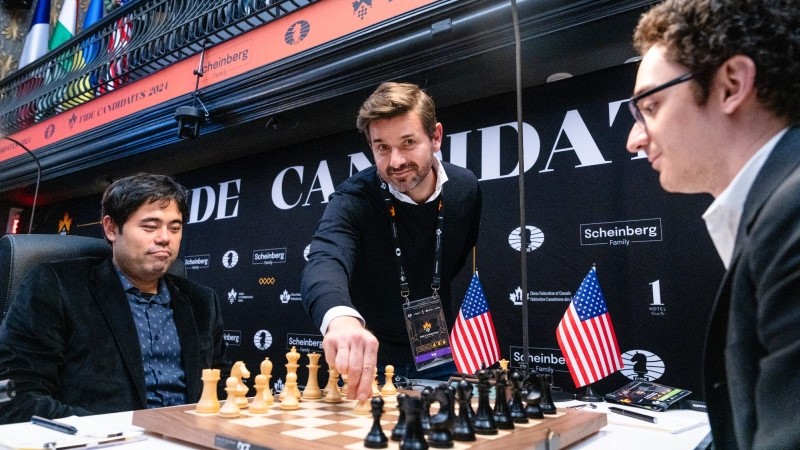
After the rest day, the second half of the FIDE Candidates kicked off on April 13. Today, we had two distinguished guests making the ceremonial first moves. Michael Hyatt, a Canadian tech entrepreneur, started the game between the two American players, Hikaru Nakamura and Fabiano Caruana. Jose Antonio Carrillo, FIDE Continental President for Americas, made the first move for the leader of the women’s tournament, Tan Zhongyi, in her game against compatriot Lei Tingjie. All of the games in Round 8 started off at a slower pace. Eight solid opening lines promised a day full of positional maneuvering and complex long-term plans. However, even a calm day without tactical fireworks treated us to several important results that had a great impact on the overall standings. In the FIDE Women’s Candidates Tournament, Lei Tingjie took down the leader, Tan Zhongyi, avenging her loss in the first round. Tan turned down a move repetition on move 21 and instead chose to deviate with 21. f4 – a choice that Lei criticized at the press conference. Lei, playing with the black pieces, felt optimistic about her position after this, as Black’s game plan became smooth sailing. At move 36, White had an interesting resource to fight for equality by sacrificing a piece with 36. Bxf5. However, Tan was low on time and did not go for it, opting for 36. Bg2. Lei confessed that she saw this opportunity but “did not take it seriously.” Soon, White was on the ropes, with all the pieces back playing defense, and Lei finished the game off with a direct attack on the white king. With Goryachkina’s game against Lagno finishing in a draw, we now have Tan, Lei, and Goryachkina in a three-way tie at the top. Humpy Koneru won her first game against Vaishali, a bittersweet result as she defeated her compatriot. However, Vaishali had good drawing chances at certain points of the game. “I started making all the mistakes once I got a good position,” said Koneru. “Black was going completely fine and my extra exchange did not matter. At one point, I even started liking my opponent’s position.” Vaishali erred again and allowed White’s passed pawns to advance with 56. d6 and 58. e5, and her position was lost after that. Anna Muzychuk was on the verge of losing against Nurgyul Salimova but managed to escape with a draw. In the FIDE Candidates Tournament, the race for first place is wide open once again. Gukesh D won against Vidit Santosh Gujrathi in a surprisingly lopsided game. With the black pieces, Gukesh capitalized on several inaccuracies from his opponent and now re-joins Nepomniachtchi as the tournament’s co-leader. “Coming back into the joint lead feels good, but I am just happy that I played a good game,” said Gukesh. “I was not expecting this game to go so well.” The game ended in a spectacular attack, with the white king ending up on g5. Vidit resigned one move before checkmate was about to appear on the board. White capitulated facing 39. Kxh5 Qxh3# 0-1 Ian Nepomniachtchi, playing with White against Nijat Abasov, tried to squeeze water from a stone in an objectively drawn endgame and even managed to win a pawn. However, the position remained equal; Abasov defended well, and the game ended in a draw. After the game, the winner of the previous two Candidates was visibly disappointed. He was sure he had better chances in the game, but Abasov defended accurately. In a key battle between the two American players, Hikaru Nakamura, having White, outplayed Fabiano Caruana. Nakamura pointed out that the pressure of playing for the coveted spot at the top probably had a negative impact on Caruana, as Fabiano made questionable choices in the opening and failed to find the best continuations at multiple points of the game. “I had this feeling that Fabiano was under some pressure because maybe Nepo was going to win his game and be on +3. It feels like it’s starting to get away,” said Nakamura. “The big moment was when Fabiano completely underestimated 25. Re3 because, not to sound like a poker player, Fabiano had a tell, just like he did in the first game. As soon as I played 25. Re3, his eyes got a little bit big. I could tell he missed that.” After a couple of moves, the position became very difficult to play for Black from a human perspective, as White’s initiative was building up naturally. The game ended with a spectacular combination, one that was clearly overlooked by Caruana: 33…b5?? 34. Ne7+ Kh8 35. Nd5! 1-0 Praggnanandhaa drew against Firouzja in the calmest game of the round and now shares third place with Nakamura, trailing the joint leaders Nepomniachtchi and Gukesh by half a point. The ninth round of the event will commence on the 14th of April at 14:30 EDT (Toronto). Standings after Round 8: Open: 1-2. Gukesh, Nepomniachtchi – 53-4. Nakamura, Praggnanandhaa – 4½5. Caruana – 4½6. Vidit – 3½7. Firouzja – 38. Abasov – 2½ Women’s: 1-3. Goryachkina, Lei, Tan – 54. Lagno – 4½5-6. Koneur, Salimova – 3½7. A. Muzychuk – 38. Vaishali – 2½ Round 9 pairings: Open: Vidit – NakamuraGukesh – PraggnanandhaaFirouzja – NepomniachtchiAbasov – Caruana Women’s: Koneru – LagnoVaishali – TanLei – SalimovaA. Muzychuk – Goryachkina Written by WGM Anna Burtasova Photos: Michal Walusza and Maria Emelianova/Chess.com Official website: candidates2024.fide.com/ Partners:
James Kang’aru Mwangi wins 2024 Forty Under 40 Africa Achiever Award

Africa’s youngest International Arbiter and FIDE Instructor, James Kang’aru Mwangi, has made history by becoming the first chess sportsman to be honored with the Forty Under 40 Africa Award. This prestigious recognition was bestowed upon him in the Sports category for his significant contributions to chess development, particularly his work in nurturing young talent. The Forty Under 40 Africa Awards ceremony took place on March 30, 2024, at the Radisson Blu Hotel in Nairobi, Kenya. As the founder and CEO of Epitome School of Chess, James Kang’aru Mwangi has been instrumental in mentoring and nurturing the talents of numerous young chess enthusiasts. His leadership has resulted in producing many National Junior Chess Champions and several African chess medalists, including the 2021 Under 17 Girls Gold Medalist and Africa Champion, 2021 Under 13 Boys Bronze Medalist, and 2017 Boys Joint First and Bronze Medalist. James currently works with schools and community-based organizations in an effort to reach out to and empower juniors and youth. His mission is to collaborate with these organizations to reach underprivileged youth in slums and rural areas.
Riga is set to host unique 100-Board team tournament

This year marks the centenary anniversary of both FIDE and the Latvian Chess Federation, the latter of which was founded 100 years ago on April 13, 1924. Latvian chess history is rich and significant. Riga, the capital of Latvia, has been the hometown of many chess legends, including Mikhail Tal and Alexei Shirov. In 2024, Riga will proudly become the host of a historical and unique event: a team tournament between teams from Latvia, Lithuania, Estonia, and FIDE, with each squad consisting of 100 players. The event will be held during the Riga Technical University Open Chess Festival, the largest chess event in Northern Europe. Date: August 3, 2024 Location: Riga, Latvia Official website: 100vs100.info/ The magnificent milestone of the FIDE and the Latvian Chess Federation centenary will be celebrated in true Baltic tradition with team matches on 100 boards. This tradition started in 1976 with an inaugural match between Latvia and Estonia, which ended in a 50:50 draw. Since then, ten more matches have been played between these teams. In 2005, the Lithuanian Chess Federation joined this tradition and has since played three matches against Latvia. The most recent matches were played in 2018 when all three Baltic countries celebrated the 100th anniversary of their republics. In 2024, the enduring neighbourhood tradition will evolve into a full-fledged tournament! Latvia, Lithuania, Estonia, and the FIDE team will face each other in a round-robin tournament. While the teams of Latvia, Lithuania, and Estonia will be composed exclusively of players representing their respective federations, the FIDE team will include players from various countries and even continents. You have the opportunity to become a part of this iconic event as well! Registration for the event is now open here: 100vs100.info/. Players can apply for a blitz tournament dedicated to the centenary of both FIDE and the Latvian Chess Federation, which will take place right after the team tournament concludes. Additionally, a variety of side chess activities are planned as part of the Riga Technical University Open Chess Festival. To get more information about these events visit rtuopen.com.
FIDE Candidates: Nepomniachtchi and Tan lead at the halfway point
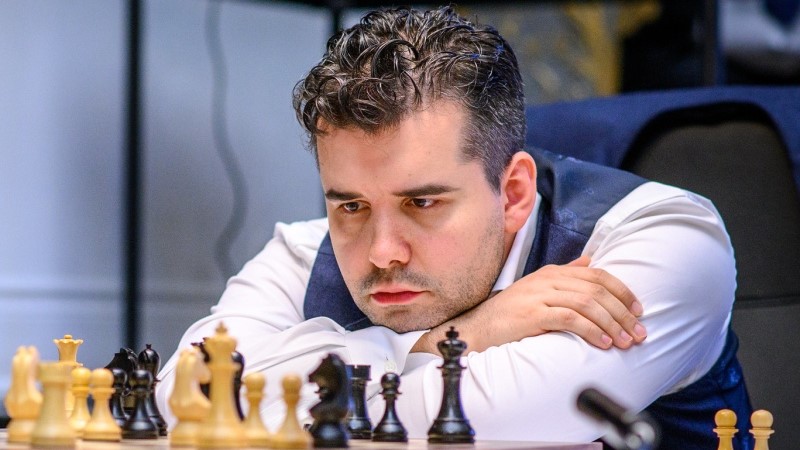
The unpredictable Toronto weather had no mercy on the players and spectators in Round 7 of the Candidates. The summer-like sunny day that the participants were treated to on the previous day transformed into a heavy downpour before the start of the games. Unlike the weather, it was a calmer day in the tournament, with only three games ending with decisive results. Gukesh D, the tournament’s co-leader, suffered a painful loss at the hands of Alireza Firouzja. Playing with White, Gukesh was up a pawn and pressing his opponent, when he miscalculated and went for 27…Nxf2, a piece sacrifice that he thought was winning. The tables turned when Firouzja found a great defensive resource with 31. Qb3, completely equalizing. The Frenchman called himself lucky multiple times at the press conference because all the lines worked well for him. Black found himself down a piece, but his queenside passed pawns proved to be sufficient counterplay. However, in the time scramble, Gukesh made another grave mistake with 36…Kh7, and his position quickly collapsed soon after. With all cameras focusing on the players, the dramatic and intense finale of this game, which was the last one to finish, was the highlight of the tournament’s broadcast. During the post-mortem, Firouzja confessed that because he no longer has anything to lose in the tournament, he will continue to play double-edged chess, hoping to generate more winning chances for himself. Hikaru Nakamura and Ian Nepomniachtchi blitzed out over 20 moves in a sharp line of the Petrov Defence, before Nepomniachtchi thought for 17 minutes on 22…Nd7. Nakamura also went for a 17-minute think before responding with 23. Nef3, and from there, both players were on their own. The game never seriously deviated from equality but featured a spectacular combination which involved the sacrifice of two pieces (26…Bxg3 followed by 27…Nf4+) and led to an imbalance rarely seen in chess: a queen for Nepomniachtchi for Nakamura’s rook and two knights. Their draw – though the logical outcome – does not do justice to the excitement that this game produced. Due to Gukesh’s loss, we now see Nepomniachtchi going into the second rest day on 4.5 points as the sole leader in the FIDE Candidates Tournament. The game featuring Praggnanandhaa R and Fabiano Caruana was a much calmer affair and ended in a draw. Both players are trailing the leader by half a point. Vidit Santosh Gujrathi had good chances against Nijat Abasov but, unfortunately, did not find the most critical continuation of his kingside attack. After 41. gxh4, Vidit could have brought the rook into the attack with 41…Rh7, which promised very good chances for Black. After 41…g4, the continuation in the game, Abasov got a chance to regroup and defend. The game ended in a draw. In the FIDE Women’s Candidates Tournament, yesterday’s fierce battles transformed into calmer ones today, with three games ending in draws. Aleksandra Goryachkina, playing with White, did not manage to pose serious problems to the tournament’s leader, Tan Zhongyi. Kateryna Lagno was putting pressure on Nurgyul Salimova with the White pieces, but Black defended well, and the draw was quickly agreed upon. “I sacrificed this pawn (16. Nxc4); I knew this idea, of course. I was sure I was fine, but when I castled and played 16…f6, I had other possibilities, too, so it was quite messy for me. I saw many possibilities and was not exactly sure which one to choose. The way I played led me to a draw, so maybe it was good,” said Salimova after the game. At the halfway point of the tournament, Anna Muzychuk and Humpy Koneru, both of whom find themselves at the bottom of the standings, also made a draw. They are going to recharge their batteries during tomorrow’s free day, hoping for a better second half of the tournament. Lei Tingjie was the only winner of the day in the FIDE Women’s Candidates. She played a lopsided game against Vaishali R, scoring a second consecutive win. “I think the game was very complicated, and at some point in the opening, I was a little worse,” shared Lei after the game. “Later on, the position was very strange with those four knights in the center. Generally, I think this game was not so good.” With this win, Lei climbed to joint third place alongside Lagno and is now half a point behind Goryachkina in second place. Tan Zhongyi, on five points, remains the sole leader of the event going into the second rest day. With the first half of the FIDE Candidates behind us, the tournament will continue with Round 8 on Saturday. The players will now meet each other once again with the colours reversed from their first matches. The eighth round of the event will commence on the 13th of April at 14:30 EDT (Toronto). Standings after Round 7: Open: 1. Nepomniachtchi – 4½2-4. Caruana, Gukesh, Praggnanandhaa – 45-6. Vidit, Nakamura – 3½7. Firouzja – 2½8. Abasov – 2 Women’s: 1. Tan Zhongyi – 52. Goryachkina – 4½3-4. Lagno, Lei – 45. Salimova – 36-8. Vaishali, Koneru, A. Muzychuk – 2½ Round 8 pairings: Open: Nakamura – CaruanaNepomniachtchi – AbasovPraggnanandhaa – FirouzjaVidit – Gukesh Women’s: Lagno – GoryachkinaSalimova – A. MuzychukTan – LeiKoneru – Vaishali Written by WGM Anna Burtasova Photos: Michal Walusza and Maria Emelianova/Chess.com Official website: candidates2024.fide.com/ Partners:
World Chess Hall of Fame hosts new exhibition “Clash for the Crown”

The World Chess Hall of Fame (WCHOF), the leading chess cultural center in the country opened “Clash for the Crown: Celebrating Chess Champions,” an all-new exhibition on April 11, 2024, which is being held in conjunction with the 100th anniversary celebration of the International Chess Federation (FIDE). “Clash for the Crown: Celebrating Chess Champions” explores the histories of the World Chess Championship and Women’s World Chess Championship through a display of artifacts from the collection of the WCHOF, FIDE and loans from world chess champions including World’s No. 1 Magnus Carlsen and private lenders. “‘Clash for the Crown’ is a powerful exhibition set to thrill and delight chess enthusiasts as they experience a century of history-defining moments and milestones across the beloved sport of chess,” said Emily Allred, Curator of the WCHOF. “We are incredibly grateful to have such rich artifacts to include in this first-of-its-kind exhibition.” The exhibition begins with the 1886 World Chess Championship, held in New York City, Saint Louis, Mo. and New Orleans, La., and won by Wilhelm Steinitz and goes all the way to the present world chess champion, GM Ding Liren. It also tracks the history of the Women’s World Chess Championship from its first winner, the legendary Vera Menchik who was the first Women’s World Champion, to Ju Wenjun, the reigning women’s world chess champion. This exhibition is being held in connection with the 100th anniversary of the founding of FIDE. To commemorate the 100th anniversary, FIDE has planned various celebrations, including festivals, historical exhibitions, the FIDE 100-year Jubilee Book, global tournaments, an online chess museum featuring rare photos, special publications, iconic event posters and more. The Chess Torch relay, marking FIDE’s first century, has already visited Asia and Africa and is set to reach the Americas soon. “I am thankful to the WCHOF and Dr. Jeanne Cairns Sinquefield and Rex Sinquefield for organizing this exhibition and taking part in marking the centenary of the birth of FIDE,” said Arkady Dvorkovich, President of FIDE. “We hope this exhibition inspires a deeper appreciation for the history of this great sport and its organization. It stands as a bridge between the past and the future, offering a window into the game’s rich heritage and FIDE’s profound role in the chess world.” Displays in the exhibition include an area where visitors can view videos of many of the past world champions and women’s world champions and interactive stations where people can learn about past champions. Programming will include lectures about the history of the World Chess Championship, collaborations with FIDE celebrating their golden anniversary and possible collaborations with current and past champions. Other “Clash for the Crown” highlights will include: Replica of the 2023 World Chess Championship Trophy won by GM Ding Liren, lent by FIDE Amber chess set once owned by World Chess Champion Mikhail Tal and is now owned by World Chess Champion Magnus Carlsen Chess set used in game 3 of the 1972 World Chess Championship Women’s World Championship medal won by Women’s World Chess Champion Alexandra Kosteniuk Women’s World Chess Championship trophy won by Women’s World Chess Champion Susan Polgar (also the first woman to be inducted into both the U.S. and World Chess Halls of Fame) and dress and scarf worn by her at the closing ceremony of the competition The medal won by Nona Gaprindashvili in the 1975 Women’s World Chess Championship A signed first-day cover from the 1984 Women’s World Chess Championship between Maia Chiburdanidze and Irina Levitina Photos by famed photojournalist Harry Benson CBE from the 2018 World Chess Championship match between Magnus Carlsen and Fabiano Caruana and the 1972 World Chess Championship Prototype of the table used in the 1978 World Chess Championship created by Cesar Iligan Dana Reizniece-Ozola, Deputy Chair of the FIDE Management Board and Willy Iclicki, Chair of FIDE Historical Committee visited the exhibition and were really impressed with various chess artifacts on display. The exhibition will be on view April 11-January 12, 2025. For more information, please visit worldchesshof.org. About the World Chess Hall of Fame The World Chess Hall of Fame (WCHOF) is a 501(c)(3) nonprofit organization committed to building awareness of the cultural and artistic significance of chess. It opened on September 9, 2011, in the Central West End after moving from previous locations in New York, Washington, D.C., and Miami. Housed in a historic 15,900 square-foot residence-turned-business in Saint Louis’ Central West End neighborhood, the WCHOF features World Chess Hall of Fame inductees, United States Chess Hall of Fame inductees selected by the U.S. Chess Trust, artifacts from the permanent collection and exhibitions highlighting the great players, historic games and rich cultural history of chess. The WCHOF partners with the Saint Louis Chess Club to provide innovative programming and outreach to local, national and international audiences. For more information, visit worldchesshof.org and on social: Facebook, Instagram, X (formerly Twitter) and YouTube channels.
100 days for 100 years of FIDE, and a Guinness World Record!
FIDE is inviting federations, chess organizers, clubs, and players to help set a Guinness World Record with at least one million games played in 24 hours! The attempt will be made on July 20, the date FIDE officially turns 100 In exactly 100 days from today on July 20, FIDE will have a celebration in Paris to mark 100 years since the organization was officially formed in the French capital. FIDE is marking its centenary with many different programs aimed at existing and new chess fans around the globe – be they schoolchildren, refugees, people in prisons, charities, club players, or newcomers to the game! Throughout the year, the FIDE centennial torch relay is going around the world to mark the occasion, with India, Switzerland, and Ghana already taking part and other places around the world lining up. In another momentous step for FIDE this year, the International Chess Federation is partnering with Guinness World Records to set a new milestone for the chess world: at least one million games played in one day! FIDE is inviting federations, chess organizers, clubs, and players to help set a Guinness World Record with the most games played in 24 hours! The attempt will be made on July 20, the date FIDE officially turns 100. To ensure the quality of each game counted, the FIDE Arbiters’ Commission will draw up regulations to ensure that all the games, both online and offline, are accurately registered, controlled and reported to the Guinness World Records Office, in a timely manner. Further details will be announced on May 1, but for now, get ready to join the biggest chess movement on the planet – FIDE’s centennial record challenge! Check out a special video on an attempt to set a Guinness World Record About the Guinness World Records Guinness World Records, originally known as the Guinness Book of Records, has emerged as the definitive authority on record-breaking achievements, stemming from the idea of resolving disputes in pubs with a book of facts. Today, it stands as a global brand, with offices spanning London, New York, Beijing, Tokyo, and Dubai, alongside a network of brand ambassadors worldwide. Its mission extends beyond the pages of its iconic book, now encompassing TV shows, social media, and live events, all aimed at documenting the extraordinary.