

In memory of David Bronstein on the 100th anniversary of his birth
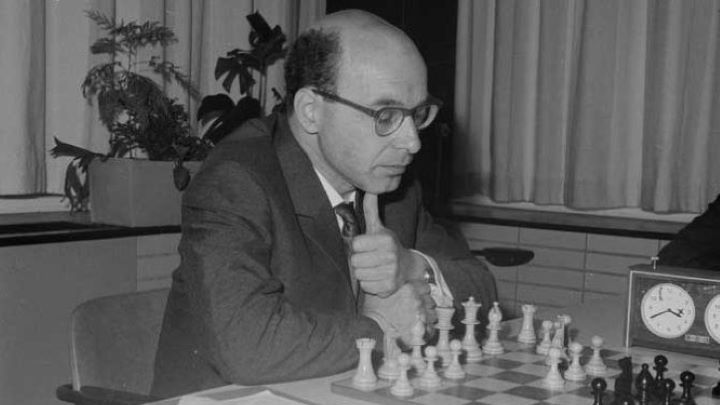
Today is 100 years since the birth of David Bronstein. David Bronstein was an outstanding grandmaster, and yet – a unique case for a man who almost became world champion – his immediate contribution to popularizing chess is no less important. Bronstein authored several great books. Along with Zurich-1953 (written for the most part by his senior friend and mentor Boris Vainstein), I would mention the remarkable “200 Open Games”. And how many wonderful and memorable articles he wrote how many insightful predictions! Judge for yourself: In his essays “On the Way to the Electronic Grandmaster” and “Chess of the Third Millennium”, Bronstein predicted much of modern computer and online chess, albeit in the terminology of 1978 (the book “A Beautiful and Furious World”, co-authored with Smolyan). “…A chess player would use a machine to extensively analyze the variants chosen based on his knowledge and intuition to test strategic ideas and control errors. It would have added at least 500 points on the professor A. Elo’s rating scale.” Photo: Eric Koch pour Anefo — Dutch National Archives, The Hague “Today, we don’t know any chess player, including the world champion, who, having made the first move, can recite all possible variations as he sees them on a tape recorder. But if the best chess players in the world were contesting with a microphone, everyone would hear how beautifully they think. However, FIDE is clueless that by organizing tournaments of talking grandmasters, the federations would gather an appreciative audience of millions. (In this case, you can’t hide your own helplessness behind other people’s moves.) Masters could use television technology to speak to the public in the language of chess symbols in such tournaments. Such a game, among other things, would remove certain inferiority from those playing since the public considers an unexpected move for themselves as a surprise for the grandmaster as well. And with closer contact, the audience would fantasize less and penetrate deeper into highly skilled and creative thinking.” “It is likely that some publisher will release a game of ‘Chess Tests’ in time. Different positions will pop out of a box for a certain amount of time, while a counter will indicate a score depending on the quickness of the solution choice.” Photo credit: D. Prants, via https://muis.ee “The Chess House Central Machine Service will appear, and you can join the computer by telephone and play with it if you like – the whole family. After the game, the computer will send you, along with your energy bill, a copy of the game.” Bronstein was a pioneer in many ways, and it is a pity that he did not become world champion. I think many of his original ideas would have received a much broader appeal. A pupil of Alexander Konstantinopolsky (by a funny coincidence, also born on February 19), he stood out both in his playing style and opening repertoire. Bronstein, along with Boleslavsky, is credited with introducing the King’s Indian Defense to the top competitive level. Thanks to them, the opening was for some time called the “Ukrainian Defence”, as two friends – Bronstein from Kyiv and Boleslavsky from Dnepropetrovsk – who had worked together since their youth, actually brought this opening into the highest tournament level. “Devik”, as he was called, played with great panache sacrificing pawns and pieces. The trajectory of his rise was very steep. Who knows how his fate and chess history would have turned out had he preserved the lead in the title match with Botvinnik in 1951? It was 11.5:10.5 on the scoreboard with just two games to play, and all he needed was not to lose. If Bronstein had held on then, many things would have been different. Having become vice-champion at 27, Bronstein could not overcome the shock of missing this chance. For another fifteen years after the match, he played at a high level and, most importantly, was bursting with ideas. Rapid chess is also Bronstein’s brainchild and even time increment called Fischer’s was originally spotted by Bronstein in Shogi, and only then, slightly modified, was adapted in chess. There were many other things: his books, where truth is mixed with fantasy but permeated with love for chess, different engaging formats, etc. Gradually, he got older; his marvelous ideas interspersed with eccentric ones, and more and more often, David reminisced about to the 1951 title match he had failed to win. This indelible bitterness was present in many of his late speeches and articles. It was felt in talks with him as well. I had a chance to talk to the legendary veteran quite a bit and even received a compliment from him during a game with van Wely (1997). After I made a subtle move, Bronstein, who hung around the table for a long time, waited for me to stand up, took me under the elbow and said in a loud whisper: “You’re playing 21st-century chess!” Photo: Anne Fürstenberg He was an eccentric, one-of-a-kind person who talked a lot, sometimes even losing his interlocutor’s attention. Bronstein gushed out most of his interesting ideas in his younger years. David lived a long life, but he was the kind of person who gave out almost the entire stock in the first half of the journey. Still, this alone more than suffices for a place in any chess pantheon. He loved chess passionately into his old age. David loved talking about it. He loved experimenting. He continued to play in tournaments even in his 70s. Bronstein always had a lot of fans, and the organizers opened doors for him. Was he a wise man as the artist portrayed him? Probably not. He was a man capable of thinking up countless original ideas. Sometimes paradoxical. Sometimes deliberately provocative. But they were brilliant and had far-reaching consequences. He was always in the limelight, no matter what he did, whether it was his brilliant play and top-level skills of a practical player, an array of ideas in the King’s Indian, Dutch,
FIDE launches the ChessMom initiative

FIDE Commission for Women’s Chess is pleased to announce a new initiative focused on supporting Professional Chess Players going through motherhood The ChessMom pilot project aims to provide support for professional chess players who are mothers of infants under one year old. Specifically, through this initiative, all expenses related to an accompanying or caregiver person for ten female players traveling with their infants to the 45th Chess Olympiad will be covered. Dana Reizniece-Ozola, FIDE’s Deputy Chair of the Management Board, expressed her support, drawing on her personal experience as a chess player and mother of four. “As a chess player and as a mother of four children and as someone who actively played chess, I understand how hard it is for mothers who are professional players to cope with both maintaining their career and living and fulfilling the critical role a mother has in the first year of their child. FIDE, therefore, fully supports this initiative by the Commission for Women’s Chess, and we will actively look towards other ways on how we can help and support chess mothers in the future,” said Dana Reizniece-Ozola. The Chess Olympiad organizer will recognize both the child and the accompanying caregiver as integral parts of the National Official Delegation, granting them all applicable rights. This includes discounted full board rates where applicable, with FIDE covering lodgings, meals, and any other applicable discounted fees as part of the Official Delegation. National Delegations should, therefore, consider a child and the accompanying caregiver as part of the National Official Delegation, with all applicable rights. “In recent years, we have seen many initiatives by FIDE in favor of Women. Now we address the most important one in their adult lives, motherhood. Our players should not have to choose between family and chess. I hope this pilot program transitions to become the norm in the near future,” said Francisco J Cruz Arce, WOM Member and ChessMom Project Leader. WOM urges National and Continental Federations to review and adjust their requirements for National Teams to include provisions for chess players who are mothers. The hope is that this initiative will evolve into consistent support for professional chess players experiencing motherhood during significant tournaments. “The idea of the project is to keep professional chess players in chess in the early stages following the birth of a child. Many chess players can’t come to the Olympiad and other chess events because there is no possibility for them to take care of a baby. This project can become a great social initiative,” said Anastasia Sorokina, WOM Chair. For more information, please contact the project Leader Francisco J Cruz Arce: fj_007@yahoo.com
FIDE Endorses ChessNoteR N6 & N9 devices

FIDE Technical Commission is delighted to announce that the FIDE Council has officially endorsed the ChessNoteR N6 and N9 devices (MB-2024-02). Developed by Black Mirror Studio, the ChessNoteR (chessnoter.com) is a groundbreaking approach to digitizing chess notations for offline gameplay. Deployed on two specially customized Android devices, the NEXUS 6 and NEXUS 9, this solution ensures heightened security and efficiency. The exclusive focus on the ChessNoteR software and essential device settings significantly enhances fair play measures in tournament conditions. Key features of these devices include streamlined tournament and opponent management, versatile board setting options, and the capability to easily transfer games to computers. Such innovations promise to benefit players in competitive settings substantially. We extend our heartfelt gratitude to IA Arasu B, IA Dinu-Ioan Nicula, and IA Hendrik du Toit of the FIDE Technical Commission for their diligent evaluation of these devices. For any inquiries or additional information, please contact Hendrik du Toit at secretary.tec@fide.com.
Cuban Championship: Ernesto Quesada and Lisandra Ordaz win titles
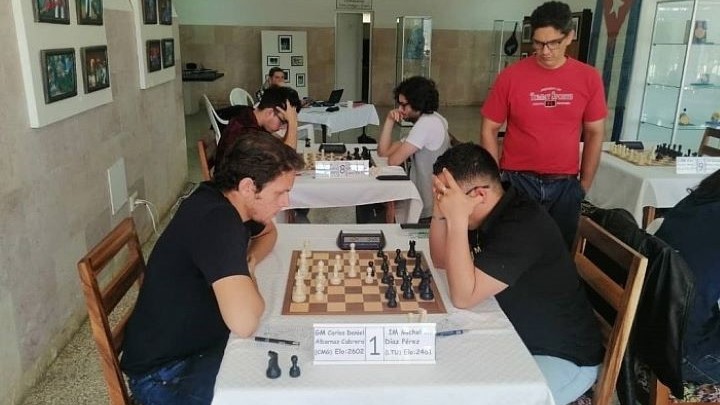
LX Cuban Absolute (Open) Championship and XLVIII National Women’s Championship were held almost simultaneously in the different parts of the island – Holguin and Pinar del Rio, respectively. The open tournament saw a close race of three top seeds, Luis Ernesto Quesada Perez, Omar Almeida and Carlos Daniel Albornoz Cabrera, who scored 7/9 and tied for first place in the end, finishing a half-point ahead of Lelys Stanley Martinez Duany. To determine the winner, a three-player tiebreaker was played in which Luis Ernesto Quesada emerged victorious, taking the title of Cuban champion. Omar Almeida finished second and took silver, while the top-rated Carlos Daniel Albornoz had to settle for bronze. Kudos to FM Kemel Antonio Gallo, who netted 6/10 and completed an IM norm. Final standings Open: 1 GM Luis Ernesto, Quesada 2560 7 2 GM Omar, Almeida Quintana 2506 7 3 GM Carlos Daniel, Albornoz 2603 7 4 GM Lelys Stanley, Martinez 2462 6½ 5 GM Dylan Isidro, Berdayes 2501 6 6 FM Kemel Antonio, Gallo 2348 6 7 IM Michel Alejandro, Diaz 2461 6 8 IM Jorge Roberto, Elias 2468 6 9 GM Ermes, Espinosa Veloz 2490 5½ 10 IM Rider, Diaz Murgada 2440 5½ The women’s event was also a close affair as IM Lisandra Ordaz Valdes and the youngest participant, WFM Leannet Mariah Bosch Valls, totalled 7.5/10 and shared first place. Another exciting tiebreaker took place a few hours after the final round, with Ordaz and Bosch facing each other in a duel for the national crown. After the opponents traded blows in the rapid 15+10 games, Lisandra Ordaz won both blitz games and clinched the title. As many as three players tied for third place, with Miranda Llanes Yerisbel winning bronze (just like in 2023) thanks to the superior rating average of the opponents. Final standings Women: 1 Lisandra Teresa, Ordaz 2310 7½ 2 Leannet Mariah, Bosch 2079 7½ 3 Yerisbel, Miranda Llanes 2262 7 4 Yaniela, Forgas Moreno 2265 7 5 Roxangel, Obregon Garcia 2118 7 6 Ineymig, Hernandez Gil 2143 6 7 Oleiny, Linares Napoles 2188 5½ 8 Melissa, Rodriguez Dominguez 2011 5½ 9 Amanda Maria, Muniz 2116 5½ 10 Vivian, Ramon Pita 2042 5 Photos: Cuba Chess Facebook Official website: supercubadatabase.simdif.com/
Magnus Carlsen wins Freestyle Chess G.O.A.T. Challenge
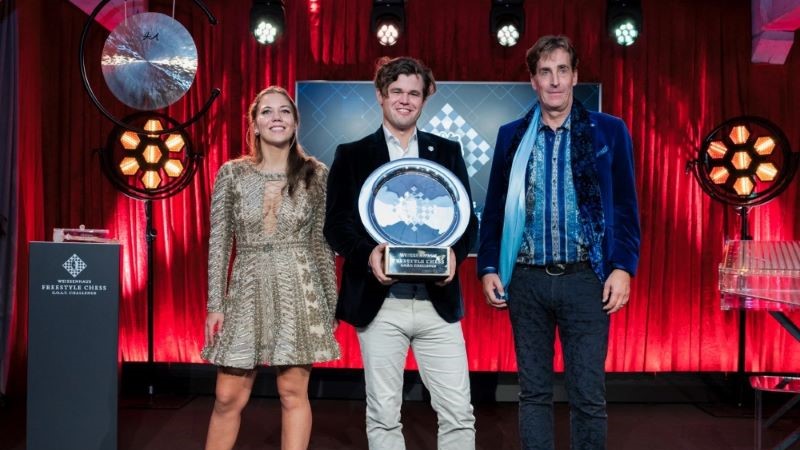
“It feels awesome to win the event,” said Magnus Carlsen after clinching the inaugural Freestyle Chess G.O.A.T. Challenge on Friday after beating Fabiano Caruana in the second game of the final. Carlsen will take home the $60,000 first prize, whereas Caruana earned $40,000. The 2024 Freestyle Chess G.O.A.T. Challenge, an over-the-board Chess960 classical tournament took place from February 9-16 in Weissenhaus, Germany. The competition consisted of a round-robin rapid that determined the pairings of the main event, a single-elimination bracket played with classical time control. Magnus Carlsen was the only player in Weissenhaus who had to defeat eight challengers, as Jan Henric Buettner noted at the prize-giving ceremony: seven grandmasters and himself. As the G.O.A.T. in the tournament of his choice, Carlsen was under more pressure than anyone else right from the start. He stood up to it. In the semi-final Magnus Carlsen went 1.g2-g4 and consequently wrote “Grob” on his scoresheet. In the second game of the final against Fabiano Caruana (the first one was drawn) he again opened with g2-g4 – and wrote “Polish”. That was difficult to understand. A deeper look at the starting position reveals the explanation. What is called the “kingside” in traditional chess and still has no name in the 960 (“g-side”, says Carlsen), Carlsen tended to locate on the left side of the board, i.e. on the c-side. That’s why g2-g4 seemed to him like b2-b4 – Polish. With Carlsen accurately writing “Polish Opening”, he avoid confusion with the “Polish Defense” (1…b7-b5). However, for 1.b2-b4, “Polish” is more of a third name after the more common “Orangutan” and “Sokolsky”. Regardless of the opening, Carlsen had the white pieces, and that’s huge in 960 with its high number of decided games compared to chess1. Already before the quarterfinals Carlsen had said that he thought it was a great advantage to start a match with White. His results reflect why he might be right: three white games, three wins. Asked by Fiona Steil-Antoni about his favorite game of the tournament, he named the final one against Caruana: “It won me the tournament, and it was also fairly good.” Carlsen was not completely satisfied with his chess overall: “Sometimes I played too impulsively.” Nevertheless, he often managed to penetrate deep into the unfamiliar position and capture its essence, he said. This may also apply to the second game against Caruana, in which the challenger soon had his back to the wall. “A miniature” was what Peter Leko feared in the opening. At times it looked as if Caruana would stabilize, but in the end, he was outplayed quite comfortably. Levon Aronian won the fight for third place and $30,000 thanks to a convincing win with the white pieces against Nodirbek Abdusattorov ($20,000). Alireza Firouzja secured fifth place ($15,000) and qualification for the 2025 edition (alongside the top four) by drawing with Gukesh Dommaraju ($12,000) while Vincent Keymer ($10,000) also won his second game vs. Ding Liren ($8,000) to finish in seventh place. Final standings: By Conrad Schormann and Peter Doggers Photos: Freestyle Chess G.O.A.T. Challenge official website Official website: freestyle-chess.com/
Montenegrin Championship: Nikita Petrov clinches title
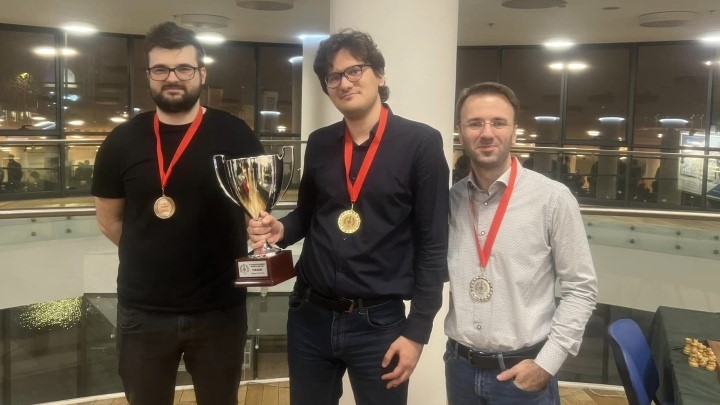
GM Nikita Petrov is the new champion of Montenegro. The native of Novorossiysk (Russia), who recently changed federation, won his first national title in a tough contest with 10-time Montenegro champion Nikola Djukic. The Montenegro Championship 2024, an 11-round Swiss tournament with classical time control, took place from February 6-15, 2024, in the country’s capital Podgorica. The event brought together 52 best local players. It was an extremely close race from start to finish, with top-seed participants either taking turns on the top or sharing the lead almost all the way. In the end, Petrov and Nikola Djukic pulled away and came to the final round a full point ahead of Luka Draskovic and Denis Kadric. Facing Bozidar Ivanovic with the white pieces, Djukic grabbed the initiative early on, then made a serious mistake but eventually converted his slight advantage deep into the endgame to take the top position for a moment. Meanwhile, playing against Milan Drasko with Black, Petrov gradually outplayed his opponent but did not protect his last pawn in an endgame and let his advantage slip away completely. Still, Nikita had some practical chances with a rook and two minor pieces (no pawns) against Milan’s rook, knight and pawn, which materialized in time trouble after White’s king walked into a mating net. As a result, both leaders pulled off victories and finished on 9/11, but Nikita Petrov clinched the title thanks to a slightly better Buchholz. As many as three players tied for third place, netting 7.5/11, with Denis Cadric claiming bronze by a superior tiebreaker. Final standings: 1 GM Petrov, Nikita 2563 9 2 GM Djukic, Nikola 2521 9 3 GM Kadric, Denis 2586 7½ 4 GM Draskovic, Luka 2485 7½ 5 IM Smirnov, Artem 2406 7½ 6 FM Vukcevic, Nemanja 2275 7 7 IM Kalezic, Blazo 2407 7 8 Vujovic, Savo 2137 7 9 GM Nikcevic, Nebojsa 2338 6½ 10 FM Sukovic, Andrej 2339 6½ Photos: Šahovski savez Crne Gore Facebook
FIDE establishes closer cooperation with International School Sport Federation
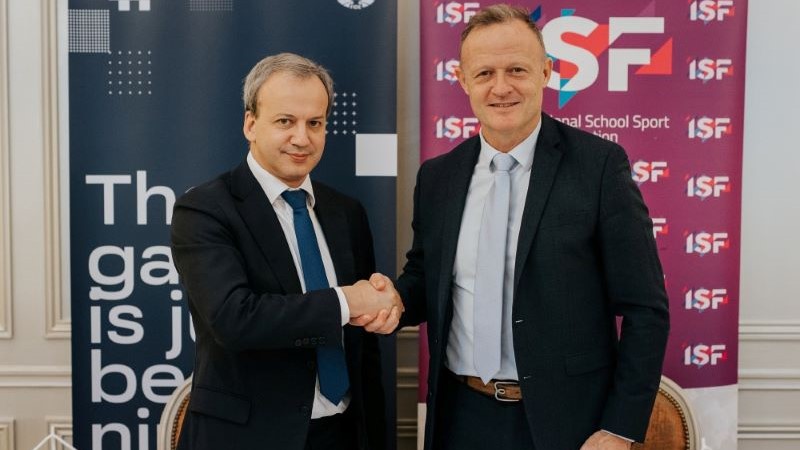
At a ceremony in Paris, the President of the International Chess Federation (FIDE), Arkady Dvorkovich, and the President of the International School Sport Federation (ISF), Laurent Petrynka, signed a Memorandum of Understanding which aims to incorporate chess in sports events for students organized by the ISF The partnership outlines key objectives, including establishing chess as a recognized sport among National School Sports Federations, specifying FIDE’s role in organizing ISF Chess competitions, and promoting chess in education at local and international levels. Additionally, the collaboration seeks to attract school-age chess enthusiasts and enhance chess visibility in the media. FIDE and ISF will jointly initiate programs encouraging school students to embrace chess, promote girls’ school sports, and utilize school chess competitions as a platform for testing new rules and formats. FIDE President Arkady Dvorkovich expressed his enthusiasm, stating, “ISF is the largest sports organization globally focusing on school sports. We are delighted to have signed this agreement to include chess in their events. With cooperation from ISF, we are opening new paths for young people to take up this beautiful sport.” ISF President Laurent Petrynka spoke highly of the value of chess: “Chess is an intensely competitive and strategic sport. Young individuals engage in chess to develop skills such as keen perception, quick thinking, and strategic planning, challenging and strengthening their mental resilience. Many qualities of chess make it highly suitable for promotion in schools.” “Within the framework of this MOU, ISF is committed to wholeheartedly promoting chess within ISF events and its member organizations, including national school sports federations. Harnessing the popularity of this sport, ISF aims to drive school sports and educational activities, fostering fair competition and gender equality in sports. Additionally, ISF is delighted to note that FIDE has officially included ISF Chess events in its calendar and will provide support in competition management, technical officials’ training, and other aspects to facilitate the rapid growth of global school sports.” The initial step following the agreement will be the inclusion of chess at the upcoming ISF Gymnasiade in Manama, Bahrain, from October 23 – 31. Hosted by the Kingdom of Bahrain and under the patronage of His Majesty King Hamad bin Isa Al Khalifa, the event will bring together school students from around the world to participate in 25 different sports, including para-sports, over eight days. Activities will range from inspiring workshops to seminars, providing students and teachers with a unique opportunity to interact with peers from across the globe. To learn more about the event and to register your team, please visit: events.isfsports.org/isf-gymnasiade-bahrain-2024/. Photos: Nicolas Launay About the ISF Established in 1972 and recognized by the International Olympic Committee since 1995, the International School Sport Federation (ISF) encompasses its motto, “We are school sport”. As the global umbrella for national school sports organizations, ISF engages with over 200,000 schools across 134 member countries. ISF provides school children aged 13-18 by hosting events globally and featuring a diverse competition and education program with over 30 sports, including para-sports. Its mission is to expand education through sport and encourage a healthy lifestyle, as well as support the physical and mental health of youth worldwide. ISF is hosting the world’s biggest international sports events for school students, including the flagship ISF Gymnasiades.
Iivo Nei and Andreas Dueckstein awarded Honorary GM title
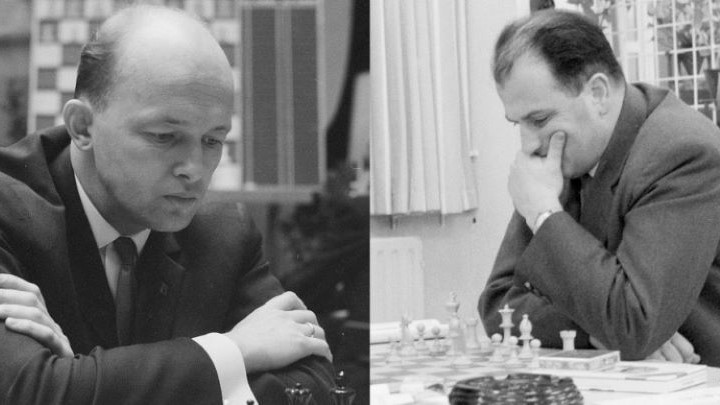
FIDE Council awarded the title of Honorary Grandmaster to Andreas Dueckstein (Austria) and Iivo Nei (Estonia) for their consistently strong results in the 1950s-70s. Currently, FIDE Historic Commission is working on unified criteria for awarding the title of Honorary Grandmaster. Below are a few words about the awardees, summarizing their careers and achievements. Ivo Nei Photo: Ingmar Muusikus Born on October 31 1931, in Tartu, Estonia, Iivo Nei started playing chess inspired by his great compatriot Paul Keres. At the beginning of his career, Nei made a name for himself, finishing 3rd in a very strong USSR Juniors Championship (Leningrad, 1947) and tying for first with Korchnoi in the same event a year later (Tallinn, 1948). Eight-time Estonian champion (1951, 1952, 1956, 1960–1962, 1971, and 1974), Iivo won the Baltic Republics championships in 1961 in Palanga, in 1962 in Tartu, in 1963 in Estonia, and in 1964 in Pärnu. His major break came in 1964 when he tied for first with Paul Keres in Beverwijk (Hoogovens tournament, later known Corus and then Tata Steel) ahead of Portisch, Ivkov, Larsen and Parma. He later achieved solid results in Beverwijk 1966 (5th), Zinnowitz 1966 (4th-6th) and Tallinn 1969 (2-3rd). Still an active player, Iivo Nei productively worked with Nona Gaprindashvili and Maia Chiburdanidze as an assistant and was notably one of Boris Spassky’s seconds in the 1972 World Championship match. He later coached GM Lembit Oll. For many years Iivo Nei served as FIDE representative in Zone 1.7 (Estonia, Latvia, Lithuania) A popular author, he penned several books in Estonian and German. Andreas Dückstein Photo: kurier.at/ Born on August 2, 1927, in Budapest, Andreas Dueckstein moved to Austria at 22 and quickly became one of the country’s strongest players, winning the national championship thrice (1954, 1956, 1977). Andreas represented Austria in seven Chess Olympiads from 1956 to 1988, notably taking individual gold in Moscow (1956) and Nice (1974), both times playing on the second board. Following his strong performance in Moscow (1956), he was awarded the IM title. Regarded as a dangerous attacking player in his prime, Dueckstein scored victories over formidable opponents such as Max Euwe, Mikhail Botvinnik (who was the reigning World Champion at that time), and Bent Larsen. Over his long and successful chess career, Dueckstein built a good tournament record: 5th at Hastings (1958/59), shared 2nd at Zonal in Berg en Dal (1960), 4–6th at Vienna (1961), 3rd at Amsterdam IBM (1964), 4th at Palma de Mallorca (1965), 6-7th in Havre (1977). Photos (top): Ron Kroon and Wim van Rossem for Anefo (Dutch National Archives, The Hague)
FIDE delegation visits headquarters of IndianOil Corporation
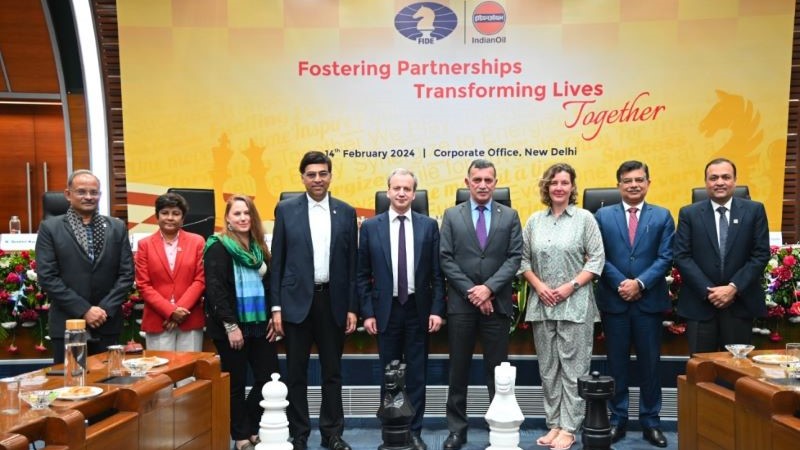
The delegation of FIDE, headed by President Arkady Dvorkovich, and chess legends Viswanathan Anand and Judit Polgar visited the headquarters of IndianOil Corporation in New Dehli to meet with the Chairman of the company, Mr Shrikant Madhav Vaidya and the company’s personnel. In addition to those present at the meeting, 30,000 IndianOil employees were following the event online. Chairman of IndianOil, Mr Shrikant Madhav Vaidya, has received the ‘Friend of FIDE’ award, a prestigious FIDE award given to individuals and companies who have made a substantial contribution to promoting chess in the world. FIDE believes that with programs like “Parivartan – Prison to Pride”, the company is reshaping lives, building a society where every pawn has the chance to become a king. The enduring partnership of IndianOil and FIDE embodies the commitment to this noble mission. IndianOil Corporation is the largest oil refiner and fuel retailer in the country. In 2021, the company launched the “Parivartan – Prison to Pride” social responsibility project. The initiative aims to engage and rehabilitate prison inmates nationwide through sports coaching programs. The Parivartan chess courses are supervised by experienced coaches, including GMs Abhijit Kunte and Surya Sekhar Ganguly, WGMs Eesha Karavade, Soumya Swaminathan, Padmini Rout, to name a few. Mr Vaidya highlighted the program’s role in supporting the transition of individuals back to community life: “Embodying our core value of Care, ‘Parivartan’ has reached out to the most disadvantaged and vulnerable section of society. Going beyond the physical and mental well-being, it aims for a positive transformation in the lives of prison inmates through sports. In fact, the various global recognitions we have received so far for this endeavour strengthen our resolve to push the envelope further to make a tangible impact.” The Parivartan project now covers 128 prisons in India in 22 states and 6 Union Territories of the country, with coaching over 6300 inmates. During the meeting, it was announced that the second in-person Chess for Freedom Conference would take place in India in May 2024. The event will feature many experts from the worldwide chess community who will take the stage to introduce concepts and approaches to using chess as a rehabilitation tool for incarcerated people. The inaugural edition of the event was held in Chicago, USA, in the spring of 2023.
Starting with a bang: Chess Torch Ceremony kicks off FIDE’s centennial celebration
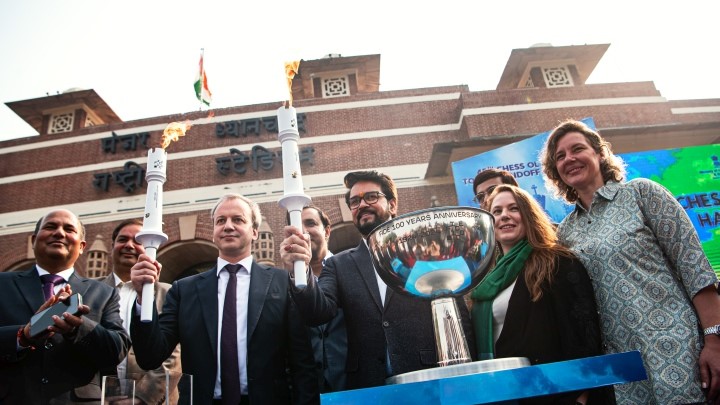
2024 promises to be a momentous year for chess as FIDE celebrates its 100th birthday. To commemorate this huge milestone, the year will be filled with chess activities around the world – from festivals and historical exhibitions, to special tournaments such as the Candidates. There is a lot in store and a lot to be excited about. Now, what better way to start the festivities with a bang? This is exactly what happened today, with a special Chess Torch Ceremony held in India to mark FIDE’s centennial celebration. The Chess Torch Ceremony began with a vibrant event in New Delhi at the Major Dhyan National Stadium. The event, rich in cultural performances and chess-related activities, saw the lighting of the Chess Torch by India’s Sports Minister, Anurag Singh Thakur. Esteemed guests and chess greats, including Viswanathan Anand and Judit Polgar, were present, and the big day included multiple chess activities and speeches. The event began at 08:30 with a Kids Blitz tournament, with chess legends Viswanathan Anand and Judit Polgar making their inaugural moves, setting a lively and inclusive tone for the day. Dr. Sanjay Kapoor, President of the All India Chess Federation, offered a warm welcome address, followed by a captivating video presentation celebrating FIDE’s centennial and its diverse activities planned for the year. Then, a “Hand & Brain” chess game between Mr Anurag Singh Thakur and Vishy Anand vs Arkady Dvorkovich and Judit Polgar was played, adding an interactive element to the event. What was the result, you may ask? Well, after some friendly competition, the game ended in a draw! FIDE President Arkady Dvorkovich delivered an address, further emphasizing the global and unifying nature of chess, stating, “It is my firm belief, and our joint vision at FIDE, that chess is not just a game or a sport, but it is a huge tool to improve our society.” This address highlighted how chess can bridge cultures, ages, and backgrounds and how FIDE aims to bring chess to all communities in the world. The speech was followed by a vibrant cultural act representing various parts of India, showcasing the country’s diverse heritage and connection to chess. The highlight of the ceremony was the lighting of the cauldron by Mr. Anurag Singh Thakur and Arkady Dvorkovich, symbolizing the official start of the Chess Torch Relay, which aims to unite the chess community worldwide. The Torch will travel the world to reach Budapest, Hungary in September, where the 45th Chess Olympiad will take place. All India Chess Federation President, Dr Sanjay Kapoor’s address beautifully highlighted the significance of the Torch: “Today, as the torch embarks on its journey from India to Budapest, let us remember that it symbolizes the unity and camaraderie that define our global chess family. And the values that it represents: perseverance, determination, and the unbreakable bonds that tie us together. Together, let us ignite the flames of inspiration and passion for the game of chess, and may they burn brightly for generations to come.” Overall, it was a uniquely meaningful day which represents the special centennial year that we, as a global chess community, will get to celebrate with FIDE. Photos: Stev Bonhage