

Deputy Chair of FIDE Management Board visits India

Following the invitation from the All India Chess Federation (AICF), Dana Reizniece-Ozola, FIDE Deputy Chair of the Management Board, had a tour around India to promote women in chess and educational chess. Within a week, Reizniece-Ozola and AICF officials visited New Delhi, Agra, Udaipur, Bengaluru, and Faridabar, covering different states of India. Motivational presentations, simultaneous games exhibitions, press conferences and official meetings were held everywhere. These trips share common goals: doubling the number of kids going in for chess in education and increasing the representation of women in chess. These tasks have always been a priority for FIDE. During her visit to Udaipur-Lakecity, Dana Reizniece-Ozola participated in an event organized at St. Anthony School and hosted by Chess In Lakecity’s Secretary, Vikas Sahu, where she interacted with young chess enthusiasts. Impressed by the growing enthusiasm for chess among children and youth, Dana Reizniece-Ozola expressed her optimism for the future of chess in Udaipur. Chess In Lakecity has organized over 50 national and international tournaments and raised 200+ rated players there. Dr. Vipnesh Bharadwaj, the Interim Secretary of the All India Chess Federation, highlighted the increasing role of youth and children in chess in India, which has led India to gain recognition in global chess competitions. This is a significant achievement for the country, and it is inspiring young children to take up chess and follow their dreams. In Bengaluru, Karnataka, the Deputy Chair of the FIDE Management Board visited a rural Hallegere School, where chess was introduced with the help of Bengaluru Urban District Chess Association, Karnataka State Chess Association and the guidance of All India Chess Federation. The school is financially supported by Revathi Kamath, who emphasizes that the best asset one can give to children is education. On 18-26 January 2024, Bengaluru Urban District Chess Association will host the first International Grandmasters’ Tournament with more than 2500 people from 20+ countries expected. Led by Sowmya M Upadhyaya, the Association is a power force behind chess in Bangalore. Seven energetic, humble women do it all – open chess in schools, organize tournaments, support social initiatives, etc. During the visit of Dana Reizniece-Ozola, the Bengaluru Urban District Chess Association organized a Discussion Panel with other sports celebrities, “Women in Sports: Pioneers and Trailblazers”. She also visited Bengaluru Central Prison in Karnataka. Following the 3rd Intercontinental Chess Championship for Prisoners, simultaneous games exhibition, an official meeting with prison authorities and discussions on developing a chess program within prison walls were held. In Bhubaneswar, the Deputy Chair of FIDE Management Board visited the Kalinga Institute of Social Sciences and Kalinga Institute of Industrial Technology. The institutes have 65,000 students, among them – 40,000 girls from underprivileged families, who have been provided free education, accommodation and food by the founder of the institution H.E. Achyuta Samanta, Member of Parliament of Kandhamal. Dana Reizniece-Ozola was honoured to address the students and was deeply impressed by their warm joy and sparkling energy. “When you come from a privileged place where education comes as a granted right, it is difficult to fully understand that in the modern world, access to education is still limited to so many. Poverty and illiteracy limit choices and deem lives to failure. God bless people like H.E. Achyuta Samanta, who provide opportunities to thousands and thousands of young girls. I am also happy that chess has become part of their education while this is another way to spot the talent and give them skills that would allow them to better navigate through complex positions of their lives,” she said. After this, Dana Reizniece-Ozola, along with Chairman FIDE Advisory Board Bharat Singh Chauhan, had a fruitful interaction with the Hon’ble Chief Minister of Odisha, Shri Naveen Patnaik, to discuss chess development programs in the state. The Chief Minister announced the plans to establish 100 chess centres and a chess academy and to equip 16,000 classes for teaching chess to pupils. In return, Reizniece-Ozola ensured that FIDE would help Odisha authorities with training chess teachers. In Faridabad, the FIDE Deputy Chair of Management Board visited the opening of the AFCA Open Rapid Chess Tournament with 650 participants. All Faridabad Chess Association, led by its President Neetu Agarwal and General Secretary Alka Chhikara, organize such events on a regular basis. Last year, All India Chess Federation Dr. Sanjay Kapoor and Bharat Singh Chauhan impressed the world with the great organization of the 44th FIDE Chess Olympiad. During the meeting of Dana Reizniece-Ozola with H.E. Anurag Singh Thakur, Minister of Youth Affairs and Sports of India, this achievement was acknowledged, setting new ambitions for Indian chess. In 2024, India will host the inauguration of Chess Torch Relay in honour of the FIDE 100 Years Anniversary. The torch will travel around all continents from New Delhi to Budapest, Hungary, where the 45th FIDE Chess Olympiad will take place.
Intense Round 4 at 2023 World Amateur Championship
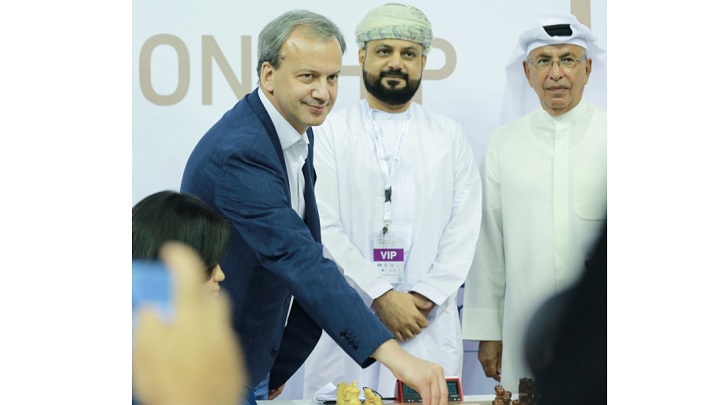
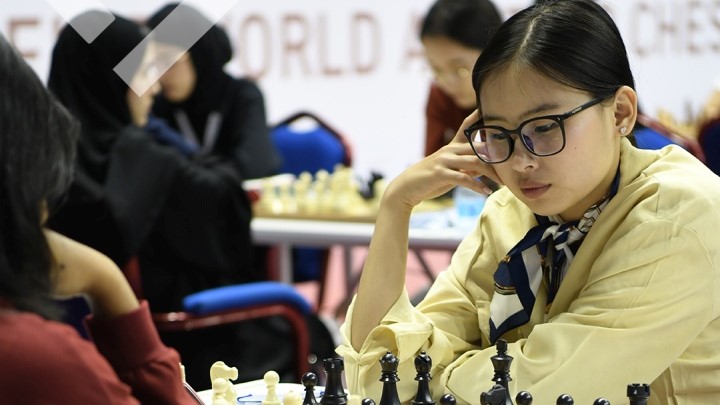
Round 4 of the World Amateur Chess Championship in Oman commenced with the first ceremonial move made by FIDE President Arkady Dvorkovich. He expressed his positive impressions of visiting the World Amateur Championship 2023 and remarked that the venue provided excellent conditions for chess players, with spacious and comfortable facilities. FIDE President also highlighted the remarkable number of participants, emphasizing the high level of competition. Arkady Dvorkovich commended the organizers for their dedicated efforts and praised the decision to host the championship in Oman, foreseeing it as a positive step to encourage more participation and expressing his excitement for future developments in the country and the region. Round 4 saw the sole leader emerge in one of the categories. Abilmansur Abdilkhair of Kazakhstan (pictured above) won a tough game against the Maldivian player Muhammed Shuaau and came out on top with a perfect score in the Open U-2300 category. Four players are trailing the leader by a half-point, sharing second place. In the Open U-2000 category, the player Sebastian Emil (FIDE) defeated Esa Ahlqvist (Finland), but his main competitors, Dashtogtokh Amarsaikhan (Mongolia) and Sri Lankan Desandhi Dhihansa Gamage, also won their games. This trio is tied for first position on 4/4. There is a six-way tie for first place in the Open U-1700 category after Round 4. Batnyam Munkhbat (Mongolia), Batra Deepak (India; pictured above), Hamed Imani Lasaki (Sweden), Alexander Martynov (FIDE), Ganbat Danzanjunai (Mongolia) and Alzaabi Humaidan Mohamed (UAE) won all four games and will clash in Round 5. Mongolian female players Sodgerelt Naranbold (pictured below) and Anujin Bat-Amgalan share the lead in the Women U 1700 category with a perfect score, followed closely by Ali Abeer (UAE). The leaders will square off in Round 5. Text: WACC 2023 media team Photos: Entisar Nasser Al-omiiri, Hamed Al-Mabsali, Abduallah Al-Rashdi, Salma Hamood, Salem Al-Salhi Official website: worldamateur2023.fide.com/ Results and standings: worldamateur2023.fide.com/result/ Live games: Open U-2300chess24.com/en/watch/live-tournaments/fide-world-amateur-championship-2023-u2300#live Open U-2000: chess24.com/en/watch/live-tournaments/fide-world-amateur-championship-2023-u2000#live Open U-1700: chess24.com/en/watch/live-tournaments/fide-world-amateur-championship-2023-u1700#live Women U-1700 https://chess24.com/en/watch/live-tournaments/fide-world-amateur-championship-2023-w1700#live Live broadcast (English/Arabic): youtube.com/@Omanchesscommitteeoman About 2023 World Amateur Chess Championship FIDE World Amateur Chess Championship 2023 is organized by the Omani Chess Committee together with the International Chess Federation, with the financial support of Gold sponsors: Syool, Apollo Hospitals, Oman LNG. Bank Muscat, Otaxi, Oronamin C Drink as well as Diamond sponsors: Asyad, OMIFCO, and Oman Airport.
Robert Huebner turns 75
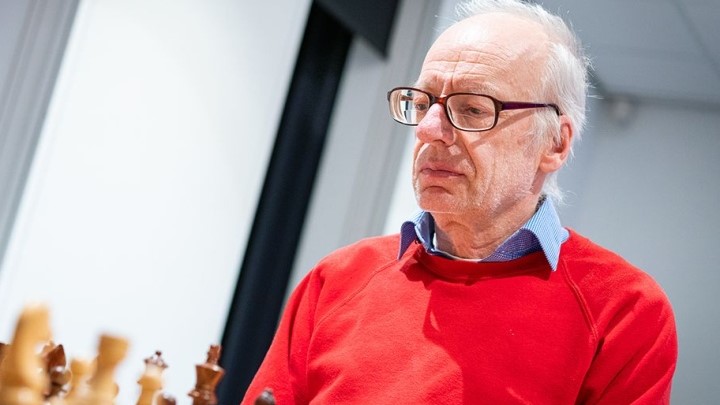
Photo above: Lennart Ootes Robert Huebner, a legendary German grandmaster, turned 75 today. Arguably the most mysterious of the top players, he has almost always been in the shadows. Meanwhile, he is a great chess player and a remarkable person. Few people remember nowadays that Huebner has qualified for the Candidates many times, from the second-place tie in Palma de Mallorca in 1970 (the young Robert, not even a GM yet, put in an excellent performance and punched his ticket to the Candidates with a round to spare, finishing behind the older Robert), to Manila 1990, where he very confidently qualified competing with a mighty new wave of chess talents. Huebner and Korchnoi in Hoogovens 1984 Photo: Fotocollectie Anefo Moreover, at his peak in 1981, Huebner was very close to reaching the title match with Karpov. He made it to the Candidates Final and grabbed the lead in a duel with Korchnoi. With 3.5-2.5 on the scoreboard, the German grandmaster had an advantage in the seventh game ending, but Korchnoi put up a stubborn resistance. On a wild goose chase, Huebner made a terrible blunder and lost. After this setback, he lost the next encounter and, having adjourned the ninth and tenth games in unpleasant positions, resigned the match. It was not the first time in his chess career. Back in 1971, after his first defeat, he forfeited the Candidates quarterfinal match against Petrosian. Throughout his entire career, Robert has been haunted by this lack of self-confidence, which strikingly contrasted with his powerful play. Huebner and Petrosian in Wijk-aan-Zee 1971 Photo: Fotocollectie Anefo In 1983, he lost a Candidates quarterfinal to Smyslov, this time on roulette (tiebreak games were played with classical time control back then, and there were no rapid and blitz games, let alone Armageddon). The match ended in a draw. The tiebreak games did not tip the balance either. It was all decided on roulette in a local casino where Huebner didn’t show up. Smyslov picked red. The ball landed on zero first. The croupier spun the wheel again, and Huebner got eliminated from the Candidates. In all fairness, the German had no real chance against Karpov and Kasparov, but he was on par with other elite players at that time. Robert nearly reached the very top being a semi-professional, as he never stopped his academic research. A graduate papyrologist and polyglot, he speaks a dozen languages, including ancient and extinct. Analyzing with Vlastimil Hort Photo: lasker-gesellschaft.de/ When it comes to annotating games, no one has ever done it as thoroughly and deeply as Huebner. He turns the analysis into scientific research, sometimes several dozen pages long. An amazing person. I had a chance to talk with Robert a little and even played one game with him, which ended in a draw. Honestly, I immediately felt his extraordinary and unique personality. It’s been a long time since we have seen Herr Robert at chess tournaments. But I’m sure he doesn’t waste any time working on something very interesting. Happy birthday, Maestro! Emil Sutovsky, FIDE CEO
Indian Triumph – Vidit and Vaishali win FIDE Grand Swiss
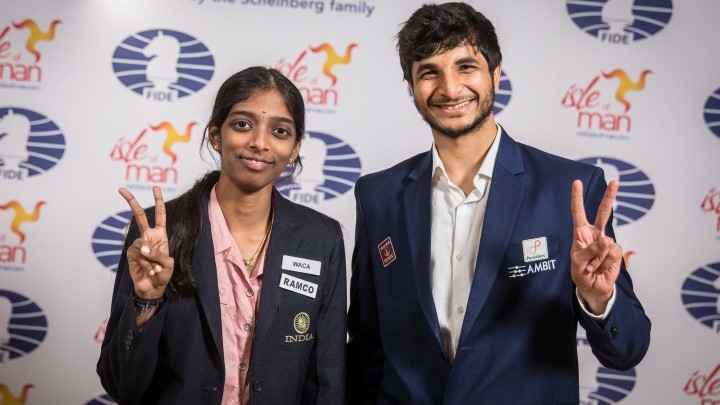
The leaders faced players who had fewer points; therefore, the pursuers had every reason to push for a win to overtake those ahead of them. These considerations manifested themselves in the opening choices on almost all boards. It is worth noting that among the trio of leaders, Andrey Esipenko had the best tie-break, followed by Hikaru Nakamura and Vidit Santosh Gujrathi. On board one, Arjun Erigaisi played 1.e4 against Hikaru Nakamura, and instead of his usual Berlin, Nakamura essayed the Kalashnikov variation in the Sicilian Defence, one of the sharpest choices in his repertoire. He varied slightly compared to his usual choice in the Kalashnikov, though. In this standard position, Nakamura had played 8…Rb8 on more than one occasion. In today’s game, he went for 8…Nf6, which is a transposition to the Sveshnikov variation where Black hasn’t played the move …b5, but rather …Be6. This is not considered optimal for Black, but it served the purpose of surprising Erigaisi, who started spending a lot of time. Nakamura’s surprise achieved its purpose, and White didn’t manage to pose serious problems. Black obtained a very comfortable middlegame with the initiative and had a half-hour advantage on the clock. In this position, Black played 17…Qe7, but placing the queen on h6 would have been more incisive, putting pressure both on the knight on e3 and, indirectly, the pawn on c2. The pawn on d6 is taboo as Rxd6 allows …Bxe3 and White loses a piece or is mated after fxe3 Qxe3. Nakamura’s choice allowed White to consolidate, but Hikaru still kept a little bit of something after he exchanged the knight on e3 and forced White to double the pawns. White shouldn’t have problems holding this position in spite of the ugly pawns on the e-file, as they restrict the mobility of Black’s knight. The queens were soon exchanged, and when Black played 33…Rb8 with the idea of …b6 to eliminate the pawns on the queenside, draw was agreed five moves later. On board two, there was an intense internal struggle visible on Vidit Santosh Gujrathi’s face as he pondered his choice on move seven. Alexandr Predke chose the solid Queen’s Gambit Declined and in the usual tabiya arising from this opening, Vidit spent 10 minutes deciding whether to go for a safety-first approach by transposing to an endgame with 7.dxc5 or to choose something else that would keep the queens on the board. After ten excruciating minutes, Vidit chose the former option. This didn’t necessarily mean that he was ready to draw, but this choice did set the calmer course of the game he wanted to play. On the other hand, playing an endgame against a ferocious attacker like Predke was perhaps not a bad idea. It turned out to be very important later on. The QGA endgame is a calm affair, so both sides comfortably finished development. Perhaps unable to control his impulses and true to his active style, Predke advanced on the kingside with 15…g5. White replied with 16.Nfd4 Nxd4 17.Bb4 (a zwischenschach to worsen the position of Black’s king) Ke8 18.Nxd4, but the position remained balanced after 18…g4. In the ensuing play, Black was a bit imprecise and allowed White to gain some momentum thanks to the maneuver Nb3-c5. Black should have eliminated the knight, and while White’s bishop pair would certainly have given him a good reason to play for a long time, but Predke would have kept decent drawing chances. Predke, again, chose the way of complications with 20…Bc6. Objectively, this move gives White an advantage, but the narrow path leading to it is incredibly well hidden. After the critical 21.Nxa6! Bf3 22.Rxd8 Kxd8 White has to find the stunning 23.h4!! (an idea that Vidit actually saw during the game!) The idea of the move is to chase away the rook from the fifth rank so the white knight can escape via c5, or in case of 23…Bxe2 24.hxg5 Nd5 24.Bc5 Bxa6 25.Bxb6 Nxb6 26.Kh2! White has better chances in the endgame as Black’s kingside is weak. Incredibly complicated and deep stuff! After 21.Nxa6 Predke didn’t go for these lines and played 21…Nd7, trying to trap the knight on a6. In the ensuing complications, White managed to keep his extra pawn and reach a technical endgame with excellent winning chances. Black cannot regain the pawn by taking on a2 because it fails to Bb5, winning the d7-knight. Vidit made most of the winning chances and in fact converted in an incredibly smooth fashion! This win brought Vidit the victory in the FIDE Grand Swiss and a spot in the Candidates tournament! It was an incredibly impressive performance by the player who lost in the first round and didn’t really believe in a comeback, but he fought every single day and was awarded for his fighting spirit. On board three, Anish Giri was very motivated to win against the leader Andrey Esipenko, as that would have given him extra FIDE Circuit points, his possible path to Toronto. However, Esipenko demonstrated excellent opening preparation to neutralise Giri’s 1.d4. Esipenko chose the Queen’s Gambit Declined, and Giri went for the Exchange variation. Then, on move eight, Esipenko played a move that on first sight, appeared like a blunder. Black’s last move was 8…c5 and after 9.dxc5 Bxc5 10.Nxd5 Nxd5 11.Rxc5 White won a pawn. Esipenko’s preparation went much deeper, and he blitzed it out until move 15. Black is a pawn down, but he has a development advantage, and in cases where players go for such lines, it means that they had analysed them to exhaustion, i.e., to a draw. However, something odd happened in this position. Giri played 16.f3, and in despite being one of the top engine’s choices, this move sent Esipenko thinking. Upon 18-minute reflection, he played 16…h5, a possible move, one of the several moves that the engines like. Then after 17.Rxb7 Esipenko spent further 34 (!) minutes and opted for a sub-optimal 17…Rd4?! instead of the correct 17…Rac8! with the threat of 18…Nd5, which offers great compensation. Giri responded with 18.Be2, and it turned out that Black didn’t have enough for the two pawns. A very strange case of suddenly forgetting one’s preparation and immediately ending up
The deadline for submitting 2028 Chess Olympiad bid approaching

On August 15, 2023, FIDE opened a bidding procedure for the 2028 Chess Olympiad. As a part of the Olympiad bid, the bidder should also hold the Chess Olympiad for People with Disabilities and FIDE Congress. The first four weeks were allocated to the expression of interest process. Potential bidders could express their interest by 6 p.m. CET on September 12, 2023. During this period, four potential organisers have come forward. As a result, the bidding process will now last 12 weeks, as per the decision of the FIDE Council. Therefore, the deadline to submit bids to office@fide.com is now set for 6 p.m. CET on November 7, 2023, which is eight weeks from September 12. Each bidding application shall be filed per the form provided in Appendix 3 to the Regulations. The Applicant shall attach the following: Letters of support from a national federation and relevant local authorities, Supporting documents (government letters, contracts, bank guarantees, etc.) at the total amount of the bid’s budget. Irrevocable guarantee issued by: a) any of the Top 100 World Banks rated on The Bankers database or another bank which may be agreed with FIDE or b) a verified government guarantee for the amount of three hundred thousand (300,000) Euros to support the bid. Additional documents may be requested by FIDE for further evaluation. The complete requirements from the organiser, including financial obligations, are determined by section 6 of the Regulations. For any relevant clarifications regarding the regulations and application requirements, the applicants are kindly asked to send a written enquiry to office@fide.com The nearest General Assembly shall award the right to host the events to the Applicant with the highest number of votes received. Regulations: Regulations for 2028 Chess Olympiad Regulations for 2028 Chess Olympiad for People with Disabilities FIDE Congress
FIDE Executive Director visits East African counties
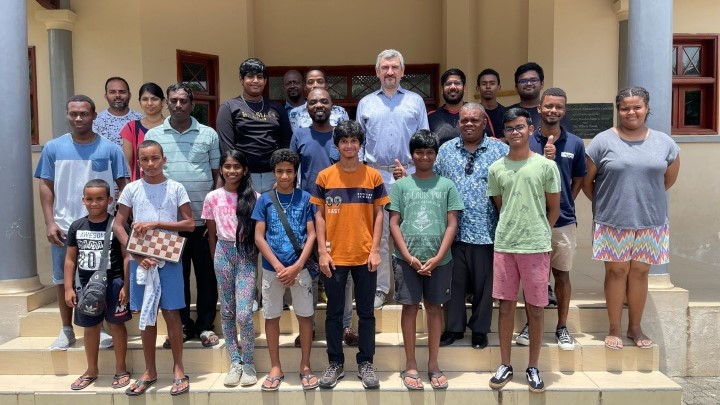
In October 2023, the Executive Director of the International Chess Federation Victor Bologan visited Madagascar, Mauritius and Seychelles, where he held several high-level meetings with local authorities and chess officials and gave simuls to enthusiasts of the game. Victor Bologan used these visits as an opportunity to discuss further chess development in the region, reiterating FIDE’s support for teaching chess in schools, social initiatives, professional chess events and increasing the level of chess among the local players. The main topics discussed during the visits also included participation in various online FIDE training programs for players, arbiters and trainers from Africa, the vital necessity of inviting at least one strong player/coach per country to help increase the overall chess level of national teams, youth, and trainers, and many others. At the meetings with local sports officials, the introduction of chess into the 2027 Indian Ocean Games and the African Games 2024 was also discussed. The first stop was Antananarivo, Madagascar, on October 18, where Bologan played a blitz tournament with local players and met the officials of the National Chess Federation. Since the country will host the Zone 4.4 championship in January 2024, the organization of this event was also discussed during the meeting. FIDE Executive Director has also visited an island Nosy Be for a chess simul and a master class for the local club players. The next stop was Mauritius Islands, where Victor Bologan met Secretary General of the Mauritius Olympic Committee Hedley Han, the Honourable Minister of Youth, Sports and Leisure of the country Stephane Toussaint, the President of the Mauritius Chess Federation Hurrynarain Bhowany, its Vice-president Patrick Li Ying and Treasurer Jay Andhin. The agenda of the visits included the discussion of various initiatives on how to promote chess on the island and in the region. Among them was an ambitious project to mix tourism and chess and to organize a circuit that includes Nosy Be (Madagascar), Mauritius and Seychelles, with an open tournament on each island, connecting it with the already existing tournament in Reunion (France). Another idea was to organize a hybrid-rated tournament for the players of the Indian Ocean countries such as Maldives, Seychelles, Comoros, Mauritius, Madagascar, Sri Lanka and Reunion (France). Following the meeting, GM Victor Bologan played simul with the 20 best players from Mauritius at the Cafe Lux, Bagatelle Mall. Gavin Anderson, the reigning Mauritian chess champion, was the only player to avoid defeat and held his game to a draw. On October 29, the FIDE Executive Director visited Seychelles, where he had a meeting with the officials of the Seychelles Olympic and Commonwealth Games Association, where they discussed the possibility of chess inclusion on the list of sports disciplines for the Indian Ocean Island Games (IOIG). After the official part of the visit, Bologan played simul with local chess enthusiasts. When asked about his impressions after the visits and the future of chess in the region, the FIDE Executive Director said: “For such small countries, the level of chess is quite decent, but of course, it can be improved. We have some examples to follow, like Iceland, where they have only 370,000 citizens but as many as seven grandmasters. I know that the federations are working hard to make progress. And the reason I am here is to see how we can help to improve the level of chess.”
A thrilling Round 3 at World Amateur Championship 2023
The third round of the World Amateur Chess Championship 2023 was held in Muscat, Sultan Qaboos Sport Complex, on November 4. The first traditional move was made by Eng Ismail Al Sawafi, Senior Manager of Public Relations and CSR at Oman LNG, the Gold sponsor of the event. The championship is gaining momentum after two rounds, with the top players trying to enhance their positions in all five categories. Some games stretched over five hours as contestants pressed for a win very hard. The Open U-1700 category saw a surprising turn of events when the top-ranked player, Sergei Inyushkin (FIDE), drew against Yemeni player Nawaf Saleh. There were plenty of exciting games, including Mongolian player Turbat Todmunkh’s victory over Paraguay Osmar and Omani Ahmed Al Rahbi’s loss to Shek Daniel of England. Turbat took the lead after the third round with a perfect score, followed by his teammate Munkhbat, Batnyam. In the Open U-2000 category, Finland player Esa Ahlqvist put in an impressive performance against the Indian player Ranjith, R.K., to win his third straight game. Sebastian Emil (FIDE) and Desandhi Dhihansa Gamage of Syria also scored victories to share the lead with Esa Ahlqvist. In the Open U-2300 category, Kazakhstani player Zhuban Bigabylov emerged on top after three rounds, scoring 3/3 alongside his compatriot Abilmansur, Mongolian players Aldar, Burentegsh and Sodbilegt, Naranbold with 3 points each. A highlight in the category was a fascinating duel between Syrian FM Malek Koniahli and Mahindrakar Indrajeet of India. This exciting game saw several nail-biting moments and ended with a draw. In the women’s category under 1700, there were several unexpected outcomes. Baldanjantsan Khuslenzaya, from Mongolia, notched up an impressive win against Arun Aditi of India and is now tied for the lead with her compatriots Bat-Amgalan Anujin and Naranbold Sodgerelt. The Chess Trainers Workshop organized by the Omani Chess Committee organized alongside the championship concluded today after three days of intensive training. Conducted by the International Arbiter / FIDE Trainer Ali Abbas of Syria and Bashir al Qadimi, the coach of the Omani national chess team, the workshop attracted 20 male and female trainers, all eager to enhance their knowledge in chess training. Round 4 of the World Amateur Chess Championship 2023 will start on November 5 at 1:00 p.m. CET. You can watch games live with expert commentaries on the Oman Chess Union YouTube channel. Text: WACC 2023 media team Photos: Entisar Nasser Al-omiiri, Hamed Al-Mabsali, Abduallah Al-Rashdi, Salma Hamood, Salem Al-Salhi FIDE World Amateur Chess Championship 2023 is organized by the Omani Chess Committee together with the International Chess Federation, with the financial support of Gold sponsors: Syool, Apollo Hospitals, Oman LNG. Bank Muscat, Otaxi, Oronamin C Drink as well as Diamond sponsors: Asyad, OMIFCO, and Oman Airport. Official website: https://worldamateur2023.fide.com/ Results and standings: https://worldamateur2023.fide.com/result/ Live games: Open U-2300chess24.com/en/watch/live-tournaments/fide-world-amateur-championship-2023-u2300#live Open U-2000: chess24.com/en/watch/live-tournaments/fide-world-amateur-championship-2023-u2000#live Open U-1700: chess24.com/en/watch/live-tournaments/fide-world-amateur-championship-2023-u1700#live Women U-1700 https://chess24.com/en/watch/live-tournaments/fide-world-amateur-championship-2023-w1700#live Live broadcast (English/Arabic): youtube.com/@Omanchesscommitteeoman
Grand Swiss: A trio of leaders after Round 10; Vaishali qualifies for Candidates
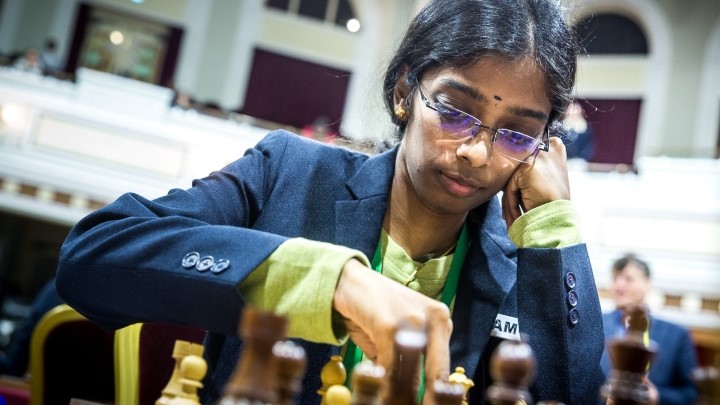
As the fight for the Candidate spots intensified, the players stepped up their efforts. A lot of decisive outcomes on the top boards mean that before the final round, the joint leaders Hikaru Nakamura, Santosh Gujrathi Vidit and Andrey Esipenko have the highest chances of both winning the tournament and securing a ticket to Toronto. In the women’s section, Vaishali R and Anna Muzychuk both won and continue to lead the tournament. The draws by the other players worked ideally for Vaishali, who punched her ticket to the Women’s Candidates with a round to spare. On board one, the all-American derby quickly went into a position with opposite-coloured bishops. They are generally an early sign of a draw, especially if they come out from a forcing line in the opening. In fact, there was a lot under the surface, and the appearances were deceiving. Hikaru Nakamura chose to transpose to the Four Knights Scotch facing Fabiano Caruana’s Petroff Defence. The Petroff was Caruana’s fireproof defence in 2018 when he used it to great effect to win the Candidates tournament and later easily hold against 1.e4 in the World Championship match against Magnus Carlsen. Nakamura’s choice, the Four Knights Scotch, is an often-used drawing line for two reasons: it leads to relatively simple positions that are easy to play; it is incredibly deeply explored, some lines leading to forced draws. However, Nakamura’s strategy in the opening was cunning. It had two layers: if his opponent remembered the most precise way to deal with the opening surprise, then a quick and energy-saving draw would be made. But if his opponent failed to do so, then he would obtain a risk-free pressure with a very likely time advantage to boot. As the game showed, it was the second possibility that happened. The moment that decided the course of the game was after White’s 12.Rd1 Caruana spent some time recalling his lines and went for the simplifying 12…Bxc3 13.bxc3 Qa5. He could have kept the position more complex with 12…Qe7, but perhaps he thought Nakamura didn’t mind a quick draw (see the first possibility explained above)? He may have been right in his assumption, but that required precision later on. As they followed an obscure game played between engines, Caruana committed a mistake that sent the game from a likely possibility number one to a definite possibility number two. The engine playing with the black pieces chose 18…Rab8, while 18…Rac8 and 18…f6 were also good moves. Caruana played 18…h6? and after 19.Bf4, he was already under severe pressure. His appearance at the board showed great concern about the position. After a further mistake with 19…Re7? (19…Rad8 was best, but even that is hanging by a thread after 20.Be5) White was on the verge of winning after 20.Re1, as Black cannot really defend the pawn on e4. Add to this that Hikaru had more than half an hour advantage on the clock, and you see the triumph of Nakamura’s opening preparation. Nakamura started to think at this point, and while he didn’t play the absolutely best move 20.Re1, he did make the second-best move in the position 20.Qe3, a tempting option that introduces ideas like Bxh6. That sacrifice happened later in the game, and coupled with the doubling on the d-file it also gave White a decisive advantage. With only eight minutes for 16 moves and his position on the edge of collapse, Black’s situation was not enviable. White continued with 28.Qh4, and soon enough, the attack on Black’s king forced Black to enter a lost endgame. Black’s rook is hanging, but there is also the threat of Re8 followed by Qg7 mate, so Black was forced to play 31…Qf4, and after the exchange of queens followed by Bg7xf6, White entered a technically winning endgame. Unlike yesterday, Nakamura didn’t allow any chances and won in 40 moves. It was an unusual game between elite players when one of them suffered an opening catastrophe. On the other hand, Nakamura won in an identical fashion against the same opponent in the last round of the Norway Chess last June. On board two Bogdan-Daniel Deac might have been surprised by Vidit Santosh Gujrathi’s choice of the Sicilian after 1.e4. The reasoning is that both players have had an excellent tournament, so as the end draws closer (no pun intended), it makes sense to play more solidly and preserve what has been achieved. White didn’t go for the open Sicilian and chose the Moscow Variation with 3.Bb5, which was met by the most complex reply 3…Nd7, keeping all pieces on the board. Both the Sicilian and the choice of 3…Nd7 indicated Vidit’s aggressive intentions for this game. Curiously enough, the position eventually took the shape of Najdorf. In line with his aggressive mood, Black transferred the knight from c5 via e6 to f4 and then launched a kingside expansion with …g5. This put White under pressure. White could have played the calm 17.Be2, avoiding the attack with …g4, though Black remains the active side. His 17.Bd2?! lost a pawn to the pretty tactic 17…g4! 18.Be2 Bxe4! With the point that 18.Nxe4 N6d5 pesters the white queen as she can no longer protect the bishop on e2. White continued with 19.Nf6, but after 19…Bxf6 Black was a sound pawn up. Vidit gradually improved his position while White dug deeply to resist on the kingside. Time trouble also became a factor. Playing on his last seconds, Deac stirred up trouble on the kingside with 34.h3. Objectively, this isn’t very good, but White didn’t want to just sit and wait while Black was making further progress. After 34…gxh3 35.Qxh5 Nf6 36.Qe2 Rd4 Black was still in control and remained so when they reached the time control. White’s last hope was that perhaps he could round up the pawn on h3 but it was dashed by Vidit’s energetic play. On board three Andrey Esipenko chose his favourite Catalan against Parham Maghsoodloo. Still, it was Black who chose a rare early on with 7…h6. Moving the h-pawn is generally useful for Black, controlling the g5-square and waiting to see how White continues with development. White chose the standard development with 8.Qc2 and 10.Bf4 and Black went down a line
Gunpowder fireworks in Round 9 of FIDE Grand Swiss
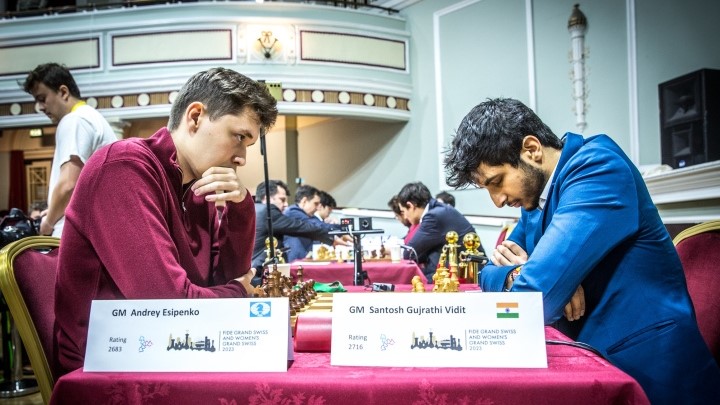
The ninth round of the FIDE Grand Swiss started earlier than usual because of the planned celebration with loud music and fireworks of the Gunpowder Plot. Most of the players were in a fighting mood, but chances were missed left and right. Fabiano Caruana messed up the opening and risked losing against Bogdan-Daniel Deac. Hikaru Nakamura needed two mistakes by Ivan Cheparinov to win a technically winning position. Parham Maghsoodloo beat Alexey Sarana to join the five other players in the lead with 6.5 points. In the women’s section, Rameshbabu Vaishali topped Antoaneta Stefanova with the black pieces to emerge as the sole leader with 7 points, ahead of Anna Muzychuk and Tan Zhongyi with 6.5 points. Round nine started three hours earlier than usual for the open section and an hour and a half earlier for the women’s section. The reason for this was the planned firework celebrations for the commemoration of the Gunpowder Plot – an attempt by Guy Fawkes to blow up the Parliament and kill King James I on 5 November 1605. Fortunately, this plot failed, so in Britain, its failure is celebrated by big fireworks. At 6:30 pm, fireworks and loud music were planned to take place some 150 meters from the Villa Marina, so in order not to affect the players, the organisation decided to move the round earlier. It is not easy to adapt to changes in the usual routine, and this particularly applies to chess players, who like to have their days as predictable as possible. The brain gets used to hard work at certain hours, and then suddenly shifting this time to an earlier hour may result in the brain protesting and not functioning at optimal capacity. Be that as it may, the players were at their boards at 11:30 am, and the round started without anybody being late. A crow that somehow found its way inside the venue celebrated this punctuality with loud caws for several minutes before seeing itself outside in the sunny weather. On board one, Fabiano Caruana used a rare idea in the Giuoco Piano against Bogdan-Daniel Deac. It has been employed only once before, in a correspondence game played in 2020. White usually plays 12.a4 in this position, but Caruana went for 12.Bd5!? instead, immediately using the fact that Black’s knight is no longer on f6 controlling the d5-square. The idea of the bishop move is to allow for the Nc4-e3 maneuver to target the weakened f5-square. This move set Deac thinking, but despite that, the opponents followed the correspondence game Muljadi – Burgarth until move 16, when Deac deviated by castling short. Whether it was because of the early starting hour or not, Caruana forgot his preparation and immediately ended up in a dangerous position. The position required concrete actions – 17.Nf5 Qf6 18.d4 with an unclear position. Caruana played the slow 17.a4? and after 17…g4! 18.hxg4 hxg4 19.Nh2 Qg5 was in real trouble. He pursued his queenside activity with 20.b5, and here, Black missed a golden opportunity. Bogdan-Daniel played the natural 20…Na5, and after the queen retreated to c2 he won a pawn by taking on e3 twice. However, Black could have played the very strong 20…Nf4! which would have given him a big advantage. The point of the move is that it doesn’t really sacrifice a piece because Black has …Ne2xg3 with checks when the knight on e3 is lost. After Black won a pawn, White exchanged queens and obtained sufficient compensation for the pawn in the form of his better pieces and control over the f-file. White threatens with Ne3, transferring the knight to an excellent square, where it targets the pawn on g4 and controls the f5-square. Caruana used his activity to regain the pawn and a draw was reached after 43 moves. On board two, Vidit Santosh Gujrathi chose a popular line against Andrey Esipenko’s Ruy Lopez. In this line, White defends the e4-pawn with d3, saves his bishop from an exchange by playing a3 and develops the queen’s knight on c3. Esipenko chose a variation where he exchanged the light-squared bishops, and soon enough, the players could have repeated moves. Many games were here with the repetition 15.Bg5 Ng4 (or 15…Nd7) 16.Bd2 Nf6, but Vidit decided to continue the game with 15.Re1. The ensuing play unfolded on the queenside, where the a and b pawns were exchanged. The open files gave White some initiative, but Black remained solid. Without weaknesses on either side White’s control over the open files on the queenside can bring little. After the queens, one pair of rooks and the bishops were traded, a draw was agreed on move 37. On board three, Hikaru Nakamura confidently played 1.e4 against Ivan Cheparinov, which was met by the Petroff Defence, a recent addition to Ivan’s repertoire. After the standard moves, Nakamura opted for the sideline 5.c4, aimed at reaching the usual Petroff positions by avoiding the main theoretical lines after the more usual 5.d4 d5 6.Bd3. Even in a sideline, Cheparinov was well prepared and obtained a good middlegame position as both players finished development. White’s IQP gave him a space advantage and free-piece play, while Black achieved smooth development, leading to a dynamically balanced middlegame. The decisive moment in the game came relatively early. After 10 minutes of thinking, Cheparinov went for the pawn sacrifice 17…Nf5? instead of the composed 17…Rb8 or 17…Qd6 (intending to meet 18.Bxd6 with 18…cxd6) defending the attacked pawn on b7. As it turned out, the sacrifice was not sound. After only three minutes, Nakamura picked up the pawn for nothing with 18.Nxb7 Qd5 19.Nc5. Perhaps what Cheparinov missed was that here 19…Bxc5 fails to 20.Re5! and White retains his extra pawn. Further exchanges followed, and by move 30, White had a technically winning position. Nakamura is usually flawless when converting material advantage, and up to a certain point, that was the case in this game, too. However, on move 36 an interesting moment arose. You wouldn’t expect it in this situation that White has only one (!) move to keep the winning advantage, but that was the case here. The move in case
Caruana misses a Tal-like combination, but still wins in Round 8 of FIDE Grand Swiss
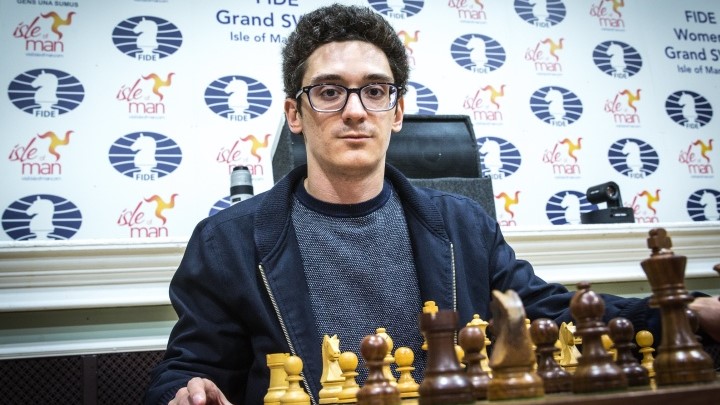
The leader Vidit Gujrathi drew his game against HikaruNakamura and allowed Bogdan-Daniel Deac, Fabiano Caruana and Andrey Esipenko to join him in the lead. The chasing pack consists of 11 players sitting half a point behind the leaders. In the women’s section, all three leaders, Antoaneta Stefanova, Anna Muzychuk and Rameshbabu Vaishali, drew, maintaining the lead ahead of Sophie Milliet, Leya Garifullina, Tan Zhongyi and Batkhuyag Munguntuul. On board one, the leader Vidit Santosh Gujrathi met Hikaru Nakamura’s Sicilian with the latter’s preference – the Alapin Variation. The Alapin is considered a very safe choice for White, especially in the lines where White doesn’t allow the creation of an isolated queen’s pawn (IQP) on d4. Usually, a typical situation arises where White has three pawns versus two on the queenside while Black has four pawns versus three on the kingside. These positions are slightly easier to play for White because his queenside majority is easier to move forward. Nakamura deviated from his choice against Raunak Sadhwani from the second round, where he went for the more fighting option of the fianchetto of the dark-squared bishop. Today, he went for the more conservative development with …e6 and slightly deviated from a previous game of his (where he took 6…cxd4) in favour of the move 6…Qd8, recently also played by Magnus Carlsen. This deviation set Vidit thinking for 35 minutes (!). As he said after the game, this was an attempt to figure out the possible move-order transpositions and the best way to continue. Eventually, he went for 7.Nc4, the most commonly played move in the position. The critical position arose on move 10. Here, White had a promising plan of 10.Qe2 followed by Nce5, h4, Ng5, possibly 0-0-0, Rh3-g3, etc., with a dangerous initiative. In the post-mortem, the players couldn’t find a satisfactory set-up for Black. When asked, Vidit said he was sorry he didn’t go for this, and the reason was that he “misevaluated the position.” He went for 10.a4, and then a short castle, but a move repetition after …Nh5, Be3 Nhf6, Bf4 Nh5 ended the game in a draw. On board two Fabiano Caruana used a relatively forgotten line against Etienne Bacrot’s Taimanov Sicilian. After choosing the line with 6.Be3 a6 Caruana played the move 7.a3, which for some time in the 1960s was a favourite of Mikhail Tal. The idea of the move is to prevent the typical Taimanov pin with …Bb4, thus allowing for a more aggressive set-up with f4, Qf3, etc. This is how Tal used to play when Black replied with 7…Nf6. Bacrot chose the more direct 7…b5, intending …Bb7 with quick queenside development while at the same time having in reserve the …b4 push. White exchanged on c6 and continued with the development of the kingside with Be2 and 0-0. As is his habit, Bacrot started spending a lot of time, and by move 13, he had 35 minutes less than his opponent while the engine wasn’t thrilled with his position. White continued forcefully, and after exchanging, the dark-squared bishops started to pile up pressure on the backward d7-pawn. In order to get rid of this pressure, Black pushed …d5, but this led to the creation of an IQP on d5. In addition to another isolated pawn on a6, White had a solid advantage. What made things worse for Black was that the position was very one-sided, and he had no counterplay. Caruana increased his advantage, but in spite of the position being safely in his favour, it wasn’t easy to find a breakthrough. He missed a deeply concealed one on move 31. Caruana played 32.Qb2 and after 32…Rc8, the worst was behind Black. The winning move was 32.Qa1!! with the deep idea of c4 and Nh5. It is very difficult to see an attack both on the queenside (the bishop on b5) and the kingside (the mating threat on g7 after the rook leaves the d4-square). It takes a lot of imagination to discover a move like Qa1, something the Great Wizard of Riga had in abundance. Unfortunately, playing Tal’s variation in the opening wasn’t enough for Caruana to complete the full circle and play like Tal the whole game. The lines are not easy to calculate but had Caruana spotted the idea, he would undoubtedly have seen the lines, too. After missing this chance, Caruana couldn’t do much against Bacrot’s precise defence, and the game was heading to a draw. However, Bacrot’s time trouble cost him the most important half a point. Black’s position is exposed, but he can still draw after 55…Rb3. In the game he played 55…Nc6? which after 56.Nxc6 Rxc6 57.Ra5! forced a winning rook endgame for White. After the exchange on a5, White placed a rook behind the passed a-pawn, and Bacrot resigned. On board three Andrey Esipenko had some “compensation” for being caught in the opening yesterday, as today he did the same with Vincent Keymer in some sharp preparation in the Reti Opening, at least judging by the time both players spent on their first 19 moves. Keymer opted for the early advance of the d-pawn, a line that became popular after Magnus Carlsen used this type of development in his match against Ian Nepomniachtchi in game nine of their match in Dubai in 2021, a game that Carlsen won. In this position, the automatic recapture on d4 with the pawn would lead to calmer play, but Keymer went for the engine’s preferred line of 7…e4, which was met by the engine’s second choice of 8.d5. White sacrificed material to obtain strong central pawns on d5 and e5. Keymer started spending a lot of time on his moves (for example, his 11th move took him almost 20 minutes) while Esipenko continued to play a-tempo. The curious thing was that both players followed the engine’s best line, a clear indication that they had analysed this before, with the difference that Esipenko had revised his notes before the game while Keymer was trying to remember his. Here the engine suggests chipping away at White’s centre by 18…c6 (or 18…Kd7 and then …c6), but after 13 minutes of