

FIDE World Amateur Championship 2023 kicks off in Muscat, Oman
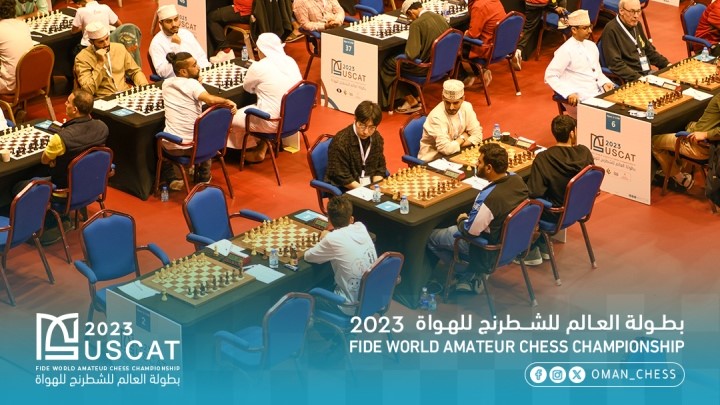
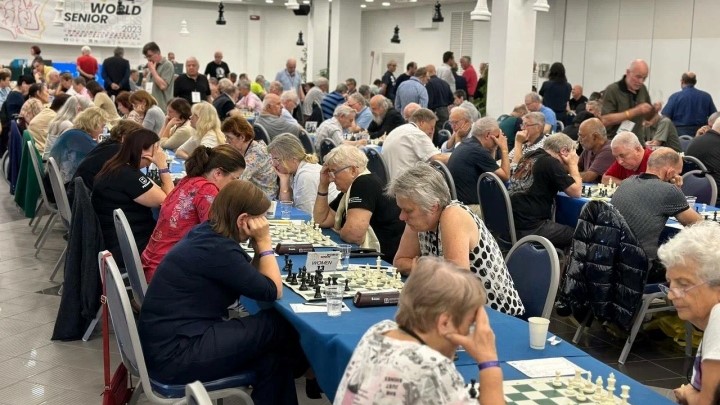
The World Amateur Chess Championship 2023 officially commenced on Thursday evening in Muscat, marking the beginning of an exciting competition that brought together amateur chess players from around the globe. Organized by the Omani Chess Committee, in partnership with the International Chess Federation, the championship runs from November 2 to November 11 in the main sports hall at the Sultan Qaboos Sports Complex in Bawshar. During a technical meeting on Thursday morning, the essential modifications to the rules and the playing system were discussed and clarified. These changes aim to enhance the competitiveness and fairness of the championship. Mahdi Abdulrahim, a distinguished member of the International Chess Federation, offered valuable insights into the rules and regulations that players must adhere to while inside the playing hall. The championship will also rigorously enforce fair play and time control measures in accordance with the FIDE rules and regulations. The championship is held in five categories: U2300 Open, U2000 Open and U1700 Open, U2000 Women and U1700 Women. All five competitions are 9-round Swiss tournaments with classical time control. Each championship day starts opening move at 4 PM. Ozgur Solakoglu, FIDE Technical Delegate and Honorary Chair of the FIDE Events Commission expressed his pleasure of being a part of the World Amateur Chess Championship, with over 400 players hailing from as many as 64 different countries. He emphasized that this remarkable turnout might be a historic record for the World Championship, giving the event status of a truly global competition. Mr Solakoglu also praised the favourable conditions and the absence of any complaints from the players. He expressed hope for a successful and competitive tournament and commended special trips for the players to explore the unique attractions of Muscat, enhancing their tournament experience. He concluded by stressing the vital role of amateur tournaments in the world of chess, as they form the foundation of the sport and provide a platform for the countless amateur players worldwide to engage with chess and foster the game’s growth and visibility. The first round of the championship was honoured by the presence of His Excellency Mr Said bin Sultan al Busaidi, the Undersecretary of the Ministry of Culture, Sports, and Youth for Culture, who made the first ceremonial move together with the President of the Oman Chess Committee Mr Ahmed Al Bulushi. Official website: worldamateur2023.fide.com/ Pairing and results: worldamateur2023.fide.com/result/ Live games: Open U-2300chess24.com/en/watch/live-tournaments/fide-world-amateur-championship-2023-u2300#live Open U-2000: chess24.com/en/watch/live-tournaments/fide-world-amateur-championship-2023-u2000#live Open U-1700: chess24.com/en/watch/live-tournaments/fide-world-amateur-championship-2023-u1700#live Women U-1700 https://chess24.com/en/watch/live-tournaments/fide-world-amateur-championship-2023-w1700#live Live broadcast (English/Arabic): youtube.com/@Omanchesscommitteeoman Text and photo: WACC 2023 media team
FIDE November 2023 rating list published
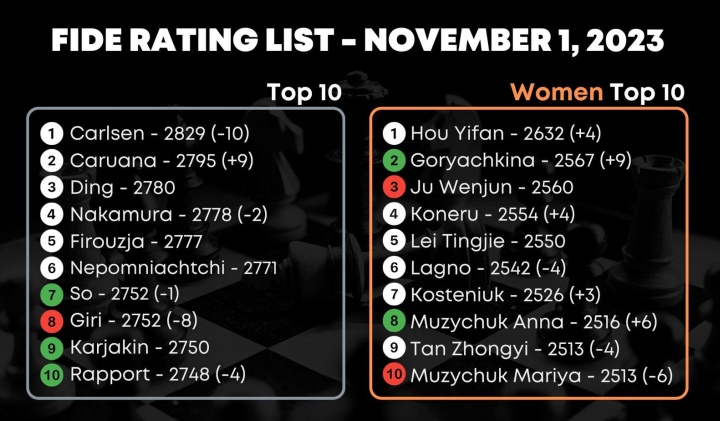
The November 2023 FIDE rating list was primarily impacted by the U.S. Championships, the European Club Cup, the 19th Asian Games Chess Team Competitions and the Qatar Masters. Fabiano Caruana consolidated his second position in the top 10 open after winning his second straight U.S. Championship title and picking 9 rating points, while Wesley So dropped one point despite finishing second but still moved three positions up in the top 10. Photo: Crystal Fuller | Saint Louis Chess Club After a long pause, women’s #1 Hou Yifan played nine classical games in the 19th Asian Games and earned four points – her first standard rating increase since December 2019. Biggest gains in top 100 Open and Women Yakubboev, Nodirbek GM 2643 (+28) Yip, Carissa IM 2399 (+27) Maghsoodloo, Parham GM 2732 (+25) Sindarov, Javokhir GM 2681 (+23) Tokhirjonova, Gulrukhbegim WGM 2370 (+20) Nurmanova, Alua WIM 2367 (+20) Vaishali, Rameshbabu IM 2467 (+19) Lee, Alice FM 2406 (+18) Artemiev, Vladislav GM 2714 (+17) Narayanan S L GM 2668 (+17) Nodirbek Yakubboev (pictured below) triumphantly returned to the top 100 Open after a 10-month absence following his solid performance at the 19th Asian Games (+9) surprising victory in Qatar Masters (+18) and won this nomination. Photo: Qatar Masters His teammate Javokhir Sindarov also did a great job in these two competitions (tying for third in Qatar), translating into 23 rating points. India’s Narayan also became one of the rating beneficiaries in Qatar. Three young players who made it to the podium of the U.S. Women’s Championship – the champion Carissa Yip (+27), the runner-up Gulrukhbegim Tokhirjonova (+20) and the bronze winner Alice Lee (+20) – substantially increased their rating with Alice reaching her career-high. Photo: Lennart Ootes | Saint Louis Chess Club Parham Maghsoodloo (pictured below) led team Iran to the gold medals at the 19th Asian Games, scoring a spectacular 7.5/9 on the first board. Coupled with a solid showing in the Qatar Open and Bundesliga, these results brought him 25 rating points, signifying his return to the 2700+ elite group. Photo: Niki Riga Alua Nurmanova underperformed in the 19th Asian Games (-11) but made up for this rating loss in the Qatar Open, where she gained an impressive 31 points. The same applies to Rameshbabu Vaishali, who netted a mere 0.1 points in the team competition but added 18.8 points to her tally in Qatar and completed her final GM norm along the way.
Nakamura invokes Fischer’s spirit in Round 7 of FIDE Grand Swiss
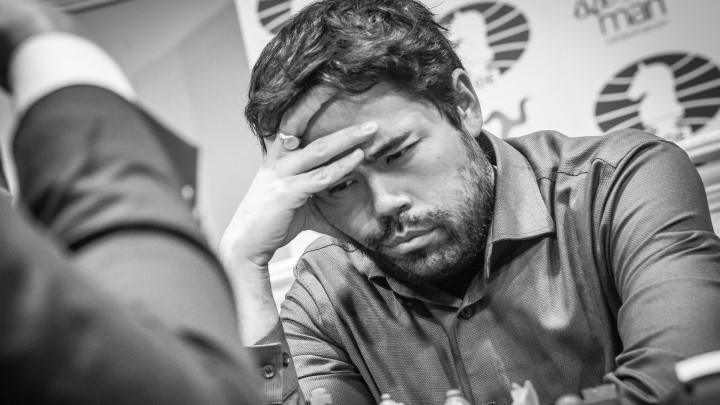
The number of draws on the top boards doesn’t tell the whole story of hard-fought games, with plenty of interesting opening ideas and spectacular sacrifices. Fabiano Caruana essayed a rare move in the Semi-Slav tabiya, while Hikaru Nakamura hoped for inspiration by employing Bobby Fischer’s favourite variation against the Sicilian Defence. Santosh Gujrathi Vidit spotted an incredible tactical shot to beat Javokhir Sindarov and emerge as the sole leader as his friend Arjun Erigaisi couldn’t break Andrey Esipenko’s defence in an epic battle that lasted for 90 moves. In the women’s section, the draw on board one between Aleksandra Goryachkina and Anna Muzychuk meant that victories by Rameshbabu Vaishali and Antoaneta Stefanova (against Bibisara Assaubayeva and Mariya Muzychuk, respectively) allowed them to join the lead to form a trio at the top. The opening surprises were in no short supply on the top boards in Round 7 of the FIDE Grand Swiss. On board one, Radoslaw Wojtaszek played Fabiano Caruana and, just like in his round four game against Anish Giri, faced an opening he prepared together with Anand’s team in 2008 for the match against Vladimir Kramnik. In that match, the Semi-Slav (and the subsequent Meran) was Anand’s main defence against 1.d4, bringing two invaluable victories on the way to winning the title. Caruana doesn’t play the Semi-Slav often, so his choice was aimed at forcing his opponent to recall lines he hadn’t looked at in his pre-game preparation. The Semi-Slav is a fighting choice, so Caruana showed his aggressive intentions early on. He also introduced an early twist. In the tabiya of the Semi-Slav, Caruana went for a less common move. In this position, the most common move for Black is 8…dxc4 (played by Anand many times, where he demonstrated several ideas from their preparation), but there are also moves like 8…e5, 8…h6 or 8…Qe7. Caruana played 8…Re8, the move recently employed by the young talents Samuel Sevian and Mittal Aditya. Wojtaszek likes to think, and this move gave him something to mull over. He followed the theoretical path, but by move 14, Caruana had a 40-minute advantage on the clock. In addition to that, he also introduced a novelty on that very move. There are several computer games from this position, and in all of them, Black played 14…Bc7, but Caruana preferred 14…Nge5. After the exchange of knights, Wojtaszek retreated the bishop to e2. Needless to say, Caruana was still well into his preparation as Wojtaszek had less than an hour to reach move 40. The ensuing middlegame was balanced. White advanced his central majority with f4 and e5, to which Black replied with …f6-f5, establishing a blockade on the e6-square. At first sight, it may appear that the protected passed pawn gives White a solid advantage, but in fact, this blockade, which can also happen from some lines of the Berlin, is known to effectively neutralize White’s extra pawn on that side of the board. Here’s an illustration of Black’s blockade. White cannot make any progress. The queens were exchanged, and then Black advanced with his own pawn majority. Fabiano made certain progress and even managed to exchange his a-pawn for White’s b-pawn, thus creating a passed pawn on the c-file. He advanced this pawn as far as c3, but this still wasn’t enough to tip the balance. The following position was reached after Black’s 60th move. Draw was agreed one move later. On board two, Hikaru Nakamura faced the Four Knights Sicilian against Alexandr Predke. This variation, which arises after 1.e4 c5 2.Nf3 e6 3.d4 cxd4 4.Nxd4 Nf6 5.Nc3 Nc6 has become very popular for several reasons: one is that it allows Black to avoid the Rossolimo by playing 2…e6, and the second is that after 6.Ndb5 Black can choose between the Sveshnikov Sicilian with 6…d6 7.Bf4 e5 8.Bg5 a6 or the very safe line 6…Bb4, third is that the complications after 6.Nxc6 bxc6 7.e5 Nd5 works nicely for Black. Therefore, it’s not a surprise that many players have chosen to avoid all of the above with moves like 6.Be2 or 6.a3, the latter one chosen by Nakamura. The little pawn move stops the pin with …Bb4, but this tempo allows Black to transpose to the Scheveningen setup where the move a3 isn’t strictly necessary. Nakamura’s twist came two moves later. Instead of the usual Scheveningen setup with 8.Be2 Hikaru chose the Sozin Attack with 8.Bc4. The Sozin was a fearsome weapon of the great Bobby Fischer. He was attracted to it because of the simple and straight-forward positional idea – White’s bishop on the a2-g8 diagonal is blunted by the pawn on e6, so White simply plays f4-f5 to attack that pawn, and in case of …e5, the diagonal for the bishop is opened and the bishop becomes a very strong piece. Modern theory hasn’t been kind to the Sozin Attack, as reliable defensive methods for Black have been found. Even Fischer gave up on it after the fourth game in his match with Spassky in Reykjavik in 1972 when Spassky countered it in a very effective fashion. And yet, here we are in 2023, and we see another American resurrect the fearsome weapon of his predecessor. Fischer had a lot of quick wins in his pet line by employing the f4-f5 advance and then using the weakened d5-square for his pieces. This was mostly because his opponents didn’t know how to react to this plan. Nowadays, Black players know what to do, and Predke wasn’t an exception. While White did take control over the d5-square, he had to give up something in return – in this case, the dark-squared bishop. Black obtained an excellent position thanks to his control of the dark squares, with the dominant bishop on e5 being the key piece. After White took the pawn on b7, Black responded with …Rb8 and took on b2. The position was heading to mass simplifications and a draw, but inaccuracies crept into Predke’s moves, and somewhat unexpectedly, White won a pawn. White didn’t really have realistic winning chances, but a pawn is a
FIDE Infinite Chess project for children with ASD keeps growing
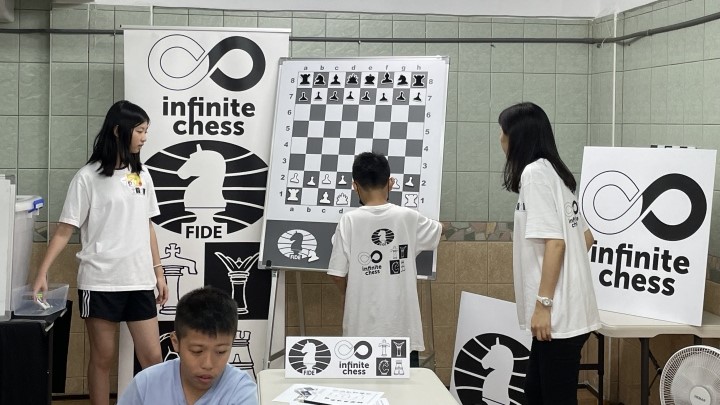
The FIDE Infinite Chess project, aimed to teach chess to children with autism spectrum disorder (ASD), continues to expand throughout the world. Spearheaded by Anastasia Sorokina, Chair of the FIDE Commission for Women’s Chess, a pilot project was launched in January 2021 in six countries: Spain, Turkey, France, Gibraltar, South Africa and Norway. Currently, it is already running in 12 countries – Albania, Cyprus, France, Gibraltar, Latvia, Malaysia, Mongolia, Morocco, South Africa, Spain, Taiwan, and Turkey – and involves 130 children with ASD. Three new partners – New Zealand, Maldives and India – have joined the project in October 2023. From September to December 2023, “Infinite Chess“ students will attend 17 lessons in groups with ASD children only or in inclusive mixed groups. The classrooms are equipped according to FIDE Infinite Chess guidelines. With the support of the International Olympic Committee, the program is planned to be launched in African and American regions. Pre-launch activities are now underway in Brazil, Puerto Rico, Nigeria and Botswana, where the first chess classes will be held there this winter. In November 2023, the 4th FIDE Educational Seminar of Infinite Chess Project, “Chess for children with an autism spectrum disorder. Learn and teach”, will be held. It aims to provide core knowledge and practical advice to teachers, trainers, and parents who wish to teach chess to kids with Autistic Spectrum Disorder. The “Infinite Chess” training program for teaching chess to children with autistic spectrum disorder (ASD) is available in several languages — English, French, Spanish, and Russian. Recently, it has been translated into Arabic language and published on the project’s website. The list of activities planned for this year also includes the Social Project Conference in Paris, France (December 06-09, 2023) and the educational seminar for teachers in Dubai, UAE, in cooperation with the FIDE Trainers’ Commission and the Asian Chess Federation (December 18). To learn more about the initiative, visit its official webpage: infinitechess.fide.com
World Senior Championship 2023 passes midpoint
It is the halftime at the World Senior Chess Championship 2023, here at Terrasini, and the participants are enjoying the day off. After visiting the beautiful city of Palermo the players are getting ready to continue battles for the titles in second half of the tournament, starting on November 1. In the meantime, let’s check out the results and standings of the WSCC 2023. After Round 6, in the Open 50+ category GMs Ivan Morovic Fernandez (CHI; pictured below), GM Suat Atalik (SRB), GM Michael Adams (ENG) and GM Artashes Minasian (ARM) are tied for the top position, each scoring 5/6. Six players, GM Maxim Novik (LTU), GM Darcy Lima (BRA), GM Klauss Bischoff (GER), GM Hannes Stefansson (ISL), the defending champion GM Zurab Sturua (GEO) and IM Uffe Vinter-Schou (DEN), are trailing the leaders by just a half-point. In the Open 65+ category, the defending champion GM John Nunn of England (pictured below) is leading the race with 5.5 points after 6 games (the highest score in the event so far). Following him, there are 5 players, sitting on 5 points: GM Nikolay Legky (FRA), FM Ole Christian Moen (NOR), GM Daniel Campora (ARG), IM Jan Rooze (BEL) and FM Terry Chapman (ENG). In the Women category, WGM Galina Strutinskaia (FIDE; pictured below) tops the standings after six rounds with 5 points, followed by two players with 4.5 points each: WIM Sopio Tereladze (GEO) and WGM Marina Makropoulou (GRE). Some facts and figures: A total of 271 players participate (including 133 titled players), representing 53 federations and 32 women players – 11% of the total number of participants 11% of all players represent the hosting federation (Italy) Standings after Round 6: Open 50+Open 65+Women Photos: Denis Burko Official website: worldseniorchess2023.com/
World Amateur Championship 2023 set to commence in Oman
World Amateur Chess Championship 2023 is about to kick off in the Sultanate of Oman. The World Amateur Chess Championship 2023 is set to commence on Thursday, November 2. Hosted by the Sultanate of Oman, represented by the Oman Chess Committee (OCC), the competition will be held in the Sultan Qaboos Sports Complex in Bausher from November 1 to 11. The championship attracted 427 players from 64 countries, including 356 male players and 71 female players. The first round of the championship will begin on November 2 under the auspices of Said bin Sultan al Busaidi, Undersecretary for Culture at the Ministry of Culture, Sports and Youth. The OCC revealed its readiness from all organizational, technical, and administrative standpoints to host the World Amateur Chess Championship 2023. This announcement was made during a press conference held at the Sultan Qaboos Sports Complex, attended by OCC Chairman Ahmed bin Darwish al Balushi and various media outlets. Ahmed al Balushi stressed the committee’s commitment to creating an unforgettable experience for participants and spectators alike. He emphasized that partners and CEOs of sponsoring companies will sponsor the initial rounds of the championship. The presidents of Arab, Asian, and International Chess federations will arrive in Muscat during the tournament, Al Balushi said. The OCC chief disclosed that an array of special activities and tours had been meticulously designed to help participants explore the attractions of the Sultanate. These initiatives include an international coaching course conducted throughout the championship. Furthermore, there will be daily activities tailored for schools and children in the morning to attract approximately 100 children daily and promote their interest in chess. The championship will receive comprehensive coverage, both from local media and through live broadcasts on several official channels, including the International Chess Federation channel. To enhance the coverage of the championship and audience involvement, a dedicated YouTube channel has been launched. This channel will feature commentating in Arabic and English, as well as technical experts and trainers from various teams to analyze the games daily and highlight the action on top boards. Elaborating on the championship’s format, Al Balushi said it would be a 9-round Swiss tournament with classical time control (90 minutes + 30-second increment). Alongside the main event, the OCC will host the School Chess Festival on November 2 in cooperation with the Oman School Sports Association. This festival targets more than 1,000 male and female students from first-grade classes representing nine educational directorates in various governorates, including Al Dakhiliyah, Al Dhahirah, Al Buraimi, Dhofar, South Al Sharqiyah, North Al Sharqiyah, Muscat, and North Al Batinah. The festival will be held at the directorate level, aiming to enhance national loyalty while encouraging chess practice for improving developmental and cognitive skills in students, stimulating creative and innovative thinking and promoting a different and distinctive way of thinking. The festival in the governorates will include various accompanying events, including face painting, children’s favourite performances, visual displays, plays, student shows and diverse competitions, all with the aim of introducing chess in a unique way. THREE CATEGORIES The competitions in the World Amateur Chess Championship will be held in three sections. In the ‘1700’ rating category, 270 players, including 210 male players, are participating. In the ‘2000’ rating category, 74 players, including 96 male players, are taking part. In the ‘2300’ rating category, 74 players, including 69 male players, will compete. The extensive participation highlights Oman’s reputation in hosting tournaments, and it reflects the vast interest and importance of the championship. As for the participating countries, according to Al Balushi, 64 are taking part, including Algeria, Argentina, Azerbaijan, Brazil, Bahrain, Belgium, China, Chile, Croatia, Cyprus, Czech Republic, Egypt, England, Spain, Finland, France, Germany, Hungary, Indonesia, India, Iran, Iraq, Italy, Jamaica, Jordan, Japan, Kazakhstan, Saudi Arabia, Kuwait, Libya, Lebanon, Lithuania, Morocco, Malaysia, Maldives, Mexico, Paraguay, Peru, Philippines, Palestine, Mongolia, Pakistan, Poland, Qatar, Romania, Singapore, Sri Lanka, Sudan, Slovakia, Sweden, Syria, Taiwan, Turkey, the United Arab Emirates, Uganda, Ukraine, the United States, Uzbekistan, Yemen, Zimbabwe, Kenya, Kyrgyzstan, and the Sultanate of Oman. Through hosting this championship, the OCC aims to enhance the chess community in the country by attracting more players and arbiters and encouraging new clubs to join. They also aim to raise the international ranking of some of their players, contributing to the development and growth of chess in Oman. The Oman Chess Committee is making every effort to provide a unique experience for participants and the audience and to strengthen its position as a leading global sports destination in the world of chess. Hosting the championship in Oman is a culmination of the efforts made by OCC. It reflects the confidence of the International Chess Federation in the capabilities of the OCC to organize and succeed in this global championship. The competition is officiated by 19 international arbiters, headed by the Malaysian Abdul Hamid bin Abdul Majeed. The Omani international, Muslim al Wadhahi, was also appointed as the deputy chairman of the Arbiters Committee. The committee includes the Iranian Mehrdad as the coordination officer, in addition to members Babrzhan from Kazakhstan, Ahmed Ajmi from Egypt, Asaad Tawfiq from Iraq, Abdullah Murad from the United Arab Emirates, Khalf al Azmi from Kuwait, as well as Khaled al Hadidi, Hamdan al Hinai, Roqaya al Balushi, Sultan al Harasi, Ahmed al Kharousi, Khadija al Qasimi, Yasser al Raisi, Younes al Rashidi, Fatima al Gharibi, and Aliaa al Siyabi from Oman.
FIDE approves new regulations for Affiliated Members

FIDE has introduced new regulations for Affiliated Members, paving the way for territories and regions to join the International Chess Federation The International Chess Federation (FIDE) has updated the regulations for Affiliated Members following approval from the FIDE Council. They will come into effect on November 1. The new regulations enable organizations that encompass Member Federations, associations representing regions or transnational territories, and groups dedicated to specific chess activities to become Affiliated Members. To be granted this status, organizations will need to secure consent from the FIDE Member Federation in their respective state, offer a rationale based on geographical or historical foundations outlining their specificities, and demonstrate operational autonomy while adhering to the standards of the chess community. Affiliated Organizations (or Affiliated Members) will have the right to take part in FIDE Congress and the General Assembly but will not have voting rights. They can organize and engage in FIDE competitions based on the specific rules and regulations of these events. This includes sending representatives to international team and individual tournaments, such as the Chess Olympiad and World Championships. They are also eligible to take part in development programs and other FIDE projects in accordance with the specific regulations for these initiatives. This development received a warm reception from the Isle of Man, currently hosting the Grand Swiss tournament, which applied to be a member federation of FIDE over 20 years ago, but the application was declined. “After the election of Mr Dvorkovich as FIDE president, we again made enquiries about the possibility of us becoming a FIDE federation, but it was not possible due to the Isle of Man not being a member of the United Nations or the International Olympic Committee. Instead, we were invited to apply to become an affiliated organization of FIDE, and this status was granted to us in late 2020”, explains Alan Ormsby, the well-known chess organizer from the Isle of Man and the director of the Grand Swiss. “Affiliated status led to the Isle of Man being recognized as a country in the FIDE ratings database, compared to the previous situation whereby our members had to be shown under the flag of England. Furthermore, the Isle of Man now has an International Ratings Officer, allowing us to register FIDE-rated tournaments. The biggest benefit of affiliated status, however, is that the Isle of Man can now enter a team in the FIDE Olympiad, which we’ll be doing for the first time at the 2024 Olympiad in Budapest. Isle of Man Chess Association is grateful to Mr Dvorkovich and his team for making this happen,” Ormsby said. FIDE President Arkady Dvorkovich welcomed the decision by the Council. “This change will help expand FIDE’s global outreach, fostering increased opportunities for chess development and the engagement of players from different regions and backgrounds. It’s a significant step toward democratizing chess and broadening access for diverse groups of people.” The new regulations can be found here.
Storms on and off the board in Round 6 of FIDE Grand Swiss
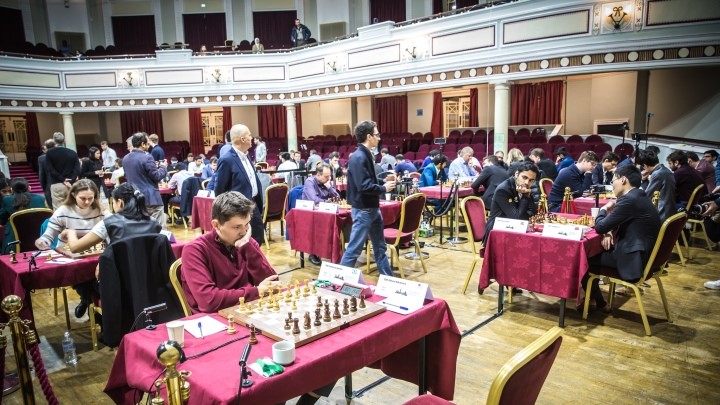
Strong winds and big waves battered Douglas all day. Before the rest day, the atmosphere was tense – nobody wanted to lose. It resulted in several draws, but some players could not stand the tension. Evgeny Najer blundered in an equal position to lose to Fabiano Caruana, while Javokhir Sindarov destroyed Samuel Sevian’s queenside, where the opponent’s king was hiding. A dramatic win by Anna Muzychuk in a drawn queen endgame against Bibisara Assaubayeva allowed her to take over the sole lead, as her main rivals could only manage draws. There was a big surprise in the opening on board one. Andrey Esipenko had a won position against Hikaru Nakamura at the FIDE Grand Prix in Berlin in 2022 when Nakamura played his usual Giuoco Piano, though that game ended in a draw. Nakamura has met Esipenko’s 1.e4 with 1…e5 in all the games they’ve played so far, but in the sixth round of the FIDE Grand Swiss, he surprised his opponent with 1.e4 c5 2.Nf3 g6. Nakamura tested the Accelerated Dragon in Qatar Masters to draw with Javokhir Sindarov, but he played it via the 2…Nc6 3.Nc3 g6 move-order. By playing 2…g6 he wanted to avoid the Rossolimo with 3.Bb5, but it allows the Maroczy Bind after c4. These considerations set Esipenko thinking as early as move three! He went for 3.c3 d5, and then instead of a transposition to the Alapin by taking on d5, he closed the centre with 4.e5. Nakamura developed the knight to c6, and after …Bg7 undermined White’s centre with …f6. This plan has been played by Assaubayeva, Vakhidov, Abdusattorov, Sindarov and Svane, so Nakamura had ample material to work with. Both players developed, and at the beginning of the middlegame White sacrificed a pawn to open the central files. The pawn on g5 is taboo as taking it allows …e7-e5 with tremendous initiative for Black. White played 14.Ne5! Nxe5 15.dxe5 Bxe5 16.Nc3 attacking the pawn on d5 and forcing 16…e6. Esipenko’s compensation consisted of his harmonious development (Black still needs to develop the light-squared bishop), pressure along the central files (especially on the e-file against the backward pawn on e6) and a safer king. The game ended in a perpetual check at the moment of highest tension. White is on the verge of clamping down the centre with Bxg6 and Be5, but Black is just in time with 20…e5. Everything is forced now as White must take on g6 and after 21.Bxg6 exd4 22.Qh5 hxg6 23.Qxg6 White delivers a perpetual check. On board two, Yu Yangyi faced the uncomfortable psychological task of coping with his own favourite opening, the Petroff Defence. Arjun Erigaisi seemed to catch his opponent unprepared. In spite of following a theoretical line, White was spending a lot of time on the known moves. As usual in such cases, Black demonstrated his perfect opening preparation and effortlessly made a draw by exchanging almost all the pieces by move 22. After the queens, the queenside pawns were also exchanged, and the draw was agreed on move 30. On board three, Fabiano Caruana used the same line in the Giuoco Piano Alireza Firouzja played against him at the Paris GCT in 2021 with 5.Bg5. It would be nice to know whether he was inspired by yesterday’s report and Morphy’s game. His opponent Evgeny Najer seemed surprised, especially as Caruana refined the opening idea by pushing his a-pawn to a5 and then opening the a-file with axb6 when Black played …b6. The beginning of the middlegame promised a complex game ahead for both players. The position remained equal, and pieces started to come off. But then, Najer blundered. Here 25…Qd8 or 25…Re7 would have kept the balance. Najer went for 25…Qa5? allowing 26.Qf3! Re7 27.Nxg6! with a winning position. In spite of spending eight minutes, Caruana missed this tactic and played 26.Re4, allowing Black to escape out of trouble by 26…f5 or 26…Be6. Najer blundered for a second time with 26…Nf6? And this time, Caruana was ruthless with 27.Nxd7! Nxe4 28.dxe4 Rxe4 29.Qf3, winning two pieces for a rook. White attacks the pawn on f7, so Black was further forced to go into a lost endgame with 29…Qf5 30.Qxf5 gxf5 31.Nb8 with the knight coming to c6. Caruana converted the advantage and won in 37 moves without allowing any more chances. On board four, Vladislav Artemiev chose an innocuous line against Alireza Firouzja’s Arkhangelsk Variation. In addition to that, he also spent masses of time on theoretical moves. His choice quickly led to an endgame where Black had little to complain about. Artemiev managed to keep the pair of bishops. Given his excellent endgame technique, it must have given him some hope. The main problem for both players was the time management – by move 15, they had spent more than an hour, leaving them with a bit more than 30 minutes to reach the time control on move 40. Black’s free-piece play and space advantage do not allow the white bishops to show their might. The critical moment arose on move 16. Black could have played the natural 16…Bf5, but he went for the pawn sacrifice with 16…Bg4 instead. After 17.Bxe5 Bxe2 18.Bxc7 Bd3 he hoped that the opposite-coloured bishops, his strong bishop on d3 and the possibility to advance his kingside pawns would provide enough compensation, but Artemiev played extremely well to neutralize these factors and obtain a winning position. However, in severe mutual time trouble, Artemiev made a decision that is hard to explain. Instead of the natural 36.Re7, Artemiev abandoned the jewel of his position, the passed c6-pawn on c6 35.Nc4? to go for the pawn on g5 after 36…Rxc6 37.Re5 Kf6 38.Be7 Kf7 39.Bxg5, but it was an unequal exchange. Black activated his rook with 39…Re6-e2 and obtained enough play for a draw. White tried to make something of his extra pawn, but the best chance for that was long gone. Javokhir Sindarov won a fierce attacking game with the black pieces against Samuel Sevian. In a King’s Indian structure, White castled queenside but was hit with a series of blows, similar to the strong waves that crashed against the shore in Douglas. The first one came early. Black executed the typical central strike with 9…d5, obtaining free piece play.
165 years of chess history in Round 5 of FIDE Grand Swiss
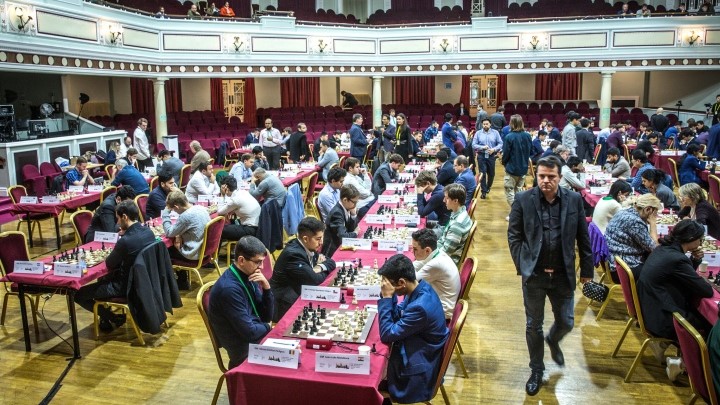
The draws on the top boards allowed Hikaru Nakamura to join the leaders as the only player to win in the upper echelon. The game of the round was undoubtedly the insanely complex battle between Alireza Firouzja and Hans Niemann. Black had excellent winning chances, but in mutual time trouble, he missed them. In the derby of the women’s section, Bibisara Assaubayeva turned things around after falling into a strategically lost position after the opening. This victory made her the sole leader in the Women’s Grand Swiss. In the fifth round of the FIDE Grand Swiss, the leader of the tournament faced the top seed on board one. Andrey Esipenko was surprised in the opening by Fabiano Caruana’s move-order after 1.d4 Nf6 2.c4 e6 3.Nf3 a6!? The point of this a-pawn move is to avoid the Catalan. In case White continues with 4.g3, then Black has the option of 4…b5!?, a move that was recently played by Hikaru Nakamura. Esipenko continued along the usual lines with 4.Nc3, and after 4…d5, we had a transposition to the line Caruana played in Round 3 against L’Ami. Perhaps to avoid possible surprises, Esipenko sprung his own surprise a few moves later. In the tabiya of the line with early …a6 he played a mysterious king move. In this position, White usually chooses among 10.Bf4, 10.Qc2 and 10.h3, but Esipenko came up with a somewhat abstract move 10.Kh1!? with some ideas of pushing the g-pawn or/and safeguarding against accidental checks on h2 or along the g1-a7 diagonal if White opens it by pushing f3 and e4 or f4. Still, the main advantage of the move was to sidestep the mainstream theory. On his next move, White tried to expand on the kingside with Nd2 and f4, which Caruana prevented by pushing …h6 and …g5. In a complex middlegame, both opponents played well, and after a series of exchanges, the draw was agreed by perpetual check on move 42. On board two, Hikaru Nakamura was luckier than Esipenko – his opponent Alexey Sarana didn’t prevent him from playing the Catalan. As is his habit early in the game (which makes him one of the trickiest players when it comes to opening preparation), Nakamura introduced an early “twist” by playing the sideline 8.Bc3 (compared to the more popular 8.Qc2, 8.Qb3, 8.a4, 8.Bf4). Black continued with 8…b6, and after 9.cxd5, he took on d5 with the pawn, unlike Magnus Carlsen, who, in his blitz game against Ding Liren in 2017, captured with a knight, keeping the long diagonal open. Soon enough, the position took Queen’s Indian shape where Black creates some activity in the centre with …c5, but his bishop on b7 is rather passive. In the complex middlegame, the position with Black’s hanging pawns on c5 and d5 arose. White tried to put pressure on them while Black had free-piece play thanks to the space those pawns provided. In this critical position, Black pushed the wrong pawn. Correct was 18…c4! 19.Nd4 Rfd8, when the nice blockading knight prevents White from attacking the pawn on d5. Sarana went for 18…d4?! and after 19.Bxb7 Qxb7 20.Rc4 White got a chance to concentrate his pieces against the c5-pawn. Another positional mistake by Black was to offer the exchange of bishops, which removed the best defender of the c5-pawn. After that, the pawn on c5 was doomed, and White won it. However, Nakamura wasn’t perfect in the conversion phase. White should have transferred the knight via e1 to f3, but instead, he went for 29.Nc5? allowing 29…Qh3 (or 29…Qg4 or even 29…Rxc5! 30.Rxc5 hxg3 31.hxg3 Nf4! with equality) and suddenly Black had sufficient compensation. However, Alexey missed several good chances and lost the d4-pawn. Sarana regained one pawn by taking on b2, but after the exchange of queens, he lost the far-advanced pawn on h3. Nakamura converted the two-pawn advantage in a long knight endgame with patient play. On board three Alireza Firouzja played the King’s Indian Attack against Hans Niemann, but just like Nakamura, he introduced a little twist early on. In this standard position, White usually plays 6.Nbd2, with the intention to push e4, but Firouzja opted for 6.Re1!?. The move also prepares e4, but not immediately, as White first wants to develop with Bf4 or Nc3, for example. Niemann responded with 6…Nc6, intending …e5, to which Firouzja changed the structure by preventing it with 7.d4. The opponent stepped into uncharted territory soon enough as after 7…a5 8.Nc3 Ne4 9.Nb5, the position was already very original and new. The game left the safe territory when, on move 16, Niemann sacrificed two pieces for a rook and a pawn. He played 16…Nxf2!? 17.Rxf2 Bxf2 18.Kxf2 Qxf6 19.Kg1 Qxb2 when the game became a big mess. Objectively, the position was balanced, but it was easier to play with Black since he had the safer king and White’s pieces lacked coordination. Both players entered severe time trouble, and this affected the quality of their moves. There were some difficult decisions to be made with very little time on the clock. It looks very dangerous for White, but in fact, he can stay afloat with 26.Ba6 or 26.Nd2. Firouzja went for 26.Qd2? which should have lost after 26…Qxc4 27.Qxd7 and now 27…Rfe8! was the killer blow. Niemann missed it and went for 27…Re2? after which the position was equal again. The engine indicates the move 28.Rc1! when the complications continue. He didn’t find this move, and after the natural 28.Bxc6 a forcing variation after 28…Qc5 29.Kh1 Qf2 30.Qh3 Re1 31.Rxe1 Qxe1 and the subsequent exchange of queens (which was premature, as Black should have kept the tension by playing …a3) on f1 led to Black winning the pinned bishop with …g5. White won the pawn on a4, and then after the time control, the following endgame appeared. This position is objectively a draw, and Firouzja managed to prove it. A wild game! On board four, Javokhir Sindarov and Yu Yangyi tested a long theoretical line in the Petroff. They followed a game by Sindarov played only a month prior to this tournament, a game he won against Bu Xiangzhi. Yu Yangyi deviated from the play of his compatriot by introducing a novelty on move 16 and quickly equalized. In the Evans
List of arbiters for green, blue, red, and yellow panels in FIDE Events 2024-2025 published
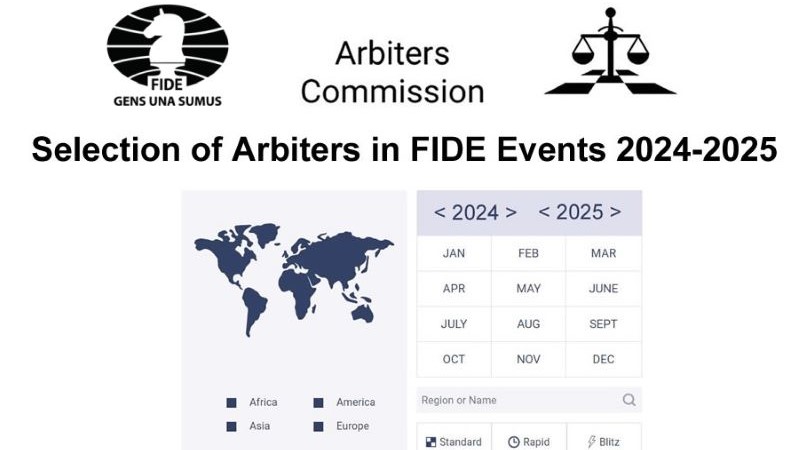
Dear Chess Friends, Chess Arbiters, The FIDE Arbiters’ Commission is pleased to release the List of arbiters for the green, blue, red, and yellow panels, which will be used for making appointments to FIDE events during the 2024-2025 cycle. We would like to thank the hundreds of Arbiters from around the world who responded to the Call of Interest for Arbiters in World Events 2024-2025 (almost 600 colleagues from 116 Federations). The panel system is described in the FIDE Handbook, B06.4 – FIDE Regulations for the Appointment of Arbiters in World Events, including Appendix B06.4.B – Arbiter Selection Procedural Rules. There are four panels named by colour: A Green Panel , containing 25 International Arbiters of category A A Blue Panel, containing 45 International Arbiters of category A or B A Red Panel, containing 60 International Arbiters of category A or B A Yellow Panel, containing the remaining International Arbiters or FIDE Arbiters of any category The Arbiters’ Commission started the procedure by releasing a Call of Interest for all International Arbiters and FIDE Arbiters who hold a valid FIDE arbiters’ license. The Call of Interest was open for more than a month, from July 25th to August 24th, 2023, and was then extended until August 28th, 2023. In total, 143 Arbiters with IA-A and IA-B categories responded to the Call for Interest. During the meeting on September 2nd 2023, the voting members (FIDE Arbiters Commission councilors, ARB Chairman, ARB Secretary), discussed the criteria for selecting arbiters for panels. The meeting was also attended by the Team of Consultants (FIDE Council, FIDE Management Board, Global Strategy Commission, and Events Commission representatives). The following criteria were used to select arbiters: gender (the total number of arbiters must be at least 25% female and at least 25% male), experience and level of arbiters’ category, undergone preparation for the appropriate arbiter position, software skills, language (English), leadership skills, teamwork skills, activity as an arbiter in the last few years, previous behaviour or misbehaviour during chess events. These selection criteria were applied by a team of voting members who used consensus as a decision-making method. The panels were formed following the FIDE Regulations, particularly B.06.4 FIDE Regulations for the Appointment of Arbiters in World Events (effective July 20th, 2023) and selection criteria. Each voting member received a list of 143 arbiters (arbiters Category A and B who participated in the Call of Interest for World Events 2024-2025) and voted for every other arbiter on it (on a scale of 143 points to 1 point). For the initial draft, the lowest score was dismissed as none of the voting members could vote for themself. Voting members discussed the draft with the Team of Consultants so as to be able to present you the final version of the List of arbiters for the green, blue, red, and yellow panels. The Arbiters’ Commission believes that this list was made in the best interests of FIDE and arbiters worldwide. Moreover, we expect that its content and integrity will be proved over the following two years when these arbiters complete their duties at FIDE World Events. Ivan Syrovy, ARB Chairman Nebojsa Baralic, ARB Secretary According to the FIDE Regulations for the Appointment of Arbiters in World Events (B.06.4), arbiters selected for the Green Panel are eligible to be appointed as: 1) Chief Arbiter of category A tournaments 2) Any role that members of the Blue Panel, Red Panel or Yellow Panel may be appointed to The Green Panel will be composed of 25 arbiters, all of whom must be Category A. The Green Panel will be used to appoint: 1) The Chief Arbiters of all Category A tournaments 2) The equivalent number of positions as Chief Arbiters in Category B tournaments LIST OF ARBITERS / GREEN PANEL (alphabetical order): Name Federation Title Category Continent Abd Hamid Bin Abd Majid MAS IA A Asia Abdulrahim, Mahdi UAE IA A Asia Bansod Swapnil IND IA A Asia Baralic, Nebojsa SRB IA A Europe Bertagnolli, Gerhard ITA IA A Europe Brokko, Margit EST IA A Europe de San Vicente, Sabrina URU IA A America Delega, Tomasz POL IA A Europe Escafre, Stephane FRA IA A Europe Freyd, Laurent FRA IA A Europe Gopakumar M S IND IA A Asia Holowczak, Alex R ENG IA A Europe Japaridze, Marika GEO IA A Europe Mena Sarasola, Jesus ESP IA A Europe Munoz Solis, Carolina CRC IA A America Nikolopoulos, Panagiotis GRE IA A Europe Pahlevanzadeh, Mehrdad IRI IA A Asia Sorokina, Anastasia AUS IA A Asia Srebrnic, Ana SLO IA A Europe Syrovy, Ivan SVK IA A Europe van den Bergh, Gunther RSA IA A Africa Vardapetyan, Ashot ARM IA A Europe Wolter, Jens GER IA A Europe Zhu, Jiaqi CHN IA A Asia Note: one spot is not occupied and during the cycle one arbiter can be added to green panel According to the FIDE Regulations for the Appointment of Arbiters in World Events (B.06.4), arbiters selected for the Blue Panel are eligible to be appointed as:1) Deputy Chief Arbiter of category A tournaments2) Chief Arbiter of category B tournaments3) Any role that members of the Red Panel or Yellow Panel may be appointed to The Blue Panel will be composed of 45 arbiters, all of whom must be Category A or B. The Blue Panel will be used to appoint:1) The Chief Arbiters of all Category B tournaments not assigned to the Green Panel2) The Deputy Chief Arbitersa) in all Category A tournamentsb) of twice the equivalent number of positions from a) in Category B tournaments LIST OF ARBITERS / BLUE PANEL (alphabetical order): Name Federation Title Category Continent Alhammadi, Faisal UAE IA B Asia Andrikopoulou, Efstathia GRE IA B Europe Bailleul, Geert BEL IA A Europe Bayat, Shohreh ENG IA A Europe Biagioli, Marco ITA IA A Europe Bird, Christopher USA IA B America Boyd, Stephen FRA IA B Europe Brustman, Agnieszka POL IA B Europe Caliskan, Ismail TUR IA B Europe Cimina, Andra LAT IA A Europe Dapiran, Franca