

Marc’Andria Maurizzi and Candela Francisco, World Junior Champions
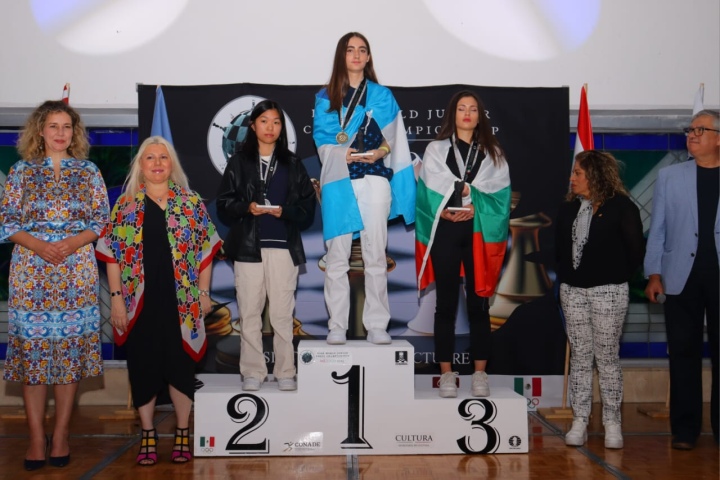
The World Junior Championships for players under 20 came to an end this Sunday in Mexico City, with two of the youngest winners in the history of the competition: 16-year-old Marc’Andria Maurizzi, from France, and Candela Francisco of Argentina, who just turned 17 a few weeks ago, clinched the titles in a thrilling finish. Both ended the championship unbeaten, with 8½/11. Their victories are not an absolute record, as Joel Lautier, also from France, won this event at a record 15 years old, while the youngest one to earn the title in the Girls’ category was Alexandra Goryachkina, at 14 years old (and then again, the next year). However, this doesn’t diminish the remarkable achievement of the 2023 winners in the slightest. Maurizzi’s victory could not be confirmed until the last moment, and it was decided thanks to a better tie-break over Arseniy Nesterov, Luka Budisavljevic, and Mamikon Gharibyan, all with 8½/11. This four-way tie in the top place was partly caused by the fact that Marc’Andria slowed the pace towards the end of the event and finished with two draws in the final two rounds. However, the French Grandmaster is an unquestionable winner: undefeated, he became the first sole leader in round 4, and his round 9 victory over Ivan Schitco is a masterpiece that became an instant classic, adding much to his credit. Arseniy Nesterov is also a worthy winner of the silver medal. After a strong start, he suffered a little bump in the road between rounds 4 and 7, when he only scored 1½ in four games, losing pace with the leaders. However, thanks to a strong finish with four consecutive wins, he could claim the place he deserved – with a bit of luck: his rival in the last round, the top seed Hans Niemann, was forced to win to keep some chances of a medal, so rejected a draw by perpetual check and went for an inferior line instead, allowing Nesterov to turn the tables and win the game. The Serbian Grandmaster Luka Budisavljevic completes the podium, in third place. He was remarkably consistent during the whole event, finishing undefeated. In the last round, he had Black against Maurizzi, and he fought almost till the bare Kings in order to get a shot at winning the event. The impression is that his result could have been even better, had he played a bit sharper at critical moments. A bit disappointing was the result of the top seed, Hans Niemman, who could only finish 8th, on 7½/11, with two losses. His overall level of play through the event was not at par with what one would expect from a player of his calibre – but he deserves all the credit for taking part in a competition where he had little to win and lots to lose. While the final result in the open category was very much in consonance with what we saw during the event, the Girls’ category was a completely different story. The last three rounds were quite a thrill, with massive swings in key games that turned the standings upside down. The top seed, Carissa Yip, seemed to have the event under control: her play was not so convincing in a couple of games, particularly in the opening, but thanks to her resourcefulness and class, she managed to score the points anyhow. This changed in Round 9, when she was paired against the tournament’s revelation, 13-year-old Miaoyi Lu (pictured below), who defeated her in great fashion. That, combined with the victory of Beloslava Krasteva, allowed the Bulgarian WGM to take the lead. The next day, Miaoyi was very close to repeating this feat and defeating the tournament leader, as she obtained a crushing position against Krasteva. However, the tenacious Bulgarian managed to pull off one of the biggest swindles of the event, winning the game and heading into the final round one whole point ahead of her rivals. Only a defeat in the last round, where she had the advantage of the White pieces, and a genuinely unlucky combination of results, could prevent Krasteva from becoming World Champion. In fact, the arbiter in charge of the pairings spent some time after round 10 checking if she was mathematically a winner with one round to spare. As it turns out, she wasn’t. The American Continental Champion, Candela Francisco, from Argentina, became the stone in Krasteva’s shoe. “Candelita”, the favourite of the Mexican fans, conceded a draw in round 2, so her tournament was a bit discrete, and her name didn’t make it to the very top places in the leaderboard until as late as round 9. But she won when it matters the most: in the decisive last-round game. The masterful way in which she outplayed Krasteva with the black pieces is worth a world title; first, with the advance h5-h4-h3, and then with a queen sacrifice that gave her attack the definitive impulse. The worst possible combination of results ended up with the Bulgarian getting neither the gold nor the silver, but the bronze medal. The silver went to Carissa Yip, who tied with Candela and Beloslava on 8½/11. For that, she had to win in the last round against Trisha Kanyamarala, which was easier said than done. Carissa had the initiative during most of the game, but only in a laborious rook endgame could she finally overtake her opponent. Not winning the Junior’s title in the last year she was eligible to play is probably a bit of a disappointment for Yip, who is clearly one of the strongest players of her generation. But second place is a decent consolation prize. Final standings: OPEN GIRLS Written by David Llada Photos: David Llada Official website: juniorchesschampionship.fenamacajedrez.com/
World Junior Championship: No changes at the top after drawish Round 8
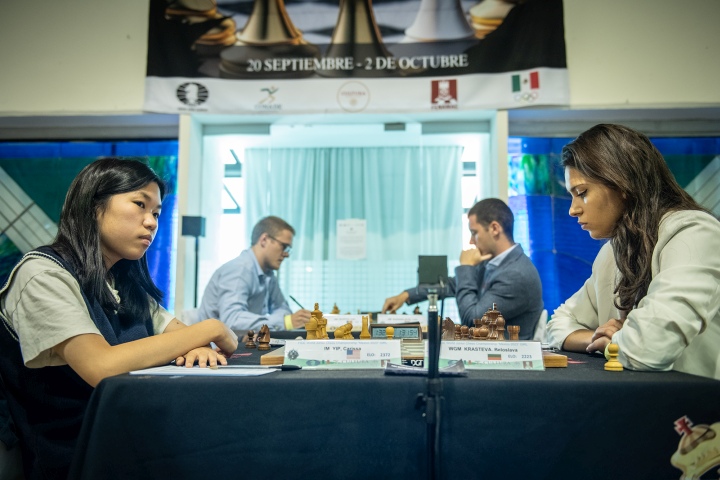
It was all draws in the top nine boards in the 8th round of the FIDE World Junior Championship (open), except for Niemann’s victory over IM Konstantin Peyrer. On the black side of a King’s Indian, Hans didn’t really get anything out of the opening, but a poor move by his opponent, 30.e3, allowed him to penetrate his rival’s camp. Peyrer survived the attack but lost three pawns and resigned 13 moves later. On the top board, the game between Santiago Avila and Marc’Andria Maurizzi was a Scotch where, surprisingly, we had an entirely new position after just eight moves. However, the heavy pieces were exchanged early into the game, and the ensuing endgame with opposite-colour bishops was a dead draw. A very similar script followed the game between Gharibyan and Dudin, which ended in a threefold repetition after 31 moves, the same as Schitko-Budisavljevic, in just 28 moves. The fight between Subelj and Makarian was much longer: after White won a pawn on move 34, Subelj kept striving to convert his advantage for thirty more moves, but to no avail. With all the pawns on the same flank, his 3 vs 2 majority was simply not enough to win, but the game continued to bare kings. Avila, Maurizzi and Dudin keep leading with 6½/8, and the Hungarian IM has almost secured his GM norm, as he will only need a draw in the remaining rounds. Elham Amar of Norway and Diago Saul Flores of Peru also have good chances of leaving Mexico with a GM norm under the belt. The 8th round at the Girls’ competition was much more enjoyable. To begin with, Carissa Yip came out of the opening in a disastrous position after she went for the wrong f-pawn advance: 15.f5 instead of 15.f7+ in a very sharp line. By move 20, she was an exchange down, and the engines indicated a +2.1 advantage for Black. However, both kings were very exposed, and Carissa made the most of her chances to create counterplay. Her resilience was rewarded with a very valuable half a point, allowing her to continue leading, half a point ahead of a disappointed Beloslava Krasteva and Roxangel Obregon. Roxangel moved up to second place after a fine victory over Trisha Kanyamarala of India. The Cuban WIM played the English Attack in the Scheveningen in an exemplary way. The current American continent champion among women, 16-year-old Candela Francisco, also moved up in the standings after beating Ingrid Skaslien of Norway. Candela is one of the four players in the field still undefeated, together with Yip, Krasteva, and Obregon. Yip’s rival for the 9th round will be the young Chinese Miaoyi Lu, one of the revelations of the event, who beat Sarah Djidjeli with apparent ease. Gleb Dudin – Santiago Avila, Marc’AndriaMaurizzi – Ivan Schitco, and Hans Niemann – Mamikon Gharibyan are the main pairings for the 9th round in the open category. In girls, apart from Carissa Yip – Miaoyi Lu, the most exciting clashes will be Beloslava Krasteva – Roxangel Obregon and Candela Francisco – Mariam Mkrtchyan. Standings after Round 8: OPEN GIRLS Written by David Llada Photos: David Llada Official website: juniorchesschampionship.fenamacajedrez.com/
The Isle of Man’s Grand Chess Spectacle
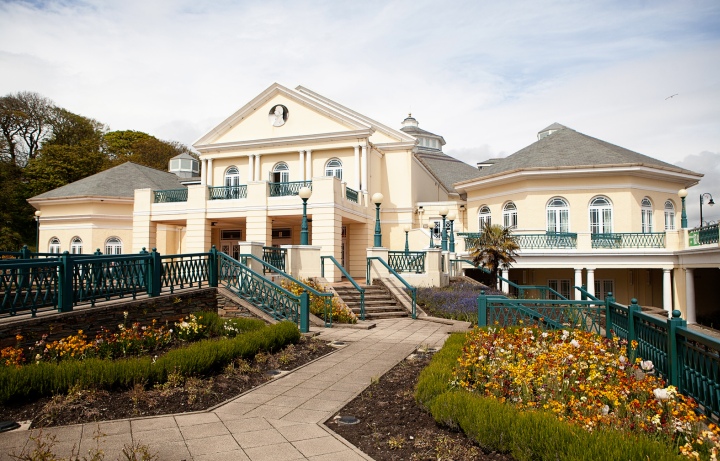
Chess makes a welcome return to the Villa Marina in Douglas, Isle of Man Preview: 2023 FIDE Grand Swiss & Women’s Grand Swiss The Isle of Man plays host once more to the chess world’s crème de la crème, as the 3rd FIDE Grand Swiss and 2nd FIDE Women’s Grand Swiss tournaments are set to launch on 25 October The return of these prestigious world championship qualifying competitions to the Isle of Man marks a momentous occasion. Over the course of 12 days, from 25 October to 5 November, the island in the Irish Sea will emerge as the epicentre of the chess world, hosting an elite assembly of top-tier players fighting for the prizes, prestige and a spot in the 2024 Candidates. Having debuted on the island in 2019, the tournaments are back in the familiar and distinguished setting of the Villa Marina, located along the island’s picturesque seafront in the capital city of Douglas. This venue hosted five editions of the Chess.com Isle of Man Masters tournaments between 2014 and 2018, as well as the 2005 British Chess Championship. Both open and women’s tournaments consist of eleven rounds, with one rest day after the first six rounds (on Tuesday, 31 October) and the final round 11 being played on Sunday 5 November, followed on the same day by the closing ceremony. Once again, the event enjoys the generous patronage of the Scheinberg family, with a prize fund to the tune of US$600,000, part of a seven-figure sponsorship package. The first three prizes in the open tournament are $80,000, $60,000 and $40,000 and, in the women’s tournament, $25,000, $17,500 and $15,000, respectively, with further prizes for those finishing below the top three places. Alan Ormsby (Isle of Man) is the tournament director, IA Alex Holowczak (England) is the chief arbiter of the Grand Swiss and IA Ana Srebrnič (Slovenia) will serve as the chief arbiter of the Women’s Grand Swiss. The biggest prize The primary function of both tournaments is as world championship qualifiers, with the two highest-placed players from each going forward to the two 2024 FIDE World Candidates’ tournaments. As in previous editions this is made a little complicated by the inclusion in the field of players who are already qualified for next year’s eight-player Candidates’ event who still wish to take part in the Grand Swiss. The Isle of Man line-up features a handful of players who have already qualified for the Candidates via the recent FIDE World Cup competitions: Rameshbabu Praggnanandhaa (India), Fabiano Caruana (USA) who were the runner-up and third-place finisher, respectively, in the month-long Baku knock-out competition. If they were to figure in the top two places in the Grand Swiss, the next player down from them on the final score table would qualify for the Candidates. Similarly, in the women’s competition, there are three players competing in the Isle of Man who have already qualified for the 2024 FIDE Women’s Candidates’ tournament, namely Aleksandra Goryachkina (competing under the FIDE flag), Nurgyul Salimova (Bulgaria) and Anna Muzychuk (Ukraine), so the same scenario applies if they also finish in the top two in the Women’s Grand Swiss. A tournament for the world’s best Only the world’s best can take part in the Grand Swiss, having had to compete within a rigorous set of requirements. This is all to ensure that the great majority of the competitors have a realistic chance of going further in the world championship cycle, plus a handful of continental and local nominees. The Grand Swiss features 21 players rated 2700+ and a further 73 rated 2600+. That leaves a further 15 to complete the field, of whom two are rated below 2400, being representatives of the host country. Very few Swiss tournaments in chess history have approached this level of strength in depth, with notable exceptions being the two previous Grand Swiss competitions, plus the 2017 Chess.com Isle of Man Masters won by Magnus Carlsen. 2023 FIDE Grand Swiss: The top ten contenders The two highest-rated contenders are both Americans: Fabiano Caruana and Hikaru Nakamura. There is a sense that neither is under pressure to succeed, for different reasons. Caruana is already through to the Candidates, so he will be in the Isle of Man for the money and the prestige. Having narrowly failed to become world champion in 2018 – he became the only losing finalist in world championship history not to lose a classical game to the eventual winner – he went through a relatively fallow period of recovery but now seems to be flexing his muscles once again. Good results in the Superbet Bucharest Classic in May and the FIDE World Cup in August bode well for the renewal of his assault on the world championship. A victory in the Grand Swiss – which would be a second straight success in the Isle of Man, where he finished 1st= in 2019 – would be another morale booster going into next year’s Candidates showdown. Hikaru Nakamura (left) meeting Fabiano Caruana in the last round of the 2019 Grand Swiss. They are the top seeds in the 2023 event (photo Maria Emelianova/chess.com) Hikaru Nakamura’s reason for being relatively relaxed about his performance in the Grand Swiss is different. Two or three years ago his burgeoning career as a chess streamer seemed to indicate a dwindling interest in over the board play, or at least classical chess, but a strong showing in the 2022 FIDE Grand Prix saw him regain his status in the longer form of the game. His victory in Norway Chess 2023, ahead of both Carlsen and Caruana, took him to second place in the FIDE ratings for the first time since 2015. Nakamura’s experience and success in strong Swiss events – he has four Gibraltar Masters titles under his belt, including three consecutive wins from 2015 to 2017 – make him a strong contender in the 2023 Grand Swiss. Alireza Firouzja, now of France and rated third in the tournament line-up, will be playing in the Isle of Man for the first time. At the time of the 2019 Grand Swiss, he was a star on the horizon. During that
World Junior Championship: Leaders prevail in Round 7
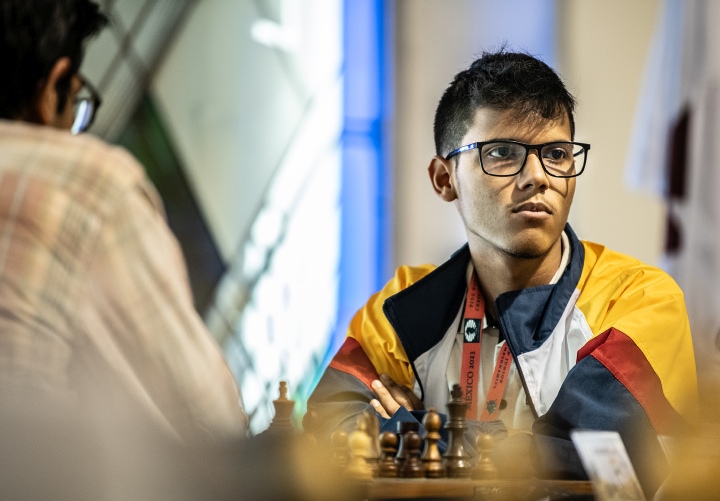
Round 7 at the FIDE World Junior Championship in Mexico has been the most intense and exciting so far. In the open section, the day started with no less than six players tied in the first place, a number that was reduced to just three co-leaders after four out of the five top boards reached a decisive result: Maurizzi, Dudin and Avila are in command with 6/7. It appears that fatigue is taking its toll on the players after the first week of competition, as critical tactical miscalculations decided some of the key games. In the game between Maurizzi and Anand Pranav (pictured below), the French GM outplayed his opponent by tactical means in a rare line of the Giuoco Piano, winning a pawn and then advancing with his majority on the Queenside. It was a fine game by Maurizzi, who so far is looking like a very solid candidate to win the event. On board two, Gleb Dudin and Ruben Koellner went for a sideline of the King’s Indian Attack, where Koellner strangely lost a central pawn right in the opening. That was too much of a gift at this level, and Dudin gave him no chance at all. The game between Dushyant Sharma (white) and Santiago Avila (pictured at the top) was also decided by a blunder early into the game, as Sharma missed a tactical trick, 17.Nxe4. The young Colombian, a favourite player among local fans, demonstrated great tactical prowess. Of the three players currently leading, he is the one with a better provisional tie-break. Being on top form, he has a very good chance to win the title: in Round 8, he will have White against Marc Andria Maurizzi in a crucial game. The top seed Hans Niemman had to settle for a draw, with Black, against the World Champion U18 2022, the Canadian Shawn Rodrigue-Lemieux. In the Short variation of the Advance Caro-Kann, Shawn played dynamically and obtained a dangerous initiative, although he was a pawn dawn. Niemman defended correctly and made use of his material advantage to equalize, and he even had some chances towards the end of the game. In the Girls’ section, Carissa Yip won again, this time with White against Sofiia Hryzlova of Switzerland. The young American prodigy seems to be in a class of her own: the way she traded a small strategic advantage for a dangerous attack at the cost of a pawn is highly instructive. After seven rounds, it is not clear who will be able to challenge Carissa’s dominance. The next one to try her luck against the leader will be Beloslava Krasteva of Bulgaria (pictured above), who defeated Mariam Mkrtchyan and moves to second place on 6/7. In her Round 7 game, Krasteva demonstrated excellent opening preparation and came up with a very interesting move in the Nimzo-Indian, 10.Qd3, which has only been played once before. Her neat victory resembles a classical game in which White straightforwardly follows a simple and logical plan. The main pairings for the 8th round are in the open section are Santiago Avila – Marc Andria Maurizzi, and Mamikon Gharibyan – Gleb Dudin. In the Girls competition, Carissa Yip will take on Beloslava Krasteva, while Roxangel Obregon will face Trisha Kanyamarala. Standings after Round 7: OPEN GIRLS Written by David Llada Photos: David Llada Official website: juniorchesschampionship.fenamacajedrez.com/
FIDE WSTC 2023: USA and Germany Lasker Schachstiftung GK win gold
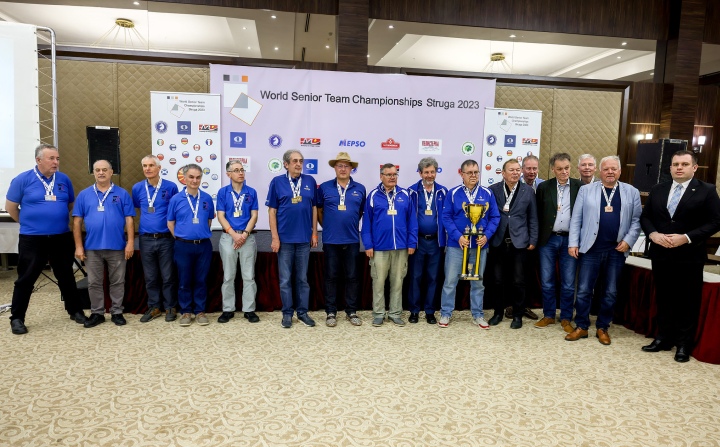
USA and Germany Lasker Schachstiftung GK clinched the titles in S50 and S65, respectively, at the 2023 FIDE World Senior Team Championship. Drama and excitement were dominating the final round of the Championship. At first sight, none of it should have happened, but chess is a sport, and what seemed certain was anything but. The favourites were playing outsiders in the last round, and two of the four leading teams did confirm their status. USA beat Poland 4-0, though not without some luck. Their win was never in question, but the Polish team should have scored at least a draw on board one. Black (Shabalov (2465)) sacrificed an exchange for sufficient compensation. The position is dynamically balanced, and in view of the threat …h4 White should have taken on a6 and then returned the exchange by taking on d6, with a likely draw. Instead, Gdanski (2484) panicked and played 33.Rxf5?? gxf5 34.Kh3 Bc5, losing the bishop on d5. On the other boards, the difference in class was too big in favour of the Americans. Kaidanov (2549) beat Sapis (2375), Novikov (2513) beat Sielicki (1956), and Yermolinsky (2419) beat Flis (1948), none of them experiencing major problems. The drama unfolded on board two in the match between Italy and Montenegro. Italy were co-leaders with USA prior to the final round and, with a win in the match, were guaranteed a silver medal, with gold a possibility depending on the tie-break. Things started well for Italy. David (2523) displayed exemplary technique to win a favourable double-rook endgame against Pajkovic (2412). His win was followed by a win by Godena (2429), who pounced on a big blunder by Podlesnik (2289). The game was balanced throughout, but here, White missed Black’s threat. He played 35.Qe3?? (better was 35.Qe1) Rf1 36.Kh2 Rf2 and the g2-pawn was lost, and with it, the game. On board three Ortega (2410) was winning quickly after the opening. In a King’s Indian, he prepared well and obtained a decisive advantage by move 20 against Miljanic (2331). White had to switch the attack to the f-file with 26.Rf1 Nf7 27.Qf2, winning a piece in view of the tactic 27…Qd8 28.Qxf6! Qxf6 29.Ne8. Instead of that, he played a move dissonant with the dynamic nature of the position: 26.a3?? and after the simple 26…Nf7 Black regrouped and was unexpectedly already winning. White no longer had a breakthrough, while Black was up in material. Miljanic went on to pick up the pawns on e4 and d6 and won the game. This dramatic turnaround proved decisive for the Italian team. Instead of a comfortable victory, they were facing the prospect of not winning the match. At first, it didn’t seem so. Borgo (2333) obtained a winning advantage against Nikac (2275). Here 27…Nxe4 28.Rxe4 Qc5 with the threats of …d3 and …Rf8 was decisive: Black is a pawn up, and White’s king is weak. Black missed this chance, and after 27…a4 28.Bd3 Nxd3 29.cxd3 was only marginally better. In fact, here, he could have forced a draw by giving checks on e1 and d2. That would have won the match for Italy… Completely unnecessary, Borgo transposed the game to a rook endgame where only he could be worse. It was a critical moment in the game. Black had to find the only move 35…Rd5! with the idea of 36.Rxb6 Rf5! cutting off the white king and threatening …Rf2xb2 if the white rook leaves the b-file. Unfortunately for Italy, he missed it, and after a few further mutual inaccuracies, White converted his advantage into a full point. Italy’s draw meant that USA were clear first, winning gold. Now Italy could only hope on their competitors not winning their matches, but they were merciless. England whitewashed the Chinese women’s team China ShenZhen W50 (4-0). It was a dominating performance, as on all four boards, the English grandmasters didn’t give a single chance to the Chinese ladies. In the Exchange Ruy Lopez, Adams (2662) as Black outplayed Liu Shilan (2083). Emms (2448) beat Chunhong Ning (2266) by breaking down Fort Knox in the French Defence. Flear (2405) won a brilliant miniature against Yun Guo (2244), and Davies (2354) strangulated Yanfeng An (2259) on the white side of a Fianchetto King’s Indian Defence. Iceland beat England 2, but it was a tight affair. On board one, a sensation was brewing as Dishman (2304) sacrificed a piece against Olafsson (2491). White played the thematic 10.Nd5! and after 10…exd5 11.exd5 Ne7 12.d4! was already winning, similar to some variations in the Sicilian Defence. Olafsson defended to the best of his abilities, but that would not have saved him had White found the crushing blow in this position. After 28.d6! Nxd6 29.Qe5 White is winning as Black is too disorganized; his king is weak, while White’s rooks dominate after Rad1. White missed this chance, and after the preparatory 28.Rad1? allowed Black to establish a dark-square blockade with 28…Nd6, which helped him save the draw. Neither Hjartarson (2432) against Lewis (2238) on board two nor Arnason (2419) against Clark (2278) on board three could achieve much. The win for Iceland came on board four, but not without luck. Thorallsson (2382) started building up an attack on the kingside against Stebbings (2257). Black’s position was resilient enough, and in the critical moment, he could even have taken over the initiative. White’s last move was 22.Re3, and here Black could have played 22…Nxe5! 23.Rxe5 Qd8! regaining the pinned knight and eliminating any danger. In fact, the position would have transposed to a drawn double-rook endgame after 24.Rh5 Qxf6 25.Qxf6 gxf6 26.Rxh6 Kg7. Black missed this chance and soon came under a strong attack after 22…Rd8? 23.Qe4 (23.Rh3 or 23.Nh5 were even stronger). The position was impossible to defend in a practical game, and White went on to deliver checkmate. This meant that Iceland won 2.5-1.5, but as it turned out, this wasn’t enough – by winning 4-0, England overtook Iceland on a tie-break (board points) and finished second, with Iceland third. On the other hand, it was just enough to edge out Italy by half a point (on tie-break) to secure bronze, as all three teams had
FIDE Trainers’ Online Seminar scheduled for mid-October 2023

Organized by the Asian Chess Federation under the supervision of the FIDE Trainer’s Commission, the FIDE Trainers’ Online Seminar will stretch from October 13-15, 2023 and cover various topics. SEMINAR PROGRAM & SCHEDULE: DAY & TIME (GMT) TOPIC LECTURER FRIDAY October 13 06:00-08:00 1. Training of Calculation Rustam Kasimdzhanov 09:00 – 11:00 2. Endgame Training.Important Theoretical Positions. Vladimir Malakhov 12:00 – 14:00 3. Introductions, FIDE, TRG and the Trainers System 4. The Roles and Challenges of the Trainers, The Role of the Captains. Artur Jussupow SATURDAY October 14 06:00 – 08:00 5. Positional Play. Recognizing Weaknesses in Pawn Structures. Rustam Kasimdzhanov 09:00 – 11:00 6. Strategy Training. Artur Jussupow 12:00 – 14:00 7. Opening Repertoire/Preparation. Building up an Opening Repertoire. Le Quang Liem SUNDAY October 15 06:00 – 08:00 8.Analyzing Own Games Iossif Dorfman 09:00 – 11:00 9. Dynamic Play in the Opening. Iossif Dorfman 12:00 – 14:00 Written Exam TRG E-Mail Organizer and contacts: FIDE Trainers’ Commission: trainers@fide.com Registration deadline: October 10, 2023 Venue: Zoom Seminar participation fee: €200 Lecturers: GM Artur Jussupow GM Iossif DorfmanGM Rustam KasimdzhanovGM Le Quang LiemGM Vladimir Malakhov Seminar language: English Rules & regulations: trainers.fide.com/trg-online-seminars/
Asian Games: Wei Yi and Zhu Jiner clinch individual titles
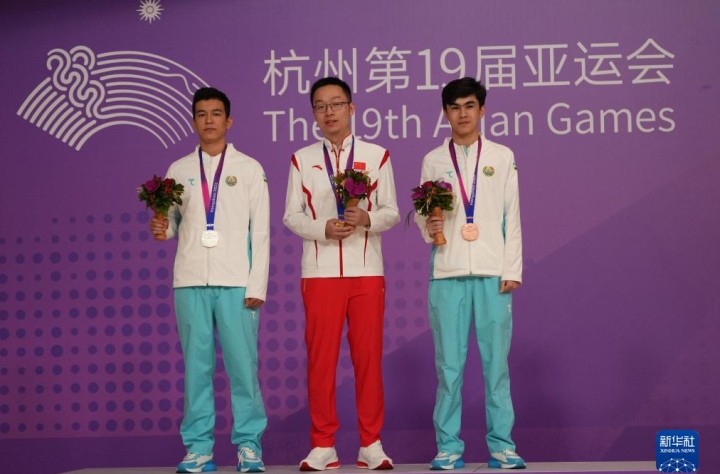
Wei Yi and Zhu Jiner emerged as the winners of the 19th Asian Games chess individual competitions on home turf in Hangzhou, China Both events, 9-round Swiss tournaments with rapid time control, took place from September 24-27, 2023. The men’s tournament was a close race, with top-seeded GMs taking turns at the top of the standings. Suffice it to say that neither of the top finishers completed the event unbeaten. Wei Yi started with a draw but then caught up with the leaders, Nodirbek Abdusattorov and Javokhir Sindarov (both of Uzbekistan) after Round 4. However, after Wei’s loss to Abdusattorov in Round 5, his gold medal prospects looked bleak. Unfazed by this setback, the Chinese GM reeled off four straight victories (including a very important one over the leader, Vidit Gujarathi, in Round 6) to clinch the title with an excellent score of 7.5/9. Nodirbek Abdusattorov (7/9) and Javokhir Sindarov (6.5/9) pulled off crucial wins in the final ninth round to secure silver and bronze, respectively. Final standings men The women’s individual event saw the triumph of Zhu Jiner, who netted 7/9 and took gold. Low-rated WIM Umida Omova made a real splash in the event by finishing second. The 17-year-old from Uzbekistan confidently navigated through a very strong field, scored 6.5/9 and tied for second place with none other than Hou Yifan. The silver went to Omonova thanks to better tiebreaks, while the four-time Women’s World Champion Hou Yifan had to settle for bronze. Final standings women Photos: Han Chuanhao, Xinhua News Agency Official website: hangzhou2022.cn/
FIDE World Senior Team Championship: Day 8 recap
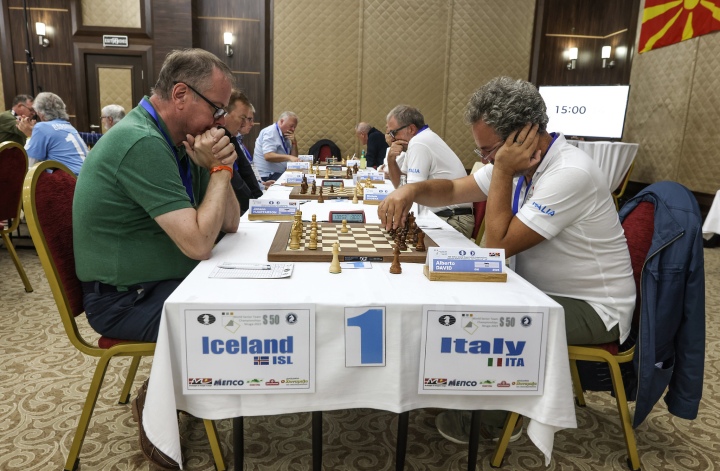
USA and Italy share first place in the S50 coming into the final round, while Germany Lasker Schachstiftung GK need just a draw in their last match to clinch the title. The penultimate round saw the favourites win their matches, and the derby on board one ended in a draw after a couple of unexpected results. Iceland faced Italy in a direct duel for the leading spot. The first game to finish was the draw on board three between Arnason (2419) and Ortega (2410). Ortega surprised his opponent with the choice of the Cordell Variation in the Ruy Lopez (1.e4 e5 2.Nf3 Nc6 3.Bb5 Bc5) and easily equalised. Moreover, he continued with confident play and obtained an advantage. The only mistake Ortega made was to accept a draw in an advantageous position. Black accepted a draw here, but it’s a risk-free position for him, and he should have continued the game, for example by 23…Qb7 24.Bb3 Bf5 when it’s clear that Black is more active. This draw could have easily made all the difference as soon enough, Thorallsson (2382) beat Bellia (2388) with the black pieces. In the Classical Sicilian, Bellia chose the Rauzer Attack, but it was Black who sprung the real surprise. In this fairly standard position, Black played the surprising 12…0-0-0!?. The move has been tested in several correspondence games with good results for Black. After the careless 13.h5?! (White had to take some measures against the threat of …d5) d5! Thorallsson already took over the initiative. Soon enough, it was Black who started an attack on the queenside, and he crowned it with a nice sacrifice. Black crashed through with 26…Rxd3! 27.cxd3 Bxb2 since the bishop cannot be taken in view of …Rb6 and …Qe5, mating, while 28.Kb1 Rb6 only prolonged the agony. At this point, the match seemed to be going in Iceland’s favour. The position on board two was drawn, and on board one, they had an advantage. A drawn position doesn’t always mean that the game will end in such a result. Godena (2429) didn’t get anything out of his favourite Alapin Sicilian against Petursson (2396), and the game slowly but surely was going towards a draw. The endgame should lead to that result with reasonable play by both sides, but something happened, and Petursson started to make strange moves. He allowed White to get the king to c4 and push b4. Suddenly, things were not easy anymore. Here, Black should have started counterplay on the kingside with 32…h4, with the idea to reduce the material there. Instead, he went for the very passive 32…Nd8? and after the natural 33.b4 White was close to winning! After the exchange of pawns on b4 it was a last chance for Black to play …h4, but he missed it, and once the pawn marched b5-b6, White had a winning advantage, which he converted. A victory for Italy almost out of nowhere! With the match tied, everything was to be decided on board one. Hjartarson (2432) seemed more patient than David (2523), who found himself under pressure soon after the opening. He saw no other way out but to sacrifice two minor pieces for a rook and a pawn. However, it was clear that the minor pieces were much stronger. White untangled with 23.Qc4 and started moving forward with Nf4. Both players committed imprecisions as the evaluation swung from better for White to better for Black, but after the time control, it became apparent that White consolidated the position. White went for 43.Nb2-c4, eyeing the d6-square. Black’s problem was that his rooks lacked open files and David tried to do something about it with 43…g5, followed by …Kg8 and …Rg7. White is winning, and the simplest way was to exchange the bishops with 46.Bf3, as White’s bishop is not very active, while Black’s is on a very solid square. White, however, went for 46.e5 but this only helped Black as it opened files for the rooks. After 46…fxe5 47.Ndxe5 gxh4 48.gxh4 Bd1! Both rooks were very active on open files. White was no longer better, but keeping in mind his game from the previous day, when he squeezed a win against Georgiev in more than 100 moves, Hjartarson kept pushing, as he knew that a win would win the match for his team and give them the lead heading to the final round. This time, he went too far with it. After massive exchanges, Black’s remaining rook broke free and started going after White’s weak pawns. The knights are notoriously bad at dealing with passed pawns on a or h files, and here Black was getting a passer on the a-file. It was now White who needed to save the draw. The position was not easy to play for both sides, but more difficult for White, who needed to find a way to deal with the passed a-pawn and also with the threat of losing the h4-pawn. Hjartarson decided to bring the king to the queenside, but here 57.Kd2? was a losing mistake. It was better to take on c6 and engineer counterplay with the passed c6-pawn. After 57…Rh3! Black was winning, but it was not simple. With very little time on the clock, David went for the safety-first move 60…Rc3, eliminating the dangerous pawn on c5. Instead, 60…Rxh4! 61.Nxc6 Ra4 62.Ka1 h4 was winning for Black. As played, White took on a2 and brought the king to b3 to secure a draw. A truly topsy-turvy match that could have gone either way! In the end, perhaps a draw was a fair result, which kept Italy one point ahead of Iceland. The other favourites won relatively easily. USA routed Uruguay 4-0. It was hardly surprising outcome as their rating advantage on all boards was several hundred rating points. Kaidanov (2549) beat Braso (2058) in a technical manner in a Catalan. Ehlvest (2530) executed a mating attack against Escofet (1902) in a French-like position arising from the Modern. Novikov (2513) easily refuted Barandiaran’s (1897) Polish Defence, and Yermolinsky (2419) overtook the initiative in a Sicilian after Barboza’s (1777) passive approach. England 1 beat Montenegro 3-1, thanks to victories on the first two boards. Adams
Carissa Yip takes the sole leadership in World Juniors
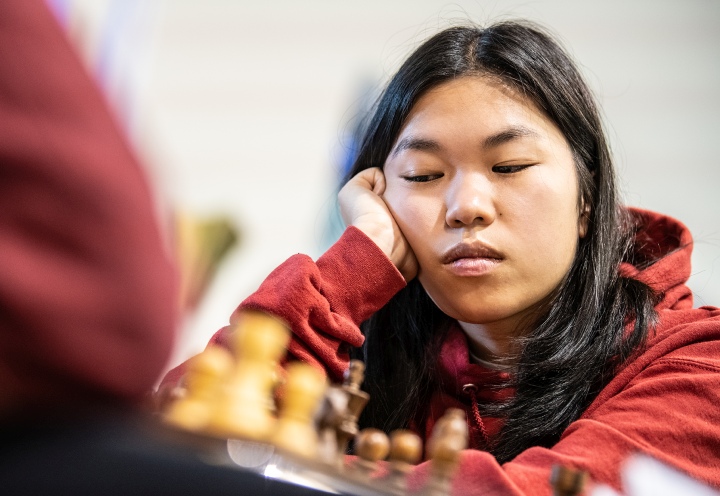
Carissa Yip is now the sole leader of the World Girls Junior Championship in Mexico after defeating Ravi Rakshitta with the black pieces. The game was a Kraumer variation of the King’s Indian, where white went for a rare move, 10.Bg5. It was precisely this bishop that would cost Ravi the game, as she gave it up (or straight away blundered it?) for little compensation nine moves later. Nevertheless, the way Carissa exploited her opponent’s mistake was truly beautiful, with her rook and knight combo completely dominating the White pieces. With this victory, Carissa became the first sole leader in the Girls’ event on 5.5/6, having defeated her two direct rivals, Mariam Mkrtchyan and Ravi Rakshitta, in consecutive rounds. After the setback in round 5, the Armenian returned to her winning ways with a very fine victory against the young Miaoyi Lu. The Chinese prodigy, with black, placed her Queen on a8 to reinforce her pressure along the long diagonal to counterweight her opponent’s Catalan bishop. However, as soon as some black pieces blocked the diagonal, the Queen found itself misplaced and far from the action, and Mkrtchyan took advantage of this fact in a masterful way, scoring a very valuable point and bouncing back from her 5th-round defeat in very convincing fashion. Sofiia Hryzlova, from Switzerland, and Beloslava Krasteva, from Bulgaria, also won in Riybd 6 and are now chasing the leader with 5/6, while Candela Francisco and Barbara Goraj drew their game on board two, which leaves them with 4.5/6. Yip, Goraj and Krasteva have been undefeated in the competition so far. In the open section, Marc Andria Maurizzi drew with the black pieces against Elham Amar of Norway. Meanwhile, five of his sixteen pursuers scored victories to catch up with the leader. For the first 15 moves, the game followed a well-known variant of the Petroff that has been played by many top GMs, but Elham deviated from known theory with 16.Bh3, which drastically changed the position. However, after the exchange of rooks, the game was completely equal, and the players split the point – probably a satisfactory result for them both. On board two, Jan Subelj obtained some initiative against Hans Niemann’s Sicilian, but objectively speaking, he never had an advantage, and the game ended in a draw by perpetual check after 36 moves. The same result was reached in the game between Arseniy Nesterov and Luka Budisavljevic after very solid play from both parts in a closed Catalan. The first decisive outcome was registered on board four, where Ruben Koellner defeated Rudik Makarian with White in a rare line of the London System. The German won a pawn in the opening and converted his advantage by weaving a lovely mating net with his rook and knight. Andy Woodward lost, with White, to Gleb Dudin, who moved to 5/6, unbeaten. Despite this setback, the hopes for the 13-year-old American to achieve a GM norm are still alive, as he is still on 4/6 and gaining 6 rating points. Maurizzi, Pranav, Dudin, Koellner, Dushyant and Santiago Avila are now all tied in first place with 5/6. The main pairings for the seventh round are Maurizzi – Pranav, Dudin – Koellner and Dushyant – Avila, all with 5/6 in the open section. In the Girls’ competition, the leader, Yip, will have white against one of the tournament’s revelations, Sofiia Hryzlova (pictured above) of Switzerland, while Krasteva will face Mariam Mkrtchyan on board two. Standings after Round 6: OPEN GIRLS Written by David Llada Photos: David Llada Official website: juniorchesschampionship.fenamacajedrez.com/
FIDE World Senior Team Championship: Day 7 recap
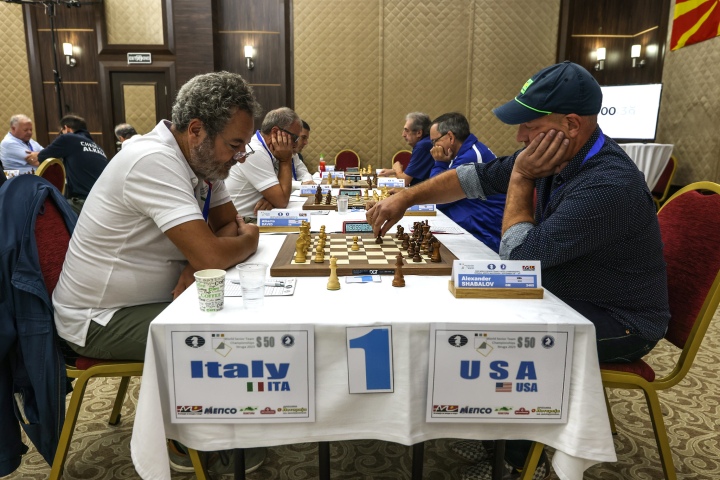
Italy beat USA to take over the top position in the S50; Germany Lasker Schachstiftung GK is unstoppable in the S65 section. The seventh round brought some unexpected results in the S50 section and very expected results in the S65 section. Italy scored a very convincing victory over USA. As the match went on, the American team didn’t even stand a chance. On board one, David (2523) demonstrated his attacking prowess and demolished Shabalov (2465) in mere 29 moves. Black’s position was already bad, but his last move 21…h6, only provoked the crashing 22.Nxf7! Qx75 23.Qg4 Kg7 24.f5! and the curtain fell just five moves down the road – 1-0. On board three, Ortega (2410) choked off Novikov (2513) in a hedgehog where, at first sight, it appeared that Black was quite alright, in view of White’s atypical placement of the pieces. It turned out however that it was a very effective setup. After 16.e5! dxe5 17.Bxe7 Nxe7 18.Nxe5 White’s initiative became too strong to contain, and Ortega didn’t allow his opponent even a single chance, winning in 36 moves. On the boards where USA was playing with the white pieces, Ehlvest (2530) couldn’t do much against Godena’s (2429) Queen’s Gambit Accepted and Yermolinsky’s (2419) misplacement of the rooks in the middlegame in the Catalan meant that he was the one fighting for equality against Bellia (2388). An impressive and dominating match for the Italian team that stepped up when it mattered most. With this victory, Italy took over the lead from USA and how sits alone at the top of the standings with 12 points. In the match between Iceland and North Macedonia Alkaloid, the first victory was scored on board three, where, in a very sharp position Bogdanovski (2385) blundered against Arnason (2419). White doesn’t really threaten much on the kingside, so Black had a chance to start his own play on the queenside with either 29…b4 or 29…Qc2. Instead, he played a defensive move 29…Rd6? which allowed White to push 30.h5, creating a real threat g5-g6. In time trouble, Black went for what looked like a simplifying sequence, missing that after 30…fxg5 31.Rfxg5 Ne3? 32.Bxe3 Qxe3 33.Qxe3 He cannot recapture on e3 in view of the mate on g8. 1-0 A balanced draw on board four between Stanojoski (2351) and Thorallsson (2382) followed before Nedev (2465) equalised the score with a win over Petursson (2396). The game was one-sided, as Black couldn’t recover from the bad opening choice he made early on. In this well-known Najdorf position arising from the line with 6.h3, Black went for the very dubious 8…d5? which led to a bad endgame after 9.fxe5 Nxe4 10.Nxe4 dxe4 11.Qxd8 Kxd8 12.Bf4. Black had problems with the pawn on e4, and while he tried to defend it with tactical means, eventually, White emerged with an extra pawn, which he converted without much trouble. With the match tied, everything depended on the result on board one. Hjartarson (2432) and Georgiev (2542) reminded us of the famous Karpov-Kasparov duels in the Classical Scheveningen. The position remained balanced for a very long time, but it was notable that Hjartarson avoided possible repetitions and kept the game going. Black should have just bided his time with 57…Qe7, for example, but he lunged forward with 57…f5? Most likely, this decision was based on miscalculation, as White could have taken the pawn on f5, either with knight or queen, which would have given him a winning advantage. However, it appears that both players were under the impression that the pawn shouldn’t be taken. The game went 58.b6 (also good) Qf6 59.Nc6? (instead of the winning capture on f5). Now Black should have played 59…Qg5, but he probably missed the drawing combination: After 59…Qg5! 60.b7 Nxb7 61.Rxb7 Rxg2! 62.Qxg2 Qh4 leads to a perpetual check. Georgiev chose 59…Qf7?! which resulted in White’s winning a piece after 60.Nd8 Qxd5 61.Qxd5 Rxd5 62.b7, but the ensuing endgame should still be a draw. White managed to win Black’s d-pawn, though it shouldn’t have sufficed. Play continued for a very long time, and the critical moment arose on move 101. White created the threat of bringing the knight to f5. Black had only one way to stop that – 101…Rb3! with the idea to pin the knight after 102.Kf4 Rb4!. Georgiev either missed White’s idea or his best defence and played 101…Re3? and after 102.Kf4 Rb3 103.Ng3, the knight was coming to f5. The game finished with a neat two-move combination. 109.Rxg7+ Kf6 110.g5+! Black resigned in view of 110…Kxf5 111.Rf7 when the rook on f1 is lost. 1-0 A dramatic win for Iceland, who are now sharing second place with USA, one point behind the leaders, whom they face in the penultimate round. In the duel of the two English teams, England 1 beat England 2 by 3-1. Adams (2662) outplayed Dishman (2304) on board one, the game ending in a pretty checkmate. White wrapped up the game with 37.Nc5 Rb4 38.Bf8 mate 1-0. What happened on board two was some sort of a mystery. After both players followed theory until move 13, Lewis (2238) chose the rare and not-very-good 13.Nf3?! instead of the theoretical 13.Qa3. After Flear (2405) replied with the natural 13…c5, White had a hallucination. Lewis played 14.Ng5?!? and after the simple 14…Qxg2, with a double attack on the rook on h1 and the knight on g5, the game was practically over. White resigned six moves later. The other two games Arkell (2352) – Clark (2278) and Stebbings (2257) – Davies (2354) were drawn without much hassle. This win allowed England 1 to stay in contention for the medals. Since they have already played all the strong teams, they can now expect weaker opponents in the last two rounds. In the S65 section, the usual suspects kept on winning. Germany Lasker Schachstiftung GK beat France 3-1 thanks to wins with the white pieces on boards one and three. The finale on board one was notable. Knaak (2438) was winning for some time, but there was no real need for Legky (2357) to blunder into a mate in one (!) with 34…Qf7?? 35.Qd6 mate. On board three, Kalintschew (2377) crowned his positional domination against Boudre (2245) with an effective exchange