

Maurizzi, Rakshitta and Yip lead FIDE World Junior Championship
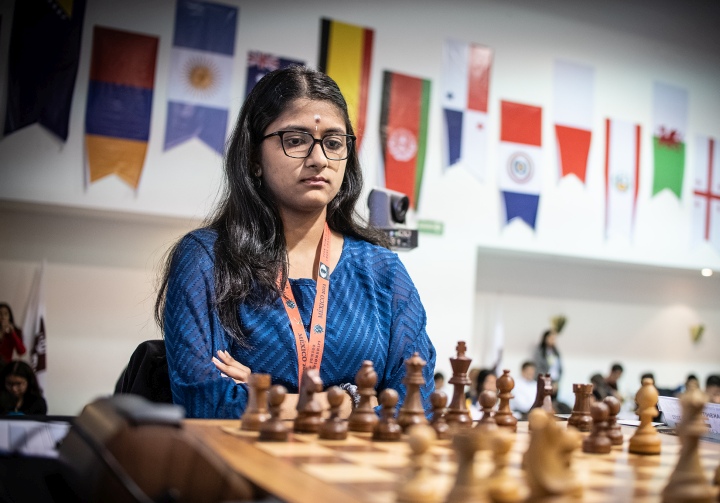
The main excitement in the 5th round of the FIDE World Junior Championships came from the Girls’ tournament, where WGM Carissa Yip made quite a statement beating IM Mariam Mkrtchyan. The Armenian had won all her 11 games at the World Championship U18 last year, and the first four games here in Mexico, but her fantastic run came to an end today. The aggressive and tactical style of the players immersed us in a chaotic game where both strived for the win. The American came up with an interesting novelty, 8.f3. A key moment in the game was the advance 16.f4?! by Carissa, which gave Mkrtchyan a clear advantage, not with just one, but several different answers. However, the position remained very double-edged, and both players made their share of inaccuracies. The Armenian missed several tactical blows that would have been decisive, and somehow allowed her opponent to survive and advance not just one but two of her pawns to the 7th rank, allowing Yip to get away with one of the biggest swindles in the competition so far. The other decisive result on the top boards came in the game between Alessia-Mihaela Ciolacu and Ravi Rakshitta. Just when the Romanian had achieved a clear edge, around move 29, she made a couple of mistakes that allowed Rakshitta to get the pair of bishops and open the position in her favour. The fatal mistake was 53.Nxc5?, a move that tied the White King to the defence of the Knight. A fine swindle too by Rakshitta, who comes from chess-playing parents with international titles and several medals at national and regional championships. She will have the White pieces against Carissa Yip in the sixth round against her co-leader, in a game that could be decisive for the final victory. In the open category, French Grandmaster Marc’andria Maurizzi continues to lead. He drew, with the White pieces, against Arseny Nesterov, in a very correct but not-so-exciting game. ”It was a solid game where there were no combat opportunities”, summed up Nesterov in the post-game interview. This result was good enough for Maurizzi to continue leading, as all the games in the top seven boards ended with the same result. He is followed by no less than 16 players with 4 points; among them, the Americans Hans Niemann and Andy Woodware, who won their round 5 games, as well as Latin American Santiago Avila Pavas. Monday 25 will be a rest day, and most of the players will take an excursion to the Pre-Hispanic City of Teotihuacan, some 50km northeast of Mexico City, to visit the pyramids. Built between the 1st and 7th centuries A.D., this archaeological site is characterized by the vast size of its monuments – in particular, the Temple of Quetzalcoatl and the Pyramids of the Sun and the Moon. Play will be resumed on Tuesday, at 16:00 local time (-7 GMT) Standings after Round 5: OPEN GIRLS Written by David Llada Photos: David Llada
Chess for Protection: Two years and counting
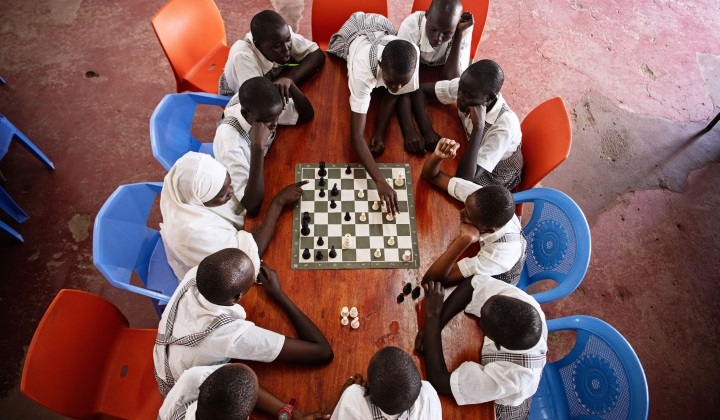
The game of chess greatly benefits society, as it offers people the opportunity to reach their full potential, regardless of their background, by gaining self-confidence, experiencing social integration and learning valuable life skills. It is the primary aim of the Chess for Protection project, implemented in collaboration with the International Chess Federation, UNHCR, the UN Refugee Agency, the Lutheran World Federation (LWF), the Kenya Chess Federation and the Kakuma Chess Club. The program, launched in August 2021, consolidates and develops chess-related activities in Kakuma Refugee Camp in Kenya. It is now entering its third year of running. A chance to heal, develop and grow “In FIDE, we really believe that chess is more than a game; it is a tool to improve the so-cial environment for millions of people. Kenya has the second biggest refugee camp and the third biggest slum in the world. Over 55% of the refugee population here are children and adolescents. Chess as a part of the extra-curricular activities will undoubtedly contribute to the well-being of youth, their psychological needs and their development. FIDE thanks UNHCR, LWC and Chess Kenya for their support in carrying out this very important social project,” says FIDE President Arkady Dvorkovich. Forced to flee their homes, the refugees are exposed to extreme stress that may impact their psychosocial well-being. Most of them are not engaged in any income-generating activities, which leaves them vulnerable to risks of being involved in dangerous behaviour – crime, violence, drugs, and gang activities – as a means for coping with the situation. That is why it is critical to ensure youth are engaged in meaningful activities where they have a chance to heal, develop and grow. And chess can help with this. “This is not just about chess; it’s about giving dreams to children and youth. This is particularly important when it comes to the lives of people in vulnerable situations. There’s strong evidence that chess increases analytical skills, self-esteem and the understanding between the cause and the consequence. Besides, it teaches not only how to win but also how to cope with defeat. Pupils attending chess classes are not only experiencing self-improvement and self-growth, they also bring enthusiasm and inspiration to their communities, acting as agents of positive changes there,” says Dana Reizniece-Ozola, Deputy Chair of the FIDE Management Board. Over the last two years, more than 2,000 refugees were introduced to chess, 36 chess clubs were established in Kakuma refugee camp and Kaloboyei settlement, over 350 chessboards were bought for these clubs, 21 facilitators were trained and are now teach-ing chess in the region, as part of the Chess for Protection project. Besides, FIDE provided fourteen bicycles and one motorbike for the mobility of those trainers. It did not take long to see the results of such efforts. “I’ve supported the project since August 2021, and it’s been such a rewarding experience for me. The chess program is having such a positive impact on the lives of the students – they are concentrated and focused at school, and they are competent problem solvers – all of them are becoming better students because of their participation in the chess group,” says Ina Guya, Protection Associate in Kakuma refugee camp. “Through the series of games and tournaments, the players have learned to manage their emotions, handle wins and losses gracefully, and cope with frustration when things don’t go as planned.” Women’s empowerment through chess In parallel with training the youth and kids in Kenyan schools, FIDE focuses on empowering young females and girls. Many of them find it difficult to meaningfully engage in education and extra-curricular activities due to negative cultural norms that often prevent them from equal access to opportunities. Chess for Protection project includes activities of the Girls Club, where, apart from playing chess, club members are meeting and communicating with successful women, reading and discussing books, attending painting workshops and many other classes. Spearheaded by Anastasia Sorokina, Chair of the FIDE WOM Commission, the project was first launched in 2021 in Angelina Jolie Primary School in Kakuma with an attendance of 40 students. After two years of running, it now includes three girls’ boarding schools in the region – Angelina Jolie Primary School, Morneau Shepell Secondary School and Bhar-El-Naam Primary School – with 250 refugee schoolgirls having chess classes twice a week. “When we embarked on this adventure, our goals were clear: to introduce chess to young girls and foster their creative development. And we are on the way to achieving that and so much more,” says Anastasia Sorokina. Female students attend online lessons by WGM Anastasiya Karlovich (UKR) and IM Salome Melia (GEO). They also study and play chess with a local tutor. “We started with groups of girls who may not have known what chess was, but they embraced the opportunity to learn with open hearts and minds. Week by week, they learnt little by little, from how to move pieces and set up the board to the more complex strategies. Their determination to improve their personal chess skills was truly inspiring,” says IM Salome Melia, chess trainer of the Girl Club Project. “We have had the pleasure of getting to know these girls and seeing their progress and growth of self-esteem and confidence. Their determination and positive attitude demonstrate that chess is not just a game; it’s a powerful instrument of transformation, a gate-way to a world of endless possibilities. The progress these girls have made fills us with happiness, and we can’t wait to see them in Kakuma in person one day,” adds another chess trainer, WGM Anastasiya Karlovich. For some of these girls, chess is just a tool to improve their school performance, problem-solving, and analytical skills; others wish to become professional chess players. “I have learned how to play chess in my school club, and I really like the game. It helps me a lot in my everyday life, improving my thinking and behaviour. It is not so easy to learn the game, but I see the progress all the time. I like to play with
FIDE World Senior Team Championship: Day 6 recap
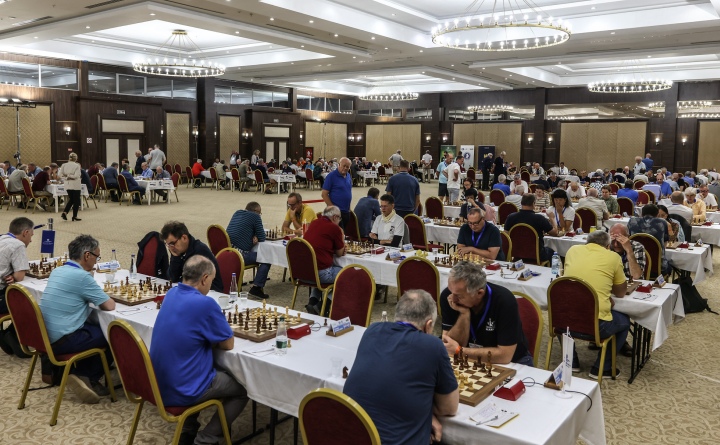
USA grabs the lead in S50; Germany Lasker Schachstiftung GK tops the standings with a perfect score in the S65 section. In Round 6, the number of draws remained the same, but what increased was the number of blunders. In the duel of the leaders, USA and Iceland, both on 9 points, the Americans made solid draws with Black on boards two and four, Kaidanov (2549) drawing Petursson (2396) and Yermolinsky (2419) drawing Thorallsson (2382), but this didn’t mean that their players with the white pieces had everything under control. True to his creative style, Shabalov (2465) found ways to unbalance even the slow and strategic Chigorin Variation of the Ruy Lopez. However, Hjartarson (2432) was up to the task, and the complexity of the position made the evaluation swing drastically. Both players missed chances, but none too obvious. Here’s the last moment in the game when Black could have won. The mess is obvious. White’s last move. 41.Ne3xf5 was a mistake. Better was to play 41.Rcg1, but even there, the position continues to be extremely complicated. In the position on the diagram, Black should have taken on f4 (instead of g6 as in the game) and after 41…Bxf4! 42.Rg4 Bxc1 43.Ne7 Kg7 44.gxh7 Kf7 45.Ng8 Bb2! manages to stop the h-pawn from promotion. In spite of being a full rook down, White can continue to create problems with 46.Bg6 Kg7 47.Be4 Kh8 48.Ne7, etc., but objectively Black should win. By taking on g6 Black allowed a pretty and very unusual construction that forced a perpetual check. White’s last move was 44.Bf5 and after Black took the rook, White gave perpetual with Nc8-d6. A unique harmony of the white pieces! The decisive win was scored by Ehlvest (2530) on board three against Arnason (2419) in another Ruy Lopez. White obtained an advantage after the opening in which Black missed an important zwischenzug and from then on, it was a game with only two results possible: a win for White or a draw. Ehlvest was not always very precise, letting his advantage slip away, but that was never obvious, and Black failed to make the most of his chances. The critical moment was just before the time control. White has just played 39.Bc3, threatening Qf6. Black’s only move was 39…Ne5, but he vacillated for one move too long with 39…Qd7? after which 40.Qe4 (40.Qh3 was even stronger) followed by Qd4 led to White soon winning a pawn. The rest of the game was exemplary, with the final zugzwang illustrating the domination of the bishop over the knight. Black chose 67…Nb1 and lost the knight after 68.Be3 and Kb2, but going to b5 wasn’t much better, as after 68.f4 Kb7 69.Kc4 Ka6 70.Kb4 Black ends up in a lost pawn endgame as the knight has no moves. An extremely important win for the USA, now leading the event as sole leaders. The match between Italy and Austria was riddled with blunders. The first game to finish was on board four, where Denk (1581) didn’t really have to lose in mere 7 (!) moves to Borgo (2333). White didn’t play the opening too well, but there was no need to play 7.Bb5?? After 7…Qa5+ Black won the b5-bishop. Denk resigned. Soon after, Opl (2151) blundered against Bellia (2388). Instead of the normal 19…Kh7, defending the pawn on h6, Black went for a “combination”. He played 19…Qf6? and after 20.Bxh6 Bxh6? (sticking to his plan) 21.Qxh6 delivered his shot 21…Bxh3, missing however 22.Ng5, both threatening with checkmate on h7 and attacking the bishop on h3. Naturally, Black resigned. On board two Ortega (2410) perhaps thought that the Austrians had been too kind. Against Druckenthaner (2182) he had the advantage, but misplayed it and reached the following position. After 35…Rxa5 36.Rh8 Kg7 37.Rxe8 Nxd5 Black should draw, but instead, he chose the suicidal 35…Ra8?? 36.Rh8 Kg7 37.Rxa8, which left him a full rook down. The stabilising presence on board one was Godena (2429), who managed to draw from a winning position a full exchange up against Denk (2186). It should have been a convincing win, but even a minimal one would do for the Italians, who are now second, only a point behind USA. The match between North Macedonia Alkaloid and England 1 was no less dramatic. On board one Adams (2662) seemed to surprise Georgiev (2542) in the opening and quickly took the initiative with the black pieces. The initiative was transformed into an extra pawn that Michael carefully nurtured to a win in 60 moves, without allowing his opponent a single chance. There were two relatively calm draws on boards two and four, where neither Emms (2448) could pose serious problems to Bogdanovski (2385) nor Davies (2354) could create much against Kutirov (2274). All the drama unfolded on board three in the game between Stanojoski (2351) and Arkell (2352). Playing his favourite Caro-Kann, which was met by Stanojoski’s favourite Exchange Variation, Arkell was fine after the opening, but allowed White to expand too much on the queenside. Then it was White’s turn to mess things, and he did so badly. The knight jump to e5 was bad as after the exchange there Black now played 25…Rc3! The queen had to go to f4 since 26.Qd2? Rg3 loses. After 26.Qf4 f6! 27.Bb8 Rcc8 suddenly the bishop was trapped on b8 and Black was a clear piece up! Stanojoski continued as if nothing had happened and Arkell started to play passively, moving his pieces to the last rank. He was still winning, but it was obvious that he wasn’t getting closer to victory. Then, just before the time control, he blundered all of his advantage. Instead of 38…Qf8 or 38…f5, he played 38…Be4? (which was good some moves earlier) and after 39.Bxe4 dxe4 40.a5 all of a sudden, White was not lost anymore! The activity of White’s pieces, the passed a-pawn and the passivity of the black pieces balance each other out. Arkell continued to play with a great degree of hesitation and soon enough blundered again. Here, probably the simplest was 44…Rf8, avoiding any tricks based on Rxf6, but moves like 44…Kg7 or 44…Rc1 were fine too. Instead, after 44…Rc7? 45.Rb6! with the threat of Rb7 White was winning! Probably in a state of
World Junior Championship U20: Maurizzi and Mkrtchyan, first sole leaders after four rounds
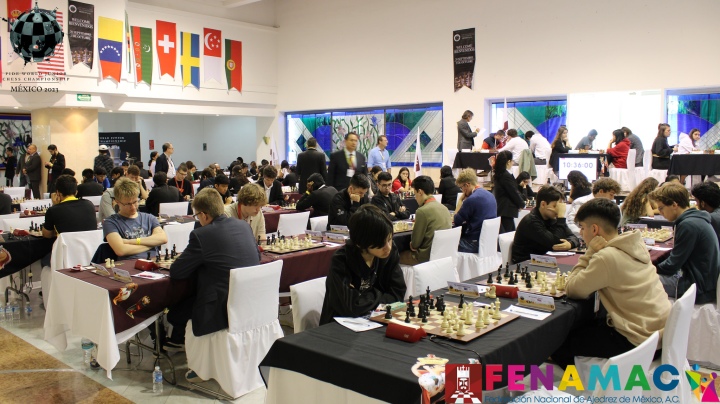
After three days of play and four rounds, GM Marc’Andria Maurizzi (France) and WIM Mariam Mkrtchyan (Armenia) have emerged as the first sole leaders at the FIDE World Junior Championships in the open and girls’ sections, respectively. They are the only players with a perfect score of 4/4. In a field that includes a total of 14 GMs and 29 IMs, the main favourites in the open were the top-seeded GM Hans Niemann (2667), from the USA, and German GM Frederik Svane (2626). Two other serious contenders are GM Anand Pranav (2509), the current U-14 world champion, and the 2022 World Champion U-18, the Canadian IM Shawn Rodrigue-Lemieux (2485). Also notable is the presence of young chess players such as the 14-year-old American IM Andy Woodward and the Colombian Andres Garzon (2144), who is just 12 years old. The first two rounds were smooth sailing for the top seeds, winning their games with relative ease against lower-rated opponents. The first upset came in round three when GM Hans Niemann (2667) was defeated in a compelling way by his compatriot, the 13-year-old American IM Andy Woodward (2480), the youngest titled player in the field. Woodward demonstrated superb preparation for this game and played a relatively new idea against the English opening, previously used by Daniil Dubov, which involves a pawn sacrifice on e5. In this position, although White is slightly better in theory, Black has a strong initiative and it is not easy for White to find the right path. And that’s exactly what happened: on move 21, an inaccurate move by Niemann led to his loss. IM Woodward couldn’t hide his enthusiasm and ambition at the end of the game. “I am definitely very happy, and I will continue fighting all the games until the end, without giving up”, he said in this interview. He also mentioned that he already has two GM norms, and his goal is to achieve the third one in this event, besides earning some rating to close the gap to the 2500 threshold required to get the title. Another interesting result was the draw achieved by the highest-rated Mexican player in the field, IM Sion Galaviz (2462), who drew against the Indian GM Anand Pranav (2509). The games became much closer in round four, where the strongest players began to cross paths. Some well-fought games ended in a draw on the top boards, like the ones between GM Ruben Koellner (2485) and GM Arseniy Nesterov (2575), the Colombian GM Santiago Avila (2510) and American IM Kirk Ghazarian (2473). In the co-leader clash after day two, French GM Marc’ Andria Maurizzi (2555, pictured below) won his game, beating the previous day’s hero Andy Woodward (2480). In the Girls’ category, the course of the event followed a very similar script, with the main favourites imposing their better play against their opponents in the first three rounds. One of the few upsets was a half-point conceded by current American Continental Champion, WGM Candela Francisco (2345), who was held to a draw by WIM Zeinep Sultanbek (2022) from Kazakhstan. The top seed, Carissa Yip (Elo 2372), won her first three games, but in the fourth round, she had to settle for a draw against WFM Tatyana Getman (2172). The American prodigy didn’t get anything from the opening, a King’s Indian, and after the queens’ exchange, Carissa opted to go for a line that forced the draw by threefold repetition. This result allowed WIM Mariam Mkrtchyan (pictured below) to become the first sole leader of the event, as the Armenian won her game with White against WIM Sofiia Hryzlova. It was a close battle, but at some point, Sofiia decided to sacrifice a pawn to open lines against the enemy king but did not get enough compensation. Mkrtchyan was ruthless in converting her advantage, and she won her fourth straight game, the result that reminded of her dominant performance at the World Championship U-18 last year in Mamaia, where she became the winner with an astonishing score of 11 out of 11. The Girls’ category also includes some young prodigies that so far have left a very good impression with their play: 8-year-old Romi Milner (1856), from the USA; the Pan American Champion, 10-year-old Mia Guzman (1753) from Mexico; and 14-year-old WIM Miaoyi Lu (2214), from China. The most interesting clashes in Round 4 are Marc Andria Maurizzi (4) vs Arseniy Nesterov 2575 (3½) and Rudik Makarian (3½) vs. Anand Pranav (3½), while Hans Niemann (3) will take on GB Harshavardhan (3). In the Girls’ section, Carissa Yip (3½) will have White against Mariam Mkrtchyan (4), a matchup that has all the makings of a stellar duel, while on board two, the young prodigy Miaoyi Lu (3½) will face the much more experienced Candela Francisco (3½). The 5th round begins at 16:00 local time (GMT-7). Written by David Llada Photos: official webste and David Llada Official website: juniorchesschampionship.fenamacajedrez.com
Chess returns to 2023 Asian Games in Hangzhou, China
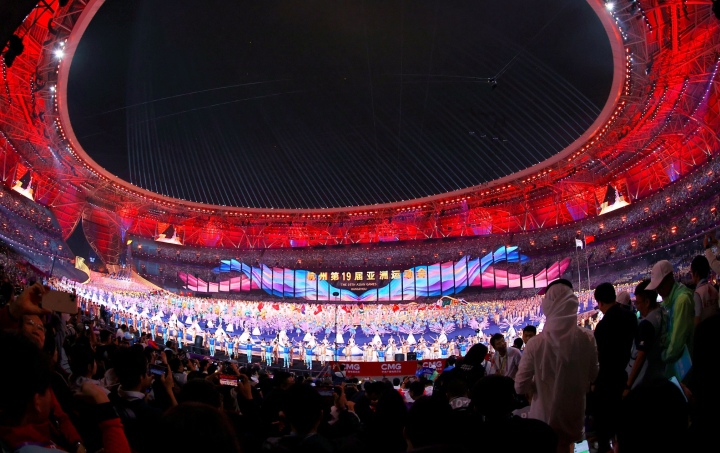
After a 13-year hiatus, chess is back to the 2023 Asian Games, which officially started on September 23, in Hangzhou, China, with a glittering opening ceremony. This return will give our game broad exposure in one of the world’s most dynamically developing parts. “Chess belongs to the family of mind sports that have a special place in the Olympic family. Currently, the International Olympic Committee doesn’t foresee chess to be included in the 2024 and 2028 Olympic games. But the development that we saw during the last few years with FIDE’s active participation gives us real hope that we will be able to include chess in Continental Games. Asian Games is one of such examples. Chess was an exhibition sport in the European Games and African Games. It is a part of the official program in some American Games, including the Central American and Caribbean Games, this year. It is a very good development. I hope that at some point a chess player will become an Olympic champion,” said FIDE President Arkady Dvorkovich in his exclusive interview with CGTN’s Liu Xin. The chess program of the 19th Asian Games features four competitions: men’s individual, women’s individual, and men’s and women’s team tournaments. The individual events with rapid time control run from September 24-27, while team competitions with classical time control will stretch from September 29 to October 7. The list of the countries-participants includes Bangladesh, China, India, Indonesia, Iran, Japan, Kazakhstan, Rep of Korea, Kuwait, Kyrgyzstan, Mongolia, Philippines, Qatar, Singapore, Sri Lanka, Chinese Taipei, Thailand, UAE, Uzbekistan and Vietnam. Many countries fielded their top players for this prestigious sports forum. We will see in action such strong and popular players as Hou Yifan, Tan Zhongyi, Zhu Jiner, Bu Xiangzhi, Wei Yi, Harika Dronavalli, Humpy Koneru, Gukesh D, Arjun Erigiasi, Vidit Gujarathi, Praggnanandhaa R, Pentala Harikrishna, Parham Maghsoudloo, Amin M. Tabatabaei, Zhansaya Abdumalik, Bibisara Assaubayeva, Dinara Saduakassova, and the winners of the 44th Chess Olympiad Nodirbek Abdusattorov, Javokhir Sindarov, Jakhongir Vakhidov, Shamsiddin Vokhidov and Nodirbek Yakkuboev. Photo: official website Official website: hangzhou2022.cn/
FIDE World Senior Team Championship: Day 5 recap
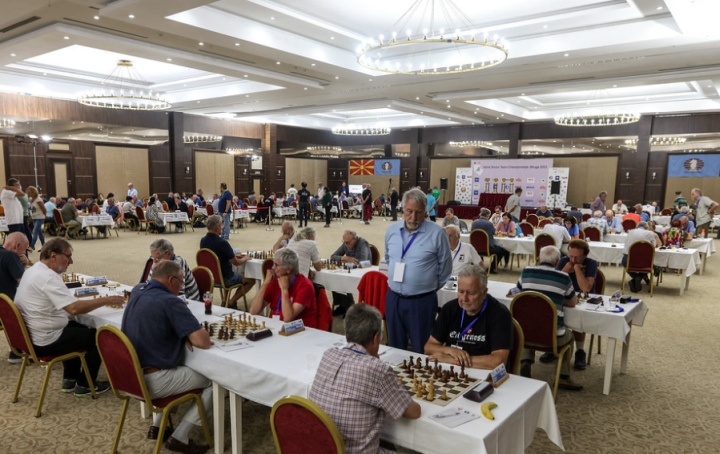
Iceland and USA are tied for the first place in the S50 section, closely followed by Italy; Germany Lasker Schachstiftung GK solely leads in the S65, with England 1, Slovakia and France trailing by two points. In the fifth round, we saw more draws than usual. Time will tell whether these were the result of match strategy, fatigue, or conservation of energy for the final rounds. The derby on the top board between USA and England 1 saw three relatively early draws. On board four, Davies (2354) had a very pleasant position with the black pieces against Novikov (2513) after successfully getting out of the opening in the Queen’s Gambit Declined with 4…a6. In the position where he offered a draw, Black was in no danger whatsoever and could have played on for a very long time. Black has a safe edge and can play on forever against White’s isolated pawn. The draw offer was surprising, especially as it was the only position where the English team could press without any risk. On board one, Adams (2662) offered a draw in a position that he didn’t really fancy, unlike the engine. The position was to Shabalov’s (2465) taste as Black was active on the kingside, but objectively, White had little to fear. Adams’s last move 19.Ra7 was a good one. Things are complicated, though, as after 19…Bc6 White needs to play 20.g3! Nh3 21.Kf1, with an advantage, but this is far from obvious. Black’s best is 19…Bd5, which leads to a messy position after 20.Rxd7 Qh6. So Adams made a practical decision to offer a draw, which was accepted. On board three Flear (2405) prepared the modern line with Bd2 in the Rubinstein Variation of the Nimzo-Indian against Ehlvest (2530) but didn’t achieve much. Ehlvest offered a draw on move 24 in an equal endgame. These draws meant that the fate of the match was in the hands of Kaidanov (2549) and Emms (2448). White won a pawn in the opening, but Black had good compensation for it. The game soon transposed to a theoretically drawn rook endgame. White played 29.Re5 in order to defend the pawn from the side with Re3. Emms defended well and successfully reduced the number of pawns on the kingside. Black waits now. White’s only try was to advance the pawn to b6 and then to try to capture the pawn on g4. On move 52, the critical position emerged on the board. Black now has a choice whether to play 52…Kg7 (in order to be ready for a possible b7) or to play 52…Rb4 first and then …Kg7. Unfortunately for Emms, after many hours of accurate defence, he made the wrong choice. The correct move was 52…Rb4! defending the pawn on g4 and only in case of 53.b7 playing 53…Kg7. Then the game and the match would have been drawn. After the mistake 52…Kg7? 53.Kxg4 Rxf2 54.Kg5, the position is won for White. White wants to transfer his king b7, but there is another threat – Rb7-c7 followed by b7, Rc8 and b8Q. Black tried to prevent the second threat and played 54…Rb2, but after 55.Rb7 Kf8 56.Kf6 The threat of mate meant that the black king needed to move. Going to g8 allows the white king to penetrate the queenside, but he could only postpone that as after 56…Ke8 57.Ke6, Kd8 fails to 58. Rb8 checkmate. Black started giving checks from behind, but the white king hid on b8 when the game was won with the elementary technique of building a bridge (the Lucena position). It was an incredibly important win for USA against one of the main competitors that allowed them to keep pace with Iceland, who also won their match. Iceland didn’t have much trouble with Montenegro. The draws on board one and four (Nikcevic (2358) – Olafsson (2491) and Thorallsson (2382) – Miljanic (2331), respectively, were from position of strength, while the Icelanders completely outplayed their opponents. A curious case happened on board three in the game Podlesnik (2289) – Arnason (2419). The game should have been drawn, but White blundered in the rook endgame and lost a couple of pawns. Then, unexpectedly, he was given a chance. Black’s last move 42…Rf5-e5 was a mistake, as the rook should have moved along the f-file to f2 or f1. Here, White should have played 43.Rd7! and the manoeuvre 43…Rh5-g5-g7 to defend the pawns doesn’t work in view of 46.Rd8 and White goes after the a7-pawn, with a drawn position. White missed this chance and played 43.a6? but after the simple 43…Re2 with the idea of …Ra2xa6 Black emerged two pawns up. On board two, Petursson (2396) defeated Pajkovic (2412) in convincing fashion. Italy continued their winning ways and beat Slovakia 3.5-0.5 with only Mrva (2361) managing a draw on board one against David (2523). Godena (2429) bested Motuz (2279) in spite of allowing an accidental drawing chance in a winning position that his opponent didn’t take, Ortega (2410) displayed exemplary technique against Dobrotka’s (2207) IQP and Borgo (2333) was superior in the complications after the opening against Kantorik (2195). The team North Macedonia Alkaloid beat Poland in a professional fashion. They had a huge rating advantage on board three, where Stanojoski (2351) faced Flis (1948) with the white pieces. So they left him to win the game while all the others drew without much fanfare: Georgiev (2542) drew Gdanski (2484), Nedev (2465) drew Sapis (2375), and Kutirov (2274) drew Masternak (2314). In the S65 section, the German team Germany Lasker Schachstiftung GK continued their excellent run, beating Israel 3-1. On board one Knaak (2438) defused an early attack and converted the extra pawn against Gruenfeld (2388), on board two Meister (2439) won a drawn double-rook endgame against Birnboim (2346) after the latter made two consecutive big mistakes. On board three, Kalintschew (2377) continued a winning streak in his unassuming way – this time Kagan (2244) managed to turn a completely harmless position on the white side of a Maroczy Bind into a lost one in several moves. On board four,
Carlsen denies Nakamura sixth straight Speed Chess title

GM Magnus Carlsen ended GM Hikaru Nakamura’s incredible run of five titles in a row with a thrilling 13.5-12.5 victory to clinch Chess.com’s flagship 2023 Speed Chess Championship Presented by Coinbase. The Norwegian got off to a strong, two-point start, but the ever-resourceful Nakamura fought to take a three-point lead in the 3+1 portion. After changing shirts, the former world champion evened the score just before the bullet section. Just as Carlsen started pulling away in the second half of the bullet, Nakamura won on demand. The latter was on the verge of winning the last game to tie the score but allowed an unforgettable double rook sacrifice that sealed the deal. Fans will not wait long to see this pairing again. They two speed demons are paired on the first day of the Champions Chess Tour AI Cup 2023 which starts on Monday at 12 p.m. ET / 18:00 CEST / 9:30 p.m. IST. This was far from their first Final in the SCC—it was their fourth. Carlsen led their encounters 2-1, but Nakamura won his first in 2022. That match went down to the wire and was decided in the very last bullet game too, where Carlsen was a hair’s length from reaching overtime. Nakamura celebrated his victory while down two queens as the match clock expired. Going into this year’s match, Carlsen led their head-to-head encounters on Chess.com in both bullet and blitz time controls. He was clearly the statistical favorite, but we have seen reality take its own form time and time again. SmarterChess agreed, showing a slight preference for Carlsen’s chances. While it estimated their chances to be equal in the 5+1 and 1+1, it forecasted Carlsen’s edge to lie in the second portion. Curiously, that was the one segment he didn’t win. “This is as good as it gets. Speed chess matches between Hikaru and I, be that blitz, or rapid, or even bullet, that’s as good a show as it gets,” said Carlsen after last year’s exhilarating Final. And this year only raised the bar again. 5+1: Nakamura 4-5 Carlsen The first half of this portion was the calm before the storm. In the first five games, Carlsen scored one victory and four games were drawn. The last four, on the other hand, were all decisive. Carlsen took the first full point in game two, a Ruy Lopez Berlin Defense that took on the shape of a Benoni Defense. The world number-one hit his rival with the ol’ “sealer sweeper” sacrifice, 27.e5! followed by 28.f5, and closed out the game with a satisfying blow 32.Rxe7!, winning a piece. 1-0 The next three games ended in draws. But on the other side of that equilibrium, the games were decisive at every turn. Carlsen took a two-point lead after finding a tricky resource, 51.d6!, in mutual time trouble. But Nakamura proved his resilience as well, bouncing back in the next by winning the objectively drawn rook and bishop vs. rook endgame. Carlsen won the next after firing the cannonball 21.Bxh6! followed by a winning attack. The last game of the match was nervy and explosive. Both players were winning at various points, although the psychological trend was certainly in Nakamura’s favor for most of it. In mutual time trouble, the American GM prevailed. 3+1: Nakamura 5-4 Carlsen Before this year, Carlsen had never lost a 3+1 portion against Nakamura in the SCC. It was a great start for the five-time SCC champ as he scored four wins in the first five games. At the halfway mark, Carlsen changed shirts and, when he returned, evened the score. Nakamura played a gorgeous attack in the first game, finishing it with a lustrous queen sacrifice on the last move, 24…Qxg3!!. This would have been our Game of the Day had it not been for the last game of the match. Nakamura won with an attack just as crushing in the next game. Suddenly, he led the match for the first time. After a draw, he won two more. Both were defensible endgames where Carlsen, with almost no time, collapsed. The first one was a rook endgame, and the second featured a piece sacrifice by Nakamura for two connected passers. “This was the most unbelievable endgame yet,” said Naroditsky about the second, while Hambleton added: “Have you ever seen a mic drop in chess? This was one of them.” Nakamura stood up emphatically and walked away as Carlsen remained in his chair looking at what went wrong. “Carlsen” and “losing equal endgames” are frankly never uttered in the same sentence, unless the latter refers to his opponent. Carlsen returned from the half-point break wearing a new shirt, the same one he had worn when he beat So on Tuesday. It seemed to work as he won two consecutive games. Then a draw. And, finally, came the last game of the segment, where he pulled the vintage Magnus endgame squeeze to tie the score. Carlsen, when asked whether changing shirts helped, responded in the post-match interview: “The result sort of speaks for itself.” The score was 9-9. One half-hour left. The stage was set for drama, and the players delivered. 1+1: Nakamura 3.5-4.5 Carlsen The only other SCC Final tied at the end of 3+1 portion was Nakamura vs. So, 2018, which was tied at 10-10. Nakamura went on to win in the bullet. In this one, Carlsen had a lousy start; then he picked up speed. The first game was a terrifying one for Carlsen fans as he hallucinated and gifted his opponent a queen. He would later say: “I did feel that from last year and the Bullet [Chess] Championship this year, that I know I could come back from a reasonable deficit. So I knew that it was all about whether my brain could start working.” And start working it did. He won three of the next four games. First, it was a same-colored bishop endgame, then a razor-sharp heavy-piece endgame, and finally, a conversion of two pigs on the seventh.Carlsen led by two. But Nakamura won on demand after Carlsen’s clever but
FIDE World Senior Team Championship: Day 4 recap
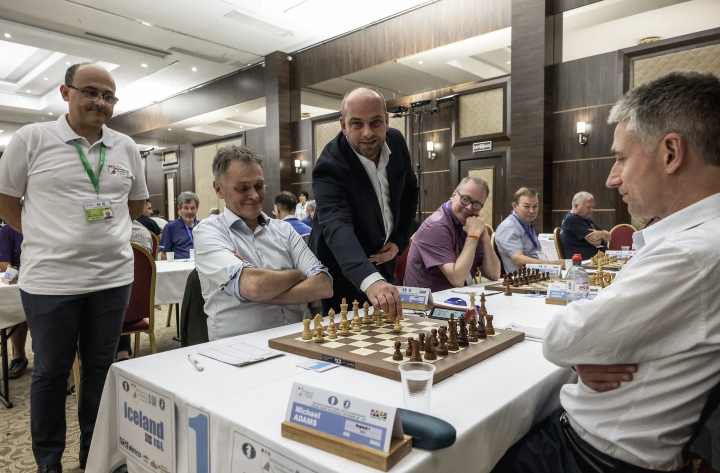
The fourth round saw tense matches and exciting turnarounds in the duels of the favourites. Two teams with the perfect score 6/6, Iceland and England 1, clashed in the central match of the day in the S50 category. The English players didn’t pose serious problems with the white pieces, as Emms (2448) couldn’t create anything against Hjartarson’s (2432) French Defence, and Arkell (2352) was similarly toothless against Thorallsson (2382). All the action happened on the odd-numbered boards. Facing Olafsson (2491) with Black, Adams (2662) chose an old favourite of his, the Queen’s Indian. The opening went surprisingly well for Black, and soon enough, he started to think about being better. Black jumped 16…Nc3 and after 17.Bxc3 dxc3, the pawn on c3 became a dangerous asset, especially as it could be supported by …Bf6. Both sides placed their pieces on natural squares, and on move 21, White embarked on a strange-looking manoeuvre. In view of White’s last move 20.h4, Adams expected 21.Ng5 here, with ideas like Qh5 or Nge4, but instead of that White played 21.Bh3 with the idea of Bf5-b1! The plan was to control both a2 and c2 in view of the impeding …Nb4, but Adams already felt that this wasn’t quite right for White. The critical moment came on move 25. Adams expected the exchange of rooks on d8. Black should still be winning, but it would have been more difficult than in the game. White played 25.Bd3? and after 25…Nb4 was forced to go back 26.Bb1, which obviously only helped Black. After 26…Qg4 White’s position collapsed, and he resigned after 27.Re1 Bxc4 28.bxc4 c2 as Black wins material. During the post-game interview on the live broadcast, Adams showed a fantastic line, which, although far from forcing or even very relevant, I have to show. Michael calculated this during the game, though he realised White’s last move 29.Qd6? was bad (better was 29.Nd6). But here he was quite happy to find 29…Qxf3!! 30.Kxf3 Nd4 31.Kf4 Nd2 mate! A position that deserves a diagram! Unfortunately for the English team, on board three, Flear (2405) couldn’t withstand the pressure in spite of defending well for some time against Petursson (2396). Here, the only move was to exchange queens by 28…Rxd4 29.Rxc7 Ra4, though White is certainly still better. However, the retreat 28…Qc8? lost on the spot in view of 29.Qd6 and after 29…Be8 30.Bxe5 fxe5 31.Qe7 Black resigned as mate will soon follow, even if he gives up a piece to postpone it. USA were very lucky to beat England 2, and for that, they had to thank Shabalov’s magic on board one. Shabalov’s (2465) attack was finely repulsed by Dishman (2304) who obtained a winning position. The price he had to pay was time-trouble. It was here that Shabalov used all his imagination to sow chaos on the board. By that point, the position became unclear and a total mess, with both players making. The best for White would have been 32.Rfd1, but instead of that, Shabalov took the pawn with 32.Rxf5. Here Black was winning with 32…Rc4!, although 32…Rxg2 and 32…Nd4 were also tempting, though not winning. In severe time scramble, Black simply blundered the pawn on f6 with 32…Ne7?? and after 33.Qxf6 White won. Before this win, USA was leading 2-1 thanks to a technical win by Novikov (2513) against Clark (2278). Black sacrificed a pawn as early as move 4 (!) in the Grunfeld. Instead of the usual 4…Nxd5, Black played the surprising 4…c6!? and obtained some compensation for the pawn after 5.dxc6 Nxc6 6.e3 e5, but didn’t make the most of it. White consolidated and converted the extra pawn. The games on boards two and four between Lewis (2238) and Kaidanov (2549) and Stebbings (2257) and Yermolinsky (2419) respectively, ended in calm draws. The match between Italy and North Macedonia Alkaloid saw incredible twists and turns. The first game to finish was David (2523) – Georgiev (2542) where Black masterfully outplayed his opponent. Black risks ending up in a passive position, and after a long thought Georgiev came up with what he called “the only move” 14…f5! Black must create activity and inject dynamism into the position. Over the next several moves, Black gave up the bishop pair to wreck White’s structure by taking on c3, making all White’s pawns isolated. The key moment was on move 20, when Black found a wonderful manoeuvre. After 20…Nd8! Black achieves beautiful harmony – the knight defends both weaknesses on e6 and b7, and Black threatens …Bc6 to exchange the defender of the white king. White’s situation was compounded by the severe time-trouble that he entered. David resisted but still blundered in the end. White’s last move was a mistake, though his position was not one to be envied. Black wrapped up with the cute 28…Rg3+! This win gave the Macedonian team the early lead. They had great positions on the remaining three boards as well. However… Thanks to his good preparation Nedev (2465) achieved an advantage both on the board and on the clock against Godena (2429). Here, White should have played 21.Rxe5 Nd7 22.Re7 Nxb6 23.Rxb7 Nxa4 24.Bxc4, but instead of that, he blundered with 21.Bc7? After 21…Nd7! the tables suddenly turned around – Black consolidated his position, and the bishop on a2 and White’s pawns became easy prey. Although Black had only a couple of minutes to reach time control, he was up to the task and scored a full point. On board three, again, thanks to very good preparation, Bogdanovski (2385) obtained a better position with Black against Ortega (2410) in the Exchange Variation of the Slav. He correctly avoided a move repetition that White was seeking but faltered at the critical moment. Instead of finally getting rid of the backward pawn with 24…c5!, with a clear advantage, Black played 25…Bb5? and allowed White to take a grip on the c5-square with 26.Nb3. The position was equal and continued to be so for a while before Black committed a horrendous blunder. Black’s last move was 35…Kd6?? (any rook move would have kept the balance) and White struck with 36.Nxa6! winning a pawn. The conversion wasn’t very difficult for Ortega. On board four Stanojoski (2351) got a small edge against Bellia (2388), but that
FIDE World Junior Championship U20 starts in Mexico City

The President of the National Chess Federation of Mexico, Dr. Mario Antonio Ramírez Barajas, together with representatives of the Mexican Government, special guests and representatives of FIDE, inaugurated the U20 World Junior Chess Championship. The multiple delegations arriving in Mexico City, received the welcoming words of President Mario Ramirez Barajas, President of the National Chess Federation of Mexico. He was joined in the praesidium by the four-time World Women’s Champion Susan Polgar, Erik del Angel Landeros, Coordinator of Technical Council for Diplomacy and Sports Cooperation of the Ministry of Foreign Affairs, Martin Bermudez, Director of the Mexican Olympic Committee, Luis Cámara Patrón, organizer of the “Copa Cámara y Asociados”, Amalia Galvan Trejo, Homero Fernandez Pedroza Director of the Cultural Complex Los Pinos, Carolina Muñoz, Chief Arbiter, Klara Kovac, member of the Fair Play Panel, and Allan Herbert, President of the Appeal Committee. The opening ceremony featured a mariachi music performance, accompanied by a talented folk dance group that did regional dances of Guadalajara, such as the “Son de la Negra” and the famous “Jarabe Tapatío”. “This world-class tournament is very meaningful for all participants of all levels. It is an opportunity and a privilege for Latin America to have a competition of this magnitude in Mexico; it is a sign of confidence and a boost that we must take advantage of to develop our technical level,” said President Mario Ramirez about the importance of this tournament. “We are now watching the future players of the world’s elite. The youngsters who will replace Magnus Carlsen, Hikaru Nakamura and that great group of top players, are in this tournament today. This is a very important additional value for the purposes of the event,” he added. For her part, Susan Polgar added some welcome words, and the event was officially open. It was followed by the ceremony of the Ignition of the Aztec Fire, granted by the Pre-Hispanic Dance Group through a cauldron and a dance. The ceremony, a pact celebrated by the Gods to give life to this world in relation to the position opposite to the first step of the sun through the zenith, symbolized the balance and order of the universe. With the ceremony concluded, President Mario Ramirez invited the players to receive the presents the Organizing Committee had prepared for them. After the opening ceremony, the organizing committee drew the colours and determined the pairings. The top-rated participants, GMs Hans Niemann and IM Carissa Yip, both from the United States, took part in the drawing lots by choosing a Mexican charro who had a white or black piece on their hats. Both top-seed picked the white pieces. Official website: juniorchampionship2023.fide.com Regulations and invitation letter (pdf) Photos: David Llada
FIDE World Senior Team Championship: Day 3 recap
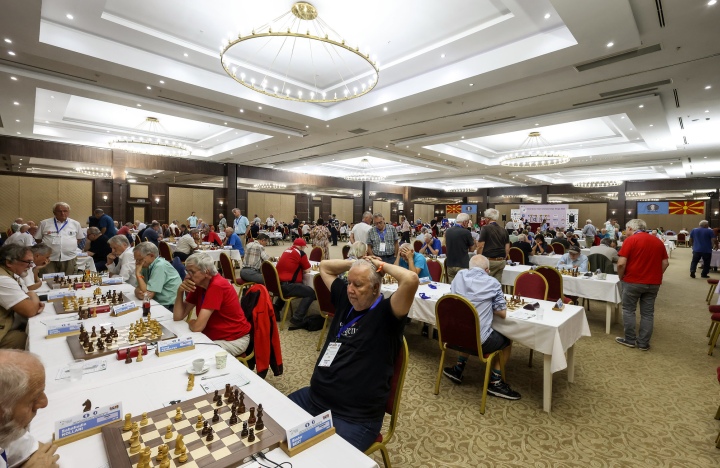
The third round of the FIDE World Senior Team Championship saw the expected clashes of the favourites, and these duels did not disappoint. The top match between North Macedonia Alkaloid and USA started slowly. Georgiev (2542) didn’t achieve anything out of the opening against Kaidanov (2549), and after the latter’s precise execution of the simplifications, a draw was agreed on move 32. The slow start was compensated by the storm on board two in the game between Ehlvest (2530) and Nedev (2465). In the Rossolimo Scicilian, Ehlvest based his preparation on the recent online game between So and Carlsen, but Nedev deviated from Carlsen’s play, and it seemingly caught White by surprise. Soon enough, both players were spending a lot of time calculating and the first critical moment arose on move 12. Instead of the simpler (and superior) 12.Qxd3, Ehlvest got tempted by the attractive 12.e6!? which after 12…fxe6 opened the f-file and prevented Black from castling. However, after 13.Qxd3 b5 14.Bc2 Qh4! it’s amazing how quickly Black’s pieces swarmed the kingside. Black’s next moves were 15…Ne5 (attacking the queen) and 16…Ng4 (threatening mate on h2) and then suddenly, he was creating a mating attack with three pieces. In this position, White had to make a crucial choice. As indicated by Nedev in the live broadcast, the best was to play 17.Nf3 and Black doesn’t have anything more than a perpetual in case of 17…Nf2 18.Kg1 Ng4, or if he wants to continue the game, 17…Qh5 18.h3, leads to an unclear position – here, White’s king is not as weakened as in the game. Ehlvest opted for 17.g3? which was a bad practical choice – the weakness of the white king became a decisive factor. After 17…Qh3 18.Rf4? was another ambitious but wrong move. The same Nf3 mentioned earlier would have limited the damage. After 18…h5 Black was already winning! White has no defence against numerous threats such as …g5, …Bb7, …h4 and …hxg3. The execution was swift. After 19.e5 g5 20.Rf3 h4! White could have resigned as either …hxg3 or …Bb7 was coming. The final position, three moves later, perfectly illustrate the disaster that struck White. Ehlvest resigned. 0-1 It was a flying start for the Macedonian team. On board three, Bogdanovski (2385) had an initiative in the opening against Novikov (2513) but didn’t play precisely, so the game fizzled out to a draw. More drama unfolded on board four. Stanojoski (2351) improvised in the opening against Yermolinsky (2419) and ended up with a knight on the rim and in a bad position. White obtained a dream Catalan position, and in search of complications, Black played 13…Ng4 14.Na4 Bxf2, which was far from even remotely adequate. After 15. Rxf2 Nxf2 16.Kxf2 White was already winning. White quickly consolidated with Be3 and Nc3, while the knight was still stuck on a6. Then the game continued normally, with White even winning the pawn on a7 as Black threw caution to the wind and concentrated on the kingside. The dramatic moment came on move 29. White wasn’t very precise, but he should still win after 29.Rxe5. However, Yermolinsky quickly played his intended 29.h4?? Stanojoski spent two-and-a-half minutes on his move and missed the winning 29…Rxf3! which turns the tables completely. The rook is taboo in view of 30.Bxf3 Nh3, while if the queen escapes, Black plays …Rg3 and …f3 with an easy win. It’s curious that Yermolinsky missed the blow on f3 completely and only found out about it when I told him during the live broadcast! Black took on a3 instead of f3 and after 30.hxg5 White was winning again. There were no more chances for Black in the remainder of the game. The tense match ended 2-2, perhaps a fair result, but these kinds of chances must be taken if a team wants to win an event. On the other hand, it may be a good omen for the Americans, as luck was clearly on their side. England beat Italy 2.5-1.5 thanks to a win by Adams (2662) against David (2523). Adams prepared a recent, but still rare, line against the Taimanov, and the surprised David decided to sacrifice a pawn in search of compensation. Black obtained it, but in the critical moment, he wasn’t up to the challenge. White’s last move was 28.Bf4, preparing g3 or g4. Here Black’s best move was 28…Rh4! preventing 29.g4 in view of 29…Rxg4! 30.Nxg4 Rxg4 31.Kf1 Bg5 and Black regains the material. Perhaps David was worried about 29.g3 but in this case he has 29…f5! (if this is too complicated, the immediate 29…Rxf4 30.Rxf4 Ne2 was a back-up option) 30.exf6 Rxf4! 31.Rxf4 Ne2 32.Kf1 Nxf4 33.gxf4 Bxf6 with a relatively easy draw as White’s pawns on the f-file are weak. Not easy, but to make a draw against a world-class player like Adams, one has to navigate such calculations. David played 28…Rgh8? but after 29.g4, he didn’t have any compensation, and Adams won convincingly. The Italians missed their chance on board four, where Borgo (2333) got a winning advantage against Arkell (2352) after the latter over-extended his position. But the Italian misplayed it and allowed his opponent to simplify the position and draw. The other two games were drawn. Emms (2448) showed excellent preparation to neutralise Godena’s (2429) Alapin Sicilian, while Ortega (2410) defended with precision to extinguish Flear’s (2405) initiative. England is tied for the top position with Iceland that whitewashed Austria. In the S65 section, only two teams managed to keep their 100% score. Germany Lasker Schachstiftung GK ended the dream run of North Macedonia after beating them 3-1. Wins with the white pieces on boards two and four were enough for a convincing win. Meister (2439) maneuvered patiently against Kralevski (2054) in a position where he had two bishops and a queen against a bishop, knight and a queen. Maneuvering is not Kralevski’s strong side and he was gradually outplayed. On board four Trajkovski (1947) badly misplayed the English Opening against Koehler (2189) and couldn’t come back after that. The draw on board one between Ilic (2044) and Knaak (2438) came as a result of mutually cautious play, but on board three Stosevski (1968)