

World Youth Chess Championship 2023: Registration deadline extended

The Organizing Committee announces that the registration deadline for the participants of the World Youth Chess Championship U14, U16, U18 2023 has been extended to September 30, 2023. The competition will take place in Montesilvano, Italy, from November 12 (arrivals) to November 25, 2023 (departures). FIDE member Federations can register one official player in each category (U14, U16, U18, open and girls). The organizers invite six official players and one accompanying person (captain/trainer) from each federation according to the Handbook. The players placed 1-3 in the previous U14, U16, U18 World Youth Championships, and the respective Champions of the last Continental Youth Championships, will have the personal right to participate in the corresponding age category. Invitation letter and regulations (pdf) FIDE World Youth Chess Championships 2023 official website E-mail: worldyouth2023@fide.com Photos: FIDE World Youth Chess Championships 2023 official website
FIDE World Senior Team Championship: Day 2 recap
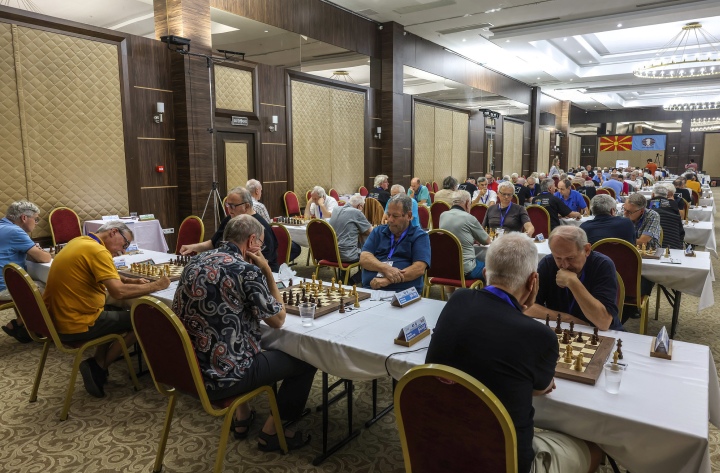
In the second round, the favourites continued to win their matches, but the resistance was visibly stiffer. One wonders, if the matches are tough so early, what would happen in the final rounds? In the S50 section USA beat Montenegro 3.5-0.5, but the match was closer than the scoreboard would suggest. The draw on board one was a result of a good defence by Nikcevic (2358) against Shabalov (2465). On board two, Pajkovic (2412) had a normal position with White in a reversed Benoni, but he misevaluated opening of the b-file, which was not forced at all, and it turned out to be in Black’s favour. On board three, Ehlvest (2530) sacrificed a pawn for a dangerous attack against Podlesnik (2289), but Black defended with great precision to maintain balance. However, in a tense position, both players blundered: Black’s last move 25…Be4? was a mistake. The only continuation to keep the game going was 25…f4. But here, inexplicably, Ehlvest didn’t play the obvious 26.Qg5, when an inevitable mate comes after Bg7 (or even the cheeky Qg7) and opted for the flashy 26.Rg6, which allowed Black to play a pretty defensive queen sacrifice with 26…Rxe7! 27.Rxe6 Rxe6, which led to an unclear situation. In fact, the position became easier to play with Black. However, instead of consolidating, which would have given him easier play and an advantage, Podlesnik continued aggressively, only to become the unfortunate player who blundered last. Here, Black should have taken on g2 with check and then captured the d6-pawn, with a tense but objectively equal position. But Black miscalculated and played 33…Bxg2?? but missed that after 34.Qxe6 Bd5 White has 35.Qxg8! winning on the spot. After Black captured the queen, White pushed d7 and won the game. 1-0 On board four, Novikov (25143) displayed good technique to overcome Miljanic (2331). England beat Poland 3-1, but they had a lucky break early on when Flear (2405) won quickly, thanks to a swift and unexpected attack against Sielicki (1956). Black sacrificed a pawn for the initiative, and here he broke through with 27…f4! After 28.exf4 Nf5 Black wrapped up in style with …Nxf2 next. 0-1 The second win for England came on board one, where Adams (2662) outplayed Gdanski (2484) from the black side of the Exchange Ruy Lopez. It was a typical Adams game where it was almost impossible to sense the moment the position started shifting from equal to a somewhat more pleasant for Black to winning for Black. There was a curious situation at the end of that game. Adams is completely winning; the question is how to do it. Instead of calculating the pawn endgame after the exchange of rooks followed by …b5, which also wins, Adams played 52…Rf4, grabbing a second pawn, forcing an immediate resignation. For those readers who might think that this was a senior moment, I hasten to say that Adams’s decision was the more practical one – why calculate when you can win without calculation? This approach has been recommended by many coaches, including Mark Dvoretsky. The other two games were drawn, even though both Emms (2448) was pressing against Sapis (2375) and Davies (2354) was doing the same against Flis (1948). Italy beat England 2 thanks to David’s (2523) win over Dishman (2304) on board one. All the other games were drawn, giving Italy a narrow win. Black’s king won’t survive, and White is spoilt for choice of winning moves (22.Rac1 and 22.Nxf7), but David went for the spectacular 22.Nxe6! Kxe6 23.Qg7 and eventually the black king was mated on b5. The home team of North Macedonia Alkaloid also won narrowly, but at least they were never in danger of losing the match. The only win happened on board one when, in a severe time trouble, Mrva (2361) forgot about his rook against Georgiev (2542). Black (Georgiev) has an extra pawn, but White has obvious counterplay on the kingside, thanks to the very stable bishop on d3. Now, White could have taken on g6 or played 38.Re7, when Georgiev wasn’t sure about the position – in fact, it is objectively equal. However, White played 38.Qf4?? and after 38…Rb4! could resign as the black rook moved away from the attack with tempo, something the rook on e1 couldn’t do. Black won the exchange and the game. 0-1 The other games were drawn, but Bogdanovski (2385), on board two, missed a one-move win against Motuz (2279). White was winning from the early middlegame, being a pawn up for nothing. With his last move, Black took on a2 and here instead of the obvious 31.Ra1, winning a piece in view of the mate on a8 (or because of a pin after 31…Ra7 32.Bd5), he played 31.Rxc5? and then couldn’t convert the extra pawn. In the S65 section, both Germany Lasker Schachstiftung GK and England 1 won 3-1. The German team had a wild game on board one where a technically winning position for Knaak (2438) against Westerinen (2237) became a complete mess after White misplayed it. White was a pawn up and dominating for a long time, and here he went for the pretty 35.Qxf8! Kxf8 36.Kf1 (36.a7 was even stronger), which should have won. But he misplayed the position completely, and soon enough, it was Black who was winning! Here 46…Qd8, 46…Qf6 and 46…Qc1 were all winning for Black, but he played 46…Ne7, and it was equal again. After many twists and turns, Black refused to give up his bishop for the a-pawn to stop promotion, and White eventually won. Nunn (2569) beat Sadiku (2143), and Kosten (2352) outplayed Xheladini (2149) to ensure England’s victory over Kosovo, as the other two games were drawn. The surprise winners were again the hosts North Macedonia, who beat Austria 1 by 2.5-1.5 after Kralevski (2054) on board two bested Danner (1967) with all the other games being drawn. North Macedonia shares first place with two wins together with four more teams. Tomorrow we will see several clashes of favorites, and it’s only Round 3! Standings after Round 2 S50 Standings after Round 2 S65 Round 3 starts tomorrow at 3 pm local time. Written by GM Alex Colovic Photos: Mark Livshitz Official website: seniorteam2023.fide.com/
Intercontinental Online Chess Championship for Prisoners: Registration deadline extended

A record number of participants – 88 teams representing 41 countries have already registered for the third Intercontinental Online Chess Championship for Prisoners, scheduled for October 11-13, 2023. Teams wanting to join the tournament can register via the following link until September 29, 2023. 57 male, 18 female and 11 youth teams made of amateur chess players, for whom the game became not just a hobby but a strong motivation to change for the better, will be representing correctional facilities from Argentina, Australia, Bulgaria, Colombia, Croatia, Czech Republic, Ecuador, England, Ghana, Georgia, Germany, Greece, Grenada, India, Iran, Ireland, Italy, Jamaica, Jersey, Kyrgyzstan, Latvia, Malawi, Mexico, Mongolia, Montenegro, North Macedonia, Norway, Paraguay, Philippines, Portugal, Romania, El Salvador, Serbia, Slovenia, Spain, Switzerland, Trinidad and Tobago, Turks and Caicos, UAE, USA, and Zimbabwe. For most of them, this international tournament is an opportunity to test their chess skills acquired in the classes within the prison walls and while playing the game with the inmates. The number of countries and correctional facilities implementing the Chess in Prisons program is constantly growing. The English Chess Federation has been running a program supporting chess in prisons since 2014. A chess player, author, and columnist, Carl Portman, who volunteers for the Chess in Prisons program in the country, has visited a number of prisons across the country. Carl provides valuable support to prison communities, where it is recognised as a purposeful activity for inmates, supporting the development of critical analysis and reasoning skills and helping to reduce reoffending rates. “As the chess columnist for the prison newspaper ‘Inside Time’, I receive a large amount of posts from inmates, and I use that feedback to measure how chess features in prisons. As one inmate wrote, ‘It has taught me to think ahead and not make rash decisions.’ My motto for life has always been ‘Don’t complain about the darkness, light a few candles’,” says Carl Portman. The reigning champions of the Championship for Prisoners, who won the event in October 2022, are the Philippines in the male section, Mongolia in the women’s category, and Serbia in the youth tournament. Jail officer 1 Cedrix B Cabangal, representing the General Santos City Jail in South Cotabato, Philippines, winners of the 2022 event, has served as a team coach since 2021, when the first tournament took place. “In 2021, I saw a post on FIDE’s website about the international tournament among prisons, and I immediately signed up. This year, we are joining again and are determined to retain our champions’ title,” he says. Participation in the tournament is free of charge. It is open for teams made of 4 players representing any correctional facility (jail or prison). Winners will be determined in male, female and youth categories. Tournament regulations More info about the program can be found here: chessforfreedom.fide.com
FIDE celebrates its centenary anniversary with a series of key events
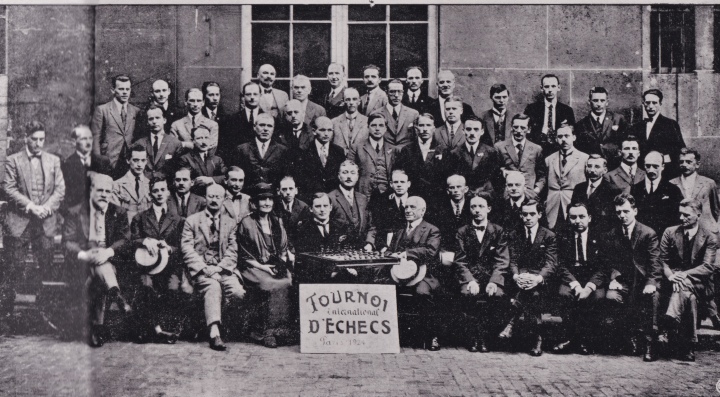
In 2024, the International Chess Federation (FIDE) celebrates its centenary anniversary. FIDE was formed on July 20, 1924, in Paris, France, at the Town Hall of the IX Arrondissement of Paris (6 Rue Drouot) during the first unofficial Chess Olympiad. Fifteen delegates from all over the world signed the Proclamation Act, and our organization was born. “A beginning has been made, the foundation laid, and the prospects are fairly good that we shall soon have a working organization, the aim of which will be, in a measure, to bring order out of chaos and to have a central authority, one of the chief aims of which will be the bringing together in international congresses lovers of the game from far distant points of the earth,” wrote the American Chess Bulletin in November 1924. As part of the celebrations throughout the year 2024, FIDE is planning numerous activities, including chess festivals, exhibitions displaying historical archives, documents and chess memorabilia, FIDE 100-year Jubilee Book by Willy Iclicki, Chair of the FIDE Historical Committee, tournaments organized all around the world, online chess museum with rare chess photos, unique publications about FIDE, posters from major events of the past, and many others. In February 2024, the Chess Torch Relay will start with the grand opening in India, the birth country of chess and the host of the 44th Chess Olympiad. It will cross the continents and finish in Budapest, Hungary, the city of the 45th FIDE Chess Olympiad. On July 20, 2024, the International Chess Day, FIDE will also attempt to set a World Guinness Record with the biggest number of chess games played in a day. The events organized to celebrate FIDE Centenary Year will culminate with a special gala in Paris, the city of FIDE’s birth. “Founded in 1924 under the motto “Gens una Sumus”, FIDE is one of the very first International Sports Federations. It is a consequence and driving force of the worldwide popularity of chess, and we want to share the brightest moments of our history and the history of our beloved game with people all around the world. The Chess Torch Relay will start in India, the country where chess was born and from where it has spread around the world and become a global game the whole world plays with enthusiasm. Chess Olympiad in Budapest that will bring together all the chess nations will also be used as the highlight spot for celebrations with anniversary awards, seminars and exhibitions,” says FIDE President Arkady Dvorkovich. The first of a series of events to mark this historic occasion will start on September 23. The countdown will begin 100 days before 1924 on FIDE social media. One hundred posts, one per day, will be published. Each post, marked with the #FIDE100 hashtag, will tell about a significant event in the history of FIDE that happened that year, starting from 1924. Our social media followers will learn when the first Chess Olympiad was organized (1927), FIDE started overseeing the World Chess Championship (1948), the first Grandmaster titles were awarded (1950), the official FIDE rating list came out (1971), FIDE was recognized by the International Olympic Committee (1999), and many other major milestones in the organization’s history. “The International Chess Federation has come a long way since its first steps a century ago. Throughout its history, FIDE has been instrumental in shaping the world of chess, and we never stop aiming for new heights, serving the game and chess community,” says Dana Reizniece-Ozola, Deputy Chair of the FIDE Management Board. We encourage all the organizers and federations to plan their regular and special events under the umbrella of #FIDE100. We are also seeking support from the chess community to rebuild the FIDE historical archive by sending us photographs, documents, videos, memorabilia, bulletins, and other chess items related to the history of FIDE and the development of chess. Please feel free to contact Willy Iclicki and send photos of your chess memorabilia to centenary@fide.com. All contributors will receive proper recognition, while FIDE would also consider offering retribution for especially valuable items. Let us make the FIDE centenary celebrations really big! The game is just beginning!
FIDE World Senior Team Championship: Day 1 recap
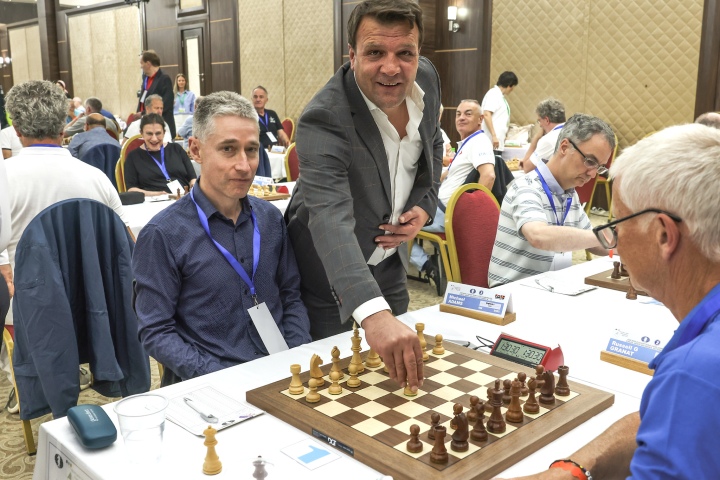
The first round of the FIDE World Senior Team Championship saw the favourites play weaker teams, as it is usually the case in Swiss events. However, this didn’t mean there weren’t certain surprises on several boards. In the S50 section, the number one seed team, USA, won 3.5-0.5 against Canada, but they were on the verge of defeat on board one. Victor Plotkin (2193) was winning in the endgame against Alexander Shabalov (2465), but did not manage to convert the Fischer-esque endgame of rook and bishop vs. rook and knight. On the other boards, Kaidanov (2549), Ehlvest (2530) and Novikov (2513) didn’t have problems overcoming Barron (2108), Findlay (2123) and Dougherty (2062), respectively. In the game Findlay-Ehlvest Black played a pretty two-move combination. Black startded with 23…Bb4, freeing the eighth rank, and after 24.Qc1 Nxg3! led to immediate resignation in view of …Rg8 next, when mate on the g-file would follow shortly 0-1 In the duel between the English teams (England 1 and England 3) the stronger one prevailed. Yet even here on board one, Michael Adams (2662) couldn’t overcome Granat (2171) with the white pieces. It was a tough fight on board two and three, where Emms (2448) won a long rook endgame against Crocker (2161) with Black and Arkell weaved his magic in his favourite Carlsbad structure to suffocate Frostick (2112). Only on board four, Davies (2354) won easily against Hewson (2023), partly because of a successful opening surprise. Playing the Benoni with Black, he obtained an advantageous position early in the game, which he converted in a convincing fashion. Italy beat England W50 4-0, and in this match, we saw a spectacular game between Ortega (2410) and Jackson (2034). White (Ortega) reached a winning position and here 27.e5! (freeing the e4-square for the knight) would have been decisive. Instead, after 27.b3? Ne5 Black was suddenly not worse at all! Several moves later, with both sides trading imprecisions, White was winning again. Here 33.Qf5 was decisive, as the king can hide on f4 in case of checks. Instead, Ortega went for the overambitious queen sacrifice 33.Qxg4? Rg1 34.Kxf3 Rxg4 35.Kxg4 Bxc3, which landed him in a lost position! With only a rook for a queen, White perhaps was counting on 36.Rxb7, with the idea of Rb8, creating the threats against the black king and also planning b7. In order to prevent Rb8, Black now should have played 36…Qe8!, but instead he erred with 36…Qb5? after which 37.Kf5 was the best continuation. However, following his plan, White played 37.Rb8? and now after 37…Qe2 Black was winning again! Ortega went boldly ahead with 38.Kg5, but 38…Bd2 would have led to a forced mate. 38…Bf6, played by Black, was also sufficient to win the game. White sent his king all the way to h7, creating a mating threat of Rf8, and Jackson correctly sacrificed the bishop with Bg7. However, instead of winning with 41…Qxc2 or 41…Qe1, Black made a fatal mistake by grabbing the f2-pawn. Suddenly after 41…Qxf2?? 42.Nf5 White was winning! White hides from the checks with Nh6, and the b-pawn will promote. 1-0 An incredible game! The host team of North Macedonia Alkaloid whitewashed USA 5 Brothers, and in many other matches, the favourites were also rather ruthless. In the S65 section, the resistance of the underdogs was tougher. The top three favourites all won 3-1, allowing two draws in their matches. In the match on board one Switzerland-Germany Lasker Schachstiftung GK, the German Grandmaster Kalintschew (2377) won a high-tempo game against Kradolfer (1912). The final position deserves a diagram. White resigned as 26.Bg1 Re1! leads to mate. 0-1 The English team led by John Nunn (2569) won by the same score, making draws on board one, where Nunn played the currently out-of-fashion Velimirovic attack. True to his style, John obtained a nice attacking position, but then, instead of continuing in the same vein, he switched to a positional route. Here, a typical Velimirovic sacrifice 15.Nf5! was very strong, but Nunn chose the second-best 15.b4, which gave him an extra pawn after mutual imprecisions, but in an endgame with rooks and opposite-coloured bishops, he couldn’t convert his advantage. The Slovak number one, Lubomir Ftacnik (2452), had a similar fate, as he couldn’t achieve more than a draw from an inferior position against Burchardt (2153) from the Germany W65 team. The close matches at the start of the S65 section indicate that this will be a very closely fought event. A good example of underdogs’ resilience is the victory by the host team of North Macedonia over Italy (2.5-1.5), with a draw on board one between Ilic (2044) and Garcia Palermo (2410) wins for Kralevski (2054) and Stosevski (1968) against Messa (2289) and Cocozza (2226) and a loss for Hadzi-Manev (1865) against Trabattoni (2232). Standings after Round 1 S50 Standings after Round 1 S65 Round 2 starts tomorrow at 3 pm local time. Written by GM Alex Colovic Photos: Mark Livshitz Official website: seniorteam2023.fide.com/
FIDE Book Awards 2023 – Call for Nominations
Dear Authors and Publishers, The FIDE Trainers’ Commission (TRG) invites you to submit your nominations for the Yuri Averbakh/Isaac Boleslavsky Book Awards 2023. Eligible are chess books published in 2022. Publishers can submit up to three books, while authors may submit one book. Submissions should be emailed to trainers@fide.com, with a deadline of October 4, 2023. Once confirmed, TRG will advise where three copies of the books should be sent to the judges for review. The panel of judges will consist of three prominent chess personalities. The winner and two runners-up will be announced in the middle of December. The Boleslavsky Isaac FIDE Book Award was launched in 2009 for the best book and publications of remarkable instructional value. In 2019, the Award name was changed to the Yuri Averbakh/Isaac Boleslavsky Award, paying tribute to these two giants of chess literature. Nomination Form List of Winners 2008-2021
FIDE World Senior Team Championship 2023 kicks off in Struga, North Macedonia
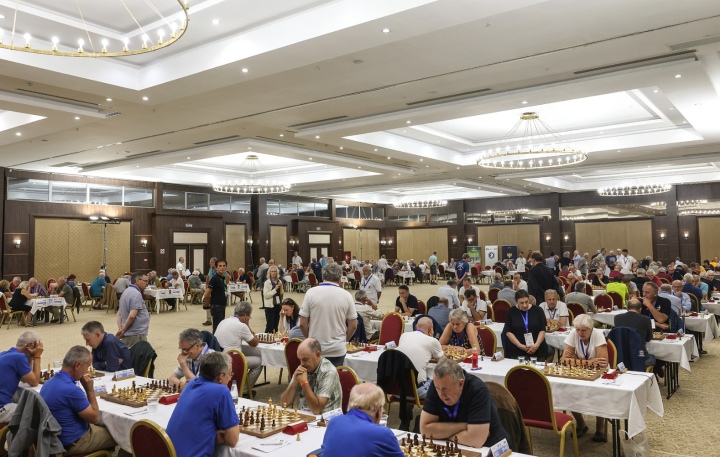
The opening ceremony of the FIDE World Senior Teams Chess Championships was held at the summer terrace of the Hotel Izgrev, the playing venue of the event, with a breathtaking view of the pearl of the Balkans, the beautiful Ohrid Lake. The championship, played in 50+ and 65+ age categories, takes place from September 18-29. The competitions are 9-round Swiss tournaments with classical time control. Players, guests and officials were welcomed by the President of the Chess Federation of North Macedonia, Sasha Bogdanovikj, Honorary Chair of the FIDE Event Commission Ozgur Solakoglu and the deputy director of the Agency for Youth and Sport in North Macedonia Isak Lizami. Mr Sasha Bogdanovikj greeted all the guests and expressed gratitude to FIDE for honouring the Chess Federation of North Macedonia and giving it an opportunity to hold this prestigious event. Mr Isak Lizami wished success to all participants and expressed his willingness to support the activities of the Chess Federation of North Macedonia. He also stated that the Agency for Youth and Sport would continue supporting all the important initiatives by the Chess Federation of North Macedonia. During the opening ceremony, guests enjoyed a small music performance by one of the top music artists in the country, Andrijana Janevska, who sang some well-known international hits and some Macedonian traditional songs. The first round is scheduled to start on September 19 at 15:00 CEST. There are a total of 48 teams from 26 countries registered in the competition (22 teams in the 50+ age category and 26 teams in the 65+ age category), with 231 players participating in the competition. The games will be broadcast on the official FIDE Channel with expert commentary by GM Aleksandar Colovic. Official website: seniorteam2023.fide.com/ Photos: Mark Livshitz
FIDE Education Commission continues its development activities around the world
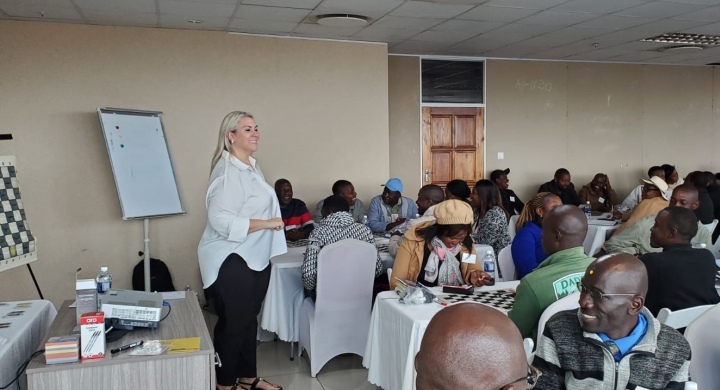
How do you introduce chess as an educational tool in classrooms on a regional or country-wide scale? The challenges for successfully implementing a chess in education (CIE) initiative can be as complex as the game of chess itself. CIE brings chess to the learners in their comfortable and familiar classroom environment. Introducing chess in the classroom proves to be equally educational to educators, federations, and even national governments. Knowledge is indeed power! FIDE’s Chess in Education Commission continues to assist federations in developing scalable and sustainable CIE initiatives. Recently completed visits to Zimbabwe and Nigeria included in-person Preparation of Teachers (PoT) courses alongside visits from government and business leaders. Partial funding from the International Olympic Committee enabled us to carry out this project effectively. Such activities laid the groundwork for the expansion of CIE and provided national federations greater visibility and credibility with stakeholders. The Chess in Education Development team and International Advisory Board from FIDE EDU expanded the resources for in-person training by including tangible resources and workbook materials for classroom use. For many countries, an in-person PoT course provides the opportunity to showcase the federation chess as an educational tool. The course allows for media coverage and meetings with key stakeholders in government and business. Federations that are seen as partners in education within the country may gain access to human and financial resources that would otherwise not be available. An added benefit is the influx of a new generation of young chess players. As a result, FIDE EDU has a positive impact on the educational environment, and the outcome of these projects is not merely the qualification of School Instructor titles to successful participants of our PoT courses but the empowerment of federations to the wide-scale introduction of CIE in their countries. Visits similar to those in Zimbabwe and Nigeria are scheduled or in the process of being scheduled for the remainder of the year. The confirmed PoT courses and accompanying stakeholder meetings include: 11-15 September: Guyana 25 – 30 September: Namibia (2 PoT deliveries, one in Windhoek and another in Swakopmund) 2-5 October: Nigeria 18 – 21 October: Tanzania 27 – 29 October: Cape Town, South Africa 25 – 28 November: Victoria Falls, Zimbabwe PoT courses are also planned in Botswana, Zambia, and The Gambia in December. Here are some highlights from our recent visits to Nigeria and Zimbabwe: The participants of the PoT course with the lecturers Anzel Laubscher (FIDE EDU member) and Jerry Nash (FIDE EDU Chair) in Lagos, Nigeria Jerry Nash dressed in traditional Nigerian attire with Anzel Laubscher, Prince Adeyinka Adewole and the most important participant Corporate simul hosted by Zimbabwe Chess Federation was a successful opportunity to create awareness and raise funds for Chess in Education locally Anyone interested in discussing the possibilities of developing CIE initiatives in their country may contact FIDE EDU by email: education@fide.com.
The final round to decide the winner of Cyprus Grand Prix and two Women’s Candidates
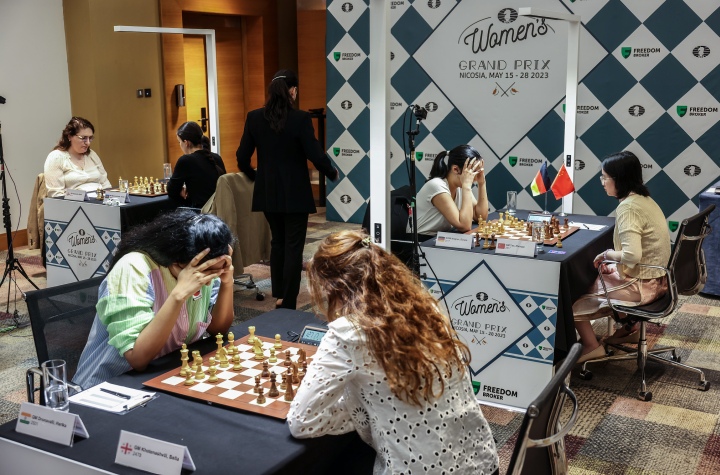
Grand Prix events are very long. Eleven rounds against strong opponents, adding game preparation and debriefing, can leave you without energy very quickly. Fatigue and exhaustion set in, and mistakes start to happen. The two-time European Champion, and current leader of the Grand Prix, Kateryna Lagno, summed the situation up perfectly. “Everybody is already very tired, and that’s why we are probably seeing some blunders.” For the first time in the tournament, all six games ended in draws, but most of them were hard-fought. With only one round to go, three players are still in the lead with 6/10 – Harika, Tan Zhongyi, and Wagner – while Lagno and Shuvalova are just behind on 5.5/10. Theoretically, up to six players could have a chance of grabbing the two coveted Candidates spots, and it will all depend on tomorrow’s results. The tenth-round ceremonial first moves were performed by Andreas Michailidis, President of the Cyprus Sports Organisation (pictured above) and Michalis Giorgallas, Cyprus Minister of Defence, in the game between Dinara Wagner and Tan Zhongyi. For Michalis Giorgallas (pictured below), it was his first time in a chess tournament. “I am very glad to be here and excited to host the tournament in Cyprus. I don’t know how to play, but I hope that my first move will give success and glory to my player.” Andreas Michailidis, in his capacity as President of the Cyprus Sports Organisation, is a regular in local events organised by the Cyprus Chess Federation – “It’s a great honour for Cyprus to host this event and for FIDE to have chosen our country and our organisation supports the tournament 100%. I admire the patience, the courage, and the expertise of the players. We don’t yet have top-level players in Cyprus, but we are working on this, and very soon, we shall compete at the highest level”. The event was also honoured by the presence this afternoon of Louiza Christodoulidou Zannetou, the Law Commissioner for Cyprus and President of the Gender Equality Committee. She was happily surprised when she went inside the playing hall: “My first reaction was that I had to go out, so as not to disturb them because I realised that they needed their peace and concentration to perform at the maximum level.” IM Assaubayeva, Bibisara vs GM Goryachkina, Aleksandra (0.5-0.5) After her loss yesterday, Goryachkina decided to play it safe today, choosing the solid Slav defence as Black. Assaubayeva went for the modern 4.Bf4 line in the Exchange variation, but Goryachkina neutralised the opponent’s initiative with the standard …Bg4-h5-g6 manoeuvre, exchanging White’s dangerous light-squared bishop. According to the engine, Black was already slightly better when both players agreed to a draw on move twenty after an unforced three-fold repetition. Goryachkina will play White in the final round against Harika – depending on the rest of this afternoon’s results. She may need a win to secure one of the two Candidate’s spots. WGM Wagner, Dinara vs GM Tan, Zhongyi (0.5-0.5) The second game to finish, after just about two and a half hours of play, was a solid affair. Co-leading the event by the slightest of margins, it seemed unlikely that they were going to take many risks. Tan Zhongyi went for one of the most solid lines in the Bogo-Indian defence with Black, a favourite of Ulf Andersson in the eighties. Wagner spent about twenty minutes on move twelve, deciding how to deal with the double pawn tension in the centre. The engine suggests that maybe 14.b4!? was a better try for an advantage. Once they started trading-off pieces on the d-file, it became clear that the game would end in a draw, which was agreed on move forty-one. GM Dronavalli, Harika vs GM Khotenashvili, Bella (0.5-0.5) Playing with Black, Khotenashvili opted for the Symmetrical variation in the English Opening, employing the so-called Botvinnik System, conceding a permanent weak square on d5 but gaining a firm grip on the dark squares. Her opening choice against the tournament co-leader worked out well: going into the middlegame Bella equalised comfortably, and her only problem was, once again, falling behind on the clock. An important idea in Harika’s strategy was to notice that 21…f5, which at first glance wins the bishop on c3, does not work due to 22.Ng5! Rxc3 23.Nxe6, and since 23…Qxe6? fails to 24.Bd5, White is already slightly better. However, this time the position was reasonably simple to play, and after 28…f5 it was clear that Black had no problems at all and that a draw would be the most likely outcome. Finally, both players agreed to share the point on move thirty-one. IM Kiolbasa, Oliwia vs GM Lagno, Kateryna (0.5-0.5) A tense but equal game, very typical of the Ruy Lopez Berlin variation. Lagno equalised comfortably coming out of the opening but was unable to create an imbalance. “I tried to create something, but she found this b4-Ne1 plan, and it looks like it’s just equal. Maybe I should have played 22…b4 myself instead of 22…g6,” Lagno explained after the game. After that, it was Kiolbasa who could have had a chance had she found 28.Nd3! but low on time Oliwia went for the clear-cut 28.Rd1-d7, and a draw was soon agreed upon. Lagno was kind enough to talk to us after the game. “It’s a hard tournament, everybody is tired already. But there is still one game to go, and I should stay concentrated.” When asked about the added stress of playing for the two Candidate spots, Lagno explained that she was trying to concentrate on the games. “I try not to think about it too much, and I don’t think it affects my play, but I see that everybody is very tired already, and that’s why we are probably seeing some blunders.” GM Dzagnidze, Nana vs IM Mammadzada, Gunay (0.5-0.5) Dzagnidze tried to surprise her opponent in the opening with the offbeat 4.h3 idea in a Delayed Alapin Sicilian. The point is to play 5.Bd3-c2 and further on advance d2-d4 but preventing the
Invitation: FIDE Congress and General Assembly 2023

Dear Member Federations, FIDE officials and Members of FIDE Commissions, Please find below the official invitation to the annual Congress and General Assembly 2023 from FIDE President Arkady Dvorkovich. The events will take place online during the period from 11 to 17 December, 2023. Schedule of the event: FIDE Commissions meetings: December 11-13, 2023 FIDE Council meeting: December 14, 2023 FIDE Zonal Council meeting: December 16, 2023 FIDE General Assembly: December 17, 2023 The exact time of the meetings, agenda, hosting platform, and invitation link will be provided in future communication. If a National Federation or an Affiliated Organization would like to propose an item to be included in the online General Assembly agenda, it shall provide the FIDE Office with all the necessary documents, using the email office@fide.com. According to the FIDE Charter, these proposals should reach the FIDE offices at least two months before the opening date of the General Assembly, by October 17, 2023. INVITATION FIDE CONGRESS AND GENERAL ASSEMBLY 2023 (PDF)