

Winners crowned at European Youth Championship 2023
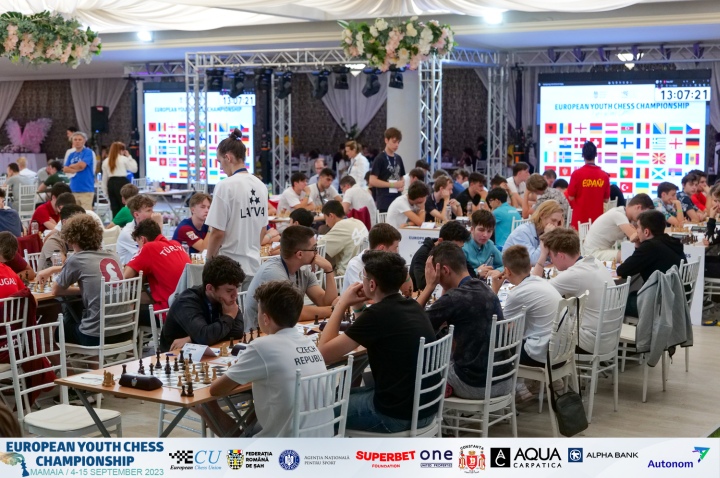
The European Youth Chess Championship 2023 is in the books. Held in six age categories – U8, U10, U12, U14, U16 and U18 (open and girls sections separately) – from September 5-14 in the Ceremony Hall Dorna in Mamaia, Romania, the event attracted over 900 participants from 46 European federations, including more than 100 titled players. All twelve competitions were 9-round Swiss events with classical time control. The event saw the triumph of Azerbaijani players, who collected four gold medals; Poland won three golds, while the home country, Romania, got two titles. It was a close race in many sections, with the champions determined by a superior tiebreak. The champions and top-finishers of the European Youth Chess Championship: Open U8 1. Mohammad Kazimzadeh (AZE)2. Luca Protopescu (FRA)3. Artem Kucher (UKR) Girls U8 1. Mehriban Afmadli (AZE)2. Daria Kravchuk (UKR)3. Mariam Rekhviashcvili (GEO) Open U10 1. Vladimir Sofronie (ROU)2. Marc Llari (FRA)3. Ali Poyraz Uzdemir (TUR) Girls U10 1. Maria Anistoroaei (ROU)2. Lilian Schirmbeck (GER)3. Zuzanna Kaminska (POL) Open U12 1. Khagan Ahmad (AZE)2. Henry Edward Tudor (GER)3. Alfred Nemitz (GER) Girls U12 1. Kinga Lajdamik (POL)2. Blanka Ejsymont (POL)3. Saadat Bashirli (AZE) Open U14 1. Rustam Rustamov (AZE)2. Benik Agasarov (ARM)3. Baptiste Lissillour (FRA) Girls U14 1. Kesaria Mgelazdze (GEO)2. Mariam Tsetskhladze (GEO)3. Sofiia Moskalets (UKR) Open U16 1. Jakub Seemann (POL)2. Diego Macias Pino (ESP)3. Jachym German (CZE) Girls U16 1. Agnesa Stepania Ter-Avetisjana (LAT)2. Dila Baloglu (TUR)3. Maria Siekanska (POL) Open U18 1. Arsen Davtyan (ARM)2. Khazar Babazada (AZE)3. Elham Abdrlauf (NOR) Girls U18 1. Martyna Wikar (POL)2. Ayan Allahverdiyeva (AZE)3. Juliette Cornileau (FRA) Complete results Official website: euromamaia2023.com/ Photos: official website
FIDE World Junior Rapid & Blitz U20 Championship 2023: Registration deadline extended
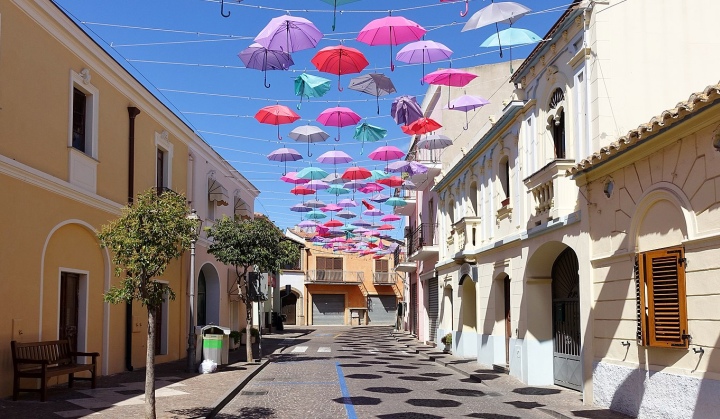
The Organizing Committee announces that the registration deadline for the participants of the first ever FIDE World Junior Rapid & Blitz U20 Chess Championship has been extended to September 20, 2023. The competition with a total prize fund of €25,000 will take place will Pula, Sardinia, October 9-16, 2023 Each National Federation can register any number of players. Personal rights will receive the winners of the World Youth Rapid and Blitz Chess Championship in Batumi 2023 and first 10 players on the starting list (10 for the open list and 10 for the girls’ list). Regulations and invitation letter (pdf) Official website: juniorrapidandblitz2023.fide.com Email: juniorrapidandblitz2023@fide.com Photo: Olaf Tausch
FIDE World Amateur Championship 2023: Registration deadline extended
The Organizing Committee of the FIDE World Amateur Chess Championship announces that the registration deadline has been extended to September 28, 2023. The competition will take place in Muscat, Oman, from November 1-11, 2023. There will be separate Championships three FIDE rating categories: Under 2300 Under 2000 Under 1700 There shall be separate Women’s Championship(s) if there are at least ten players from at least two continents in each category. The Championships are open for players registered by their national federation. FIDE member federations have the right to send as many players as they wish. Official website: worldamateur2023.fide.com E-mail: worldamateur2023@fide.com
The deadline for submitting 2028 Chess Olympiad bid set for November 7

On August 15, 2023, FIDE opened a bidding procedure for the 2028 Chess Olympiad. As a part of the Olympiad bid, the bidder should also hold the Chess Olympiad for People with Disabilities and FIDE Congress. The first four weeks were allocated to the expression of interest process. Potential bidders could express their interest by 6 p.m. CET on September 12, 2023. During this period, four potential organisers have come forward. As a result, the bidding process will now last 12 weeks, as per the decision of the FIDE Council. Therefore, the deadline to submit bids to office@fide.com is now set for 6 p.m. CET on November 7, 2023, which is eight weeks from September 12. Each bidding application shall be filed per the form provided in Appendix 3 to the Regulations. The Applicant shall attach the following: Letters of support from a national federation and relevant local authorities, Supporting documents (government letters, contracts, bank guarantees, etc.) at the total amount of the bid’s budget. Irrevocable guarantee issued by: a) any of the Top 100 World Banks rated on The Bankers database or another bank which may be agreed with FIDE or b) a verified government guarantee for the amount of three hundred thousand (300,000) Euros to support the bid. Additional documents may be requested by FIDE for further evaluation. The complete requirements from the organiser, including financial obligations, are determined by section 6 of the Regulations. For any relevant clarifications regarding the regulations and application requirements, the applicants are kindly asked to send a written enquiry to office@fide.com The nearest General Assembly shall award the right to host the events to the Applicant with the highest number of votes received. Regulations: 2028 Chess Olympiad Regulations FIDE Congress Regulations for the Competition for Players with Disabilities will be added later.
Georgia wins FIDE World Women’s Team Championship 2023
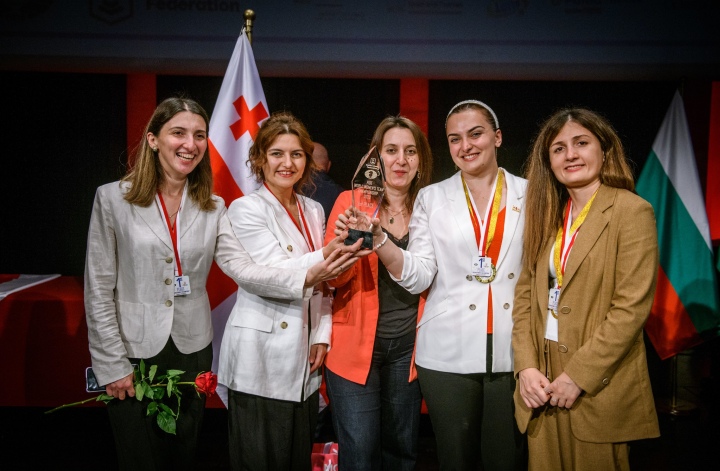
Kazakhstan gets the silver medal, and the bronze goes to France. The experience of the Georgian players prevailed over the youth and talent of the Kazakhstani team, which, with an average age of 18 years old, performed above all expectations and will bring home a praiseworthy Silver medal. It’s not the first time that Georgia has won this championship: in 2015, under a different format but with an identical lineup, Bella Khotenashvili, Meri Arabidze, Nino Batsiashvili, Lela Javakhishvili, and Salome Melia secured the trophy for their country in Sochi, 2015. In the Small Final, the clash between France and the USA was a very close affair, but in the end, it was “les bleues” who got the bronze medal after a draw in the first match and a 3-1 victory in the second. Georgia – Kazakhstan (2½-1½) (3½-½) The first match between Georgia and Kazakhstan set the tone for the final, with Lela Javakhishvili turning into the hero of the day, as she won both games in great fashion. Playing on the white side of a King’s Indian against Amina Kairbekova, she got an advantage right out of the opening that she soon converted into an extra pawn. At some point, her rival managed to equalise, but shortly after Amina made a mistake that allowed Lela to be in command again. With things looking so good on the fourth board from so early, all the Georgians played free of pressure. Nurmanova tried a new move in the Ruy Lopez, 11.Nxe5, against Batsiashvili, but the resulting position was completely equal and ended in a draw. The same result was registered in the second board, Arabidze-Kamalidenova, where the young Kazakhstani took risks from the opening, sacrificing a pawn for activity. Even though she got enough compensation, she never achieved an advantage. The game between Assaubayeva (with White) and Khotenashvili was a Queen’s Gambit Declined (Exchange variation), where as early as move nine, we had a completely new position on the board. With no real chances to win the game, Bibisara settled for a draw with a perpetual check. When Javakhishvili finally converted her advantage, the match was over: 2½-1½. The second match was not meant to change the fate of the final, and Georgia won again, even by a higher score. On the third board, the game between Nino Batsiashvili and Alua Nurmanova saw an early queen exchange, which soon led to a draw, increasing the pressure on the Kazakhstani players. The key was the battle on the first board between Bella Khotenashvili and Bibisara Assaubayeva. Both players followed an unorthodox plan in the King’s Indian, and White had a small edge out of the opening. Under pressure, Bibisara blundered a piece when her position was already hopeless. Lela Javakhishvili was better with Black after her opponent played the opening carelessly, but after checking the match situation after 90 minutes of play, she decided to go for a line that would guarantee her a draw. Perfectly aware that this result was not enough, her opponent tried to force matters and keep the game going, only to lose. The second-board clash between Kamalidenova and Arabidze was very balanced, but towards the end, Meruert lost the thread of the game and her position collapsed, leaving the final score in a double victory for the Georgians by 2½-1½ and 3½-½. France – USA (2-2) (3-1) The first match for the bronze was quite a slaughter fest, with 6 out of the 8 games reaching a decisive result, many of them after several unexpected turns. On the fourth board, two former teammates found themselves facing each other, representing their countries of adoption. Mitra Hejazipour, with White, and playing now for France, chose the wrong plan with 23.f4 and 24.Rf3, giving up a pawn for the attack. Atousa Pourkashiyan, playing for the USA, demonstrated that Black had nothing to fear and grabbed the full point. Anastasia Savina had an inferior position with White, but Tatev Abrahamyan went wrong, allowing the white queen to penetrate the black king’s position, and resigning shortly after. Alice Lee went wrong with 19.Qa5 and allowed Deimante to grasp the initiative, and to make things worse, she then blundered a pawn with 22.Rc3, missing a simple tactic. However, things went horribly wrong for Deimante from then on. She gave up an exchange, unnecessarily, to capture one of White’s pawns, and then she got her pieces entangled in the first rank, losing material and the game. In the meantime, Sophie Milliet played a brilliant attacking game with Black, with an exchange sacrifice included. With her victory, the first match was tied 2-2. For the second match, the Americans replaced Abrahamyan with Zatonskih, while Hejazipour gave her place to Natacha Benmesbah. France’s second board, Anastasia Savina, got out of the opening with a better position against Anna Zatonskih, but the game ended in a draw. Atousa Pourkashiyan went for a false combination, probably missing something important in her calculation and lost almost on the spot, giving the full point to Natacha. Sophie Milliet, on the White side of a Richter-Rauzer Sicilian, saw her attack progressing much faster than her opponent’s counterplay and scored another brilliant victory, the second of the day for her, becoming the star of the French team. On the first board, the clash between Daulyte-Cornette and Lee was “unbalanced but roughly equal” and ended in a draw after 60 moves, when the match had already been decided on the two lower boards. A fantastic performance by the French team, which brought them a historical and well-deserved bronze medal. The individual medals, decided by tournament performance, were awarded as follows: First board:Alice Lee (USA) – GoldDeimantė Daulytė-Cornette (FRA) – SilverBibisara Assaubayeva (KAZ) – Bronze Second board:Meri Arabidze (GEO) – GoldYang Shen (CHI) – SilverAnastasia Savina (FRA) – Bronze Third board:Nino Batsiashvili (GEO) – GoldTatev Abrahamyan (USA) – SilverSophie Milliet (FRA) – Bronze Fourth board:Qi Guo (CHN) – GoldLela Javakhishvili (GEO) – SilverAlua Nurmanova (KAZ) – Bronze The closing ceremony took place shortly after the conclusion of the games, in the nearby Music Academy
Inmates around the globe get ready for Intercontinental Chess Championship for Prisoners

From October 11-13, 2023, FIDE, jointly with Cook County (Chicago) Sheriff’s office, will hold the third Intercontinental Online Chess Championship for Prisoners, dedicated to the International Day of Education in Prison. The online event is open to male, female and youth teams representing correctional facilities. Registration for participation is open here until September 22. So far, 53 teams representing prisons and correctional facilities from 27 countries have already registered for the competition. Inmates from Argentina, Australia, Bulgaria, Colombia, Croatia, Czech Republic, Ecuador, England, Germany, Greece, India, Ireland, Italy, Jamaica, Jersey, Kyrgyzstan, Latvia, Malawi, North Macedonia, Philippines, Portugal, El Salvador, Serbia, Slovenia, Spain, Turks and Caicos Islands and the USA are getting ready for the event. 39 teams will compete in the male tournament, 9 teams will fight for the medals in the women’s event, and four teams will be playing in the youth section of the championship. For some participants, it will be the first official online chess tournament ever played, while many others have already taken part in previous events and are working hard to improve their chess skills. Indian teams will be represented by the “Parivartan – Prison to Pride” social responsibility project run by IndianOil since August 2021. The initiative aims to engage and rehabilitate prison inmates nationwide through sports coaching programs. The Parivartan chess courses are supervised by experienced coaches, including GMs Abhijit Kunte and Surya Sekhar Ganguly, WGMs Eesha Karavade, Soumya Swaminathan, Padmini Rout, to name a few. “I was pleased with the kindness of the prison authorities and the quiet atmosphere. All the inmates were very enthusiastic, calm, and patient while learning chess. The attendance throughout the camp was almost 100”, said Shri Ketan Khaire, Chess Coach of Yerawada Central Jail, Pune. In four phases so far, the Parivartan project has covered 51 Prisons spanning 21 states and 5 Union Territories of the country with coaching over 2950 Inmates. On another continent, preparations for the upcoming championship are also in full swing. Inmates of Maula Prison, Malawi, have chess lessons and play monthly tournaments within the prison walls. The Chess in Prison program was launched at Maula Prison last year with the support of the Dadaz Chess Academy. Susan Namangale, founder of the Dadaz Chess Academy and the Global Head of “The Gift of Chess”, a nonprofit organization transforming the lives of people through the universal language of chess, says that the academy has also reached out to other penitentiaries in the country. “They are all very happy with the program. It is a great tool to improve the quality of life for prisoners as this prepares them for liberation”, Namangale says. On the European continent, in Bulgaria, prison tournaments were held to determine the players who will now participate in the upcoming Intercontinental Chess Championship. The Bulgarian team is made up of amateur players who have already played chess before going to prison but with less intensity. Chess tournaments are a part of the regular activities for the inmates in Bulgarian prisons. The participants are mostly individuals who respect prison rules and do not commit disciplinary violations. They usually have a good level of education and a propensity for a law-abiding lifestyle. “The game of chess has a positive influence on their behaviour and supports the process of rehabilitation. It cultivates sportsmanship, tolerance, honesty and precision”, says Chief Commissioner Ivaylo Yordanov, Director General of the General Directorate “Execution of Sentences”. A three-day “Chess in Prison” marathon will not only include a live broadcast of the championship but will also feature some special quests – FIDE officials, government officers, members of the penitentiary administration and policymakers, who will share the best practices of introducing chess to inmates, as well as former convicts proving through their own experience the positive impact of the game on prisoners. Tournament regulations More info about the program here: chessforfreedom.fide.com
Sam Sevian wins 2023 Champions Showdown 9LX

GM Sam Sevian won the 2023 Champions Showdown after a brilliant final day, where he defeated both Garry Kasparov and Fabiano Caruana to finish with 7/9 and take home the $37,500 first place prize. The event featured Chess 960 (aka Fischer Random), a chess variant where the starting position of the pieces is randomized along the first rank. The tournament, a 10-player round-robin, with a time control of 20 minutes per side with a 5-second increment, took place from September 8-10, 2023 in the World Chess Hall of Fame, Saint Louis Chess Club. ROUND 7 Going into the day Sevian and Aronian were tied for the lead with 4.5/6. While Aronian could only manage to draw against So, Sevian defeated Kasparov, after the former World Champion overstepped the time limit while trying to defend a pawn down. Also winning was Caruana, who outplayed Xiong from the Black side in nice positional style: Xiong-Caruana: final position after 32…Ng5 0-1 ROUND 8 In the penultimate round Sevian drew with Xiong, maintaining his lead but allowing others a chance to reach him. Aronian, just a half-point behind Sevian, lost to Caruana after flagging in a difficult position, leaving Caruana in second place going into the final round. Also winning to enter the tie for second was Shankland, who refuted a faulty Greek Gift sacrifice from Kasparov to win his second straight game as well: Shankland-Kasparov: after 22.Nf4 Black was forced to resign, as h5 is falling next. ROUND 9 The final round featured the crucial game Caruana – Sevian, with Fabiano needing to win in order to overtake first place. A sharp battle ensued, with the critical moment occurring when Sevian went all-out for an attack, finding a stunning bishop sacrifice in order to get his heavy pieces in front of White’s king. Caruana was simply unable to defend the position and Sevian clinched tournament victory as he was soon to deliver mate. Caruana-Sevian: 18…Bxb2!! was a stunner, with idea 19.Kxb2 Rgg6!-+, lifting the second rook in order to hunt down White’s king. Shankland would go on to draw against Xiong, leaving him in second place with 6.0/9, while Aronian and So both managed to win their final games, as So converted an extra pawn in the endgame against Robson while Aronian took down Nakamura thanks to a vicious counterattack on the queenside. Good prep pays off! Shankland chose the right player to analyze with. | Photo courtesy of Saint Louis Chess Club, Lennart Ootes So scored 2.5/3 to sneak into the tie for second. | Photo courtesy of Saint Louis Chess Club, Lennart Ootes A second place finish for Levon Aronian as well. | Photo courtesy of Saint Louis Chess Club, Lennart Ootes Written by IM Kostya Kavutskiy
Portuguese Championship: José Guilherme Santos clinches title

José Guilherme Santos is the new champion of Portugal. The 20-year-old FM turned in a commanding performance and won his first national title with a round to spare. The 2023 Portuguese national chess championship took place from September 3-10 at the Hotel D. Luís in Coimbra. José Guilherme Santos dominated the field from the start, scoring an impressive 8/9 and conceding his opponents just two draws. The champion completed his second IM norm and picked up 49 rating points. FM Bruno Martins finished 1.5 points behind the champion and took silver. Thanks to his final-round victory over Paolo Dias, Bruno also achieved an IM norm. Rounding out the podium was a four-time national champion, IM André Sousa, who had won this event in 2019-2022. The champion and the runner-up became the only unbeaten players in the tournament. Final standings: 1 FM SANTOS, José Guilherme 2392 8 2 FM MARTINS, Bruno 2325 6½ 3 IM SOUSA, André V 2430 6 4 IM ROCHA, Sérgio 2306 5½ 5 IM VEIGA, Francisco 2354 5 6 GM FERNANDES, António 2321 5 7 NM FIDALGO, André Neves 2229 4 8 IM DIAS, Paulo 2320 2½ 9 FM SANTOS, António P 2219 2 10 NM SOUSA, João Dinis 2249 ½ Official website: fpx.pt/ Photos: official website
FIDE WWTC 2023: Georgia and Kazakhstan to fight for the gold
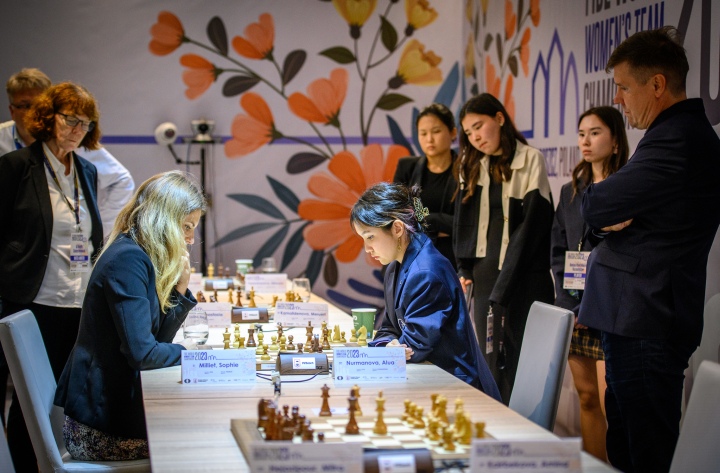
The two semifinals had to be decided on blitz tie-breaks. France and the USA will play for the bronze medal. Kazakhstan – France (1-3) (3-1) (blitz: 4-0) In the first match, things went quite well for the French squad. At the expense of some minor concessions in the center, Daulyte-Cornette built a very dangerous attack with White, throwing her pieces towards Bibisara Assaubayeva’s King. Bibisara, who had not yet lost a game in this event, found herself under tremendous pressure. Deimante was a bit short of time towards the end, with only seconds on the clock, but her advantage was overwhelming, and she converted it without hesitation. The second French victory came in the third board, also with the white pieces: the clash between Milliet and Nurmanova was quite a roller coaster, and in fact, Sophie was worse for most of the game. But at some point, the young Kazakhstani overlooked a simple tactical trick that allowed Milliet to capture the A pawn and turn the tables, setting the score in a 3-1 victory for France. Nurmanova took her revenge in the second match, which followed a very different storyline. Alua completely outplayed her opponent with the white pieces in a very instructive attacking game. Short of time and against the ropes, Milliet had to resign. Earlier in the match, Mitra Hejazipour blundered a pawn in the opening, and Amina Kairbekova was merciless. With the remaining two games ending in a draw, the match was to be decided in the tie-break. It was clear that the result and the emotions of the second rapid match affected the mood and confidence of the players as they entered the playing hall for the tie-break. Kazakhstan was on a roll, and the youngsters got a clean sweep in the blitz games. Reaching the final is no doubt a fair and well-deserved result for the Kazakhstani players, who completely dominated the pool stage, but a bitter end for a French team that was one of the revelations of the event. Georgia – USA (2½-1½) (1½-2½) (blitz: 3½-½) We could say that Georgia took control of the first match from early on, as Lela Javakhishvili delivered a brilliant blow to Pourkashiyan’s position. Curiously enough, Lela didn’t find the best continuation to follow up on her attack, and little by little, her advantage vanished, being this the only game to end in a draw. However, being aware that they were probably going to lose on the fourth board was something that weighed on the American players. Tatev Abrahamyan went wrong in a drawish position and lost to Nino Batsiashvili. Anna Zatonskih defended a slightly inferior position against Meri Arabidze, falling behind on the clock. Arabidze was very smart and broke through with 66.e4 at the right time, provoking a mistake from Anna. The only victory for the Americans came on board one, where Alice Lee got yet another scalp, outplaying Bella Khotenashvili with White in a very fine game. For the second game, the coach of the US team decided to bench Anna Zatonskih, who was replaced by Annie Wang. This proved to be the right call, as Annie scored the crucial victory for her team in a London system against Nino Batsiashvili. As all the other games ended in a draw, this victory allowed the USA to force a tie-break. The blitz games were quite one-sided, with the Americans failing to show their A-game. Abrahamyan managed to neutralise Arabidze, reaching a quick draw. However, Atousa blundered a pawn against Javakhishvili, while Annie Wang blundered a whole piece and gifted the whole point to Batsiashvili. In the remaining game, on the first board, Alice Lee also fell for a simple tactical trick that left her one exchange down and resigned shortly after. The Georgians will have the chance tomorrow to increase even further their impressive track record of victories in women’s competitions. The final fight for the medals will take place tomorrow, with the games beginning at 14:00 local time, one hour earlier than previous rounds. Written by David Llada Photos: Michal Walusza and Niki Riga Official website: worldwomenteams.fide.com. About the event The 2023 FIDE World Women’s Team Championship takes place from 5-12 September in Bydgoszcz (Poland). Twelve teams participate: Georgia, USA, China, India, Ukraine, Poland, Germany, FIDE Americas, France, Kazakhstan, Bulgaria, and Egypt, each with four players (plus two reserves). They are divided into two pools of approximate strength. Four teams will be eliminated at the pool stage, with the best eight teams advancing to a double-round knockout stage. The matches are decided by team points, with 2 points for the winning team and 1 each in case of a draw. Time control is 45 minutes for the whole game, with an increment of 10 seconds per move starting from move 1. Event website: worldwomenteams.fide.com About Bydgoszcz Located in northern Poland, less than 200km from the capital, Warsaw, Bydgoszcz sits at the junction of the rivers Vistula and Brda. With 350,000 inhabitants, it is served by its own domestic airport. An architecturally rich city, Bydgoszcz is home to a number of universities, like the Casimir the Great University, the University of Technology and Life Sciences and a conservatory. With a thriving cultural life, it also hosts the Pomeranian Philharmonic concert hall and the Opera Nova opera house. More information: bydgoszcz.pl
WWTC 2023: Kazakhstan-France and USA-Georgia to cross swords in semifinal
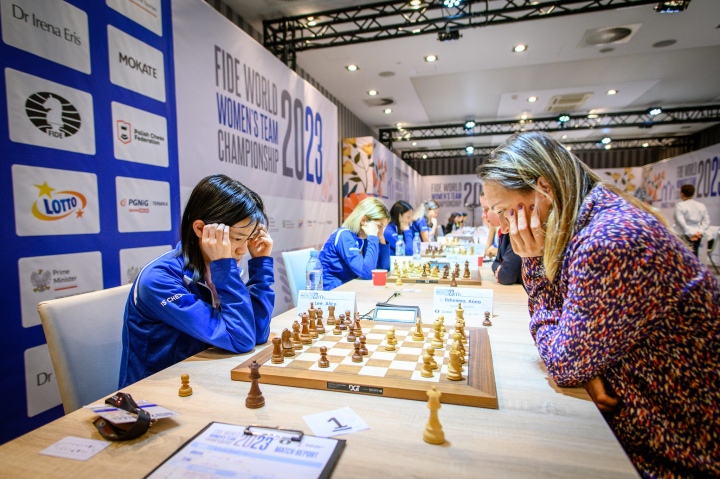
France – Poland (3-1) (2½-1½) France was one of the first teams to secure their qualification for the FIDE World Women’s Team Championship semifinals, with a double victory over the home team, Poland. The first match was one-way traffic: Klaudia Kulon won again in the fourth board, extending her successful run to a remarkable 4½/5, but all her teammates succumbed against “les bleus”, setting the score of the first clash at 3-1. Despite the pressure of being forced to win, the Polish squad played better in the second round, which was much closer, but France always had the match under control. This time, it was Klaudia who took even more risks than usual and lost her game and, with it, the match (2½-1½). Significantly reinforced with the incorporation of Mitra Hejazipour in the third/fourth board, France demonstrated once again to be a very competitive squad, on par with the big guns, despite the poor form of Natacha Benmesbah (1/4). Georgia – China (2½-1½) (2-2) Georgia-China was probably the closest match of the Quarter Finals. In the first round, Meri Arabidze ground her way with the black pieces to achieve a fine win over Kaiyu Ning, which was enough to give the victory to her team (2½-1½), as all the other three games ended in a draw. In the second clash, China had excellent chances to hit back. While the games in the three lower boards seemed pretty equal, Yuxin Song managed to build an advantage with White against Bella Khotenashvili, and she was, in fact, very close to winning. However, Song let her advantage slip, and in the end, she could have even lost. The relief on the faces of the Georgians was blatantly obvious when Bella and Yuxin shook hands and signed the draw, promoting Georgia to the semifinals. USA – Ukraine (2½-1½) (2½-1½) The USA won both matches against Ukraine by the minimum margin on both occasions. The Ukrainians demonstrated their resilience and gave the Americans a run for their money, but the USA was the better team, and their victory was a fair result. Young prodigy Alice Lee drew both her games against Anna Ushenina on the first board, but the USA victory was cemented on the lower boards, where Tatev Abrahamyan and Atousa Pourkashiyan won both their games. In the second clash, Anna Zatonskih blundered still in the opening (23…dxc4?) and lost on the spot against Nataliya Buksa, but this lone win for Ukrainians was not enough to change the fate of the qualifying. Kazakhstan – Germany (2-2) (3-1) The clash between Kazakhstan and Germany was probably the most exciting battle of the day. The first game between Paehtz and Assaubayeva was a relatively quiet draw in 25 moves. The exchange of blows happened on boards two and three, where Alua Nurmanova gave no chance to Josefine Heinemann, while Meruert Kamalidenova made a dubious pawn sacrifice that Dinara Wagner punished ruthlessly. With a draw on the scoreboard, everything was at stake in the second match, where all four games reached a decisive outcome. Nurmanova won again against Heinemann, and so did Amina Kairbekova on the fourth board. However, the lucky Germans still hoped for one more miracle, as Elisabeth Paehtz got a clear advantage out of the opening against Bibisara Assaubayeva while Dinara Wagner was building an attack in her game. However, the blunders caused by the time trouble struck again in the game between Paehtz and Assaubayeva, with the advantage changing sides with almost every move in the final stage of the game. In the end, it was the Kazakhstani the one who made the second-to-last mistake, inflicting a painful defeat on Paehtz. Dinara won her game, but it did not change anything. The semifinal matches will be Kazakhstan-France and USA-Georgia, where none of the four teams seems to be a favourite. As in previous days, the first of the Rapid matches is played at 15:00 local time and the second at 18:00. Written by David Llada Photos: Michal Walusza and David Llada Official website: worldwomenteams.fide.com. About the event The 2023 FIDE World Women’s Team Championship takes place from 5-12 September in Bydgoszcz (Poland). Twelve teams participate: Georgia, USA, China, India, Ukraine, Poland, Germany, FIDE Americas, France, Kazakhstan, Bulgaria, and Egypt, each with four players (plus two reserves). They are divided into two pools of approximate strength. Four teams will be eliminated at the pool stage, with the best eight teams advancing to a double-round knockout stage. The matches are decided by team points, with 2 points for the winning team and 1 each in case of a draw. Time control is 45 minutes for the whole game, with an increment of 10 seconds per move starting from move 1. Event website: worldwomenteams.fide.com About Bydgoszcz Located in northern Poland, less than 200km from the capital, Warsaw, Bydgoszcz sits at the junction of the rivers Vistula and Brda. With 350,000 inhabitants, it is served by its own domestic airport. An architecturally rich city, Bydgoszcz is home to a number of universities, like the Casimir the Great University, the University of Technology and Life Sciences and a conservatory. With a thriving cultural life, it also hosts the Pomeranian Philharmonic concert hall and the Opera Nova opera house. More information: bydgoszcz.pl