

WWTC 2023: Kazakhstan-France and USA-Georgia to cross swords in semifinal
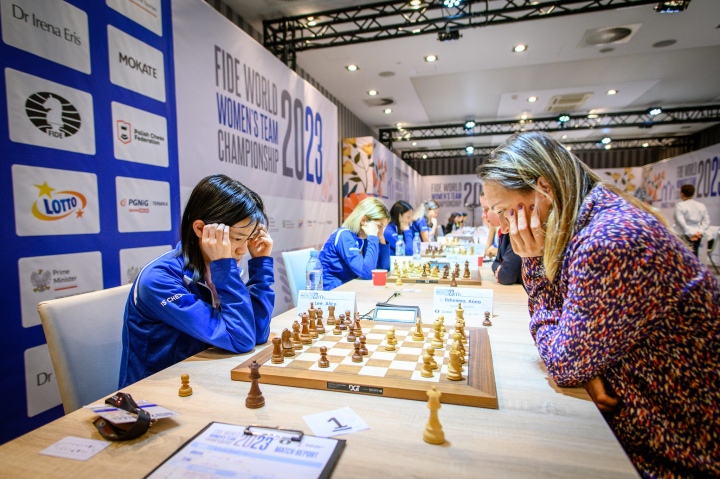
France – Poland (3-1) (2½-1½) France was one of the first teams to secure their qualification for the FIDE World Women’s Team Championship semifinals, with a double victory over the home team, Poland. The first match was one-way traffic: Klaudia Kulon won again in the fourth board, extending her successful run to a remarkable 4½/5, but all her teammates succumbed against “les bleus”, setting the score of the first clash at 3-1. Despite the pressure of being forced to win, the Polish squad played better in the second round, which was much closer, but France always had the match under control. This time, it was Klaudia who took even more risks than usual and lost her game and, with it, the match (2½-1½). Significantly reinforced with the incorporation of Mitra Hejazipour in the third/fourth board, France demonstrated once again to be a very competitive squad, on par with the big guns, despite the poor form of Natacha Benmesbah (1/4). Georgia – China (2½-1½) (2-2) Georgia-China was probably the closest match of the Quarter Finals. In the first round, Meri Arabidze ground her way with the black pieces to achieve a fine win over Kaiyu Ning, which was enough to give the victory to her team (2½-1½), as all the other three games ended in a draw. In the second clash, China had excellent chances to hit back. While the games in the three lower boards seemed pretty equal, Yuxin Song managed to build an advantage with White against Bella Khotenashvili, and she was, in fact, very close to winning. However, Song let her advantage slip, and in the end, she could have even lost. The relief on the faces of the Georgians was blatantly obvious when Bella and Yuxin shook hands and signed the draw, promoting Georgia to the semifinals. USA – Ukraine (2½-1½) (2½-1½) The USA won both matches against Ukraine by the minimum margin on both occasions. The Ukrainians demonstrated their resilience and gave the Americans a run for their money, but the USA was the better team, and their victory was a fair result. Young prodigy Alice Lee drew both her games against Anna Ushenina on the first board, but the USA victory was cemented on the lower boards, where Tatev Abrahamyan and Atousa Pourkashiyan won both their games. In the second clash, Anna Zatonskih blundered still in the opening (23…dxc4?) and lost on the spot against Nataliya Buksa, but this lone win for Ukrainians was not enough to change the fate of the qualifying. Kazakhstan – Germany (2-2) (3-1) The clash between Kazakhstan and Germany was probably the most exciting battle of the day. The first game between Paehtz and Assaubayeva was a relatively quiet draw in 25 moves. The exchange of blows happened on boards two and three, where Alua Nurmanova gave no chance to Josefine Heinemann, while Meruert Kamalidenova made a dubious pawn sacrifice that Dinara Wagner punished ruthlessly. With a draw on the scoreboard, everything was at stake in the second match, where all four games reached a decisive outcome. Nurmanova won again against Heinemann, and so did Amina Kairbekova on the fourth board. However, the lucky Germans still hoped for one more miracle, as Elisabeth Paehtz got a clear advantage out of the opening against Bibisara Assaubayeva while Dinara Wagner was building an attack in her game. However, the blunders caused by the time trouble struck again in the game between Paehtz and Assaubayeva, with the advantage changing sides with almost every move in the final stage of the game. In the end, it was the Kazakhstani the one who made the second-to-last mistake, inflicting a painful defeat on Paehtz. Dinara won her game, but it did not change anything. The semifinal matches will be Kazakhstan-France and USA-Georgia, where none of the four teams seems to be a favourite. As in previous days, the first of the Rapid matches is played at 15:00 local time and the second at 18:00. Written by David Llada Photos: Michal Walusza and David Llada Official website: worldwomenteams.fide.com. About the event The 2023 FIDE World Women’s Team Championship takes place from 5-12 September in Bydgoszcz (Poland). Twelve teams participate: Georgia, USA, China, India, Ukraine, Poland, Germany, FIDE Americas, France, Kazakhstan, Bulgaria, and Egypt, each with four players (plus two reserves). They are divided into two pools of approximate strength. Four teams will be eliminated at the pool stage, with the best eight teams advancing to a double-round knockout stage. The matches are decided by team points, with 2 points for the winning team and 1 each in case of a draw. Time control is 45 minutes for the whole game, with an increment of 10 seconds per move starting from move 1. Event website: worldwomenteams.fide.com About Bydgoszcz Located in northern Poland, less than 200km from the capital, Warsaw, Bydgoszcz sits at the junction of the rivers Vistula and Brda. With 350,000 inhabitants, it is served by its own domestic airport. An architecturally rich city, Bydgoszcz is home to a number of universities, like the Casimir the Great University, the University of Technology and Life Sciences and a conservatory. With a thriving cultural life, it also hosts the Pomeranian Philharmonic concert hall and the Opera Nova opera house. More information: bydgoszcz.pl
FIDE WWTC 2023: A big upset for India, a huge miracle for Germany
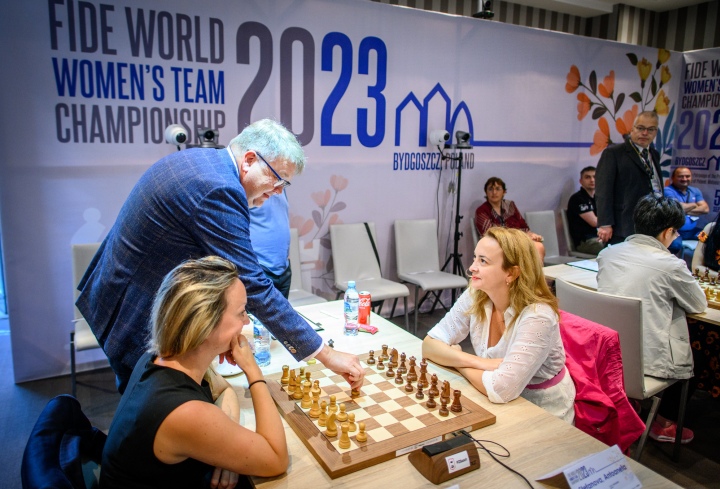
Kazakhstan, Georgia, the USA and Poland enter the knockout stage as the top seeds. In a dramatic turn of events, Bulgaria suffers a last-minute defeat at the hands of Germany and says goodbye to the competition, while India is eliminated after France and Ukraine unexpectedly tie a very tense match. The last round of the Pools stage was full of unexpected turns and twists, as no less than seven teams had yet to secure their qualification for the knockout stage. In Pool A, the clash between Kazakhstan and Georgia (2-2) seemed like a trivial affair, as both teams had already earned their spot. However, the match turned out to be quite the slaughter-fest, with all four games ending with a decisive result. In a slightly inferior position with Black against Bella Khotenashvili, Bibisara Assaubayeva opted for a bold exchange sacrifice that was objectively incorrect. However, it paid off, as Bella was in time trouble and panicked, giving away a whole piece unnecessarily and letting her position collapse. In the fourth board, 16-year-old Amina Kairbekova demonstrated once again that she is probably the most underrated player on the field, as today she outplayed the experienced Salome Melia. Meri Arabidze and Nino Batsiashvili scored the two victories for the Georgians, levelling the match: they both show to be in top shape, having scored so far 4/5 and 3½/4, respectively. India, the 4th seeded team in the competition, had lost its matches in rounds 2, 3 and 4, but today did their part, winning confidently against Egypt by 3½-½. Their qualification was to depend on the result of the match between Ukraine and France, in which a victory by either of the teams would have given the Indians a hail-Mary qualification, as they had better tie-break (board points). It was the moment when all the drama unfolded. Natalia Zhukova drew against Mitra Hejazipour. Natacha Benmesbah ruined a very advantageous position against Yelyzaveta Hrebenshchykova and lost. Anastasia Savina evened up the score, winning convincingly against Inna Gaponenko. The match and India’s fate were to be decided in the game between Nataliya Buksa (white) and Deimante Daulyte-Cornette (black). Buksa had a favourable position, but the game entered a stage where both players had very little time on the clock. Nataliya blundered a simple mate in two that her opponent overlooked – not once, but twice! In a wild time scramble, the advantage changed sides several times, and after 66 moves, despite having a winning position, Nataliya decided that she had had enough stress and offered a draw that secured her team a spot in the knockout stage. A satisfactory result for both France and Ukraine, but a heartbreaker for India. In Pool B, the situation resembled the one in Pool A, as the two teams who had already qualified, USA and Poland, were to cross swords in the 5th round. And again, the clash was anything but peaceful, with the home team getting the upper hand. Monika Socko struck first and paved the way for her team with an early win against a well-known rival for her, Anna Zatonskih. Socko was a pawn up from early into the game, while her opponent, being short of time, failed to find the best defence. Oliwia Kiolbasa put an end to Alice Lee’s winning run, defeating her in a very nice game. Aleksandra Maltsevskaya rejected a draw by threefold repetition but found herself in a lost endgame shortly after, giving the USA their only victory in the match and leaving the score at 2½-1½ for the home team. China recovered from the double defeat suffered yesterday in rounds 3 and 4, and with a good performance on the bottom boards beating FIDE Americas 3-1, and punched their ticket to the knockout stage. All eyes were on the match Germany-Bulgaria, which was one of the last to end. After a draw was reached in boards 2 and 3, the situation was clearly in favour of the Bulgarians: Elisabeth Paehtz was a pawn up against Antoaneta Stefanova but with no realistic chances to win, while in the fourth board, Viktoria Radeva had a completely winning position against Jana Schneider. Radeva reached an endgame with a rook vs. two pawns, with the engines announcing mate in 25 moves. But as it so often happens, one simple mistake was enough to turn a decisive victory into a draw. Probably distracted by what had just happened, it was Stefanova’s turn to make a mistake, and she lost her game, giving away the crucial point. Germany, after having lost their first three matches in succession and having won only two games in the entire competition (Schneider 1-0 Campos in round 4, and Paehtz 1-0 Stefanova in round 5), leapfrogged Bulgaria in the last turn, defeating them by the minimum score (2½-1½), tying on match points, and barely overtaking them on board points. Pool A results: Georgia (2-2) KazakhstanUkraine (2-2) FranceEgypt (½-3½) India Pool A Standings: Kazakhstan – 9Georgia – 7France – 5Ukraine – 5India – 4Egypt – 0 Pool B results: China (3-1) FIDE AmericasPoland (2½-1½) USAGermany (2½-1½) Bulgaria Pool B Standings: USA – 7Poland – 7China – 6Germany – 4Bulgaria – 4FIDE Americas – 2 Written by David Llada Photos: Michal Walusza Official website: worldwomenteams.fide.com. About the event The 2023 FIDE World Women’s Team Championship takes place from 5-12 September in Bydgoszcz (Poland). Twelve teams participate: Georgia, USA, China, India, Ukraine, Poland, Germany, FIDE Americas, France, Kazakhstan, Bulgaria, and Egypt, each with four players (plus two reserves). They are divided into two pools of approximate strength. Four teams will be eliminated at the pool stage, with the best eight teams advancing to a double-round knockout stage. The matches are decided by team points, with 2 points for the winning team and 1 each in case of a draw. Time control is 45 minutes for the whole game, with an increment of 10 seconds per move starting from move 1. Event website: worldwomenteams.fide.com About Bydgoszcz Located in northern Poland, less than 200km from the capital,
Cape Verde Women’s Championship 2023: Célia Rodriguez retains title
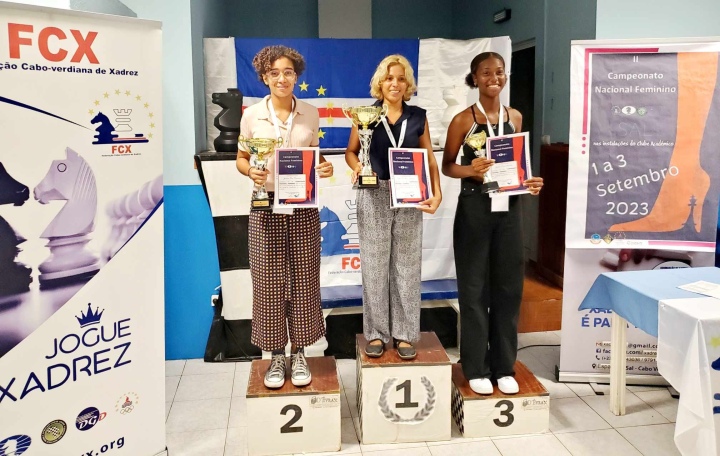
The 2nd Cape Verde Women’s National Championship, a 5-round Swiss tournament, took place from September 1-3 at Clube Juventude on the island of Sal. As many as 20 players registered before the start, but due to the flight cancellation from the island of S. Nicolau to the island of Sal, only 19 participants ended up competing in the event. Two rounds were scheduled every day, one in the morning and one in the afternoon. In one of the morning rounds, some participants, probably unaccustomed to the strict regulations, arrived shortly after the 30-minute grace period and forfeited for non-attendance. Among these players was the defending National Champion, Célia Rodriguez, who was due to play the 2022 runner-up. As a result, heading to the final round, Juliana Monteiro needed only a draw to clinch the title of 2023 champion. Facing the defending champion, Célia Rodriguez, Juliana Monteiro grabbed the initiative in the opening and was building up the pressure until the 24th move, when she made a mistake to drop her advantage. In subsequent play, the two traded inaccuracies, but on move 78, there was a 3-time repetition. Unfortunately for her, Juliana missed that and did not claim a draw that would have secured her the national title. Célia Rodriguez went on to win this dramatic game and became a two-time Cape Veridan Women’s Champion, thanks to superior tiebreaks. For the runner-up, Juliana Monteiro, it was a painful lesson, but she showed that her chess had improved considerably. Final standings: 1 Rodriguez Guevara, Celia 1729 4 2 Pio Monteiro, Juliana 1297 4 3 Almeida, Jacira Laura 1331 4 4 Martins, Katlene Jussara 1232 4 5 Moreno, Akiane 1310 3½ 6 Moreno, Viviane 1046 3 7 Martins, Amanda Maria 1384 3 8 Lopes, Jussara Patricia 3 9 Brito, Karima Monteiro 3 10 Spinola, Divania 1329 2½ Complete standings Official webpage: fcvx.org/cnf-2023/
FIDE WWTC: Kazakhstan, Georgia, USA and Poland advance to quarterfinals
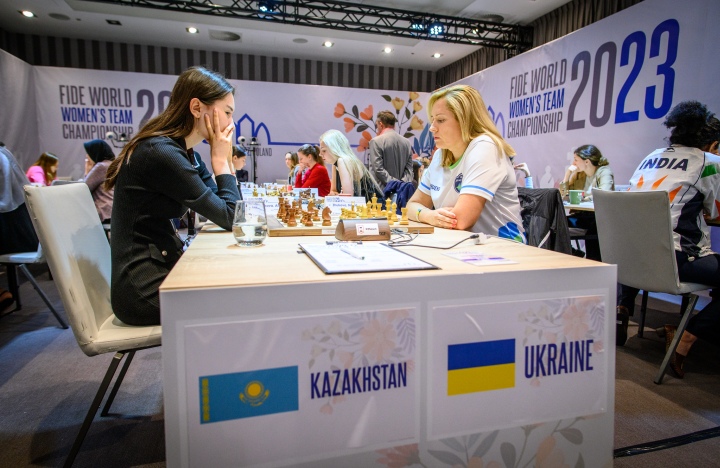
Kazakhstan scored their fourth victory in a row and seems unstoppable, while the USA emerges as the strongest team from Pool B. Round 3 Pool A Kazakhstan (2½-1½) FranceGeorgia (3½-½) EgyptUkraine (2½-1½) India Pool B USA (2-2) FIDE AmericasChina (1-3) BulgariaPoland (2½-1½) Germany The leaders in Pool A, Kazakhstan, were off to a great start, as Bibisara Assaubayeva got a very promising position against Deimante Daulyte-Cornette. However, Bibisara didn’t play precisely enough and let her early advantage fade away. Kazakhstan’s victory came in their boards where they had the black pieces: Meruert Kamalidenova convincingly beat Sophie Millet, and Amina Kairbekova scored a full point against Natasha Benmesbah. The reigning French Champion, Mitra Hejazipour, clinched her first victory playing for the national team, but that was not enough to change the fate of the match. Georgia cruised over Egypt to recover from the defeat in the previous round. Shahenda Wafa was very close to winning against Nino Batsiashvili, as she was a pawn up for most of the game, but she prematurely traded the queens and liquidated to a rook endgame that was a theoretical draw. The match against Ukraine was a cold shower for India. Towards the end of the round, 3-1 looked as the most likely outcome, as Vantika Agrawal had an overwhelming position against Buksa, while Savitha Shri also reached a favourable endgame in her game with Yelyzaveta Hrebenshchykova. In the end, Savitha had to settle for a draw, but the worst was yet to come: on board two, Agrawal made a horrible blunder (29.d7??) and lost almost on the spot. A serious setback for India and a miraculous triumph for the Ukranians. In pool B, the most relevant result was probably the surprising defeat of China in the hands of Bulgaria by 3-1. At some point, Stefanova’s position against Yuxin Song looked slightly dubious, but she demonstrated her class with a slashing counter-attack on the kingside. Viktoria Radeva scored the second victory for the Bulgarians after Yiyi Xiao fell into a simple tactic. Poland also notched up a big win against their historical rival, Germany. On the fourth board, Klaudia Kulon, a very aggressive and dynamic player, got the kind of position that she enjoys playing, being one pawn down in exchange for the initiative. Her victory against Hanna Marie Klek forced Dinara Wagner to push for a win in a very delicate position, which resulted in Monika Socko’s getting a decisive advantage. However, in the time trouble, Socko fell for a simple perpetual check that, but thankfully for the Polish team, it was enough to seal the victory in the match. In “the Battle of the Americas”, the North and South split the points. Alice Lee continued her impressive performance beating Cuban IM Lisandra Ordaz, while the Argentinian Maria Jose Campos got a victory for FIDE Americas against Annie Wang. The final score 2-2 was a fair result. Round 4 Pool A France (3-1) EgyptKazakhstan (2½-1½) UkraineIndia (1-3) Georgia Pool B USA (2½-1½) ChinaFIDE Americas (1½-2½) GermanyBulgaria (2-2) Poland In Round 4, Kazakhstan extended their winning run with an important victory against Ukraine (2½-1½). Bibisara played a fine game against Anna Ushenina and smoothly converted her extra pawn in a bishop endgame. Alua Nurmanova scored the second full point for the Kazakhstani, while Natalia Zhukova got her second win in a row in the fourth board. The clash between two main contenders for the final victory, India and Georgia, was decided in favour of the Georgians by 3-1. The Indians were still a bit shaky after their dramatic defeat in the previous round, and Harika lost with White in an instructive game very well played by Bella Khotenashvili. The second victory for Georgia also came with the black pieces: Divya Deshmukh tried to defend a weak pawn with some tactics that didn’t really work, and Nino Batsiashvili got a very comfortable position with an extra pawn. The GM from Batumi got sweet revenge for the defeat she had suffered last week at the hands of Deshmukh in the Tata Steel Chess India. France – Egypt was a very one-sided match, won by the Europeans by an indisputable 3-1. The good news is that Egypt achieved its maiden board victory after Ayah Moaataz (1959) checkmated Sophie Millet (2335) on the third board. In Pool B, the main clash of the fourth round was the match between the USA and China, where the Americans came on top by 2½-1½. It was the second defeat of the day for the young Chinese team, a disappointing result after their good performance on the first day of competition. 13-year-old Alice Lee won again and is now on 3½/4, having conceded only one draw in the first round. The way she played an equal endgame against Yuxin Song speaks volumes about how confident the young American feels at the chess board, always trying to keep the game going, waiting for an opportunity. FIDE Americas vs. Germany was a very close match, but in the end, it was decided in favour of the Europeans thanks to a victory in the fourth board, where Jana Schneider outplayed Maria Jose Campos from Argentina. Poland had to settle for a draw against Bulgaria. Klaudia Kulon is on fire and won her third game in a row, this time against Beloslava Krasteva, but Gergana Peycheva levelled the score. This result, however, was good enough for the home team to advance to the knockout stage, regardless of their result tomorrow. With these results, Kazakhstan and Georgia qualified for the knockout stage from Pool A, while France, Ukraine and India will fight in Round 5 for the remaining two qualification spots. As for Pool B, USA and Poland have secured their place in the quarterfinals. No less than four teams – China, Bulgaria, FIDE Americas and Germany – will battle for two remaining places in the knockout stage. Written by David Llada Photos: Michal Walusza Official website: worldwomenteams.fide.com. About the event The 2023 FIDE World Women’s Team Championship takes place from
FIDE WWTC 2023: USA, China and Kazakhstan lead after Day 1
13-year-old Alice Lee defeated former Women’s World Champion Antoaneta Stefanova. Kazakhstan surprises, taking the lead following the defeats of India and Georgia. Round 1 In the Pool A, Georgia scored the best result of the round, a resounding victory by 3½-½ against a direct rival, Ukraine. The Georgian players cemented their win thanks to their dominant performance on the White boards: Meri Arabidze and Lela Javakhishvili showed great drive, and with an accurate play, they got the full point against Nataliya Buksa and Anastasiya Rakhmangulova, respectively. Khotenasvili, with Black on the first board, played a solid Grunfeld line and drew comfortably against Ushenina. The result could have been much closer, though, had Inna Gaponenko managed to convert the winning position she achieved against Nino Batsiashvili. However, the Ukrainian IM, who often falls in time scrambles, let the victory slip at the exact moment when she was going for the kill. Batsiashvili grabbed her chance and, with ingenious play, pulled off the biggest swindle of the day. India defeated France 3-1, but some of the games in the match were quite double-edged, and at times, it seemed as if the match could go either way. Vantika Agrawal is in great shape, and her sound king move 15.Ke2! gave her the upper hand against Deimante Daulyte-Cornette, who shortly after lost a pawn. Vantika’s conversion of her material advantage was flawless. Another Indian player in great shape is Divya Deshmukh, who arrived in Bydgoszcz as the surprising winner of the Tata Steel Rapid India with a splendid performance. With Black, she put Anastasia Savina under some pressure, and the French second board succumbed after making two mistakes in succession, 18.g3 and 20.Kg2. Divya was merciless and punished her opponent with a strong hand. Kazakhstan got a scare very early into the game, as in the second board both players seemed to have mixed up the move order in a Najdorf. Shahenda Wafa played a premature 9.e5, and Kamalidenova got confused and played 9…dxe5 right away (instead of 9…Bb7), giving White a chance to get a decisive advantage with 10.Ndxb5! However, the Egyptian player also missed this intermediate move, but without it, the a8-rook is a Trojan horse. Kamalidenova did not give her opponent a second chance. On the first board, Bibisara Assaubayeva was also ruthless as she outplayed Shrook Wafa, sealing the result at 3-2 for the Kazakhstani players. In Pool B, the home team lost against China by 2½ – 1½ in a match with several twists. Aleksandra Maltsevskaya, making her debut with the Polish national team, played a bit shaky in the opening (with black), and fell into a trap by Kaiyu Ning. Being down material since move 20, Aleksandra kept the game going, hoping for a miracle, and her resilience was rewarded, as Kaiyu failed to deliver a final blow. The very experienced Monika Socko got a clear edge against Yang Shen when the young Chinese misplayed the opening; however, Socko rushed to simplify the position and let the advantage slip, agreeing to a draw after 31 moves. The match was decided on the fourth board, where IM Qi Guo outplayed Michalina Rudzinska. Another thrilling match was the one between Germany and the US. The world is eager to see how 13-year-old Alice Lee will perform in the international arena, and her game today against such an experienced player as Elisabeth Paehtz was an excellent test to start with. With Black, the German GM rejected an early possible draw by threefold repetition against the young prodigy and tried to keep the game going for as long as possible, building some initiative. However, Alice never gave her opponent the slightest chance to get an advantage, and the game was a draw after 75 moves. The match was decided on the second board, where Dinara Wagner lost to Anna Zatonskih. Despite playing one of her pet openings, the Catalan, and being, in general, a very well-prepared player, Dinara seemed to struggle during the whole game to find a safe square to place her Queen, and on move 30, she blundered a knight. The match between the team FIDE Americas and Bulgaria was a very close affair, which came to an unexpected conclusion. The American ladies got ahead on the scoreboard after Lisandra Ordaz, with black, defeated former World Champion Antoaneta Stefanova in great fashion. The position around move 30, where the Cuban IM had a very strong Knight on d4 while Stefanova’s was stuck on a6, is very illustrative. Meantime, Jennifer Perez had Viktoria Radeva against the ropes, so it was all set for a convincing victory for FIDE America. Very short of time, Jennifer started to chase the black king, who ran away across the entire board and managed to hide from the threats for long enough to make her lose on time, despite the time increment of 10 seconds per move. In the end, it was 2-2 and a little setback for the South American players. Round 2 The second round of the day was packed with action: only a few games were decided in the first hour of play, but then, as the end of the afternoon was nearing, quite a few games took an unexpected turn. Kazakhstan took the lead in pool A after Georgia was defeated by France (2½ – 1½), while the USA and China are in command of pool B. Things started on the wrong foot for Georgia, as Salome Melia blundered a pawn early in the opening against Natacha Benmesbah, and could not offer much resistance. The game between Deimane Daulyte-Cornette and Bela Khotenashvili was a beautiful fight to watch. Demaine was by no means better, as Black’s bishop’s pair was restricting her play; however, the French player seized the initiative with her plan 22.g4-g5-g6. The position that emerged, with the White knights creating all kinds of threats, was extremely difficult to assess in a rapid game. Unfortunately, when the tension was reaching its peak, and the game was at its sharpest, Bella blundered a Rook.
FIDE World Women’s Team Championship 2023 starts in Bydgoszcz, Poland
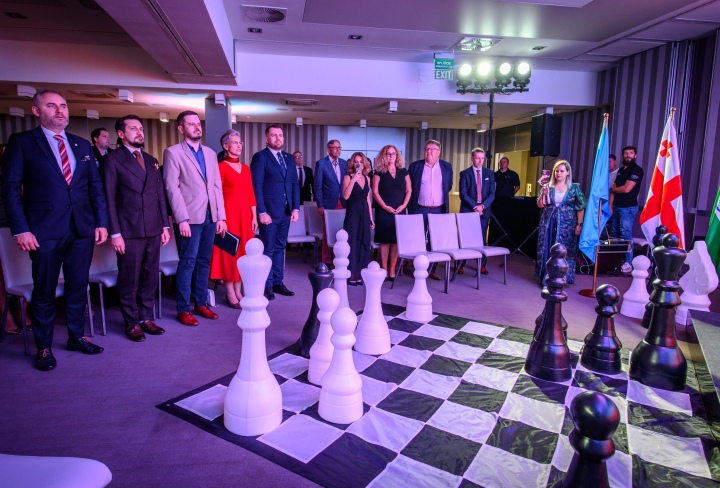
The FIDE World Women’s Team Championship kicked off on September 5 with the opening ceremony held in Bydgoszcz, Poland, in a very relaxed and cosy atmosphere. The event was graced with the presence of Grażyna Szabelska, plenipotentiary of the Kuyavian-Pomeranian Voivode, representing Mateusz Morawiecki, Prime Minister of the Republic of Poland. Also in attendance were Gunnar Bjornsson – FIDE Technical Delegate, Tomasz Delega, Chief Arbiter and former president of the Polish Chess Federation, Anastasia Sorokina, Chairperson of the FIDE Women’s Commission, Hesham Elgendy – President of the Egyptian Chess Federation, Jan Kusina, former president of the Polish Chess Federation, and Maciej Cybulski, Tournament Director. Radosław Jedynak, President of the Polish Chess Federation, made the first speech, in which he welcomed the twelve participant teams and encouraged them not only to give their very best at the chess board but also to find the time to explore the city, its architectural richness and cultural life, and bring back home the best possible memory about their visit to Poland. The next authority to take the floor was Łukasz Turlej, FIDE Secretary General, who highlighted the involvement of the Prime Minister himself in making this event possible and hinted at the possibility of Poland hosting even more top events in the near future. Grażyna Szabelska made the last speech, in which she read the letter addressed by the Polish Prime Minister Mateusz Morawiecki to the participants and attendants: “Ladies and gentlemen, for the next week, we will have the opportunity to witness exciting battles between twelve outstanding women’s chess teams, all competing for the title of the world’s best team. This is all thanks to the Women’s World Team Chess Championship, which kicks off today and takes place this year on Polish soil, in the welcoming city of Bydgoszcz. I warmly welcome all the teams and extend sincere appreciation to each of the participants in this year’s tournament. Chess is a unique sport often referred to as the “royal game.” It teaches us truly regal attributes – strategic thinking and the ability to foresee. It requires concentration, knowledge, constant improvement, and mastery over weaknesses. Chess is widely regarded as a noble game and synonymous with wisdom. At the same time, chess is a true school of character. It compels us to confront our own weaknesses, establishes the right hierarchy of values, teaches us to exert effort, and strengthens our belief in our abilities. This is perfectly illustrated by the popular maxim among many players: ‘If you want to know a person, their character, strengths, and weaknesses, play chess with them.’ Ladies and gentlemen, the Women’s World Team Chess Championship that is about to begin is a true celebration for chess enthusiasts. On this occasion, I would like to express my gratitude to the organizers of the tournament and to everyone who supported the efforts involved in its preparation. To the athletes taking part in this sporting competition, I wish for it to be conducted in the spirit of fair play and bring much satisfaction from the battles you will engage in over the coming days. I already extend my heartfelt congratulations to the tournament champions and all the teams participating in it. May these prestigious competitions be etched in golden letters in your memory and on the path of your sporting achievements. I warmly greet everyone gathered at the inauguration of the championship.” The drawing of lots for the two pools produced the following pairings for Round 1: Pool A India – FranceKazakhstan – EgyptUkraine – Georgia Pool B Bulgaria – FIDE AmericasUSA – GermanyChina – Poland The technical meeting with the team captains will take place tomorrow, September 6th, at 10:00. The first round of the Pools stage will kick off at 15:00 CEST. Live coverage, as well as full information about the event, can be found on the official website: worldwomenteams.fide.com. Written by David Llada Photos: Michal Walusza About Bydgoszcz Located in northern Poland, less than 200km from the capital, Warsaw, Bydgoszcz sits at the junction of the rivers Vistula and Brda. With 350,000 inhabitants, it is served by its own domestic airport. An architecturally rich city, Bydgoszcz is home to a number of universities, like the Casimir the Great University, the University of Technology and Life Sciences and a conservatory. With a thriving cultural life, it also hosts the Pomeranian Philharmonic concert hall and the Opera Nova opera house. More information: bydgoszcz.pl
Vitaly Sivuk wins 2023 Malaysian Open
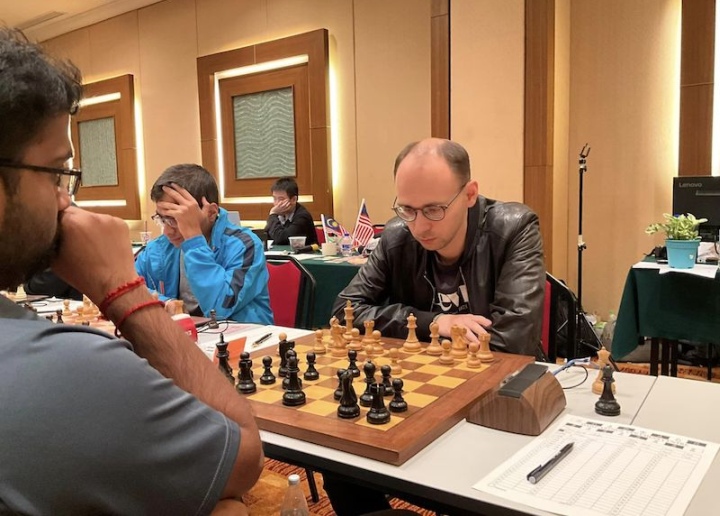
Vitaly Sivuk (SWE) emerged as the winner of the 2023 Malaysian Open Championship. As many as four players scored 7/9 and tied for first place, but the reigning champion of Sweden came out on top thanks to superior Buchholz. The 18th edition of the Malaysian Chess Festival, supported by the FIDE Aid Package, took place from August 25 to September 3 in Kuala Lumpur. The festival program included several competitions, including the Malaysian Open Championship, a nine-round Swiss tournament with classical time control that brought together 139 players (nine GMs). The tournament was a very close race that came down to the wire. Heading into the final ninth round, Mitrabha Guha of India was a half-point ahead of Sivuk, while a large group of players trailed the leader by a full point. Unfortunately for Guha, he suffered a painful defeat at the hands of his countryman, Deepan Chakkravarthy, and allowed three players to catch up with him. In the end, just 2.5 Buchholz points separated the champion (Sivuk) from the runner-up (Guha), while Aditya Bagus Arfan (Indonesia) and Deepan Chakkravarthy finished third and fourth respectively. A large group of players netted 6.5/9 and tied for fifth place. Final standings: 1 GM Sivuk, Vitaly SWE 2459 7 2 GM Mitrabha, Guha IND 2505 7 3 FM Arfan, Aditya Bagus INA 2410 7 4 GM Deepan, Chakkravarthy IND 2446 7 5 GM Iniyan, P IND 2502 6½ 6 GM Laylo, Darwin PHI 2426 6½ 7 IM Nitin, S. IND 2386 6½ 8 IM Kushagra, Mohan IND 2397 6½ 9 FM Poh, Yu Tian MAS 2377 6½ 10 GM Nguyen, Van Huy VIE 2363 6½ Complete results Photos: gilachess.org
Georgia and USA, main favourites in Poland
13-year-old Alice Lee will lead the USA team The FIDE World Women’s Team Championship will kick off on September 6th in Bydgoszcz (Poland), with Georgia setting its eyes on increasing even further its impressive track record of victories in women’s competitions. The Georgians, top the starting list well ahead of its main competitors, USA and China, although they will be playing without their leader Nana Dzagnidze, substituted by Meri Arabidze at the last moment. The event also marks the return of China to the international arena after its absence in the last Olympiad, but they do so with a weakened team: the World Champion Ju Wenjun, the runner-up Lei Tingjie, and the Candidate’s finalist Tan Zhongyi will all be missing from the team. The competition will follow a similar format to the previous edition, held in Sitges (Spain) in 2021, with all games played under a Rapid time control of 45 minutes for the whole game, with an increment of 10 seconds per move starting from move 1. The twelve teams of four players (plus two reserves) are divided into two pools of approximate strength according to the team’s average rating. Georgia and India, and USA and China, are the top-seeded teams in pools A and B, respectively. Pool A: Georgia (2391)*India (2320)Ukraine (2306)France (2270)Kazakhstan (2223)Egypt (2035) Pool B: USA (2340)China (2335)Germany (2303)Poland (2310)FIDE Americas (2279)Bulgaria (2228) *Average rating of the team according to the September 1st FIDE Rapid Rating list. The matches are decided by team points, with 2 points for the winning team and 1 each in case of a draw. Four teams will be eliminated at the pool stage, with the best eight teams advancing to a double-round knockout stage. The fact that some of the usual favourites, like China, Ukraine, or the USA, are missing some key players in their levels the field, making the competition more exciting and giving an opportunity to some young up-and-coming talents to be in the spotlight and show what there are capable of. Pool A Georgia will come to Bydgoszcz with their stellar line-up (with the only absence of Meri Arabidze), but nevertheless, they will have to show their A-game to come ahead of India, headed by Harika Dronavalli (pictured below) and Padmini Rout. It is significant that the last board of the Indian team, 17-year-old Divya Deshmukh, has just won the Tata Steel Chess Rapid event despite being by far the lowest-rated player in the field. In fact, she entered the tournament as a last-minute replacement! Photo: David Llada Ukraine will have Anna Ushenina defending the first board while the veteran Natalia Zhukova makes a return to the national team. The two-time European Champion hasn’t been very active in recent times, and his last rapid event was the World Rapid and Blitz 2021 in Poland, but her experience and ambition make her a formidable leader in a team event. France will feature Sophie Millet on the top board. Despite missing its top-rated player, Marie Sebag, the squad is reinforced with the incorporation of Mitra Hejazipour, who just won the French championship in brilliant fashion a few days ago. Kazakhstan would have been a serious contender for victory in this World Women’s Team Championship if they had managed to get their three aces in the team. However, with Abdumalik and Saduakassova not taking part in the event, the young Bibisara Assaubayeva will not only have to score the points but also take over her shoulders the role of team leader, showing the way to her much less-experienced colleagues. Photo: Mark Livshitz Egypt, the strongest African team, will feature Shrook Wafa and Mona Khaled on the top boards. Pool B: One of the sensations of the competition is that the USA team will be led by 13-year-old Alice Lee (pictured below), the youngest American female player to achieve the IM title and the third ever youngest internationally, only behind Judit Polgar and Kateryna Lagno. A three-time World Youth Champion, Lee became this year the second-rated female player in the American continent. Her debut on the first board should compensate for the absence of a household name in US chess, Irina Krush, who has had a packed schedule this summer after playing consecutively in Dubai, Baku, and the recently concluded Tata Steel Chess tournament in India. The second main novelty in the USA team is the debut of 25-year-old Atousa Pourkashiyan, who changed federations only a few months ago. Photo: St Louis Chess Club / Bryan Adams China may be missing its top guns, but such a strong chess country has plenty of worthy replacements, and the team they have put together for this event is still very competitive: with Yang Shen (2369) on the first board, plus Qi Guo (2451), Yiyi Xiao (2240) and Kaiyu Ning (2279), the Chinese are still the third-seeded squad, and will surely be able to put up a fight against anyone. Even without the World Champion, they cannot be ruled out as potential winners. Germany will be headed once again by Elisabeth Paehtz and Dinara Wagner, with Josefine Heinemann and Hanna Marie Klek completing the starting quartet. The home team, Poland, is seventh in the starting list (fourth in their pool). The fans have every reason to be excited, as their team is one of the youngest in the field and strong enough to have serious aspirations. Once again, Poland will be led by the eight-time national Champion Monika Socko (pictured below), the only remaining member of the Polish team that won a Silver medal at the Baku Chess Olympiad in 2016. But let’s look at the age of other team members: Oliwia Kiołbasa (23), Aleksandra Maltsevskaya (21), Michalina Rudzińska (21), and Julia Antolak (23). They make Klaudia Kulon (31) look like a veteran! Photo: Anna Shtourman The team “FIDE Americas” features players from five different countries in the continent (Peru, Cuba, Argentina, Paraguay and Colombia) that otherwise would not have the chance to compete internationally. The three-time American Continental women’s champion (and twice world junior champion)
FIDE September 2023 rating list: Gukesh debuts in top 10, Praggnanandhaa enters top 20
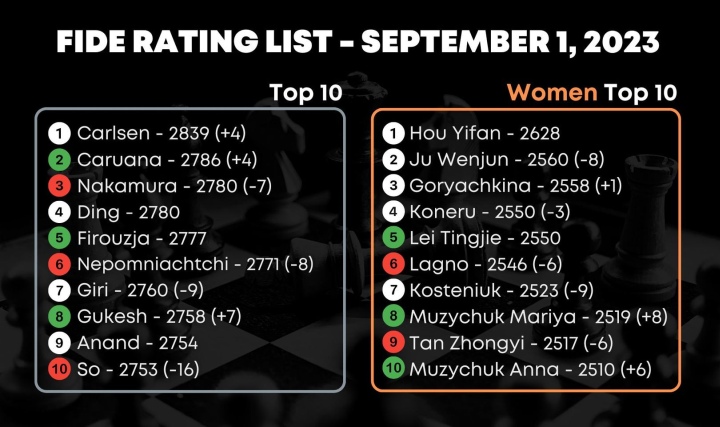
The FIDE World Cup and Women’s World Cup impacted the September rating list the most. Following their solid performance in the World Cup, Fabiano Caruana returned to the second position in the top 100 after almost a two-year break, while Gukesh D gained 7 points and made his first appearance in the top 10 open. Photo: Anna Shtourman Biggest gains in Top 100 Open and Women Velpula Sarayu 2387 (+336) Abasov, Nijat GM 2677 (+31) Beydullayeva, Govhar WGM 2383 (+28) Ambartsumova, Karina IM 2418 (+25) Grigoryan, Karen GM 2643 (+24) Salimova, Nurgyul IM 2424 (+21) Praggnanandhaa R GM 2727 (+20) Keymer, Vincent GM 2717 (+16) Divya Deshmukh WGM 2385 (+13) Rakhmangulova, Anastasiya WIM 2354 (+13) Sarayu Velpula (pictured below) deservedly topped the list after making an extraordinary 335-point rating jump in August. The 17-year-old from India achieved one of the greatest results in modern chess history by picking up 214 points in XI Torneo Internacional Cidade de Pontevedra Masters (the last seed, she also completed her first WIM, WGM, and IM norms) and earning another 122 points in Leca Chess Open. Over the last two months, Sarayu Velpula increased her rating by 542 points and debuted in the top 100 Women. Photo: Cristian Arcas/ Pontevedra Masters Praggnanandhaa R, Vincent Keymer, and Nurgyul Salimova became the primary rating beneficiaries of the FIDE World Cup in Baku. The young Indian and German reached their career high and debuted in the top 20 and top 30 open, respectively. Govhar Beydullayeva and Divya Deshmukh scored a modest amount of points in the FIDE Women’s World Cup but fared well in the Abu Dhabi Masters Chess Tournament to make it into the top 10 of biggest rating gainers in August. Anastasiya Rakhmangulova lost some rating points in the FIDE Women’s World Cup but made up for that with her excellent showing in the Slovak Open 2023. With hundreds of rapid games by leading GMs played, the two main competitions in August, the FIDE World Cup and the FIDE World Rapid Team Championship, brought about significant shifts in rapid rating lists. Photo: Stev Bonhage Praggnanandhaa’s progress in the rapid rating list is no less remarkable than his rise in classical chess. The World Cup finalist earned an impressive 58 points in August and moved 35 positions up. The same applies to the Women’s World Cup runner-up, Nurgyul Salimova, who earned the same 58 points. The list of rapid chess overperformers also includes Mai Narva (+37), Teodora Injac (+32), Baadur Jobava (+24), Gukesh D (+22), Pentala Harikrishna (+16) and Zhu Jiner (+15) to name a few.
WR Chess triumphs as inaugural FIDE World Rapid Team Champions

With just two draws and ten victories in 12 matches, the team WR Chess won the inaugural FIDE World Rapid Team Championship, securing the title with a round to spare. Team Freedom finished second, while the Indian squad of MGD1 was third Altogether, WR Chess secured 22 matchpoints, Freedom finished on 20, and third-placed MGD1 had 18. The champion was decided in round 11 after WR Chess won their match and second-placed Freedom drew, which meant they couldn’t catch up. The first place in the event also comes with a cup, medals and a prize of 100,000 Euros. Second-placed Freedom received 60,000 Euros, while MGD1 won 40,000 Euros. There were three more prizes: Team Armenia received 25,000 Euros after clinching fourth place, while the team of Germany and Friends staged a great surprise, ending in fifth place and winning 12,500 Euros. The energetic team of Columbus Energy Kings Of Chess from Kraków won 12,500 Euros as the best-performing team with a rating below 2400. The special prize for the best game by a youngster was won by eleven-year-old Christian Glöckler from Hesse, one of the great talents of German chess, who is ranked fifth in the world in his age group. The CEO of WR Group, Wadim Rosenstein, presented Glöckler with the “Rainer Niermann Cup” for his victory over South African GM Kenny Solomon. In an event that saw amateurs play side by side with world champions and super strong grandmasters, where even the president of FIDE took part (on the amateur board), the spirit of FIDE’s motto Gens Una Sumus (“We are one family”) shined throughout. The CEO of WR Group (the event sponsor) and player, Wadim Rosenstein, expressed his satisfaction with the positive reception of his idea for an open-world rapid chess championship: “It was marvellous to gather so many chess stars in one place, and I believe everyone not only appreciated it but also truly enjoyed the experience.” When asked about his feelings on winning the inaugural World Championship title, Rosenstein’s response was succinct yet candid: “It was stressful.” Reflecting on the effort he and his team invested in securing first place in this fiercely competitive field, Rosenstein further shared: “We dedicated extensive hours of hard work. I am deeply grateful to [team captain] Jan Gustaffson, whose guidance was instrumental in enhancing my understanding of chess. I personally devoted countless hours to chess preparation. My gratitude extends to the entire team whose collective support brought us to this point. Every moment spent together was enjoyable, and I cherish the incredible time we had as a team.” Final standings: The complete final standings of the World Rapid Team Championship can be found here. How WR Chess won first place WR Chess won in 10 of the 12 matches, defeating all of the top-placed teams except Armenia, who held them to a draw in round 10. This includes convincing victories over runners-up Freedom (5:1, in Round 5) as well as the exceptionally strong teams of Kompetenzakademie Allstars (5.5-0.5, in Round 8) and ASV AlphaEchecs Linz (5-1, in Round 11). The first time Jan Gustafsson’s team had problems was in Round 10 when Vincent Keymer made a last-minute save to avoid losing to team Armenia. Round 11 was crucial – WR Chess defeated ASV AlphaEchecs Linz with 5:1, coming up to 21 matchpoints. Meanwhile, Freedom, the sole team with the potential to challenge the lead, had to settle for a draw in their match against the Chess Pensioners. This outcome assured WR Chess of clinching the championship title regardless of the final round’s outcome – a remarkable feat in the face of a highly competitive field of players. The sweet taste of victory almost turned sour as the team were struggling in the last round against the squad of the Berlin Chess Federation but managed to hold a draw. Wesley So, Nodirbek Abdusattorov, Ian Nepomniachtchi, Jan-Krzysztof Duda, R Praggnanandhaa, Vincent Keymer, Hou Yifan and Alexandra Kosteniuk (ranked in the order of the boards they were playing) are all giants of chess. To see them play together as a team is a thrilling spectacle, captivating for any lover of the black-and-white game. The team started preparing early – meeting in Dubai in June for a training camp and building up the team spirit, getting a feel for one another. With the help of businessman Wadim Rosenstein on the board 6 and steered by the great German GM Jan Gustaffson as team captain, the ten proved to be the Dream Team of chess, almost gliding through the event in the face of serious competition from a host of teams made up of super Grandmasters and strong players on all boards. How rounds 9 to 12 unfolded: With four rounds left to play, the final leg of the inaugural FIDE World Rapid Team Championship saw several twists and turns as the teams were having their final chance to improve their performance. WR Chess – which had won all eight matches in the previous two days – started strongly in Round 9, defeating Chess Pensioners with 3.5-2.5. In that match, WR’s Ian Nepomniachtchi defeated Peter Svidler in an impressive game. The second-placed team, Freedom, defeated Ashdod Elit Chess Club by 4.5-1.5. The round also saw an Indian duel between third-placed Team MGD1 and Six-pack, which ended 5-1. Following Round 9, WR Chess maintained their lead with a three-matchpoint advantage over the second-placed team, Freedom and were five points ahead of third-placed MGD1. Round 10 brought an upset: After a nine-match victory run, WR Chess were finally stopped. The very strong team of Armenia took them by surprise and was on the brink of winning. First, WR Chess Wesley So had a quick draw with Gabriel Sargissian. Then, Alberto Atoyan defeated WR’s Wadim Rosenstein to help Armenia take the lead. Kosteniuk managed to strike back for WR by defeating Elina Danielian, but then Shant Sargsyan held Jan-Krzysztof Duda to a draw with black pieces. Now, Vincent Keymer had to win his game against Samvel Ter-Sahakyan just to save