

FIDE World Junior U20 Championship: Registration deadline extended
FIDE and the Mexican Chess Federation have extended the registration period for the participants of the World Junior U20 Championship. The tournament will take place from September 20 to October 2, 2023 in Mexico City, Mexico. FIDE member Federations should send the information and the corresponding payments for their players before September 8, 2023. The same date, September 8, also applies to Mexican players who are willing to register. The official email: juniorchampionship2023@fide.com Each National Federation can enter one player born on or after January 1, 2003 in each of two categories – Open and Girls, with a maximum of two invited players and send as many additional players as they wish. Official website: juniorchampionship2023.fide.com Regulations and invitation letter (pdf)
5th FIDE World Championship for People with Disabilities crosses midpoint
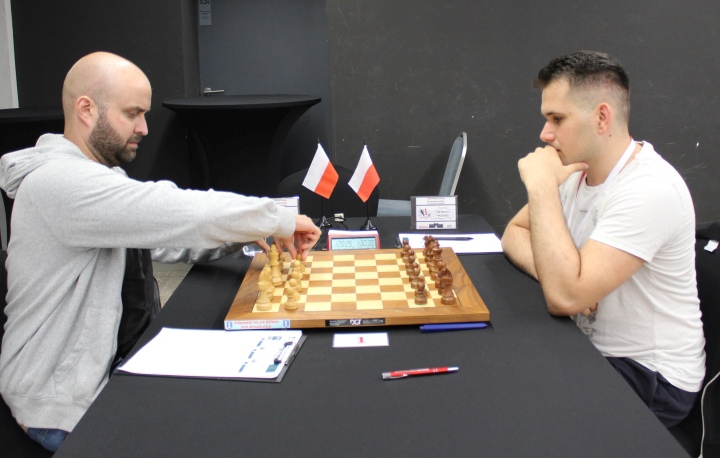
The participants of the 5th FIDE World Championship for People with Disabilities have passed the halfway mark. In the fifth round, two Polish players faced each other on the first board. FM Marcin Molenda was leading the tournament with a perfect score of 4/4 points, while his opponent, GM Marcin Tazbir, was trailing by a half-point (pictured above). Tazbir emerged victorious in this clash, thus dethroning Molenda from the top position. The battle was intense from the very beginning, but a tactical oversight by Molenda in the middlegame allowed his opponent to quickly secure a winning position. Tazbir, Marcin – Molenda, Marcin The position is roughly equal. White has more space on the board, his pieces are better coordinated, and the c5 pawn is very strong. However, Black possesses a bishop pair, and the correct idea would be activating the light-squared one by 18…Bc6= or 18…b5= (18…b6). Molenda, however, decided to attack the d3-pawn straight away and played 18…Bb5??. Unfortunately for him, it is a huge blunder, as after 19.Nd6!+- Black can’t protect his pieces. The game continued with 19…Nxd3 (19…Bxd3 20.Qxe5+-; 19…Bxd6 20.cxd6 Qxd6 21.Qxe5+-) 20.Nxb5 Nxe1 21.Qxe1 Qd7 22.a4. White has two light pieces for a rook and a pawn, but because of black’s passiveness and weak structure, Marcin had little problem converting the advantage. The rest of the game was a smooth sail for White: 22…Bd8 23.Nc4 Be7 24.Ne5 Qe8 25.c6! bxc6 26.Bxc6 Bb4 27.Bxe8 Bxe1 28.Bxf7+ Rxf7 29.Nxf7 Bxf2 30.Kxf2 Kxf7 31.Kf3 Black resigned. 1-0 After this win Marcin Tazbir is leading the field (4.5/5 points), followed by four players on 4/5: IM Lukasz Nowak (Poland), FM Marcin Molenda (Poland), and IM Daniel Pulvett. Emilia Egeman of Poland (pictured above) tops the women’s standings (3/5 points). In Round 5, The 17-year-old defeated a higher-rated Ukrainian opponent Oleksii Filippskikh with a beautiful tactical strike, shattering the defense around the opponent’s king. FIlippskikh, Oleksii – Egeman, Emilia 26…Rxe4!!-+ 27.Ne6 (27.Bxe4 was objectively the best option for White but after 27…Qh3 White has to give up her queen: 28.Qxd2 Bxd2 29.Bg2 (29.Rb3 Qg4) Qg4 30.Ra4 b5 and Black emerges with an extra piece) Ree2 28.Rf6 Rxg2+ 29.Kf1 Bg7 30.Rfb4?? Qb5+ 0-1 The special guest of the fourth round was FIDE Secretary General Łukasz Turlej. He made the first ceremonial move on the top board. FIDE Secretary General Lukasz Turlej makes the first move on the top board FM Marcin Molenda – IM Lukasz Nowak In the sixth round of the tournament, the sole leader, GM Marcin Tazbir, will take on Nikolay Mukha from Ukraine with Black. On the second board, two International Masters will face each other: Daniel Pulvett from Spain will try to make good use of the white pieces against Lukasz Nowak from Poland. The upcoming rounds will be decisive in determining the champions and the medalists.
Aleksandra Goryachkina: “I try to imitate Alexandra Kosteniuk in knockouts”
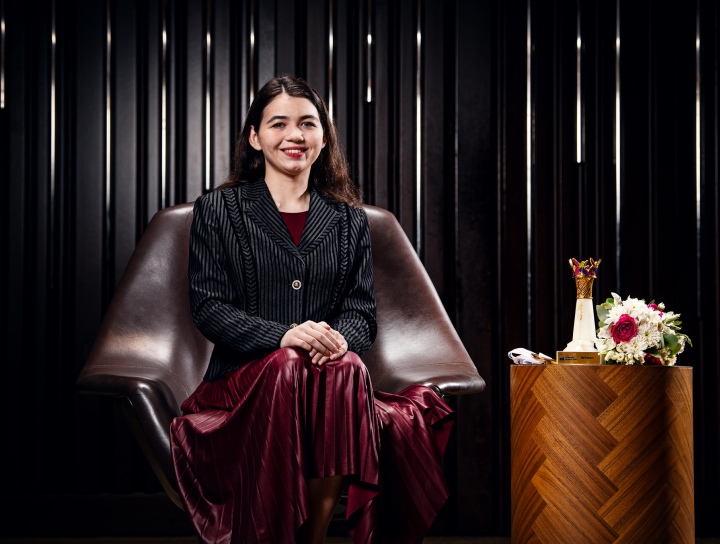
FIDE PR Officer Anna Volkova spoke with the 2023 FIDE Women’s World Cup winner soon after her triumph. You can watch the video version of the interview on our YouTube channel in Russian with English subtitles. Photos by Stev Bonhage. – We are joined by Aleksandra Goryachkina, winner of the 2023 FIDE Women’s World Cup. Aleksandra, congratulations on this success. Your career has seen many tournament victories, including national championships and the Candidates Tournament. At the last World Cup, you took second place. How do you feel after this victory? How difficult was it? – Thank you. Knockouts, in general, are never easy. The final was quite challenging. Until then I played smoothly and confidently. Then I became nervous because I hadn’t won the final yet, and this is where the problems started. – You played the first three rounds confidently, without any tie-breaks: winning with White and making draws with Black. Tell us about this stage of the event; how confident did you feel, did you manage to catch the momentum, or were the opponents not so tough? – Since I have a high rating, I played with lower-rated opponents and in the first three rounds, the opposition was not the strongest. I could have scored even more points, but I reached my main goal, and it was enough. – If we talk about some turning points, the tie-break with Harika was quite long, tiring and tense. Was it the most difficult match of the tournament? – The hardest match was probably the final. The match with Harika was also very difficult: she is quite a strong opponent, and she was very motivated. I already have my spot in the candidates; she wanted to get it, too. Perhaps, for her, it would have been better if she was paired with some other opponent. But these things happen. We played two fairly even draws in the classical games; I had almost no chance there. But in the tie-break, I won the first game with Black. I can’t say I deserved it because she dropped a piece in one move. But then I lost the second game unexpectedly with White; it was one-way traffic. She played an excellent game, of course. I decided to stabilise the situation a little bit, and we played two draws again. Then in blitz, I won the first game again with Black, and in the second game with White, I already knew the trick. I pulled myself together and survived. – The final also seemed quite dramatic: not everything was going smoothly for you. Tell us about it. – To be honest, I didn’t arrive at the final in the best condition. I had some health problems, which unsettled me a bit. All the games in the final were topsy-turvy. But I was lucky somehow. I’m glad I managed to achieve a good result. – If we talk about your recent major victories – a win in the Grand Prix series and this tournament, and speaking about the formats of chess tournaments, where do you feel more comfortable, playing Swiss or knockout events? – I didn’t win the whole Grand Prix series, just one stage, and I finished second to Lagno. Which format is better? Whichever you win, I guess. – Who helped you at this tournament? Who supported you? We saw your father, and we saw some fans who came specifically to your games. Can you tell us about your support and its visibility and necessity at this kind of tournament? – The support was purely moral – my dad and the fans. Of course, it was unexpected that they would cheer for me so much. Speaking of coaching, it was a challenge. Nobody helped me, and it is certainly not easy in knockout events. – How do you manage to cope with physical fatigue in general? After all, the tournament lasted for almost a month, and your opponents are the strongest women chess players in the world. – Perhaps, one should try to avoid playing tie-breaks because they take up a lot of energy. If you rest at those moments, you can recover, prepare a bit, sleep, and, in general, it goes easier afterwards. In one of my interviews, I have already mentioned that I try to imitate Alexandra Kosteniuk in knockouts; she won the knockout World Championship and the first World Cup. She won both without tie-breaks if I remember correctly. That’s what you call a top-level! – A final question is about your plans. What tournaments are coming up for you? What goals do you set for yourself? – I think I will play the Grand Swiss and the Rapid & Blitz World Championship at the end of the year. I will try to perform as well as I possibly can. – Thank you very much. Congratulations again. New victories! – Thank you.
FIDE World Cup 2023 winner and third place to be decided in tiebreaks
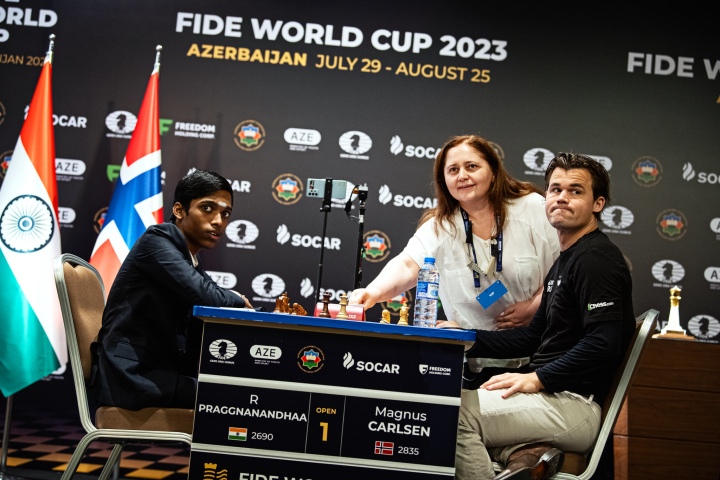
Carlsen and Praggnanandhaa’s quick draw sets the stage for thrilling tiebreaks, but the Norwegian’s health remains an issue. Caruana stages comeback to reach the tiebreaks for third place Magnus Carlsen made a quick draw with the white pieces today with Praggnanandhaa in their second game of the finals. With both games ending in a draw, the decision of who will be the World Cup winner will be made in the tiebreaks on Thursday The game between Carlsen and Praggnanandhaa lasted just 30 moves and was over in slightly more than an hour. In the Four Knights Game, neither side managed to get even a slight advantage. The game progressed quickly – by move ten both sides exchanged two pairs of minor pieces and the queens. The two then proceeded to exchange the other heavy pieces and finished in an endgame with same-colour bishops and a symmetrical pawn structure. It seems that the Norwegian has still not fully recovered from the food poisoning he experienced a few days back, which has impacted his willingness to play. Everything now depends on the tiebreaks on Thursday. As the tiebreaks approach on Thursday, all eyes are on Carlsen’s potential recovery. The day will begin with a two-game rapid match, a format in which Carlsen, as the reigning World Rapid Champion, is seen as the favourite. However, his ability to regain strength and focus remains uncertain. Meanwhile, Praggnanandhaa, who recently turned 18, has displayed remarkable skills and confidence, unsettling many top-world players despite his young age. In the match for third place, Fabiano Caruana staged a comeback, defeating Nijat Abasov with white pieces in a hard-fought game where the American had initiative throughout but had to fight hard to win. In the Four Knights line of the Sicilian, the two ventured into a sharp line with a lot of tactical obstacles to solve. After Black (Abasov) misplayed on move 11, White’s initiative grew considerably. By move 14, White was already significantly better. Abasov kept on resisting. He gave up a rook for a knight and a pawn. By move 31, the two finally entered an endgame where White had two rooks against a rook and a bishop, with three pawns each on the kingside. White was better but had to prove it by finding a way to victory which Caruana managed to do after nearly four and a half hours of play. With a victory each, Caruana and Abasov need to rest well for tomorrow as everything will be decided in the tiebreaks. The tiebreaks will take place on Thursday, 24th August from 2 PM local time in Baku. Here follows a closer look at today’s games: Magnus Carlsen is not someone who settles for average but it seems that in today’s game, he did not have much will to fight. In the Rubinstein Variation of Four Knights game, Carlsen forced an exchange line which Pragg was happy to follow as Black The queens and two sets of light pieces are off the board. Black castled short and after some more positional manoeuvring, another set of exchanges followed with the two players agreeing on a draw in the following position: Fabiano Caruana and Nijat Abasov played a sharp game in the Sicilian with lots of twists and turns. The main theoretical moves in this postion are 11…g5 and 11…e5. Abasov opted for 11…Qe7? giving Caruana a chance for a push in the center: 12.c4! Qf6 13.c3! Blocking off threats to the queenside. 13…g5? This move only aggravated Black’s problems. After 14.Bd6+ Kg7 15.Qxf6+ Kxf6 16.Nxa8 White emerged an exchange up. In subsequent play the opponent traded some inaccuracies and reached the following position: Black should have played 24…Bf5 here, without deciding on c3. Instead, after 24…dxc3 25.Rd6+ the evaluation bar tilted in White’s favor again. The two finally transitioned to an endgame where Black was a clear exchange down but White’s path to victory wasn’t easy. White is significantly better but since Black’s rook is still on the board, Nijat has more defensive options. After reaching time control, Fabiano sank into deep reflextion and came out with the winning plan. After relocating his king to the kingside he ousted Black’s rook from the fourth and fifth ranks and advanced his pawns. Abasov resisted, but by move 59, Fabiano finally had him where he wanted and Nijat threw in the towel: After imminent g2-g4 Black can’t avoit the exchange of the rooks and White wins easily. 1-0 Text: Milan Dinic Photo: Stev Bonhage and Maria Emelianova (chess.com) About the event The FIDE World Cup 2023 is taking place from 29 July to 25 August 2023 in Baku, Azerbaijan. In the Open tournament, 206 players were eligible to take part and 103 in the Women’s event. There will be eight rounds in the Open and seven in the Women’s tournament. Each round will be played under a knock-out system, consisting of a 2-game match. In the case of a tie, the players will play a rapid and, if necessary, a blitz tiebreak until the winner is determined. The winners of the top three places in both sections will qualify for the 2024 Candidates tournament. In both events, the time control for each game is 90 minutes for the first 40 moves, followed by 30 minutes for the rest of the game with an increment of 30 seconds per move starting from move 1. The prize fund for the entire event is 2.5 million US Dollars, with $1,834,000 in the Open and $676,250 in the Women’s tournament. The 2023 FIDE World Cup has the largest prize fund for any chess tournament ever played. More information about the event: worldcup2023.fide.com/ Regulations: Open tournament: handbook.fide.com/files/handbook/WorldCup2023Regulations.pdf Women’s event: handbook.fide.com/files/handbook/WWorldCup2023Regulations.pdf Schedule: worldcup2023.fide.com/schedule
FIDE World Fischer Random Chess Championship – Call for Bids

1.1 The International Chess Federation (FIDE) will hold the next FIDE World Fischer Random Chess Championship from February 19-25, 2024. 1.2 FIDE is opening a bidding procedure to invite any federation member of FIDE or any organiser approved by the national federation to host the event. The federation’s letter of support may be provided later when the bid’s evaluation procedure is launched. 1.3 The proposed format is one used for the FIDE World Fischer Random Chess Championship 2022 (handbook.fide.com/files/handbook/FRCCRegulations2022.pdf). 1.4 The bid may contain proposals on the event’s format modification, including qualification and main tournament systems, time control and commercial conditions. The FIDE Council shall decide whether these conditions are admissible. 1.5 The minimum prize fund of the event shall be 400,000 USD. 1.6 The Bidding Form shall be filled in by an Applicant. A signed copy shall be submitted as e-mail messages to the FIDE Secretariat to office@fide.com from August 23 to October 20 2023, 23:59 Lausanne time (FIDE has a right to extend this deadline). All the documents shall be submitted in English. Additional documents may be requested by the FIDE General Strategy Commission (GSC) for further evaluation. 1.7 Once the Organiser is granted the right to organise the event, a relevant announcement shall be made on the FIDE website. FIDE Technical Delegate (FIDE TD) may be appointed at the same time to supervise the event on behalf of FIDE in consultation with GSC.
Clash of chess titans in Düsseldorf: World Rapid Team Championship preview

The first-ever World Rapid Team Championship is set to start in Dusseldorf, bringing together spectacular players from all across the globe The stage is set for an unprecedented showdown from the 25th until the 29th of August as the chess elite will gather in Germany for the inaugural world team championship in rapid chess. Forty teams from all corners of the world are registered to take part in the tournament. Stellar line-up A number of the world’s strongest players are scheduled to take part in the event. The list of contenders reads like a “who’s who” of the chess world: Wesley So, Levon Aronian, Fabiano Caruana, Ian Nepomniachtchi, Maxime Vachier-Lagrave, Jan-Krzysztof Dudam Richard Rapport, Peter Svidler, Alexander Grischuk and Daniil Dubov. Joining them will be two former world champions – Vishy Anand and Vladimir Kramnik (who will be playing for the humorously named Chess Pensioners team) as well as the former World Champion Candidate, Nigel Short. Among women players taking part are former World Champions Hou Yifan, Alexandra Kosteniuk, and Mariya Muzychuk, as well as strong woman players such as Kateryna Lagno, Elisabeth Paehtz, Harika Dronavali and Polina Shuvalova. The full list of players taking part can be found here. The frontrunners Among the 40 teams taking part, there are two very strong contestants for first place. With an average rating of 2542, the top favourite of the event is team “Freedom”, headed by Emil Sutovsky. With the likes of Vidit, Dubov, Rapport and Najer in the team, as well as Polina Shuvalova, they are the top team vying for first place. Another strong contender is the WT Chess Team. Made up of former Women’s World Champions Hou Yifan and Alexandra Kosteniuk, two-time World Championship candidate Ian Nepomniachtchi and a list of super-strong young talents – Praggnanandhaa, Abdusattorov, Keymer and Duda, they will be the team to watch out for. However, the fact that each team has to have a recreational player in their ranks who has never achieved a rating of 2000 in any FIDE category will have a huge effect on the results. The full list of teams, including team composition, can be found here. Team structure Each team will consist of at least six but no more than nine players. Apart from having to include at least one female player, for the first time in a high-level club event, teams will have to include a recreational player, who has never achieved a Standard, Rapid or Blitz FIDE rating of 2000 or more. The teams are not required to assign board numbers in rating order, which allows a chance for some unique board matchups, setting the scene for potential surprises. Each match is played on six boards, which means that the team captains (who may also be players) can decide who will play and who will rest in their nine-member squad. The format The event is 12-round Swiss tournament. The first named team in a pairing shall have the white pieces on the odd-numbered boards and the black pieces on the even-numbered boards. The time control will be 15 minutes, with a 10-second increment from move one. The scoring will be based on matchpoints: a win scores two points, a draw scores one point and a loss means zero points. A team with the highest number of matchpoints in the relevant final standings shall be declared World Rapid Team Champion. The regulations of the event can be found here. Prizes The tournament will feature a 250,000 Europe prize fund, with the prizes distributed in the following order: In case of a tie, the prize money shall be distributed according to the tie breaks. Event coverage FIDE will be providing its coverage of the event with a dedicated live programme on FIDE’s official YouTube and Twitch channels. Commenting on the games will be our-time US champion and one of the most prominent chess figures GM Yasser Seirawan. He will be joined by GM Maurice Ashley and the European Women’s Individual Chess Champion, and a seven-time French Women’s Champion WGM Almira Skripchenko. The venue & spectators The tournament will be played in Dusseldorf’s Rheinterrasse (Address: Joseph-Beuys-Ufer 33, 40479 Düsseldorf), located right in the heart of Dusseldorf, directly on the Rhine. Spectators who wish to follow the event can attend free of charge from 26-28 August, from 13:00 until the end of the games. The entrance to the playing hall with smartphones or any other electronic devices will be prohibited. Such devices should be left in the lockers, which will be located outside of the playing area. To get fast-track access to the event, click here. Schedule: August 25 — Arrival August 29 — Departure The organisation The event is organised by FIDE in partnership with WR Group Holding GmbH – an international provider of certification, project logistics and customs services. All official information about the tournament can be found on the event website: worldrapidteams2023.fide.com/ Text: Milan Dinic
EDU Commission announces its 10th Preparation of Teachers course
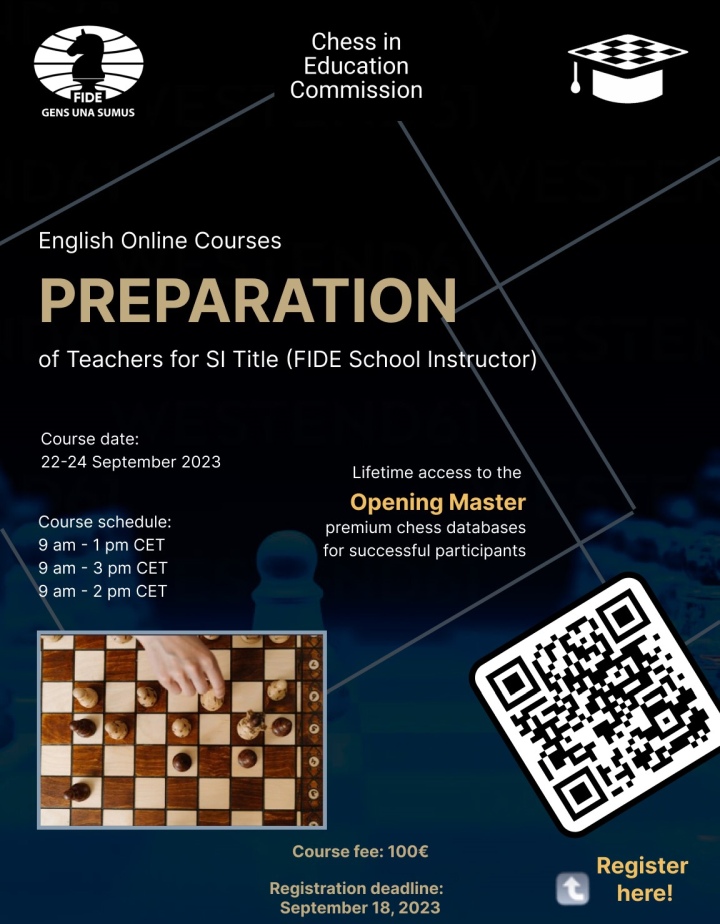
FIDE Chess in Education Commission is pleased to announce the dates of the new Preparation of Teachers course. The course will be held online in English from September 22-24, 2023. The target audience is teachers, chess educators, beginner and advanced players with basic chess knowledge and experience working with children. Participants, based upon their exam results, qualify for the FIDE title of School Instructor. Upon successful completion of the course, participants will be offered lifetime access to the Opening Master premium chess database, which currently contains over 9.6 million official over-the-board chess games and is growing on a monthly basis. Read the detailed course description here. Candidates who wish to attend the course must complete and return the registration form. The cut-off date for applications is September 18. Applicants are accepted on a first-come, first-served basis, and the maximum number of places on the course is 20. If you have any questions, please feel free to contact us at edu.courses@fide.com
FIDE World Cup: Carlsen and Praggnanandhaa draw in the first game of the finals
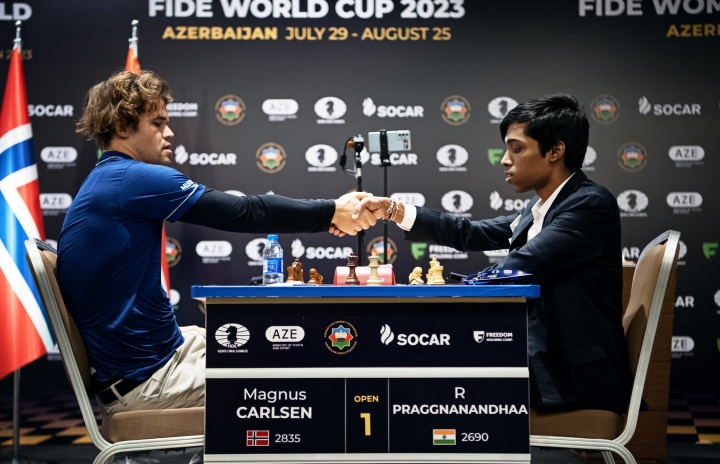
Playing as White, the 18-year-old Indian prodigy, R Praggnanandhaa, couldn’t obtain a significant advantage over the former World Champion Carlsen. Meanwhile, Fabiano Caruana suffered a surprising defeat against local player Nijat Abasov in the match for third place Magnus Carlsen and R Praggnanandhaa split a point after a game which lasted 35 moves and around three hours. In the Four Knights line of the English Opening, R Praggnanandhaa (as White) went for a sharp line, putting pressure on the queenside, but Carlsen responded with a counter-push in the centre and comfortably equalised. In an even position, with three Kingside pawns and a knight and a rook each, the two decided to call it a day. In the aftermath of the game, Magnus Carlsen expressed his discomfort during the post-game interview, revealing that he was feeling unwell due to food poisoning. Despite his health setback, Carlsen’s performance on the board remained formidable. In the match for third place, Fabiano Caruana suffered a defeat at the hands of Nijat Abasov, making a critical mistake in the final stage of the game. In the Catalan Opening, the position was even until move 16, when White (Abasov) started the ball rolling by doubling his rook along the g-file. Abasov then proceeded to organise an attack on the Black king’s fortress, but Caruana had sufficient defensive resources. Unfortunately for the American, he tripped up on move 23, immediately landing in an effectively lost position. Three moves later, he resigned. An upsetting defeat for the former World Champion Candidate, who will have to win tomorrow’s game to reach the tiebreaks and fight for third place. Caruana will have a slight advantage tomorrow as he will be playing with the white pieces. Here follows a closer look at today’s games: Although intense, today’s game between Praggnanandhaa and Carlsen did not bring much excitement. In the Four Knights Kingside Fianchetto of the English, Praggnanandhaa pressed on the queenside, but Magnus effectively defused the tension. 17…Bc6 With this move, Carlsen parried all the threats and steered into an equal endgame. In the line 18.Bxc6 bxc6 White can’t take the c6-pawn in view of 19…Rc8. 18.Qxd8 Rfd8 19.Bxc6 bxc6 White has a passer on the a-file, but Black has enough time and pieces to stop it from progressing, and he also has countering resources in the centre. In the following moves, the a-pawn was exchanged for a black pawn in the centre, and the two reached the following position in which they decided to draw: If one takes into account Carlsen’s claim that he wasn’t feeling well due to food poisoning, the willingness to go for a calm draw was understandable. ½ – ½ Fabiano Caruana defended well in the Catalan against Nijat Abasov, but a slip by the American allowed White to obtain a winning position. White is preparing for an assault on the black king. The most straightforward move was to get the knight to e4, bringing it into the attack. Abasov played 22.Qe3 (22.Ke4 and 22.Ne2 were much better options), which the engines consider as a mistake, suggesting that the position is now even. Black should have responded with 22…f5!, aiming to numb White’s attack. Caruana went for 22…Nb6 and after 23.Be4 Black made a fatal blunder. 23…Qb4?? Leaving the f6-square undefended. 24.Bxh7 Kxh7 25.Ne4 Qe7 – the queen returned to defend, but now it’s too late. 26.f5! Black resigned. There is no reasonable defence against 27.Nf6 followed by 28.Qxh6+ with checkmate to follow. 1-0 Text: Milan Dinic Photo: Stev Bonhage and Maria Emelianova (chess.com) About the event The FIDE World Cup 2023 is taking place from 29 July to 25 August 2023 in Baku, Azerbaijan. In the Open tournament, 206 players were eligible to take part and 103 in the Women’s event. There will be eight rounds in the Open and seven in the Women’s tournament. Each round will be played under a knock-out system, consisting of a 2-game match. In the case of a tie, the players will play a rapid and, if necessary, a blitz tiebreak until the winner is determined. The winners of the top three places in both sections will qualify for the 2024 Candidates tournament. In both events, the time control for each game is 90 minutes for the first 40 moves, followed by 30 minutes for the rest of the game with an increment of 30 seconds per move starting from move 1. The prize fund for the entire event is 2.5 million US Dollars, with $1,834,000 in the Open and $676,250 in the Women’s tournament. The 2023 FIDE World Cup has the largest prize fund for any chess tournament ever played. More information about the event: worldcup2023.fide.com/ Regulations: Open tournament: handbook.fide.com/files/handbook/WorldCup2023Regulations.pdf Women’s event: handbook.fide.com/files/handbook/WWorldCup2023Regulations.pdf Schedule: worldcup2023.fide.com/schedule
Goryachkina wins Women’s World Cup
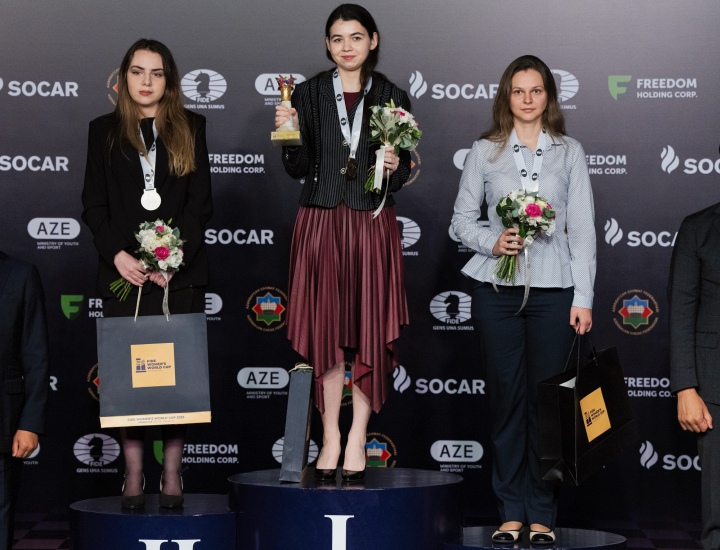
The 18-year-old Indian prodigy defeated the favourite Fabiano Caruana after winning the second tiebreak 1.5-0.5. Earlier in the day, Aleksandra Goryachkina defeated Nurgyul Salimova to clinch the title in the Women’s tournament Baku witnessed an intense day as two nail-biting tiebreak matches unfolded. In the Women’s finals, Aleksandra Goryachkina won the title by defeating Nurgyul Salimova, however, the outcome could easily have been different. In a major upset, the favourite Fabiano Caruana was ousted by 18-year-old R Praggnanandhaa in the open category following two tiebreak rounds. The Open Tournament Highlights After two draws in the regular part of the semi-finals, former challenger Fabiano Caruana and the rising star from India, R Praggnanandhaa, met in the tiebreaks to decide who would go to the finals. The initial two rapid tiebreak games ended in draws. Notably, Caruana had a winning position in the first tiebreak game but failed to capitalise, allowing Prag to evade defeat. In the second game, both sides were equal throughout. Then, in the second rapid tiebreak match – where the time controls moved from 25 to 10 minutes each – Praggnanandhaa played significantly better in the first game, gaining the upper hand on the white side of the Italian Game. Caruana correctly sacrificed a pawn and reached equality but then played somewhat sluggishly and allowed his opponent to consolidate. Pragg then advanced his pawns, capturing one and subsequently launching an assault on Black’s Queenside, joined by the white king. Even though White promoted a second queen, Caruana continued to resist, hoping for a miracle. Unfortunately for the American, Pragg was confident in his execution and secured victory. In the second game, Praggnanandhaa again achieved a better position (this time as Black). In the endgame, the Indian was completely winning, but he allowed White to make a comeback, and the game ended in a draw, thus eliminating Caruana. This will be the first final for R Praggnandnhaa in the World Cup, where he will be facing Magnus Carlsen (who will also be playing his first World Cup final). Caruana will go up against Nijat Abasov in the battle for third place. The finals of the Open World Cup, as well as the match for third place, will be held on Tuesday, 22nd of August. The Women’s Tournament Highlights In today’s tiebreak match, Goryachkina was completely lost in the first game. Playing the London System, Salimova (as White) had a clear advantage early on but then misplayed in a completely winning position, allowing Goryachkina to save a draw with a perpetual check. In game two, in the Catalan, Goryachkina managed to secure an extra pawn on the queenside as her opponent did not demonstrate the necessary knowledge and accuracy in the opening. In the endgame, she was close to clinching victory on two occasions but allowed Black to make a save. After 89 moves, in time trouble – in a 2:1 pawn endgame for Goryachkina where White had a knight, and Black had a bishop – Salimova eventually cracked in a drawish position and made the decisive mistake. White managed to penetrate with her king to the kingside to support her two passers that rushed towards promotion. Black resisted a bit more before resigning on move 105. A great victory by Aleksandra Goryachkina who was the runner-up in the 2021 edition of the event. Additionally, she secured the first-place prize of $50,000. Goryachkina has confidently played the entire event: out of six matches, in four she won in the regular part (against Odraz Valdes, Divya, Batsiashvili and Tan), and in two she won in the tiebreaks (against Dronavalli and Salimova). Despite losing in the finals, Bulagria’s Nurgyul Salimova had a spectacular performance in Baku and is a huge surprise for the chess world. She defeated some of the strongest world players, such as Polina Shuvalova and Anna Muzychuk (who finished third in the Women’s World Cup). Here follows a closer look at some of the top games of the day: We begin with the tiebreak match between Aleksandra Goryachkina and Nurgyul Salimova. Goryachkina had a lucky escape in the regular part of the match, securing a tiebreak. Even today, as the match started, it seemed that Salimova was the better player. She completely dominated Goryachkina in their first rapid tiebreaker. Diagram after 14.Bd2 By this point, the position was around even, but now Goryachkina made a series of moves, after which she ended up completely lost. 14…Be7? (14…f6! dislodging the white knight was necessary) 15.b3! Rc8 16.Rc1 c5? 17.Na5?! Qa6? 18.dxc5 Rxc5 19.Rxc5 Bxc5 20.b4 White is quickly advancing her queenside pawns, getting complete control over the position. 20…Bb6 21.b5 Qc8 22.Nac6 O-O 23.Qf3 f6 24.Nc4 Bc5 25.Be3! Nxe3 26.Nxe3 Kh8 27.Nxf5 exf5 28.Qd5 White is completely winning. However, Salimova was in time trouble and soon she started to err… 28…Bb6 29.a5 Bc7 30.Nxa7 Qb8 31.Nc6 Bxh2+ 32.Kh1 Qf4 All of the sudden Black has some threats. 33.Qf3? The first big mistake by White. She should have just continued with 33.Nd4! Now 33…Qh4 is met with 34.Nf6, while 34…Qh6 fails to 35.Nxf5 33…Qh4 34.Qh3 Qc4 35.Kxh2?? Another blunder. White was still winning after a precise 35.Rb1. Now it’s around even. 35…Qxf1 36.Qxf5 Qc4 37 a6 g6 38.Qd7 Qf4+ And now it’s perpetual. 39.Kg1 Qc1+ 40.Kh2 Qf4+ 41.Kg1 Qc1+ 42.Kh2 ½ – ½ Goryachkina made two consecutive saves in her match against Salimova. To win, she had to take control of the situation and not rely on luck. That is exactly what happened in the second tiebreak game, as Salimova started blundering early on. This well-known theoretical position is around even, but Black did not play the main move 12…Bd5, tested on the highest level, but opted for less precise 13…c5 and after 14.dxc5 Na6 15.Qxc5 White emerged with an extra runner on the queenside. Alexandra was gradually making progress and reached a winning position. White’s only problem is that her king is a bit restricted. With this in mind, Alexandra should have played 36.e3! removing Black d4 pawn. However, Goryachkina made several mistakes, allowing Black to equalise. 36.Be4 Nf6 37.Bd3
FIDE World Cup Round 7 Day 2: Ukrainian Anna Muzychuk wins bronze
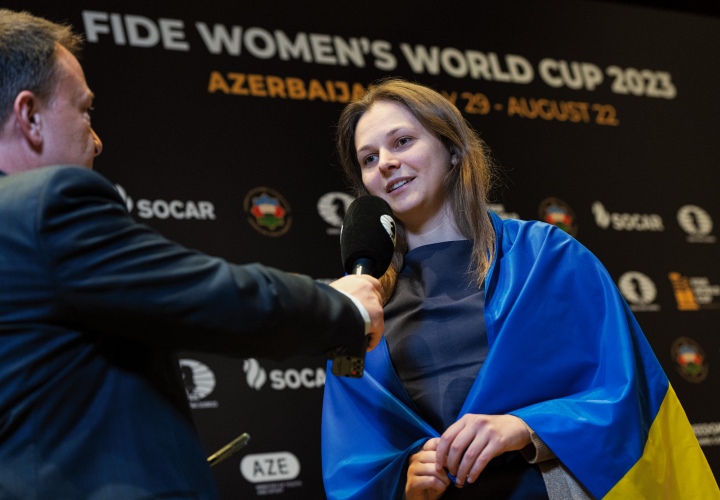
Anna Muzychuk defeated former Women’s World Champion Tan Zhongyi by 1.5:0.5 and took third place. In the Open, Magnus Carlsen qualified for his first-ever final in this competition Anna Muzychuk has won third place in the Women’s World Cup after drawing in today’s game against former World Champion Tan Zhongyi. She scored in the first game, winning the match 1.5:0.5. In a post-game interview, Anna – with the Ukrainian flag on her shoulders, a gift from the Ukrainian ambassador to Azerbaijan – thanked everyone for their support and to those who helped and are helping her and her family who now live in Spain. In the Women’s finals, Aleksandra Goryachkina had a lucky escape with a draw against Nurgyul Salimova, as the two head for the tiebreaks. The former World Champion Magnus Carlsen has qualified for his first-ever final of the Open World Cup tournament after drawing as Black against Nijat Abasov of Azerbaijan. The Norwegian won in the first game, so a draw was enough. Carlsen’s biggest success at the World Cup so far was clinching third place in the 2021 event in Sochi. Now, he will fight for a chance to add the only missing jewel in his crown of tournament victories. The second semi-final match, between R Praggnanandhaa and Fabiano Caruana, goes to the tiebreaks after another draw following a tense battle which lasted over four and a half hours. The Women’s Tournament Highlights In their second game of the match for third place, Anna Muzychuk (playing as Black) achieved a significant advantage as early as move 10. After White’s 22nd move, Black was on the brink of scoring a victory with a piece sacrifice which Muzychuk didn’t see. Throughout the game, Black had the initiative and was pushing, but the Ukrainian could not find the best moves to secure a victory. In the end, the two reached a drawn bishop endgame. The longest game of the day was in the fight for first place between Nurgyul Salimova and Aleksandra Goryachkina. Playing as White, Salimova achieved a significantly better position against Goryachkina by move 33. By move 45, White was winning. Unfortunately for Salimova, she made several mistakes in the endgame, which was enough for Goryachkina to reach safety. Moreover, Aleksandra then tested Nurgyul in a rook and knight vs rook drawing endgame for quite a while before they agreed to split a point. The winner of the Women’s World Cup will be decided in the tiebreaks. The Open Tournament Highlights Magnus Carlsen only needed a draw to get through to the finals. To stay in the race, his opponent Nijat Abasov (the Azeri star who surprisingly reached the finals) needed to win in this game where he was playing as White. Abasov went for the London system – an opening which does not require detailed knowledge of many lines and which also allows White to achieve a solid position. In the first part of the game, White got a slight edge, but soon it was Black exerting some pressure on the opponent’s position. As the situation started clearing in the centre, the two reached an equal endgame with two rooks and a bishop each, where neither side had a chance to make progress. After trading the rooks, Magnus gave up his bishop to end up with two runners on the Queenside, but White was just in time to hold, and a draw was agreed after all the pieces were exchanged on the board. Despite losing this match, Nijat Abasov is still in the race, but he will be fighting for third place. R Praggnandnandhaa and Fabiano Caruana drew again today. In the Catalan, White (Praggnanandhaa) made a mistake right after the opening, which allowed Black some chances, but Caruana decided not to take them. In a complicated game with plenty of manoeuvring and tactics, Black emerged slightly better, but Pragg held his ground with an accurate defence. In the end, the opponents advanced passers on the opposite wings, but after trading them, they realised it was time for a draw. The tiebreaks will take place on Monday, 21st of August. Here follows a closer look at some of the top games from the second day of the semi-finals of the Open and the finals in the Women’s World Cup: Praggnanandhaa, playing with White, made an imprecision in the early stage of the game, allowing Black some chances that Caruana did not utilise. White has just played 15.Na3? Taking on c6, followed by Rc1 and pressuring the weak pawns on the c-file, was the best option. Now, Black had a good chance to grab the initiative with 15…Nxd4 16.Bxb7 Rb8 17.Bxa6 e5! 18.Qe3 Ng4 with powerful pressure on both wings. It seems that, however, Caruana either missed it or did not feel comfortable venturing down this line and went for 15…g5 16.Qe3 Qxd4 17.Qxd4 Nxd4 18.Bxb7 Ra7 19.Bg2 Rb8 20.Rd1 c5 Black was pressuring in the endgame, but Pragg demonstrated accuracy in defence and found the only move to hold his ground in the end. It looks like White’s a4 is doomed, but Pragg found 34.Na1! With this paradoxical move in the corner, White was right in time to protect his queenside pawns. After 34…Nc5 (exchanging the knights would have been devastating for Black) 35.b3 Rb4 36.Ke3 f5, the position is even. 37.Kd2 f4 38.Kc3 Rb8 39.gxf4 gxf4 40.a5 Ne4+ 41.Kb2 f3 42.Nc2 43.f2 Rf1 e5 44.a6 Nc6 45.Nb4 Ra8 46.Rxf2 Nxa6 47.Nc6 and the two agreed to split a point. ½ – ½ Anna Muzychuk was significantly better in the second game against Tan Zhongyi. Despite finishing the game with a draw, that was enough for third place. It was a more than fair outcome, given how well Anna played today and in the first game against Tan. After several imprecisions by Tan, Anna grabbed the initiative right in the opening and, by move 21, got a chance for a spectacular finish. Black could have launched a devastating attack with 21…Bxc3 22.bxc3 Rab8 23.Qd4 Rb1+ 24.Kd2 Rb2+ and White’s position is desperate. Instead, Muzychuk went for 22…Rae8 23.Ba6