

Samunenkov and Gurel receive wild cards for FIDE Grand Swiss 2023
The world’s strongest Swiss-system chess event, FIDE Grand Swiss, is set to be played on the Isle of Man from October 23 to November 6, 2023. The tournament is the gathering of the world’s top guns with two FIDE Candidates spots on stake, an opportunity to take home part of the USD 600,000 combined prize fund, and a perfect testing ground for young talents. At the end of July, we announced that 100 players had already confirmed their participation in the Grand Swiss and 40 players in the Women’s Grand Swiss. However, wild cards are still being distributed, and we’re happy to announce that two of them will go to the exceptional young talents, International Masters Ihor Samunenkov from Ukraine and Ediz Gurel from Turkey. Samunenkov in 2021, photo by Chess.com 14-year-old IM Ihor Samunenkov made headlines in 2021 when at the age of 12, he became the Ukrainian Champion, not in his age group, but an overall one! Currently rated 2515, Ihor is the world’s number two among players under 14 after GM Abhimanyu Mishra, who is already on the list of Grand Swiss participants. Gurel at the U16 Chess Olympiad, photo by Lennart Ootes IM Ediz Gurel from Turkey is also well known in the chess world. With 2512, he is the strongest 15-year-old in the world. These days, he’s leading the Turkish team at the Youth Olympiad U16 which is underway in Netherlands. He came there right after scoring a major upset at the FIDE World Cup where he defeated GM Velimir Ivic in the first game of their match. It is worth noting that two more players have just qualified for the Grand Swiss from the World Cup currently running in Azerbaijan. Hungarian GM Ferenc Berkes in the World Cup and IM Medina Warda Aulia from Indonesia in the Women’s World Cup got the tickets to FIDE Grand Swiss reserved for players who reach the Round of 16 in Baku.
Interview with FIDE CEO GM Emil Sutovsky

Taken during the FIDE World Cup in Baku, Azerbaijan, on the 7th of August, 2023, by IM Michael Rahal, FIDE Press Officer of the event. You can watch the full interview on our YouTube channel. – I’m joined by International Grandmaster and FIDE Chief Executive Officer since 2022, Emil Sutovsky. Emil, good morning and thank you for coming to the interview. – Hi, Michael. – Emil, as a player, you went over 2700 in 2012, but now you’re basically just playing a few games each year. Your main role now is FIDE’s Chief Executive Officer. You were Director General from 2018 to 2022. Tell us about your new role in FIDE since last year, what does your job entail, and the difference with being a Director General? – Thank you. A good question. I keep doing more or less the same things, but it’s just more responsibility because now we have a wider scope of activities. I also have to take various decisions, which my present position reflects more because the description of Director General is a bit vaguer than CEO. Obviously, most of the decisions are related to the commercial side and professional side of the competitions because, as you are fully aware, FIDE does both the professional part and the social and educational part. So, I’m more focused on the commercial side, professional broadcasting, and I’m also in charge of all major events like World Championships, World Cups and so on. In the Olympiad, of course, the responsibility is huge, and it is growing. The number of our competitions is getting bigger and our team also has expanded to that effect. I hope that the results which we bring are well felt in the chess community. – We’re in Baku, in the trophy room of the Marriot Boulevard Hotel, in the wonderful surroundings of the World Cup 2023. The World Cup was originally planned for South Korea, but finally came to Baku. And I know that your personal and professional involvement was key, it was fundamental in bringing it here. Tell me, how did the bid come about? – We had negotiations with South Korea throughout 2022, and during the Olympiad in Chennai it was announced publicly that they’re going to submit a bid. For us, it would have been great if South Korea emerged as another major player on the chess map. As you know, we are trying to develop chess and stage it in as many countries and continents as possible. Of course, South Korea is an important strategical region where we’d be happy to host an event like the World Cup or similar. While we were expecting them to submit a bid, it started to take more and more time and when the deadline finally came, nothing official had been submitted. In parallel, we were taking to Baku. As you know, I was born in Baku. And actually, my first serious chess partner was none other than Garry Kasparov himself. We lived on the same street, literally 100 yards away. And I remember visiting him when I was 5 or 6 and so on. We played the game. Of course, he was already a top player and I was just a kid. It was an inspiration for me. I left Baku over 30 years ago, my family moved to Israel, but the ties remained and I think it was also noticeable throughout the years when I was a player and later a coach. I helped many of the young Azeri players since Radjabov. At one stage or another many of them were my students. So, I kept this good contact with the local federation. And we did organize some projects before. But when the idea to stage the World Cup emerged, I came to Baku in advance to have some negotiations and to meet the sports minister who supported the idea. And then we managed to organize a meeting with the President of the country, Mr. Aliyev, and, of course, the FIDE President, Arkady Dvorkovich, led the delegation. I was a part of it and the decision was taken. I think it’s very natural that it’s organised in Baku, with its vast chess tradition and strong players. Typically, there was a well-known squad from Baku in Open competitions, but in recent years, the ladies from Azerbaijan have also progressed enormously, finishing top five in the Olympiad. Therefore, it was a natural choice and I think it was a good decision. And the level of organization is something we are pleased about. – We’re about to finish the third round, which is halfway through the tournament. Is it running as planned from what you’ve seen? Would you have changed anything? – In general, I’m happy. I think the event itself is unique for chess, a combination of the top players participating but also an opportunity for representatives from many countries. There are over 90 countries here taking part, and the champions are participating. For the first time ever, an Indonesian player qualified for the top 16: that’s already something very meaningful and hopefully can boost interest for chess in the country. FIDE has brought a huge team here to help the local organizers. Previously, that was not the practice, but already for a few years now we have been doing it in order to secure the highest possible level of organization. It’s a long four weeks event, and it requires a lot of preparation. Obviously, we can always find ways to improve. I think that one major area we will try to invest more and improve is making the games more spectacular on screen: maybe using other more sophisticated approaches to broadcast the events, because we have been improving the quality of the broadcasts, but the format remained the same throughout. Chess has been broadcasted over the last 20 years, and I still think that we can do a lot about
Important changes in FIDE Regulations for the Appointment of Arbiters in World Events

Dear chess friends, We would like to inform you about the most important changes in FIDE Regulations for Appointment of Arbiters in World Events (Handbook B06.4), effective from July 20th 2023. These regulations existed since 2022, and they established the first panels of arbiters. The reasons for changing the regulations are: a) increase the number of arbiters in each panel to enable more people to get appointments as Chief and Deputy Chief Arbiter of world events. b) adding the possibility to deal with unforeseen circumstances c) Fair Play Officers have been removed from the regulations d) correct some typos and unclear rules – distinguish between nomination and appointment e) open the process of establishing panels to other relevant bodies as FIDE Council, MB, EVE and GSC through a consultation team Some more detailed information: These regulations no more deal with Fair play officers as they have their own FIDE commission and it is different role being an arbiter and being a FPO. In accordance with FIDE policy, at least 25 % of arbiters in higher Panels (green, blue or red) must be female, each Panel must be geographically diverse, and have representation from each Continent. Higher Panels were enlarged (green from 20 to 25 members, blue from 35 to 45 members, red from 50 to 60 members) Until now, arbiter could be appointed as a Chief Arbiter to a maximum of two (2) FIDE official events per year, same applied for Deputy Chief Arbiter. Now the total nomination is limited – Arbiters can be appointed as a Chief Arbiter or Deputy Chief Arbiter to a maximum of two (2) FIDE official events per year. FIDE President keeps the rights to grant exception to arbiter from the lower panel. At the Olympiad, the Organiser may propose up to 25% of the arbiters, who do not need to be on a panel. They may come from the host Federation, or a Federation that shares a land border with the host Federation. The procedural rules to establish the Panels was updated. Councillors on the Arbiters Commission will discuss the Panel membership with other bodies – Continental arbiters commissions and also with a consultation team. The consultation team includes one representative from each of FIDE Council, the FIDE Management Board, the Global Strategy Commission, and the FIDE Events Commission. IA Ivan SYROVYChairmanFIDE Arbiters’ Commission IA Nebojsa BARALICSecretaryFIDE Arbiters’ Commission
FIDE World Youth Olympiad 2023: Day 3 Recap
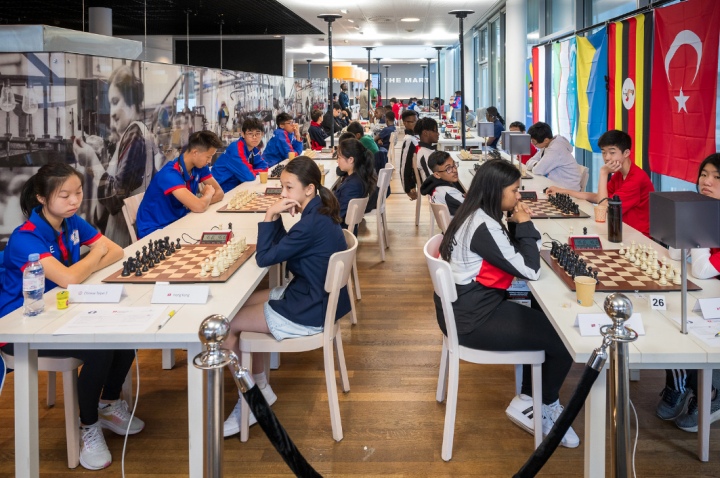
On the third day of the Youth Olympiad, two rounds were played. It was a day filled with sharp openings and tough endgames, and above all, it became China’s day. At the beginning of the third day, China and the Netherlands 1 were leading the standings. In the fourth round, these teams faced each other. The winner of this match would take the lead. There isn’t a player who falls behind the others in team China: they all score above average. In fact, at the start of the day, all Chinese players are still undefeated. Although the Dutch team has also collected all match points, the individual results are somewhat more variable. Photo: Lennart Ootes The powerful Chinese player Miaoyi Lu continues to win. On the live stream, Stefan Kuipers tells his co-commentator Anna-Maja Kazarian about one of his favorites in this tournament: China’s board four player, Miaoyi Lu. Both in the opening and in the endgame, she is intimidatingly fast and accurate. In her game in the third round against the Dutch Dana Verheij, she pauses in a sharp Richter-Rauzer variation of the Sicilian: This seems justified. Interesting possibilities like 10.e5! are already on the horizon. When the d-file opens, the power of the battery of rook and queen becomes evident. At the same time, the knight and queen are tied to the defense of the bishop on d7. Miaoyi Lu chooses the equally strong 10.f4 and after 10…Be7, she plays 11.e5. This move has now become even stronger. After 11…dxe5 12.fxe5 Nd5 13.Bxe7 Qxe7 14.Ne4, it becomes clear that the dark squares are vulnerable in Black’s camp. Black seems to get away with 14…0-0 15.c4 Nb6 16.Qf2 Rab8; everything is covered. But that’s not the case. Miaoyi Lu demonstrates the weaknesses of the black position with 17.Nf6+!! Naturally, black must not capture, and after the sad 17…Kh8 18.Qh4 h6, the knight remains invulnerable, allowing white to calmly build up an attack. The game didn’t last much longer. After 19.Bd3 Na4, white wins the black queen: 20.Qe4 g6 21.Qh4! White retreats to threaten checkmate on h6 and bring a deadly discovered check into the position. After 21…Kg7, 22.Nh5+ decides the game. 1-0. Once again, an excellent performance by the Chinese player. At the second board, we see Tong(Qd) Xiao win convincingly against Arthur de Winter. For a long time, the players followed a recent top-level game between Pentala Harikrishna and Nikita Vitiugov, which was won by the latter. Even then, the player playing with the black pieces remained unfazed after a check and moved his king confidently with 10…Kf8. However, the king turned out to be less safe than expected. The following position emerged several moves down the road: Although black had the opportunity to fork the queen and bishop with 27…f4, white was not concerned about it. After 28.Bxf4 gxf4 29.Nxf4, the black king is under attack and the black pieces become dead wood. The rook on h8, the bishop on f8, and the knight on h6 are all written off, while the white rooks are ready to invade the seventh rank. White soon won. 1-0 When the third board between Prajit Sai Kumar and Xiangrui Kong was won by the Chinese player, Yichen Han on board 1 had to defend the Dutch honor against Haowen Xue. However, he only managed to achieve a draw with the white pieces. China confidently won by a score of 3½-½ and grabbed the lead. Inevitably, there are many teams in pursuit. The eagerness of the teams to win is evident from the number of Najdorf positions in the playing hall. Additionally, the fast time control of 45+10 leads to true chess spectacles. In the second board of the match Kazakhstan 1–Azerbaijan, Ahmad Khagan seemed to have more success with the white pieces against Daniyal Sapenov. The game followed the same variation as the game of the day yesterday (Milikow—Makridis, brilliantly won by the latter), but instead of the calm 9.Be2, White played 9.Nd5 Bxd5 10.exd5, resulting in a completely different pawn structure. The position in the next diagram seems intimidating for Black, but in reality, the black king can navigate through it. Meanwhile, the white pawn on d5 is merely blocking the white pieces. White tried to remedy this by sacrificing his pawn with 25.d6+, but it made little difference. Not much later, a draw by repetition was agreed. The match between Kazakhstan 1 and Azerbaijan was decided on the lower two boards. On the fourth board, a mutual pawn breakthrough led to almost comical scenes. Alua Nurmanova from Kazakhstan (Black) had already won a piece, but with advanced pawns, caution is always required. Her opponent from Azerbaijan Narmin Abdinova tried to complicate things with 36.Ne7+ Rxe7 37.b7, but by then, Black had enough material to sacrifice the rook with 37…Rxb7 and then advance her c-passer. Black won, resulting in a convincing 3-1 victory for Kazakhstan 1 over Azerbaijan. Unfortunately for WIM Zsoka Gaal of Hungary, who is one of the few girls consistently sitting at the first board in the tournament, her team couldn’t capitalize on her convincing victory with the black pieces over Ukrainian FM Maksym Dubnevych. Ukraine decided the match in their favor (3-1) despite Hungary’s higher ratings on all boards. The final position on board 3, between Vladyslav Fishchuk and Kristof Pal Kolimar, tells the story. The other two games were decided in the rook endgame. Matyas Palczert continued pressing for a win against Anastasiia Hnatyshyn in a seemingly equal position. However, he risked going down. Matyas played 45.Kb1?! here to escape from the check. He had his reasons for this move: Anastasiia had less than a minute on her clock, and moreover, the b-pawn could potentially become a dangerous passer. However, the subsequent moves were not always accurate, with both players missing chances to win. Additionally, Matyas’s clock was ticking down as well. In this position, Anastasiia could have taken advantage of Matyas’s earlier optimism with 52…e3! The point is that Black threatens …Rg1+ followed by …e2, promoting the pawn. White would need to move the king closer to the pawn with 53.Kd1, but that would give Black the
FIDE World Cup R6 Game 1: Goryachkina wins, Caruana makes a lucky escape
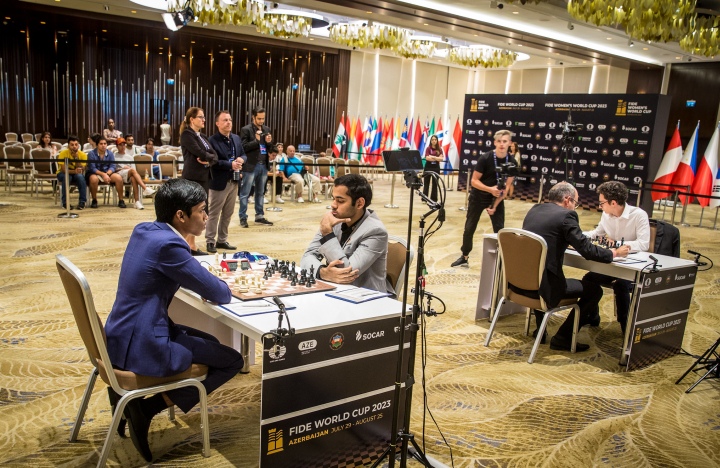
Carlsen and Erigaisi win in the open event. Goryachkina scores only victory in the women’s semis Magnus Carlsen and Arjun Erigaisi started with a victory in the quarter-finals. Fabiano Caruana was on the brink of losing to compatriot Dominguez Perez but managed to save a draw. Vidit and Abasov drew after a lengthy endgame. In the Women’s tournament, Aleksandra Goryachkina seized the initiative in the semifinals by defeating former World Champion Tan Zhongyi with the black pieces. Bulgaria’s Nurgyul Salimova managed to hold Anna Muzychuk to a draw as Black after playing precisely following a sharp opening line. The Open Tournament Highlights Magnus Carlsen was the first to finish his game, scoring a victory as Black against India’s Gukesh D. In the Queen Pawn Opening, the player from Chennai maintained an even position for a long time but then misplayed in the endgame. With each side having a rook and three pawns, Gukesh chose the wrong plan, allowing Carlsen to activate his king and pawns. With each check White gave, Carlsen was closer to the first rank. After 48 moves, Black’s placed his pawn on e2 and Gukesh resigned. In an Indian derby, Arjun Erigaisi beat Praggnanandhaa with black pieces. The two sides were even throughout the game, but in the endgame stage – following a piece sacrifice by Erigaisi – Praggnanadhaa blundered, allowing Black to execute an attack on the white king and create conditions to promote his pawn, which was already on d3. The 18-year-old Praggnanandhaa resisted but had to resign in the end. Fabiano Caruana found himself in trouble against compatriot Leinier Dominguez Perez. Following the Italian Game, the two sides were even until Black’s 34th move when – in a knight and rook endgame – Caruana made several imprecisions costing him two pawns. However, Caruana was looking for the best ways to survive in the lost postion hoping for a miracle, and it happened: Dominguez blundered and allowed Black to activate his rook and knight in attacking the white king. A very lucky break for Caruana and a huge miss by Dominguez. Vidit Santos Gujrathi and Nijat Abasov split a point in the Rossolimo Attack of the Sicilian, both sides played precisely. By move 25, the two have reached an endgame where each side had six pawns, a black-squared bishop and a rook. From that move onwards followed a complex and lengthy debate where each side tried to outmanoeuvre the other by moving the rook and the bishop around the board. White managed to get some chances but didn’t use them. The Women’s Tournament Highlights Aleksandra Goryachkina beat the former Women’s World Champion Tan Zhongyi with black pieces in the exchange line of the Queen’s Gambit Declined. After an imprecision by White, Goryachkina managed to get more initiative and press across the board. However, she dropped her advantage, and soon the position was even. Still transitioning to the endgame, Tan made another blunder which allowed Black to penetrate her second rank with a rook, ending up winning. Nurgyul Salimova held Ukraine’s Anna Muzychuk to a draw with black pieces, in their first encounter in the semifinals. The two played a sharp line in the Caro-Kann where White had slightly more activity at one point, but Black could counter. White managed to create a passer on the a-file, but Salimova was just in time to hold. On move 32, the two decided to split a point. The full results of today’s games can be found here: worldcup2023.fide.com/pairings. The second game of round six starts on Wednesday, 14th of August, at 3 PM local time in Baku, Azerbaijan. Here follows a closer look at some of the games from today’s round: Gukesh lost to Carlsen after completely misplaying an even rook endgame. White (Gukesh) should have just proceeded with 35.c4, creating a passer on the queenside. Instead, he played 34.Ra2?? allowing Black the time to activate his king and push on. Carlsen didn’t see the best move (34…Kd6) and instead went for 34…Rg5, but Black was still better. Now Gukesh made another blunder – 35.Ra7+ and his position became beyond repair. It was the start of a series of pointless checks which helped the black king and pawns to move towards the first rank. Thirteen moves down the road, the opponents reached the following position: Since Black’s e-pawn will cost Black the rook, Gukesh reigned. 0-1 In another victory for Black, Arjun Erigaisi defeated compatriot Praggnanandhaa after Rameshbabu blundered in responding to a piece sacrifice. 35…Nxg3! 36.fxg3 d3 37.Bg2?? White needed to get his king out of the line of fire from the black queen with 37.Kh1 maintaining balance. 37….Qb6+ 38.Kh2 Qf2! Now, Back is threatening checkmate and has the time to push his d-pawn further. 39.Rg1 Re2 40.Qe7 d2 41.Qf6+ Qxf6 42.exf6 Kxf6 43.Rf1+ Ke5 and the black king marches down the board to support his passer. White is a piece up but completely paralysed. Pragnanandhaa tried to find options with giving the bishop back, but the pawn endgame was hopeless for White. 0-1, 53 moves. Leinier Dominguez Perez was on the brink of defeating Fabiano Caruana with white pieces after Black made costly mistakes in an even endgame. Caruana here made a serious mistake with seemingly logical 34…Rb6? (34…Ra6 was much better). Now after 35.Nxd4 Ng6 36.Rc6! Black has no option but to avoid trade with 36…Rb7 37.Rxe6 and White emerged two pawns up and clearly better. Dominguez made a few inaccuracies down the line and gave up one of his extra pawns but managed to hold his advantage until the move 54: Here Leinier stumbled with 54.Ne2? White is still in command after 54.Ra6! with the idea of d6+ followed by Rd6. As played, Black got an opportunity to coordinate his pieces and pester Whites’ king. 54…Rh2 55.Ra6 Rh3 56.Kd4 Rd3+! 57.Kc5 Nd7 and now Black holds. Dominguez tried for another 14 moves but eventually had to settle for a draw. 1/2-1/2, 71 moves A lucky save by Caruana. Aleksandra Goryachkina defeated Tan Zhongyi as Black. The former world champion from China made several mistakes in the game. The position is even. A natural move such as
FIDE Chess Olympiad 2028 – Call for bids

International Chess Federation (FIDE) is opening a bidding procedure for organising the major team competition in the chess 2028 calendar, the Chess Olympiad. Held over 15 days (including arrivals and departures), this global team event gathers thousands of players and chess fans. A whopping 186 chess federations were represented by a team in the open and 162 in the women’s section during the last Chess Olympiad in Chennai, India. Two other important events are to be held under the umbrella of this major chess gathering: Olympiad for People with Disabilities 2028 (where the organisers must be ready to host at least 80 teams) and FIDE Congress 2028. The bidder shall be responsible for hosting all three events and providing the proposal that would allow hosting the maximum number of teams. Currently, FIDE encompasses 199 federations and is expanding each year, as does the Olympiad with every new edition. Regulations The complete information about Chess Olympiad 2028 is in the Main Event Regulations. Information about FIDE Congress is here We will add the Regulations for the Competition for Players with Disabilities when they are ready later. Who can bid Any federation member of FIDE or any Organiser approved by a national federation may apply for the organisation of the FIDE Chess Olympiad and compulsory accompanying events. It is important to note that priority will be given to the bidders, who will also suggest hosting other FIDE events. Expression of interest and bidding process As per the decision of the FIDE Council, the first four weeks of the bidding process are allocated for the expression of interest. If no more than one potential bidder expresses their interest within four weeks, the overall bidding process shall last for eight weeks. If several parties express their interest within four weeks, the bidding process shall last 12 weeks. There is no form for expressing interest, and there is no need to fill in the formal bidding form at this stage. Potential bidders can express their interest by sending a formal letter to the FIDE office at office@fide.com by 6pm CET on September 12th, 2023. The letter of interest is not binding. The formal bidding application may be filled out after or instead of the expression of interest. Each application shall be filed per the form provided in Appendix 3 to the Regulations. The Applicant shall attach the following: Letters of support from a national federation and relevant local authorities, Supporting documents (government letters, contracts, bank guarantees, etc.) at the total amount of the bid’s budget. Irrevocable guarantee issued by: a) any of the Top 100 World Banks rated on The Bankers database or another bank which may be agreed with FIDE or b) a verified government guarantee for the amount of three hundred thousand (300,000) Euros to support the bid. Additional documents may be requested by FIDE for further evaluation. The complete requirements from the organiser, including financial obligations, are determined by section 6 of the Regulations. The nearest General Assembly shall award the right to host the events to the Applicant with the highest number of votes received.
FIDE World Youth Olympiad 2023: Day 2 Recap
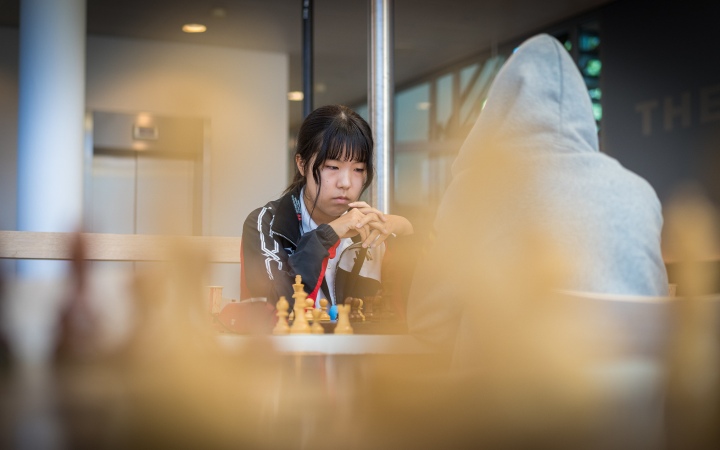
After three rounds at the FIDE World Youth Olympiad 2023, China and Netherlands 1 jointly lead with 3/3. On the second day of the Olympiad, two rounds were played. Round 2 was held in the morning, right on the schedule. Just outside the “top boards,” there were many draws. The high seed teams 6 (Uzbekistan), 7 (Azerbaijan), 8 (France), and 9 (Israel) drew against lower-rated teams Bulgaria, Kazakhstan 2, Greece, and Italy, respectively. The top team, Turkey, whitewashed the 3rd team of the Netherlands, and their opponent from Round 1, Georgia, showed that their 2-2 draw was not a one-time success. They convincingly beat Slovakia by 3-1. Now back to the top boards. Kazakhstan 1 defeated India 3-1. It wasn’t easy, as only the black boards of Kazakhstan managed to win in the endgame. FM Sepenov relentlessly held onto a slight advantage in an endgame with heavy pieces, and eventually, the exposed white king (CM Adireddy) turned out to be a significant problem. WIM Nurmanova scored her second point for the team Kazakhstan. China continued its dominance by winning again with a score of 3.5-0.5, this time against Switzerland. Except for the draw between WFM Manko (Switzerland) and Kong Xiangrui, the Chinese players demonstrated sharper play than their Swiss opponents. The Dutch first team scored a narrow 2.5-1.5 win against Latvia, but it could have been different. On the first board, Arsenijs Savicevs played an excellent game against FM Yichen Han. The position emerging of Caro-Kann, Advance Variation, had strong similarities with the French Advance. In this line, black should be cautious of the move dxc5 followed by b4. Han underestimated this idea and ended up in a worse position by move 7. Move 13.c4 exposed Black’s weakness: White was developed and ready for action, while Black’s king was stuck in the center. Black seemed to solve some of his problems but with 22.Nf6 Savicevs showed that it was indeed White playing for a win. He preserved his advantage deep into the endgame but winning was still not straightforward. With 39…Rd7??, black blundered and allowed a beautiful skewer! White found the tactics and won the game. See the exciting battle on lichess On board 2, Arthur de Winter defeated Aleksejs Adamovics by handling the middlegame and endgame in the Maroczy structure better than his opponent. On board 3, Mikelis Vingris and Prajit Kumar didn’t upset the balance, resulting in a 1.5-1.5 draw. It all came down to the game on board 4 between the ladies Ter-Avetisjana and Verheij. Ter-Avetisjana pressed for a win but miscalculated a pawn sacrifice, giving Verheij a significant advantage that she duly converted into a full point, securing the win for the Netherlands. Hungary, seeded 5th, also won their second match. They defeated the 2nd team of the Netherlands by a score of 3.5-0.5, although it wasn’t as smooth as it might seem. Boards 1 (Kobe Smeets) and 2 (Roger Labruyere) played excellent games for the Dutch team. Nevertheless, WIM Gaal (board 1) and FM Palczert (board 2) from Hungary proved stronger in the endgame. The 4th team of the Netherlands narrowly lost to Cyprus (2.5-1.5). Boyd Leenen was inspired after his game yesterday (a beautiful attacking game against his Chinese opponent). This time, Leenen initiated the attack and broke through his opponent’s position with a rook lift along the h-file. See the game on lichess In Round 3, which was held in the afternoon, the two top teams faced each other. Top-seeded Kazakhstan 1 played against 5th-seed Hungary. It was an intense battle between these two strong squads, resulting in a 2-2 tie. On the first board, WIM Zsoka Gaal had significant chances to defeat IM Ansat, who had previously made two draws. Unfortunately for Zsoka, her advantage evaporated in a complex endgame. On board 2, Kazakhstan secured a full point, as FM Sapenov (Kazakhstan) ultimately capitalized on an earlier missed opportunity. FM Kolimar played an instructive game against FM Mamedov and scored the victory for Hungary. On move 25, Mamedov allowed the white rook on c7, which then extended white’s control over the 7th rank with a second rook. The final position doesn’t feature two white rooks on the 7th rank, but two pawns! A beautiful win, see below. On the 4th board, there was a fierce battle with chances for advantage for both sides, but FM Giang and WIM Nurmanova ultimately agreed to a draw. As a result, Kazakhstan dropped the lead as China and Netherlands 1 scored three match victories. The Chinese squad has been performing exceptionally well. In Round 3 trounced Romania 4-0! China has not suffered any losses yet and has the most board points of all teams, making just two draws. The team has been playing very consistently; none of the players has had a difficult position in three rounds. The only exception happened on board 3 in this match, where Xiangrui Kong was building a brilliant attack. Everything was going well for him until moves 33 and 34, where he slipped up. His opponent, FM Cnejev, missed the opportunity, and on move 36, Kong executed a decisive combination to win material. Netherlands 1 is the only team joining China with 3 wins. They once again triumphed over Canada 1 by a score of 2.5-1.5. On board 1, FM Yichen Han is still to find his footing in the tournament. This time, Han had a winning position for most of his game, but under severe pressure, he turned it into a theoretical rook and bishop versus rook (without pawns) draw. He tried to push for more, but FM Atanasov didn’t yield. On board 2, another FM Johnathan Han from the Canadian team, faced FM Arthur de Winter. Han stood well in the Najdorf Sicilian, building up his advantage, although the position remained complex. After a misstep by his opponent, FM de Winter patiently seized control and secured a point for the Netherlands. CM Max Chen of Canada might regret not capitalizing in his game. Facing Prajit Kumar, he achieved a
2nd FIDE Council Meeting 2023: List of decisions

2nd FIDE Council Meeting August 1, 2023 LIST OF DECISIONS CM2-2023/01 To note President’s report. CM2-2023/02 To note Treasurer’s report. CM2-2023/03 To note information on FIDE major events calendar. CM2-2023/04 To open bidding procedure for the World Rapid and Blitz Championships 2024 on 15 August 2023. CM2-2023/05 To approve the FIDE Chess Olympiad 2028 Regulations and to open a bidding procedure by August 15, 2023. The call for bids shall be as follows: 4 weeks are allocated for the expression of interest. If there is no more than one potential bidder that express their interest within 4 weeks, the overall bidding process shall last for 8 weeks. If there are several parties that express their interest within 4 weeks, the overall bidding process shall last for 12 weeks. CM2-2023/06 To approve the World Fischer Random Chess Championship 2024 to be held preliminary on 18-24 February 2024 and to open bidding procedure for the event from 15 August to 30 September 2023. CM2-2023/07 To note the Global Strategy Commission’s report. CM2-2023/08 To note the Arbiters’ Commission’s report. CM2-2023/09 To approve the recommendations of the Arbiters’ Commission on Seminars, Classification upgrades, Amendments to the lecturer list, FA norms and titles. CM2-2023/10 To nominate President as the Council’s representative to the Consultation Team formed by Arbiters’ Commission on creation of the Arbiters’ Panels for the cycle 2024-2025. CM2-2023/11 To note the Qualification Commission’s report. CM2-2023/12 To approve the proposal on Rating Regulations amendments in principle, pending receipt of additional expert and public opinion. To instruct the Qualification Commission to collect such experts’ assessment, review all opinions and present the final version of the rating regulation changes to the FIDE Council in October 2023. Once approved, the changes will be communicated to the public by 1 December 2023 and will come into effect starting 1 January 2024. CM2-2023/13 To approve the recommendations of the Qualification Commission on titles. CM2-2023/14 To collect proposals of the Council members in respect of the Transfer Task Force’s report regarding transfer regulations and to have an expanded Working Group meeting to discuss those proposals. CM2-2023/15 Based on factual transfer statistics and analysis, MB to formulate alternative proposals for Council’s consideration regarding admission to team events. CM2-2023/16 To inform the Affiliated Organisations that no event regulations of their respective tournaments which imply titles and norms should be published without a prior FIDE approval. CM2-2023/17 To approve the recommendations of the Trainers’ Commission on titles and Academies. CM2-2023/18 To approve the recommendations of the Events Commission on titles. CM2-2023/19 To award World Junior U20 Chess Championships 2024 to Delhi, India, subject to the successful inspection. CM2-2023/20 To award World Senior Team Chess Championships 2024 to Krakow, Poland, subject to the successful inspection. CM2-2023/21 To award World Senior Chess Championships 2024 to Constanta (Mamaia), Romania, subject to the successful inspection. CM2-2023/22 To award World Youth U14, U16, U18 Championships 2024 to Florianopolis, Brazil, subject to the successful inspection. CM2-2023/23 To award World Amateur Chess Championships 2024 to Acqui Terme, Italy, subject to the successful inspection. CM2-2023/24 To award World Cadet & Youth Rapid & Blitz Championships 2024 to Durres, Albania, subject to the successful inspection. CM2-2023/25 To conduct the necessary inspections for the World Cadet U8, U10, U12 Championships 2024 and World Schools Chess Championships 2024. CM2-2023/26 To note that no bids have been received for World Cup under 8, 10, 12 2024, World School Team Championship 2024. and World Under 20 Junior Rapid and Blitz Championships 2024. CM2-2023/27 To note that Uzbekistan Chess Federation offered to organize World Under 20 Junior Rapid and Blitz Championships 2024 and World School Rapid and Blitz Championships 2024 in Uzbekistan. To inspect the proposed venues. CM2-2023/28 To note that the Georgian Chess Federation offered to organize the World Cup under 8, 10, 12 2024, subject of inspection. To inspect the proposed venue. CM2-2023/29 To note the Fair Play Commission’s report. CM2-2023/30 To note the Technical Commission’s report. CM2-2023/31 To approve the proposal of the Technical Commission regarding play-off and tie-break regulations. Table of Changes. CM2-2023/32 To recognise DGT 2500 as a FIDE Endorsed product. CM2-2023/33 To approve updated FIDE Online Chess Regulations. Table of changes. CM2-2023/34 To note the Planning and Development Commission’s report. CM2-2023/35 To note Chess in Education Commission’s report. CM2-2023/36 To approve the recommendations of the Chess in Education Commission on School Instructor title. CM2-2023/37 To note the Social Commission’s report. CM2-2023/38 To note the Chess in Multi-sport Games Committee’s report. CM2-2023/39 To note Continental reports. CM2-2023/40 To suggest to the General Assembly the approval of the New Caledonia Chess Federation as an affiliated organisation of FIDE. CM2-2023/41 To amend the resolution of the FIDE Council CM1-2023/44 as follows: “To recommend the application of the Tonga Chess Federation for the ratification by the General Assembly”. To confirm that Tonga Chess Federation is eligible to receive FIDE Development Fund support according to PDC programs starting from August 2, 2023. CM2-2023/42 To approve the FIDE Questionnaire for National Federations applying for FIDE Membership. CM2-2023/43 To note the report of the FIDE Special Envoys on the situation in Bulgarian chess. CM2-2023/44 To note the report of the Reverse Delegate on South Africa. CM2-2023/45 To approve FIDE Policy on Transgender Chess Players Registration, effective from August 21, 2023. CM2-2023/46 To note FIDE 100 Years Anniversary update. CM2-2023/47 To announce the dates of the next meeting of the FIDE Council in due course. CM2-2023/48 To announce the dates and venue of the FIDE General Assembly in due course.
FIDE World Cup Round 5 Tiebreaks: Nepomniachtchi eliminated
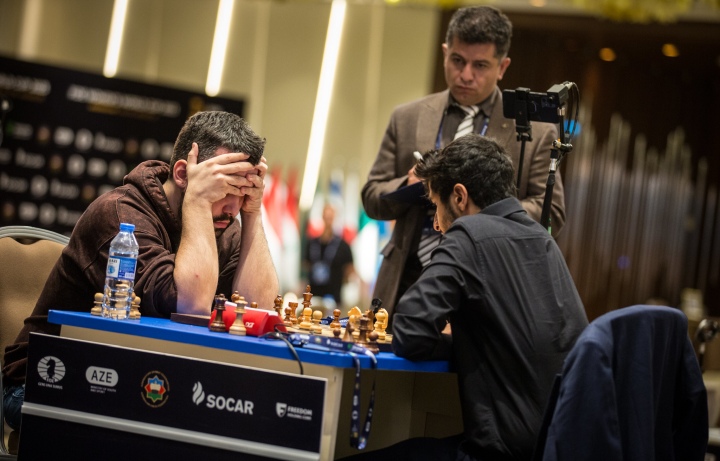
Vidit Santos Gujrathi won both games in the second tiebreak, securing the last free spot in the quarter-finals of the Open. Salimova, Goryachkina and Muzuchyk are through to the semi-finals of the Women’s tournament Vidit Santos Gujrathi has become the fourth Indian player (alongside Erigaisi, Gukesh and Praggnanandhaa) to qualify for the final eight in the Open. He eliminated Ian Nepomniachtchi, defeating him in the second round of the rapid. The two were fighting for the only remaining spot in the quarter-finals of the World Cup. In the Women’s World Cup, Salimova beat Shuvalova in both rapid tiebreak games, while Goryachkina and Muzuchyk had to go all the way to the Blitz to secure their sports in the semis. The Open Tournament Highlights Two-time World Champion Candidate Ian Nepomniachtchi is out of the World Cup after losing to Vidit Santos Gujrathi in the tiebreaks. The two drew both of their classical games in round five. In the first rapid tiebreak, both games ended in a draw, with both sides playing evenly. However, in the second tiebreak, where each had 10 minutes, Nepomniachtchi faltered. First, he lost as White in the Neo-Catalan – making a blunder in the middlegame, recovering, and then again when opting to go to a rook and queen endgame. In the second game of the second tiebreak, in the Dutch Defence, Vidit – who was now leading the white pieces – was in control from the very beginning. Despite both sides making several imprecise moves, Vidit had the upper hand and won. This was a third tiebreak in the World Cup for both players, but it seems that it left a bigger toll on the former World Champion Candidate, whose strength failed him today. Vidit will be playing against Azerbaijan’s Nijat Abasov in the quarter-finals. The Women’s Tournament Highlights After making a comeback yesterday, Polina Shuvalova is out, having lost both games in the first rapid tiebreak to Bulgarian IM Nurgyul Salimova. Game one was crucial for Shuvalova: playing as Black, she was gifted a completely winning position in the endgame. Instead of converting it into victory, she made two consecutive blunders, dropping the victory in the first one and ending up losing after the second. In game two, Shuvalova allowed her king to get trapped in the middle and ended up defending a lost position but to no avail. Aleksandra Goryachkina had a difficult task against Harika Dronavalli but managed to prevail. The two played three rounds of tiebreaks to decide who would move to the semi-finals in the Women’s event. Goryachkina won the first tiebreak game today after Harika blundered a bishop in a drawn endgame. Goryachkina played as White in the second game and had a better position. However, she misplayed and allowed Dronavalli to dominate across the board. Then followed two draws in the 10-minute rapid games, with Harika having a strong advantage in the second but dropping it and finishing with a draw. It was time for the Blitz: In the first game Dronavalli misplayed in a rook and queen endgame and lost. In the second Blitz game, Goryachkina had a sizable advantage and no counterplay from her opponent but did not try too hard to convert, as a draw was enough to qualify for the semi-finals. She is taking on Tan Zhongyi in the semi-finals. Elisabeth Paehtz and Anna Muzychuk were the last to finish after three stages of tiebreaks which saw the Ukrainian GM progress to the next stage. In both rapid matches, Paehtz and Muzychuk exchanged heavy blows. In the second game of the second tiebreak, Paehtz had a lucky break: she completely misplayed in a winning position and transferred a strong advantage to White, who, in turn, misplayed and ended up losing. Interestingly, Black won all the rapid games. In the Blitz Match, Muzychuk – a three-time world blitz champion among women – won the first game after Paehtz overlooked the only opponent’s threat in an overwhelming position. The second game ended in a draw. Muzychuk will be playing Nurgyul Salimova in the semi-finals. Round 6 starts on Tuesday, 15th of August, at 3 PM local time in Baku, Azerbaijan. Here follows a closer look at some of the top games from round five tiebreaks: Ian Nepomniachtchi was defeated by Vidit in both games of the second tiebreak. In game one, where he played as White, Nepomniachtchi was completely lost after blundering in the following position: Black is already better, pressuring along the d-file and having more options to attack the white king. The most logical move for White was to move the queen to e2, but Nepomniachtchi went two squares too far. 25.Qg4?? After this, Black is dominating: 25…Qc6+ 26.Kg1 Nf5 27.Rf3 Rd4. Vidit, however, went for 25…Nf5 which is strong enough but not decisive 26.Rf3 Qc6! 27.Ne5 Qa8 28.Kg1 And now, instead of 28…Rd2! the Indian GM played 28…Rd4? allowing White to equalise with 29.Rf4! Things were even in the next few moves, as White managed to escape Black’s pressure on the king. But then Nepomniachtchi again made a mistake, which opened a road to a dead end for him. With the rooks being exchanged on f8 in the previous move, Nepomniachtchi should have tried to keep things steady and play 37.Nc3, to help protest his weak a2-pawn. Instead, he opted to simplify: 37.Nxd6? Qxd6 38.Qf3+ Ke7 39.Qc3 Kf7 40.Qf3+ Ke7 41.Qc3+ Kf7 42.Qf3+ Kg8! A bit of psychological play and adding some extra time (due to a 10-second bonification per move) by Vidit. 43.Rd1 Qf8 44.Qe3 Rxa2 45.g5 Qf5 46.Rd8+ Kh7 47.gxh6 Ra1+ 48.Kg2 Qg4+ Forcing the exchange of queens 49.Qd3 Qxg3+ 50.hxg3 Kxh6 Black has a winning rook endgame which he executed confidently. 0-1, 60 moves In the second game of the second tiebreak, Nepomniachtchi lost control from the opening and was weaker throughout, ending up losing. A well-deserved success for Vidit. Polina Shuvalova suffered a huge misfortune today, losing a winning endgame in their first rapid game of the tiebreaks agasint Nurgyul Salimova. Playing as Black, Shuvalova found herself in the following position after several bad
2023 2nd FIDE Council Meeting: List of Decisions

FIDE publishes the list of decisions of the 2nd FIDE Council meeting 2023, held on August 1 in Baku, Azerbaijan. 2nd FIDE Council Meeting 2023: List of decisions