

Third edition of Queens’ Festival goes big
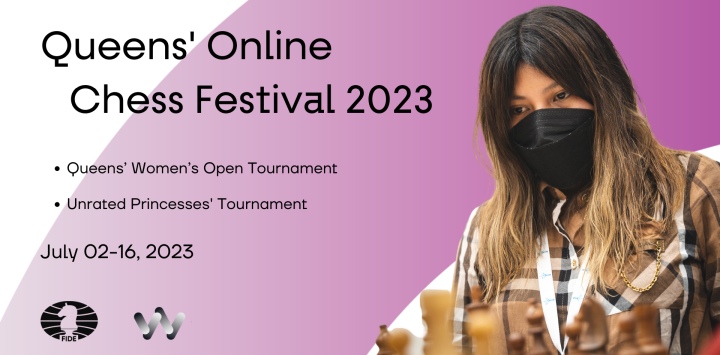
Over 800 female players from 124 countries participated in the third edition of the Queens’ Online Chess Festival, a series of continental women’s online blitz tournaments that took place from July 2-16. The ambitious global project aiming at connecting women chess players from around the world was organized by FIDE Commission for Women’s Chess. The festival program included two competitions: Queens’ Women Open Tournament (all female participants with FIDE ID) and Unrated Princesses’ tournament (for girls without FIDE ID competing in U9 and U16 categories). The Queens’ Women Open Tournament saw the triumph of IM Deysi Cori from Peru, with WIM Nguyen Hong Anh and WGM Hoang Thi Bao Tram (both of Vietnam) finishing second and third, respectively. In the Unrated Princesses’ tournament, Melissa Wong from Malaysia scored 5 points and emerged as the winner in the U9 age category. Rajakaruna R M Sayuni Suhansa, with 4½ points and Lyayan Batyrova with 4 points, took second and third places, respectively. Medals in the older category – U16 girls – were won by Divya Bhavani Chembrolu from India (1st place, 7 points), Dariya Aukenova (2nd place, 5½ points) and Chetana Gopalakrishnan (3rd place, 4½ points). It is worth mentioning that refugee girls from FIDE’s “Chess for protection” project also took part in the Unrated Princesses’ tournament. Fifteen female students from Kenya, representing Angelina Jolie Primary School, Morneau Shepell Secondary School and Bhar-El-Naam Primary School, were competing in U9 and U16 categories. The main prize for the winners was really impressive! The winners of both events are invited to the 45th World Chess Olympiad 2024 in Budapest, Hungary. The ticket, full-board accommodation for 3 days and invitations to the Opening Ceremony of the Chess Olympiad 2024 for the winner and one accompanying person will be covered. In addition, the medal-winners and the top finishers in continental qualifications received training sessions with female grandmasters. “We believe that more chess tournaments for female players can bring lasting results to boost female participation in all aspects of chess life. Therefore we offer our winners training sessions with leading chess trainers as well as the chance to see the flagship FIDE event – the Chess Olympiad,” said the Chair of the FIDE WOM Commission, Anastasia Sorokina. The finals of the Queens’ Women Open Tournament and the Unrated Princesses’ tournaments were streamed live on the FIDE Youtube channel with expert commentary by WGM Anastasiya Karlovich and WIM Fiona Steil-Antoni. Link to the broadcast: youtu.be/72vbPHkL1A0
FIDE delegation visits China Qiyuan Hangzhou Branch

Chess will be part of the Hangzhou Asian Games 2023, to be held in the China Qiyuan, Hangzhou Branch. On July 17, Victor Bologan, FIDE Executive Director and Zhu Chen, FIDE Treasurer, visited the China Qiyuan Hangzhou Branch (Intelligence Building), and had a productive discussion with Hang Tianpeng, President of the China Qiyuan Hangzhou Branch, and Liu Xiao, head of the Intelligence and Sports Management Office of the China Qiyuan Hangzhou Branch. The sides exchanged views on future cooperation in promoting and developing chess projects. Both parties believe that the meeting was effective and beneficial and will become a starting point for future joint projects. The representatives of the FIDE stressed the importance of conducting mutually beneficial and win-win in-depth exchanges in promoting the standardization of international chess and industrial development. FIDE delegates highly praised the development of the intellectual sports and industry of the China Qiyuan Hangzhou Branch. Both sides had a frank exchange on their respective strengths, communicated intentions in regard to organizing and hosting chess competitions, conferences, and seminars, and expressed hope to deepen cooperation in the future. Also attending the meeting were Yu Ting, Deputy Director of the Intelligence and Sports Management Department of China Qiyuan Hangzhou Branch, Ma Yangchen, Executive President of China Chess Event Co., Ltd., and Du Qiang, General Manager of Hangzhou Qizhan Digital Technology Co., Ltd. In the afternoon of the same day, July 17, Secretary of Shaoxing Municipal Party Committee, Mr Wen, gave a friendly welcome to Zhu Chen, Victor Bologan, and Ma Yangchen. Mr Hu Min, Vice Mayor of Shaoxing, also attended the meeting. Mr Wen warmly greeted the FIDE delegation and told them about Shaoxing’s economic and social development, history and culture, as well as its achievements in preparing for the Hangzhou Asian Games and launching the chess game. According to him, chess has a solid competitive foundation in Shaoxing, cultivating a group of masters. He also expressed hope of FIDE’s continuing its support of Shaoxing’s chess sports, deepening cooperation in organizing events, and building up Shaoxing’s reputation as one of the chess strongholds in China. Zhu Chen complimented the vigorous development of Shaoxing chess in recent years, especially the successful hosting of several high-level competitions. Victor Bologan briefed on the relevant arrangements for FIDE’s 100th anniversary to be celebrated next year. He also noted that Shaoxing once held the “Belt and Road” Women’s Chess International Open and looked forward to launching other major chess projects in the city. Subsequently, both sides had in-depth exchanges on chess promotion and development in the future.
WWC Match 2023: Everything hangs on the final game
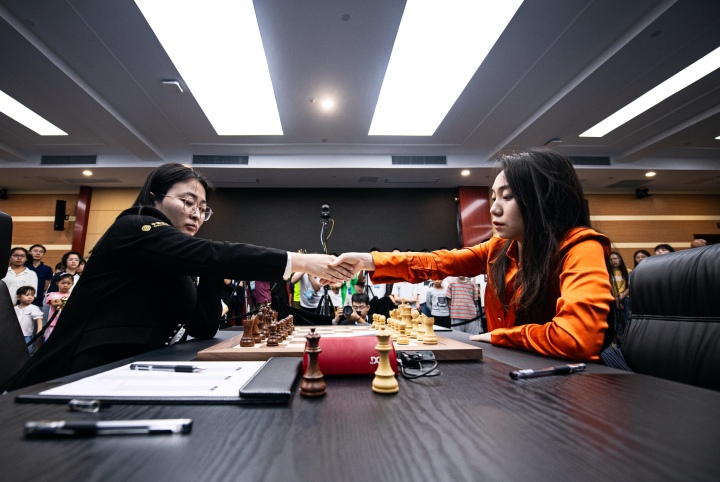
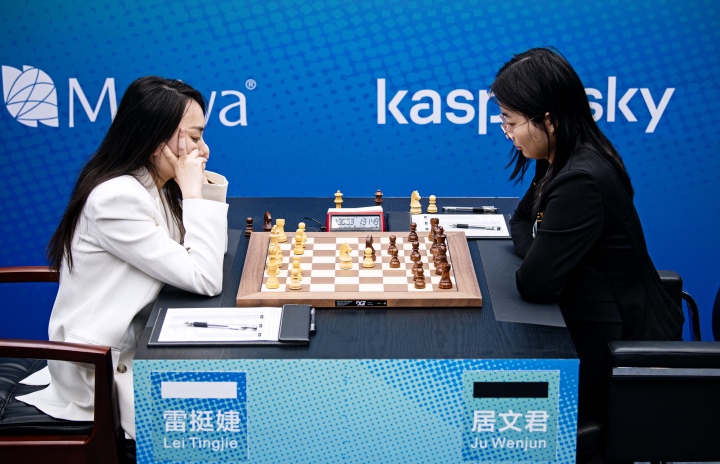
After game 11 of the match for the title of Women’s World Champion ended in a draw, the players are tied at 5.5:5.5. Everything now hinges on the final, 12th game of the match In a complicated and tense positional game, Lei Tingjie who was playing as White handed over some initiative to defending Women’s World Champion Ju Wenjun, but it wasn’t enough for a victory. This was the penultimate game in the classical part of the match, and it marked the last game where the challenger was playing as White. She opted for the Italian opening, the same one in which she scored a victory in game five – her only triumph over Ju in the match so far. Ju opted for a slightly different line than the one in game five. The two reached a dynamic position where Black had more spatial control. Lei tried to make progress by putting pressure on the e5 pawn, but Ju was countering well and gradually shoved White’s pieces back . After a lot of positional manoeuvering, White decided to transfer her king from the queenside to the kingside but gave her opponent some interesting options. Black launched a push in the centre after which she ended with a slightly better position. However, at the critical moment closer to the time control, instead of increasing the pressure by temporarily sacrificing the bishop, the defending Women’s World Champion decided to go for a series of exchanges, releasing the tension. In an even endgame that transpired, with queens and opposite-coloured bishops, the two agreed on a draw after 48 moves. The outcome of the match now hangs on game 12 where the defending World Champion will be White. If either side manages to win, they will take the crown. If that game ends in a draw, the title of the Women’s World Champion will be decided in a rapid tiebreaker. Game twelve will take place on Saturday, 22nd July, at 3 PM Local Time in Chongqing (GMT +8). Here follows a closer look at Game 11 of the match: As the two players sat across each other, Ju Wenjun was firmly looking at the chess board while Lei’s eyes went around the room. Each player had their own way of focusing. The first moves were made by Luo Jianping, Deputy Director of the Standing Committee of Changshou District People’s Congress and Yan Chunming, from the List of Good Samaritans of China. This was Lei’s last chance with white pieces against the defending Women’s World Champion. As in all of the previous games in the match where she played as White, she opened with 1.e4. Unlike game nine, in which she played the Sicilian, the World Champion returned to her main response move to 1.e4. After 2.Nf3 Nc6 3.Bc4 Ju opted for 3…Nf6, going into the Two Knights Defence. The two played a popular line in which White tried to take control over the d-square, but Black confidently countered this plan. Both sides have finished development and played very solid, not taking too many risks, noted Grandmaster Alik Gershon. Black has a strong knight on d5 and controls more of the centre, but White can put some pressure on the e5-pawn. The position is even. Both sides proceeded to align their rooks on the e-file and slowly arranged their pieces to optimal squares. Since the e5-pawn is well protected, White appears to run out of active options. Black, on the other hand, can regroup by moving her bishop to g7 and take more control over the center by f7-f5. After a long positional manoeuvring Ju got some spatial advantage and increased the initiative in the centre. Trying to strengthen her control over the e4-square, Lei played f2-f3 but weakened the dark squares in her camp. The position is complicated. Black is trying to force a push in the centre as White is trying to hold. White made a slight imprecision according to the engine: 33.Kf1?! with the idea of transferring her king to the queenside. Better was 33.Qe1, to reinforce the e-file defence. Here Black had a chance to make some progress by playing 33…Bg7 to prepare her dark-squared bishop shift to either f8 or h6, depending on the circumstances. If White sticks with her plan, then after 34.Ke1 Nf6 35.Kd1 Qd5 Black is clearly better. Instead, Ju played 33…Kg7. Now White’s king continued a long walk to the queenside while Black struck in the center and advanced her pawn to e3: 34.Ke1 Rh8 35.Kd1 e4 36.fxe4 fxe4 37.Kc1 e3 The key moment. White had a couple of safe options 37. Qg2 and 37. Qe1 but instead, the challenger took the pawn – 37.Nxe3. 37…Rhe8?! with this natural move Ju missed a chance to pose some problems for Lei with 37…Bg5! temporarily sacrificing a piece to pin the e3-knight and aim at the king on c1. White holds there, but it would not be that easy, especially closer to the time control. Instead, the line Ju chose led to a series of exchanges where the pressure eased off. Black regained the sacrificed pawn, but now the two were in an endgame with opposite-coloured bishops and no realistic winning chances for either side. The game ended soon afterwards, on move 48, following a threefold repetition. Both Ju and Lei are tied, 5.5:5.5. Everything now hangs on the final, 12th game of the match. If it ends in a draw, the two will proceed to rapid tiebreaks. Text: Milan Dinic Photos: Stev Bonhage Official website: womenworldchampionship.fide.com/ About the Match The match will take place in two Chinese cities, where each of the contestants comes from. The first half of the match will be in Shanghai, while the second half takes place in Chongqing. The match will consist of 12 games of classical chess. The payers will have 90 minutes for the first 40 moves, followed by 30 more minutes for the rest of the game, plus a 30-second increment per move starting on move one. Players cannot offer a draw before they reach the 41st move. In case of a tie,
FIDE turns 99

Today, July 20, 2023, we are celebrating our 99th birthday! Many of you across the world will celebrate International Chess Day with various activities and happenings all about our beloved game. On this day, we want to reinforce the tradition started in previous years: we ask members of the chess community to teach someone how to play chess. The more, the merrier! Be it your neighbour, niece, colleague or grandfather, let’s make the chess family grow. Don’t forget to share your experience on social media using the hashtag #Internationalchessday. Let’s make our celebrations really big and prove that chess is the most played game in the world! Why did the United Nations choose exactly July 20 to celebrate chess? It was done to mark the date of the International Chess Federation’s establishment in 1924, so it is also our birthday! Let’s briefly walk through our history and remember all the major milestones that lead us to this day. International Chess Federation, or shorter, FIDE (stands for Fédération Internationale des Échecs), is the governing body for the game of chess. What does FIDE do? It organizes major chess events, which form the World Championship Cycle, Chess Olympiads, Rapid and Blitz Championships, tournaments for people with disabilities, veterans, and children, as well as various exhibition and online events. It awards international chess titles, like the coveted Grandmaster, and calculates rating. FIDE creates and implements the rules of chess and standards for tournaments. It is actively involved in social projects and the promotion of chess on the grassroots level. FIDE is recognized by International Olympic Committee and includes as many as 199 national chess federations! Let’s have a closer look. FIDE was formed on July 20, 1924, in Paris, France, during the first unofficial Chess Olympiad. It was born at the Town Hall of the IX Arrondissement of Paris (6 Rue Drouot). Fifteen delegates from all over the world signed the proclamation act, and our organization was born. In 1927, FIDE organized the first Chess Olympiad and the first Women’s World Championship in London. In 1948, FIDE started overseeing the World Chess Championship. Today, both absolute and women’s chess crowns belong to players from China: Ding Liren and Ju Wenjun. In 1950, FIDE awarded its first Grandmaster title to 27 players. Today, FIDE titles also include International Master, Women’s Grandmaster, Women’s International Master, and lower-level ones like FIDE Master or FIDE Candidates Master. The first official FIDE rating list came out in 1971. This universal rating system, named after its creator Arpad Elo measures a player’s skill level and tracks their progress over time. New rating lists are out at the beginning of every month, and professionals and amateurs alike are eager to check the new numbers next to their surname. In 1999, FIDE was recognized by the International Olympic Committee – a major milestone in the organization’s history. The motto of FIDE is “Gens una sumus”, which translates from Latin as “We are one family”. This motto is a reflection of the organization’s vision of chess as a sport that unites people from all over the world. Family means care, and in recent years FIDE’s social projects have become an essential part of the organization’s operations. “Infinite Chess” project introduces the game to children with ASD, “Chess for Freedom” program brings chess behind the bars of prisons, “Chess for Protection” helps refugees find their way with the help of the game. FIDE financially supports its veterans in need and holds competitions for people with disabilities. The first Chess Olympiad for People with Disabilities took place in January-February 2023 in Belgrade. Chess has found its place in the ever-changing world of modern technology. Today, FIDE organizes online and hybrid events and implements new technological solutions. In 2023 chess became part of the Olympic Esports Series. Next year, FIDE will celebrate its 100-year birthday. The International Chess Federation has come a long way since its first steps a century ago. Today, it is based in Switzerland alongside other major sports governing bodies. It encompasses 199 national chess federations, which makes FIDE one of the largest sports federations in the world. Throughout its history, FIDE has been instrumental in shaping the world of chess, and we never stop aiming for new heights, serving the game and chess community.
ChessFest takes over London

The UK’s largest chess event took place on Sunday 16th July in London’s Trafalgar Square. Now in its third year, the annual open-air chess festival saw over 15,000 people attend the free event organised by the charity, Chess in Schools and Communities, to promote and raise awareness for the game we all love. After two previous years of scorching 30+ degree temperatures, the 2023 event took place under cooler conditions and thankfully remained rain-free, not that we’re convinced any of the 350+ chess boards would have been vacated for anything less than a deluge. The highlight of the day was the living chess displays which have been the centrepiece of previous events. With actors taking the place of the pieces, they re-enacted some of the best games played by UK players, with GM David Howell on hand to commentate on the re-enactment of his game against Ivan Sokolov from the 2009 Staunton Memorial. ChessFest also offered a “Challenge the Chess Master” where the masters had two and a half minutes to the public’s five, with prizes to those who managed a win or a draw. The number of masters steadily increased throughout the day from the scheduled four to nine to cope with the long queues that formed. It was a veritable “Who’s Who” of the chess world with GM David Howell, GM Gawain Jones, GM Luke McShane, GM Ravi Haria, GM Stuart Conquest, IM Andrew Martin, IM Harriet Hunt, IM Richard Palliser, IM Tom Rendle, IM Callum Kilpatrick, IM Malcolm Pein, WGM Katarzyna Toma, FM Tim Wall, FM Jonathan Pein and FM Akshaya Kalaiyalahan all taking turns. Even titled players, like GM Jonathan Roswon and IM Gavin Wall, who had turned up to spectate, were co-opted into pitching in! At the other end of the spectrum, one of the UK’s brightest prospects and the World U-8 Rapid & Blitz champion, Bodhana Sivanandan, challenged the USA’s own prodigy, 9-year old, Megan Paragua, in a match played live on the internet from Trafalgar Square and broadcast on the giant screen with commentary for the public. Although ahead in both games, Bodhana lost the match 0.5-1.5 but captained a team of London Juniors to a win in a match played against ChessFest Liverpool – who were having their own outdoor festival at Liverpool ONE – Chevasse Park. New for 2023 was the interactive chess puzzle competition organised by ChessKid starring the star of the online platform FunMaster Mike (FM Mike Klein). All children attending ChessFest were given new accounts to ChessKid and given 10 minutes to solve as many puzzles as possible on their mobile phones or devices. Hundreds took part, with the giant screen showing a live leaderboard. If the results are anything to go by, the future of UK junior chess is looking bright, with some awesome scores being recorded. To cap it off, Chess in Schools tutors were offering children and adults a free chess lesson in the “Teaching Zone”. Lessons ranged from how the pieces moved to the ultra-advanced nuances of the Accelerated Dragon. A total of 35 tutors provided close to 500 lessons throughout the day. ChessFest also took part in Nottingham on Saturday 15th July and in Hull on Sunday 16th July, with the juniors from Hull emerging victorious in their online challenge game against London. ChessFest will be back in 2024 and will be looking to build on this year’s success by bringing chess to more people across the UK. Text and photos: ChessFest official website
Ju and Lei still levelled as WWC Match 2023 enters final phase
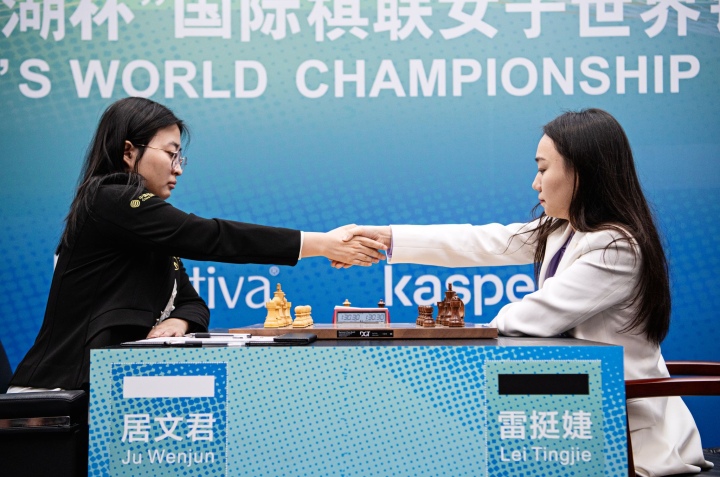
The classical part of the match for the women’s world champion in chess is nearing its end, with only two more games left. The current score is 5:5 As the classical part of the match for the title of the women’s world champion in chess nears its end, the appetite for risk among players is falling. Game ten was a largely calm battle. Defending world champion Ju Wenjun opened with 1.Nf3, the same move she played in game eight when she defeated Lei. The challenger chose a slightly different response than the one in game eight, and, from an English Opening the two transitioned into a Queen’s gambit position. Despite a small imprecision by Ju in the opening, neither side managed to grab the initiative. Following exchanges in the middlegame, the two entered a drawn rook and queen endgame. Ju emerged a pawn up, but Black’s active pieces offered sufficient compensation. Soon, Lei regained a pawn and, by move 32, restored material equality. Soon Ju traded the queens and forced an even rook endgame. Despite both players being comfortable with splitting a point, neither could offer a draw before move 40. Soon, the 40th move threshold was passed, and the two happily shook hands. The close score is evidence of the high level of play exhibited by both competitors. Thursday, 19th July, is the final rest day of the match. Both sides will need to approach the rest day with more thought than any other rest day before: with just two more games for the final victory push, both need to be at their best. If the score remains tied after these games, the match will proceed to tiebreaks. Game eleven will take place on Friday, 21st July, at 3 PM Local Time in Chongqing (GMT +8). Here follows a closer look at game 10 of the match: With the score levelled and three more games to go (including today’s), it seemed that the defending World Champion had a slight advantage – she equalised the score in a critical moment to halt Lei’s surge and will be playing as white in two of the last three remaining games in the classical part of the match. By playing 1.Nf3 the defending champion opened with the same move as in game eight, when she defeated Lei. After some thought, Lei responded with 1…Nf6 and not 1…d5 as in game eight. In the press conference after game nine, the players we asked if they believed in superstition. While Ju’s reply was a firm “no”, Lei confirmed that she did. Whether this had any play in Lei’s opening move choice in today’s game is anyone’s guess. Ju wanted to avoid allowing Lei to enter the Tarrasch line, where the challenger had shown great skills in the previous games. Still, from the English Opening, the two gradually transitioned into a structure of the Queen’s Gambit where Black had the isolated d5-pawn – very similar to the Tarrasch Defence. Here Ju made a slight imprecision with 14.N2f3. It allowed White to play 14…Ne4 as Black aims to seize the initiative. Overall, during the match, Lei came across as better prepared in the openings. In all but one of the previous games, it was Lei who was better prepared in the openings and offering more surprises, noted Grandmaster Alik Gershon. 15.Nd2 “The world champion shows great character by admitting and fixing her mistake on the very next move with 15. Nd2!”, said Grandmaster Alik Gershon. Still, Ju lost a tempo. Here Lei spent 20 minutes thinking about what to do next. She had three options: To take on d4 and follow a line of exchanges or, place her knight on g5 and keep the pressure on the e4-square. The third option was 15…Qf6, with the idea of placing the queen of h6 and making mating threats on the white king as well as pinning the e3-square for some potential tactics. After she finished calculating the lines, Lei went for the most straight-forward, 15…Nxd4, and then tried to transfer her rook to the kingside via Re6-g6 (h6). However, Ju was on her guard and thwarted this plan. Here a series of exchanges followed, pushing the game towards a draw. 18.Nxe4 Bxd4 19.Qxd4 Rxe4 20.Qxd5 Rxe3. An interesting moment occurred here when Ju started laughing. Despite trying to be discrete about it, it was noticeable to Lei and the audience. In the press conference, Ju explained that “something came to my mind, not about chess… Then I just couldn’t stop laughing”. This was not taken as a bad thing by Lei. 21.Bc4 Re7 22.Qxb7 Bb5 23.Qd5 Following the sequence of natural moves, the opponents reached a roughly equal position despite Black being a pawn down. Still, Lei was the one who needed to play more precisely here. Grandmaster Xu Yi – who knows both players well as he played with them in the Chinese leagues – noted that Lei “needs to be careful here, especially when playing against Ju”, hinting at the world champion’s preference to try and squeeze a victory out of a tiny advantage. A few moves down the road, the bishops were off the board, and the two entered queen and rook endgame. Ju’s extra pawn on c4 is exposed to attack, while Black’s pieces are very active. Soon the c4-pawn fell, and Ju forced an exchange of queens leading to a dead-even rook endgame. Although it was a draw, the two could not offer it to one another before move 40, as per regulations. The two played until move 47 and decided to call it a day. On routines and rankings The press conference after game 10 yielded some notable comments from the players about their routines and preparation. While both were unwilling to say anything more than the ordinary about their daily habits, they did reveal one interesting detail. When asked by the Chinese Woman Grandmaster Gu Xiaobing how many hours of sleep they get, Ju said she sleeps about eight hours a day, while Lei revealed that she sleeps as much
Implementation of the C.07 Tie-Break Regulations postponed

FIDE TEC received numerous inquiries and upon careful evaluation of the previously announced C.07 Tie-Break Regulations, set to be effective from July 1, 2023, the SPP Department within the FIDE TEC Commission identified a need for certain clarifications. This primarily pertains to the definitions related to Play-Offs, Direct Encounters, and Unplayed Games. Under the stewardship of Mr. Roberto Ricca, the SPP Department has completed this necessary refinement. The revised definition is currently under review for approval by the FIDE Council. Our objective is to publish the updated version of the “C.07 Tie-Break Regulations” in early August 2023, with an effective date of September 1, 2023. Vendors of Pairing Software are thereby granted time to implement these revised tie-break rules until April 1, 2024. We urge everyone to stay vigilant for the imminent publication of these new regulations. Enquiries: Hendrik du Toit – secretary.tec@fide.com
FIDE Education Commission announces its 9th Preparation of Teachers course
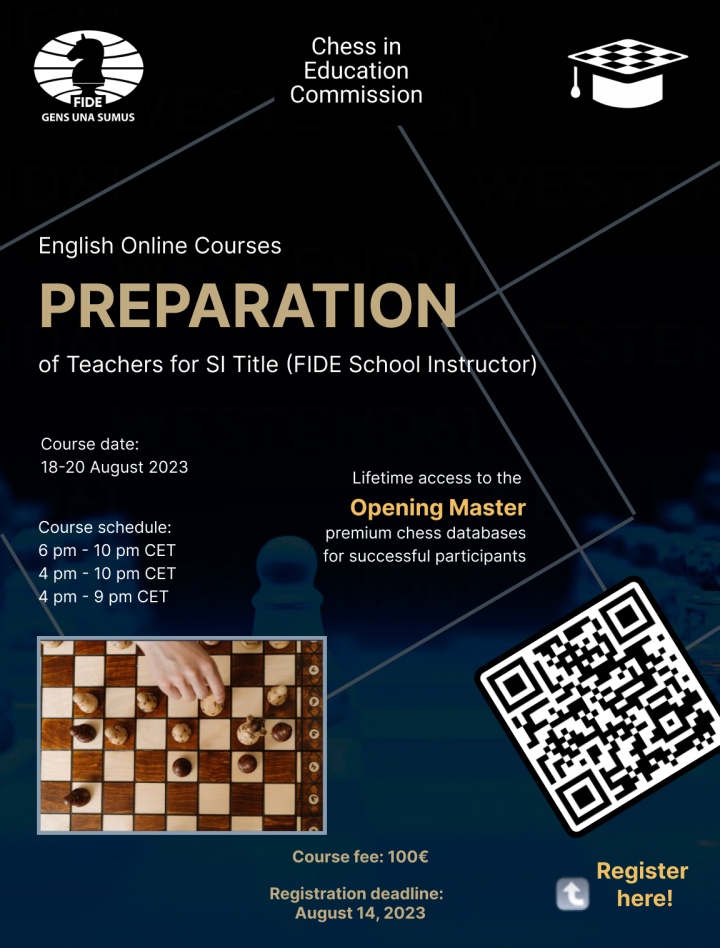
FIDE Chess in Education Commission is delighted to share the exciting news about the upcoming 9th Preparation of Teachers course. We invite you to join us for this exceptional learning experience. Ideal for teachers, chess educators, and beginner and advanced players who have a basic knowledge of chess and experience working with children, the course will be run online in English from August 18-20, 2023. The participants will have an opportunity to take an exam to qualify for the esteemed FIDE title of School Instructor. Moreover, FIDE Chess in Education Commission offer participants who successfully complete the course a special benefit – exclusive lifetime access to the Opening Master Premium Chess Database, which currently contains more than 9.6 million official over-the-board chess games and is being updated on a monthly basis. For a comprehensive overview of the course, please refer to the detailed course description available at the following link:cloud.fide.com/s/zdjnrtTwXtfGoK4 To secure your spot, kindly complete and submit the registration form provided here:cloud.fide.com/s/N74JLEdq3qcKwc4 Please note that the deadline for applications is August 14. Given the limited number of places available (20 in total), we encourage you to register at your earliest convenience, as applications will be processed on a first-come, first-served basis. Should you have any inquiries or require further assistance, please don’t hesitate to reach out to us at edu.courses@fide.com We look forward to embarking on this enriching educational journey together and expanding the horizons of chess education.
WWC Match 2023: A surprise and a counter-surprise, but game 9 ends in a draw
In what turned out to be yet another day of surprises, Lei Tingjie and Ju Wenjun settled for a draw in their round nine game after an intense battle which lasted four hours and 59 moves. The score remains even, 4.5:4.5 Ju started with a surprise on move one, choosing to respond to 1.e4 with c5 – an opening she had not played for a long time. In the Four Knights Variation of the Sicilian both sides blitzed their opening moves. After Ju made another unusual choice with 8…Bb7, Lei then struck back with her own surprise with 10.a3. Despite the tit-for-tat exchange of surprises, the position on the board remained balanced. After finishing the opening phase, the two quickly progressed to a forced line where several pieces were exchanged, ending in an even queen and rook endgame. Staying true to her spirit of looking to take the initiative, Lei temporarily sacrificed a pawn. A pair of rooks was exchanged, and White managed to regain a pawn, but eventually, the queens were traded off. By move 40 – when the first time control was reached – the game was a complete dead draw. Lei was trying to make a breakthrough in a theoretical draw, but on move 59 finally, the two agreed on a draw following threefold repetition. In the post-game press conference, Lei said that the game was “normal” and that “neither side had much chance”. She added that she wasn’t surprised much by Ju’s 1…c5 move. Ju agreed that the game was “solid for both”. At one point in the press conference, it seemed that Lei forgot how many games were played in the match so far. When asked how physically intense the match is, Lei couldn’t immediately remember the number of games played and needed to be reminded. “It hasn’t been too difficult for me… Also, the score is even right now and I am happy to play like this”, she added. For the defending World Champion Ju, this was a relatively comfortable draw. After staging a comeback with a victory in game eight, Ju managed to halt Lei’s momentum, preventing her from gaining any advantage or unleashing her initiative. In game ten, Ju Wenjun will play with the white pieces and also in game 12, giving her a slight edge. With only three more games remaining in the classical part of the match, both players must be cautious not to make any mistakes, as there won’t be many opportunities for a comeback. Game ten will take place on Wednesday, 19th July, at 3 PM Local Time in Chongqing (GMT +8). Here follows a closer look at game nine of the match: The honour of making the first move in today’s game was given to Wang Shengao, Chairman of the Standing Committee of Changshou District People’s Congress, and Xiong Bin, a National Model Worker. Lei Tingjie was playing as White and opened with 1.e4. 1…c5 Another opening surprise from Ju Wenjun, who did not play this opening in the match before. “This is going to be very interesting” was the first comment made by Grandmaster Judit Polgar as she saw Ju’s move. Both sides played quickly, entering the Four Knights Variation. The last time Ju Wenjun went for this opening was in 2018. However, this was part of her opening preparation earlier in her career. The two played very quickly in the opening. Ju just put her bishop on b7, which is a rare move in this position. 8…c5 or Qc7 are considered the main continuations here. 9.Be2 c5 and now Lei launched a novelty: 10.a3. It would seem that now Lei took her opponent by surprise after being stunnedby Black’s opening choice. The standard move for White in this line is to castle short. The idea with 10.a3 is for White to play c4 and prevent Black’s d5-knight from jumping to the b4-square and then relocating to d4 via c6. 10…Qc7 is met with 11.Nd6+! and if 11…Bxd6 12.exd6 (Qxd6?? 13.c4) Qc6 13.f3 – a computer move, an odd move, but giving White an edge. “This just goes to show how different chess is nowadays”, noted Judit Polgar – “you see players playing these moves without any emotions, and these are the moves you would never dare to consider in earlier times”. 10…Ne3 Not the most obvious move choice, but White’s e4-knight is hanging and the line is forced. 11.Bxe3 Bxe4 12.0-0 And the position is even. Black needed to undermine White’s e5-pawn, and Ju decided to play straight away 16…f6 after spending four minutes on the clock. This was the first point in the game where both players spent a significant amount of time thinking about the next move. White had an option to take on f6 and proceed with placing her queen on e4 (putting pressure on the e6 pawn and pinning the d7 pawn) or g3 – holding the d6-square pinned but also aiming at the black king’s fortress. After 12 minutes of thinking, Lei played 17.Qg3. Now it was Ju’s turn to spend more time on the clock. After more than 17 minutes, she went for the best move choice: 17…fxe5 Now followed a series of exchanges wrapped in tactics which both players needed to calculate beforehand: 18.Qxe5 Bf6 19.Qd6 Bxb2 20.Bxc5 Rf7 21.Rb1 Be5! “This was a shock to Lei”, said Polgar, noting that she wasn’t sure the challenger saw this coming. White hasn’t overlooked a piece or anything like that, but she just gave Black a simple way to make things easier and hold an even position. 22.Qxe5 Rf5 23.Qd6 Rfxc5 The two have traded the bishop and reached an even position with mutual pawn weaknesses balancing each other. Instead of defending her c4-pawn, Lei decided to sacrifice it, hoping to exert some pressure with 24.Rb7. However, it was not enough to achieve anything tangible as Ju timely returned the pawn and liquidated in a drawish rook endgame. A draw was agreed on move 59 following threefold repetition. Text: Milan Dinic Photos: Stev Bonhage Official website: womenworldchampionship.fide.com/ About the Match The match will take
FIDE World Championships 2024 Call for Bids is Closed

FIDE Events Commission would like to announce the results of the procedure Call for Bids FIDE World Championships 2024. The Events Commission has received 15 bids for 8 competitions in total: 1 bid is for World Junior U20 Chess Championships 2024 2 bids for World Senior Team Chess Championships 2024 1 bid for World Senior Chess Championships 2024 1 bid World Youth U14, U16, U18 Championships 2024 1 bid for World Amateur Chess Championships 2024 3 bids for World School Chess Championships 2024 1 bid for World Cadet & Youth Rapid & Blitz Championships 2024 5 bids for World Cadet U8, U10, U12 Championships 2024 For more details, please check the Events Commission website events.fide.com/ in BID 2024 menu.