

WWC Match 2023: Lei surprises Ju but game one ends in a draw
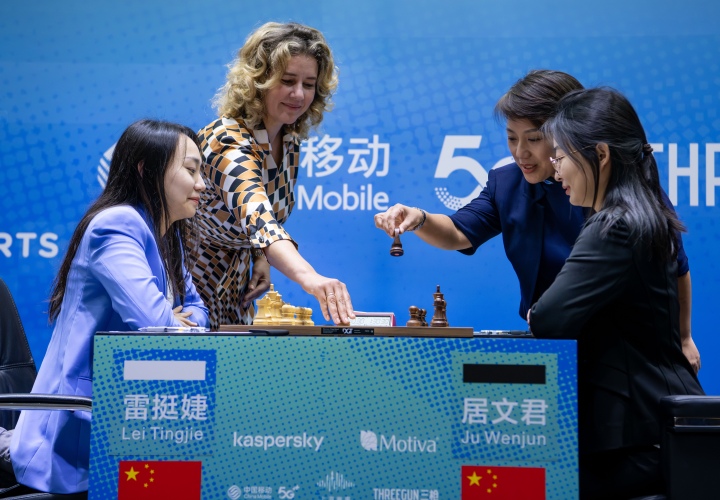
In the first game of the Women’s World Championship Match, challenger Lei Tingjie surprised defender Ju Wenjun in the opening, but Black managed to hold a draw The first game of the match for the title of Women’s World Champion started sharp at 3 PM local time in Shanghai. As determined in the drawing of lots, the challenger Lei Tingjie was leading the white pieces against the defender, Ju Wenjun. The first game of the match saw a first surprise as Lei opened with 1.e4 instead of her usual 1.d4. In the Berlin Defence of Ruy Lopez with 5.Re1, White opted for a rare line sacrificing a central pawn for the initiative. Ju, although taking more time on the clock, managed to counter effectively, eventually returning the extra pawn to exchange the queens and thwart White’s hopes of mounting an attack. Still, White has a small edge thanks to a slightly better pawn structure and two bishops. Neither side managed to tilt the balance for a long time. However, at one point, the world champion made an inaccuracy with move 26…a6, which allowed White some chances. Lei leapt at the opportunity and got a better better position but then simplified and entered what was an even rook endgame. Ju had one problem in the background – she was significantly behind on the clock and had little time to calculate. Despite time troubles, Ju managed to reach the first time control and hold the position. After 50 moves and just over three hours of play, the game ended in a draw. Although Lei surprised the world champion, she was unable to gain the upper hand. Nevertheless, the unexpected start promises more excitement in the upcoming games. In the press conference, both players said it was a tough game but that they feel confident about how it began. Both Ju and Lei praised the point that the match is taking place in China and think it will prove to be a turning point for Chinese chess. “This is a good thing for Chinese chess. Our chess organisation is doing a lot to promote the game and this will help,” said the defending champion Ju. ‘More children will take up chess and this is good for China and chess’, Lei added. Game two starts on Thursday, 6th July at 3 PM local time in Shanghai (+8 GMT). Here follows a closer look at the game one of the match: Lei Tingjie is known for playing 1.d4 as her first move, but she surprised her opponent by opening with 1.e4. Ju opted for the popular Berlin Defence in the Ruy Lopez. Popularised by Vladimir Kramnik in his 2000 title match against Kasparov, the Berlin is considered to be a drawing weapon for Black and has been extensively used at the top level in recent years. Following exchanges in the centre, Lei went for a line in which she gave up a central pawn for better development, hoping to grab the initiative. 11.Nc3 Played quickly by Lei, suggesting this is her preparation. The moves 11.c3 or Bf4 are considered as the main continuations here. 11…Rxe1 12.Qxe1 Bxd4 13.Bd3 13.Bf4 is considered the main line. 13.Bd3 is a relatively new move recently played by such strong players as Fabiano Caruana, Parham Maghsoodloo and Jorden van Foreest. White is preventing Black from getting the knight on the thematic f5-square. White has a pair of bishops and the initiative compensating the sacrificed pawn. Black has to be cautious of an obvious threat with Qe4 – simultaneously threatening mate and attacking the bishop on d4. As White was building up pressure, it was noticeable that Black spent significantly more time: by move 20, Lei had an hour and 23 minutes, while Ju was down to 50 minutes. 19…Ne4 Played after 20 minutes. 19…f6 or 19…Nf5 considered to be better options. Ju decided to give up her extra pawn to stabilize the position and liquidate into an endgame. However, White kept a small edge thanks to two bishops and a slightly better pawn structure. At some point, Ju silently offered a draw by move repetition, but Lei refused and rightly so, as her opponent committed an inaccuracy a few moves down the road. Instead of 26…d4 Ju played 26…a6 giving White some interesting options. Lei immediately started her push on the kingside with 27.h4. Another – probably even better – move was 27.Bd1, protecting c2-pawn and untying her dark-squared bishop. After another imprecision by Black 27…Nf8 (instead of 27…d4). White’s hopes in the game have suddenly increased. Lei continued her kingside advance, and after 28.g4 (28.Bd1 also looks interesting) 28…f5 the opponents reached the critical juncture of the game. After 29.Bb4 Kf7 30. gxf5 Bxf5 31. Re7+ Kf6 32. c4 dxc4 33. Bxc4 Be6 34. Bxe6 Nxe6 35. Rxb7 White could have emerged with an extra pawn and some winning chances. However, with 29.gxf5 Lei loosened her grip, as after 29…Bxf5 30.Bf3 Be4! the worst was behind Black. By this point, Ju had 10 minutes on the clock while Lei had 21, and the inaccuracies crept in again. As a result, White got an edge, but then it was Lei’s turn to err. With 33.Bxf8?! White exchanged her strong bishop for a passive Black’s knight, dropping the advantage immediately. Better options were Kg2, Rc3 and f3. As Black was worse on time, this exchange only played into Ju’s hands. Although Ju had a weak pawn on e4, it was not enough for White to make substantial progress. The only hope for Lei was to go after the b5-pawn, with the idea of creating two passers on the queenside, but Ju effectively countered this plan by attacking the c2-pawn. After reaching the first time control, White created a passer on the b-file, but Black held comfortably thanks to her active rook. After 50 moves and just over three hours of play, Lei and Ju decided to call it a day and split a point. Text: Milan Dinic Photos: David Llada and Stev Bonhage Official website: womenworldchampionship.fide.com/ About the Match The match will take place in two Chinese cities, where each of
World Schools Team Championship 2023: Registration deadline extended

FIDE and the Kazakhstan Chess Federation have extended the registration deadline for the participants of the World Schools Team Championship 2023 (WSTC). National Federations should submit or complete the information about their invited and additional teams using the link for the online registration form before July 10. The championship will take place in Aktau, Caspian Sea-Side, from August 3 (arrivals) to August 8 (departures) of 2023. The playing venue is Halyk Arena. About 50 National Federations first to enter with preliminary confirmation of participation in WSTC have already received for one of their teams “invited team” status and a travel grant (for schools located in member Federations affiliated to Africa or the Americas, the travel grants are up to $10,000, for schools situated in member Federations affiliated to Asia or Europe they are up to $5,000). Registration form: https://wstcc2023.fide.com/registration/ Contact email: wstcc@fide.com Regulations and invitation letter (pdf) Photo: welcome.kz
2023 FIDE World Cup: Players lists and pairings announced

FIDE World Cup, held every two years, will celebrate its 10th edition in Baku, Azerbaijan, from 30 July to 24 August 2023. With 206 players in the open section, plus 103 in the Women’s competition, this event has seen its combined prize pool boosted to a whopping USD 2.5 million, the single largest one at any chess event in the world. For many players, the World Cup is the first and only opportunity to enter the race for the World Championship crown since the three top finishers in the event will advance to the next stage: the super exclusive Candidates Tournament. This means one more spot than in the previous edition, Sochi 2021, where only the finalists would qualify: in Baku, the winner of the match for 3rd/4th place will also get the coveted invitation for the Candidates, which adds some extra excitement to this already thrilling competition. The rating favourites of the open event are the #1 in FIDE July 2023 rating list Magnus Carlsen (Norway, 2835), Hikaru Nakamura (USA, 2787; received a wild card), Fabiano Caruana (USA, 2782), Ian Nepomniachtchi (FIDE, 2779), Anish Giri (Netherlands, 2775), Wesley So (USA, 2769), Teimour Radjabov (Azerbaijan, 2747), Gukesh D (India, 2744), Shakhriyar Mamedyarov (Azerbaijan, 2742), Maxime Vachier-Lagrave (France, 2739) alongside many other well-known chess players from all over the world. The FIDE Women’s World Cup will feature the reigning champion Ju Wenjun (China, 2564), the 2020 Challenger Aleksandra Goryachkina (FIDE, 2557), Humpy Koneru (India, 2553), Kateryna Lagno (FIDE, 2552), Alexandra Kosteniuk (Switzerland, 2523), Tan Zhongyi (China, 2523), Nana Dzagnidze (Georgia, 2511), the Ukrainians Mariya and Anna Muzychuk (2511 and 2504, respectively), and many other chess stars. Most top players in both competitions have a bye in the first round, but we still have some exciting matchups. Looking further into the draw, we can spot some interesting potential clashes. In the open event, Magnus Carlsen has a relatively easy draw up to the Round of 32 in which he most likely (provided he beats his compatriot in Aryan Tari in the Round of 64) will face either Amin Tabatabaei or Vincent Keymer. Moving down, we see a couple of possible high-profile battles, Abdusattorov – Korobov and Ivanchuk – Wei Yi and two duels of youngsters Sarin – Deac and Shevchenko – Sarana, as early as in Round 3. The second-seeded Hikaru Nakamura can meet Carlsen only in the final, but most likely, he will have his first serious test in Round 3, taking on up-and-coming Nodirbek Yakubboev. In the women’s event, there are several potential exciting confrontations in Round 3: Assaubayeva – Paehtz, the Ukrainian derby Anna Muzychuk – Anna Ushenina, Krush – Shuvalova, Zhao Xue – Batsiashvili (although the former will have to see off very talented Carissa Yip first). Since two top seeds, Ju Wenjun and Aleksandra Goryachkina, have easy early rounds, it is interesting to see whether they will make it all the way to the final to set a repeat of their 2020 title match. The World Cup is one of FIDE’s flagship competitions, and in recent editions, it has clearly become one of the most followed events in the chess calendar. It reflects FIDE’s efforts to expand the competition, increasing the variety of qualification paths and the number of represented countries. List of players for the Open Section (highlighted the 50 players BYE in Round 1) Pairings for Open Section Round 1 List of players for the Women Section (highlighed the 25 players BYE in Round 1) Pairings for Women Section Round 1 Official website: worldcup2023.fide.com/
FIDE distributes €25,000 among chess veterans

After carefully considering the numerous applications received, the special panel appointed by the FIDE Council decided that these will be the ten chess players, coaches, and promoters to benefit from the second instalment of FIDE’s support to chess veterans in 2023: Nikola Padevsky (BUL)Goran Cabrilo (SRB)Yuri Meshkov (RUS)Vassilis Aristotelous (CYP)Mario Galeano (PAR)Jens Kristiansen (DEN)Živko Janevski (MKD)Ulrich Jahr (POL)Lubov Zsiltsova-Lisenko (UKR)Dang Tat Thang (VIE) A total of €25,000 will be distributed among them, each receiving €2,500. As we did on previous occasions, we would pay tribute to these illustrious veterans with a few words about each one of them, summarizing their careers and achievements. Nikola Padevsky (BUL) Photo: Anefo – Dutch National Archives Born in 1933 in Bulgaria’s second-largest city Plovdiv, Nikola Padevsky quickly came to the forefront of national chess. He became the Bulgarian National Champion in 1954 and repeated this success in 1955, 1962 and 1964. In 1957, Nikola became IM and was awarded the GM title seven years later. Padevsky took part in World Student Team Championship six times (from 1954 through 1959). Nikola’s performance in his last championship (Hungary, 1959) was remarkable as playing first board, he helped Bulgaria to pull ahead of team USSR and win gold. A real fixture in the national team, he represented Bulgaria in eleven Chess Olympiads (every Olympiad from 1956 to 1978 except for 1976), playing first board in 1956, 1962 and 1964. His solid tournament record includes the victory in the inaugural Rubinstein Memorial (Polanica Zdrój) in 1963 and shared first place in Varna (1960), Varna (1975), Athens (Acropolis International, 1983) and Kragujevac (1984). From 1981-1989 Nikola Padevsky served as the coach of the Bulgarian national team. Nikola Padevsky is one of the oldest living grandmasters. Goran Cabrilo (SRB) Photo: alo.rs/ Born in 1958 in Yugoslavia, Goran Cabrilo made seven appearances in the national championship. Although Goran never won a medal, he finished fifth in 1989 and 1990. Goran Čabrilo delivered a good performance in the Zonal Tournament (Nea Makri, 1989) and qualified for the Interzonal Tournament (Manila 1990) where he shared 40-47th place. Goran served as the coach of the Serbian national team at the Chess Olympiad in Elista (1998). He also worked with both junior national teams in 2000. Over his long career as a player, he took part in numerous tournaments sharing first place in Trnava (1981), Subotica (1992), Vršac (2006) and Belgrad (2008). Goran Cabrilo still participates in chess competitions, but due to health problems, only those not far from his home. Yuri Meshkov (RUS) Photo: papinchess Born in Smolensk in 1950, IM Yuri Meshkov became visually impaired at seven and was introduced to chess five years later. Inspired by Mikhail Botvinnik’s three-volume book (a gift from his father) and the positional style of the fifth World Champion, Yuri progressed rapidly and soon became a CM. His real breakthrough came in 1980 when Meshkov qualified for the final stage of the RSFSR Championship and was awarded the master title. Graduated from the Smolensk Pedagogical Institute, Yuri Meshkov, for many years worked as a chess coach and instructor. Over his long career, he helped GMs Nikolai Chadayev, Vadim Malakhatko, Alexander Kovchan, David Navara, IM Alexei Potapov, FIDE masters Artyom Benza and Ekaterina Prudnikova. In 1991, together with Vladimir Krayushkin, he organized a chess school under the guidance of grandmasters Alexander Belyavsky and Adrian Mikhalchishin. After the collapse of the Union, the school existed under the patronage of Anatoly Karpov. Most of the training sessions took place in his home Smolensk region. Since 2007, Yuri Meshkov has been participating in chess competitions among the visually impaired. In 2010 and 2013, he became the IBCA World Champion. He is the winner of the IBCA World Chess Olympiad (2008, 2012), the World Team Championship among chess players with disabilities (2013, 2015, 2017, 2018), European vice-champion, five-time champion of Russia in individual competitions or as a member of the national team among visually impaired chess players (2008, 2009, 2010, 2013, 2015). From 2010-2018 Yuri participated in five Chess Olympiads playing for a team of visually impaired players. A talented organizer, Yuri Meshkov held multiple competitions in his home Smolensk region. Vassilis Aristotelous (CYP) Photo: Vassilis Aristotelous’ Facebook Born in 1956, FIDE Instructor, FIDE Arbiter, and AIM Vassilis Aristotelous enormously contributed to chess in his home Cyprus. The 2008 national champion, he represented Cyprus at six Chess Olympiads and multiple international competitions. For many years Vassilis made bulletins for the Cyprus Chess Championship, providing coverage for each round, including all the games of each round, photos, and updates. Throughout his career, Vassilis Aristotelous has been giving chess lectures and simultaneous exhibitions at schools, popularizing chess and attracting new talents. A gifted author Vassilis has been writing articles for one of the leading Cyprus newspapers and penned four chess books. Over the years, he also served as a Public Relations Officer on the Cyprus Chess Federation’s managing board. Mario Galeano (PAR) Photo: Mario Galeano’s Facebook Born in 1947 in Colonia General Aquino, Paraguay, Mario Galeano Vergara became an iconic figure in his home country. Mario made a name for himself as an efficient organizer of numerous chess competitions across Paraguay, including Copa Pte. de la República (1983, 1985, 1986), Memorial Don Julio Domínguez (1988), Memorial Arturo Barchini (1988), Panam. Juvenil con la FEPARAJ (1988, 1990) Memorial Dr. Raúl Sosa Ugarte (1992), Coop. San Cristobal (2002), ITT Copa Gobernación del Amambay (2006), Memorial Ronald Cantero (2007, 2008, 2009, 2010), Copa Roggio (2009), Copa ITAIPU (2011) and many others. Jens Kristiansen (DEN) Born in 1952 in Copenhagen, Jens Kristiansen won his first Danish championship in 1979 and became IM in the same year. A three-time national champion, he represented Denmark at Chess Olympiads four times between 1978 and 1990. He also delivered the best result playing second board in the 1983 European Team Championship. Jens can be called a late bloomer as he earned the title of GM aged 60 after winning the 2012 World Senior Championship. A year later, he shared first place with
FIDE Women’s World Championship Match 2023 commences in Shanghai
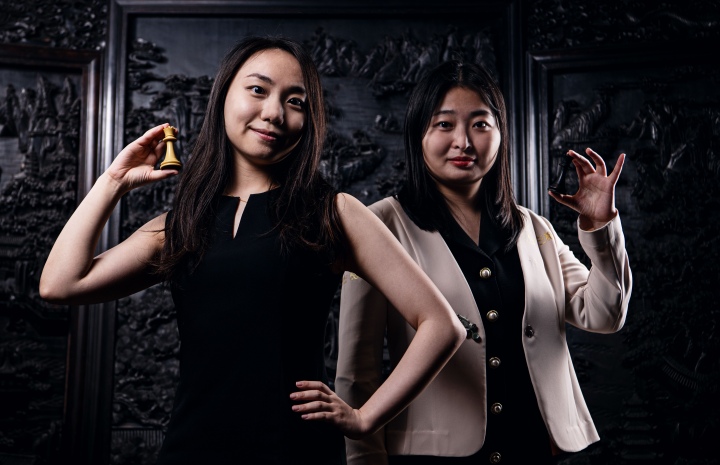
The match for the title of the 18th Women’s World Champion was officially opened in Shanghai. The drawing of lots determined that the challenger Lei Tingjie will start with the white pieces The 2023 FIDE Women’s World Championship Match kicked off today in Shanghai, where the first part of the match to determine the 18th women’s world champion will take place. In a refined ceremony in the grand ballroom of the Intercontinental Hotel, the two players – defending world champion Ju Wenjun and challenger Lei Tingjie – got up on stage with FIDE officials to choose the colours they will start the match with. The ceremony had two stages: first, there was a drawing of lots to determine who would have the first choice in the drawing of colours. Secondly, there was the actual process of determining the colours. The first to choose in the first draw was the current Women’s World Champion Ju Wenjun who picked up a box containing a black knight. This meant that Lei Tingjie would be the first to choose the pieces. In the second phase, Lei chose first, and she picked a box with the white queen, which signified that she would begin the match with the white pieces. The opening ceremony was preceded by a press conference, where the hosts and players expressed their views and expectations about the match. Tian Hongwei, General Secretary of the Chinese Chess Association, welcomed the chess world to China. Stressing the importance of the competition, Tian noted the contribution her country made to women’s chess. “This is the fourth time that two Chinese players compete for the Women’s World Chess title after 2000, 2010 and 2018. This is enough to prove that the level of Chinese women’s chess is at the top of the world, which is also the inevitable result of the popularization and development of Chinese chess,” Tian said. Dana Reizniece-Ozola, Deputy Chair of the FIDE Management Board and serving as the supervisor of the appeals committee for the match, expressed gratitude to the hosts for organizing the championship. Reizniece-Ozola noted the significance of the event as FIDE prepares to celebrate its 100th anniversary: “It’s a special moment for FIDE as next year we will be celebrating our 100th anniversary. The winner of this match will be the champion in a year where we mark our first centenary”. The FIDE official also praised Chinese achievements in women’s chess, noting that out of 17 women’s world chess champions so far, six come from China. She highlighted the systematic support provided by the Chinese government for chess – including the use of the game in education – and praised China’s recent victories in the chess world, including Ding Liren’s triumph in the world championship match earlier in the year. Then it was time for the players to speak. The challenger, Lei Tingjie, has proved to be one of the best players in the world. She qualified from the Grand Swiss Tournament held in 2019 and went on to win the Women’s Candidates. As for Ju Wenjun, she is a role model not only for young girls and women but also for male chess players. She is among the six women in history who excelled the ELO of 2600 and has already defended her title twice. The defending World Champion Ju Wenjun expressed her enthusiasm for the match, anticipating an exciting three weeks of competition: “It will be exciting and a lot of fighting spirit for the next three weeks. I feel I will do my best, also because of my love for chess. I will do everything to fight and win every game”. For Ju, this is her third championship match. When asked if this dual is any different from the previous ones, she said: “Every match is very important and tells its own story. I will consider this as a new match and will do my best… I will do everything to fight and win every game”. Lei Tingjie seemed relaxed ahead of the match, despite being one of the youngest challengers ever (at the age of 26): “I want to win, but I am here to improve myself. I will try my best to play good chess. I am the challenger so I don’t feel any pressure at all”. “I have a good team, and things are going well. My mood is good, I am happy to be here and ready to fight,” Lei added. The two players who are at the top of the Chinese and world chess know each other well for years. “I learnt a lot about chess from Ju. She is one of the top players in the world, and I have been following her games closely”, Lei said. “First time I met Lei, she was a kid. She is an excellent chess player, especially taking into account her young age”, the defending champion Ju Wenjun noted. For the next three weeks, the Chinese cities of Shanghai and Chongqing will play host to the Women’s World Championship match. As both of the contenders come from China, it was decided that their native cities host the event: the first part of the match will take place in Shanghai, the home city of defending champion Ju Wenjun while the second part will take place in Chongqing, where the challenger Lei Tingjie is from. Officials from both cities were present at the event and stressed their support in promoting the match. Shanghai plans to hold a series of events to promote chess, including grandmasters going out and playing chess with the public. Shanghai’s official Shan Xiali pointed out the rich history of chess in the city, also known as the “Paris of the East”: “The relationship between Shanghai and chess has a long history. Shanghai is an early city in China to promote chess. The city also has a good chess mass base and cultural atmosphere, and many excellent chess players are from Shanghai”. As the women’s world chess caravan will move to the central Chinese city of
The 2023 FIDE World Cup wild cards revealed
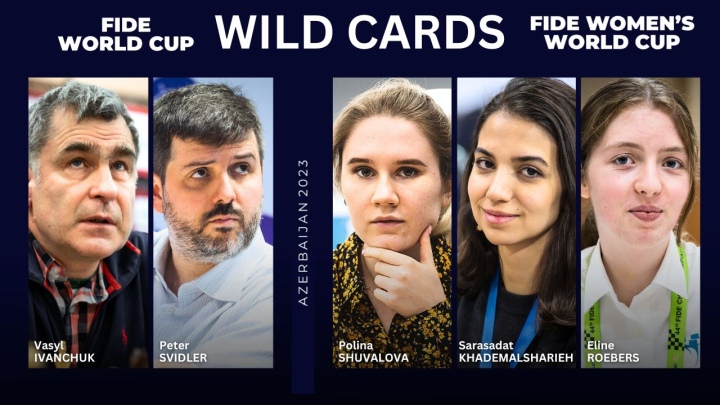
FIDE has approved the final list of Wild Cards for the 2023 World Cup. In both the Open and the Women’s tournament, the final list features a mix of seasoned players and promising young talents Apart from Hikaru Nakamura (No. 2 on the July 2023 Rating list, who recently scored a brilliant victory in Stavanger) and Arjun Erigaisi (No. 2 on the world junior list, the winner of the 2023 Sharjah Masters held in May), two more distinguished chess names received the Wild Card for the 2023 World Cup – Vasyl Ivanchuk and Peter Svidler. Renowned for their remarkable achievements, both players have left an indelible mark on the game as their results include playing the World Championship final and winning the World Cup and World Rapid Championship. Considered to be exceptionally strong world Grandmasters, both have had great results recently: Peter Svidler won the TePe Sigeman tournament in Malmo (Sweden) in May 2023, while Vasyl Ivanchuk picked up 17 rating points in June and tied for first place at the just concluded GM tournament in Bydgoszcz (Poland). In the Women’s World Cup, three Wild cards were given to the top three non-qualified players – Zhu Jiner (2498), Polina Shuvalova (2496) and Sarasadat Khademalsharieh (2488). Many in the chess world will be focused on Sarasadat who had not played classical chess for almost a year save a small tournament in May 2023. The final Wild Card was granted to the very talented 17-year-old Eline Roebers, who increased her rating by 62 points in the past three months and crossed a 2400 ELO mark (2419). The event in Baku will be her first test at such a high level. With the Wild Cards announced and the full list of participants now known, the stage is set for a battle where the world’s finest chess players will gather in Baku (Azerbaijan) to decide the winner of the World Cup. List of players for the Open Section (highlighted the 50 players BYE in Round 1) Pairings for Open Section Round 1 List of players for the Women Section (highlighed the 25 players BYE in Round 1) Pairings for Women Section Round 1 Official website: worldcup2023.fide.com/
VAR in chess: New technologies will be used to help arbiters at 2023 Western Asia Youth Chess

Thanks to technologies and the idChess platform, for the first time in chess, an assistant system for arbiters has appeared that allows you to track controversial moments in the game and make the right decisions. What is VAR VAR (Video assistant referee) is a set of technological solutions to help referees at sports competitions. In many sports, various technologies are already used to help referees make decisions. For example, there is a line-calling system (Hawk-Eye) in tennis that shows the projection of the ball on the line at controversial moments. A similar system is used in volleyball. In recent years, the VAR system has become widely accepted in football: VAR in football is a video surveillance system from different points of the football pitch. During the match, the video assistant referee team constantly checks for errors related to certain actions. Video assistants pay attention to goals and situations leading to goals, penalties, and situations leading to penalties, mistaken identity, and red cards. The VAR team contacts the referee only in case of clear and obvious errors or serious missed incidents. At the same time, the match referee has the right to watch the video recording of the moment and make a decision. In the English Premier League, the technology appeared in the 2019/2020 season, and the percentage of correct decisions in key game episodes increased to 94%. A year earlier, the figure was 82%; that is, almost every fifth decision of the referee in important moments was wrong. In all sports listed above, the final decision remains with the human referee. In other words, VAR systems provide additional information but do not make decisions for referees. How VAR works in chess based on the idChess technology The use of VAR in chess can be divided into three stages: 1) Controversial moments One of the players called the arbiter to note the violation A controversial situation has arisen; for example, the first payer claims that the second one touched a chess piece but did not move it, and the second player denies it. The arbiter missed the moment and can only be guided by the presumption of innocence. 2) VAR review and recommendations If there is a broadcast using the idChess platform, the arbiter can pause the game broadcast in the mobile application and watch the recording of the game using VAR, which shows the behaviour of the players. 3) Decision making The arbiter watches the game and makes a decision. The VAR technology allows you to increase the number of correct decisions made by chess arbiters and make the decision-making process simpler and more transparent for both arbiters and players.
Triveni Continental Kings win the inaugural Global Chess League

In a heart-pounding climax to the inaugural Global Chess League, the title was decided in a thrilling sudden-death blitz tiebreaktiebreak in which Triveni Continental Kings triumphed over upGrad Mumba Masters. Dubai, July 2, 2023: The inaugural edition of the Global Chess League reached its climax in the grand final, which took place at the Le Meridien Hotel in Dubai. In a never-before-seen nail-biting ending to a chess event, the winner was decided through three stages of tiebreakstiebreaks. After two rounds of rapid ending in a draw, and then another two rounds of blitz in which the opponents split the points again, the champions were decided in a series of sudden-death blitz games where the decisive outcome came in the fourth game. In a spectacular finish, Danish 19-year-old Grandmaster Jonas Bjerre brought victory for Triveni Continental Kings after defeating Uzbek 17-year-old prodigy Javokhir Sindarov in a suspenseful game. Bjerre, who was one of the most inexperienced players in the tournament and lost most of his games, delivered the crucial victory to his team when it mattered. After suffering four losses to Sindarov, in a drawn-even endgame which the Uzbek player decided to force, Bjerre got the upper hand and won. “The last game was incredibly tense. It was really exciting. I’m still shivering”, said Bjerre, whose journey in this tournament can be described as – from zero to hero. “Levon (team captain) told me – just fight; if you win this game, you will win the event”, Bjerre added. With this crucial victory, Bjerre not only clinched the title for his team but also won the $500,000 prize. The overall prize fund for the tournament was a stunning one million. The rapid matches The Champion was decided between the Triveni Continental Kings (led by one of the strongest world GMs, Levon Aronian) and upGrad Mumba Masters (headed by Maxime Vachier-Lagrave, the 2021 World Blitz Champion) in rapid, blitz and sudden-death matches. The finals consisted of two rapid matches and the winners had to take both of them. In case of a draw (each team winning one match), the winner would have been decided in a blitz match. As per regulations, the choice of colours was determined by a coin flip. Luck would have it that Triveni Continental Kings will play as White. In the first match, Triveni Continental Kings emerged victorious after turning around games on two boards, winning by 9:7. The key game of the match was played between Levon Aronian, who defeated Maxime Vacheir-Lagrave in a sharp and complicated battle. In the second match, upGrad staged a confident comeback. Dominating from the outset, they defeated Triveni by a score of 12:3. The tiebreaks With both sides tied, the grand finale was heading for the 2-round blitz tiebreak where players had three minutes each, with a two-second increment per move. In a blitz game, the pressure is on, and even the best can make costly errors in a flash. Still, among the 12 players in the finals, four were former world blitz champions – Mumba’s Maxime Vachier-Lagrave and Alexander Grischuk and Triveni’s Levon Aronian and Kateryna Lagno. Triveni Continental Kings played as White in the first blitz round. In a spectacular performance, upGrad Mumba Masters dominated across the boards. With confident victories on boards three, five and six, Mumba Masters got the first blitz round in the bag early on. The other games ended with two draws (MVL and Lagno drew), while Yu Yangyi defeated Alexander Grischuk, helping Triveni avoid being completely crushed. The final result was 14:5 for Mumba. The tables had turned, and it was now on Triveni to equalize. With Mumba playing with white pieces, it wasn’t going to be easy for either side. Tension was huge, not just on the boards – the sister of Mumba’s Vidit Gujrathi was seen in the audience shaking from excitement, while most of the spectators were on the edge of their seats. In a thrilling blitz showdown, Triveni mounted a fierce comeback, seizing the victory from Mumba by 13:7 and turning the tide in their favour. With Mumba and Triveni each claiming a win, the ultimate champion was decided in a heart-pounding sudden-death match. The sudden death match was to be played on one board, not six. The board was selected by the drawing of the lots. As fate would have it, the first board selected was number five: it was a duel between Sara Khadem, who came in as a replacement for Triveni, and India’s Harika Dronavalli. Just before the game started, players of both teams entered the playing arena in a show of camaraderie and anticipation. The game between Khadem and Dronavalli was tough. White got an extra pawn, but it was not enough for a winning advantage. As the game progressed, both sides pushed but objectively, it should have ended in a draw. But Harika was pressing, but Khadem held her ground and forced a draw. The sudden death match continued. In the second drawing of the lots, board five was not included. The draw saw board two selected, where former world blitz Champion Alexander Grischuk went up against one of the world’s strongest players, Yu Yangyi. In a fiercely contested battle, Yu Yangyi managed to create a 2:1 pawn advantage in a gripping endgame. With victory in sight, Yu Yangyi pursued the win, but Grischuk was defying the odds and holding. Amidst the ticking clock and mounting pressure, Yu Yangyi had to settle for a draw just moments away from losing on time. In the next – third(!) – drawing of lots, with numbers five and two removed, board four came up announcing a duel between 3-time world blitz champion Kateryna Lagno and India’s strongest woman player and the first woman to become Grandmaster, Koneru Humpy. In yet another suspenseful game, Koneru Humpy got the upper hand against Lagno and achieved a winning position. In a desperate scramble, Lagno managed somehow to fight back and escape with a draw, to Koneru’s disbelief. Now, the fourth sudden death pair was to be determined,
GCL Day 10: Triveni Continental Kings to face upGrad Mumba Masters in the finals

Dubai, 1st July 2023 – It was yet another day of huge upsets at the Tech Mahindra Global Chess League as all the event favourites lost their final matches. In a shocking outcome, two of the teams which dominated the Global Chess League from the beginning – Ganges Grandmasters and SG Alpine Warriors – were knocked out of the race for the top two places in the finals. Instead, it will be Triveni Continental Kings and upGrad Mumba Masters who will fight out for the coveted crown in the finals of the first edition of Tech Mahindra Global Chess League. Triveni’s journey to the top was the most unlikely. Despite setbacks and a rocky start, they made a triumphant comeback with four consecutive wins. Meanwhile, upGrad Mumba Masters consistently hovered near the top but struggled in the latter part of the event. Nonetheless, they rallied in the final two rounds, eliminating the tournament leaders, Ganges Grandmasters and SG Alpine Warriors. They also had a stroke of luck on their side—had Chingari defeated Balan Alaskan Knights in the last match, they would have been the ones reaching the finals. Nevertheless, fortune favours the bold, and the outcome feels well-deserved. Everything is now set for the finals of the first edition of the Tech Mahindra Global Chess League which takes place on Sunday, July 2nd, at 5:30 PM local time in Dubai. Triveni Continental Kings vs Ganges Grandmasters (11:6) This match was the last chance for Triveni – if they have lost, they would have been out of the tournament. For Ganges, this was their final chance to score points and secure the top place in the round-robin part.While a draw was enough for team Ganges, Triveni had to win and that put them in a psychological mindset to do it. In the Caro-Kann defence, Aronian grabbed initiative and posed serious threats to Anand. Unphased, the former World Champion got his knight and rook to the bottom of the board and found a perpetual check to hold a draw. In the meantime, Sara Khadem scored a huge victory for Triveni as she defeated Bella Khotenashvili in a sharp battle. By this point, Triveni team was dominating on three of the four remaining boards. Wei Yi struck on board three against Leinier Dominguez. Despite being in a weaker position, Kateryna Lagno managed to draw the game with Hou Yifan. Triveni was on the edge of a historic victory. In a complete twist – Yu Yangyi of Triveni lost against Rapport despite dominating the game from the beginning. The result was 8:5 for Triveni – Ganges had to win on the prodigy board to take the win. However, Esipenko was losing to Jonas Bjerre who took the initiative early on and forced a winning rook endgame. Esipenko tried his best and delayed resigning, but he couldn’t escape defeat. The final result was 11:6, for Triveni. A crushing loss for the Ganges and an amazing step up by Triveni. With this victory, they have taken the top of the scoreboard with 18 match points and have become the first team to reach the finals. Triveni, who have been struggling since the outset and had to replace a player, have won four straight matches to reach the top. A spectacular success! “We came back from the dead. We’ve gone so far and we have one more match to go. We were just focused and playing for a win”, said icon player Levon Aronian. The team also praised Sara Khadem who came in as a replacement after Nana Dzagnidze left the tournament for personal reasons. “Sara really changed the atmosphere in the team – she helped team moral and here we are”, said Levon Aronian. Team manager Loek van Wely said that he was proud of his team, “We din’t care much about the results, we feel we had a slight psychological advantage. Most important for us was to get the first win after the round of losses to get a sweet taste of victory once again and get it going from there. We have to wait and see who we play in the finals first, I think we lost twice to upGrad and Alpine looks strong on paper but in the finals its anybody’s game so we will prepare accordingly.” SG Alpine Warriors vs Chingari Gulf Titans (7:8) The Warriors and the Titans were the only remaining teams to play two matches on the final day. SG Alpine Wariors have been in strong contention for first place since the start of the league. Given the open race for the top, the outcome of this match could prove crucial (or fatal) for either teams’ ambitions to reach the finals on Sunday. The Warriors started with white pieces. Both sides played cautiously and steadily – avoiding risk but after about 45 minutes of play, the positions began to unravel. Magnus Carlsen won his game after Jan-KryzstofDuda misplayed approaching the endgame, overlooking a piece. Team Chingari struck back on board two when Shakhriyar Mamedyarov got the upper hand against Gukesh D in the endgame. An unusual game took place between Irina Krush and Titans’ player and former Women’s World Champion Alexandra Kosteniuk. While Kosteniuk got some initiative in the opening, she misplayed in the middlegame, allowing white to take over the advantage. In a game which saw a lot of twists and turns, Kosteniuk obtained a significant material advantage, but Krush found a way out with perpetual check to save a draw. With two more games endindg in a draw the result was: 7:6 for the Titans. Everything was hanging on the last game between Wariors’ Elisabeth Paehtz and Titans’ Polina Shuvalova. In the Sicilian, White gained some initiative early on but then overstretched allowing Black to counter. The two transpired into an even rook endgame but Shuvalova made a mistake bringing White to the crisp of victory. However, Paehtz dropped the advantage and it was even again. Paehtz knew her team needed her to win so she was desperately trying to complicate
FIDE June 2023 Rating List: Nakamura is back to #2
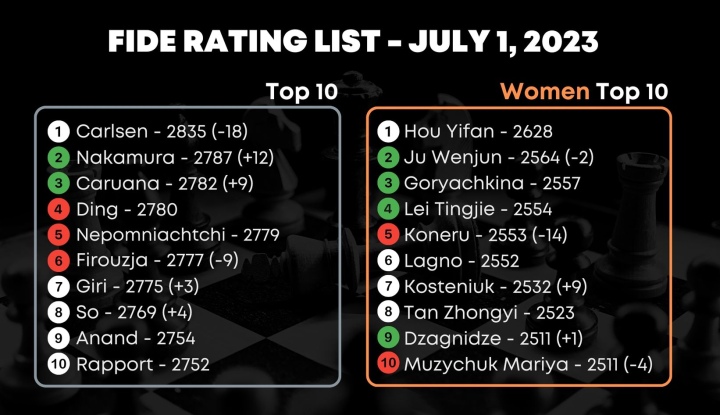
The results of the 2023 Norway Chess and Cairns Cup, two very strong round robins, had the most significant impact on the July rating list. Hikaru Nakamura and Fabiano Caruana put in stellar performances at the eleventh edition of Norway chess and soared up to #2 and #3 on the list. The American GM, who won the event, repeated the career-high second position he once had climbed in October of 2015 (although with a higher rating). Photo: Norway Chess Several female players showcased their brilliance in the Cairns Cup, but only one member of the top 10, Alexandra Kosteniuk, substantially improved her rating (+9). On the other hand, Humpy Koneru dropped 14 rating points and slid down to fifth position on the list. Biggest gains in top 100 Open and Women Zatonskih, Anna IM USA 2364 (+74) Fressinet, Laurent GM FRA 2652 (+20) Vaishali, Rameshbabu IM IND 2431 (+15) Sargsyan, Shant GM ARM 2654 (+14) Injac, Teodora IM SRB 2415 (+14) Sindarov, Javokhir GM UZB 2659 (+13) Ivanchuk, Vasyl GM UKR 2667 (+12) Krush, Irina GM USA 2447 (+11) Divya Deshmukh WGM IND 2400 (+11) Grandelius, Nils GM SWE 2686 (+10) Following her great showing at the 2023 Cairns Cup, Anna Zatonskih (pictured below) deservedly became the player to make the biggest progress last month. The event winner picked up whopping 74 points and triumphantly returned to the top 100 Women. Her compatriot and teammate Irina Krush also did a good job in Saint Lois, finishing fourth and picking 11 rating points. Photo: Crystal Fuller | Saint Louis Chess Club French Team Championship Top 16 usually brings together many high-rated players from all over the world, and the 2023 edition was no exception. Inside the top 100 open, Laurent Fressinet, Vasyl Ivanchuk and Nils Grandelius fared best in this competition earning 20, 12 and 10 points, respectively. The 2023 Dubai Open, the strongest Swiss tournament in June, attracted many GMs, with Javokhir Sindarov (who tied for the first place; pictured below), Shant Sargsyan and Teodora Injac becoming the primary rating beneficiaries inside top 100 Open and Women, while several youngsters – Xue Haowen (+84!), Aravindh Chithambaram (+18), Karthik Venkataraman (+17), Emin Ohanyan (+29), Murali Karthikeyan (+23) and Sina Movahed (+40) – picked up quite a few points. Photo: Dubai Chess & Culture Club Divya Deshmukh delivered a commanding performance at the 2023 Asian Championship and finished clear first which translates into +11 rating points.