

FIDE WGP Cyprus R07: Missed opportunities
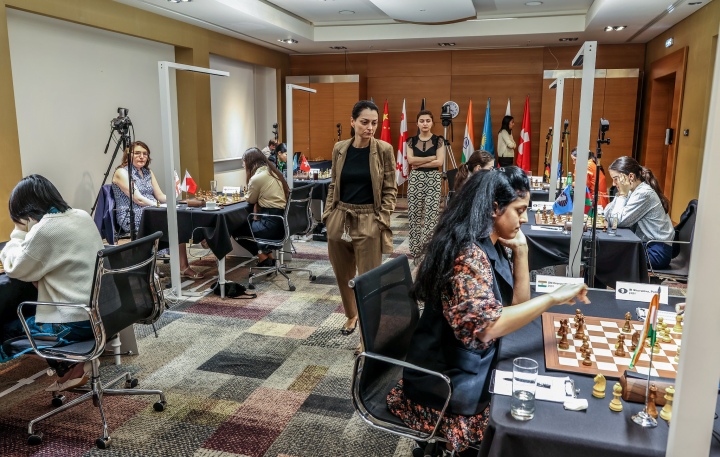
The seventh round of the Cyprus Women’s Grand Prix ended with a huge surprise: WGM Dinara Wagner, the lowest-rated player in the field, leads the event with four rounds to go and is on track for her second IM norm and, who knows, even a GM norm. In addition to the surprise leader, the key element of the day was several missed opportunities. Both Tan Zhongyi and Gunay Mammadzada won their opponent’s queen for a rook and a minor piece but were unable to convert. The ceremonial first move was played by Christiana Erotokritou, Member of the Cyprus Parliament for the Democratic Party and Chair of the Budget and Finance Committee. After the round had begun, Christiana was kind enough to talk to us: “My heart feels support for women who want to push themselves, to push their brains and their minds, to take their efforts to the next level. And whatever inspires your mind to move quicker, faster, better, more cleverly — I think that is something women should be inspired by. And that’s why I’m here.” Christiana is passionate about the game, and her choice of move – 1.e4 – was based on his suggestion. IM Shuvalova, Polina vs GM Dronavalli, Harika (0,5-0,5) The first game to finish ended in a draw by perpetual check. Shuvalova went for a well-known line in the Rubinstein variation of the Four Knights Opening, which leads to a forced draw with perfect play. The key move, which Black must know beforehand, is 14…Qh4! Any other move allows White to consolidate the position and convert the extra material. I found several Grandmaster games with the same continuation, among them Vasilevich vs Lagno. Once again, Shuvalova finished the game with more time on her clock than at the beginning. GM Kosteniuk, Alexandra vs IM Assaubayeva, Bibisara (0-1) Bibisara Assaubayeva scored her first win of the tournament against Alexandra Kosteniuk. They had faced each other many times, but only twice in classical chess, with one victory each. Their most recent game finished in a win for Assaubayeva with Black, in the Astana leg of the WGP. Funnily enough, most of their games have been Sicilian Defence in which Kosteniuk had the white pieces. “I don’t know why, but I always play with Alexandra Kosteniuk with Black but the results in our games are different. Today I was more prepared in the opening, and that’s it,” Bibisara explained to Press Officer Michael Rahal after the game. In today’s game, Assaubayeva went for 2…Nc6 and Kosteniuk once again played the Rossolimo Attack, one of her main weapons in Cyprus. It’s hard to say if Kosteniuk mixed up her move order or just wanted to get out of the book as soon as possible – in any case, after eight minutes of thought, she opted for 8.Na3 instead of the most theoretical 8.Bf4. However, there is an important difference: the bishop can’t get to d6, and therefore, there is less compensation for the sacrificed pawn. Assaubayeva played very well, nullifying her opponent’s initiative and consolidating her extra pawn, plus the two bishops. On move twenty, the engine was already suggesting +4 advantages for Black, and Assaubayeva wrapped up the game with ease. After the game, she was kind enough to spend some time with us discussing the encounter and her tournament up to now. IM Mammadzada, Gunay vs GM Goryachkina, Aleksandra (0,5-0,5) Mammadzada and Goryachkina are from the same generation. They played several times in the Under-10 and Under-12 European and World Girls Championships and subsequently in quite a few events, with Goryachkina generally taking the upper hand. But today Mammadzada was in top form. In an equal position that emerged in a theoretical line of Slav defence, Goryachkina overextended with 20…e5, allowing Mammadzada’s knights to create havoc. However, the real damage was done after the blunder 28…Qc7 Any other queen move would have allowed Goryachkina to hold a worse, but not lost position, but the c7 square was unfortunate – Mammadzada’s 29.Qc5! highlighted the threats to the a7 and b4 pawns but, more importantly, Ne7+ winning the queen, a combination that was unavoidable and occurred in the game. However, Goryachkina is a tough nut to crack. She defended with rook and knight tenaciously, and although Mammadzada played well enough to create the imbalance needed to convert, she was unable to seal the deal. IM Kiolbasa, Oliwia vs GM Dzagnidze, Nana (0-1) Nana Dzagnidze won her second game in Cyprus this afternoon by defeating Oliwia Kiolbasa in a fine game. As expected, Dzagnidze went for the Taimanov Sicilian, and Kiolbasa prepared an interesting side-line, with 7.a3 followed by the aggressive push 10.h4 and 11.h5. After the game, Dzagnidze mentioned that Kiolbasa had already played this line and that she came well prepared. Nonetheless, Dzagnidze is a very experienced grandmaster with a huge baggage of classical games behind her. After some thought, she came up with a very principled way to continue, winning a pawn for dubious compensation. Kiolbasa was still able to complicate matters and fight back in an open position with opposite-coloured bishops, but Dzagnidze kept her cool and notched up a point. When asked about how she forgets a bad game and prepares for the next one, Dzagnidze was very professional: “When you play such a tournament, you are obliged to forget about the previous game and concentrate on what you have now. And if you are a professional chess player, you need to do your best in every single game”. For Kiolbasa, there just doesn’t seem to be any light at the end of the tunnel. After her fourth loss in a row, and six out of the seven games, it will require a mighty effort for her to stand up to the pressure and carry on for the last four games. GM Lagno, Kateryna vs WGM Wagner, Dinara (0-1) This clash promised to be interesting. In their only previous game together, Lagno defeated Wagner in Astana at the first leg of the WGP series. In this afternoon’s game, Lagno
2023 GCT Superbet Rapid & Blitz Poland: Day 2 Recap
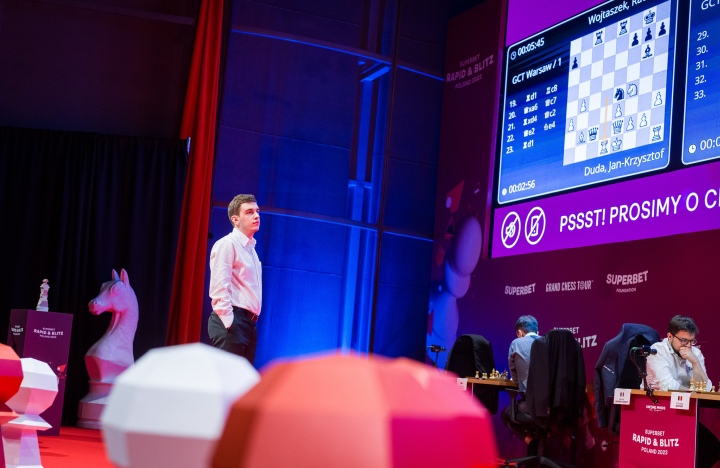
Wesley So and Jan-Krzysztof Duda continued to lead the 2023 Superbet Rapid & Blitz after a hard-fought day resulted in 12 out of a total 15 games drawn. With three games left to play in the rapid portion, So and Duda are in first with 9.0/12 points, while Levon Aronian is in clear third with 8.0/12. Meanwhile a rusty Carlsen fared slightly better in today’s action, drawing all three of his games but without ever being worse. RAPID | ROUNDS 4-6 Surprisingly, all five games in the first round of the day were drawn, with Carlsen pushing MVL all the way in a two knights vs. pawn endgame but never managing to win. Perhaps the wildest game of the day was the encounter between Rapport and Duda, which featured some wild complications arising out of a Vienna Game that ultimately ended in a perpetual check: After 13…Qf1! both kings were in danger, with Rapport soon needing to give a perpetual. Carlsen looked in better form today, but has yet to win a game. | Photo courtesy of Grand Chess Tour, Lennart Ootes The fifth round was the only one with decisive results, as first Duda took advantage of a late-middlegame blunder by Wojtaszek which allowed him to transition into a winning queen ending: Wojtaszek’s 38…gxh4?? lost the game on the spot after 39.Qf4+!+-, with an easily winning bishop vs. knight endgame. Duda continued his excellent form during Day 2 | Photo courtesy of Grand Chess Tour, Lennart Ootes So kept pace, defeating Shevchenko after spotting a nice tactical resource to win a piece: The clever 47.Re1! ended the game on the spot after 47…Bc5 48.Re8+ Kh7 48.Ne4+-, winning a piece Picking up his first win was Deac, who exploited a serious blunder by Giri to win a pawn in the endgame, after which he duly converted. Deac has struggled so far but finally managed to score his first win. | Photo courtesy of Grand Chess Tour, Lennart Ootes Meanwhile Carlsen faced a c3-Sicilian from Aronian and executed an interesting positional exchange sacrifice, leaving him with two pawns and an unopposed bishop for the rook. But as the pieces got traded off neither side could make much progress and a repetition was eventually found. Two wins and four draws for Aronian, who remains just a point behind the leaders. | Photo courtesy of Grand Chess Tour, Bryan Adams The final round of the day again saw all draws, as in the battle of the leaders So missed a big chance against Duda which would have given him a clear lead, instead allowing a perpetual: Here Duda found 43…Ne3+!, forcing a draw by perpetual check. Still win-less, Carlsen started with 1.b3 against Giri and in the middlegame went for another positional exchange sacrifice. But he missed his only chance to get a clear advantage (34.d5), allowing Giri to eventually hold on with precise defense. The 2023 Superbet Rapid & Blitz continues Tuesday, May 23, with tournament action live starting at 7:05 AM CT with Grandmaster commentators Yasser Seirawan, Var Akobian, Cristian Chirila and International Master Nazi Paikidze on grandchesstour.org and on the Saint Louis Chess Club’s YouTube and Twitch.tv channels. Text: IM Kostya Kavutskiy Photos: Courtesy of Grand Chess Tour and Spectrum Studios Credits available on Flickr. Further Information:Web: GrandChessTour.org | Twitter: @GrandChessTourInstagram: @GrandChessTour | Facebook: @GrandChessTour#GrandChessTour#SuperbetRapidBlitzPoland Venue: Museum of the History of Polish Jews in Warsaw, PolandMay 21 – May 25, 2023 Press Contact:press@grandchesstour.org Livestream:GrandChessTour.org
Unprecedented Showdown: Ding Liren, Magnus Carlsen, Viswanathan Anand and Hou Yifan join GCL

The inaugural edition of Tech Mahindra Global Chess League will make history, featuring numerous chess icons that include a total of thirteen players who have been World Champions in different categories from 14 different countries. India/US/UK – 23rd May, 2023: Global Chess League (GCL), a joint venture between Tech Mahindra and FIDE, today announced the complete list of players for the upcoming inaugural edition. The first season of the Global Chess League will be held at the Dubai Chess & Culture Club from June 21st – July 2nd, 2023, in association with the Dubai Sports Council. It will feature reigning World Chess Champion Ding Liren, world’s top ranked chess player and five-time World Champion Magnus Carlsen, five-time World Champion Viswanathan Anand, and four-time Women’s World champion Hou Yifan, among others. Grandmaster Liren said, “Global Chess League appeared to be a fantastic opportunity from the moment I heard about it, and I was eager to participate. Not only is it an interesting format, but also, as an ICON player, I get to contribute to an exciting concept that will change the face of the chess world for years to come. Further, knowing that GCL will see participation from players worldwide, it will be a strong field, and I look forward to meeting all the players.” Carlsen is the world’s top-ranked chess player. A five-time World Chess Champion, and the reigning four-time World Rapid Chess Champion, Carlsen’s peak FIDE rating has been the highest in chess history. Speaking about his association with the league, the world’s top-ranked chess player Grandmaster Magnus Carlsen, said, “The Global Chess League will be a great new event in over-the-board chess that has never been done before. I am excited to be a part of this unique mixed-team format. Chess is played by many people worldwide, but it needs to catch up to other major sports as a spectator sport, and I am optimistic that GCL will contribute significantly to this. I look forward to meeting the team, competing against India’s exciting new generation of players, and enjoying the league’s team spirit.” All teams will compete in a one-of-a-kind joint team format at GCL, with each team consisting of six players a minimum of two women chess players per team. To add to the thrilling level of competition, five more World Champions will be competing in the Global Chess League, including reigning World Chess Champion Ding Liren, 2021 World Rapid Chess Champion Nodirbek Abdusattorov, 2021 World Blitz Chess Champion Maxime Vachier-Lagrave, 2013 World Rapid Chess Champion Shakhriyar Mamedyarov, 2008 Blitz Chess World Champion Leinier Domínguez, three-time Blitz Chess World Champion Alexander Grischuk, and 2018 World Rapid Chess Champion Daniil Dubov. Global Chess League will also feature top female superstars, including Grandmaster Hou Yifan, a four-time Women’s World Chess Champion and the second highest-rated female player of all time. She was a chess prodigy who was the youngest female player ever to qualify for the title of grandmaster at the age of 14. Hou Yifan is accompanied by Grandmaster Koneru Humpy, Grandmaster Harika Dronavalli, Grandmaster Kateryna Lagno, Grandmaster Alexandra Kosteniuk, Grandmaster Tan Zhongyi, Grandmaster Nana Dzagnidze, Grandmaster Bella Khotenashvili, Grandmaster Nino Batsiashvili, Grandmaster Irina Krush, International Master Polina Shuvalova, and 2018 European Women’s Champion in rapid chess, Elisabeth Paehtz. Chess Grandmaster Hou Yifan, four-time women’s world chess champion, said, “Global Chess League has already sparked widespread interest, and it is amazing to witness such fervour for the game of chess. I am grateful to Tech Mahindra and FIDE for inviting me to participate in the league’s inaugural season, and I cannot wait for the season to begin. GCL, with its unique joint format of men and women players on the same team, is certain to take the game in new directions and open doors that have never been explored before. Chess fans all over the world are in for a treat.” In addition to the renowned champions, the league will provide a stage for emerging talent from diverse nations, offering them an opportunity to compete against the very best in the world. Six U21 players will also compete in the GCL, with the trio of Grandmasters, Praggnanandhaa R., Raunak Sadhwani, and Nihal Sarin, leading the pack of prodigies. Grandmaster Jonas Buhl Bjerre, Grandmaster Javokhir Sindarov, chess prodigy and Grandmaster Andrey Esipenko complete the list of players in the category. The FIDE President, Arkady Dvorkovich, said, “The Tech Mahindra Global Chess League will feature chess icons, legends, and world champions from around the world, and we are excited to see the biggest names in chess compete for the top prize. This league promises a never-before-seen level of thrilling chess action, and the anticipation is palpable. We are confident the league will usher in a new era in the modern chess ecosystem.” In addition to the players mentioned above, the Global Chess League will feature several other superstars of chess, including chess Grandmasters Vidit Gujrathi, Gukesh D, Arjun Erigaisi, Teimour Radjabov, Yi Wei, Yu Yangyi, Richard Rapport, Kirill Shevchenko, Jan-Krzysztof Duda and Salem Salah. Jagdish Mitra, Chairperson, Global Chess League Board, said, “We are honoured to have some of the biggest names in chess for the inaugural edition. Apart from being great players, all of them have been ambassadors for the game in their respective countries and worldwide. With them on board, GCL only adds another feather to its cap in becoming a true game changer for the chess ecosystem by introducing a mixed-team format in chess in which men, women, and u-21 players will play on the same team. This is a true testament to our belief in providing equal opportunities to all, regardless of gender. We are certain that the league will drive and inspire a new generation of players to be interested in the growing chess community.” The league will also set the standards for technological innovations in the sport of chess as Tech Mahindra and FIDE will explore innovative ways to promote the game through interactive technology-enabled platforms by leveraging next-generation technologies such as 5G, artificial intelligence, and virtual reality, among others. About Tech Mahindra Global Chess League: The Global Chess League is the world’s first and largest official franchise league of its kind, with chess players from all over the world competing in a unique joint team format. It is a joint
FIDE on the situation in Arab Chess Federation

FIDE has been informed about the current situation in the Arab Chess Federation and the decision of the Arab Sports Union to appoint an interim committee to lead the ACF. In order to give a proper legal assessment of this decision, FIDE has sent official requests to the interested parties asking to provide updated Charters of both organizations, as well as other relevant information. FIDE will make efforts to resolve any issues through dialogue and in compliance with democratic procedures.
Chess for Freedom Conference brings together experts from all around the world

The first Chess for Freedom Conference, the three-day event, organized by FIDE and the Cook County Sheriff’s Office (Chicago, USA), was held in Chicago, USA from the 17th to 20th of May, 2023. More than 40 participants, including FIDE officials, representatives of national chess federations and prison staff involved in programmes that introduce chess to inmates, dicussed concepts of using chess as a rehabilitation tool for incarcerated people. Experts from all over the world shared information about their national initiatives and approaches to teaching chess in prisons. On the first day of the conference, the FIDE delegation visited the Cook County Jail, where chess programme was introduced to inmates more than 10 years ago. On the second day, they participated in the plenary sessions, featuring many experts from the worldwide chess community presenting their national initiatives and approaches to teaching chess in prisons. Participants were greeted by the FIDE President Arkady Dvorkovich: “We are here to summarize, analyze and share our best practices accumulated since the start of the project. We will put together our methodologies in teaching chess to prisoners as well as holding chess competitions inside correctional facilities and among them. I hope that we will engage more countries and be able to promote this programme around the world.” In her introductory speech, Deputy Chair of the FIDE Management Board Dana Reizniece-Ozolatold about the development of the programme since its launch with the invitational online chess demonstration tournament for prisoners in May 2021. “Our future plans include the development of the training methodology, awareness raising activities and post-incarceration educational programmes. We believe in the possibility of joining our efforts in the implementation of this important social project and expect that the greatest results are yet to come,” she added. To demonstrate and explore how chess can be used to help rehabilitate incarcerated people, speakers of the conference shared experience of their countries and correctional facilities in introducing chess to inmates. According to IM Batchimeg Tuvshintugs, who works at the national Court Decision Making Agency, Mongolia was one of the first countries where chess was intruduced to prisons as a tool of rehabilitation. In 1958, the first Penitentiary and Prisoner Chess Championships were held, and the inmates were instructed to prepare well for future competitions. According to the archives, chess tournaments were regularly held among the prisoners on the occasion of holidays, and chess masters were invited to simultaneous exhibitions and trainings. These days, a variety of training and educational activities are organized for inmates, focusing on improving their skills and education, developing their talents, and spending their free time properly, based on their interests. As of January 2023, a total of about 350 prisoners are practicing chess in 15 prisons. In the future, in order to successfully implement and expand the “Chess in Prison” project, it is planned to connect the practice of chess with the reward system of the prisoners. Delegation from India presented “Parivartan – Prison to Pride” an initiative to engage and rehabilitate prison inmates across the country through sports coaching programmes. Launched in August 2021 by IndianOil, training programmes in chess, basketball, volleyball, badmintonand carrom are now covering over 2950 inmatesfrom 51 Prisons in 21 states of India. The chess coaches involved in the project include Grandmasters Abhijit Kunte and Surya Sekhar Ganguly, Woman Grandmasters Eesha Karavade, Soumya Swaminathan, Padmini Rout, and others. “We take pride of saying that chess was invented in India. In earlier days chess was played by kings and military commanders in order to develop strategy to defeat enemies. A new version of chess was procreated by FIDE and the Cook County Department of Corrections. This version is for liberating incarcerated people. Look forward to see that Chess for Freedom project reaches all prisons on the planet,” – said Mukeshranjan Das, Executive Director (HR) of Indian Oil. Among other topics of the conference were experiences of chess coaches who are teaching the game to inmates. Jop Delemarre, a Dutch chess trainer with more than 20 years of chess training experience, made a presentation “A prison becomes a home when you have the key”, where he gave some hints how to introduce chess to prisoners and motivate them to learn. “They don’t care how much you know, until they know how much you care about them. One of the things you need to realize that in the beginning it is not about explaining chess – how the pieces move or the tactics work. You first need to give them the idea that you care for them, that you are giving them the opportunity to learn again and to activate their learning mindset.” Hector Guifarro was one of those speakers, who proved by personal example that the game has a positive impact on the lives of people who have ended up in jail after making a wrong choice. A former convict picked up chess while serving his sentence, and, after being released from prison, he took the path of helping others and teaching more and more people to play chess. One of his recent undertakings is an idea to combine boxing and chess lessons via “Chess for Fighters” classes. A program that introduces chess to youth in his community helps these children in the ring and in life. “Our goal is to make a difference in the community by keeping kids off the streets and teaching them the fundamentals of boxing and chess. But we won’t stop there. We want to build future chess champions and open the door for our youth to compete at chess tournaments at both state and national levels!” he said. To learn more about national initiatives and approaches to teaching chess in prisons, watch broadcast of the conference on FIDE Youtube or download presentations of the speakers: André Vögtlin – What can social chess do in society Anna DeLuna Fergusson – Using Technology to Expand Access to Chess in Corrections Arie van den Hurk – Chess in Dutch Prisons a promising new experience Batchimeg Tuvshintugs – History of chess in prisons in Mongolia Carl Portman – From Genesis to Revelation Dana Reizniece-Ozola – Chess for Freedom Grigg, Oldfield,
2023 GCT Superbet Rapid & Blitz Poland: Day 1 Recap
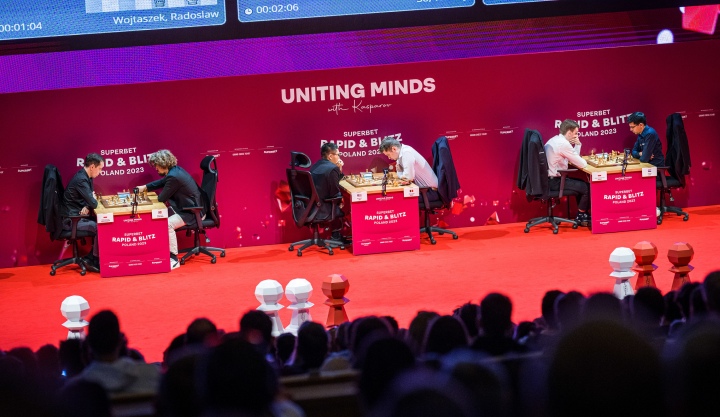
The second leg of the 2023 Grand Chess Tour kicked off yesterday in Warsaw, Poland, with World No. 1 Magnus Carlsen, Levon Aronian, and several other wildcards joining the GCT field for five days of non-stop rapid and blitz action. After the first day, Wesley So, Levon Aronian, and local favorite Jan-Krzysztof Duda lead with a score of 5.0/6, while Carlsen is in 7th place after scoring one loss and two draws The opening ceremony began with a drawing of lots and featured a simul where each of the tournament participants played in tandem on 25 boards, alternating moves. Local sport stars, chess influences, and local chess players got a chance to face the GCT field. In the end, the grandmasters won 19 games, with three draws and three losses. Photo Courtesy of Grand Chess Tour, Lennart Ootes RAPID | ROUNDS 1-3 The first round started off with multiple decisive games, including a huge upset as Wojtaszek defeated a gambling Carlsen, who chose the extremely risky (but festive) Polish Opening (1.d4 b5) and fell under heavy pressure from the outset. After 10.d5! Wojtaszek’s idea was to meet 10…exd5 with 11.e5!, sacrificing a pawn for a long-term initiative. The former Polish No.1 took down the Polish Defense…in Poland! | Photo courtesy of Grand Chess Tour, Lennart Ootes Other important results saw So defeating Deac, Rapport defeating Shevchenko, and Duda grinding out a win against Giri in a technical endgame: Here Duda played 52.Kd6!, transitioning to a winning rook ending. In Round 2 the players settled down a bit, as the games Carlsen-So, Giri-MVL, and Rapport-Wojtaszek all ended peacefully. In the meantime Aronian took advantage of a late endgame blunder by Shevchenko to pick up the full point, while Duda took the sole lead with 2/2 after defeating Deac in a long positional squeeze. After 41…b5!, Duda started to take over as Black. Local favorite Duda is one of three players tied for first. | Photo courtesy of Grand Chess Tour, Lennart Ootes The final round saw more action with Aronian winning his second game of the day as he defeated Giri in a rook endgame, while Vachier-Lagrave scored a brilliant attacking effort against Deac. But the most exciting game was won by So, who managed to exploit a late endgame blunder by Rapport in order to win while a full rook down: Rather than repeating moves for a draw, So found 55.Qf8!!, winning the game due to the dual threats of Qxh6+ (which leads to mate) and d8=Q. A great first day for So, who scored two wins and a draw. | Photo courtesy of Grand Chess Tour, Lennart Ootes In the meantime Carlsen drew his third round game against Duda, as he played the Caro-Kann and comfortably held a slightly worse endgame. I haven’t really played or studied chess much recently, and it was showing!” – Carlsen | Photo courtesy of Grand Chess Tour, Lennart Ootes The 2023 Superbet Rapid & Blitz continues Monday, May 22, with tournament action live starting at 7:05 AM CT with Grandmaster commentators Yasser Seirawan, Var Akobian, Cristian Chirila and International Master Nazi Paikidze on grandchesstour.org and on the Saint Louis Chess Club’s YouTube and Twitch.tv channels. Text: IM Kostya Kavutskiy Photos: Courtesy of Grand Chess Tour and Spectrum Studios Credits available on Flickr. Further Information:Web: GrandChessTour.org | Twitter: @GrandChessTourInstagram: @GrandChessTour | Facebook: @GrandChessTour#GrandChessTour#SuperbetRapidBlitzPoland Venue: Museum of the History of Polish Jews in Warsaw, PolandMay 21 – May 25, 2023 Press Contact:press@grandchesstour.org Livestream:GrandChessTour.org
Four-way tie at WGP Nicosia
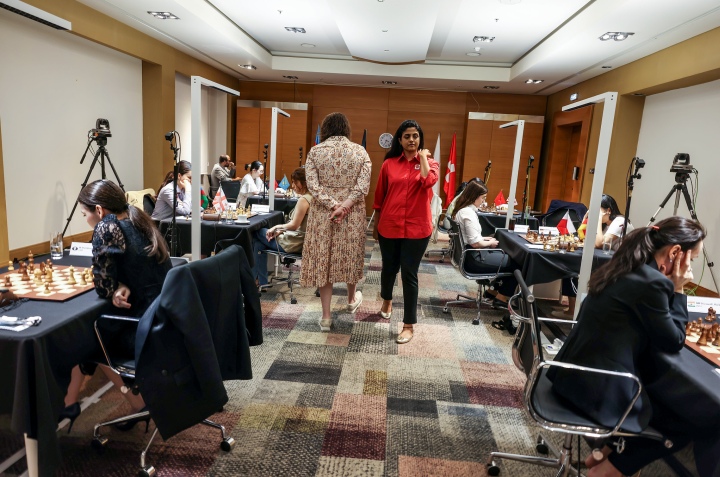
After six rounds and going into the rest day, there is a four-way tie for the lead at the Cyprus Women’s Grand Prix. Tan Zhongyi, Kateryna Lagno, Harika Dronavalli, and Diana Wagner are all on 4/6 and also undefeated, with two wins and four draws. Tomorrow is a rest day, and the tournament will resume on Tuesday at 3 pm. The players will enjoy a much-needed rest to relax at the swimming pool or hop on to one of the several trips to the beach or the mountains that the organizers have arranged. GM Goryachkina, Aleksandra vs IM Shuvalova, Polina (0’5-0’5) Playing for the same country, it stands to reason that Goryachkina and Shuvalova would have faced each other quite a few times. Although both of them are from the same generation – Shuvalova is 22 years old, and Goryachkina is 24 – they weren’t in the same age group. Therefore, they didn’t meet at the U-18 national categories. Goryachkina has generally prevailed in their classical games, whereas Shuvalova has defeated her in blitz and rapid. Polina Shuvalova is a fast and confident player. This also has some drawbacks, but it also can help you win a lot of games, putting time pressure on your opponent. This afternoon Polina unbelievingly finished with more time on her clock than at the start of the game. After signing the draw, she was kind enough to speak to us for a few minutes. “This line is more or less drawish and part of my preparation up to 22.Re7,” Shuvalova said after the game. “That is why I had more time on the clock than when I started.” When asked about how she was able to change gears at night after a tough result and prepare for the next day, Shuvalova pragmatically explained: “It’s part of life. Of course, I was angry after the game, but I was more relaxed when I understood it wasn’t completely winning. If you go to bed and you are still thinking about the game, it means something has gone wrong for you. When you still have games in the tournament, you should just think about the next game”. IM Assaubayeva, Bibisara vs GM Tan, Zhongyi (0’5-0’5) Excluding rapid and blitz games, Assaubayeva and Tan Zhongyi had only faced each other once before, in the Astana leg of the 2022-2023 Women’s Grand Prix. In that game, a Queen’s Gambit Declined, in which Assaubayeva played White, Tan Zhongyi emerged victorious. Today’s game, a theoretical affair in the fashionable Four Knight’s English Opening, was equal from start to finish. The line has a 93% draw rate, and both players were booked to the teeth with the engine’s first move analysis. No surprise that the game ended in a draw in exactly 30 moves. GM Dzagnidze, Nana vs GM Kosteniuk, Alexandra (0-1) These two Grand Masters have played each other no less than fifty-nine times, the first of them in the 2009 European Women’s Team Championship. In classical chess, nineteen very hard-fought games, the shortest of them 29 moves and the longest 87 moves, but most of them in the 40-60 move range! Kosteniuk has dominated Dzagnidze by eight wins to two with eleven draws, but their most recent game – played in the Munich WGP 2023 – ended in a draw. In a Ragozin defence, Kosteniuk followed the 2017 game between Khademalsharieh and Serarols Mabras, sacrificing a pawn for the initiative. However, Dzagnidze smelled the danger and preferred to finish her development. After some complications, Kosteniuk seized the advantage on the queenside and, at the same time, put her opponent in serious time trouble. In the end, Alexandra switched to the kingside and finished things off with a direct attack. “It’s always nice to win. I used to be very disappointed making draws but now I am happy to draw in complicated games,” Kosteniuk explained after the game. Regarding her clear advantage in the scoreboard against Dzagnidze, Kosteniuk mentioned the psychology behind it: “If you are falling behind in the scoreboard, psychologically it’s harder to play because you always have those memories of losses and wins.” GM Khotenashvili, Bella vs IM Mammadzada, Gunay (0,5-0,5) Bella Khotenashvili and Gunay Mammadzada have played each other on four occasions in the past, although only one of those games has been disputed under classical time control. In the 2018 European Individual Championship, Mammadzada defeated Khotenashvili playing the White side of the Ruy Lopez. This afternoon, Mammadzada played a very principled line with Black, giving up the bishop pair to establish a rock-solid pawn formation on the light squares. GM’s Laznicka, Svetushkin, and Pourramezanali are a few of the higher-rated players who have used the system in the past. “In the two games I lost, I misplayed drawish positions. I hope I will convert these misplayed games in the future,e” Mammadzada said after the game in her interview. However, it seemed that Khotenashvili had a better understanding of the middlegame nuances and, after the exchange of queens, gradually increased her advantage on the queenside. But everything changed on move twenty-two. In this position, Khotenashvili initiated a sequence of mass exchanges beginning with 22.Bxd6 that ultimately lead her only to equality. Instead, 22.e3 was the way to go, and Black still had to find a way of solving her king’s position to exchange the rook on the c-file: not an easy task at all. A draw was finally agreed on move 41 in a completely drawn opposite-coloured bishop endgame. Asked about her plans for the free day, Mammadzada said that she still wasn’t sure. “I want to have a good rest first of all. I know Cyprus is known for its historical places so maybe I will check them out. We’ll see!” Add interview link WGM Wagner, Dinara vs IM Kiolbasa, Oliwia (1-0) Dinara and Oliwia played twice in the Under-12 European and World Championships, back in 2011, but since then, strangely enough, they had never met again in classical chess. Struggling over the last several
FIDE WGP Nicosia: Harika scores her second win and joins the lead
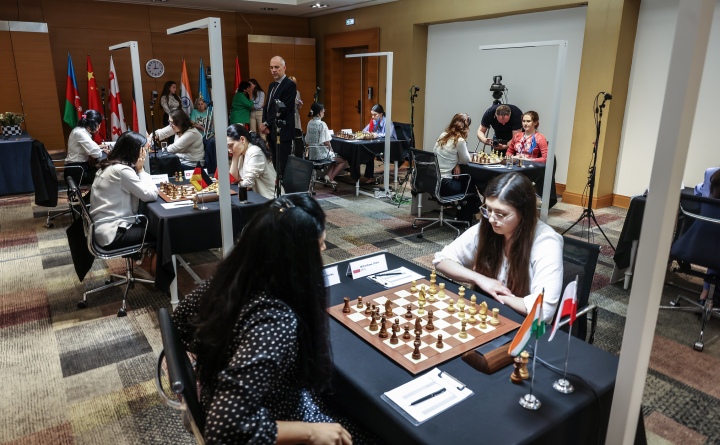
85-year-old WIM Edith Krizsán-Bilek is a pioneer in women’s chess. She has been playing all her life. In 1958, Krizsán-Bilek won the Hungarian Women’s Chess Championship and has represented Hungary in several Chess Olympiads, winning individual and team medals. Even now, she travels to Cyprus regularly, giving talks to kids and teaching chess, accompanied by friends and family. This afternoon she attended the fifth round of the Cyprus Women’s Grand Prix, inspiring all the players with her presence. It was a special moment for everyone involved when she was applauded by the players at the start of the round. The hero of the round was Harika Dronavalli. Supported by a few Indian fans who came to cheer her on, she defeated Oliwia Kiolbasa with Black and now shares the lead with Tan Zhongi and Lagno, who could only draw their games. GM Lagno, Kateryna vs GM Goryachkina, Aleksandra (0,5-0,5) The most important game of the round and, maybe, of the entire series. Goryachkina and Lagno have faced each other nine times in classical games, including two games during the current Grand Prix series. With two wins and seven draws, Goryachkina outscores Lagno by the slightest of margins, although it must be said that Lagno has had her fair share of victories in blitz and rapid. Today’s game was a theoretical battle in the 4.d3 Berlin defence in the Ruy Lopez. Instead of 5…0-0, which Goryachkina chose against Lagno a month ago in New Delhi, she decided to mix things up and go for 5…Nd4, an active line achieving the two bishops and initiative in exchange for a severely weakened pawn structure. All the games played in this line have ended in draws, including a 2019 encounter between Nakamura and Aronian or more recent games played by Giri or Kryvoruchko. Lagno had prepared a new idea, 13.Qd3, but as usual, Goryachkina had done her homework and uncorked a very nice exchange sacrifice to keep the balance. According to the engine, Aleksandra could have even gone for more had she played 22…Bxe3 instead of 22…Bf3+. The idea is to keep playing an exchange down and prioritize the centralization of the black king. Both players discussed this and other variations after the game while they were undergoing the fair-play postgame procedures. IM Kiolbasa, Oliwia vs GM Dronavalli, Harika (0-1) It’s hard to say for sure, but judging by the amount of time that Kiolbasa spent on the opening, it seems she was surprised by the Neo-Arkhangelsk variation of the Ruy Lopez that Harika played against her this afternoon. Although it’s not one of her main repertoire lines, she did play it recently against Zhu Jiner in the 2023 Munich leg of the Grand Prix. In this afternoon’s game, she can safely say that her work on the opening has been successful. Although Black has two sets of doubled pawns from the opening, it’s easy to see that only Harika is fighting for the advantage: strong doubled rooks on the f-file and clear attacking chances. Harika could have cashed in with 22…Rxf2, winning a pawn but losing part of her positional advantage. Instead, she preferred to play for the attack, especially taking into account Kiolbasa’s time trouble. With precise and aggressive play, she took down the point, cruising into joint lead with 3.5/5. In her postgame interview, she was joined by a team of local Indian supporters, who arrived just at the right moment to see her convert her advantage. “I’m not thinking much about the standings; I’m just trying to play my own chess and give my best,” were her wise words after the game. IM Shuvalova, Polina vs GM Khotenashvili, Bella (0’5-0’5) According to my database, Shuvalova and Khotenashvili had only played once together, a draw in the 2022 World Rapid Championship. This afternoon, Shuvalova’s opening preparation was spot on. In a dangerous side-line of the Grunfeld defence, she played fast and with a lot of confidence, blitzing out her attacking moves and putting maximum pressure on her Georgian opponent. By advancing her h-pawn to h6, she created a very dangerous wedge in Khotenashvili’s castled kingside – a decisive tactical option for a back-rank mate. The key moment was move twenty-seven. Instead of exchanging queens, 27.Rxa7 straight away was much better, reducing Black’s defensive opportunities in the double rook ending. The engine assesses the endgame as won for White, but Shuvalova chose a different option, grabbing a pawn but substantially reducing her winning chances, and the game finally ended in a draw. GM Dzagnidze, Nana vs IM Assaubayeva, Bibisara (0.5-0.5) Assaubayeva has demonstrated time and time again her strength on the black side of the King’s Indian defence, so it was no surprise to see the experienced Dzagnidze select one of the many offbeat side-lines with double fianchetto. The idea was to take her opponent out of the book as soon as possible and make her think for herself from the get-go. The plan was successful: Assaubayeva didn’t seem at home in the opening phase, spending much more time than usual. Dzagnidze got a small edge out of the middlegame: control over the central dark squares and potentially a two vs one pawn majority on the queenside. However, Assaubayeva defended well, keeping the disadvantage at a minimum. Approaching the time control, Assaubayeva misplayed her position in her opponent’s time trouble, landing in a very dangerous queen plus knight vs queen plus bishop endgame, totally lost according to the engines. Nonetheless, inaccurate play by Dzagnidze combined with strong defence by Assaubayeva earned the latter a well-deserved half point. IM Mammadzada, Gunay vs GM Tan, Zhongyi (0,5-0,5) In their first game together, Mammadzada went for the Catalan Opening with 3.g3, sidestepping Tan Zhongyi’s Queen’s Indian defence. After a few theoretical moves, Mammadzada forfeited her Catalan bishop in exchange for what seemed to be a superior pawn structure. However, as in other games in this event, the top Azerbaijan female player was spending too much time on the clock. With her opponent under severe time pressure,
FIDE WGP Nicosia: Goryachkina wins, Lagno and Tan Zhongyi lead
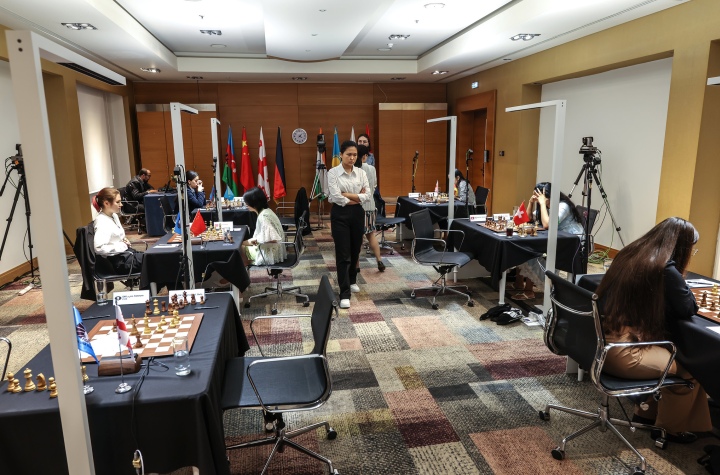
“Chess is hard, no one said it was going to be easy.” Wise words by Kosteniuk this afternoon summing up in a sentence how difficult it is to play good chess, especially at the highest level. This afternoon we saw an array of missed opportunities, tenacious defence, a couple of blunders, and some excellent endgame technique. With her win, the only victory of the fourth round, Aleksandra Goryachkina recovers some ground and joins the group that trails the leaders Tan Zhongyi and Lagno by just half a point. With seven rounds to go it’s still anyone’s game. GM Khotenashvili, Bella vs GM Lagno, Kateryna (0,5-0,5) The round had hardly started, with most of the games still under ten moves in, and my screen was already indicating a 30-move draw on one of the boards. After checking that it wasn’t a mistake, I rapidly went to search for the players. According to my database, this was the eighth classical game between Khotenashvili and Lagno: three wins for Lagno, three draws, and just one win for Khotenashvili. Interestingly, the first game they played together was back in 2002, in the International Youth Games Under-14 category! Khotenashvili happily explained what had happened. “I generally don’t like to play these long computer draws, but as Lagno repeated the same line I played in the second round against Kosteniuk, I deviated, and sometimes these things happen,” she explained in her brief postgame interview. “When you play such a strong tournament, you need good preparation and a lot of energy. So, I’m trying to do my best. For now, I feel that I’m in good shape.” GM Tan, Zhongyi vs IM Shuvalova, Polina (0,5-0,5) Clearly, the most equal game of the day, bordering on a quick theoretical draw. In a Neo-Grunfeld defence, Shuvalova equalised comfortably with great home preparation following a 2018 game between GM’s Inarkiev and Ponkratov. After twenty moves, most of the pieces were exchanged, and the opponents reached a completely equal ending. Maybe it can be argued that Tan Zhongyi had a minor academic edge, but it didn’t seem likely at all that she would be able to convert. A draw was agreed on move forty-three in an equal bishop endgame. GM Dronavalli, Harika vs GM Kosteniuk, Alexandra (0,5-0,5) Harika and Kosteniuk have a huge playing history. According to my database, they played more than ninety official games, although only twenty-four were classical. They are very closely matched: seven wins each and ten draws, the last of them three months ago at the Munich WGP. In yet another rather obscure line in the Catalan opening, Kosteniuk improved on her second-round game against Khotenashvili and achieved quite a decent position going into the middlegame. Excellent piece play, pawn structure, and king safety for just a pawn, but still a very difficult position to handle. “Neither of us had a clue on what was going on”, she said after the game in her first short interview of the event. IM Assaubayeva, Bibisara vs IM Mammadzada, Gunay (0,5-0,5) An interesting match-up between two young and upcoming stars. According to my database, this was the first classical game between them: in eight previous blitz and rapid games, Assaubayeva outscored Mammadzada by 5-3. Heavily prepared theoretically for the game, Assaubayeva went for a pawn sacrifice in the Exchange Slav, giving her strong tactical compensation with superior development and attack. The move 15.Ke2, played almost instantly, is a key indicator that she was playing fast, confident, and “still in the book”. Around move twenty-five, Assaubayeva had two times the amount of time than her opponent, who, it has to be said, defended a difficult position very tenaciously. Assaubayeva wasn’t able to cash in on the attack but did force a slightly favourable ending, even still being down a pawn. However, Mammadzada defended accurately, and a draw was agreed on move forty-two, in an endgame with opposite-coloured bishops. WGM Wagner, Dinara vs GM Dzagnidze, Nana (0,5-0,5) A missed opportunity for Dinara Wagner, who is displaying a great level of play here in Nicosia, and excellent time management. Dzagnidze tried, unsuccessfully, to surprise her opponent by employing a rare side-line in the Queen’s Gambit – the so-called Dzindzi-Indian defence, named after GM Roman Dzindzichashvili. But Wagner didn’t even blink. She proceeded to play fast and confidently, isolating one of Dzagnidze’s centre pawns and then exchanging off the appropriate pieces to reach a favourable ending with a clear extra pawn and, uncharacteristically for her, much more time on the clock. However, Dzagnidze defended very accurately and reduced the disadvantage to a minimum. A draw was agreed on move sixty-five. GM Goryachkina, Aleksandra vs IM Kiolbasa, Oliwia (1-0) The last game to finish and the only one with a decisive result. Today was a tough outing for Kiolbasa. According to my database, they had never faced each other before in an official classical game, and Goryachkina is a very strong opponent for the young Polish IM. Kiolbasa came to the game extremely well-prepared. The first 18 moves of the game followed the 2020 Goryachkina vs Dubov game, which ended in a win for Dubov. Kiolbasa improved on Dubov’s play with 18…Rc4, hitting the d4-pawn, the first engine option (Dubov played the slightly inferior 18…Nb6). Surprised but at the same time imperturbable, Goryachkina spent more than 20 minutes remembering her analysis, ultimately coming up with the correct sequence. Surprised herself, Kiolbasa blundered heavily with 21…Rxd1? Instead, 21…e5 would have led to a dynamically balanced position. Goryachkina could have decided the game with 23.Qxa5, snatching a pawn, but instead headed to a superior rook + knight vs rook + bishop ending, in which she ground her opponent down in great fashion. In her postgame interview, Goryachkina herself didn’t quite understand why she hadn’t captured the pawn. Standings after Round 4 Text: IM Michael Rahal (Nicosia, Cyprus) Photos: Mark Livshitz About Freedom Finance Europe Freedom Finance Europe, a subsidiary of Freedom Holding Corp., is a leading European stockbroker. The company’s Freedom24 web and mobile app investment platform provides traders with
Preliminary confirmation of participation in WSTC 2023: Deadline announced
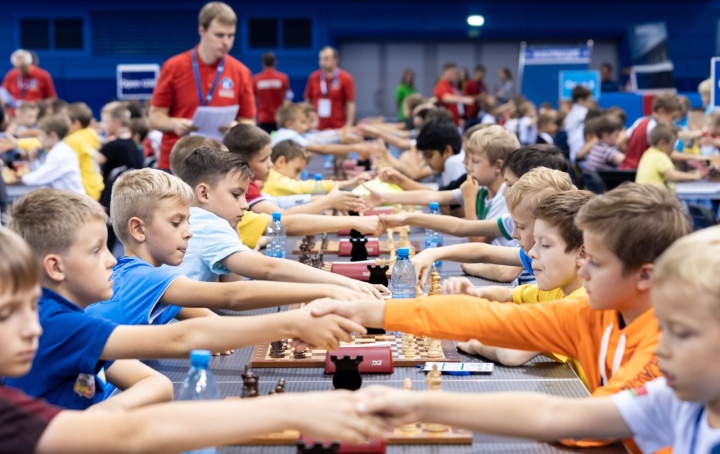
To all FIDE National Federations All FIDE member federations should email the FIDE Events Commission for preliminary confirmation of participation in the World Schools Team Championship (WSTC) 2023. Only federations that held or are going to hold Stage 1 (National Championship) are eligible to apply for “invited team” status (with expenses for accommodations and travel covered by the organisers for one team). National Federations should indicate the exact dates before Thursday, May 26; and after the competitions finish, provide the data (documents and photos) that confirm the organisation of the Championship as per Article 2.4 of the WSTC Regulations. If the National Championship has already been held, National Federations should submit all the necessary information according to Article 2.4 of the Regulations to the FIDE Events Commission. The Events Commission should be emailed at: fideevents@fide.com Regulations of the World Schools Team Championship (pdf)