

The next generation of chess stars playing in Doha

A strong field of young talents is set to challenge the elite at the World Rapid and Blitz in Doha this December. Here are some of the names who may become the next kings and queens of the chessboard. In less than three weeks the eyes of the chess world will be on Doha – the capital of Qatar which, for the last week of the year, will be the world centre of chess, where the World Rapid and Blitz Champions will be decided. Usually, the main media interest is on the top-dogs – the 2700+ regulars who traditionally dominate big events: Carlsen, Gukesh, Nepomniachtchi, Caruana in the Open, or the likes of Ju Wenjun, Lei Tingjie, Goryachkina, Koneru, Lagno, Anna Muzychuk in the Women’s competition. But Doha will also be the stage for another story shaping chess – a generational showdown between the established stars and those whose rise is just beginning. Teenagers and even pre-teens are lining up on the same boards, facing the same clocks, testing themselves against the stars they grew up watching. Some already have grandmaster titles. Some have become national champions before they finished school. All of them are moving fast – both on and off the board. These are the rising stars in Doha. Young, ambitious, ruthless and fearless, staking their claim for the top. The Open Photo: Michal Walusza GM Ivan Zemlyanskii (pictured above) – born in 2010, he already boasts a rating over 2590 in classical chess. In May 2024, at the age of just 13, Ivan became the youngest Russian grandmaster in history and one of the youngest in the world, after scoring his final norm at the Sharjah Masters. Since then, he has been closing in on the 2600 mark. GM Savva Vetokhin is another new name with serious results. Born in 2009, he is already a 2550 plus grandmaster and has a long line of youth medals. His titles include the World Under-10 champion, the World Under-14 Blitz champion, and a silver medal at the World Under-8 Rapid Championship. His commanding victory at the strong Sunway Sitges open in 2024, without a single loss, marked him out as a player to follow. Photo: Michal Walusza GM Yağız Kaan Erdoğmuş (pictured above) from Turkey, born in 2011, is the fourth-youngest grandmaster in history and the youngest player ever to reach 2600. He has already made strong impressions at events such as Grenke and the TePe Sigeman tournament. Coming across as confident both on and off the board, Erdoğmuş is recognised for his attacking style, demonstrated in the much talked about “Turkish Immortal” game against Aditya Mittal in the 2025 Grand Swiss. At just 14 and already a top 100 player, he will be one of the most closely watched prodigies in Doha. GM Ediz Gürel, also from Turkey, was born in 2008 and became a grandmaster in 2024. He won an individual bronze medal playing on board two for Turkey at the 45th Chess Olympiad in Budapest in September 2024. In 2025, he made headlines by defeating reigning world champion Gukesh in Samarkand, becoming one of the youngest players ever to beat a reigning World Champion. That single game as well as his broader performance in Samarkand placed him firmly in the global spotlight. IM Faustino Oro (pictured above) of Argentina was born in 2013. Known as the “Messi of chess”, He became the first player under 12 to cross 2500 rating and to score a grandmaster norm. His unbeaten 7½ out of 9 at a Legends and Prodigies event in Madrid confirmed that his strength is not limited to junior tournaments. IM Mukhammadzokhid Suyarov from Uzbekistan, born in 2009, has a classical rating of 2454 and already holds the IM title. He is coming to Doha with the crown of the World Junior Rapid Champion, which he won in Lima, in September. His current rapid rating is 2411. Mukhammadzokhid has beaten several grandmasters in strong open tournaments, scored well in events such as the UzChess Cup, qualified from the Asian zonal to the 2025 World Cup and took third place in a Chessable Masters qualifier. Photo: Eteri Kublashvili IM Aldiyar Ansat (pictured above) of Kazakhstan – born in 2008 – became the chess champion of Kazakhstan in 2023 and has a rating in the high 2400s. Aldiyar has already won the Asian Zonal 3.4 Championship, earning a place in the 2025 World Cup. For a teenager, leading a strong and rising chess country in major events is a big statement. IM Erdem Khubukshanov, born in 2007, is another young star on the rise. His classical rating is around 2500 and his rapid and blitz ratings are around 2420. He has been scoring plus results in strong open tournaments and has established himself as part of the new generation of ambitious IMs who are close to grandmaster level. Photo: Michal Walusza GM Ihor Samunenkov (pictured above) from Ukraine, born in 2009, is already a grandmaster with a standard rating close to 2580. He is seen as one of the leaders among the under 16 players worldwide, and his steady results in elite junior events have built him a reputation as a very solid and mature player for his age. GM Denis Lazavik, at 19, sits slightly above the usual age line for a junior event, but very much within the spirit of a rising star. He is a 2600 level grandmaster, one of the most successful young players in online and rapid chess, with strong results in elite internet tournaments and over the board opens. He is not yet a regular in the biggest classical super tournaments, which keeps him in the “still rising” group rather than the fully established elite. GM Bharath Subramaniyam H of India, born in 2007, became India’s 73rd grandmaster at the age of 14 years and two months. Now in the mid-2500s, he has a record full of strong international results and earlier youth titles. His pace of development has kept him in
Casto Abundo (1950-2025)
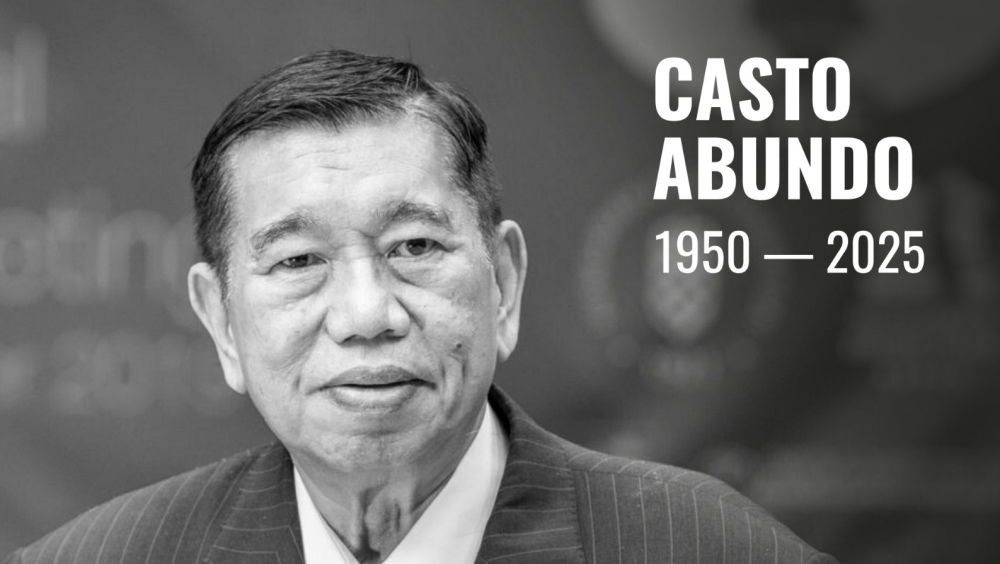
It is with deep sadness that the International Chess Federation (FIDE) has learned of the passing of Casto Abundo, Executive Director of the Asian Chess Federation. Throughout his long and distinguished career, he tirelessly promoted chess at both continental and international levels. An International Arbiter since 1978, he served as FIDE Secretary from 1988 to 1990. His exceptional organizational skills were demonstrated as director and Chief Arbiter at major events, including the 1992 Chess Olympiad in Manila, the 2000 World Championship, and the 2001 World Cup. As Vice-President (2006-2014) and later Executive Director of the Asian Chess Federation, he was instrumental in strengthening its institutional framework. His groundbreaking initiatives created a solid foundation for the development of chess in Asia for years to come. Casto Abundo’s passing is a great loss to the global chess community. Known for his visionary leadership, he possessed a rare ability to unite national federations, fostering a spirit of mutual respect and shared purpose. FIDE and the Asian Chess Federation extend their heartfelt condolences to his family, colleagues, and loved ones. His profound professional and human legacy will remain deeply cherished and will continue to inspire the path forward.
Diego Flores wins 100th Argentine Championship

GM Diego Flores emerged as the winner of the 2025 Argentine Championship, claiming his eighth national title. The champion scored an impressive 8.5/11 and was the only player to complete the event undefeated. With this victory, Flores has equaled the legendary Miguel Najdorf‘s record for the most titles in the history of the competition. The 100th edition of the Argentine Championship, a 12-player round-robin tournament, took place at Buenos Aires City Hall from November 25 to December 5. Flores entered the competition as the top seed and confirmed his status as the pre-tournament favorite. After a relatively slow start with two draws, he picked up steam, took the lead by winning three straight games, and never relinquished it. As fate would have it, the final 11th round featured a clash between the leader and his closest rival, the 2021 champion Federico Perez Ponsa. With a full-point cushion, Flores played solid chess and secured the title after a draw was agreed on move 37. Perez Ponsa finished a point behind the champion, taking silver with 7.5/11. GMs Diego Valerga and Leonardo Tristan both scored 7/11 and tied for third place, with Valerga claiming the final podium spot due to a greater number of victories. The young prodigy IM Faustino Oro turned in a solid performance, netting 6.5/11 and tying for fifth place. Final standings: 1 GM Diego Flores 2563 8½ 2 GM Federico Perez Ponsa 2528 7½ 3 GM Diego Valerga 2420 7 4 GM Leonardo Tristan 2487 7 5 IM Faustino Oro 2495 6½ 6 IM Pablo Ismael Acosta 2501 6½ 7 IM Julian Villca 2391 6 8 IM Mario Villanueva 2465 5½ 9 FM Carlos David Gomez 2407 4 10 IM Cristian Dolezal 2374 3½ 11 WGM Candela Guecamburu 2238 2½ 12 IM Pablo Barrionuevo 2260 1½ Photos: FADA Facebook
Decision-making: From chessboard to boardroom

Leadership Lessons from the 2025 FIDE World Corporate Chess Championship Corporate chess is thriving across global companies. Google boasts a community of 2,500 active players, including executives like Dennis Hassabis, and runs both online and over-the-board tournaments. J.P. Morgan started a global chess club three years ago and now has 500 players worldwide, with local clubs forming in multiple countries. UBS has a long-standing Zurich club with 400–500 players and is expanding its reach to the USA, India, and beyond. In an increasingly competitive and dynamic global marketplace, the ability to think strategically has become a defining feature of successful businesses and their leaders. While strategy is often associated with corporate planning and market positioning, it also lies at the heart of one of the world’s oldest and most intellectually respected games – chess. Chess is more than a pastime; it is a complex exercise in planning, risk assessment, and tactical execution. The parallels between chess and business are striking, showing how principles from the game can enhance leadership, improve decision-making, and drive long-term corporate success. Representing Morgan Stanley, Gabor Szamoskozi highlights these connections: careful consideration of each decision, anticipating the next steps, and managing time effectively are skills that apply equally to the board and the workplace. The 2025 FIDE World Corporate Chess Championship During the 2025 FIDE World Cup, held in India in November, eleven top companies from around the world converged in Goa to compete in the 2025 FIDE World Corporate Chess Championship. For a few days, this corporate tournament ran parallel to the main event. The championship highlighted the growing role of chess in modern workplaces, offering employee teams a global stage to represent their organisations. Participating teams spanned technology, finance, consulting, engineering, and fast-growing firms from emerging markets. Currently ranked seventh in the official world chess rankings, R. Praggnanandhaa pointed out the importance of the event during his visit: “Having more corporate companies involved in chess is certainly very positive for the game. I’ve noticed that most of them are large organisations, and it’s a unique opportunity for them to play in the same venue as the World Cup. When companies are excited, participate, and contribute even in a small way, it benefits the game and is appreciated by all the players.” After qualifying online against hundreds of other companies, Greco was crowned the 2025 Corporate Chess Champion, officially recognised as the smartest company in the world. Morgan Stanley finished as the runner-up, while Deloitte and Google secured third and fourth place, respectively. Decision-making Both chess and business involve making decisions with imperfect information and limited time. A chess player must evaluate multiple possibilities under time constraints, recognizing that hesitation can lead to lost opportunities. “You have one and a half hours for a full chess game, but you need to manage your time from the very first move to the last. It’s the same with work deadlines: you might have a month to complete a project, but if you don’t recognise the sense of urgency from day one and use your time wisely, you risk missing the deadline”, explained Filippos Stamos, Senior Software Engineer at Microsoft. Similarly, managers often face deadlines and must choose among competing priorities with limited data. The ability to make confident, timely decisions, without succumbing to stress, is a shared hallmark of both domains. Alongside his role as Senior Tax Manager at Deloitte, International Chess Master Mateusz Kolosowski has competed at a very high level in chess for many years. “It’s very difficult for chess players to handle time pressure – every single move can be critical, and you have to be ready to take responsibility for each decision. This experience has greatly helped me in my professional career”. Women in chess and business Hallgerdur Helga Thorsteindottir was the only female participant in the Goa finals. “It feels a bit lonely being the only woman on my board,” she said. “I hope more women get involved – there are many who play chess, and firms should actively promote inclusivity.” Playing for Deloitte was a major motivation. “Chess is respected within firms, but we want it to grow and become more visible. Events like this are a great way to connect chess and business.” Leadership Chess imparts numerous qualities applicable to leadership: Learning from mistakes: A mistake in chess may cost a piece; in business, it may cost market share. Reviewing what went wrong fosters growth. Stamos shared his own company experience: “Chess has helped me a lot with self-improvement. In chess, I analyse my games and learn from my mistakes, and that is the mentality we have at Microsoft, at least in my department: we always reflect, see what we could have done better, and strive to improve. This aspect of chess is excellent and directly connected to work”. Vision and purpose: A strong player always begins with a goal. Leaders must similarly articulate a clear mission to guide their teams. Resilience and emotional intelligence: Chess demands calm, even in the face of setbacks. Effective leaders remain composed, motivating teams and navigating uncertainty. Kolosowski talked about his role as team captain: “Primarily, it’s about taking responsibility for every decision you make. Leadership, though it may seem counterintuitive in chess, is also crucial. I hold a relatively senior position at Deloitte and am responsible for an entire team of professionals. While chess is often considered an individual sport, in team competitions you need to organize your team, ensure everyone is performing well, and foster team spirit.” Adaptability: No chess game unfolds exactly as expected. Likewise, evolving consumer preferences and technological changes require businesses to pivot quickly. Chess and business careers Many prominent executives emphasize the influence of chess on their careers. Some use the game to sharpen analytical skills, while others leverage it to teach employees the value of planning and patience. “In chess, you need to anticipate future moves, develop new strategies, and assess your strengths and weaknesses. In my line of work, learning something new is fine, but
Winners crowned at 27th Asian Youth Chess Championships
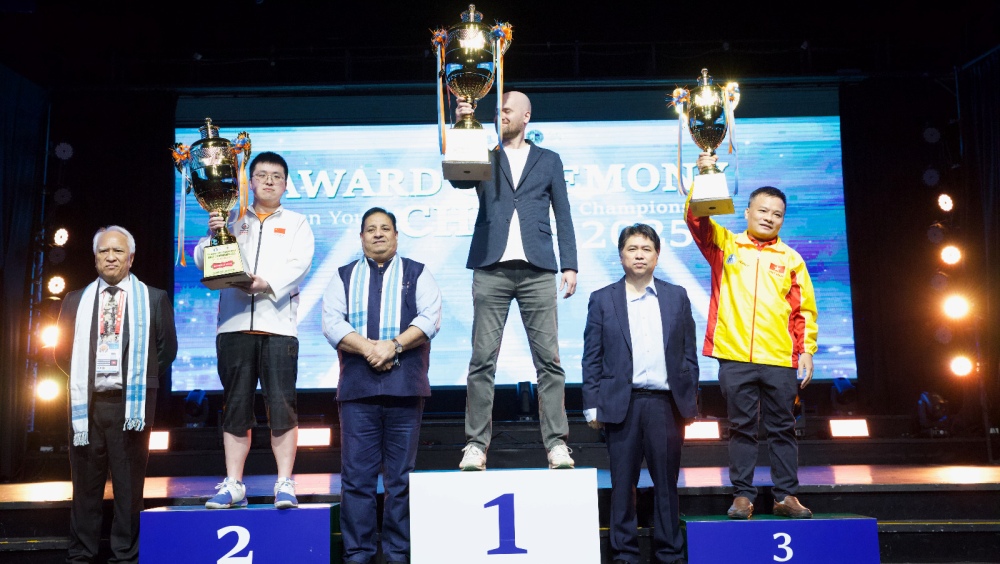
From left to right: Chief Arbiter K.K. Chan, Asian Chess Federation Deputy President Bharat Singh and Thailand Chess Association President Sahapol Nakvanich The 27th Asian Youth Chess Championships, held from 20–30 November 2025, concluded after a record-breaking gathering of 697 young players from 33 countries. Players competing under the FIDE flag emerged as the overall winners in the classical (standard) section, securing a medal haul of 2 gold, 2 silver, and 2 bronze. China and Vietnam followed closely on the medal table. The event, organized by the Thailand Chess Association under the auspices of FIDE and the Asian Chess Federation, featured Standard, Rapid, and Blitz tournaments across the Under-8, 10, 12, 14, 16, and 18 age groups for both boys and girls. The massive organizational effort was streamlined by technology, utilizing a dedicated Asian Chess Federation portal for registration, visa applications, flight and hotel management, and printing of ID cards (with individual QR codes), table name cards, and certificates for all participants. An AI-powered system also managed the event’s photo gallery. Visit asianchess.com for photos of medalists in standard events. Visit chess-results.com for round by round results and to download scoresheets. India tops rapid event Indian youngsters topped the Asian Youth Rapid Chess Championship, leading the medal count with 3 gold, 1 silver, and 5 bronze. Vietnam followed with a tally of 2 gold, 4 silver, and 2 bronze, while China and the FIDE contingent shared third place with identical results of 1 gold, 2 silver, and 1 bronze each. Visit asianchess.com for Rapid event results and awards photos. To encourage teamwork, medals were awarded in each category based on the total score of the top three players from a federation. Federations with fewer than three players were not eligible. Ties were broken using the players’ tie-break scores. Visit: Team Awards Asian Youth Chess Championship Standard – Asian Chess Iran, Kazakhstan and China dominate blitz After days of intense calculation and quiet tension, the championships culminated in a fittingly frantic finale: the blitz. With pieces flying and clocks ticking mercilessly, Asia’s best young minds battled in a lightning-fast showdown. When the dust settled, Iran stood atop the medal table with 3 gold and 1 silver. Kazakhstan and China followed closely, sharing second and third places with identical finishes of 2 gold, 1 silver, and 1 bronze—proof of the razor-thin margins in this rapid-fire discipline. Beaming with pride, Thailand Chess Association President Sahapol Nakvanich (pictured above, left) praised the event’s success. “The huge turnout motivated us even more to continue hosting events of this magnitude—and even bigger ones in the future,” he said. Full results: chess-results.com Visit: blitz individual medalists Photo gallery Official website: asianchess.com/
Women’s Grand Prix 2026-2027: Changes in qualification paths
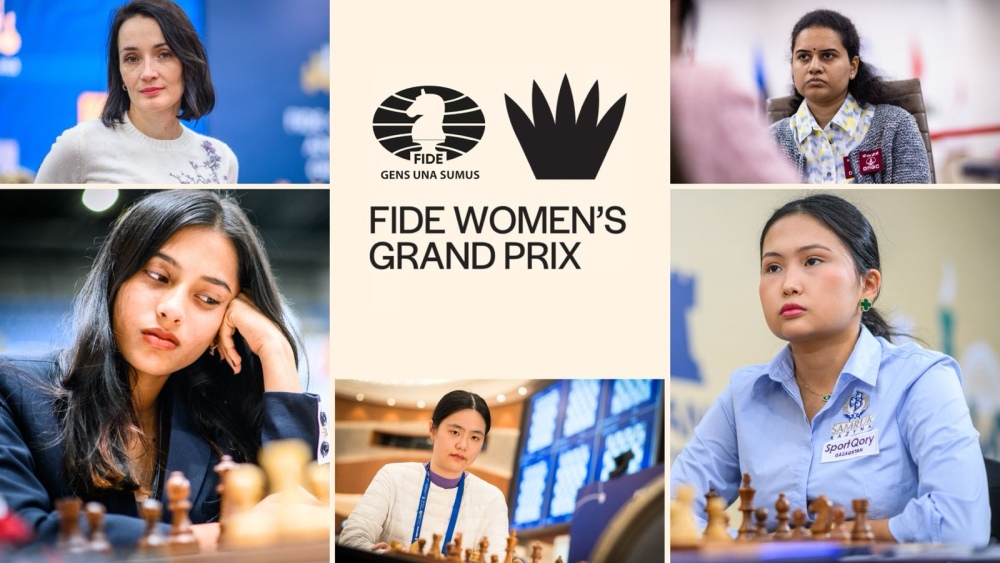
The Women’s Grand Prix series returns in 2026 with changes in qualification paths. While the overall structure of the series stays the same – 20 players, six tournaments and each participant playing three events – one important change affects how players qualify. Compared to the 2024–2025 cycle, the number of rating-based qualification places has been reduced from four to three. The freed spot has been reassigned to the “2024–2025 Women’s Events” quota. According to the FIDE Global Strategy Commission, this adjustment strengthens the role of sporting performance. Instead of relying mainly on rating lists, the system will now reward players who actively compete and achieve strong results in official women’s events. Here’s a look at the new qualification format and the players who have already secured their spots: Both FIDE Women’s World Championship Match 2025 participants: GM Ju Wenjun and GM Tan Zhongyi Top-2 finishers at the FIDE Women’s Grand Prix Series 2024-25: GM Zhu Jiner and GM Aleksandra Goryachkina. FIDE Women’s World Cup 2025 semifinalists: GM Divya Deshmukh, GM Humpy Koneru and GM Lei Tingjie. Top-3 finishers at the FIDE Women’s Grand Swiss 2025: GM Vaishali R, GM Kateryna Lagno, GM Bibissara Assaubayeva. Highest-placed at the FIDE Women’s Events 2024-25 cycle: the highest ranked player, excluding those who have qualified for WGP Series by other paths. 3 spots allocated based on the Standard Rating in the April 2026 FIDE Rating List 6 spots for players nominated by Organisers of WGP tournaments: one player per each of the six WGP tournament Organiser. What stays the same Six WGP tournaments over two years 20 participants Each player takes part in three tournaments All tournaments are 10-player round robins Qualification for the Women’s Candidates still goes to the top two players in the overall WGP standings Why the change matters By shifting one qualification spot from rating lists to event results, FIDE aims to encourage greater participation in women’s events, reward recent performance over established rating, and increase opportunities for rising players who may not yet be among the top-rated. The proposed regulations keep the familiar WGP format, but place greater emphasis on results achieved over the board. With one additional spot linked to performance in Women’s Events, the qualification system becomes more dynamic and opens the door for a broader group of players to enter the series. Full regulations of the FIDE Women’s Grand Prix 2026-2027 can be found [HERE]
First-ever Pia Cramling Cup and two seminars for women announced

The FIDE Commission for Women’s Chess is delighted to announce the inaugural Pia Cramling Cup, a new tournament for girls and women established in collaboration with Pia Cramling and the Stockholm Chess Federation. The competition will be held during the historic Rilton Cup. One of the event’s sponsors is DGT, the company that brings the best and most innovative chess products to players around the world. Taking place on January 2, 2026, at the Scandic Continental in Stockholm, the event marks a truly special milestone – not just as a new competition, but as a celebration of one of the most iconic figures in women’s chess: Pia Cramling. A former world number one, a pioneer of women’s competitive chess, and one of the strongest female players in history, Pia Cramling has devoted her life to excellence at the board. Today, she continues her legacy in a new dimension: investing in the future of talent. The Pia Cramling Cup stands as a testament to her belief in supporting young and emerging female players – offering them a platform, visibility, and the inspiration to strive for greatness. The presence and personal involvement of Pia Cramling send a powerful message to every girl entering the playing hall: you can become a champion too. The Pia Cramling Cup will be a FIDE rated rapid event, played in 7 rapid rounds. The entry fee is free. Registration link is available [HERE] Prizes will be sponsored by the FIDE Commission for Women’s Chess, DGT, and Majana, reinforcing our shared commitment to creating opportunities and motivation for the next generation of female chess players. 1st Pia Cramling Cup – FULL REGULATIONS (DOCX) We warmly welcome all girls and women to register, participate, join us in Stockholm and become part of this historic first edition! DGT Board Operator Seminar at the Rilton Cup The FIDE Commission for Women’s Chess is pleased to share an exciting development opportunity for arbiters, organizers, and chess professionals: the DGT Board Operator Certification Seminar, taking place alongside the renowned Rilton Cup in Stockholm, Sweden. This seminar is organised by DGT in cooperation with the FIDE Commission for Women’s Chess, Stockholm Chess Federation, andthe Rilton Cup. Venue: Scandic Continental, Vasagatan 22 Dates: 03–04 January 2026 Time: 09:00–14:00 (local time) Instructor: International Arbiter (Category A) Sotiris Logothetis This two-day onsite seminar provides hands-on training with DGT’s digital board technology, essential for anyone wishing to work with modern chess broadcasting and technical tournament operations. Seminar highlights Participants will learn: The functioning of DGT e-Boards and e-Pieces Setting up and managing events using DGT LiveChess Broadcasting live games onsite and online Troubleshooting and advanced operational techniques Integration with leading online platforms such as Chess.com, Lichess, and others Successful attendees will receive official certification as DGT Operators, gaining a recognized qualification that supports professional involvement in international chess events. The seminar will be conducted in English. Participation fee Standard participant fee: €200 SPECIAL OFFER for women: participation for female attendees will be fully covered by the FIDE Commission for Women’s Chess, as part of our mission to create more opportunities for women in chess! Our cooperation with DGT continues to strengthen, as they are also one of the key partners and sponsors of the Pia Cramling Cup, which will be held during the Rilton Cup and serves as a meaningful initiative supporting girls and young women in chess. Read more about the seminar: https://dgt.nl/seminar-rilton-cup Register here to secure your spot: https://www.dgt.nl/register FIDE Commission for Women’s Chess and Norwegian Chess Federation to host Arbiters’ Seminar The FIDE Commission for Women’s Chess and the Norwegian Chess Federation, under the auspices of FIDE, will host the 213th Internet-based FIDE Arbiters’ Seminar for women from January 9 to 11, 2026. Lecturer: IA Panagiotis Nikolopoulos (GRE), FIDE Lecturer.Assistant Lecturer: IA Tomasz Delega (POL), Lecturer Training Programme.Technical Organizer: IA Anastasia Sorokina (AUS), FIDE Lecturer. The seminar will be conducted in English. Upon successful completion, the seminar will award norms and titles for the FIDE Arbiter, in accordance with the FIDE Regulations for the titles of Arbiters. Registration link: https://forms.gle/QVjdtSJUG6EFTXpj7 Note: Up to 22 participants, women only. Each continent (America, Africa, Asia, Europe) has a right to nominate 2 participants per continent (4 continents = 8 participants). Norwegian Chess federation as co-organizer has a right to nominate 2 participants. Participation by nomination first. In the case of free slots, organizers will accept individual participation. No fee for the participants. WOM will cover 20 euros per participant to ARB and will cover lecture fee, lecture assistants fee, organizing expenses etc. Schedule: January 9, 202616:00-21:00 Laws of Chess January 10, 202609:30-12:00 Laws of Chess, Rapid, Blitz, Appendices and Guidelines12:15-13:00 System of Games13:00-14:30 Tie break regulations16:00-18:00 Fair play Regulations18:15-19:30 Titles Regulations19:45-21:00 Ratings Regulations January 11, 202609:30-11:00 General Regulations for Competition11:00-12:00 Arbiters’ titles12:15-14:00 FIDE Swiss Rules, Pairings16:00-16:45 The role of Chief Arbiter16:30-17:00 Review, Questions-Answers17:00-21:00 Examination Test
FIDE December 2025 rating list published
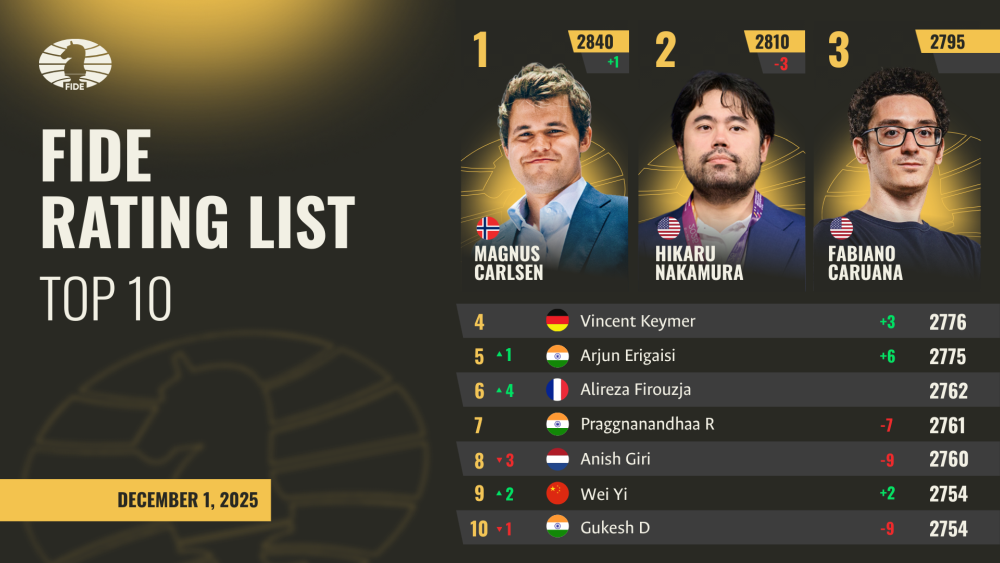
The FIDE December 2025 rating list was primarily shaped by the recently concluded World Cup in Goa, India and the Women’s World Team Championship in Linares, Spain. While the top 10 Open saw no distinct shifts, the top 10 Women witnessed a significant breakthrough. IM Polina Shuvalova broke into the women’s top 10 for the first time in her career following her stellar performance (a TPR of 2827) in Linares, where she scored 9.5/10. Photo: Pavel Dvorkovich Biggest rating gains in the top 100 Open and Women Shuvalova, Polina IM FIDE 2502 (+30) Kairbekova, Amina WGM KAZ 2353 (+29) Martinez Alcantara, Jose Eduardo GM MEX 2667 (+23) Nurman, Alua WGM KAZ 2367 (+23) Kamalidenova, Meruert IM KAZ 2366 (+23) Donchenko, Alexander GM GER 2661 (+20) Tabatabaei, M. Amin GM IRI 2700 (+19) Esipenko, Andrey GM RUS 2698 (+17) Padmini, Rout IM IND 2354 (+17) Leko, Peter GM HUN 2676 (+16) Grebnev, Alexey GM FIDE 2632 (+15) Shuvalova became the biggest rating gainer in November, closely followed by Amina Kairbekova (pictured below) who earned an impressive 29 rating points in the SixDays Budapest GM-B, climbing to her career-high 89th place in the top 100 Women. Photo: Anna Shtourman Several grandmasters made strides at the FIDE World Cup 2025, significantly increasing their rating. Jose Eduardo Martinez Alcantara and Alexander Donchenko, who both reached the quarterfinals in Goa, earned 23 and 20 points respectively. The bronze winner Andrey Esipenko, who qualified for the Candidates 2026, collected 17 rating points, bringing him within just two points of the 2700 mark. Peter Leko proved that he still has what it takes by advancing to Round 4 in Goa and gaining 16 rating points. The former World Championship challenger, Hungarian GM returned to the top 50 Open after an almost eight-year absence. Photo: Eteri Kublashvili Alexey Grebnev continues his rapid ascent. The 2024 World Youth Champion made it to Round 5 at the FIDE World Cup, netting 15 rating points and making his debut in the top 100 Open and while also entering the top 10 Juniors. Amin Tabatabaei did not participate in the World Cup, but picked up valuable points in the 23emes Rencontres Nationales et Internationales d’Echecs (France) Offene Internationale Bayerische Schachmeisterschaft (Germany) – enough to return to the 2700-club. Notably, Alua Nurman from Kazakhstan delivered a very strong performance in the latter tournament, adding 23 rating points to her tally. Photo: Pavel Dvorkovich Her countrywoman Meruert Kamalidenova and India’s Padmini Rout (pictured above) distinguished themselves at the FIDE World Women’s Team Championship, earned 23 and 17 points respectively while playing for their national teams.
FIDE President meets with Kazakh Head of State Kassym-Jomart Tokayev
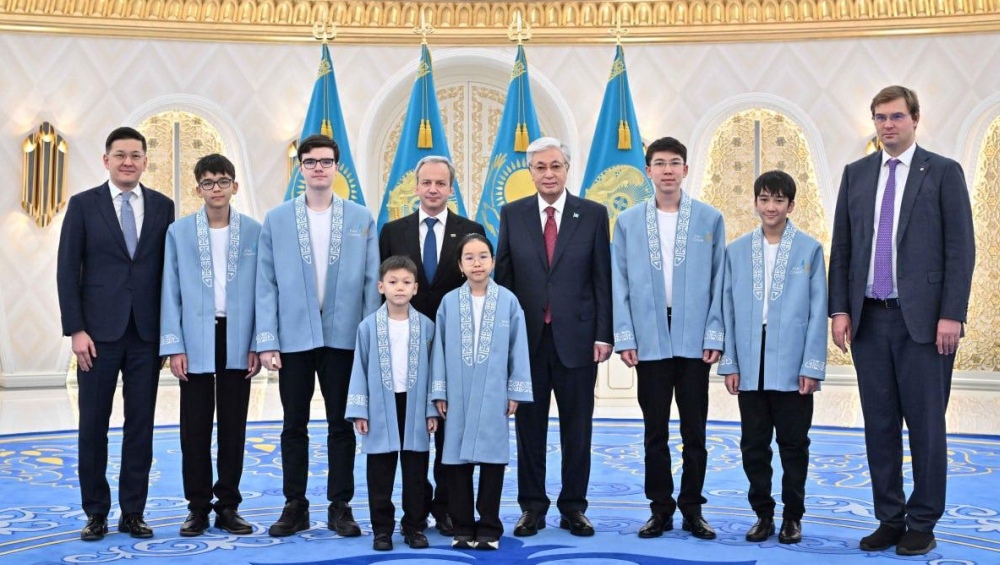
On 28 November 2025, FIDE President Arkady Dvorkovich visited Kazakhstan and held a fruitful meeting with Head of State Kassym-Jomart Tokayev. During the meeting, the Head of State expressed strong appreciation for the support that FIDE provides to the Kazakhstan Chess Federation, coaches, and young players. President Tokayev emphasized that chess in Kazakhstan is not merely a sport, but also a vital component of intellectual culture, moral upbringing, and education. He noted the growing popularity of chess among children and youth and underscored that special attention is being devoted to developing chess infrastructure and integrating the game into the national education system. The discussion also addressed the importance of deepening comprehensive cooperation between the Kazakhstan Chess Federation and FIDE, including the organization of major international tournaments in Kazakhstan and the implementation of joint development initiatives. In response, Arkady Dvorkovich provided a detailed overview of Kazakhstan’s newly adopted Comprehensive Chess Development Plan, which establishes a framework for collaborative efforts among the state, private sector, and national federation. He also reported that last year, Kazakhstani chess players earned the highest number of medals across all competitions held under the auspices of FIDE. Photos: Aqorda and Kazakhstan Chess Federation
FIDE World Rapid and Blitz Championships 2025: Tickets now available
The FIDE World Rapid and Blitz Championships return to Doha this December, bringing five days of fast chess, high stakes, and a field packed with the biggest names in the game. Fans can watch the games live at Qatar University’s Sports and Events Complex, where the world’s best players will compete for four world titles and a share of a prize fund exceeding €1,000,000. Tickets are now on sale, and spectators can tailor their visit to Doha through four types of passes designed for different viewing preferences. Individual Rounds allow fans to drop in for specific Rapid rounds, perfect for those who want to watch a particular player or a key moment in the standings. Half Day Passes cover defined blocks of Blitz rounds and are ideal for following the rapid-fire shifts on the leaderboard as the pace accelerates. Day Passes offer full access to each day’s programme, so fans can enjoy every round, every upset, and every finale. Multi-Day Passes provide the best value for those who want the complete championship experience from start to finish. TICKET PRICING Rapid tickets Individual rounds 25 QAR for rounds 1 to 12 40 QAR for round 13 Day passes 50 QAR for 26 December 50 QAR for 27 December 70 QAR for 28 December All-days Rapid pass 100 QAR Blitz tickets Half-day passes 35 QAR for rounds 1 to 6 35 QAR for rounds 7 to 13 35 QAR for rounds 14 to 19 65 QAR for the finals and closing ceremony Day passes 50 QAR for 29 December 80 QAR for 30 December All-days Blitz pass 100 QAR Full Event Pass 160 QAR This pass covers all Rapid and Blitz days. VIP ticket options will be announced soon and will include premium seating and additional benefits for fans who want an enhanced experience at the venue. Details will be shared on the official event website as soon as they are finalised. Fans are encouraged to secure their passes at special early-bird prices, and be part of the FIDE World Rapid and Blitz Championships 2025 in Doha. Tickets are available now through the official ticketing platform. Link to the ticketing platform: snoonu.com/scity/events/competitions/fide-world-rapid-and-blitz-championships-qatar-2025 About the event The FIDE World Rapid & Blitz Championships 2025 is taking place in Doha, Qatar from December 26 to 30, bringing together the world’s elite chess talent for a thrilling end-of-year showdown. Held at the Sports and Events Complex of the Qatar University, this edition features both Open and Women’s events in Rapid and Blitz formats, with a total prize fund of over €1,000,000. Doha returns as host after nine years, underscoring Qatar’s growing stature in the chess world. The full list of registered players can be found here: Rapid Open: worldrapidandblitz2025.fide.com/participants-rapid-open/ Rapid Women: worldrapidandblitz2025.fide.com/participants-rapid-women/ Blitz Open: worldrapidandblitz2025.fide.com/participants-blitz-open/ Blitz Women: worldrapidandblitz2025.fide.com/participants-blitz-women/ Official website of the Championships: worldrapidandblitz2025.fide.com