

Chess for Freedom in Serbia: From DIY chess set to gold medals

FIDE officials met the inmates of the Penitentiary Home in Belgrade (Padinska Skela) during their visit to Serbia this week. Deputy Chair of the FIDE Management Board Dana Reizniece-Ozola and FIDE Legal Director Aleksandr Martynov played a simul against the prisoners and talked to prison administration about the positive impact of the Chess for Freedom programme on the re-socialization and behaviour of the inmates. According to the project supervisors – Vladimir Bukvic, the warden of the Penal Correctional Facility “Padinska Skela” and Sasa Popovic, head of treatment sector – the game plays a very important role in prison, teaching its players valuable life lessons, developing critical thinking and reducing violent behavior. In October 2022, at the second Intercontinental Online Chess Championship for Prisoners, Serbia was the only country that managed to get two medals in the event – winning gold in the youth tournament and silver in the women’s section. Nebojsa Baralic, Chief Advisor to the President of the Serbian Chess Federation and Director of the 2nd FIDE Intercontinental Online Chess Championship for Prisoners, told the attendees about all the activities that have been carried out since chess was introduced to Serbian prisons. The Serbian Chess Federation, together with the Administration for the Execution of Criminal Sanctions, organize chess lessons for inmates, master classes and simuls with professional players, and conducts inter-jail chess competitions. Men’s, women’s and youth teams have extended their training and practice to prepare them for the 3rd Intercontinental Online Chess Championship for Prisoners in October 2023. Currently, prison inmates are engaged in making an outdoor chess board inside the prison’s garden. The DIY chess set will be used during the tournaments inside the prison. To learn more about the implementation of the Chess for Freedom project in different countries, visit the official website of the initiative: https://chessforfreedom.fide.com/ It can also be done by attending the first in-person Chess for Freedom Conference that will take place May 17th – May 20th, 2023, in Chicago, USA. Details and registration link here: https://chessforfreedom.fide.com
WGP 2022-2023: Missed opportunities in Munich
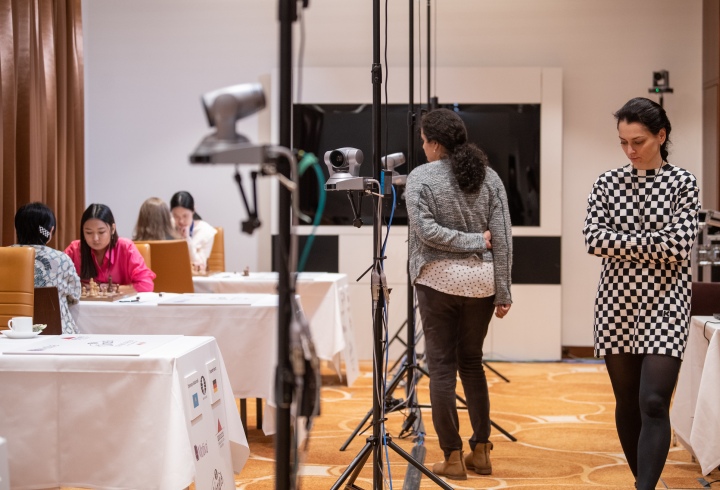
IM Michael Rahal (Munich, Germany) Time trouble is causing havoc in the Munich leg of the 2022-2023 Women’s Gran Prix, which is being disputed every afternoon in the central Kempinski hotel. Today’s fifth round saw many missed opportunities in several games: incredible turnarounds and lost positions that suddenly became won. The ceremonial first move, performed on the Harika-Kosteniuk board, was made by Daniel Stock, Head of Sports of Munich TV. A few minutes earlier, Stock interviewed top German female player Elisabeth Paehtz at the board, a rare occurrence in tournament chess but an excellent opportunity to spread the word on television. GM Abdumalik, Zhansaya vs GM Paehtz, Elisabeth (0.5-0.5) Not even an hour had gone by, and the first game had already finished. In a very theoretical Sicilian Sveshnikov variation, they went down a path that has been tread extensively in the past. More specifically, they followed a previous 2015 game between elite grandmasters Lenier Dominguez and Alexander Grischuk, which also ended in a draw by move repetition. GM Tan, Zhongyi vs WGM Wagner, Dinara (0.5-0.5) In their third game together – 2-0 for Tan Zhongyi previously – the former Chinese Women’s World Champion went for the Catalan Opening, catching Wagner by surprise. In a popular theoretical position, the German number two, five-time Russian Junior Chess Champion, spent nearly 45 minutes – practically half her total thinking time for the game – on her eighth move. Soon she fell into a difficult position, both on the board and on the clock. With less than 3 minutes on the clock – 52 minutes for her opponent – Wagner reached a critical position in the game: Tan Zhongyi sacrificed a pawn for the attack, but Wagner reacted magnificently in defence. Suddenly, she had a chance to save the game. “I have to fix my time management for the second half of the tournament,” Wagner explained to press officer IM Michael Rahal after the game. “I was trying to calculate several moves, but 45 minutes is just too much”. GM Harika, Dronavalli vs GM Kosteniuk, Alexandra (0.5-0.5) Without any doubt, Harika and Kosteniuk have one of the most extensive head-to-head records: 92 games and counting. Most of them are blitz and rapid – many of them online – and it is really close: Kosteniuk outscores Harika by 30 wins to 23 with 39 draws. In today’s encounter, Harika went for the Exchange Variation in the Slav defence, a solid line that Harika had only used a couple of times many years ago. Leaving the opening, the former World Under 20 champion from India was already leading the dance, enjoying the bishop pair and a slightly better pawn structure. Harika kept piling up the pressure with pins and threats and achieved a won position. “I was winning for sure with 46.Qe1 (instead of 46.Qc3 played in the game). It was my first idea, and I just don’t understand why I changed my mind”. Kosteniuk held on tenaciously and received her prize: a draw by move repetition. GM Muzychuk, Anna vs WGM Zhu, Jiner (0.5-0.5) After being defeated by Anna’s sister yesterday, the former World U14 Chess champion had the chance for redemption this afternoon. Playing with Black, Zhu Jiner repeated the Four Knights Sicilian variation that she used successfully against Abdumalik in the third round. Muzychuk opted for a different line involving a pawn sacrifice that wasn’t accepted, and already on move eight the position was completely new. With precise play, Zhu Jiner maintained the balance going into the middlegame: the position was equal but unbalanced, as each player had a pawn majority on one side of the board. A draw was agreed on move 38 after a threefold repetition. In her post-game interview, Anna Muzychuk was happy with the draw even though she thought she had missed some chances. GM Dzagnidze, Nana vs GM Koneru, Humpy (0.5-0.5) Another classic match-up here in Munich. According to my database, Dzagnidze and Humpy have faced each other on 57 occasions, with a very close score: 22 wins for Humpy and 18 for Dzagnidze, with 17 draws. For this game, playing with Black, Humpy chose the dangerous Kramnik-Shirov Counterattack in the English Opening. Visibly surprised, Dzagnidze went into the tank for 15 minutes and blundered twice: first with 10.d3 and on the next move with 11.bxa5 (11.b5 was necessary). Humpy quickly obtained a dangerous initiative on the queenside, and, according to the engines, surprisingly enough, Dzagnidze was already in big trouble before move fifteen. Humpy won a pawn for hardly any compensation, but her technique was off-point. With an elegant defensive exchange sacrifice, Dzagnidze managed to hold the position and force a draw. In her post-game interview, Dzagnidze explained that she was very surprised at how well Humpy had played the opening. GM Muzychuk, Mariya vs IM Kashlinskaya, Alina (0-1) In high spirits after yesterday’s round, the former Women’s World Champion opened the game with the popular Italian Opening. Kashlinskaya, Poland’s number one female player since May 2022, equalised with a timely …d5 break but soon fell into a difficult position after miscalculating the defence of her e5 pawn. A few moves later, Kashlinskaya was in dire straits: the thrust 29.g4 would have won on the spot. But winning won positions is always difficult. Approaching time trouble, Muzychuk blundered heavily, and Kashlinskaya found a nice tactic, turning the tables completely. With precise play, she liquidated into a clearly won endgame, taking home the full point and reaching 50% in the tournament. “Obviously, I am very happy with the win, although I was quite lucky today. I have a bet with my husband – elite GM Radosław Wojtaszek – that whenever I win, I have to buy dessert, so we shall have a nice dinner tonight,” a happy Kashlinskaya explained in her post-game interview. The players will enjoy a free day tomorrow and participate in the traditional Munich charity chess gala in the evening. The sixth round will be played on Wednesday, February 8th, at 3 PM at the Kempinski Hotel venue. The
Darwin Laylo wins Philippine Championship

The 2022/2023 Philippine National Chess Championship “Battle of Grandmasters” Grand Finals took place in the City of Malolos from February 1-7, 2023. The 10-player round-robin brought together three GMs, four IMs, one national master, one WGM and one WIM. Somewhat surprisingly, two out of three GMs participating found themselves at the bottom of the final standings. However, Darwin Laylo (pictured above) upheld the honour of the GM title and came out on top after scoring 6.5/9. The runner-up IM Jan Emmanuel Garcia (pictured below) finished just a half-point behind the champion. Both the winner and the runner-up completed the event unbeaten. IM Michael Concio netted 5.5 points and took bronze. WGM Janelle Mae Frayna (pictured below) and NM Mark Jay Bacojo, who tied for fifth place, turned in solid performance given their rating and picked up 32 and 49 rating points, respectively. Final standings: 1 GM Laylo, Darwin 2433 6½ 2 IM Garcia, Jan Emmanuel 2409 6 3 IM Concio, Michael 2380 5½ 4 IM Bersamina, Paulo 2427 5 5 WGM Frayna, Janelle Mae 2234 4½ 6 NM Bacojo, Mark Jay 2266 4½ 7 IM Quizon, Daniel 2397 4½ 8 GM Gomez, John Paul 2474 3½ 9 GM Antonio, Rogelio 2409 3½ 10 WIM San Diego, Marie 2157 1½ Photos: NCFP Facebook page
WGP Munich: Who dares wins
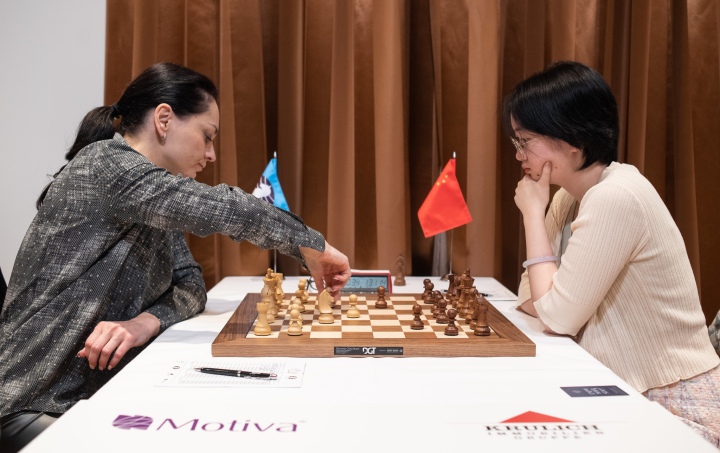
By IM Michael Rahal (Munich, Germany) “Who dares wins” is a motto made popular in the English-speaking world by the British Special Air Service, although the expression appears in a medieval Arabic book of fairy tales. Even though her opening strategy today was somewhat dubious, Alexandra Kosteniuk notched up her fourth win in a row by defeating Tan Zhongyi in a roller-coaster game with massive risks. “I’m not satisfied with my play, but of course, it’s better to have 4/4 instead of 0/4. However, I still need to improve a lot,” were Kosteniuk’s first impressions after the game. The ceremonial first move was made by Jolly Kunjappu, a performance artist and philosopher. Born in Chennai, Jolly has been living in Munich for about 50 years and is a huge chess fan. He advanced 1.c4 on the Humpy Koneru vs Anna Muzychuk board, but the pawn was immediately returned to the original square, and Humpy decided on 1.d4 for the game. The live exposure of the Munich leg of the Gran Prix is exceeding expectations. Every afternoon more than 5000 concurrent viewers are signing in on the different Twitch and YouTube channels covering the event to follow the games and grandmaster commentary. GM Paehtz, Elisabeth vs GM Harika, Dronavalli – (0,5–0,5) Harika has traditionally been a tough opponent for Paehtz: in 29 games she has emerged victorious in 9 encounters. Paehtz went for the Four Knights Opening, choosing the side-line 8.Bd2 instead of the mainstream 8.exd5 in an attempt to surprise her opponent. However, Harika came to the game well-prepared and confidently blitzed out her opening moves, equalising comfortably coming out of the opening. Although there was still a lot to play for, a draw was agreed on move 25 after a three-fold move repetition, allowing both players to keep their scores at 50%. IM Kashlinskaya, Alina vs GM Abdumalik, Zhansaya (0.5-0.5) It was a very close match-up as Kashlinskaya and Abdumalik have played 9 games with each other before, with a tiny score advantage for the Kazakhstan player. Playing the opening fast, they went for a fashionable line of the Semi-Slav defence, in which Black gets the pair of bishops in exchange for some minor pawn weaknesses. With precise defensive play, Abdumalik kept the balance in the position, and, after some simplifications, a draw was agreed on move 32. Zhansaya Abdumalik was kind enough to come to the press centre after the game to give us her impressions on the first four rounds of the tournament. WGM Zhu, Jiner vs GM Muzychuk, Mariya (0-1) In high spirits after her excellent win against Abdumalik in the previous round, Zhu Jiner opened today’s game with 1.e4. Previously, Zhu Jiner and Mariya Muzychuk had only faced each other three times with three consecutive draws. Muzychuk went for the Sicilian Defence, and soon the Marozcy structure appeared on the board, not for the first time in the tournament. Zhu Jiner enjoyed a small space advantage going into the middlegame, and when Muzychuk lashed out 22…f5, Zhu Jiner was prepared to trade off the rooks and steer into a slightly better endgame. By means of a timely pawn sacrifice, Zhu Jiner increased the pressure on the dark squares, but Mariya defended tenaciously. Unfortunately, the top Chinese female player crossed the line at some point – the plan with a5 creating a passed pawn was just too ambitious – and ultimately had to concede defeat. After the game, Mariya Muzychuk analysed her victory with commentator WIM Veronika Exler for the online audience. GM Kosteniuk, Alexandra vs GM Tan, Zhongyi (1-0) The rivalry between these two players is unparalleled. According to my database, they have disputed 26 games in classical, rapid and blitz, with a total score of 9 wins a piece and 8 draws. Playing with the White pieces and a full point ahead in the standings, Kosteniuk went for the Alapin c3 variation against Tan Zhongyi’s favourite Hyper-Accelerated Dragon defence. Muddling the waters, she tried to off-balance her opponent, straying away from theory as early as move six. However, the plan backfired. Tan Zhongyi played for the initiative, winning a pawn going into the middlegame. But she didn’t follow up correctly and Kosteniuk got back into the game. The key moment came on move 23. In a difficult position, Tan Zhongyi used up 26 of the 36 minutes left on her clock and blundered with 23…a5 allowing Kosteniuk’s attack to crash through after 24.Na3 Ka6 24.Rxb5 Rxc3 25.dxc3 Bc1 26.Rxc4 | 1-0, 34 moves GM Koneru, Humpy vs GM Muzychuk, Anna (1-0) A very equal match-up. In 38 games, they stand 8 wins for Humpy against 9 wins for Muzychuk, having tied the rest. In a side-line of the Gruenfeld Defence, Humpy bravely sacrificed a pawn on b2, which was undoubtedly part of her opening preparation for the game. “I had prepared this pawn sacrifice for the game,” Humpy explained to Press Officer IM Michael Rahal. The idea took Muzychuk totally by surprise: she used up more than half an hour to calculate the consequences of the capture. Finally, she went ahead, grabbing the pawn, only to give it back a few moves later to reduce the positional pressure. However, Humpy found an interesting tactical resource to complicate the game and, already very low on time, Muzychuk lost her way and ended up with two pieces for a rook but many pawns down. Humpy wrapped up the game with ease, scoring her first win in the event. WGM Wagner, Dinara vs GM Dzagnidze, Nana (0.5-0.5) A very interesting game, given that it is the first time they have faced each other. Wagner hasn’t started the tournament in good form, although she has had some opportunities to score in the first rounds. In an open variation of the Catalan, Wagner decided to sacrifice her d4 pawn for the initiative. It’s hard to say if it was specific opening preparation or a spur-of-the-moment decision. There was certainly enough positional compensation, but probably nothing more. From then on, it was a
WGP Munich: Kosteniuk 3/3 at full steam
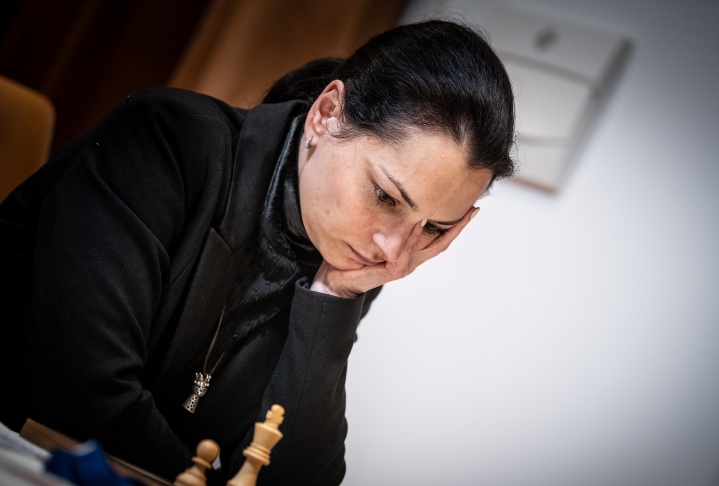
By IM Michael Rahal (Munich, Germany) Alexandra Kosteniuk, playing under the neutral FIDE flag, scored her third consecutive win against tailender Dinara Wagner this afternoon in the Women’s Grand Prix. Kosteniuk dominated her opponent and took advantage of the time-trouble phase to transition into a winning ending. “It was a very difficult game with a lot of calculation,” were the first words after the game. The round started as usual at 3 PM in the central Munich Kempinski Hotel. The ceremonial first move was performed by GM Stefan Kindermann, Founder of the Munich Chess Academy, who advanced the e-pawn two squares after Mariya Muzychuk whispered the move to him secretly in her game against Humpy Koneru. Kindermann was accompanied by Roman Krulich (CEO of Krulich Immobilien) and his wife, Natalie Kröcker. Krulich is the main sponsor of the event and one of the drivers behind the chess scene in Munich. Also present in today’s round was Helmut Pfleger, a well-known grandmaster, who not only played for Germany in seven Olympiads from 1964 to 1982 but also hosted a series of chess programs on German public TV, including “Chess of the Grandmasters”. GM Kosteniuk, Alexandra – WGM Wagner, Dinara (1-0) By means of a subtle move order, Kosteniuk was able to deviate from Wagner’s Sicilian Defence and achieve a nice space advantage with the Marozcy structure. On move 17, Wagner went for the thematic …d5 pawn break, albeit at an untimely moment. Kosteniuk used up most of her time calculating deep lines with multiple sacrifices but ultimately decided to play it safe, taking the full point after dominating her opponent in a very favourable rook ending. “I am quite tired. It was a very difficult game with a lot of calculations. In time trouble, I wasn’t able to finish the game by tactics, but the position was still better,” Kosteniuk explained to commentator WIM Veronika Exler on the live broadcast. GM Muzychuk, Mariya – GM Koneru, Humpy (0.5-0.5) Humpy Koneru has an excellent record against Mariya Muzychuk – she has won 12 of the 24 games they have played. However, Humpy was very satisfied with the draw today. Playing with Black, Humpy chose the solid Four Knights Opening, a line in which the queens are quickly exchanged in the opening. Although Muzychuk won a pawn, the nature of the opposite-coloured bishop ending proved to be equal, and a draw was agreed on move 31. “I have got six games with Black out of eleven in this tournament. I’m just trying to keep on playing. Yesterday was a good opportunity for me, but I missed out. And in the two Black games, I played quite solidly. So, I’ll try my best to come back,” she explained in an interesting interview, in which she also went into detail regarding yesterday’s rollercoaster game against Abdumalik. GM Tan, Zhongyi – GM Paehtz, Elisabeth (0.5-0.5) According to my database, Tan Zhongyi and Elisabeth Paehtz had played a total of 15 games in the past, with the Chinese female player leading by a significant margin, having won none less than 11 of those encounters. Paehtz was definitely eager to make an impression this afternoon and leave behind yesterday’s blunder against Kosteniuk. Her opening choice, the aggressive King’s Indian Defence, was ideal. Already on move eight she surprised her opponent with a new pawn sacrifice, which, although thematic, had never been played before. For the pawn, the Paehtz enjoyed great piece play and dark-square domination, which ultimately allowed her to recover the material and go into a slightly better endgame. The key moment came about on move 37. Paehtz had a difficult choice between two seemingly promising continuations: 37…a3 or 37…Bxc4. Paehtz went for the second option, allowing her opponent to exchange some pawns and narrowly escape defeat. The engine suggests that 37…a3 should lead to a win, but the calculation is far from human. A heart-breaking result for the German player, who was leading the way for most of the game. GM Harika, Dronavalli – IM Kashlinskaya, Alina (0.5-0.5) Having played together eight times in the past – four wins to one for Harika with three draws – and based on the tournament situation, both players were eager to go for a fight. Kashlinskaya selected the solid Rubinstein variation in the French defence in an attempt to force her opponent into unknown territory. Well-prepared, Harika followed the steps of Ponomariov and Korchnoi, exchanging queens and pushing a small edge in development in the late middlegame. Under certain pressure, Kashlinskaya opted to sacrifice a pawn to finish her development and go into an ending with two bishops against a bishop and knight – a pawn down but with good drawing chances. By exchanging one of the bishops for her opponent’s knight, Kashlinskaya forced an opposite-coloured bishop ending, legendarily known for their drawing tendency. GM Abdumalik, Zhansaya – WGM Zhu, Jiner (0-1) Recently, most Chinese players notoriously travel to tournaments by themselves. Due to the pandemic, it’s been increasingly hard to get permission to travel outside the country. Zhu Jiner is by herself in Munich, connecting only by Zoom with her coach in China for game preparation. Even so, today, she displayed all her skills, defeating Zhansaya Abdumalik with Black in a model Sicilian Sveshnikov game. Zhu Jiner turned down a draw offer on move twenty. “My position had a lot of playability,” she explained in her post-game interview. She went on to launch a fierce attack, culminating in an elegant rook sacrifice that forced resignation. Zhu Jiner doesn’t socialize much during the rest of the day: “I don’t have much free time here. For the most part, I am preparing the games with my coach”. GM Muzychuk, Anna – GM Dzagnidze, Nana (0.5-0.5) A very equal game from start to finish. Playing with White, Anna Muzychuk was able to construct a satisfactory Marozcy structure but inaccurate 21.Qb1 allowed Dzagnidze to equalize with the thematic pawn break 23…d5! However, the game continued, and a few moves later, Muzychuk was enjoying more time on the
Poland makes history at Chess Olympiad for People with Disabilities
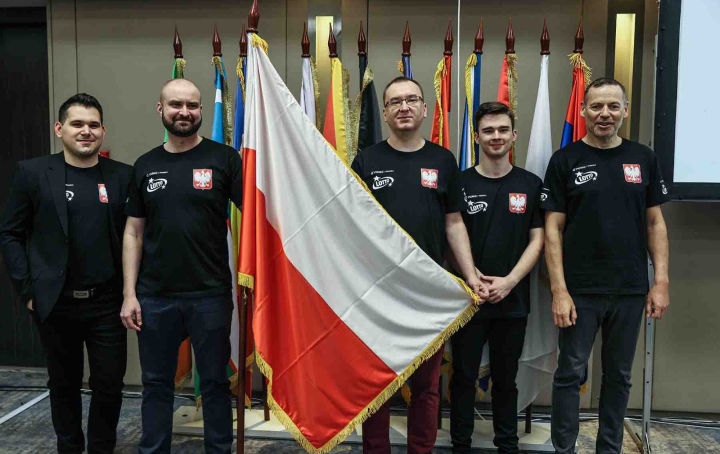
The Polish team won all six matches in Belgrade and took their first Olympic gold in chess since 1930. IPCA got the silver, and the Philippines won the bronze Like many times during the 20th century, the Serbian capital Belgrade was a place where (again) chess history had been made, as players with disabilities showed their chess skills on a global stage in a first-ever Olympiad dedicated to them. The inaugural event celebrating diversity and competition has been a milestone moment for chess. During the past six days, 26 teams with participants from 33 countries competed for the title. Poland achieved huge success as the team led by GM Marcin Tazbir confidently won the Olympiad, defeating all of their opponents and scoring 12 match points. The team of Physically disabled chess players (IPCA) won second place with 10 match points. Four teams: the Philipines, India, Serbia 1 and Uzbekistan, shared third to sixth place with eight match points. The cheerful squad of the Philipines came in third after a better tie-break. Croatia – who had a bad start to the tournament – finished seventh, while second-seed Israel finished eighth and third-seed Hungary took the modest 9th place. Poland’s Marcin Tazbir: “A great success for our country and our chess society” Marcin Tazbir is visually impaired. He started losing his eyesight when he was 16. He was already a good player, an IM, by that point. He had a demanding role in this event, playing board one in all matches (winning two games and drawing four). “I believe that people in our country will say this is a great success. Poland has medals from the Olympiads but before the [Second World] war. So, this type of event is also a great success for our country and our chess society”, Marcin Tazibir said in an interview for FIDE. The Polish team was the favourite to win. They had the highest average ELO (2327) and proved their status in every match. Poland’s journey to the top started with a 3:1 victory over Germany in the first round. In Round 2, they narrowly defeated the team IPCA (2,5:1,5) and then crushed the international team of FIDE 3,5:0,5. They then defeated the Philippines (2,5:1,5) and India (3:1). In the last round, the Poles were up against their biggest rivals in this event – Israel. Despite having an average lower rating than Poland, Israel (2171), led by Grandmaster Yehuda Gruenfeld, put on a strong performance and – with India and IPCA – were always in the race for the top place. One of the heroes of the Polish team is FM Marcin Molenda (pictured below), who played on board two. Molenda had an amazing score of 5,5 out of six, drawing just one game in the last round against Israel. Poland’s team was a class above anyone else. Out of 24 games played, they won 17,5 points! Altogether, the Polish team lost just three games! “I strongly believe that this event is a great opportunity for people with disabilities to feel the atmosphere of the Olympiad and a great event… To be able to come together, play and compete is something special for all of us and a great chance to overcome our limits,” Tazbir said. The foundation of future Olympiads for people with disabilities Grandmaster Thomas Luther had a pivotal role in making the first Chess Olympiad for people with disabilities happen. As the head of the FIDE Commission for people with disabilities, Luther and his team worked hard to get attention and support from across the chess world. “I’m very happy! We worked on this for such a long time, and finally, we have done it. Successfully! This event is the foundation of future Olympiads for people with disabilities, and I am so proud and happy to have taken part in this”. Pulling everything together and organising the event wasn’t easy. “There were many challenges and questions about the event”, Luther noted. “Do we need this event? Will it be successful? Will people accept it? Will the players come? Will there be exceptional difficulties…? But all went very fine and smoothly. We are looking forward to making the next Olympiad happen – we will increase the participation of countries and use the lessons learnt in Belgrade to improve.” Speaking about how he will remember the past six days in Belgrade, Luther said: “I will remember Belgrade as a very special place. So much chess history is tied to Belgrade and Serbia. Now, another piece of chess history is made in this beautiful country. We are very grateful to everyone here in Serbia who were working so hard to make this event a success.” The closing ceremony: “One special dream has come true” The closing ceremony of the first Chess Olympiad for people with disabilities took place at 7 PM, in the same hall of the Crown Plaza hotel where the matches were played over the past six days. Present at the ceremony were high-ranking officials of the City of Belgrade, as well as the deputy chairperson of the Management Board of FIDE, Dana Reizniece-Ozola and FIDE Special Tasks Director, Akaki Iashvili. “This is a very special moment. They say that a true dream is not the one you leave when the morning comes, but the one that fills in every living moment of yours… One special dream has come true,” Dana Reizniece-Ozola said. “We are extremely proud to have managed to organise this Olympiad! FIDE would like to thank the sponsors – the Serbian Government, the Serbian energy giant NIS, Coca-Cola, Rossety, the Serbian Chess Federation, the arbiters, volunteers and everyone else involved for playing a huge role in making this event happen and for making it a huge success.” Reizniece-Ozola applauded the FIDE Commission for people with disabilities as well as other organisations and federation members working in this field. “I am grateful to them for being agile and for providing honest feedback and helpful suggestions on how to make future Olympiads and events for people with disabilities even better.” She noted that in the
2023 1st FIDE Players with Disabilities Commission meeting: Minutes

FIDE publishes the Minutes of the 2023 1st FIDE Players with Disabilities Commission meeting, which was held on February 3 in Belgrade, Serbia. Download Minutes of the Meeting
FIDE Players with Disabilities Commission holds meeting in Belgrade
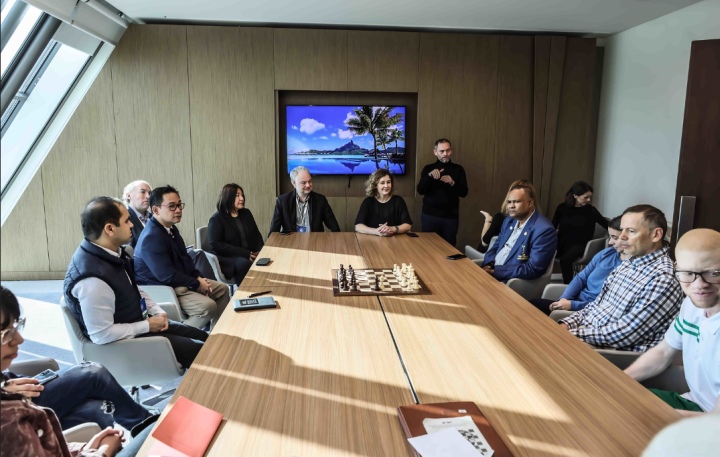
During the penultimate fifth round of the first FIDE Chess Olympiad for People with Disabilities, one of the most active FIDE Commissions and the organizing force behind this significant event in chess life held its meeting. Members, councillors, and friends of the Players with Disabilities Commission (DIS) gathered in Crowne Plaza Hotel on February 3, 2023, in the Serbian capital, Belgrade. Some of the players participating in the Chess Olympiad joined the meeting to contribute their ideas and provide feedback. In 2023, DIS Commission welcomed 11 new members, seven of them were in attendance and presented new approaches related to chess players with disabilities. One of the main topics of discussion was the ongoing Chess Olympiad for People with Disabilities, the flagman tournament of the commission. This tournament is held for the first time, and this presents a unique learning opportunity. Taking into account the current experience of organizers and players, changes were proposed for future editions of the event. The Commissions will take into consideration all proposals. One of the main aims is to accommodate the certain needs that different disabilities present and do it in the best possible way. The system for team registration shall be improved too. To facilitate this process, it is proposed that every National Chess Federation appoints a point-of-contact officer who can provide support specifically for chess players with disabilities and register their team in cooperation with any local organizations for such players. GM Thomas Luther, DIS Chairman, and Dana Reizniece-Ozola, Deputy Chair of FIDE Management Board The commission has great plans for the future. Later this year, in August, it aims to organize the Individual World Championship for People with Disabilities. The Polish Chess Federation is interested in hosting the event and has submitted a bid which is now going through the necessary procedures. Another 2023 initiative is to organize the workshop “Equal Opportunities” and “Sensitivity Seminars”. The latter is a new idea introduced by DIS member James Infiesto, who offered to volunteer and assist. In sharing his experience with these types of seminars in his country, he provides a valuable contribution to the DIS Commission. The Sensitivity Seminar will focus on talks and lectures dedicated to various disabilities, all in one venue. The goal of this seminar is to improve understanding and interaction between chess players with different disabilities — a chance to better understand the needs of others when attending events like the Chess Olympiad for People with Disabilities. “We want to do our part in helping provide better conditions and equal opportunities in chess for players with disabilities. We are on the right track, but there is still a long road ahead of us. The Olympiad for People with Disabilities, organized every two years, will be our event to connect, inform, celebrate and educate the chess world on the needs of chess players with disabilities,” were the words with which Nikos Kalesis, DIS Secretary, finished his report on the meeting. In attendance were: DIS Chair, GM Thomas Luther (Germany), Secretary Nikolaos Kalesis (Greece), Kema Goryaeva, Councillor Dora Martinez (USA), Councillor James Infiesto (Philippines), Member Serpil Turgay Seckin (Turkey), Member Handenur Sahin who is playing on Board 1 for Team Turkey, Member Natasha Morales Santos (Puerto Rico) who is also playing in Team FIDE, Member Dominique Dervieux (France), Member Rahman Mallick Masudur (Bangladesh), Phillip K Gardner (England), Member Piotr Dukaczewski (Poland), Member Tapiwa Gora, Member Andrei Gurbanov, Ewa Kamierczak. You can download the Minutes of the Meeting here. Photos by Mark Livshitz
WGP Munich: Kosteniuk takes the lead
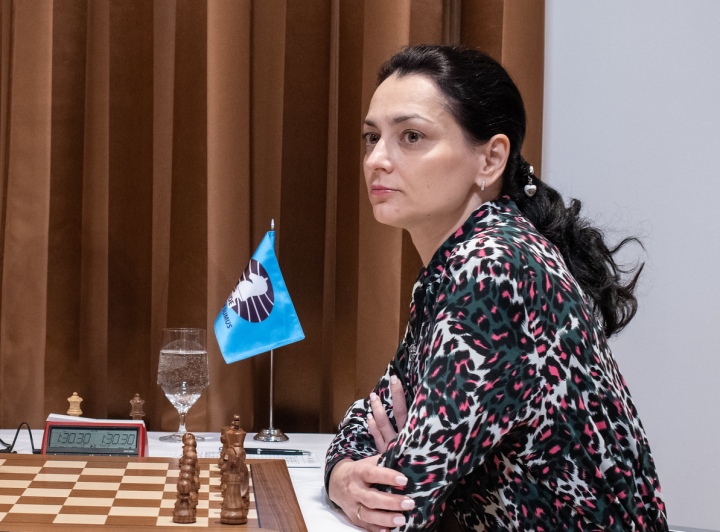
Alexandra Kosteniuk is the early leader of the Munich leg of the 2023 Women’s Grand Prix after scoring her second consecutive win this afternoon against local player Elisabeth Paehtz. Playing under the FIDE flag, Kosteniuk took advantage of an unexpected blunder by her opponent and makes her claim for the tournament title. Nonetheless, three players – Tan Zhongyi, Anna Muzychuk and Nana Dzagnidze – are just behind the leader, on one and a half points. The ceremonial first move, played on the Paehtz-Kosteniuk board, was made by Dr Peer Friess, representing the Bavarian State Chancellery. Being a strong club player himself, rated 1895 FIDE, Friess had no trouble at all advancing Paehtz’s e-pawn to e4. Kashlinskaya, Alina vs Tan, Zhongyi (0,5-0,5) The first game to finish ended in a solid draw. They had previously played nine games with an overall score of 5.5-3.5 in favour of the Chinese player. Although Tan Zhongyi went for the Sicilian defence, the position transposed to the Advance Variation of the French. Kashlinskaya had prepared an interesting pawn sacrifice (8.Re1!?) which Tan Zhongyi declined after a few minutes of thought. White insisted and ultimately achieved some positional compensation for the pawn. With her king still stranded in the centre, Tan Zhongyi intelligently preferred to return the extra pawn and exchange queens in an attempt to steer the game towards the ending. After mass exchanges, both players agreed to a draw on move thirty-one. This a good result for the Chinese player, who rapidly returned to her room to participate in the preliminary stage of the Online Champions Chess Tour! Paehtz, Elisabeth — Kosteniuk, Alexandra (0-1) One of the most interesting match-ups of the day. These two players have a long-playing history, with more than 72 games against each other, according to my database (43-29 for Kosteniuk). Paehtz opened the game with the Evans Gambit, a bold choice for this type of event but very much in the aggressive style of German’s number one female player. Kosteniuk came to the game well-prepared: she had practiced this variation previously in blitz. However, with everything to play for, on move 23, Paehtz developed her bishop to the unprotected f4 square. Kosteniuk couldn’t believe her eyes, but didn’t take long to capture the bishop with her rook, forcing her opponent to resign. “Today’s game finished unexpectedly because apparently she just blundered,” Kosteniuk explained in her post-game interview with Press Officer IM Michael Rahal. “The e8 square was a blind spot for her”. Zhu, Jiner – Dronavalli Harika (0.5-0.5) A complicated battle. Both players ended up in a position which probably neither of them had planned to be in before the game. Zhu Jiner achieved the middlegame advantage of two connected passed pawns on the sixth and seventh ranks, a force to be reckoned with. In exchange, Harika obtained a couple of extra pawns which, going into the ending, might prove to be decisive. After missing a couple of solid opportunities to increase her advantage, Zhu Jiner went for a forced line that won a piece but only left her with the option of forcing a perpetual due to the lack of material. “Will I play this tricky line again in the future? I will keep that as a secret. I didn’t expect to land into this position, so it will be a good experience for the future” said Harika with a smile on her face in her post-game interview. Humpy Koneru – Abdumalik, Zhansaya (0.5-0.5) What a rollercoaster of a game! I am sure that neither of the players can be completely satisfied with the end result. The opening and middlegame were all Humpy. Her two bishops on a2 and b2, pointing in the direction of her opponent’s king, should have proven decisive – the engine suggests 24.Bxf6 as the beginning of a winning variation. However, low on time, Humpy blundered the exchange, and Abdumalik turned the tables. By move 50, she had an extra rook, and it looked like Humpy would have to resign very soon. But India’s number one female player bravely fought on, advancing her three connected passed pawns. Unable to find a way to win, a draw was agreed on move 75, just before Abdumalik would have been forced to give up her extra pieces for the pawns. Dzagnidze, Nana – Muzychuk, Mariya (0.5-0.5) A missed opportunity for the younger of the Muzychuk sisters. Dzagnidze sacrificed a pawn in the opening for active piece play, and an attack on the king but Mariya defended with precision and netted another two pawns deep into the middlegame. With three extra pawns, things were looking very grim for Dzagnidze, but in time trouble, Mariya blundered most of her advantage with 36…Nd6 (36…Ra8 was the way to go) and Dzagnidze got back into the game, recovering two of the pawns and holding a queen ending to a draw. Wagner, Dinara – Muzychuk, Anna (0-1) One of the most exciting games of the round. Wagner went all out for the win today with enterprising and aggressive play. She could have rounded off an excellent game by finding 34.Qe6+! exchanging queens, with a completely won rook ending. But once again, time trouble came into play. Wagner blundered with 34.d6? dropping a full pawn – Black quickly snatched it after 34…Qc6+ 35. Re4 Qxd6. Anna correctly rejected her opponent’s draw offer, understanding that the tide had turned. Maybe the queen ending could have been played better – the engines suggest that 66.Kg1 (instead of 66.Kh2) is a table-base draw – but low on time, this type of ending is typically very hard to defend. The third round will be played on Saturday, February 4th at 3pm at the Kempinski Hotel venue. The games can be followed live with commentary by GM Stefan Kindermann and WIM Veronika Exler on the FIDE Youtube channel. Standings after Round 2: Text: IM Michael Rahal (Munich, Germany) Photos: David Llada Official website: womengrandprix.fide.com/ Partners:
Olympiad for People with Disabilities: Poland one step away from the gold
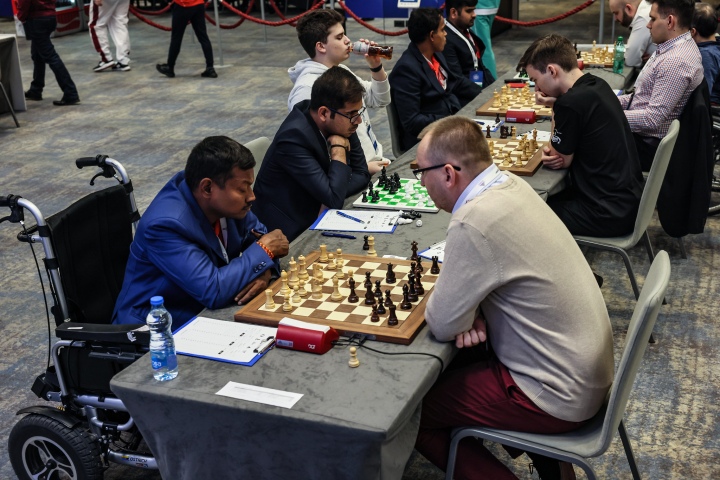
Poland defeated their direct competitor for first place, India, and are one round away from clinching gold at the first Chess Olympiad for People with Disabilities As the event in Belgrade nears its end, key games on top boards are getting longer, and tiredness is starting to kick in. While this is usual in any tournament, for some of the participants of the first Olympiad for People with Disabilities, this can be particularly hard because of their health. Uzbekistan’s board number one, Sirojiddin Zaynidinov and Hungary’s Zoltan Zambo spent nearly six hours playing their round five game – a strain that even the elite chess players would find challenging to manage. Given the various types and levels of health issues players with disabilities have, there is a special health team dedicated to looking after them. Does having a disability make it harder to play chess? The medical perspective Dr Sofija Jovanovic is the Medical Doctor of the Olympiad, and she is in charge of looking after the health and well-being of all the participants. She says that the quantity of attention paid to the general health status of the players with disabilities is larger than in regular events. “We have a finer line to meet here”. Dr Jovanovic notes that because of their disabilities, the players are well in tune with their health conditions, and they take good care of the rest of themselves, which makes things easier. “We don’t have large health problems here. We have a disability we try to match in every area of the competition: so, we have the volunteers who are helping them play chess, and we have people who are supported in all other areas.” In terms of health issues that have most commonly come up – “it’s headaches, flu symptoms, and nose bleeds. Here, however, we have to be extra careful with the symptomatology as it might correlate with something bigger,” notes Dr Jovanovic. However, the players can sometimes overreact: “It’s refreshing to see someone so in tune with their health. At the same time, it’s also a bit overbearing, but sometimes a headache is just a headache”. Medicine highlights the benefits of cognitive challenges such as doing sudoku, crosswords and anything of that variety. It also notes the value of competitive sports for general well-being. Chess is the overlap of these two spheres. “Different studies show that being part of a competitive sport – no matter your health, gender, ethnicity background – is going to help you deal with personal loss or defeat in sports or other things you will have to overcome in life later on”, dr Jovanovic notes. Can spending too much time on chess be bad for your health? “It depends”, the doctor says. “It depends on what else you can do with your free time and how you prefer to spend it. Some prefer cognitive over physical or vice versa. You’re not supposed to ignore your health, of course.” You can watch the full interview with Dr Sofija Jovanovic – here. Games and results of Round Five The penultimate round brought four key matches between the leading teams: Poland (8) – India (7), Philippines (6) – Israel (6), Cuba (6) – IPCA (6), and Uzbekistan (6) – Hungary (5). The rise of Asian chess has been visible in their results so far, exceeding rating predictions, but in the 5th round, they had to pass the most challenging tests against the top three favourites: Poland, Israel and Hungary. For the encounter with the Polish leaders, the Indian selection opted to have Soundarya Kumar Pradhan (1881), the lowest-rated member of the team, against the GM Marcin Tazbir (2.507), the strongest player in the Belgrade field. Such an experiment worked well in the second round match vs Cuba (3:1), thanks to all three wins on lower boards, but this time the Polish players had a significant advantage in rating even against the most successful Indian players – Shashikant Kutwai (3.5 points out of 4 games), Kishan Gangolli (4) and Naveen Kumar (two out of three). As it might have been expected, Marcin Tazbir was the first one to score. Black was desperately low on time and in a weaker position. Tazibir used his advantage and, with a nice sacrifice, went for the mating attack: 27.Nf6+ gxg6 28.exf6 Kf8 29.Qg5 Qb7 30.Qg7+ Ke8 31.Qg8+ Kd7 32.Qxf7+ Kd6 33.Be5+ Kc6 34.Rc1+ Kb6 33.Bd4+ Nc5 34.Bxc5+ and Black resigned. The most anticipated game was on the second board, between two players who collected together 7.5/8. Disturbed by the loss on the first board, Shashikant Kutwal missed the right plan (30.h4 Bh6 31.Nd6) in the sharp tactical battle, and the advantage instantly went to the other side: 30.Rxe8+ Qxe8 31.h4 Bh6 32.Nd6 Qe3 33.Nxf7 Kxf7 34.Rd8 Qc1+ 35.Qe1 Qxb2 36.Rf8+ Kg6 37.h5+ Kxh5 38.Qd1+ Kg6 39.Qg4+ Bg5 40.Rh8 f5 41.Qx3 Qxb4, and the Polish FM Marcin Molenda celebrated his 5th consecutive win, the same as his team did (3:1) after peaceful outcomes were signed on the lower boards. After the most important win in this Olympiad, the team Poland leads two match points ahead of the squad of the International Physically Disabled Chess Association (IPCA). The two teams met in the 2nd round when Poland celebrated a close win 2.5:1.5, but the race isn’t over yet. The 7th seeded IPCA got into the last round with another surprise, a very convincing victory against Cuba 3.5:0.5 that keeps their hope for gold alive. If they win and Poland loses their last match, the IPCA team will have a clear advantage in the first tiebreak criteria, the number of board points (at the moment, it is equal – 14.5:14.5). The match Cuba – IPCA was the most balanced one in average rating, with slight advantages of each team on separate boards. However, IPCA won without a single defeat, with the half point earned by Stanislav Mikheev (Serbia) and the wins of Sargis Sargissyan (Armenia), Eugenio Campos (Angola) and Artom Andriienko (Ukraine). In another derby of the fifth round, Israel was a clear favourite on the 2nd and 3rd