

Abdusattorov enters top 20 Open in February 2023 rating list
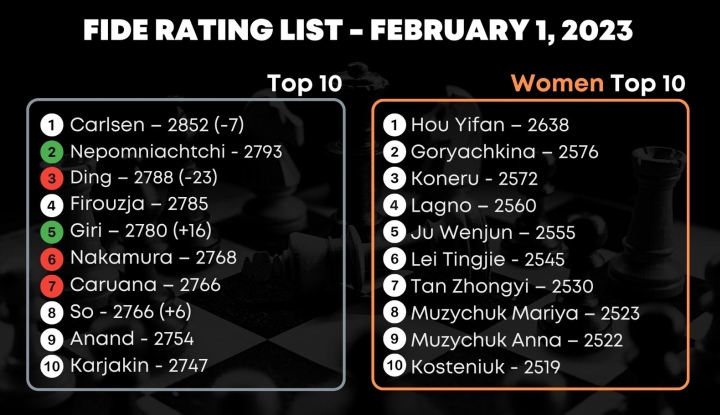
The 2023 Tata Steel Chess festival was the major event in the previous month that brought about significant changes at the top. The champion, Anish Giri (pictured below) picked up 16 points and climbed to #5 (the last time he mounted that high was back in November 2019), while Ian Nepomniachtchi, who was inactive in January, reached #2 for the first time in his career, after Ding Liren‘s lackluster performance in Wijk ann Zee that cost him 23 rating points. Magnus Carlsen also dropped 7 points in Tata Steel Masters, but his top position remains uncontested. Photo: tatasteelchess.com | Maaike Brink There were no changes at the top of the Women’s list, but not for long, as 12 of the top female players are taking part in the second leg of the FIDE Women Grand Prix in Munich, Germany, which opened yesterday and will last until February 14. Biggest gains in Top 100 Open and Women Donchenko, Alexander GER 2654 (+27) Abdusattorov, Nodirbek UZB 2734 (+21) Vantika Agrawal IND 2370 (+18) Giri, Anish NED 2780 (+16) Divya Deshmukh IND 2363 (+14) Yip, Carissa USA 2369 (+12) Sargsyan, Anna ARM 2371 (+10) Maghsoodloo, Parham IRI 2728 (+9) Guichard, Pauline FRA 2379 (+9) Alexander Donchenko lost some rating points in November and December of 2022, but he turned things around in the first month of 2023, convincingly winning Tata Steel Challengers. This success translates into +27 rating points and his debut in the top 100 Open. Photo: tatasteelchess.com | Lennart Ootes Nodirbek Abdusattorov (pictured above) also made a huge leap following his solid performance in Tata Steel Masters. Despite losing in the final round and missing the title, the Uzbek youngster netted 21 rating points and broke into the top 20 Open for the first time in his career. Parham Maghsoodloo demonstrated his fighting spirit in Wijk aan Zee and, after a strong finish, earned 9 rating points. The winner of the 48th Edition of the Indian Women’s National Championship Divya Deshmukh (pictured below), got 14 rating points, but the bronze-winner, Vantika Agrawal, did even better in this domain, increasing her rating by 18 points. Photo: All India Chess Federation Carissa Yip steamrolled the competition at the 2023 Pan-American Intercollegiate Team Championship, gaining 12 rating points, while Anna Sargsyan also did a great job in this competition and picked up 10 points.
Dana Reizniece-Ozola welcomes the chess queens to Munich
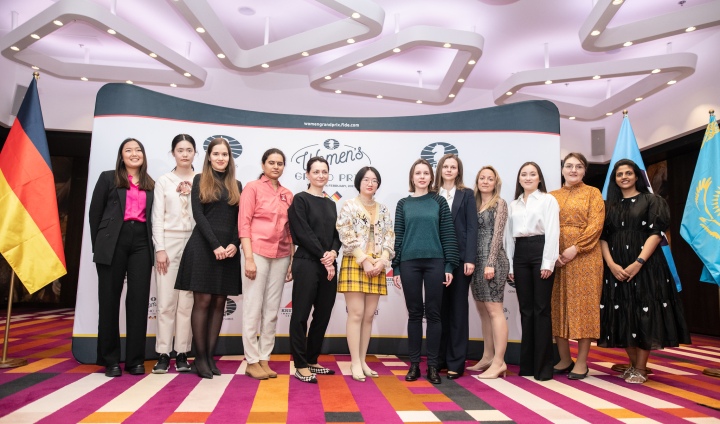
The opening ceremony of the 2022-2023 Munich leg of the Women’s Grand Prix was held this evening at the centrally located five-star luxury Vier Jahreszeiten Kempinski hotel, situated directly in the city centre of Munich. The twelve participants, authorities, arbiters and officials, enjoyed a 45-minute series of activities, national anthems, speeches and videos, culminating in a family group photo. Representing Fide, Dana Reizniece-Ozola, Deputy Chair of the management board, welcomed the “chess queens” to Munich and congratulated them on their participation in the Women’s Grand Prix. She also extended her thanks to all the main sponsors of the event: the Krulich Immobilien Group, a real estate company based in Munich, and Motiva, a long-term sponsor of FIDE that empowers women in chess. Hugely appreciative of the importance of the organizing team, Dana stated: “The beauty of a chess game is mainly set by the number of sacrifices in it, but organizing chess tournaments is more about the investment of time, energy and resources so that the event is a success”. After the anthems, the main tournament sponsor, Roman Krulich of the Krulich Immobilien Group, took the floor. After thanking Emil Sutovsky for the idea of organizing the event, Krulich welcomed everyone to Munich. “Together with Stefan Kindermann and Gerald Hertneck, we have been supporting chess here in Munich for more than twenty years, bringing the game closer to children who can’t afford the lessons”, were Krulich’s opening words. He also thanked the Director of the luxury Vier Jahreszeiten Kempinski hotel, Holger Schroth, for their help as the venue of the exciting tournament. The participants enjoyed a movie clip featuring most of the players in the recent Astana event, after which GM Stefan Kindermann, founder of the Munich Chess Academy and one of the commentators of the event, gave a short speech in which he broke down the impressive chess history of the city of Munich, highlighting the 1908 Lasker-Tarrasch World Championship Match and the 1958 Chess Olympiad. Finally, all the players were invited on to the stage for a photo opportunity and drinks were served. Round 1 pairings: Harika Dronavalli vs Koneru HumpyMaria Muzychuk vs Anna MuzychukAlexandra Kosteniuk vs Alina KashlinskayaTan Zhongyi vs Zhu JinerElisabeth Paehtz vs Dinara WagnerZhansaya Abdumalik vs Nana Dzagnidze Text: IM Michael Rahal Photos: David Llada Official website: womengrandprix.fide.com/
Olympiad for People with Disabilities R3: The halfway point
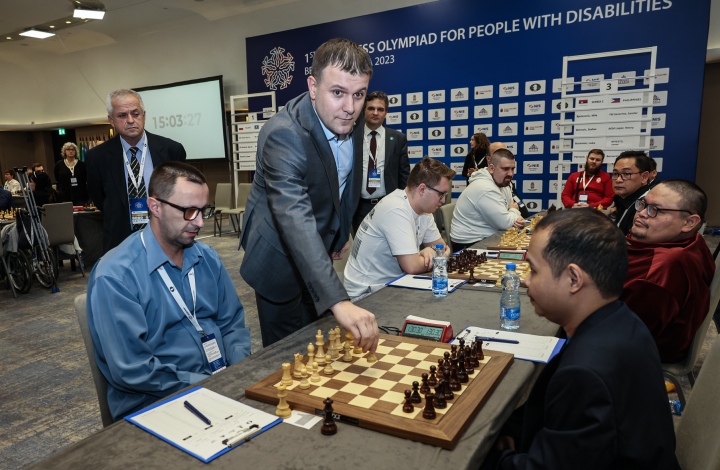
Following three rounds of play, India, the Philippines and Poland are in the lead at the first Chess Olympiad for People with Disabilities. The third round was opened by the Serbian Minister of Trade, Tourism and Telecommunications, Husein Memic. Despite a very friendly and warm atmosphere at the tournament, the battles over the chessboard are becoming tougher, and the games are lasting longer. Despite the extended ‘work hours’, many of the players continued to spend time outside of the playing hall, waiting for their other teammates and analyzing the games, often with members of other teams. This is rarely seen in other chess events. One of the guests at the event is Bharat Singh Chauhan – secretary of the All India Chess Federation and the tournament director of the 44th Chess Olympiad in Chennai. Speaking about the inaugural Olympiad for people with disabilities, Singh complemented FIDE and local organizers on putting this event together. “It’s a very difficult tournament, and it’s a great initiative by FIDE to bring disabled people together”, Singh noted. Singh believes that people with disabilities should have their own Olympiad: “It’s a right decision for FIDE to have a separate event for people with disabilities. It’s a right for them to have their own, separate Olympiad.” Asked to summarize what it takes to organize a chess Olympiad, Singh singled out one thing – courage. “We had three months to organize a huge event [the 44th Olympiad in Chennai], and it was right after the peak of Covid. Singh also compared the Olympiad for people with disabilities to other events: “Every tournament has different challenges. Here even – every player is different. It’s really difficult to say that this is an easy tournament to organize.” Top games and results of the third round: Tough at the top The rating favourite Poland continued their hot run as they defeated the international squad of FIDE by 3.5:0.5. FIDE team’s Andrei Obodchuk and Natasha Morales Santos missed their chances to save the balanced endings. The most exciting match of the round was played by the teams of India and Israel. Until the last seconds, it looked like the battle would finish 2:2. Darpan Inani from India regretted he had missed an opportunity to make a big surprise. However, the chess Goddess Caissa gave Indian players a hand in the following position: While the experienced GM Yehuda Gruenfeld was looking for the fastest road to win with black pieces, the time on his clock expired, and Shashikant Kutwal won the last game of the round and the whole match – 3:1! The Philippines scored an impressive victory over the second team of Serbia (3.5:0.5). On board four, Darry Bernardo extended his material advantage with a small combination: 34.Qe7 Nf6 35.Rxe6! fxe6 36.Qxe6+ Qf7 37.Qxc8+ and Vladan Petrovic resigned on the 42nd move. As a consolation for domestic fans, the first team of Serbia won in the ex-Yugoslav derby against Montenegro – 3:1. The Cuban team quickly came to a 2:0 lead, and the draws on lower boards were enough for a 3:1 win against Romania. Pedro Morales Romero found an elegant way to break into the black king’s fortress: 25.Rxf4! Qxf4 26.Bxe6! and Mihai Bursuc immediately resigned. After 26…fxe6 white queen penetrates the “seventh heaven”: 27.Qd4+ e5 28.Qa7, with an inevitable mate on the 7th rank. The rise of the Uzbekistan team continued with a 2.5:1.5 win over Germany. It was interesting to see how Axadxson Kimsanboev created two different mating threats to Manuela Mekus. White sacrificed a piece to escape from the first one but fell to another one: 40….Re8 41.g4 h4 42.Ng3 hxg3 43.Kxg3 Bc7+ 44.Kh4 Kf7 45.Rxd3 Rh8# The 4th-seed Croatian team recovered from surprising losses in the first two rounds. The maximal result of 4:0 against Panama came with some luck since Jesus Camilo Osorio lost a completely winning position on the 2nd board. The African derby ended with a convincing win by Zambia over Kenya – 3.5:0.5. The full list of results from the second round can be found – here. The pairings of the third round can be found – here. The centenary of the birth of Svetozar Gligoric To celebrate the centenary of the birth of one of the greatest chess players in history, Svetozar Gligoric (who was born in Belgrade on 2nd of February 1923 – died in Belgrade, on 14th August 2012), the Serbian chess federation will host a reception at the prestigious Veterans’ Club Building in Belgrade on Thursday, at noon. The event will feature a short movie dedicated to the great Yugoslav and Serbian chess legend, accompanied by an exhibition of photos from Gligoric’s life and career. Chess players, FIDE President Arkady Dvorkovich, as well as high-ranking officials of the Serbian government, will attend the event. In honour of the great Gliga, a Blitz tournament will be held in Belgrade on the 5th of February, followed by a two-day Rapid event featuring strong international players. Text: Milan Dinic (FIDE Press Officer) and Marjan Kovacevic (DIS reporter) Photos: Mark Livshitz About the event The Chess Olympiad for People with Disabilities, a six-round Swiss tournaemnt is played at the Crowne Plaza Hotel in Belgrade, Serbia. The time control is 90 minutes for the first 40 moves, followed by 30 minutes for the rest of the game, with an addition of 30 seconds per move starting from move one. The default time is 15 minutes. The second round starts on Tuesday, January 31, at 3 PM CET time. For more about chess for people with disabilities, you can go to the official website of the Players with Disabilities Commission: dis.fide.com/ You can find more information on the official website: dis-olympiad.fide.com/ About NIS NIS (Petroleum Industry of Serbia) is one of the largest vertically integrated energy companies in Southeast Europe. Its core business includes exploration, production and refining of crude oil and natural gas, sales and distribution of a wide range of petroleum products, as well as implementing projects related to petrochemical operations and power generation. One of the NIS’ strategic commitments and fundamental practices is continuous improvement of the living standard of communities of the company’s operation.
Sergio Pereira wins FIDE Zone 4.3 Individual Championship
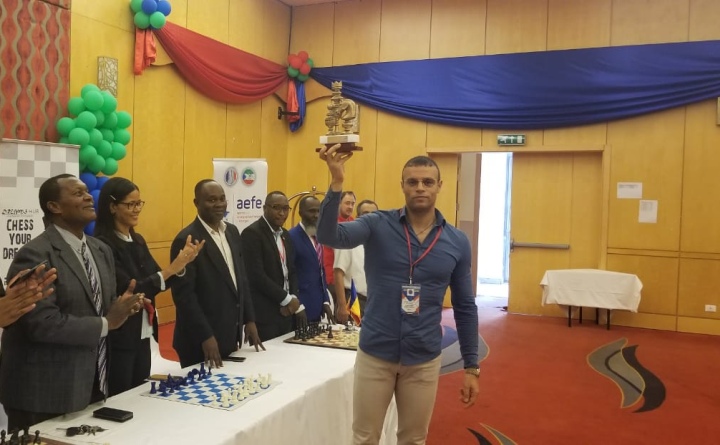
The FIDE Zone 4.3 Individual Championship took place in Bisila Palace Hotel in Malabo, Equatorial Guinea and brought together 15 contestants from Gabon, Cameroon, Burundi, Sao Tome and Principe, Chad and Equatorial Guinea. The list of participants included strong amateurs and a few titled and rated players, such as IM Marius Amba Oyon (Cameroon), CM Barthelemy Bongo Akanga (Gabon) and AFM Wilfried Ntamatungiro (Burundi). Officiated by chief arbiter Abdelfattah Akkour, his deputy Emile Ebongue and national arbiter Bernabé Oyono, the 9-round Swiss tournament stretched over seven days. Sergio Pereira entered the event as a rating favorite and did not disappoint. The untitled player from Sao Tome and Principe scored an impressive 8/9 and finished clear first a full point ahead of Marius Amba Oyon and Barthelemy Bongo Akanga, who tied for second position. Marius took second place thanks to a slightly better Buchholz, while Barthelemy, the only player to beat the champion, came third. Final standings: 1 Pereira, Sergio STP 2007 8 2 IM Amba, Oyon Marius CMR 1903 7 3 AFM Ntamatungiro, Wilfried BDI 1817 6½ 4 CM Bongo Akanga, Barthelemy GAB 1811 6 5 Oscar Naranjo Gonzalez GEQ 0 5½ 6 Akram, Yousouf Dahab CHA 1649 5 7 Nicolas Christopher Xavier GEQ 5 8 Abdelaziz Bokhit, Badjoiri CHA 1618 5 9 Mahamat Hachim Bachar CHA 1741 5 10 Jonathan Sima, Avene GEQ 5 Alongside the Zonal Individual Championship, a TRG seminar was held. It was conducted by FIDE Executive Director GM Victor Bologan, who covered eight important topics over twenty hours. Attendance was high, with fifteen 15 trainers from 3 countries interacting very actively, asking questions and giving comments. In the end, they all took the final exam. An Arbitres’ seminar was also offered by Mr Akkour Abdelfattah, with the attendance of three countries: Thad, Cameroon and the host country Equatorial Guinea. It concluded with an exam taken by the participants. During his short stay FIDE Executive Director met with one of the most important local authorities, the President of the National Olympic Committee of Equatorial Guinea, Mr Alejandro Martin Owono, to discuss Chess development in the country. From left to right: Federico Ele Rano, President of Malabo chess club; María Obono, Secretary of the Olympic Committee of Equatorial Guinea; Pedro Nguema Ebile, President of the Equatorial Guinea Chess Federation; Alejandro Martín Owono Evuna, President of the Olympic Committee of Equatorial Guinea; Victor Bologan, FIDE Executive Director; Paulina Oliveira Borupu, Vice President of the Olympic Committee of Equatorial Guinea During the meeting, GM Bologan stressed the steady progress of FENAGE, which over a few years has hit considerable milestones as a chess institution (2 FIDE congresses 2020 – 2022, one Olympiad full attendance and now organizing a Zonal Chess championship). He praised the existing collaboration between chess institutions FIDE/FENAGE and expressed his commitment to assisting and supporting the young federation. He also highlighted the rapid chess development and penetration in the country under the “Chess in Schools” and “Chess in Prisons” projects. Several exciting side events took place on the sixth day of the Zonal tournament, including a simul by GM Victor Bologan with ten random players at the French School of Malabo. Due to his tight schedule, GM Bologan played extremely quickly, rushing from one table to the other, despite the heat (38 degrees Celsius) and the generator’s intense noise (there was a blackout in the city). Thirty-five minutes after the initial move was made, all ten players capitulated, and an unexpected explosion of applauses and hoorays blasted from the crowd, recognizing an impressive performance by GM, who offered a short interview to the local media.
Chessable Publishing Schedule

Sponsored content The merger of Chess.com and the PlayMagnus Group has broken a ‘Berlin Wall’ in the chess community (no opening puns intended, of course!). Among the major beneficiaries of this momentous event: the improving chess player. Now free from ‘taking sides’, the world’s most influential chess instructors can spread their knowledge on all the major chess platforms, leveraging the technological power of these platforms for the most efficient and effective chess study possible. Chief among these platforms is Chessable, which harnesses the power of spaced repetition learning in its MoveTrainer® technology. Combining this powerful software with instructional content from the world’s finest chess players and coaches, users can learn and memorize openings, tactical patterns, and endgame skills faster and easier than ever before. Before the Chess.com merger, Chessable had already shown it could effectively pair its technology with top quality instructional content. In 2022, it launched courses from such superstars as GM Maurice Ashley, GM Levon Aronian, and even World Champion Magnus Carlsen. And with the merger complete, Chessable can already look forward to a bright 2023. That’s because it’s already struck deals to publish courses with premier Chess.com content creators such as IM Levy Rozman, the Botez Sisters, GM Daniel Naroditsky, and more. Chessable and Chess.com users can look forward to such course releases as early as this spring. They can also look out for opportunities to take part in Chessable’s new Masterclasses: 2-hour live, interactive chess lessons with renowned authors using Chessable’s Classroom tool. For more information, visit go.chessable.com/masterclass/. Those not yet familiar with Chessable can register completely free, and do so easily with their existing Chess.com or Google account. Simply go to chessable.com/ and get started today to select from more than 600 courses on the chess openings, tactics, endgames, and more.
Inspiring battles at Chess Olympiad for People with Disabilities
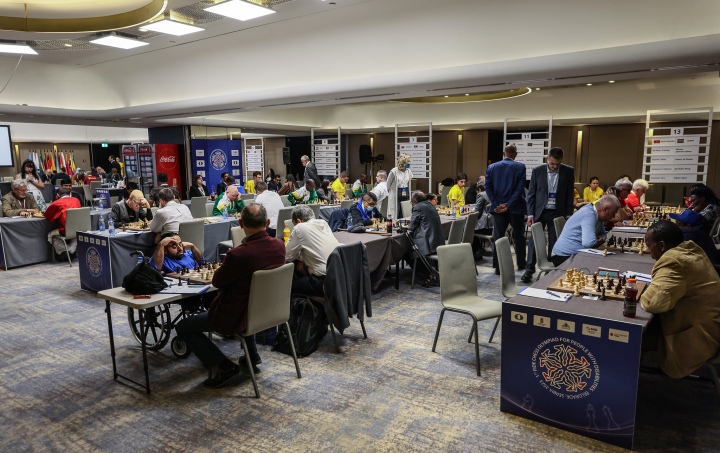
Following two days of competition, there are now six teams with a perfect score. However, for many, the socialising aspect and the atmosphere seem to be the most significant factor. The second day of the Olympiad started with the first move ceremony, carried out by Darija Kisic Tepavcevic, a doctor and epidemiologist who is currently serving as the Serbian minister of family welfare and demography. As a doctor, Darija Kisic Tepavcevic was intrigued by the event and discussed with FIDE President Arkady Dvorkovich how chess benefits people with disabilities. During the conversation, she posed a curious question – are the players in the event matched by their disability? That is a fair point as, arguably, a person with a hearing impairment is not in the same position as someone who is visually impaired or suffering from a severe physical disability. Thomas Luther, head of the FIDE Commission for players with disabilities, said that it would have been fair to match people based on their disabilities but that in such s case, we would have several mini-tournaments, and that wouldn’t be practical given the current circumstances. “This is the first Olympiad for people with disabilities, and for us, this is primarily about bringing everyone together as one, as a Family – which we are. Hopefully, in the future, we will have many hundreds or a thousand participants, and we can put each competitor in a group of people who have a similar disability”, Luther explained. Just two days into the event, the atmosphere in Belgrade is distinctive compared to typical chess events. Unlike in other top tournaments – especially those for the chess elite – where participants usually quickly depart the playing area after their game, at the Olympiad for people with disabilities, many players stick close to the playing area or sit together with their teammates or players from other countries to analyse their games. The ambience is reminiscent of a friendly chess club where everyone smiles and talks to each other. But still, while the atmosphere may be friendly, the games are serious. The twists and turns of Round 2 The top-seeded team of Poland got an early boost against the international squad of IPCA when IM Jacek Stachanczyk gave a lesson in opening tactics to Artem Andriienko from Ukraine: 13.Nd5! The pawn on b4 can’t be protected (13…a5 14.Bb5); capturing exd5 loses Queen (13…exd5 14.exd5+); and after 13…Nxd5 14.exd5 Qxd5 (14…Qc8/Qd7 15.Nb6) 15.Be4 the black bishop is lost. One of the youngest participants of this tournament in Belgrade chose not to suffer long and resigned right away. Later on, a draw was agreed on the first board, and FM Marcin Molenda extended the lead to 2.5:1.5, compensating for the loss of Pawel Piekielny against Eugenio Campos from Angola. Israel was ruthless with 3.5:0.5 against the first team of the host country, Serbia. Aleksandra Aleksandrova executed a swift mating attack, and Andrei Gurbanov demonstrated a temporary sacrifice to liquidate into a won endgame against Dragan Zivic: 25.Nb6+! Nxb6 26.Rxd8+ Kxd8 27.Bxd6+ Qxb6 28.Qe8+ Kc7 29.Qe5+ Bd6 30.Qg7+ Kb8 31.Qxh8+ and White won on move 34 1-0 The main upsets of the round were losses of the 3rd, 4th and 5th teams from the starting rating list. The international selection playing under the FIDE flag had an advantage in rating on two upper boards in the match with the 3rd-seed Hungary, and they used it. The main surprise, however, was created by the young Natasha Morales Santos from Puerto Rico, after surviving with her king locked down in the centre of the board: 32.Ne4 Bxe4 33.Bxe4 R5xe4+ 34.Qxe4 Bg5+ 35.Kxg5 Rxe4 36.Kf6 Re3 37.Rc1 Rf3+ 38.Ke7, and she outplayed the opponent rated 450 points higher to bring her team a victory by the score of 3:1! The 4th-seeded Croatia had a nightmare start on day one when they lost to Serbia’s second team. This time they were defeated by Uzbekistan 3:1, and the 5th seed Cuba lost 3:1 against the team from India. The second team of Serbia continued with its great run from the first day and scored another convincing victory. This time they confidently defeated Zimbabwe with 3.5:0.5 and surprisingly remained in the group of leaders. It shows how the difference in average rating matters little in a tough team competition such as this one. The next 3rd round will conclude the first half of the inaugural Chess Olympiad for people with disabilities, and some of the matches may already be of key importance, especially for those on the top of the standings: Poland – FIDE; India – Israel; Serbia 2 – Philippines and ICCD – Hungary. The full list of results from the second round can be found – here. The pairings of the third round can be found – here. “Chess gave me the opportunity to beat giants” Behind every player, there is a very big life story. Jesus Osorio (38) is a remarkable person from Panama. Despite having brittle bone disease, he has overcome many challenges and is pursuing his passion for chess. Inspired by his brother, a marathon runner, Jesus wanted to achieve something big, and at the age of 10, he picked up chess. Since then, he has dedicated his life to promoting the sport. Now, he has achieved his dream of representing Panama in the Chess Olympiad. “In chess, we are all on an equal playing field, and I’m grateful for the opportunity to be here.” Jesus is married and has two children, one of whom has a disability. He is also a TV show host, showcasing the world of chess, and has a popular TikTok channel in Panama dedicated to the sport. Chess has given Jesus a lot, and he shares his story with pride. “Chess is the only sport where there is no difference between an abled and disabled person. Chess gave me the opportunity to beat giants. This sport gave me the opportunity to challenge myself.” Through his interview with FIDE, Jesus shared his life and chess journey, inspiring us all with his determination and love for the game. By Milan Dinic (FIDE Press Officer) and Marjan Kovacevic (DIS reporter) Photos by Mark Livshitz About the event The
FIDE Circuit race: Anish Giri moves into the lead

Anish Giri is the new leader of the FIDE Circuit race following his excellent performance in the 2023 Tata Steel Masters. In a dramatic final round, the Dutchman leapfrogged Nodirbek Abdusattorov, who was leading most of the event and finished clear fist soaring to the top position in the race. Photo: tatasteelchess.com, Jurriaan Hoefsmit The top finishers in this competition, Nodirberk Abdusattorov and Magnus Carlsen round out the top three, while Wesley So, Fabiano Caruana and Parham Maghsoodloo earned enough points to make it into the top 10. There were plenty of FIDE Circuit points at stake in the 2023 Tata Steel Challengers as well. The winner of the event, Alexander Donchenko, mounted to fifth place whereas Mustafa Yilmaz, Javokhir Sindarov and Amin Tabatabaei are also among the top tenners. Photo: Azerbaijan Chess Federation Facebook Several tournaments counting toward the FIDE Circuit race ended in January. Although these competitions were not as big as Tata Steel events, their winners and top finishers picked up some points to get on the scoreboard. The national champions of India and Azerbaijan, Karthik Venkataraman and Vasif Durarbayli (pictured above), netted 6.43 and 6.83 points, respectively, while the winner of the IX Floripa Chess Open, Alan Pichot, gained 5.26 points. FIDE Circuit race top 10 as of January 31, 2023 1 Giri, Anish 2780 NED 27.00 2 Abdusattorov, Nodirbek 2734 UZB 20.25 3 Carlsen, Magnus 2852 NOR 20.25 4 So, Wesley 2766 USA 16.20 5 Donchenko, Alexander 2654 GER 13.33 6 Caruana, Fabiano 2766 USA 12.15 7 Maghsoodloo, Parham 2728 IRI 12.15 8 Yilmaz, Mustafa 2629 TUR 10.66 9 Sindarov, Javokhir 2661 UZB 9.33 10 Tabatabaei, Amin 2677 IRI 8.00 You can find FIDE Circuit overall standings on ratings.fide.com/circuit.phtml At the end of 2022, FIDE Council approved a major reform of the qualification paths to the Candidates Tournament – the event that decides the challenger for the World Championship match. One of the paths is the newly created FIDE Circuit (Path D). The player accumulating the most points during 2023 in eligible tournaments qualifies for the 2024 Candidates Tournament. The final score is calculated as the sum of the player’s five highest results.
Olympiad for People with Disabilities Round 1: From dreams to reality
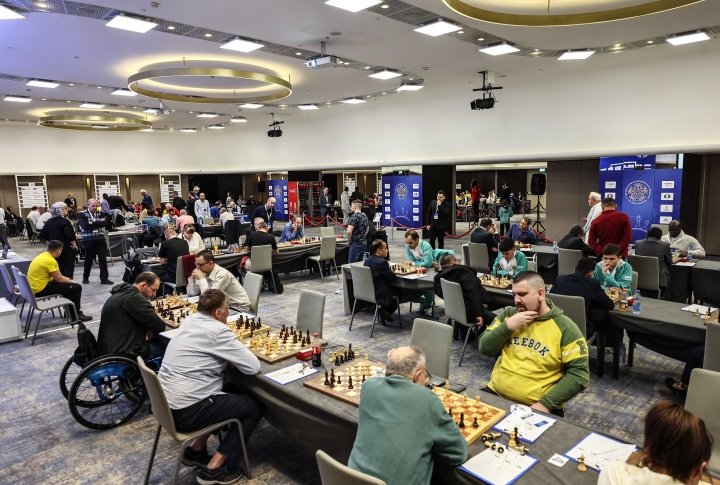
The chess part of the journey of the first Chess Olympiad for People with Disabilities started with the first round kicking off in Belgrade, Serbia A milestone moment in chess history occurred on January 30, 2023, shortly after 3 PM CET, when the opening move of the first Olympiad for players with disabilities was played in the main hall of Belgrade’s Crowne Plaza hotel. “This is the beginning of a new era of inclusion in chess, as players with disabilities started their first ever paralympic event,” said Thomas Luther, head of the FIDE Commission for players with disabilities. In chess, the ceremonial first move at the start of the tournament is a long-standing tradition, usually carried out by a high-ranking government official, FIDE President, key sponsor, or famous player. In the opening round, the spotlight was given to those who don’t often have it, as Grandmaster Thomas Luther, head of the FIDE Commission for players with disabilities, in the presence of FIDE President Arkady Dvorkovich, made the first move in the match between Venezuela and Israel. “This is really a touching moment for me. This is a dream of my life to have this Olympiad take place, and for so many years, many friends worked for this to happen, and now the tournament has started. I feel overjoyed”, Thomas Luther said immediately afterwards. Luther also noted that statistically, 15% of all people have a disability and that chess is a perfect game and the perfect sport for them. “For many of these players, chess is a way to enter a social life. By playing this game, these people really have a life”, said Luther. Joining the ceremony, but on the first board in the match between Poland and Germany, the honour of making the first move was given to Nikola Selakovic, Minister of Labour, Employment, Veterans and Social Affairs of the Government of Serbia. A sign of how seriously the Serbian government took its commitment to supporting this event is signalled by the fact that it is planned that every day at least one high-ranking state official will visit the Olympiad or even take part in the first-move ceremony. The President of FIDE, Arkady Dvorkovich, was optimistic about what this event means for inclusion in chess. “FIDE has a long history of supporting players with disabilities. Some of them were able to take part in previous Olympiads. We thought they deserved better – to be the full-scale participants and have their own event. This is the first step to making high-level chess accessible for our family members… This is just the first step in a very long journey to have chess fully inclusive for all the players, regardless of their disabilities”, Arkady Dvorkovich said in an interview. Dvorkovich plans to stay in Belgrade for the duration of the event, which is unusual when compared to other tournaments. “This time, it’s special, and I thought I should be here and make our partners and sponsors confident that for us, this is a real priority”, he explained. The President of FIDE expressed hope that the next Olympiad for people with disabilities will have at least 50 countries taking part. Games and results of the first round After an intensive first day of the Olympiad, all the favourites scored victories save Croatia. Poland, the rating favourites at this event, started confidently defeating Germany 3:1. The match wasn’t that easy, as the difference in average rating had initially suggested. On the third board, Matthias Dorner scored the only win for the German squad, using the right moment for a nice temporary piece sacrifice in the middlegame: 29…Nxc5! winning a pawn as 30.dxc5 is met with 30…Re2! Woman FIDE Master Aleksandra Aleksandrova brought the first victorious point to second seed Israel, but Venezuela put a strong resistance. After the draw was agreed on the third board, with two long-lasting endgames on the top boards, Alexey Streltsov defeated Harlen Jose Otero Munelo, securing the key victorious point for Israel in the match. A nice mating final was executed by Attila Paal-Szucz in the match Hungary – Turkey: 29.Rxe5! fxe5 30.Rf7 Re8 31.Qxe5! (31…Qxe5 32.Rh7#) 1-0 The 3rd seed players had to work hard for the 3:1 victory when Suleyman Saltik won against the opponent with over 400 points advantage in rating! The first day of the Olympiad saw the first big surprise: the second team of the host country, Serbia, staged an upset as they defeated the seasoned team of Croatia, 2.5:1.5. Also, the team of Zimbabwe – which has an average ELO of 1363 – drew with the team of the International Chess Committee of the Deaf (ICCD), which has two players with an ELO of above 2000. The full list of results from the first round can be found – here. The pairings of the second round can be found – here. Report by Press Officer Milan Dinic Photos by Mark Livshitz About the event The Chess Olympiad for People with Disabilities, a six-round Swiss tournaemnt is played at the Crowne Plaza Hotel in Belgrade, Serbia. The time control is 90 minutes for the first 40 moves, followed by 30 minutes for the rest of the game, with an addition of 30 seconds per move starting from move one. The default time is 15 minutes. The second round starts on Tuesday, January 31, at 3 PM CET time. For more about chess for people with disabilities, you can go to the official website of the Players with Disabilities Commission: dis.fide.com/ You can find more information on the official website: dis-olympiad.fide.com/ About NIS NIS (Petroleum Industry of Serbia) is one of the largest vertically integrated energy companies in Southeast Europe. Its core business includes exploration, production and refining of crude oil and natural gas, sales and distribution of a wide range of petroleum products, as well as implementing projects related to petrochemical operations and power generation. One of the NIS’ strategic commitments and fundamental practices is continuous improvement of the living standard of communities of the company’s operation. NIS also attaches immense importance to setting an example and supporting development of professional and children’s sport.
Azerbaijan Championship: Vasif Durarbayli clinches second title

It became a tradition that the national championship is the year’s first competition in Azerbaijan. The two-stage event with a total prize fund of 25,000 AZN took place in Baku from January 13-28. Although the top Azerbaijani players Mamedyarov, Radjabov, Mamedov, and Guseinov did participate, the tournament brought together eight grandmasters and four international masters. With the top eight players having an average rating of 2568, the competition counts towards the FIDE Circuit. Many young players took part in the competition, with 30-year-old Vasif Durarbayli being the oldest participant. On the other end of the spectrum was the 12-year-old runner-up of the European Youth Championship, Khagan Ahmad. The first stage of the competition was a 9-round Swiss tournament with classical time control. The top four finishers – Vasif Durarbayli (7/9), Vugar Asadli (6.5/9), Mahammad Muradli (6.5/9) and Eltaj Safarli (6.5/9) – advanced to the playoffs to determine the champion. In the two-game semifinals (with rapid and blitz if needed), the winner of the first stage, Durarbayli, beat Safarli 1.5-0.5, while Asadli whitewashed Muradli 2-0. Both the final and the match for the bronze medal were very close battles. Asadli won the first game in the final and needed just a draw in the second one to secure the title, but Durarbayli stormed back and sent the match to the rapid games. Vasif Durarbayli dominated in the faster format, winning both encounters and clinching his second national title. In the match for third place after three straight draws, Safarli delivered in the fourth encounter and took bronze. Photo: Azerbaijan Chess Federation Facebook Official website: asf.org.az/en
Tolerance Games, Asian Chess Women’s Contest announced
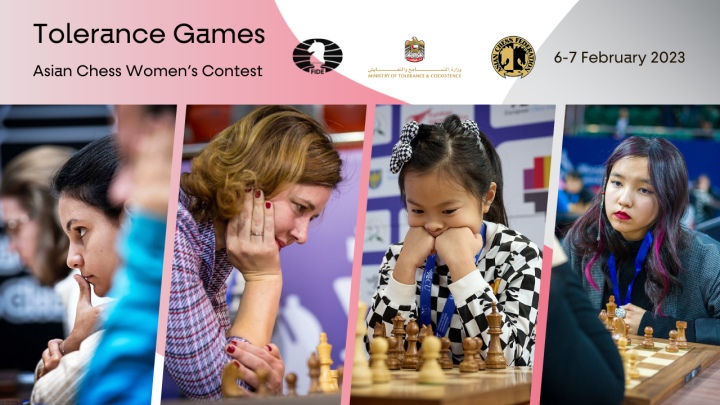
UAE Ministry of Tolerance and Coexistence, International Chess Federation, and Asian Chess Federation are pleased to announce the Tolerance Games – Asian Chess Women’s Contest that will take place from February 06-07, 2023, in Abu-Dhabi, UAE. The event will be held as a part of the Global Tolerance and Human Fraternity Summit in Etihad Towers. Girls and ladies from Asia and all around the world are welcome to participate in various activities, from playing chess to learning about the empowerment chess gives to women and society. Program of the Tolerance Games: February 06, 2023 10:30 – 11:30 – Opening ceremony 11:30 – 12:30 – “Little Chess Star” Chess Tournament (8 invited girls play two qualification tournaments, followed by the final match for the first and second place.) 11:30 – 13:30 – Session with a coach “Learn to play in one hour” for all the guests. 13:00 – 13:45 – Grand Final of “Little Chess Star” Chess Tournament (Two finalists will play the mini-match for the first and second place). 17:00 – 20:30 – Open Asian Women Blitz Chess Tournament (7 rounds blitz tournament (time control: 5min + 3sec) for up to 100 female chess players). 17:30 – 19:30 – Leadership workshop “Women and Chess – Promoting Tolerance & Women Empowerment” featuring Anastasia Sorokina, Chair of FIDE Commission for Women in Chess; Dana Reizniece-Ozola, Women chess grandmaster, politician, FIDE Deputy Chair of Management Board; Anastasia Karlovich, WIM, Ukrainian chess journalist and photographer. February 07, 2023 10:00 – 11:00 – Simultaneous Game Exhibition with invited Women Chess Grandmaster 12:00 – 12:30 – Closing ceremony of “Little Chess Stars Tournament” and Open Asian Women Blitz Chess Tournament All Asian female players are welcome to participate in the Open Asian Women Blitz Chess Tournament. Players may register online at chess-results.com/anmeldung.aspx?lan=1&ggid=719754 The playing venue of the event is Etihad Towers, Abu Dhabi. The tournament will be held on 6 February 2023 as follows: Technical Meeting 16:00 Round 1 17:00Round 2 17:30Round 3 18:00Round 4 18:30Round 5 19:00Round 6 19:30Round 7 20:00 Time control for each player per game is 5 minutes + 3 seconds for each move, starting with the first one. The winner is determined by the highest number of points scored. In case of equality of points, the winner is determined by application of the tie-breaking criteria: ◦ Direct encounter◦ Number of games won◦ Number of Games won with the Black Pieces◦ Buchholz System The winners will receive trophies and share AED 21,000 in cash prizes, with AED 7,000 going to the winner.