

FIDE Circuit race: Anish Giri moves into the lead

Anish Giri is the new leader of the FIDE Circuit race following his excellent performance in the 2023 Tata Steel Masters. In a dramatic final round, the Dutchman leapfrogged Nodirbek Abdusattorov, who was leading most of the event and finished clear fist soaring to the top position in the race. Photo: tatasteelchess.com, Jurriaan Hoefsmit The top finishers in this competition, Nodirberk Abdusattorov and Magnus Carlsen round out the top three, while Wesley So, Fabiano Caruana and Parham Maghsoodloo earned enough points to make it into the top 10. There were plenty of FIDE Circuit points at stake in the 2023 Tata Steel Challengers as well. The winner of the event, Alexander Donchenko, mounted to fifth place whereas Mustafa Yilmaz, Javokhir Sindarov and Amin Tabatabaei are also among the top tenners. Photo: Azerbaijan Chess Federation Facebook Several tournaments counting toward the FIDE Circuit race ended in January. Although these competitions were not as big as Tata Steel events, their winners and top finishers picked up some points to get on the scoreboard. The national champions of India and Azerbaijan, Karthik Venkataraman and Vasif Durarbayli (pictured above), netted 6.43 and 6.83 points, respectively, while the winner of the IX Floripa Chess Open, Alan Pichot, gained 5.26 points. FIDE Circuit race top 10 as of January 31, 2023 1 Giri, Anish 2780 NED 27.00 2 Abdusattorov, Nodirbek 2734 UZB 20.25 3 Carlsen, Magnus 2852 NOR 20.25 4 So, Wesley 2766 USA 16.20 5 Donchenko, Alexander 2654 GER 13.33 6 Caruana, Fabiano 2766 USA 12.15 7 Maghsoodloo, Parham 2728 IRI 12.15 8 Yilmaz, Mustafa 2629 TUR 10.66 9 Sindarov, Javokhir 2661 UZB 9.33 10 Tabatabaei, Amin 2677 IRI 8.00 You can find FIDE Circuit overall standings on ratings.fide.com/circuit.phtml At the end of 2022, FIDE Council approved a major reform of the qualification paths to the Candidates Tournament – the event that decides the challenger for the World Championship match. One of the paths is the newly created FIDE Circuit (Path D). The player accumulating the most points during 2023 in eligible tournaments qualifies for the 2024 Candidates Tournament. The final score is calculated as the sum of the player’s five highest results.
Olympiad for People with Disabilities Round 1: From dreams to reality
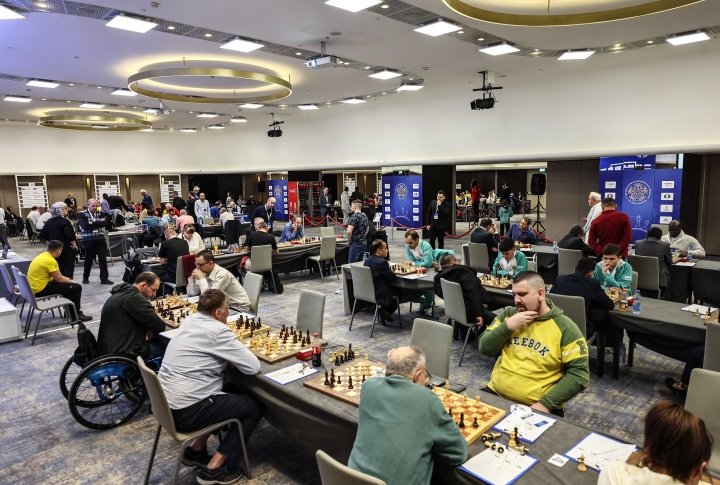
The chess part of the journey of the first Chess Olympiad for People with Disabilities started with the first round kicking off in Belgrade, Serbia A milestone moment in chess history occurred on January 30, 2023, shortly after 3 PM CET, when the opening move of the first Olympiad for players with disabilities was played in the main hall of Belgrade’s Crowne Plaza hotel. “This is the beginning of a new era of inclusion in chess, as players with disabilities started their first ever paralympic event,” said Thomas Luther, head of the FIDE Commission for players with disabilities. In chess, the ceremonial first move at the start of the tournament is a long-standing tradition, usually carried out by a high-ranking government official, FIDE President, key sponsor, or famous player. In the opening round, the spotlight was given to those who don’t often have it, as Grandmaster Thomas Luther, head of the FIDE Commission for players with disabilities, in the presence of FIDE President Arkady Dvorkovich, made the first move in the match between Venezuela and Israel. “This is really a touching moment for me. This is a dream of my life to have this Olympiad take place, and for so many years, many friends worked for this to happen, and now the tournament has started. I feel overjoyed”, Thomas Luther said immediately afterwards. Luther also noted that statistically, 15% of all people have a disability and that chess is a perfect game and the perfect sport for them. “For many of these players, chess is a way to enter a social life. By playing this game, these people really have a life”, said Luther. Joining the ceremony, but on the first board in the match between Poland and Germany, the honour of making the first move was given to Nikola Selakovic, Minister of Labour, Employment, Veterans and Social Affairs of the Government of Serbia. A sign of how seriously the Serbian government took its commitment to supporting this event is signalled by the fact that it is planned that every day at least one high-ranking state official will visit the Olympiad or even take part in the first-move ceremony. The President of FIDE, Arkady Dvorkovich, was optimistic about what this event means for inclusion in chess. “FIDE has a long history of supporting players with disabilities. Some of them were able to take part in previous Olympiads. We thought they deserved better – to be the full-scale participants and have their own event. This is the first step to making high-level chess accessible for our family members… This is just the first step in a very long journey to have chess fully inclusive for all the players, regardless of their disabilities”, Arkady Dvorkovich said in an interview. Dvorkovich plans to stay in Belgrade for the duration of the event, which is unusual when compared to other tournaments. “This time, it’s special, and I thought I should be here and make our partners and sponsors confident that for us, this is a real priority”, he explained. The President of FIDE expressed hope that the next Olympiad for people with disabilities will have at least 50 countries taking part. Games and results of the first round After an intensive first day of the Olympiad, all the favourites scored victories save Croatia. Poland, the rating favourites at this event, started confidently defeating Germany 3:1. The match wasn’t that easy, as the difference in average rating had initially suggested. On the third board, Matthias Dorner scored the only win for the German squad, using the right moment for a nice temporary piece sacrifice in the middlegame: 29…Nxc5! winning a pawn as 30.dxc5 is met with 30…Re2! Woman FIDE Master Aleksandra Aleksandrova brought the first victorious point to second seed Israel, but Venezuela put a strong resistance. After the draw was agreed on the third board, with two long-lasting endgames on the top boards, Alexey Streltsov defeated Harlen Jose Otero Munelo, securing the key victorious point for Israel in the match. A nice mating final was executed by Attila Paal-Szucz in the match Hungary – Turkey: 29.Rxe5! fxe5 30.Rf7 Re8 31.Qxe5! (31…Qxe5 32.Rh7#) 1-0 The 3rd seed players had to work hard for the 3:1 victory when Suleyman Saltik won against the opponent with over 400 points advantage in rating! The first day of the Olympiad saw the first big surprise: the second team of the host country, Serbia, staged an upset as they defeated the seasoned team of Croatia, 2.5:1.5. Also, the team of Zimbabwe – which has an average ELO of 1363 – drew with the team of the International Chess Committee of the Deaf (ICCD), which has two players with an ELO of above 2000. The full list of results from the first round can be found – here. The pairings of the second round can be found – here. Report by Press Officer Milan Dinic Photos by Mark Livshitz About the event The Chess Olympiad for People with Disabilities, a six-round Swiss tournaemnt is played at the Crowne Plaza Hotel in Belgrade, Serbia. The time control is 90 minutes for the first 40 moves, followed by 30 minutes for the rest of the game, with an addition of 30 seconds per move starting from move one. The default time is 15 minutes. The second round starts on Tuesday, January 31, at 3 PM CET time. For more about chess for people with disabilities, you can go to the official website of the Players with Disabilities Commission: dis.fide.com/ You can find more information on the official website: dis-olympiad.fide.com/ About NIS NIS (Petroleum Industry of Serbia) is one of the largest vertically integrated energy companies in Southeast Europe. Its core business includes exploration, production and refining of crude oil and natural gas, sales and distribution of a wide range of petroleum products, as well as implementing projects related to petrochemical operations and power generation. One of the NIS’ strategic commitments and fundamental practices is continuous improvement of the living standard of communities of the company’s operation. NIS also attaches immense importance to setting an example and supporting development of professional and children’s sport.
Azerbaijan Championship: Vasif Durarbayli clinches second title

It became a tradition that the national championship is the year’s first competition in Azerbaijan. The two-stage event with a total prize fund of 25,000 AZN took place in Baku from January 13-28. Although the top Azerbaijani players Mamedyarov, Radjabov, Mamedov, and Guseinov did participate, the tournament brought together eight grandmasters and four international masters. With the top eight players having an average rating of 2568, the competition counts towards the FIDE Circuit. Many young players took part in the competition, with 30-year-old Vasif Durarbayli being the oldest participant. On the other end of the spectrum was the 12-year-old runner-up of the European Youth Championship, Khagan Ahmad. The first stage of the competition was a 9-round Swiss tournament with classical time control. The top four finishers – Vasif Durarbayli (7/9), Vugar Asadli (6.5/9), Mahammad Muradli (6.5/9) and Eltaj Safarli (6.5/9) – advanced to the playoffs to determine the champion. In the two-game semifinals (with rapid and blitz if needed), the winner of the first stage, Durarbayli, beat Safarli 1.5-0.5, while Asadli whitewashed Muradli 2-0. Both the final and the match for the bronze medal were very close battles. Asadli won the first game in the final and needed just a draw in the second one to secure the title, but Durarbayli stormed back and sent the match to the rapid games. Vasif Durarbayli dominated in the faster format, winning both encounters and clinching his second national title. In the match for third place after three straight draws, Safarli delivered in the fourth encounter and took bronze. Photo: Azerbaijan Chess Federation Facebook Official website: asf.org.az/en
Tolerance Games, Asian Chess Women’s Contest announced
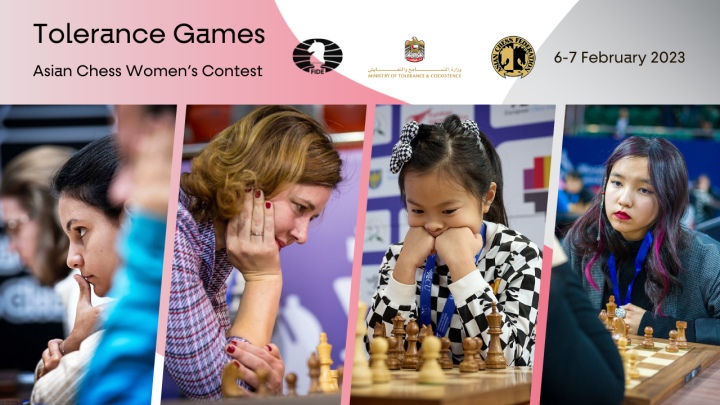
UAE Ministry of Tolerance and Coexistence, International Chess Federation, and Asian Chess Federation are pleased to announce the Tolerance Games – Asian Chess Women’s Contest that will take place from February 06-07, 2023, in Abu-Dhabi, UAE. The event will be held as a part of the Global Tolerance and Human Fraternity Summit in Etihad Towers. Girls and ladies from Asia and all around the world are welcome to participate in various activities, from playing chess to learning about the empowerment chess gives to women and society. Program of the Tolerance Games: February 06, 2023 10:30 – 11:30 – Opening ceremony 11:30 – 12:30 – “Little Chess Star” Chess Tournament (8 invited girls play two qualification tournaments, followed by the final match for the first and second place.) 11:30 – 13:30 – Session with a coach “Learn to play in one hour” for all the guests. 13:00 – 13:45 – Grand Final of “Little Chess Star” Chess Tournament (Two finalists will play the mini-match for the first and second place). 17:00 – 20:30 – Open Asian Women Blitz Chess Tournament (7 rounds blitz tournament (time control: 5min + 3sec) for up to 100 female chess players). 17:30 – 19:30 – Leadership workshop “Women and Chess – Promoting Tolerance & Women Empowerment” featuring Anastasia Sorokina, Chair of FIDE Commission for Women in Chess; Dana Reizniece-Ozola, Women chess grandmaster, politician, FIDE Deputy Chair of Management Board; Anastasia Karlovich, WIM, Ukrainian chess journalist and photographer. February 07, 2023 10:00 – 11:00 – Simultaneous Game Exhibition with invited Women Chess Grandmaster 12:00 – 12:30 – Closing ceremony of “Little Chess Stars Tournament” and Open Asian Women Blitz Chess Tournament All Asian female players are welcome to participate in the Open Asian Women Blitz Chess Tournament. Players may register online at chess-results.com/anmeldung.aspx?lan=1&ggid=719754 The playing venue of the event is Etihad Towers, Abu Dhabi. The tournament will be held on 6 February 2023 as follows: Technical Meeting 16:00 Round 1 17:00Round 2 17:30Round 3 18:00Round 4 18:30Round 5 19:00Round 6 19:30Round 7 20:00 Time control for each player per game is 5 minutes + 3 seconds for each move, starting with the first one. The winner is determined by the highest number of points scored. In case of equality of points, the winner is determined by application of the tie-breaking criteria: ◦ Direct encounter◦ Number of games won◦ Number of Games won with the Black Pieces◦ Buchholz System The winners will receive trophies and share AED 21,000 in cash prizes, with AED 7,000 going to the winner.
Breaking barriers: Inaugural Chess Olympiad for People with Disabilities opens in Belgrade

In the historic building of the National Assembly of Serbia, players from all continents, FIDE officials, members of the Serbian government, chess celebrities and guests gathered to inaugurate the first-ever Chess Olympiad for people with disabilities. The Serbian National Assembly building is a majestic and breathtaking structure. It has been the epicentre of many historic decisions and events which shaped Southeast Europe and, this evening, it was a place where new pages of chess history were written. The International Chess Federation (FIDE) and the chess world have come together to recognize the importance of chess in helping people with disabilities to overcome their challenges and achieve their full potential. In the central hall of the Assembly building, usually reserved for presidents, Prime Ministers, monarchs and politicians, the chess world – represented by about 150 admirers of the game from various backgrounds and cultures – took centre stage. The ceremony began with a short video about the previous important events in chess history tied to the capital of Serbia (once, Yugoslavia); to name a few: the days when all top world players and champions in the second part of the 20th century often played in the city, to the huge crowds gathering at the Palace of Unions (which sits just diagonally across the Assembly building) where the first match USSR vs The Rest of the World took place in 1970, to the Fischer-Spassky match in 1992. The video was subtitled, and there were also sign language interpreters for people hard of hearing. “Chess is one of the most inclusive sports in the world” Following the video, FIDE President Arkady Dvorkovich, as well as the Deputy CEO of the Serbian energy company “NIS Serbia” Vadim Smirnov, the Serbian Minister for Sports Zoran Gajic, as well as the President of the Serbian chess federation Dragan Lazic, addressed the audience. FIDE president Arkady Dvorkovich said that the chess community came together to make this event possible, recognizing the power of chess in helping individuals with disabilities achieve their full potential. “This is the first ever Chess Olympiad organized by FIDE for players who have disabilities but who are very much able to play chess and able to live their proud lives”, Dvorkovich said. He thanked the Serbian government for the support and pointed out that it took “just a few minutes” for the Prime Minister Ana Brnabic and the minister of Sport Zoran Gajic to decide that Serbia would host the event. “Chess is one of the most inclusive sports in the world, and we are proud of that. Children and, seniors, people from any background, are playing chess without any obstacles. We will continue to support this great journey”, the FIDE President said. Dvorkovich also made reference to the Serbian tennis player Novak Djokovic who today won the Australian Open and became the absolute best tennis player in tennis history, noting that Serbia is a country of sport. “Serbia – the country of sport” Zoran Gajic, the Serbian minister of sport and a well-known person in the volleyball world who won several medals as a coach in Olympic, world, and European events, reiterated Dvorkovich’s concluding statement. “Welcome to Serbia – the country of sport”, Gajic said, noting that his country is very honoured to be hosting this event, the first ever in history. As a country of sports, Serbia wants to use this event to promote sports among people with disabilities. Although Serbia is a country of Novak Djokovic, Nikola Jokic, and other great players, we also respect our great Grandmasters – Svetozar Gligoric, Ljubomir Ljubojevic and Alisa Maric and others, and we want to share that with everyone”. Sport is a deeply ingrained part of the Serbian culture and has a long-standing tradition in the country. While basketball and football (soccer) are among the most popular sports, chess is very widespread. Despite having roughly 7,5 million people, Serbia is among the top five countries in the world (with Russia, Germany, the US and Spain) with the largest number of titled chess players. “Chess as a part of a healthy lifestyle” Vadim Smirnov, the deputy CEO of NIS Serbia, one of the key sponsors of the event, emphasized the importance of chess as a part of a healthy lifestyle. “NIS is a family of 12.000 employees [in Serbia], and a healthy lifestyle is a part of our values. We will always support sports, and children’s sports in particular. Chess teaches you work and fair play, and those are the values very important in our business. We strongly believe in equality for the whole world, in sports and among us as people”, Smirnov said. Dragan Lazic, the President of the Serbian chess federation, thanked FIDE for choosing Serbia as the place for the first Olympiad for people with disabilities and expressed hope that in the next years, the country will also host a chess Olympiad. Following the drawing of lots, Poland – the top seed team – will start the tournament with white pieces. The link between chess, volleyball and the meaning of life Zoran Gajic, the Serbian minister of sport, is a renowned coach in volleyball and has won many medals, including in the Olympics. In an interview for FIDE, he pointed out the link between chess and volleyball. “Mathematics, geometry, physical laws and natural sciences, logical way of thinking – these are all elements that are very important in the preparation of volleyball and general sports teams and all link back to chess. Not to mention the statistical method of opponent analysis, analysis of one’s matches, training, level of training and recovery of athletes… All this must be predicted a few moves in advance. In our sport (in volleyball), there are terms such as a player’s career, a four-year Olympic cycle, mesocycles, and micro cycles… These are periods that are planned in order to be organized. Everything I said reminds irresistibly of chess.” He also noted that chess is a great metaphor for the meaning of life: “A life path to success is
Anish Giri wins Tata Steel Masters 2023

In a dramatic turn of events, Anish Giri beat Richard Rapport and leapfrogged Nodirberk Abdusattorov, who suffered a painful defeat at the hands of Jorden Van Foreest. Anish finished a half-point ahead of Nodirbek and won his home tournament for the first time in his career. Magnus Carlsen outplayed Arjun Erigaisi and tied for second place with Abdusattorov but came third due to inferior tiebreaks. Parham Maghsoodloo also ended on a high note besting Levon Aronian. Anish Giri – Richard Rapport 1-0 Richard Rapport essayed a rare line 6…g6 in the Sicilian Rauzer allowing White to disrupt his pawn structure. Black timely played thematic f6-f5 and nearly equalized but Giri still had a slight edge. Anish got a chance to increase his advantage with 29.Bxe6 followed by 30.h4, but after the Dutchman opted for innocuous 29.Bd5, the worst was behind Rapport. Giri tried the last push in an equal position, and surprisingly, it worked out for him. After 34…Kg8 (Kh8, Kh7 Kf8) Black is out of danger, but Richard chose the only self-defeating square 34…Kg6?? apparently missing 35.Rxd6! Black’s position collapsed, and he capitulated just a few moves later after 35…Kg5 36. Rd5 Qe1+ 37. Kg2 Be7 38. Rxf5+ Kh4 39. Qg3+ 1-0 Nodirbek Abdusattorov – Jorden Van Foreest 0-1 The game saw a rare line of the Sicilian Taimanov in which White traded the queens and steered into a slightly better maneuvering endgame. With 16.g5 followed by 17.f4 Nodirbek shut down Black’s g8-knight but made some positional concessions of the e5-square and potentially weak g5-pawn. White should have struck on the queenside with a2-a4 at some point, but Abdusattorov continued maneuvering instead. Later on, he planted one of his knights on f6 but then committed a serious inaccuracy by trading it for Black’s passive g8-knight. Little by little, Van Foreest got to White’s weak pawns, inflicted defeat on the leader, and helped his compatriot win the event. Arjun Erigaisi – Magnus Carlsen 0-1 Eager to win, Carlsen opted for the double fianchetto and got an offbeat, fresh position, which gradually transformed into King’s Indian type of structure. Erigaisi played somewhat sluggishly and allowed Magnus to grab initiative with 17…a4, but the World Champion missed this chance, and the position became equal again. In the subsequent play, White gradually evacuated his king to the queenside while Black sacrificed a piece on g4 for two pawns and got full compensation and good practical chances. Arjun held his ground for quite a while, but after passing the time control, he lost his way, returned a piece in a wrong situation (he could have done it earlier, maintaining equality) and found himself in a hopeless position. The final portion of the game was a smooth sail for Carlsen, who won effortlessly. Ding Liren – Fabiano Caruana ½–½ The opponents decided to leave the tournament behind as soon as possible in made a quick draw in the Ruy Lopez. Praggnanandhaa R – Wesley So ½–½ The American played his pet Semi-Tarrasch line in which Black sacrificed a pawn for the initiative. The opponents seemed to follow their home preparation for quite a while, but when the dust settled, an equal endgame emerged on the board. White managed to win a pawn, but it did not change the evaluation of the position even by a fraction, and the opponents shook hands on move 44. Levon Aronian – Parham Maghsoodloo 0-1 The opponent tested a popular line of the Sicilian Najdorf in which White got an edge after Black wasted a couple of tempi with Nf6-e8-f6. In the following maneuvering Levon played somewhat hesitantly and let his opponent make the thematic exchange sacrifice on c3. Black got some compensation but hardly more. However, just a few moves later, Levon miscalculated and played 26.c3? hoping to regain the pawn after 26…dxc3 later on. It was not the case, though, as Parham clung to this pawn, which eventually cost White an exchange. Soon it came down to a queen endgame where Black’s a-pawn freely advanced to a2, forcing Aronian to capitulate. Vincent Keymer – Gukesh D ½–½ The Indian mixed up two plans in the Nimzo-Indian, and the German immediately grabbed the initiative by striking in the center. However, to keep the ball rolling, Keymer had to find a quite unorthodox move 15.Qb3! allowing Black to ruin his pawn structure on the kingside. Vincent did not, and the opponents quickly traded most of the pieces and sealed the piece in a dead-equal position. Final standings: 1. Anish Giri – 8.5; 2. Nodirbek Abdusattorov – 8; Magnus Carlsen – 8; 4. Wesley So – 7.5; 5. Fabiano Caruana – 7; 6. Parham Maghsoodloo – 7; 7. Levon Aronian – 6.5; 8. Richard Rapport – 6.5; 9. Rameshbabu Praggnanandhaa – 6; 10. Jorden Van Foreest – 6; 11. Ding Liren 5.5; 12. Gukesh D – 5.5; 13. Vincent Keymer – 5; 14. Arjun Erigaisi – 4. Alexander Donchenko (pictured above, right) emerged as the winner of the Tata Steel Challengers after beating Velimir Ivic in the final round. The champion scored 10/13, finished a point clear of Mustafa Yilmaz and punched his ticket to the next year Tata Steel Masters next year. Stefan Beukema won the Amateur section and qualified for the Challengers next year. Official website: tatasteelchess.com Photos: tatasteelchess.com, Jurriaan Hoefsmit and Lennart Ootes
Top female chess in Munich

By IM Michael Rahal (Barcelona, Spain) The second event of the 2022-2023 Women’s Grand Prix Series will kick off in a few days in Munich, the capital of the state of Bavaria. Twelve of the world’s top female players will dispute an eleven-round all-play-all with their eyes set on the 15,000 euros first prize plus the valuable WGP points that add up for direct qualification to the 2023-2024 FIDE Women’s Candidates. After Berlin and Hamburg, Munich is the third-largest city in Germany, with a population of more than 1.5 million inhabitants. A global centre for science, technology, business and finance, Munich enjoys a high standard and quality of living and is consistently ranked as one of the world’s most liveable cities. Many multinational companies are located in the city, such as BMW, Siemens or Allianz, along with two research universities and world-renowned technology and science museums like the Deutsches Museum and BMW Museum. Its annual Oktoberfest, featuring a beer festival and a travelling carnival, is the world’s largest “people’s festival “, and attracts considerable tourism in late September. Photo: Thomas Wolf Home to one of the Bundesliga’s top teams – FC Bayern München, fielding GM’s Maghsoodloo, Tabatabaei and Huschenbeth – the event will be held in the centrally located five-star luxury Vier Jahreszeiten Kempinski hotel, situated directly in the city centre of Munich, very close to the Opera and Marienplatz. The tournament’s principal sponsor is the Krulich Immobilien Group, a real estate company based in Munich with branches in Berlin, Dresden, Leipzig and Zwickau. Roman Krulich, a former Munich Youth Champion, has been a long-time supporter and sponsor of chess events. A strong +2200 club player in his own right, he represented Monaco in the 2008 Dresden Chess Olympiad. As the founder of the Munich Chess Academie and the Munich Chess Foundation, he supports the development of chess in schools, chess for refugees and chess for the elderly. According to the rules of the series, each of the four WGP events will attract twelve of the sixteen players. The Munich participants, sorted by rating, are: GM Koneru Humpy (2572 – India) GM Tan Zhongyi (2530 – China)GM Maria Muzychuk (2523 – Ukraine)GM Anna Muzychuk (2522 – Ukraine)GM Alexandra Kosteniuk (2519 – FIDE)GM Nana Dzagnidze (2517 – Georgia)GM Harika Dronavalli (2507 – India)GM Zhansaya Abdumalik (2496 – Kazakhstan)IM/WGM Alina Kashlinskaya (2491 – Poland)WGM Zhu Jiner (2486 – China)GM Elisabeth Paehtz (2464 – Germany)WGM Dinara Wagner (2413 – Germany) The first round, scheduled for Thursday, February 2nd, already features some very cool match-ups. As per the rules, players of the same federation must dispute their games at the beginning of the tournament: Harika Dronavalli vs Koneru Humpy Maria Muzychuk vs Anna Muzychuk Alexandra Kosteniuk vs Alina Kashlinskaya Tan Zhongyi vs Zhu Jiner Elisabeth Paehtz vs Dinara Wagner Zhansaya Abdumalik vs Nana Dzagnidze The total prize fund for each leg will be €80,000, with another €80,000 being distributed among the top 8 finishers in the global Women’s Grand Prix Series standings, according to the cumulative points they score across the four events. Official website: womengrandprix.fide.com/
Tata Steel Chess Masters: Abdusattorov leads going into the final round
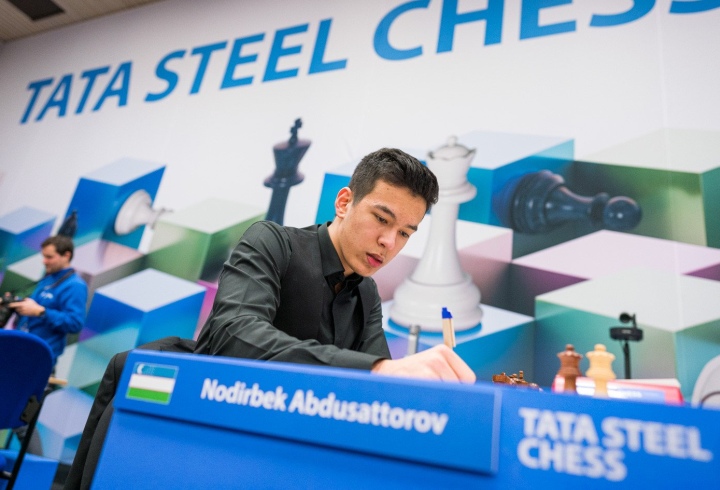
Nodirbek Abdusattorov preserved his half-point lead over Anish Giri heading into the final round of Tata Steel Masters. Richard Rapport and Parham Maghsoodloo beat Ding Liren and Arjun Erigaisi, respectively, but these results did not affect the standings on the top. Wesley So – Nodirbek Abdusattorov ½–½ The American GM went for an early queen exchange in the Queen’s Gambit Accepted but did not achieve even a slight advantage. Moreover, after Nodirbek sacrificed a pawn, Wesley had to demonstrate accuracy in defence to reach a draw. Jorden Van Foreest – Anish Giri ½–½ Van Foreest introduced another novelty, this time on the white side of the Ragozin Defence (8.h4) and then, following his preparation, sacrificed an exchange. Playing on his own, Giri maintained the balance up to move 26, when he gave his compatriot a chance to get a decisive advantage. After 26. Rc1 Na4 27. Qe4 cxd4 28. Nxf7 Rf6 29. Qe5 R6xf7 30. 30. h6 White dominates, but Jorden opted for 26. dxc5 and emerged better but with no straight win in sight. Just a few moves down the road, White had another chance 29.Nxf7 followed by the quiet move 30.Kh2! but it was really hard to find for a human being. As played, Black managed to exchange the queens liquidating into an endgame with an extra exchange for which White had more than sufficient compensation. Van Foreest pushed to the very end, but Giri demonstrated great accuracy in defence and sealed a draw on move 79. Magnus Carlsen – Praggnanandhaa R ½–½ The Indian youngster opted for a rare 9…g6 continuation in the Queen’s Gambit Accepted but found himself in an inferior position. Magnus skillfully built up pressure and on move 22, had a chance to win a pawn but missed this opportunity. After 22. Nxf7! White is clearly better, as 22…Kxf7 fails to 23. Rf3 Qd7 24. Qd3 Kf6 25. g4, but Magnus preferred 21.Rfe1 and also got an advantage, but not as big. Just a few moves later, the World Champion captured the b6-pawn but allowed his opponent to equalize with a series of precise moves. After very exciting complications, the opponents liquidated into a queen endgame where Praggnanandhaa defended well and scored a half-point. Fabiano Caruana – Vincent Keymer ½–½ In the Ruy Lopez, Keymer surprised his opponent with a new move 11…d5, immediately striking in the center. In the ensuing complications that required precise calculation White got a chance to get the upper hand with 25.Bc6, but Fabiano opted for a more natural 25.Rb1, after which Black was out of danger. The opponents shook hands right before reaching the time control. Gukesh D – Levon Aronian ½–½ The game saw another Ragozin Defence in which the opponent stepped into uncharted territory early on. Levon sacrificed a pawn in a balanced position with so-called hanging pawns and transposed into a rook endgame in which he had to demonstrate accuracy. Black was doing fine for a while, correctly sacrificed another pawn to get a passer on the kingside but mistakenly advanced it too early and found himself on the brink of defeat. After hard-to-find sequence 52. Rf1 Rb3 53. Rh1 Rh3 54. Rg1 Kxh5 55. a4 Rb3 56. Rb1 White wins, but luckily for Aronian, Gukesh opted for a natural 52.Kc4 and allowed Black to get a sufficient counterplay. Gukesh got another chance after Levon protected his passer from behind instead of from the side but did not seize this opportunity. In the end, White emerged two pawns up but had to settle for a draw. Richard Rapport – Ding Liren 1-0 Rapport went for 4.Qxd4 on the white side of the Sicilian Defence but did not get anything from the opening. After trading the queens, the Black opened up the center and was doing OK, but closer to the time control, Ding started making inaccuracies culminating with 36…Bf3? that cost him an exchange and eventually the game. Parham Maghsoodloo – Arjun Erigaisi 1-0 The opponents followed a long theoretical line in the Gruenfeld Defence in which the Iranian essayed the new move 19.Qb4 instead of 19.Rxb7 played before by Sevian and Grischuk. Arjun maintained balance for a while, but his decision not to trade queens was a step in the wrong direction. The position remained equal, but Black had less room for error. After White put pressure on the f7-pawn reacted with 30…f5 that cost him an exchange. In the subsequent play both sides did not play optimally, but eventually, Maghsoodloo converted his extra material into a full point. Standings after Round 10: 1. Nodirbek Abdusattorov – 8; 2. Anish Giri – 7.5; 3-4. Magnus Carlsen and Wesley So – 7; 5-7. Levon Aronian, Fabiano Caruana and Richard Rapport – 6.5; 8. Parham Maghsoodloo; 9. Rameshbabu Praggnanandhaa 10-12. Ding Liren, Gukesh D and Jorden Van Foreest – 5; 13. Vincent Keymer – 4.5; 14. Arjun Erigaisi – 4. Photos: tatasteelchess.com, Jurriaan Hoefsmit and Lennart Ootes
Tata Steel Masters: The leaders keep status quo
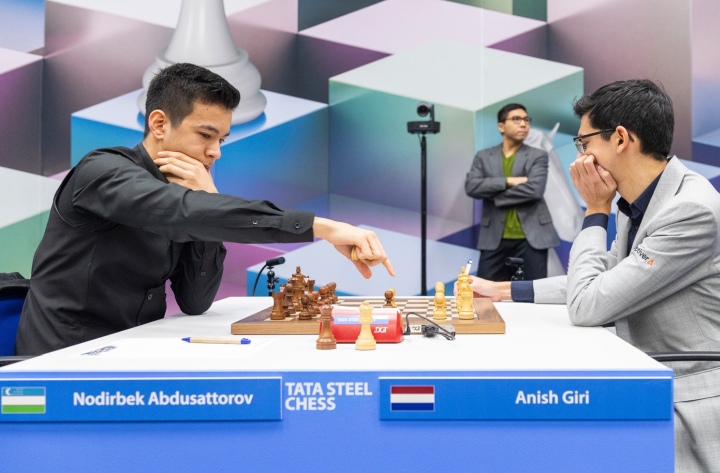
The situation in the leading group did not change after Roun 11, which has been the most peaceful in the Tata Steel Masters. Parham Maghsoodloo was the only player to score a victory defeating Rameshbabu Praggnanandhaa with the black pieces. Nodirbek Abdusattorov is still in front with 7.5/11, a half-point ahead of Anish Giri. Magnus Carlsen and Wesley So are trailing the leader by a full point. Anish Giri – Nodirbek Abusattorov ½–½ It was a serious test for the leader who faced his closest rival with Black, and Nodirbek passed it confidently. In a rare line of the Queen’s Gambit Accepted, the opponents castled on opposite sides, which promised a really exciting battle, but after Anish avoided the most principled continuation 12.Ndb5 (a much safer 12.Nc2 was played) Black comfortably equalized. Soon most of the pieces were traded, and the opponents split a point in an equal knight endgame. Magnus Carlsen – Wesley So ½–½ The game saw a popular line of the Nimzo-Indian in which the World Champion decided to get rid of his isolated d-pawn, defusing the tension in the center. After massive exchanges, the opponents steered into a bishop-vs-knight endgame with pawns on both wings. On paper, it favours the side with a bishop, but in practical terms, Magnus could not make much progress as Wesley defended with great accuracy. As soon as Black sacrificed his knight for White’s h-pawn, reaching a well-known position with a “wrong bishop,” a draw became inevitable. Levon Aronian – Fabiano Caruana ½–½ The opponents played a long theoretical line of the Tarrasch Defense in which the first original move was made very late. The ending that emerged in the game is considered to be safe for Black, despite White’s having an extra pawn. This evaluation was confirmed one more time as Fabiano had little difficulty reaching a draw. Praggnanandhaa R – Parham Maghsoodloo 0-1 The Indian youngster executed an original maneuver Nf3-h2-g4-e3 on the white side of the Najdorf with 6.h3 got an edge after Maghsoodloo’s questionable knight transfer from f6 to c5. However, in the first critical position of the game, Praggnanandhaa went in the wrong direction. The right way is 17. b4! Nca4 18. Nxa4 Nxa4 19. c4 bxc4 20. Rfc1 c3 21. Nd1 and White is clearly better, but Praggnanandhaa opted for a dubious sacrifice 17.Nf5? only to find himself in a tough situation after 17… Bxf5 18. exf5 d5 19. Bh6 Rfd8 20. Rad1 e4 21. Qg4 Nca4 22. Nxa4 Nxa4 23. fxg6 hxg6 24. f4 Qb6+ 25. Kh1 f5 Maghsoodloo built up pressure with solid and logical moves and got an overwhelming advantage by move 30. The Iranian could have won before time control, but despite missing this opportunity, he wrapped up the game with a nice trick. White is ready to sacrifice his bishop for the e2-pawn, followed by Rg5 and Rxf5 with a draw, but 52…Rh2+! wins on the spot 0-1 Vincent Keymer – Richard Rapport ½–½ The opponents diverged from the bitten trail very early and ended up in the King’s Indian type of position with the semi-open center in which White had some space advantage. Black was holding his ground but with 23…Nf8?! followed by returning the knight back 24…Nd7 Rapport gave his opponent a chance to get a sizable advantage. After 25.Nxb6! Nxb6 26. Bxa6 Rxc3 27. Bxc3 Nbd5 28. Bxf6 Nxf6 White’s queenside pawns are very dangerous, but Vincent played less precise 25.axb6 and also got an advantage but not as big. Just a few moves later, he allowed Black to trade two minor pieces for a rook and a pawn, reaching a balanced position with sufficient counterplay. With several precise moves Rapport managed to protect his a-passer and reached a draw. Ding Liren – Jorden Van Foreest ½–½ Van Foreest uncorked a novelty 10…dxc4 in a well-known line of Semi-Slav based on deep preparation with chess engines. Black’s position looked dubious, but it is probably holdable when it comes to concrete variations. Playing on his own, Ding did not manage to find the most precise moves and the opponents soon liquidated into a roughly equal endgame in which the draw was agreed by repetition. Arjun Erigaisi – Gukesh D Erigaisi introduced the new move 12.Nbd2 in a popular line of Berlin Defence in Ruy Lopez but did not achieve much as Gukesh quickly equalized with several natural and strong moves. To the opponents’ credit, they battled in a balanced position to the very end and split a point only after exhausting all the reasonable options. Standings after Round 11: 1. Nodirbek Abdusattorov – 7.5; 2. Anish Giri – 7; 3-4. Magnus Carlsen and Wesley So – 6.5; 5-6. Levon Aronian and Fabiano Caruana – 6; 7. Richard Rapport – 5.5; 8-10. Rameshbabu Praggnanandhaa, Ding Liren and Parham Maghsoodloo – 5; 11-12. Gukesh D and Jorden Van Foreest – 4.5; 13-14. Arjun Erigaisi and Vincent Keymer – 4. Photos: tatasteelchess.com, Jurriaan Hoefsmit and Lennart Ootes
First International Solving Championships of 2023 announced

As a traditional introduction to a solving season, the 19th International Solving Contest (ISC) will be held this Sunday, January 29. A set of chess problems will be simultaneously offered to more than 500 solvers around the world at 11 AM CET. The local controllers will be responsible for the legality of the results on site, while the central controllers Axel Steinbrink (Germany) and Luc Palmans (Belgium), will do the hard work of checking scanned solving sheets sent from all competitions. Chess composition lives on enthusiasm and voluntary work, even when it comes to such a huge project. The ISC type of hybrid solving competition is becoming increasingly popular since it allows enthusiasts from many countries to participate without extra costs. In 2023, the ISC will reach 42 locations in 26 different countries: Belgium, Brazil, Croatia, Czech Republic, Denmark, Finland, France, Great Britain, Georgia, Germany, Greece, India, Israel, Japan, Latvia, Lithuania, Mongolia, Netherlands, North Macedonia, Poland, Romania, Serbia, Slovakia, Slovenia, and Switzerland. There are three ISC categories ranging by format and levels of difficulty. Category 1 is for the most ambitious solvers, Category 2 is for solvers rated up to 2000, and Category 3 is for U13 solvers born in 2010 and later. The first two categories count for the solvers rating. They include 12 problems split into two rounds of 120 minutes each. There will twelve problems, two from each of the six different genres: mate in 2, mate in 3, mate in more moves, endgame, helpmate and selfmate. Category 3 is a youth competition aimed at popularizing composition and discovering new talents. It lasts 120 minutes and includes six problems: 4 in 2 moves, 1 in 3 moves, and 1 endgame. ISC is a relaxed and joyful event whose primary mission is to spread the beauty of chess art. You can see people of all ages, races and backgrounds joining it in very different ways. ISC participants from Bangalore (India), solving on the floor/ Photo Shankar Ram To test your solving skills and feel the atmosphere of this competition you can tackle two entries from the previous 2022 ISC edition. The first one is a hard nut to crack from Category 3: 1) White to play and mate in 2 moves (HINT: We are searching for an unconventional move) The next endgame was on the table for Category 2: 2) White to play and win (HINT: White is a piece up, but cxb3+ is a huge threat. Is it possible to coordinate pieces and take advantage of Black’s king vulnerable position?) You can find more ISC details on the Solving page of the World Federation for Chess Composition. Soon after the 19th ISC, the season of national solving championships will begin. Most of them are open for foreign participants, as the legs of the yearly World Solving Cup. The first one to come is the Finnish Chess Solving Championship, held annually since 1980. It will take place on Saturday, February 18, at Chess Arena in Helsinki. The announcement is published on the WFCC homepage, in the section World Solving Cup 2022-2023. The Finnish championship lasts three hours (from 1 to 4 PM in 2023) and is conducted in one session with 12-15 problems to be solved. There will also be a B-group for young and/or less experienced solvers with only orthodox mates and studies. The director of the competition, Neal Turner, a long-time Secretary of the WFCC, has been devoted to solving competitions in Finland for decades. The Finish Chess Problem Society (Suomen Tehtäväniekat) was established in 1935. From the 1st World Chess Solving Championship (WCSC) 1977, Finnish solvers were dominating. In the years 1977-95, their national team, led by Pauli Perkonoja, collected seven gold medals. This long-standing record was matched by the German team in 2002 and broken by the Polish squad in 2016. (Poland won 12 out of the last 13 WCSCs). In 1982 Pauli Perkonoja (born 1941) became the first solver to be granted the title of International Solving Grandmaster of the FIDE. He won the individual competition of the WCSC seven times (the first four times, it was an unofficial title). At the age of 64, Pauli won the 1st European Chess Solving Championship and soon after withdrew from international competitions. European Solving Champion at 64: Pauli Perkonoja (in 2005) | Photo Hannu Harkola Finland has produced two more World Champions and Solving Grandmasters. Kari Valtonen won WCSC 1984, and Jorma Paavilainen did it in 2001. International Solving Master Harri Hurme (1945-2019) was an irreplaceable member of the golden national team. Pauli Perkonoja still holds the Finnish record with 14 domestic titles, ahead of Jorma Paavilainen and Kari Karhunen, who won the national championship ten times each. The Finnish Chess Problem Society produces chess problem books and a high-quality magazine,”Tehtäväniekka”, edited by Jorma Paavilainen. The Society has been represented in the World Federation for Chess Composition by Hannu Harkola, now WFCC Honorary Member. A tireless worker on behalf of chess composition, Harkola has been involved in its international organization for more than 50 years. The solutions to the problems from the ISC 2022 1: (F. Giegold National Zeitung 1971) 1.Rc3! threatening with Rc7#; 1…bxc3 2.Qb7# 2: (Minski, Hergert original for ISC 2022) 1.Bc6! Rxc6 2.d5! Bxd5 3.Ra1+ Kb5 4.Nd4+ Kc5 5.Rb1! (threatening with 6.Rb5#) a6 6.Rb5+! axb5 7.Nb3+ cxb3 8.d4#! Official website: https://www.wfcc.ch/