

FIDE World Rapid and Blitz Championships 2025: Tickets now available
The FIDE World Rapid and Blitz Championships return to Doha this December, bringing five days of fast chess, high stakes, and a field packed with the biggest names in the game. Fans can watch the games live at Qatar University’s Sports and Events Complex, where the world’s best players will compete for four world titles and a share of a prize fund exceeding €1,000,000. Tickets are now on sale, and spectators can tailor their visit to Doha through four types of passes designed for different viewing preferences. Individual Rounds allow fans to drop in for specific Rapid rounds, perfect for those who want to watch a particular player or a key moment in the standings. Half Day Passes cover defined blocks of Blitz rounds and are ideal for following the rapid-fire shifts on the leaderboard as the pace accelerates. Day Passes offer full access to each day’s programme, so fans can enjoy every round, every upset, and every finale. Multi-Day Passes provide the best value for those who want the complete championship experience from start to finish. TICKET PRICING Rapid tickets Individual rounds 25 QAR for rounds 1 to 12 40 QAR for round 13 Day passes 50 QAR for 26 December 50 QAR for 27 December 70 QAR for 28 December All-days Rapid pass 100 QAR Blitz tickets Half-day passes 35 QAR for rounds 1 to 6 35 QAR for rounds 7 to 13 35 QAR for rounds 14 to 19 65 QAR for the finals and closing ceremony Day passes 50 QAR for 29 December 80 QAR for 30 December All-days Blitz pass 100 QAR Full Event Pass 160 QAR This pass covers all Rapid and Blitz days. VIP ticket options will be announced soon and will include premium seating and additional benefits for fans who want an enhanced experience at the venue. Details will be shared on the official event website as soon as they are finalised. Fans are encouraged to secure their passes at special early-bird prices, and be part of the FIDE World Rapid and Blitz Championships 2025 in Doha. Tickets are available now through the official ticketing platform. Link to the ticketing platform: snoonu.com/scity/events/competitions/fide-world-rapid-and-blitz-championships-qatar-2025 About the event The FIDE World Rapid & Blitz Championships 2025 is taking place in Doha, Qatar from December 26 to 30, bringing together the world’s elite chess talent for a thrilling end-of-year showdown. Held at the Sports and Events Complex of the Qatar University, this edition features both Open and Women’s events in Rapid and Blitz formats, with a total prize fund of over €1,000,000. Doha returns as host after nine years, underscoring Qatar’s growing stature in the chess world. The full list of registered players can be found here: Rapid Open: worldrapidandblitz2025.fide.com/participants-rapid-open/ Rapid Women: worldrapidandblitz2025.fide.com/participants-rapid-women/ Blitz Open: worldrapidandblitz2025.fide.com/participants-blitz-open/ Blitz Women: worldrapidandblitz2025.fide.com/participants-blitz-women/ Official website of the Championships: worldrapidandblitz2025.fide.com
Goodnight Goa – 2025 FIDE World Cup comes to a close

The closing ceremony of the 2025 FIDE World Cup was hosted in the playing hall at Resort Rio this evening, bringing to an end nearly a month of elite chess and marking the final chapter of one of the world’s most demanding knockout events. The hall was filled with players, officials, dignitaries, and guests as the celebrations began, blending formal recognition with performances, speeches, and moments honouring the champions of this year’s competition. Charismatic presenters Ash Chandler and Rebekah Watkins opened the ceremony, reflecting on a tournament that brought together 206 players from more than 80 countries. They described Goa as the “heartbeat of the chess world” for the past several weeks, setting the tone for an evening of gratitude, recognition, and celebration. The audience stood first for the Indian National Anthem, followed by the FIDE Anthem, after which dignitaries were welcomed with a bouquet presentation led by Dr Ajay R. Gaude, Director of Sports & Youth Affairs, Government of Goa. The guests of honour included Chief Minister of Goa Dr Pramod Sawant, FIDE Deputy President Viswanathan Anand, AICF President Nitin Narang, and FIDE Secretary General Lukasz Turlej. A tournament highlights film followed, capturing decisive upsets, tiebreak drama, brilliant comebacks, and the raw emotion that defined this World Cup. After being here for so long and feeling worlds away from the early rounds, the video served as a reminder of how far the event had come and of the many top players who travelled to Goa to compete. As the hosts put it, it was “like reliving the entire World Cup all over again.” The film set the stage for the first major address of the evening by AICF President Shri Nitin Narang, who spoke about how the World Cup came to Goa and praised the collective effort behind this successful edition. He shared a short but fitting story: “There was once a young player who lost so often that he began noting down every mistake in a tiny notebook. One day someone asked him, ‘How do you stay motivated despite losing so much?’ He smiled and said, ‘I am not losing, I am collecting data on how winning works.’ That is the spirit of chess. That is the spirit of this World Cup. Every move, every mistake, every comeback – all of it becomes the epic story of how champions are built.” Keeping the momentum high, lantern dancers then took to the stage with a mesmerising performance. Adorned with candles balanced on their heads, they danced, lifted one another, and moved in synchrony, a striking spectacle. This was followed by a keynote address from five-time World Champion, Indian chess icon, and FIDE Deputy President Viswanathan Anand, who thanked the AICF and Government of Goa, spoke about the difficulty of the knockout format, India’s rise as a global chess hub, and congratulated the three new Candidates qualifiers. He also shared a personal reflection: “Hosting the World Cup here is deeply symbolic for me. I remember how it was when I started my path to a Grandmaster title. When I became the country’s first Grandmaster in 1988, it was a major moment, but also the beginning of a long road built by those who love chess and believe in the potential of India. Look around the country now. Chess is no longer an isolated pursuit. It is a mass sport with growing passion. What we see today is a beautiful culmination of that journey and I feel blessed to be part of it. This World Cup, staged with excellence and true love for chess, has shown to the entire world that India is not just the ancient home of chess or its current leader, but that it is determined to be its future.” Next, Hon’ble Chief Minister of Goa Dr Pramod Sawant addressed the audience, highlighting Goa’s rising profile as an international sporting destination. He noted that when he first took office he saw Goa mainly as a tourist hub, but the state has since shown that it is much more, and hosting one of the flagship events in chess has reinforced its status as a leading venue for sport. A live sand-art performance by renowned artist Rahul Arya then took viewers on a narrated visual journey of chess, or “chaturanga,” and the paths of the players who fought through this World Cup. The highlight of the evening followed as the award ceremony took centre stage. Ceremony dignitaries first joined the stage as they would present the players with their awards. Bronze medalist Andrey Esipenko was the first to receive his medal, followed by Wei Yi, and finally the new FIDE World Cup Champion, Javokhir Sindarov, who was presented with the gold medal and the Viswanathan Anand Trophy. Golden streamers then burst onto the stage, highlighting the sense of victory even more. The national anthem of Uzbekistan played in the hall before a special surprise video was screened for the champion, featuring a congratulatory message from the President of Uzbekistan to the young star. He was then handed the microphone for his own short victory speech, in which he spoke about his long and fortunate connection with India, recalling that he first played here at the age of seven, winning the Under-7 Asian Championships, and later returned for the 2022 FIDE Olympiad in Chennai. Above all, he repeated how genuinely happy he felt in this moment. The ceremony concluded with final remarks from the hosts, after which FIDE Deputy President Viswanathan Anand returned to the podium to formally declare the FIDE World Cup 2025 closed. As the lights dimmed and guests moved toward the poolside gala dinner, the celebrations marked the end of a World Cup that delivered unforgettable games, rising stars, and the crowning of three new Candidates. Written by WIM Charlize van Zyl (Goa, India) Photos: Michal Walusza
Javokhir Sindarov crowned 2025 FIDE World Cup Champion

Javokhir Sindarov secured the title after a tense tiebreak match lasting only two games, earning a place in the history books as the youngest FIDE World Cup Champion. The final day of the FIDE World Cup arrived with all the ingredients for a dramatic finish. What began on November 1st with 206 players had now narrowed to just two: Chinese Number 1 Wei Yi and Uzbek star Javokhir Sindarov. Both had endured long, difficult paths to reach this stage, and after two classical draws, they carried the battle into tiebreaks. With both players exceptional in rapid and blitz throughout the event, there was no clear favourite. With his 2–0 classical victory over Nodirbek Yakubboev, Andrey Esipenko secured third place and qualification to the Candidates, leaving only one board on the stage today. All attention shifted to the final match, a fitting conclusion to an almost month-long marathon. The ceremonial first move was made by GM Dibyendu Barua, Vice President of the All India Chess Federation and the second Indian player after Viswanathan Anand to earn the grandmaster title. While the tiebreaks took center stage, the atmosphere in the hall reflected the significance of the moment. Preparations for the closing ceremony had begun early in the morning, with a stage set up along the side of the hall. Outside, tables were arranged poolside for the gala-style dinner that would bring the month-long event to an elegant close. But before the celebrations begin, let’s take a look at how the games unfolded today. Final tiebreak result:Wei Yi ½ – 1 ½ Javokhir Sindarov Wei Yi (2752) vs Javokhir Sindarov (2721) The day began with a change of pace: Sindarov avoided Wei Yi’s trusted Petroff by beginning with 1.d4, and a Queen’s Gambit Declined Ragozin soon appeared on the board. It was a largely even game with interesting play from both sides, remaining balanced as it moved into a bishop endgame. Everything pointed toward a draw until a sudden, serious mistake shifted the evaluation. Wei Yi had just played 30…g5, whereas almost any bishop move would have held equality. This instead allowed White to reach a winning position after 31.Be4, forcing the trade of bishops. After 31…Bxe4, White would enter a winning pawn and then queen endgame – both promote their pawns simultaneously, but Black would lose due to vulnerability of his kingside pawns. If 31…Bc6, the key move 32.h5 becomes essential, leading again to a favourable bishop trade and a dominant white king. Sindarov, however, took a few minutes before choosing 31.h5, which returned the evaluation to equality. Wei Yi, visibly aware of his earlier error, immediately removed the bishop from the dangerous h1-a8 diagonal, delayed the trade, maintained opposition, and guided the game safely to a draw. He said that after the game he realised this which made him sad, b ut he tried to not let it get to him in the next game, where he then delivered. The second game began with an Italian, where Sindarov, playing with the Black pieces, opted for a solid setup with …Be7 and …d6. In the middlegame, however, it was White who adopted a more passive approach, allowing Black to arrange his rooks at active positions. Still with the only weakness in his camp – the c2-pawn – White comfortably maintained balance. Curiously, it was Sindarov who offered a draw at one point, which Wei Yi declined. And then the time scramble began. Wei opened up the position with the objectively strong but double-edged pawn-push f3-f4, and it nearly worked for him as White emerged clearly better at some point. Chinese GM did not find the precise 52.Qg6! which would have posed serious problems for Black after 52…Qxg6 53.hxg6 as his king trapped in the corner. Instead White played 52.g4? and it was equal again. Sindarov played intelligently, creating practical problems for White, where a single misstep could tip the balance. Black’s rook duo on the first rank grew increasingly dangerous, while Wei Yi survived several critical moments by making moves with only one second left on the clock. But eventually time pressure took its toll, producing a decisive mistake from Wei Yi: Black’s queen is preparing to infiltrate via 57…Qh4, and White must find the only move 57.Kg2 to stay alive. After 57…Qh4, White has 58.Rf8+! Kxf8 59.Qf3, forcing perpetual check, and Black cannot escape. Instead, with a single second remaining, Wei Yi erred with 57.Rxd4?? Sindarov immediately jumped on the opportunity: 57…Qh4+ 58.Kf4 Re1 59.Qg2 Qg5+ 60.Kg3 Qe3+ Wei Yi extended his hand in resignation, and Sindarov happily accepted, prompting applause throughout the hall. The happy champion described the victory as the best day of his life and career, adding that it was only the beginning. Outside the hall, he was embraced by family and friends, celebrating him with cheers and wrapping an Uzbek flag around his shoulders, the start of an evening of celebrations. And that concludes our time here in Goa after a month of intense chess. The spotlight has been on the final four for the past week, but looking back, the event was filled with memorable performances and stories. From José Martínez’s impressive run and upset over Nodirbek Abdusattorov, to Frederik Svane’s victory against World Champion Gukesh D, to viral moments like Daniil Dubov’s “10-minute prep” against Praggnanandhaa, and heartbreaking ones such as Arjun Erigaisi’s final tiebreak blunder against Wei Yi. These are moments we will remember, and I hope you will too. This World Cup delivered upsets, brilliance, drama, and most importantly, three new FIDE Candidates Qualifiers who will compete next year in Cyprus. Now, the focus shifts to the next major event: the 2025 FIDE Rapid and Blitz Championships in Doha, Qatar, from 26-30 December. Stay tuned. Written by WIM Charlize van Zyl (Goa, India) Photos: Michal Walusza
FIDE World Cup: A quick draw sets up tiebreaks for title as Esipenko wins third place
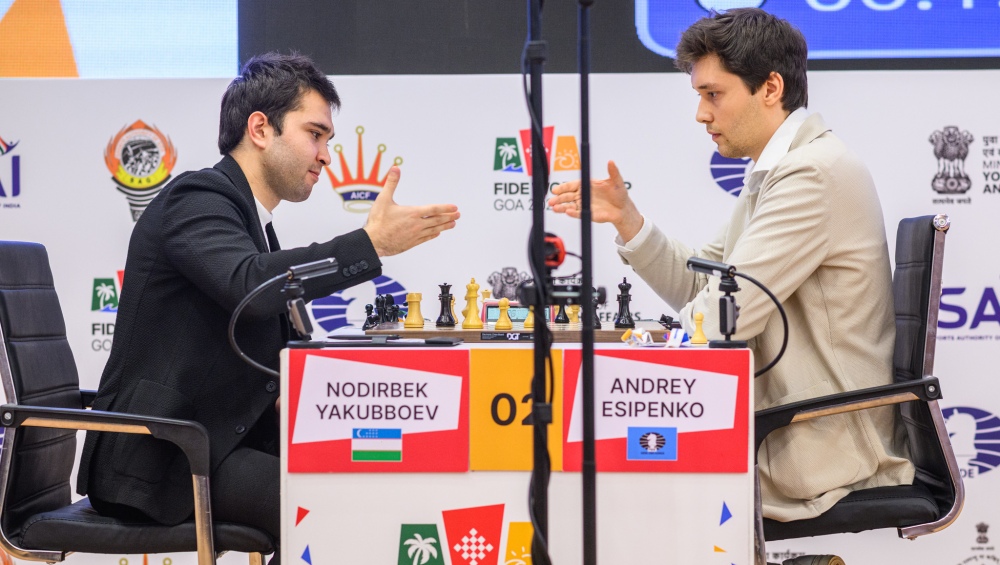
What a day at the FIDE World Cup finals. The players entered with very different levels of pressure. On one side, Javokhir Sindarov and Wei Yi faced far less tension, with the high likelihood of a draw sending their match to tiebreaks, a recurring pattern throughout this event. That is exactly what happened, as the game concluded within thirty minutes. On the other board, Nodirbek Yakubboev was in a must-win situation to level the match and keep his chances alive in the tiebreaks. Perhaps, nerves weighed heavily on the young Uzbek player, as he faltered early and allowed Andrey Esipenko to take control and secure victory. The first move was made by another local sporting icon, Ms. Saina Nehwal, Olympic bronze medalist in badminton, setting an inspiring tone for the day. Let’s take a look at the game for third place, and then a closer look at the contenders for first: Round 8 Game 2 results: Nodirbek Yakubboev 0–1 Andrey Esipenko Wei Yi ½–½ Javokhir Sindarov Nodirbek Yakubboev (2689) vs Andrey Esipenko (2693) The game began with an offbeat Neo-Catalan in which Yakubboev, playing White, opted for a line that concedes a slight advantage to Black but introduces early complexity and aims to take Esipenko out of his comfort zone. The idea seemed promising until one inaccurate decision completely shifted the momentum, and Yakubboev was unable to recover. Here, White played 11.Bxd5? labelled an “inexcusable move” by GM Peter Leko in the FIDE studio because it gives up the crucial light-squared bishop and hands Black full control over the light squares. After 11…Nxd5 12.Qxd5 b5!, with …Bb7 coming next, Black’s initiative is already very strong. White also cannot capture the seemingly free rook: 13.Qxa8 Bb7 14.Qa7 Nc6! 15.Nxc6 Qxc6 Here Black threatens immediate checkmate along with …Bb8 to trap the queen. In the game, Yakubboev instead played 13.Nf3 and continued from a difficult position. Esipenko’s handling from this point was especially notable: rather than following the computer’s top choices, he played natural, harmonious moves, very much in line with the style often compared to Capablanca, placing his pieces on perfect squares and increasing the pressure at the right moments. It was a clean, instructive conversion as he traded-off key pieces, maintained full control, denied counterplay, and finished the game with a beautiful mating net. Black is already completely winning here. Esipenko continued with 24…Nc1, inviting the mistaken 25.Rxc1 (which occurred in the game), and then followed with 25…Rxd2+ 26.Kg3 Qe2. White could delay but not prevent the impending checkmate. This victory sealed the match for Esipenko, who left the hall visibly relieved and exhausted. With two classical wins, he bypassed tiebreaks entirely and secured both third place and a coveted spot in the 2026 Candidates. Wei Yi (2752) vs Javokhir Sindarov (2721) There was little to elaborate on in the game for first place, as the players entered another Rubinstein Variation of the Four Knights Spanish, a line well known for its drawish nature. Both players blitzed out their moves with ease, clearly choosing to conserve energy and head into the tiebreaks tomorrow. Since the game offered little material, here is a closer look at the finalists: Wei Yi Wei Yi has long been regarded as one of the most naturally gifted attacking players of his generation. He became a grandmaster at 13, one of the youngest in history, and has built a career defined by calculation, creativity, and consistency at elite level. His resume includes a World Youth Championship title, three Chinese Championship titles, and two Olympiad gold medals in Tromsø 2014 and Batumi 2018. His famous win over Lázaro Bruzón in Danzhou 2015 remains one of the most celebrated modern attacking masterpieces. In recent years, he has delivered strong results in top classical and rapid events, including the victory in the 2024 Tata Steel Masters, maintained a 2700+ rating, and proven to be a dependable top-board player for China. Reaching the final here in Goa reflects his stability and resourcefulness throughout this event. Wei Yi’s 2025 FIDE World Cup ResultsRound 2: beat GM Kacper Piorun 2–0 (classical)Round 3: beat GM Benjamin Gledura in rapid tiebreaksRound 4: beat GM Parham Maghsoodloo in the final blitz gamesRound 5: beat GM Samuel Sevian 1.5–0.5 (classical)Quarterfinals: beat GM Arjun Erigaisi in the fourth rapid gameSemifinals: beat GM Andrey Esipenko with a key rapid win Javokhir Sindarov Javokhir Sindarov is one of the brightest stars of Uzbekistan’s new generation. Born in 2005, he became a grandmaster at age twelve and has since grown into a central figure in Central Asian chess. He is a two-time Uzbek Champion and a key member of the national team that won the 2022 Olympiad in Chennai. His 2025 season has been exceptional. He won the TePe Sigeman & Co Tournament, tied for first at the UzChess Cup Masters only to be edged out in tiebreaks, and achieved a 2796 performance rating at the FIDE World Rapid Team Championship. His impressive results have strengthened his position among the world’s rising elite. Reaching the final in Goa is the biggest individual milestone of his career so far, and combined with his qualification for the 2026 Candidates Tournament, it marks his arrival as one of the most ambitious young talents in top-level chess. Sindarov’s road to the 2025 FIDE World Cup finalRound 2: beat GM Nikita Petrov 1.5–0.5Round 3: beat GM Nikolas Theodorou 1.5–0.5Round 4: beat GM Yu Yangyi in rapid tiebreaksRound 5: beat GM Frederik Svane 1.5–0.5Quarterfinals: beat GM José Martínez in a six-game classic–rapid–blitz marathonSemifinals: beat GM Nodirbek Yakubboev in rapid tiebreaks Both finalists are not only serious Candidates contenders, but entirely deserving World Cup finalists. Tomorrow, only one will lift the Viswanathan Anand Trophy. The winner will be decided in the tiebreaks beginning at 15:00. Don’t miss it. The action can be followed live on the FIDE YouTube Channel, featuring expert commentary by GMs Jan Gustafsson and Peter Leko. To watch the games in person, tickets can be purchased [HERE] Written by WIM Charlize van Zyl
FIDE World Cup: Esipenko strikes first against Yakubboev as Sindarov and Wei Yi draw
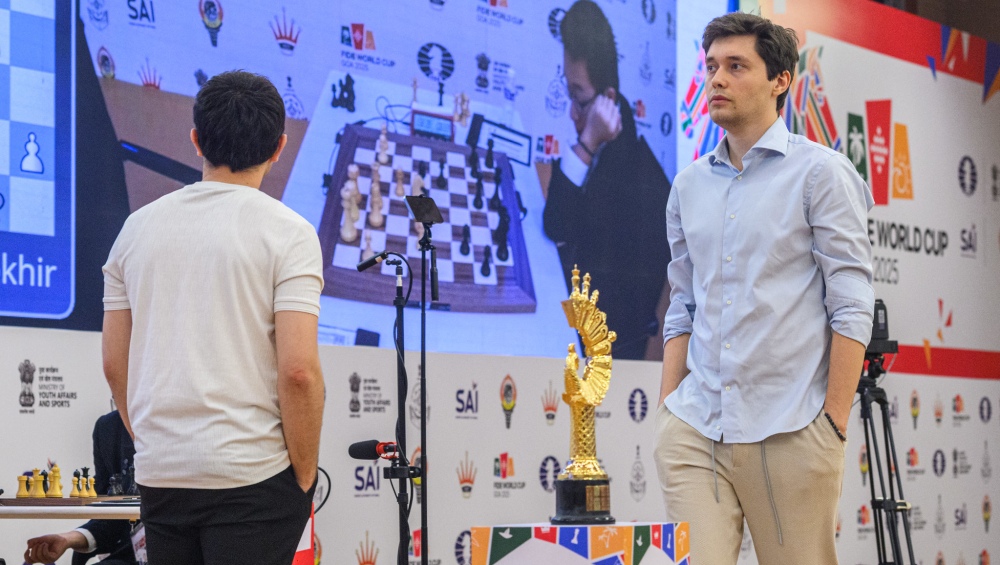
After seven gruelling rounds and twenty-three days of intense chess, the FIDE World Cup reached its final stage with Wei Yi and Javokhir Sindarov battling for first place and the 120,000 USD first prize, and Andrey Esipenko and Nodirbek Yakubboev fighting for third place and the final Candidates qualification spot. Both matches carry enormous weight, creating a tense atmosphere throughout the hall. In the match for the title, a complex opening led to a position where Wei Yi had chances to push for more, but with the Black pieces he steered the game toward a more balanced continuation and an eventual draw. On the other board, Andrey Esipenko successfully recovered from yesterday’s loss and struck first in his match against Yakubboev. A notable change in the hall today was the arrival of the official trophy, the Viswanathan Anand Trophy, displayed on the stage for the first time. Glistening under the overhead lights, it immediately drew the attention of media, spectators, and the players themselves. The ceremonial first move was made by Indian sporting icon Abhinav Bindra, an Olympic gold medalist in shooting who made history by winning India’s first-ever individual Olympic gold. A fitting choice for the board of Wei Yi – Sindarov, as both players are Olympiad gold medalists themselves in 2014, 2018, and 2022 respectively. Let’s take a look at the two games today: Game 1 results Andrey Esipenko 1-0 Nodirbek Yakubboev Javokhir Sindarov ½ – ½ Wei Yi Andrey Esipenko (2693) vs Nodirbek Yakubboev (2689) Emotionally, the battle for third place may be even more demanding, as both players entered today still carrying the weight of semifinal losses. Yakubboev was coming off a ½–1½ tiebreak defeat to his compatriot Javokhir Sindarov, while Esipenko had experienced an equally painful ½–1½ loss defined by one final, decisive blunder that turned a winning position into a loss. As our commentator GM Peter Leko noted during the broadcast, the best way to recover from a loss is simply to play good moves the next day, and that is exactly what Esipenko did to take the lead in the match. An Open Sicilian that soon transposed into the Four Knights Variation set the tone. The game quickly entered a sideline chosen by Yakubboev, who then spent considerable time on his ninth move, raising questions about his level of preparation and confidence. Esipenko achieved the better position out of the opening, and an important moment soon arose: Here, 15.Nd6 is a strong knight jump that plants a thorn in Black’s camp. After 15…Bxd6 16.exd6, the pawn cannot be captured by the queen straight away due to the threat of c4 hitting the pinned bishop. And after 16…Bxf3 17.Rxf3 Qxd6 18.f5, White is clearly better. In his post-game visit to the studio, Esipenko explained that he had seen this line but did not evaluate it as favorably for White as the computer suggests. Instead, he opted for 15.Be3 and the game continued. Eventually, the players transitioned into an endgame that chess engines evaluate as equal. Still, it required a great deal of accuracy from Black. After making a couple of inaccuracies, Sindarov should have gone for a rook endgame down a pawn with drawing prospects, but he chose otherwise. White was already slightly better on both the board and the clock. For better or worse Black should have traded his knight for the bishop and work hard for a draw after 32…Nxc1 33.Kxc1 cxb3 34.axb3 Rd3 35.Rf2+ Ke7 36.Rf3 Rd5. However, with only a few minutes remaining, Black played 32…h5?, allowing Esipenko to keep the bishop with 33.Bd2 (although Be3 was even stronger). After that, Black’s position collapsed rapidly: 33…Ra5 34.Be3 a6 35.bxc4 Re5 36.Bd4 Rg5 37.Kf2 Rxg3 38.Be3 and Yakubboev resigned. Aside from playing good moves, Esipenko described how he recovered after yesterday’s heartbreak: dinner at his favourite restaurant, time relaxing with his second, and switching off from chess by watching the Arsenal vs Tottenham football match,.made even sweeter by his favourite team, Arsenal, winning and lifting his mood. Now the momentum shifts to Yakubboev, who must regroup and strike back with the White pieces tomorrow. Javokhir Sindarov (2721) vs Wei Yi (2752) The match for first place is a closely contested one, with both players in excellent form, riding strong momentum, and a touch of luck, from earlier rounds. Although both earned Candidates qualification after their semifinal victories, the work is far from over. One match remains to determine the overall champion and the significant prize fund. Both entered today with confidence reinforced by winning their previous matches. With the Black pieces, Wei Yi again relied on his main weapon of the event; the Petroff Defense: 1.e4 e5 2.Nf3 Nf6. Sindarov countered with the lesser-played Modern Attack, 3.d4, soon reaching a fresh position. Judging by their quick pace, both players appeared very well-prepared. The game evolved into a high-level strategic battle where both continued with impressive accuracy. It was the kind of game that is difficult to fully grasp at a glance, but revealing of the depth of understanding that top-level players possess. When everything appeared balanced, an important moment emerged: White should simply capture on c5 here, but instead erred with 22.Rb1, giving Black a chance, though not an easy one to convert. The sequence 22…Qxd3 23.Qxd3 Bxd3 24.Rxb2 resulted in the following position: This is the final critical moment. Black was the one pressing but needed to find 24…Rxf4! After 25.Nxc5 Rxg4 26.Bg3 Bxf1 27.Kxf1 Rf8+, Black has a rook and two pawns for two minor pieces. It is by no means winning, but Black is the stronger side pushing for something. Instead, Wei Yi chose 24…Bxe4, and the game immediately simplified into a drawn opposite-colored bishops endgame, followed by an expected draw. In the post-game interview, Wei Yi mentioned that he had calculated 24…Rxf4 but evaluated it as better for White, and since he had the Black pieces today, he preferred the more solid continuation, an outcome he said he was satisfied with. Tomorrow the players switch colours. Let’s
FIDE Social Chess Storytelling Challenge: Deadline approaching

Participants of FIDE Social Chess Storytelling Challenge have until November 30, 2025, to submit their stories under the theme “Every Move Counts.” To date, the Challenge has received 32 submissions from the following countries: Germany, Nigeria, El Salvador, South Africa, Ghana, USA, Democratic Republic of Congo, Mexico, England, Guam, Netherlands, Kenya, Spain, India, Lesotho, Vietnam, Hungary, Mauritius, Costa Rica, and Brazil. The challenge invites filmmakers, educators, and chess promoters worldwide to showcase how chess is changing lives and strengthening communities. From classrooms and rehabilitation centers to local clubs and public spaces, these stories reveal how the game can inspire growth, connection, and inclusion. Participants can enter in two categories: Professional and Grassroots (Amateur), and are encouraged to submit short films that highlight the social impact of chess in creative and authentic ways. Winning films will receive a FIDE trophy and an invitation to the Opening Ceremony of the 2026 Chess Olympiad, including accommodation for two nights for two guests. The selected stories will also be featured during the 2025 FIDE Social Chess Conference and showcased on FIDE’s official media channels. Participation is open to everyone, regardless of age or nationality. Submission deadline: November 30, 2025 Submit your film here: fide.com/social2025-storytelling-challenge/#send
From Pawns to Queens: A new Chess in Schools Initiative
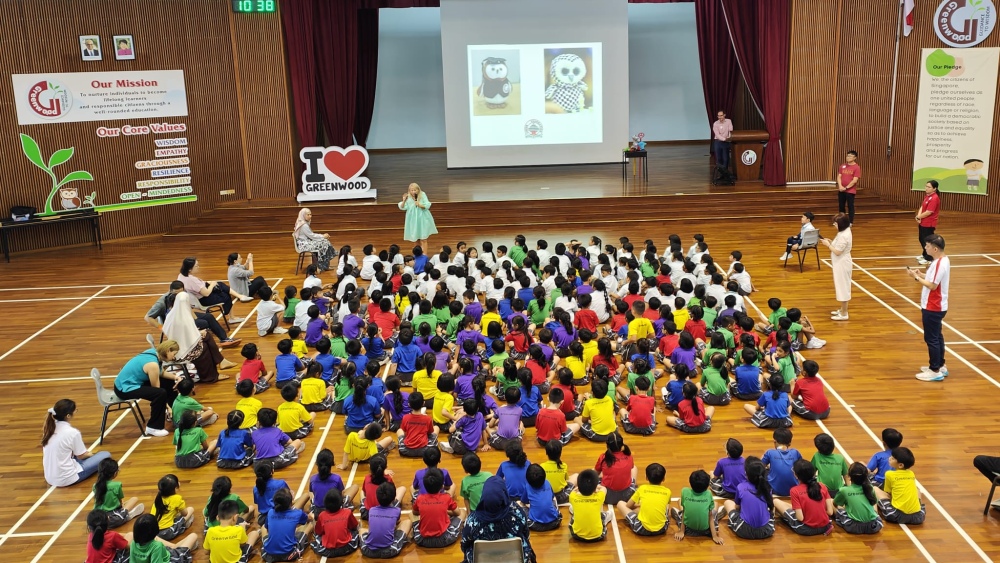
The Singapore Chess Federation “SCF” is delighted to announce our latest project, “From Pawns to Queens”, a chess in schools initiative in collaboration with Greenwood Primary School. This project aims to trial a large-scale beginner chess programme to promote chess learning among the school’s Primary 1 and Primary 2 students, with the longer term goal to make chess a regular feature in the school’s programmes at all levels, and use chess learning to teach essential cognitive and life skills. The idea of the name “From Pawns to Queens” stemmed from the literal meaning of teaching our young students how to move all the pieces. Beyond mastering the game, our mission is to inspire children to embrace the concepts of empowerment, growth, and development—both on and off the board. Just as pawns have the potential to become queens through strategic effort and perseverance, we encourage kids to realise their own potential, develop confidence, and grow into empowered individuals. The project started with a chess camp that took place on the 4th and 5th of November. Each day began with a mass briefing in the school hall, with Woman FIDE Master Dijana Dengler explaining the origin of chess and the absolute basics to 455 Primary 1 and 2 (aged 7 and 8) students. Dijana, a councilor in FIDE’s Chess in Education Commission and a chess teacher at Overseas Family School is highly experienced and skilled at teaching the basics of chess to young children. Her entertaining presentation, with the help of FT Philipp Ziegler, also from Overseas Family School, captivated the audiences who eagerly engaged with her whenever questions were posed. Dijana Dengler and Philipp Ziegler from Overseas Family School provided engaging teaching sessions to the Greenwood Primary kids After 45 minutes, the group returned to their respective classrooms for a more in-depth learning experience. The SCF team, together with 16 volunteers from the chess community, then spent the next 2 hours continuing the teaching process, and allowing the children to experience playing chess against each other for the first time. The feedback from the school was highly positive. Many of the kids expressed joy at learning the game and wished to learn more after the training camp. SCF hopes to continue our collaboration with Greenwood Primary School in bringing more chess to its students. The Singapore Chess Community came together to launch this programme The SCF is heartened that the Singapore Chess Community has stepped forward to support this programme. We sincerely thank the following partners: Greenwood Primary School Team Principal: Mrs. Tricilia Chua Vice-Principal: Mr. Tan Kar Wee Year Head/Lower Primary: Mrs. Sharon Teo Assistant Year Head/Lower Primary: Mdm Celeste Teo Chess Academies and teachers Ms Elisha Paciencia, Ms Ericka Paciencia, Mr Aziz Abdul from Chess Grande Mr. Osric Mooi WIM Anjela Khegay FM Dino Ballecer from Chess Whizdom Mr. Arlan Cabe from Chess Castle Pte Ltd Mr. Jedidiah Huang from The Jedi Chess Academy Chess enthusiasts Ms Vanessa Mcconville, Ms Dijana Dengler and Mr. Philipp Ziegler from Overseas Family School Mr. Peter Dengler from London Stock Exchange Group Students Mr. Andrew Tan, Ms. Eden Pang, Ms. Audelle Sim, Mr. Joash Chan and Ms. Dayana Chin For more information regarding From Pawns to Queens and other SCF social initiatives, please contact socialprojects@singaporechess.org.sg
FIDE Team crowned World Champions in Linares
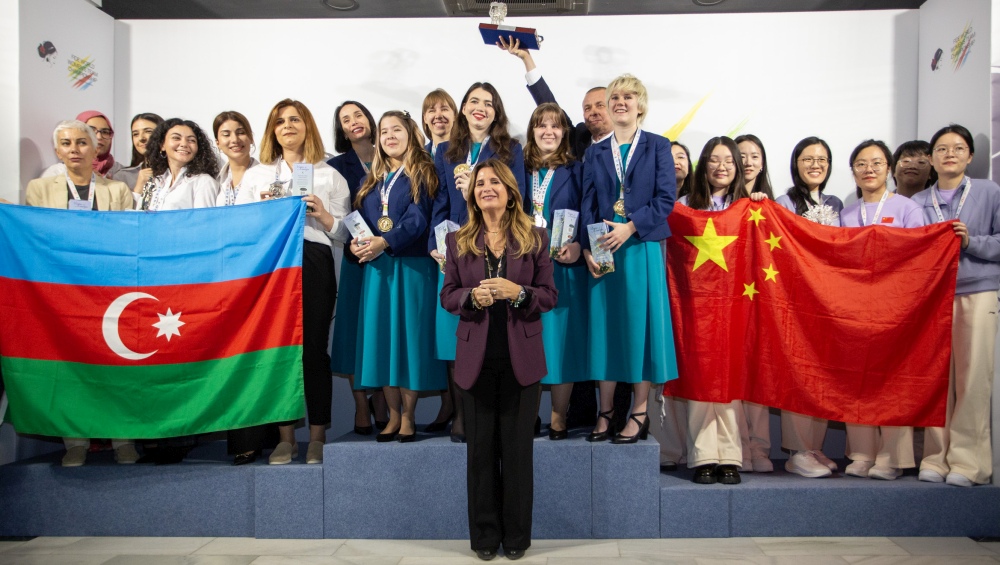
Azerbaijan’s historic silver and China’s resilient bronze cap a thrilling Women’s World Team Championship. The 2025 Women’s World Team Championship concluded in Linares with a showcase of elite competition, rising talent, and historic performances. Team FIDE claimed the world title with an undefeated run, Azerbaijan secured a landmark silver, and China completed the podium with a well-earned bronze. Exceptional individual results across all six boards highlighted the global depth of the women’s game, from Ulviyya Fataliyeva’s commanding board-one gold to Polina Shuvalova’s sensational 9.5/10 and 2827 rating performance on board three. Final standings The closing ceremony brought a festive end to an intense and unforgettable week of competition. Winners’ trophies, gold, silver, and bronze medals, along with a selection of commemorative gifts, were presented by Auxi del Olmo, Mayor of Linares; Javier Ochoa, President of the Spanish Chess Federation; and Victor Bologan, FIDE Executive Director. 🏆 1st place – Gold Medal: FIDE Team With undefeated match play and standout individual performances, the FIDE squad claimed the championship title in commanding style. 🥈 2nd place – Silver Medal: Azerbaijan A remarkable run, full of grit and inspired tiebreak victories, earned Azerbaijan a well-deserved second place. 🥉 3rd place – Bronze Medal: China Led by GM Hou Yifan and supported by a rising generation of talents, China secured the final podium spot after two narrow wins in the bronze-medal duel. Individual board medals Three individual medals – gold, silver, and bronze – were also awarded at the prize-giving ceremony by Martin De La Torre, Concejal de Juventud y Deportes. The prizes were determined by rating performance, with eligibility requiring a minimum of five classical games played during the event. Board/place Player Country Performance Games Points 1st board 🥇 Fataliyeva, Ulviyya AZE 2524 10 6 🥈 Hou, Yifan CHN 2523 6 3½ 🥉 Padmini, Rout IND 2495 7 4 2nd board 🥇 Kamalidenova, Meruert KAZ 2531 9 6 🥈 Javakhishvili, Lela GEO 2492 6 4 🥉 Song, Yuxin CHN 2488 10 6 3rd board 🥇 Shuvalova, Polina FIDE 2827 10 9.5 🥈 Khotenashvili, Bella GEO 2456 6 4 🥉 Lu, Miaoyi CHN 2376 10 5 4th board 🥇 Arabidze, Meri GEO 2463 7 5 🥈 Garifullina, Leya FIDE 2407 8 5½ 🥉 Savitha Shri B IND 2401 7 4 5th board 🥇 Shukhman, Anna FIDE 2675 5 4½ 🥈 Zhai, Mo CHN 2391 8 4½ 🥉 Nurgaliyeva, Zarina KAZ 2276 5 2 6th board 🥇 Kaliakhmet, Elnaz KAZ 2515 9 7 Let’s take a closer look at how the afternoon unfolded. Luis Rentero Lechuga, son of Luis Rentero Suarez, driving force behind the classic Linares tournaments, opened the final round with the gong ceremony. Team FIDE dominated Azerbaijan in the final with an impressive 5.5–2.5 overall score. Throughout the championship, the squad remained undefeated, conceding very few individual games. While every team member delivered consistently strong performances, the backbone of their success came from the lower boards: Polina Shuvalova (gold on board three), Leya Garifullina (silver on board four), and Anna Shukhman (gold on board five), all of whom were in exceptional form. The first match ended 3–1 for FIDE, with two wins and two draws. On board three, IM Polina Shuvalova (2473) continued her remarkable run, securing the board gold medal with an extraordinary 9.5/10, one of the finest individual results of the event. On board one, GM Aleksandra Goryachkina (2540) once again demonstrated her world-class technique, gradually outplaying IM Ulviyya Fataliyeva (2420) in a long and demanding queen endgame. Queen endings are notoriously treacherous: perpetual check motifs lurk everywhere, and even a pawn advantage offers no guarantee of victory. Fataliyeva had already defended with admirable resilience for seventy-four moves, but exhausted after a long tournament and a gruelling game, she missed the drawing resource 74…Qf7! Another good option was 74…Qa8+, maintaining the balance. Instead, Ulviyya chose the wrong check 74…Qa5+?, a move that ultimately loses after 75.Kf6 Qa7+ 76.Qd7! Qa3+ 77.Kf6! The g-pawn, and the game, could not be saved. It was a heart-breaking defeat for Ulviyya Fataliyeva, though her gold medal on board one remains a remarkable achievement and undoubtedly one she will treasure throughout her career. The second match closed the event with a 2.5–1.5 victory for FIDE, featuring three draws, though GM Kateryna Lagno (2517) escaped one difficult moment, and a clean, confident win by IM Leya Garifullina (2458) that sealed the championship title. https://youtu.be/9p5lFNPFe8g In the battle for bronze, China prevailed over Kazakhstan with a narrow but deserved 5–3 overall score, delivered through two hard-fought 2.5–1.5 victories. Led by GM Hou Yifan (2620), who guided a youthful line-up with her trademark calm authority, China secured an excellent third place along with a handful of individual distinctions. The Chinese squad earned two silver medals: one for the former four-time Women’s World Champion on board one, and another for WGM Zhai Mo (2384) on board five. They added two bronze medals as well, thanks to strong performances from IM Song Yuxin (2448) on board two and rising star IM Lu Miaoyi (2440) on board three. Kazakhstan’s campaign, meanwhile, was undoubtedly hampered by the absence of their top player, GM Bibisara Assaubayeva (2513), during the semi-finals. According to the team captain, Assaubayeva had fallen ill. She returned for the first game of today’s match, playing White on board one against IM Song Yuxin, who stepped in for Hou Yifan, but was defeated and understandably chose to rest again for the second encounter. Even so, the Kazakh team did not leave empty-handed. They claimed three individual medals: gold for IM Meruert Kamalidenova (pictured above, center) on board two, gold for WIM Elnaz Kaliakhmet (2274) on board six, and bronze for WIM Zarina Nurgaliyeva (2310) on board five. Despite narrowly missing out on a place in the final, the experience gained, especially for their young talents, will surely prove invaluable in the years ahead. Written by IM
FIDE World Cup: Sindarov and Wei Yi advance to final after dramatic tiebreaks
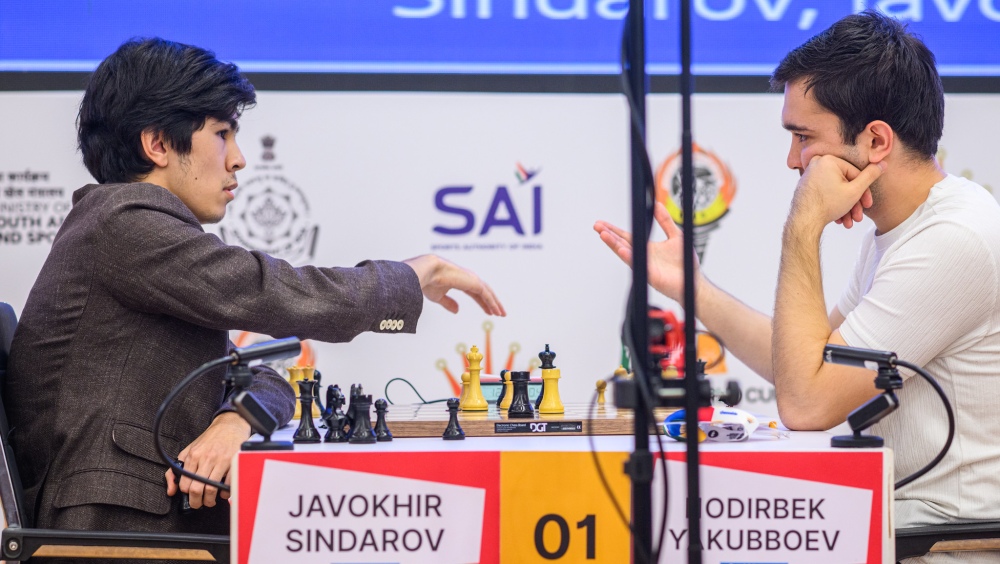
It was the quickest day at the FIDE World Cup so far, with both semifinal tiebreak matches ending in the first 15+10 rapid portion. The day concluded by 16:45, but the speed did not diminish the drama. In the match between Javokhir Sindarov and Nodirbek Yakubboev, Sindarov’s preparation paid off as he took the first rapid game converting a winning endgame. The second game was more tense, with Yakubboev finding real chances to strike back, but the players eventually drew, sending Sindarov through as the first player to reach the finals as well as the 2026 FIDE Candidates. On the opposite side of the stage, the match between Andrey Esipenko and Wei Yi was a rollercoaster from beginning to end. Wei Yi, considered the favourite, obtained winning chances as Black in the first game but ultimately drew. In the second rapid game, it was Esipenko who held the advantage until a fateful rook blunder reversed the outcome and cost him the match. It was a shocking end to the semifinal tiebreaks. The ceremonial first move was made by Mr. Sadanand Shet Tanavade, Member of Parliament (Rajya Sabha), on the board between Sindarov and Yakubboev. Throughout the event, it has been encouraging to see the interest shown by government officials and the AICF’s efforts to invite distinguished guests to each game. At 15:00, the silence of the hall shifted to the quick tapping of clocks. Unlike the classical games, all players seemed settled from the very first moves, confidently blitzing out their opening choices. Here is a closer look at how the games unfolded: Semifinals tiebreak results: Andrey Esipenko ½–1½ Wei YiJavokhir Sindarov 1½–½ Nodirbek Yakubboev Javokhir Sindarov (2721) vs Nodirbek Yakubboev (2689) Javokhir Sindarov is only a few rating points away from becoming the top player in Uzbekistan. As The Guardian recently described, he is “on the verge” of the world elite, and he demonstrated that level today by starting the semifinal tiebreaks with a win over Nodirbek Yakubboev with the Black pieces. The first game began in a typical Semi-Slav structure, following a sideline known for its solidity. Both players appeared well prepared, but they soon diverged from known theory. Up to that point they had played accurately, but White, already behind on time throughout the game, made several imprecise decisions that allowed Black to take over. In a closed position with both sides holding two rooks, White with a bishop, and Black with a knight, Sindarov used the flexibility of his knight to maneuver it into strong squares on the queenside. This eventually forced the bishop-knight exchange, leaving Black with a superior pawn structure. In the resulting position, Black controlled the board with active rooks pressing against White’s isolated e-pawn. With less than a minute remaining, Yakubboev was forced to defend resourcefully. Sindarov did not find an immediate finishing blow, but he eventually secured two connected passed pawns on the queenside. With no realistic defensive chances left, Yakubboev resigned, placing himself in a must-win situation with Black in the second rapid game. Their second 15+10 game began in a Sicilian Najdorf and quickly turned chaotic after White launched an early kingside pawn storm. A key psychological moment came when Sindarov spent nine minutes on 12.f4. Our studio commentators, Grandmasters Peter Leko and Jan Gustafsson, pointed out that this may have caused Yakubboev to relax slightly and choose the wrong plan. White gained an advantage, and Black soon had to give up the exchange, relying on the bishop pair to create counterplay. As is often the case in this time control, chances swung back and forth. Sindarov lost his advantage for a moment, and suddenly Black stood better with real hope of staying in the event. But a major mistake changed the evaluation again. Although White did not convert perfectly and allowed equality more than once, he eventually steered the game into a draw. Here, Black should ignore the potential discovered check on the d-file and play something like 26…Bg2, followed by 27.Bxe3+ Kc6 28.Rh2 Bf3. The position remains equal but requires accuracy from White. Instead, Yakubboev played 26…Kc8?, moving the king away from danger but shutting off his rook and giving White a +3 advantage. Sindarov was not fully precise in converting, exchanging winning chances for equality several times, but a final liquidation to a draw was enough to secure his place in the finals and the 2026 FIDE Candidates. Sindarov was delighted after the match, though he expressed sadness for his teammate, noting that Yakubboev had played well. In our interview, he spoke proudly about his performance today and shared that his family, including his brother, had traveled to Goa to support him, bringing Uzbek food and sweets to lift his spirits. It seems to be working. Andrey Esipenko (2693) vs Wei Yi (2752) Wei Yi looked markedly different after winning the tiebreak against Andrey Esipenko today, especially given the stroke of luck that helped him not just survive the second game but win it. First, let’s revisit the opening rapid game, where the Chinese grandmaster once again started strongly, echoing his match against Arjun Erigaisi, where he recovered from a difficult classical phase with much stronger play in the tiebreaks. With the Black pieces, the game repeated yesterday’s Petroff Defense with the lesser-played 7.Be4, but this time Wei Yi had improved preparation and adopted a slightly different move order, confidently emerging with a better position. In the final stage of the game, a crucial moment appeared: Both players were low on time, and this last move by White was inaccurate. Black had the strong 33…Bd6, forcing the bishops off the board due to the threat of …c5, leading to a centralised king after 34.Bxd6 Kxd6 and real winning chances. Instead, Wei opted for 33…Bf4, and after 34.Re2 Be5, the players repeated moves and drew the game. A steady Italian Game started their second rapid encounter. For a long time, the position seemed dry, with no clear attacking prospects and a stable 0.0 evaluation. Then White
Women’s World Team Championship: Shuvalova shines, Azerbaijan stuns, the final is set

Team FIDE outlast China as Azerbaijan survives a heart-stopping tiebreak against Kazakhstan. The penultimate day of the Women’s World Team Championship delivered exactly the drama one expects from a tournament of this calibre. Team FIDE moved confidently into the final after overcoming China in two tight 2.5–1.5 matches, driven once again by the unstoppable form of Polina Shuvalova. On the other side of the hall, Azerbaijan and Kazakhstan battled deep into the tiebreaks, producing a roller-coaster duel that ended with Azerbaijan’s well-earned blitz tiebreaker victory. It was a day marked by courage, precision, and the fine margins that so often define knockout chess. With these results, the final line-up is confirmed: Final: FIDE Team vs Azerbaijan Third-place match: Kazakhstan vs China Let’s look at how the afternoon unfolded in greater detail in each pool. The gong ceremony to open each of the rounds was performed by Akaki Iashvili, FIDE Special Tasks Director and Mahir Mammedov, FIDE Vice President. With two 2.5–1.5 victories, Team FIDE secured their spot in the final, overcoming a very tenacious Chinese squad, one blending youthful fire on the middle boards with deep experience at the top. Once again, IM Polina Shuvalova (2472) proved to be the team’s driving force, scoring two superb victories against the talented IM Lu Miaoyi (2440). With a perfect 6/6 so far, Shuvalova is all but guaranteed the board-one gold medal, and she may well be on the verge of reclaiming her 2500 rating. China certainly had their chances. GM Hou Yifan (2620) showcased her enduring class by defeating GM Aleksandra Goryachkina (2540), reminding everyone that her strength, despite a reduced competitive schedule, remains unquestionable. And in the first match, the narrative could have shifted dramatically. On board two, with Black, IM Song Yuxin (2448) had played an outstanding game against GM Kateryna Lagno (2517) and achieved a winning position. Black enjoyed an extra pawn, superior piece coordination, and the engines evaluated the position at roughly +4. At this critical moment, victory was within reach had Song chosen 40…f4!, advancing her kingside majority and cutting communication between the rook on h6 and the bishop on c1. She may have feared the reply 41.Rb6, but after 41…Rc7, Black keeps the b7 pawn defended and can continue calmly with ideas such as …Ne1–d3 or …Ng5–h3, maintaining full control. Instead, Song opted for 40…Rc6?, allowing Lagno counterplay. After 41.Rxc6 bxc6 42.c4 f4 43.b5!, White created a passed pawn just in time, forcing a draw a few moves later. A near miss for China, and a crucial half-point saved for team FIDE, in a match where every moment mattered. In the other semi-final match, team Azerbaijan edged out team Kazakhstan in one of the most thrilling tiebreaks I have witnessed live in a very long time. The final 3–1 score in the four-game blitz match was achieved with plenty of sweat and emotion, but it was fully deserved. Much like in football, when a team fails to convert its chances during regular play, a last-minute strike can dramatically reverse the outcome. Kazakhstan had one foot in the final, but after missing their key opportunities, momentum slipped away, and even the introduction of GM Bibisara Assaubayeva (2513) for the blitz (despite her feeling unwell throughout the day) wasn’t enough to overcome the energy and determination of the Azerbaijani squad. https://youtu.be/iybv–ejxfY?si=TAe-vhMve37UN8m7 In the classical portion, both teams had real chances to score a win in the first match, but in the end, all four games were drawn. Kazakhstan’s WIM Elnaz Kaliakhmet (2274) played a superb positional game against IM Gulnar Mammadova (2338), handling the queenless middlegame and ensuing endgame with great finesse. Her control of the position, especially with the rook anchored on the seventh rank, looked promising, and from my seat directly behind her, I found myself instinctively searching for the ideal route to bring the bishop to d5 to convert the advantage. Then came 43.Nf6+, a move that would have been a brilliant finishing touch, if not for the simple refutation 43…Nxf6 44.gxf6 Rf1+!, after which Black regains the f6 pawn and equalizes. A more accurate and patient choice was 43.Ne3!, preparing 44.Bd5+ and the devastating 45.Rf7!. In that line, White’s threats multiply rapidly, and converting the advantage would have been only a matter of time. A heart-breaking miss for Kaliakhmet, and one of several moments where Kazakhstan’s path to the final slipped away at the last possible moment. The second classical set left Kazakhstan’s third board (and team captain) heartbroken. With 1.5-1.5 on the scoreboard, spectators were already sensing that Kazakhstan would prevail without a tiebreak. In this position, 55.f4! is a clear win, picking up the pawn on g5 and basically forcing resignation. WIM Zarina Nurgaliyeva (2310) chose 55.Rb8, which also is winning, but let’s continue. A few moves later, already with the pawn on b7, things are not so simple. The only way to win now is to play 60.Kh2! and now if 60…Kg7 then White can play 61.Rd8! Rxb7 62.Rd4 picking up the g-pawn with an easy technical win with the two connected passed pawns. Alternatively, if 60… Rb2 we use triangulation to transfer the turn to the opponent with 61.Kg1 Rb1+ 62.Kg2 and the position is zugzwang. Now, if Black moves the king to g7, then we pick up the g-pawn as before, and if Black waits with 62…Rb2 then 63.Kf1! and we head out into the open with the king with a winning ending. Not so easy! Unfortunately, Nurgaliyeva chose precisely this moment to play 60.f4?, which is now a big mistake as after 60…gxf3 61.Kxf3 Kg7! this is a theoretical drawn position as there is no way to make clear progress. The final and third-place playoff will start on November 23 at 11:30 AM local time, two hours before the usual starting time. According to the regulations, each duel consists of two matches with the same time control as the qualifying stage: 45 minutes per player for the entire game, plus a 30-second increment per move starting from