

Women’s Candidates Pool B: Missed opportunities in Khiva
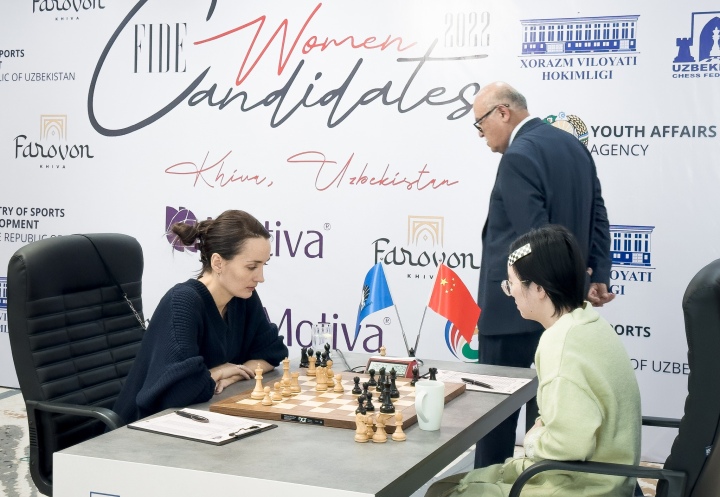
Uzbekistan is booming with chess. The chess federation is building on the resonant successes of their national team – gold medal in the 2022 Chennai Olympiad and silver medal in the recent 2022 World Team Championship in Israel – and putting Uzbekistan on the chess map. Bringing the Women’s Candidates to Khiva is a huge step in this direction, but other initiatives must go side by side. In the same venue as the main event, they have organized the 1st International Al-Beruniy Chess Tournament, a three-group Swiss with several grandmasters, including Nodirbek Yakubboev, one of the five Chennai heroes. Also participating in group B is twelve-year-old Oksana Goriachkina, Aleksandra Goryachkina’s younger sister. Nonetheless, the main focus of the chess world is in the small room that hosts the 4-player B-pool of the Women’s Candidates, which, after two of the four scheduled rounds, has all to be played for. Going into the rest day, both matches are tied 1-1. Aleksandra Goryachkina (GM 2584) vs Alexandra Kosteniuk (GM 2521) Playing with White, Goryachkina opened with 1.e4. Although she thrives in all three moves, in the past, she has always played 1.d4 or 1.c4 against Kosteniuk. The game was a mainstream Ruy Lopez, and, following the latest trend, Goryachkina decided to prevent the Marshall Attack with 8.a4. It’s always hard to speculate on the possible opening preparation, but Kosteniuk uncorked an interesting move (12…Ba8), which was played many years ago by Geller but has recently been shelved for 12…Bc8. She did spend nearly 10 minutes on her eleventh move, so it might also have been a spur-of-the-moment decision. According to the computer, the position was a bit worse for Black – Kosteniuk’s bishops seemed slightly more passive due to her pawn structure – but on the other hand, there was no obvious plan for improving White’s position in sight. After 19…Bg5! followed by 20…Qd7 and 21…Qf5, Kosteniuk arranged her pieces on good squares, and the position became equal. A draw was agreed on move 36 after a threefold repetition. Goryachkina was quite frank in her post-game interview with Press Officer Anna Kantane. “I’m still warming up in this tournament, not everything is smooth, but I’m doing my best. I haven’t used all of my opportunities yet. My opponent lets me get promising positions, but then she defends pretty well”. Kateryna Lagno (GM 2563) vs Tan Zhongyi (GM 2514) In a popular 3.Bb5+ Moscow variation of the Sicilian Defence, Lagno tried an interesting move 11.Re3, played by GM Daniil Dubov in a recent 2022 online event. The idea is to swing the rook over to the kingside in some lines or even to work on the c-file in other variations. The main move with more than 1500 games in the database is 11.Nbd2. After a few minutes to collect her thoughts, Tan Zhongyi correctly decided to finish her development and castle short. After 14…f6, it seemed she was well on her way to equalize. Meanwhile, Lagno was playing very fast, clearly in her home preparation. Already under time pressure, thirty minutes behind her opponent on the clock, Tan Zhongyi went for the premature 16…b5? After Lagno’s precise reaction 17.Bg5! followed by 19.Nd3, the weakness of the c5 square became quite unpleasant for Black. However, the Chinese player kept her calm and struck back with 20…b4! followed by a very precise knight manoeuvre, maintaining the balance on the board. After 34 moves, both players agreed to a draw by perpetual check. After the game, Tan Zhongyi was kind enough to attend the press conference. “I feel a little nervous. I feel like my game is a little tense, and I didn’t completely release myself. I hope it will be better after tomorrow’s break,” were her first impressions. She went on to discuss the opening in the second game. “Lagno’s first 18 moves were played so fast; it was probably all home preparation. Maybe I should have played …b6. I don’t know what she missed, but after b4, I managed to simplify the situation, and I am very satisfied with today’s draw”. Tomorrow is a rest day. A sightseeing trip has been organized, but with so much at stake, players might prefer to concentrate on the final two games of their matches. The third game is scheduled for Friday, December 2nd, at 3pm, and can be followed live with expert grandmaster commentary on FIDE YouTube Channel. Tournament format and prizes Under the new knock-out format, players in each of the two brackets or “pools” will play a four-game match (plus tie-breaks, if needed) in order to advance to the next stage, with the final match being played over the distance of six games. The prize fund for this pool is €70,000, while another €110,000 will be at stake in the Women’s Candidates Final, raising the total to a record-breaking amount of €250,000. Khiva Established around 1500 years ago and currently housing a population of more than 90,000 people, Khiva is the former capital of Khwarezmia, and one of the three Uzbekistan historical cities on the Silk Road. The inner town, Itchan Kala, is encircled by brick walls, whose foundations are believed to have been laid in the 10th century. Mosques, madrassahs, and minarets are the present-day must-see highlights of the city. OFFICIAL WEBSITE: womenscandidates.fide.com/ There is also a Flickr official page from where you can download the photos in high resolution. Text: IM Michael Rahal Photo: Photo: Timur Sattarov and Xushnud Baltaev
From Monaco to Khiva: Women’s Candidates continue on the Silk Road

The first game of the 2022 Women’s Candidates Pool B kicked off this afternoon in the walled city of Khiva – a remote desert oasis on the Silk Road in Uzbekistan. In light of the country’s current chess boom, due to the many recent outstanding results by their national team, the federation bid for this event. Surrounded by glittering madrassahs, mosques and minarets and under the watchful eyes of chief arbiter Husan Turdialiev (International arbiter from Uzbekistan) and Berik Balgabaev (Advisor to the FIDE President), the games began punctually at 3 pm local time in the magnificent Farovon Hotel venue. Amongst other authorities, the Governor of the Xorazm Region, Farkhod Ermanov, and the President of the Uzbekistan Chess Federation, Alisher Sadullaev, made the ceremonial first moves. The winner will face off with Lei Tingjie in 2023 for the right to challenge for the Women’s World Chess title. Tan Zhongyi (GM 2514) vs Kateryna Lagno (GM 2563) Barring rapid and blitz, Tan Zhongyi has so far trailed Lagno by 5,5 – 3,5 since their first classical game in 2016. Most recently, they faced each other in the Astana Women’s Gran Prix in September, a critical game for Lagno, who went on to win the event. Also, given that Lagno out-rates Tan Zhongyi by the slightest of margins, she might be considered the favourite in this match-up. However, a four-game match is over very quickly: whoever draws first blood might easily cruise on to the win. Therefore, caution will usually prevail. Playing with White, Zhongyi went for the Exchange Variation of the Queen’s Gambit, a line that she has had experience with both colours. Well prepared, Lagno chose a relatively new idea – 9…Ne8 – which the World Champion Magnus Carlsen has used very recently. According to the expert commentators of the event – GM Arturs Neiksans and WGM Keti Tsatsalashvili – the move 18.axb4, allowing the exchange of White’s d3-bishop might have been slightly inaccurate. However, Tan Zhongyi played solidly for the rest of the game, preventing Lagno from increasing her small advantage. A draw was finally agreed in a completely equal position on move 40. In conversation with event Press Officer Anna Kantane, Lagno understood that she might have missed a chance. “I think I had a slight edge after she gave me the light-squared bishop, but then I was unable to find the right way to proceed,” were Lagno’s feelings right after the game. “After that, the game is equal, so the draw is OK, but I have the feeling that I was better after the opening”. Aleksandra Goryachkina (GM 2584), Alexandra Kosteniuk (GM 2521) A very close match-up, despite Goyrachkina’s higher FIDE rating. In seventeen classical games, Kosteniuk is overall in the lead 6-3 with 8 draws. More importantly, Kosteniuk prevailed in the 2021 World Cup final, in which she defeated Goryachkina by 1.5-0.5, in one of her most important successes. However, Goryachkina did win the previous 2019 Candidates Tournament and fought for the World Championship against the current champion Ju Wenjun. In today’s game, Kosteniuk opened with 1.e4, and Goryachkina defended with the Berlin variation in the Ruy Lopez. Instead of going for the famous ending, Kosteniuk played a fashionable line, introducing a novel idea in the opening – 9.Kh1 and 10.Ng1, relocating the knight to g3. Unfazed, Goryachkina also manoeuvred with her minor pieces, achieving equality going into the middlegame. Notwithstanding, after a couple of inaccurate moves, Kosteniuk fell into a passive position, and her opponent began to pile up the pressure. With only ten minutes each for the 40-move time control, Goryachkina missed a key move: 34…Qh5 (instead of 34…f5 played in the game) threatening 35…Qe2, followed by 35…b4, would have led to a sizable advantage, according to the engines. Kosteniuk was definitely not satisfied with her performance today. “At some point, I did something very wrong, and I was very worried about my position, but I was lucky in time trouble, being able to exchange everything”, a relieved Kosteniuk explained after the game. The second game is scheduled for Wednesday, November 30th, at 3 pm local time. The games can be followed live with expert grandmaster commentary on FIDE YouTube Channel. Sidebar Under the new knock-out format, players in each of the two brackets or “pools” will play a four-game match (plus tie-breaks, if needed) in order to advance to the next stage, with the final match being played over the distance of six games. The prize fund for this pool is €70,000, while another €110,000 will be at stake in the Women’s Candidates Final, raising the total to a record-breaking amount of €250,000. OFFICIAL WEBSITE: womenscandidates.fide.com/ There is also a Flickr official page from where you can download the photos in high resolution:https://www.flickr.com/photos/fide/albums/72177720304027695 Text: IM Michael Rahal Photo: Photo: Timur Sattarov and Xushnud Baltaev
African Amateur Individual Championship 2022 gets underway in Kenya
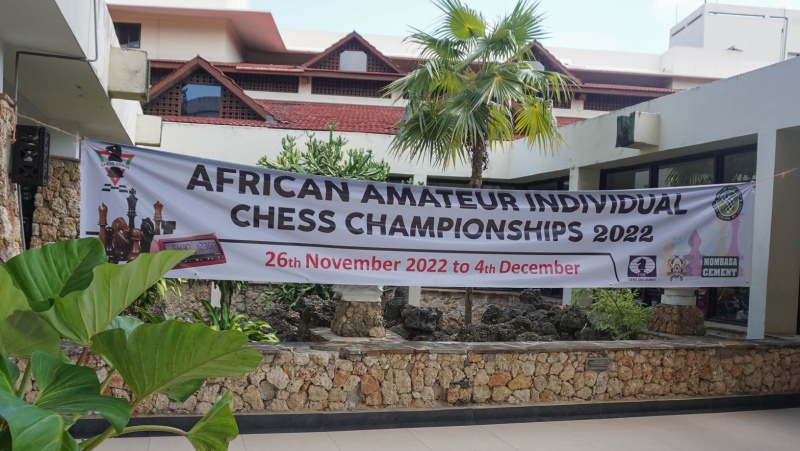
The seventh edition of the African Amateur Individual Chess Championship is taking place at the Mombasa Continental Resort, Kenya. The event attracted a total of 93 players from 15 federations, the highest attendance in the event since its inception in 2015 in Matola, Mozambique. The Open section has three groups: the U2300, U2000 and U1700, while the Ladies’ section has the U1700 and a combined U2300 & U2000. In round two, 17-year-old wonderboy Robert “McLigeyo” Oluka, rated 1786 took an early lead as he upset top seed FIDE Master (FM) Abubaker Tagelsir of Sudan, rated 2231 in the toughest section, the Under 2300 open. McLigeyo is fresh from the African Junior Chess Championship in Algeria earlier this month, where he finished 5th overall in the open section tying on points with the third and fourth players losing out on tie-break points. In the combined 12-player sections of women Under 2000 and 2300, the reigning Kenya National Chess Champion Woman FIDE Master (WFM) Sasha Mongeli maintained the lead with maximum points in a category Kenya is highly tipped to scoop big fielding a total of seven players. Sasha stopped Uganda’s Milly Takali and Zambia’s Naomi Mwale in rounds one and two, respectively. In the Under 2000 open section, the eighth seed Faruk Karim Kizza of Uganda, is in the lead with maximum points in the 22-player section that includes second seed Kenya reigning men champion Martin Njoroge. Njoroge, rated 1973, survived a very bad position to force a draw against Sudan’s Hussain Abdalla, rated 1889, to place seventh currently with 1.5 points in the 9-round event. In the women Under 1700 category, top seed Olympiad debutant Jully Mutisya of Kenya is in the lead with maximum points and faces second seed Safinah Mugide of Uganda in round three. In the Under 1700 open section, the 34-player tournament the third seed Calvin Ntumwa of Uganda grabbed the lead after scoring two straight victories. In round two, there was a major upset when Kenya’s Zadock Nyakundi, rated 1569 beat the top seed Leornard Nghifikwe of Namibia, rated 1699, to obtain a precious win and Elo rating points. Other upsets in round two were Kenya’s 16-year-old Candidate Master (CM) Aguda Lwanga (1575) holding the second seed Dahir Mahad (1695) of Somalia and Kenya’s rising 14-year-old Jamie Kanango (1357) toppling his experienced compatriot Thomas Nzioki (1662). In round three action among top games, veteran CM Benjamin Magana faces Ugandan FM and second seed Haruna Nsubuga on Board 1, and Oluka plays compatriot Samuel Wafula on Board 2. In women Under 2300, Sasha takes on WFM Gloria Nansubuga of Uganda on Board 1, while Kenya’s 2021 World Amateur Woman Under 1700 champion Madelta Glenda is pitted against Linda Shaba of Zimbabwe on Board 2. Text and photos: Chess Kenya
FIDE Aid Package to Open Tournaments 2023
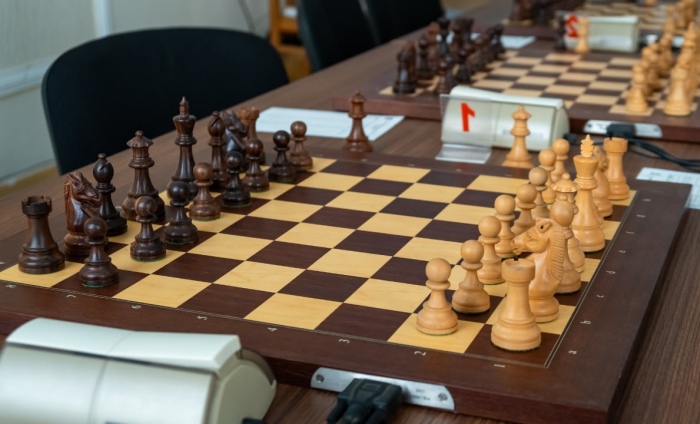
Following the success of the FIDE Open Tournaments support program during the last two years, FIDE will be extending its Aid Package Program in 2023, increasing the total funding to a record amount of €200,000. When FIDE first launched this global program in 2021, its goal was to achieve a multiplier effect: by supporting open tournaments amidst the pandemic, we intended to indirectly support many other segments of the chess community, including young players, professionals, women players, arbiters, seniors, and even beginners. The positive impact and feedback received have even surpassed expectations, which justifies the continuation of the program – and its expansion. “Open tournaments represent a very important integral part of the entire chess community eco-system. It helps young players to grow, it provides bread – and sometimes butter – for hundreds of 2500-2700 players, and it represents a very important part of professional life for women players 2300-2500”, explained Emil Sutovsky on behalf of the GSC. “It also helps local chess clubs and communities, and it is oftentimes an important link between chess and city hall or region. We must do our utmost to preserve it.” Each open tournament organiser applying for the Aid Package shall accept the conditions and meet the requirements listed here: CONDITIONS & REQUIREMENTS An application for the Aid Package shall be sent to gsc@fide.com by 31 December 2022 The Aid Package can be at most 20% of the prize fund and 10% of the total budget. In any case, the support per event shall not exceed 12 thousand Euros. At least 10% of the total prize fund shall be allocated for women’s prizes, and at least 5% of the total prize fund shall be allocated for Veteran’s prizes. FIDE may require the tournament to establish lower fees (or absence of fees) for the agreed categories of participants (veterans, youth, women, and representatives of developing countries) Mention “Financially supported by FIDE” shall be visible on the tournament’s media resources (e. g., website, social media pages) FIDE may require FIDE and its sponsors to be reasonably represented at the tournament The beneficiaries of the Aid Package must send FIDE an administrative report at the conclusion of the event, sharing data like an increase in the prize fund, increase in participation, media and social media coverage, number of women, juniors and seniors who took part, et cetera. We also expect the beneficiaries to assist the FIDE media team with the event’s coverage. The Organiser is requested to fill out the following form (all the provided data will remain confidential): APPLICATION FORM. SELECTION CRITERIA Events with the classical time control shall be prioritised Event’s history Event’s strength Geographical location Amount of the prize fund and its distribution Fair Play measures The list of the selected Opens shall be announced by 15 January 2023.
Women’s Candidates Tournament Pool B kicks off in ancient Khiva
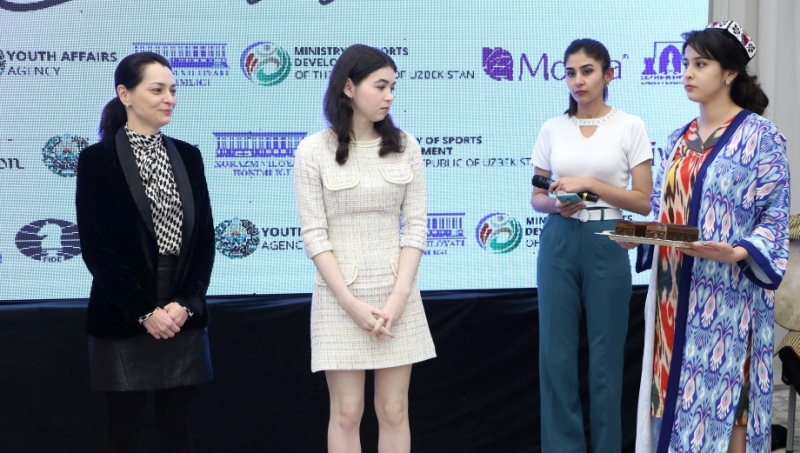
A long-awaited second pool of the FIDE Women’s Candidates has finally started in Uzbekistan, in the beautiful oasis city of Khiva. In the next two weeks, the chess world will follow exciting chess battles of leading world female players fighting for the second spot in the big final. The winner of Pool B will take on Lei Tingjie, who qualified from Pool A a month ago. The opening ceremony was filled with local flair, including traditional tea and music, allowing players and guests to enjoy the amazing Uzbek hospitality. Alisher Sadullaev, the President of the Uzbekistan Chess Federation (pictured below), gave a welcoming speech. “I’m very happy to see those strong grandmasters here in Uzbekistan, probably for the very first time.” He also thanked FIDE for the great cooperation and expressed hope that it would be just the beginning of it. Deputy governor of the Xorazm region, of which Khiva is the capital, Sanatbek Salayev, was another guest at the opening ceremony. Radiating genuine warmth, he expressed his happiness and pride in holding such a prestigious tournament in his region. After the speeches, it was time to draw colours for each game. Traditionally dressed Uzbek ladies presented the players with beautiful caskets with chess queens hidden inside – one with black and the other with white. A player with the higher rating in each match-up had a right to choose. Aleksandra Goryachkina, the highest-rated player in the event, picked a chest with the black queen inside, thus giving Alexandra Kosteniuk the white pieces in their first game. In the second pair, it was Kateryna Lagno to take a pick. Again, the right to choose did not bring luck, as Lagno pointed to the box with the black queen inside. Tan Zhongyi will start her Candidates campaign with the white pieces. The first games start on Tuesday, November 29, at 3 pm local time. Below you can find the schedule for the event: November 28 Arrival day Technical meeting / 5:00 pm Opening Ceremony / 8:00 pm November 29 Round 1 Game 1 / 3:00 pm November 30 Round 1 Game 2 / 3:00 pm December 1 Free day December 2 Round 1 Game 3 / 3:00 pm December 3 Round 1 Game 4 / 3:00 pm December 4 Tie-breaks / 3:00 pm December 5 Free Day December 6 Round 2 Game 1 / 3:00 pm December 7 Round 2 Game 2 / 3:00 pm December 8 Free day December 9 Round 2 Game 3 / 3:00 pm December 10 Round 2 Game 4 / 3:00 pm December 11 Tie-breaks / 2:00 pm Closing Ceremony More information is available on the official website: womenscandidates.fide.com/ Text: Anna Kantane Photo: Eteri Kublashvili
Women’s Candidates Tournament Pool B: Introducing the players

Pool B of the FIDE Women’s Candidates Tournament is held in the ancient city of Khiva, in Uzbekistan. The event takes place from November 28 to December 11 at Hotel Farovon Khiva. This bracket will see the clash between the 2020 runner-up Aleksandra Goryachkina, Alexandra Kosteniuk and Tan Zhongyi as the top finishers at the FIDE World Cup 2021, and Kateryna Lagno as one of the top-three finishers at the FIDE Women’s Grand Prix 2019–2021. Aleksandra Goryachkina Born September 28 1998 Federation: FIDE Rating: 2584 Aleksandra Goryachkina is a two-time world junior U20 champion (2012, 2013) and a two-time women’s champion of Russia (2015, 2017). She is also the overall winner of the previous edition of the Women’s Gran Prix, which was played between 2019 and 2021, after sharing first place in Monaco and Lausanne. She automatically qualified for the Women’s Grand Prix 2022-23 by becoming one of the four semi-finalists of the FIDE Women’s World Cup 2021 held in Sochi in July-August 2021. Aleksandra was born on September 28, 1998, in Orsk, a city in the Orenburg region in the Southern Ural, where Europe meets Asia. Her father, Yury, a strong chess player, has helped his daughter since she was a child. Goryachkina immediately achieved a dominant position in her age group and improved her position by winning the world youth championships under 10 and 14 years old, as well as the European championships under 12 and 14 years old. Soon, a rising star moved to Salekhard, the only city in the world that is located directly on the Polar Circle. Aleksandra started to work with a famous coach and GM, Vladimir Belov, and it was again a breakthrough: she won the Russian Women’s Cup in Saint Petersburg (2011), became the world’s second youngest woman grandmaster after Hou Yifan, won the European and world championships in higher age groups, while often being much younger than her rivals. Over the year, her rating grew by almost 300 points from 2045 to 2333. In 2012, Goryachkina won the Russian Cup and then the world’s junior U20 championship. In 2013, Aleksandra regained her “Chess Princess” title and debuted in the Superfinal of the Russian Championship. In her match against the best Russian female chess players, it took Goryachkina three attempts to achieve her goal: Aleksandra took first place in Chita 2015. In the same year, she won the Russian Women’s Cup for the second time. In 2017, Aleksandra Goryachkina became a two-time Russian women’s champion and won the silver medal in the Individual European Women’s Championship. In 2013, Goryachkina debuted at the European Team Championship as part of the Russian national women’s team. In 2015, she became the champion of the Old World as part of the national women’s team and won the gold medal for the best result on the third board. In 2017, she won the World Team Championship as part of the Russian national women’s team. At the FIDE Women’s Candidates Tournament (Kazan, Russia) in the end of May – June 2019, Aleksandra Goryachkina had an impressive victory with two rounds to go and qualified for the Women’s World Chess Championship match against Ju Wenjun. The match, played in Shanghai and Vladivostok, was one of the most exciting ones in recent times. Despite being down on the scoreboard on two occasions, Goryachkina fought fiercely and managed to level the score by winning the 12th and last classical game, forcing a tiebreak. She lost one of the four rapid games, drawing the other three, which allowed Ju Wenjun to retain the title. Kateryna Lagno Born: December 27, 1989 Federation: FIDE Rating: 2563 Kateryna Lagno is a two-time European women’s champion (2005, 2008), the women’s World rapid champion (2014), a two-time Word blitz champion (2010, 2018), a two-time winner of the World Chess Olympiads – in 2006 as part of the Ukrainian national team and in 2014 as a member of the Russian national team. Despite not winning any of the legs in the previous edition of the FIDE Women’s Grand Prix, she finished in the third position in the overall standings for the series, thanks to her regularity: she obtained 3rd place in Gibraltar and 4th place in Skolkovo and Monaco. She qualified for the current edition by rating. Lagno was born on December 27, 1989, in Lviv, a major city in Western Ukraine. Kateryna started her chess career as a prodigal child: she learnt to play when she was two, and at seven, she became the Ukrainian champion among girls under 10 years. She achieved that rank two more times; furthermore, Lagno became the national champion among girls under 12 years three times in a row. In 2000, Katya enrolled in the famous chess school of Kramatorsk, Donetsk region, where she studied alongside Ruslan Ponomariov, Sergey Karjakin, Zahar Efimenko and other future grandmasters. In 2002, Lagno broke Judit Polgar’s record (that seemed to be unbreakable), thus becoming the youngest woman grandmaster in history – she achieved the “honourable” rank at the age of 12 years and 4 months. Kateryna Lagno took her first big steps in professional chess very soon: she made it all the way to the quarterfinals of the Women’s World Championship (Elista, 2004), won the Women’s European Championship in 2005, was first at the super tournament known as the North Urals Cup in 2006, became the Olympic champion as a member of the Ukrainian national team (Turin, 2006), and again the was victorious at Women’s European Championship in 2008. Kateryna became the World women’s blitz champion in 2010, the world and European champion as part of the Ukrainian national team in 2013, and won the World women’s rapid championship in 2014. In 2014, Ekaterina Lagno filed an application to join the Russian Chess Federation; during the Olympiad in Tromso, she played on the first board of the Russian national women’s team and became the Olympic champion for the second time in her career. Ekaterina is also the world and European champion as a member of
Winners crowned at World Senior Championship 2022
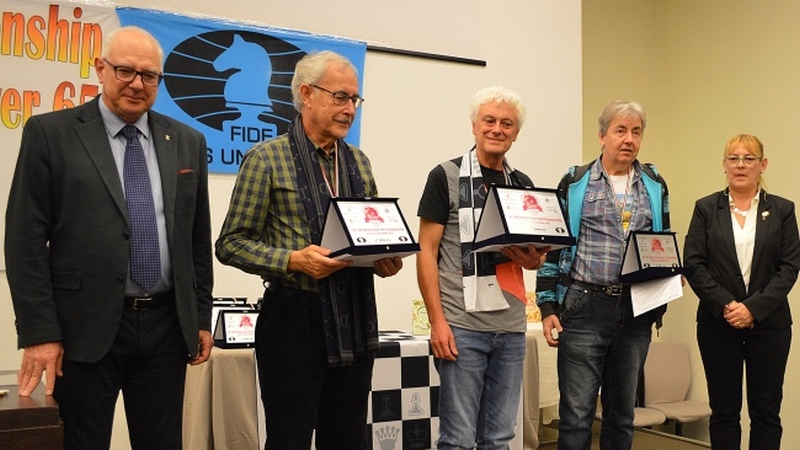
The 30th edition of the FIDE World Senior Chess Championship in Assisi (Italy) ended on Saturday, November 26, after a hard fight until the last minute. The first player to become Senior World Chess Champion 2022 was legendary Nona Gaprindashvili (GEO). After nearly one hour of play with IM Jean-Luc Roos (FRA), the opponents agreed on a draw. With this result, Nona scored 7 points and got the best tiebreaks among all female players in the Open 65+ section to claim gold. It is Nona’s eighth Senior World Championship title, an extraordinary achievement by the “Grand Dame of Chess”. WGM Galina Strutinskaia (FID) finished on 7 points as well (winning her last game) and took silver. The bronze medal goes to WFM Larisa Khropova (FID). GM John Nunn (ENG) emerged as the winner and Senior World Chess Champion in section Open 65+. Coming into the final round, a half point behind Jens Kristiansen (DEN), he notched up a crucial victory over IM Valentin Bogdanov (UKR) and finished on 9 points. Meanwhile, his main rival and leader, Kristiansen, suffered a defeat at the hands of GM Jose Luis Fernandez Garcia (ESP). As a result, they tied for second place GM Nikolay Legky (FRA) and IM Nils-Gustaf Renman (SWE), all on 8½ points. In accordance with Buchholz (second tiebreaker), Fernandez Garcia won silver, and Legky took bronze. Final standings 65+: 1 GM Nunn, John ENG 2580 9 2 GM Fernandez Garcia, Jose ESP 2358 8½ 3 GM Legky, Nikolay FRA 2350 8½ 4 GM Kristiansen, Jens DEN 2353 8½ 5 IM Renman, Nils-Gustaf SWE 2320 8½ 6 IM Hebert, Jean CAN 2333 8 7 GM Knaak, Rainer GER 2457 8 8 GM Jansa, Vlastimil CZE 2390 8 9 IM Pomes, Marcet Joan ESP 2197 8 10 IM Maryasin, Boris ISR 2258 7½ It all came down to the wire in the Open 50+ as well. In the final eleventh round, GM Maxim Novik (LTU) won against one of two leaders GM Fernandez Ivan Morovic (CHI), whereas GM Zurab Sturua (GEO) made a quick draw with GM Vladislav Nevednichy (ROU). Both Sturua and Novik finished on 8½ 11 and tied for the first place without playing each other. The Buchholz favoured the Georgian player who claimed his second title after the triumph in Katerini, Greece, back in 2014. Novik came second, and Morovic finished third (8 points). Although Elvira Berend (LUX) was the first to finish her final-round game, she had to sweat it to the very end. Eventually, her quick draw was enough to become the Women’s World Champion in the section Open 50+. It was nearly like a Hitchcock trailer: WGM Elvira Berend (LUX) and WIM Sopio Tereladze (GEO) both finished on 7½ points, with a paper-thin Buchholz advantage for Berend. IM Angela Borsuk (ISR) came third. Final standings 50+: 1 GM Sturua, Zurab GEO 2522 8½ 2 GM Novik, Maxim LTU 2412 8½ 3 GM Morovic Fernandez, Ivan CHI 2480 8 4 GM Nevednichy, Vladislav ROU 2499 8 5 GM Bischoff, Klaus GER 2479 8 6 IM Bellia, Fabrizio ITA 2398 8 7 GM Pavlovic, Milos SRB 2447 7½ 8 GM Holzke, Frank GER 2476 7½ 9 GM Antonio, Rogelio PHI 2397 7½ 10 IM Vinter-Schou, Uffe DEN 2375 7½ Official Website: scaccomattissimo.com/assisi-2022-en/ Complete results and final stadings: chess-results.com/tnr691291.aspx?lan=1&art=0&flag=30
China is World Team Champion 2022
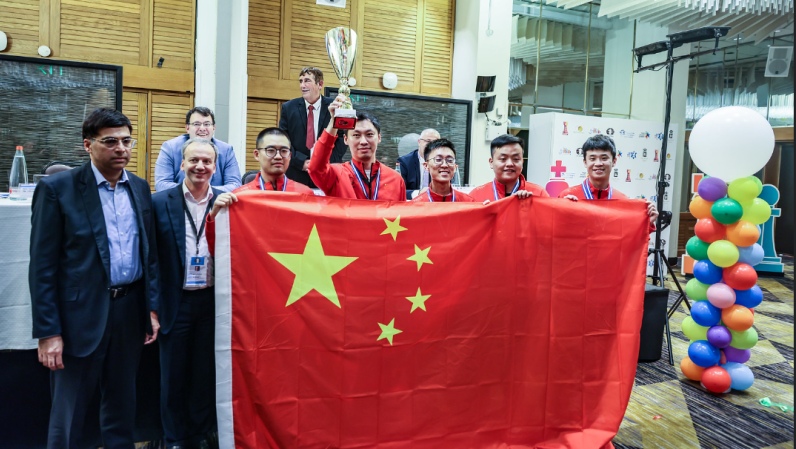
Uzbekistan second, Spain third, India fourth The FIDE World Team Championship 2022 featured a faster time control than in previous editions of this tournament. GM Ivan Sokolov, the Captain of the Uzbekistan team, said, “this increment of 10 seconds per move probably favours a bit younger players.” Sokolov noted that the two teams which played for gold, China and Uzbekistan, had young players on their rosters. The four grandmasters who played the final two matches for China were Lu Shanglei, age 27, Xu Xiangyu, age 23, Bai Jinshi, age 23, and Li Di, age 23. Their opponents from Uzbekistan were, in round 1, GM Nodirbek Yakubboev, age 20, GM Javokhir Sindarov, age 16 (the youngest player in this championship), GM Shamsiddin Vokhidov, age 20, and GM Jakhongir Vakhidov, age 27. In round 2, IM Ortik Nigmatov, age 22, took over the fourth board, Vakhidov moved up to the third board, and Vokhidov, who lost in round 1, sat out round 2. Dignitaries and Commentary Arkady Dvorkovich, FIDE President, rang the gong to start the first round, while former Israel Chess Federation President Israel Gelfer, who is also a former FIDE Vice President, kicked off the second round. GM Alik Gershon and IM Almira Skripchenko were in the commentary booth during round 1. Gershon, of Israel, is known for playing 523 simultaneous games in 2010, to break what was then the world record. A seven-time French Women’s Chess Champion, Skripchenko, commentated every round in Jerusalem. Grandmaster and former World Chess Champion Viswanathan Anand served as a commentator daily. The only exception was round 1 on Friday, when he participated in a FIDE Council meeting. Anand was back for round 2 to share commentating duties with Skripchenko again. Ms Feruza Makhmudova, Ambassador of Uzbekistan to Israel (pictured below), visited the FIDE World Team Championship 2022 on its final day. Speaking about Uzbekistan’s second-place finish in this tournament, Makhmudova said, “This tournament was a new step in the development of the chess culture in our country. Chess gives Uzbekistan a way to present its strength. I am very excited that our team is a young team, as more than 60% of our population is under the age of 30. These team members are chess ambassadors, and they are doing their jobs excellently. They are connecting Uzbekistan to other countries.” Final: Round 1 China defeated Uzbekistan in their round 1 match 2.5-1.5. The games on boards 1, 2 and four were drawn, but on board 3, Bai Jinshi got the better of Shamsiddin Vokhidov, who missed some important tactics in the following critical position: Bai Jinshi – Shamsiddin Vokhidov Black had sufficient compensation for an exchange but one careless move 33…Rb8 cost him dearly. After 34.f4! Qxf4 35.Qa7! Qe5 36. Rxf6 Kxf6 37.Rf1+ Kg5 (more stubborn was 37…Kg7 38.Qxf7 Kh8) 38.Rxf7 Rh8 39.Qe7+ Kh6 40.Qh4+ Qh5 41.Qf6 Rg8 42.Bf3 Shamsuddin threw in the towel. 1-0 Small Final: Round 1 India and Spain tied their round 1 match 2-2. The teams traded blows on boards 2 and 4, where Nihal Sarin (India) and Ruiz Miguel Santos (Spain) beat David Anton Guijarro and Krishnan Sasikiran and split points on boards 1 and 3. Final: Round 2 Uzbek players started strong in a must-win situation and had a chance to send the final match into a tiebreaker at some point. Indeed, Nordirbek Yakubboev put tremendous pressure on Lu Shanglei on the first board while the positions on three other boards seemed balanced. It did not pan out for Uzbekistan this time, though. Yakubboev snatched a “poisoned” pawn in an overwhelming position and let his opponent off the hook, while Ortik Nigmatov misplayed a drawish rook endgame and lost to Li Di. Two other games were drawn, and China scored another 2.5-1.5 victory to clinch the title. In a short interview after his game, Li Di thanked the Chinese Chess Association for sending the team to Jerusalem and said he would remember this experience for his whole life. Small Final: Round 2 India and Spain tied their round 2 match by drawing all four games and putting another 2-2 on the scoreboard. The first game to finish was played on board 3 where S. L. Narayanan, as Black, drew with Daniil Yuffa, who stepped in for Alexei Shirov. Narayanan said he expected to play Shirov again, so he replied on his own knowledge of chess rather than player-specific preparation against Yuffa. Three other games were also uneventful draws. Tiebreak Spain won the tiebreak against India 3-1 and took bronze (their first medal ever in team competition), with Jaime Santos Latasa and David Anton Guijarro winning on boards 1 and 2. Knockout stage: Individual Board Awards Players assigned to the same board number (including boards 5 and 6) compete for individual gold, silver, and bronze board awards. A player needed to play at least five games to be eligible for a board award. Board 1 1. Vachier-Lagrave, Maxime (2782, FRA) 2. Lu, Shanglei (2752, CHN) 3. Mamedyarov, Shakhiryar (2749, AZE) Board 2 1. Sindarov, Javokhir (2764, UZB) 2. Nabaty, Tamir (2764, ISR) 3. Shevchenko, Kirill (2763, UKR) Board 3 1. Fressinet, Laurent (2742, FRA) 2. Guseinov, Gadir (2737, AZE) 3. Narayanan, S.L. (2716, IND) Board 4 1. Bai, Jinshi (2739, CHN) 2. Vakhidov, Jakhongir (2705, UZB) 3. Gumularz, Szymon (2538, POL) Board 5 (first reserve) 1. Li, Di (2661, CHN) 2. Santos Ruiz, Miguel (2581, ESP) 3. Kevlishvili, Robby (2511, NED) Text: WIM Alexey Root, FIDE Press Officer, Jerusalem Photos: Dr. Mark Livshitz and Maria Emelianova Official website: worldteams.fide.com
FIDE President visits the Middle East
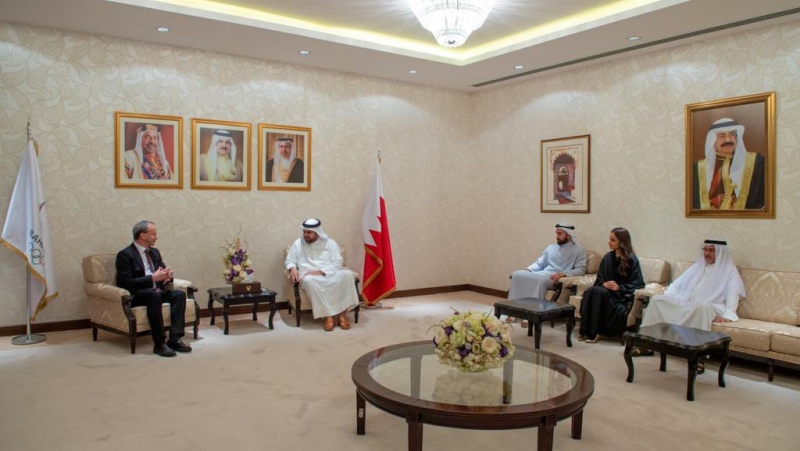
This week, the President of the International Chess Federation, Arkady Dvorkovich, held several high-level meetings in the Middle East before joining the rest of the team in Jerusalem for the Q4 FIDE Council Meeting. The first stop was Bahrain, on November 22, where Dvorkovich met with the Vice-President of the Bahrain Olympic Committee, his Highness Shaikh Isa Bin Ali bin Khalifa Al Khalifa, the Secretary-General Mr Faris Al Kooheji, and the Board Member Dr Shaikha Hessa bint Khalid Al Khalifa. Two of the main topics of the discussion were possibly holding some top FIDE events in Bahrein, as well as the inclusion of chess into the regional games. The third edition of the Gulf Games was held this year in Kuwait, and the next one, in 2026, will see the participation of 10 countries from the region. The Bahrain Chess Federation is a member of the National Olympic Committee, as well as a member of FIDE since 1982, and the island currently has 570 rated players. The last top-level chess event held in Bahrain was the exhibition match between Vladimir Kramnik and Deep Fritz in 2002. The FIDE president also met with His Highness Aymen Al Moayed, Minister of Youth and Sports, and since this week, Supreme Council for Youth & Sports Secretary General. The Minister demonstrated a great interest in creating a technification centre or academy in Bahrain offering high-level training to young talents from the region. The next stop was Beirut, where the Deputy Chair of the Management Board, Dana Reizniece-Ozola, and the Chairman of the Trainers Commission, Sami Khader, joined the FIDE President. The host was the President of the Lebanon Federation, Khaled Badieh, who prepared a packed agenda of visits and high-level meetings. With Minister of Youth and Sports, George Kallas November 23 started with a meeting with George Kallas, Minister of Youth and Sports for Lebanon (pictured above, left), followed by a meeting with the Vice President of the Olympic Committee, Mr Jack Tamer, and its Secretary General, Mr Hassan Rostom. After a break, the round of meetings continued in the afternoon, where the FIDE delegation had the chance to meet with the Minister of Culture, Mr Muhammad Wissam Adnan Murtada, the Minister of Education, Abbas Halabi, and the Secretary General of the Council of Ministers, Mr Mahmoud Makiya. Most of these top-level meetings follow a similar script: the possibility of hosting a FIDE event is usually accompanied by a proposal to create a plan to train and develop local talents, so the best players in the country can make the most of the opportunity. This way, the host can ensure that the investment in the event has a long-lasting effect. Then, the authorities receive a comprehensive explanation of why chess is such a formidable tool for education, and they are presented with some examples of social projects developed by FIDE. In the case of Lebanon, the chess in prisons project, and the possibility of including chess in cultural sites and as a part of cultural festivals, were two of the ideas that resounded the most among our hosts. With the Lebanese Minister of Education, Mr Abbas Halabi “I am very satisfied with the visit of THE FIDE President”, said the President of the Lebanon Chess Federation, Khaled Badieh. “It is of great help since it opens doors to the government and provides guidance. The Federation will do its best to follow up on the initiatives discussed and deliver”, he added. FIDE had signed a Memorandum of Understanding with the Lebanese Ministry of Education back in 2010, but the results were quite modest. While chess has a strong presence at universities, where it is very well considered, chess in school activities are scattered and lack coordination and support. “There is a vibrant chess life in Lebanon, but scattered. I would be happy if our meetings with government officials and representatives of the chess community could help to enhance their cooperation for the benefit of professional chess players, but most importantly, to engage even more kids in schools and chess clubs”, said Arkady Dvorkovich. Lebanon currently has 1800 registered players, 290 of which are FIDE-rated. “Before the arrival of the President, I had the chance to visit visiting schools and chess clubs. What pleased me the most was seeing many young players and girls among the members”, says Dana Reizniece-Ozola. “Many of these clubs are self-organised, quite a few were created during the pandemic, and they act like the local community clubs: people gather there to play chess but also to socialise, connect, and spend some quality time together”, she added. With Lebanon Olympic Committee One last meeting before leaving Beirut was held between Dvorkovich and Dr Nabil Badr. A prominent business figure in Lebanon, Mr Badr is also a member of the Parliament, and he has been President of the Lebanese and Mediterranean chess federations. Arkady Dvorkovich and Dr. Nabil Badr, former President of the Lebanese Chess Federation
World Team Championship 2022: China and Uzbekistan face off in the final
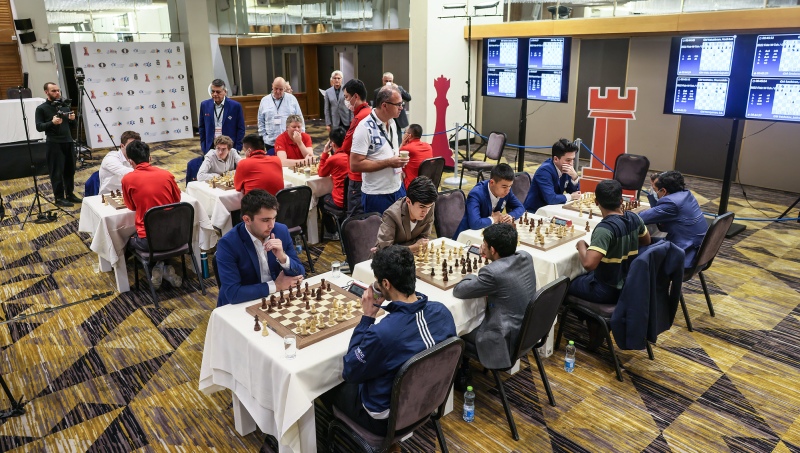
India and Spain are to play for bronze Except for Grandmaster Hans Niemann, who remains abroad for other tournament opportunities, the USA players and the USA team captain returned to their homes for Thanksgiving, a traditional holiday in the USA. On the fourth Thursday of November, celebrants sing the folk song Simple Gifts and the hymn We Gather Together. After a tense semifinal Round 1, which saw two tied matches, in Round 2, Thanksgiving lyrics resonated with the teams-winners China and Uzbekistan. After round 1, chess fan Nechama Joanes, whose first name means “a consolation” in Hebrew, felt sorry for players who drew. She said, “A draw means two people don’t win”, so they are not satisfied. Nechama learned the rules of chess when she was seven, and she is now 11 years old. Her favourite part of the tournament was watching everyone think very hard and stay focused. Semifinals Round 1 Dr Zvika Barkai, Chairman of the Israel Chess Federation, rang the gong to start the first round of the semifinals. India and Uzbekistan tied their round 1 match 2-2. On the first board, Vidit Santosh Gujrathi drew with Nordirbek Yakubboev, although at some point, his position looked very dangerous. On the second board, Nihal Sarin and Javokhir Sindharov quickly traded the majority of pieces and split a point in an equal rook endgame. On third board S. L. Narayanan gradually outplayed Shamsiddin Vokhidov with the black pieces to give his team the lead. Luckily for Uzbekistan, on board four, Jakhongir Vakhidov‘s pawn avalanche swept away S.P Sethuraman‘s defences. China and Spain also tied their match 2-2. After the games on boards 1 and 3 were drawn, David Anton Guijarro, playing on the second board with Black, instructively outmanoeuvred Xu Xiangyu and put his team in front. Xu Xiangyu – David Anton Guijarro White is in zugzwang. Indeed, virtually any move leads to material losses. Xu Xiangyu tried 33.e5, but after 33…dxe5 34.fxe5 Rc5! Black won a pawn and smoothly converted it. | 0-1, 48 moves In a short interview, Anton Guijarro (pictured below) said that this game might be his favourite win in the tournament. However, China levelled the score after Di Li beat Miguel Santos Ruiz on board 4. Round 2 To start round 2 of the semifinals, Jonathan Tal, age 14, a member of the Tel Aviv Chess Club, rang the gong. Uzbekistan defeated India 2.5-1.5. On the first board, Nordirbek Yakubboev prevailed over Vidit Santosh Gujrathi with the black pieces in a very complicated battle. Javokhir Sindharov skillfully pressured Nihal Sarin’s pawn weaknesses and then broke through on the kingside. Javokhir Sindharov – Nihal Sarin 52.Qxd3! forced an immediate resignation as 52… Qxd3 is met with 53. Rf7+ Nxf7 54. Rxf7+ Rg7 55. Rxg7+ Kh8 56. Rd7+ 1-0 India retaliated on board 3, where S. L. Narayanan won as White against Shamsiddin Vokhidov, but it was not enough to save the match as the game between Jakhongir Vakhidov and Krishnan Sasikiran ended in a draw. Meanwhile, China defeated Spain 3-1. On the second board, Xu Xiangyu drew as Black against Spain’s David Anton Guijarro. Daniil Yuffa took over Miguel Santos Ruiz on the fourth board and drew his game as White against Di Li. The decisive outcomes were posted on boards 1 and 3. Lu Shanglei, as White, impeccably converted his extra pawn into a full point against Jaime Santos Latasa, while Bai Jinshi cold-bloodily extinguished Alexei Shirov’s initiative and scored the second victory for his team. The hymn We Gather Together was written after Spain lost in the Battle of Turnhout and suffered almost 50% casualties. That battle was in 1597 against the Dutch and English. This time, Spain’s opponent was China, and the casualties were just as bad. Out of the eight games played today (4 in round 1 and 4 in round 2), Spain got 3 out of 8 points or 37.5%. Winning the fight The hymn We Gather Together includes the lyric, “So from the beginning the fight we were winning.” That lyric applies to China in this tournament. China has been unstoppable since the FIDE World Team Championship 2022 began on November 19. The team dominated Pool A with 4 match wins and one tied match. Yesterday, China eliminated Poland with one winning match and one tied match. In the two-round semifinals, China tied Spain in round 1, then won 3-1 to advance to the finals. The folk song Simple Gifts includes the lyric, “‘Tis the gift to come down where we ought to be.” Yesterday, the Uzbek first board Nordirbek Yakubboev said that his team intended to win gold in Jerusalem, just as it did in Chennai at the 2022 Olympiad. Is the gold medal podium meant for Uzbeks, or do the Chinese belong there? Tomorrow’s final will determine this championship’s gold medal winner and second-place finisher. Also tomorrow a “small final” to determine the third place and fourth place finishers, to be contested between Spain and India. Each match will consist of two games, to be played an hour earlier than on previous days. On Friday, November 25, round 1 will be at 2 p.m. local time and round 2 at 5 p.m. If a tiebreak is needed, that will be played at 7:30 p.m. Text: WIM Alexey Root, FIDE Press Officer, Jerusalem Photos: Dr. Mark Livshitz and Maria Emelianova Official website: worldteams.fide.com