

FIDE World Cup 2025 semifinals: Game 2 ends in deadlock as tiebreaks await
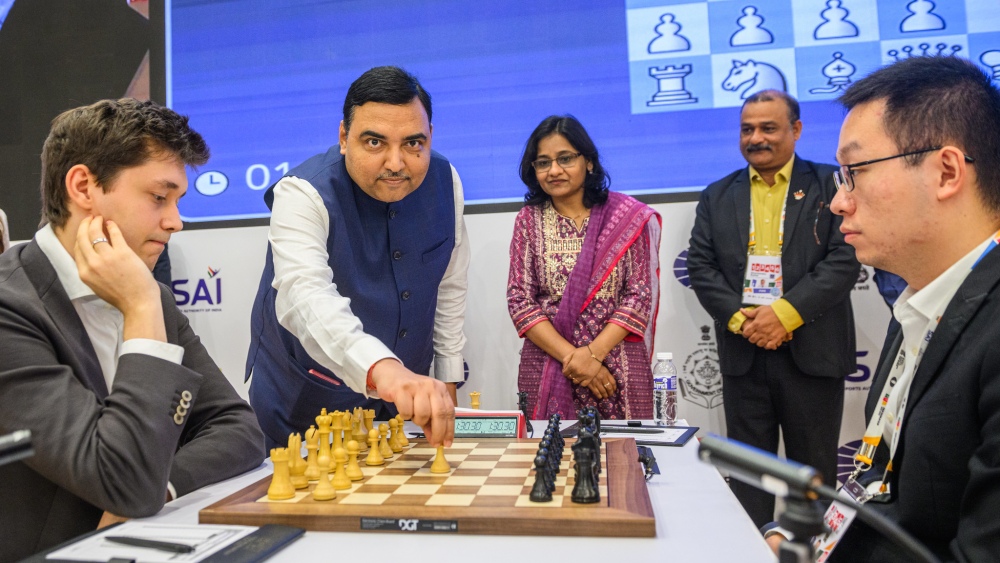
The second classical games of the semifinals followed a familiar script in Goa. Once again, deep preparation shaped both encounters, long early thinks filled the hall, and the positions that emerged were rich but balanced. And once again, neither game produced a winner. With two more draws on the board, all semifinal spots will now be decided in tomorrow’s tiebreaks. The ceremonial first moves were made by Mr. Sanjay Dhivre, IRS (Indian Revenue Service), Additional Commissioner of Income Tax, and Mrs. Bhagyahree Dhivare, IAS (Indian Administrative Service), CEO of the Election Commission Nagaland on board two. The first result arrived from the all-Uzbek clash between Javokhir Sindarov and Nodirbek Yakubboev. Their game featured subtle opening nuances before resolving into a level endgame on move 31. For two players who know each other exceptionally well and entered a line offering limited winning chances, the early handshake felt natural. The second game, between Andrey Esipenko and Wei Yi, carried more tension. The Chinese grandmaster had been outprepared and slightly outplayed in their first game. When I ran into him at dinner last night, I asked him about it, and he admitted he was “lucky” to escape with a draw. So it was concerning to see a similar storyline developing today when Esipenko, now with the white pieces, produced specific preparation and reached a slightly better position. He even had a moment where he could have pressed for more, but the chance passed. Wei stayed solid under pressure and steered the game to safety. With nearly a full month of play behind them, hours of preparation each day, and the physical and mental strain of the World Cup at its peak, fatigue is becoming a real presence for the final four. Today might have reflected exactly that. Here is how the games unfolded. Semifinals Game 2 results: Andrey Esipenko ½-½ Wei Yi Javokhir Sindarov ½-½ Nodirbek Yakubboev Andrey Esipenko (2693) vs Wei Yi (2752) Today’s game began with the Nimzowitsch Attack in the Petrov. Esipenko showed clear preparation in older theoretical paths, choosing 7.Bf4 (a line popular in the early 2000s) instead of the more modern 7.Be3. Wei Yi appeared surprised and paused for several minutes before replying. Despite having played this structure before, including a 2016 game against Wesley So, he clearly expected something different. This once again highlighted the strong preparation from Esipenko and his second, David Paravyan, who have been working effectively here in Goa (reportedly in between lobster dinners). Another notable moment arrived a few moves later when Esipenko played the rarer 10.Be2, spending around twelve minutes before committing. It raised the question of whether he had left his preparation or was digging deep to recall his lines, but in either case, it was another surprise. Later in the game, a critical moment arose, one that required calculation and understanding rather than automatic moves. In a position where White could press slightly, Esipenko chose a safer continuation instead of the line that offered the most practical chances. Here, the direct 20.f4 would have stopped Black from playing …g5 and left the h-pawn as a long-term target. It was not a winning attempt, but it was the kind of position where White makes Black solve problems under pressure. In a knockout setting, it would have been an attractive practical try. Instead, Esipenko chose 20.f3, allowing 20…g5. Both players developed naturally on the only open e-file. Wei tripled his heavy pieces lining up an “Alekhine’s gun” formation, but all rooks were eventually exchanged on the same file, easing Black’s defensive task. With the position equalised, the players began to repeat moves. Wei was low on time, and Esipenko played on briefly to push him to move forty, but no progress was possible. A second repetition confirmed the draw. Javokhir Sindarov (2721) vs Nodirbek Yakubboev (2689) The young Uzbek teammates agreed to a draw on move 31 in an objectively level endgame, but the opening phase contained several important subtleties. The game began with the Four Knights Spanish, the same opening Sindarov faced as Black in his second game against José Martínez in the quarterfinals, where the players followed a forcing drawing line. Today’s game started similarly but deviated early: 1.e4 e5 2.Nf3 Nc6 3.Nc3 Nf6 4.Bb5. Here, Yakubboev visibly hesitated, reaching for his knight before pausing and finally committing to the Rubinstein Variation with 4…Nd4. Perhaps he recalled Sindarov’s previous game and preferred to avoid that exact path, but he went ahead with the move nonetheless. This time, White deviated with 5.Nxd4 instead of 5.Bc4. The resulting structure is known for being solid for White but lacking major winning prospects, making it an interesting choice from Sindarov, who is usually more ambitious with the White pieces. A key moment soon appeared, demanding long calculation from both players. Here, Black’s main theoretical choice is 9…0-0, willingly giving up the pawn because after 10.Bxd7 Bxd7 11.Qxd7 Rae8, Black has threats such as …Qxf2 and ample compensation through piece activity and pressure. However, with elimination on the line, the semifinalists have generally been choosing safer continuations. This may explain Yakubboev’s decision to play 9…c6 instead, keeping the pawn. But this was not ideal, as it allowed White to build some initiative with 10.Qe2+ Qe7 11.Qh5!. The point is that capturing the bishop with 11…cxb5, is met by 12.Bg5 with a heavy pressure along the e-file – a type of dynamic position that suits Sindarov well. After thinking for nearly 30 minutes, Sindarov instead played the immediate 10.Qh5. This nuanced move-order shift gave Black slightly more room to reorganize. Yakubboev gradually solved his development issues, exchanged pieces, and steered the game into a balanced endgame that led to the eventual draw. One might label this 99%-accuracy duel as a “stale draw,” but a closer look reveals several important moments. Still, taking this match to tiebreaks by teammates and close friends is understandable, if not expected. But tomorrow, only one of them will progress, and with faster time controls, the depth of preparation and sensitivity
Women’s World Team Championship quarter-finals: Team FIDE and China set to clash in anticipated semi-final
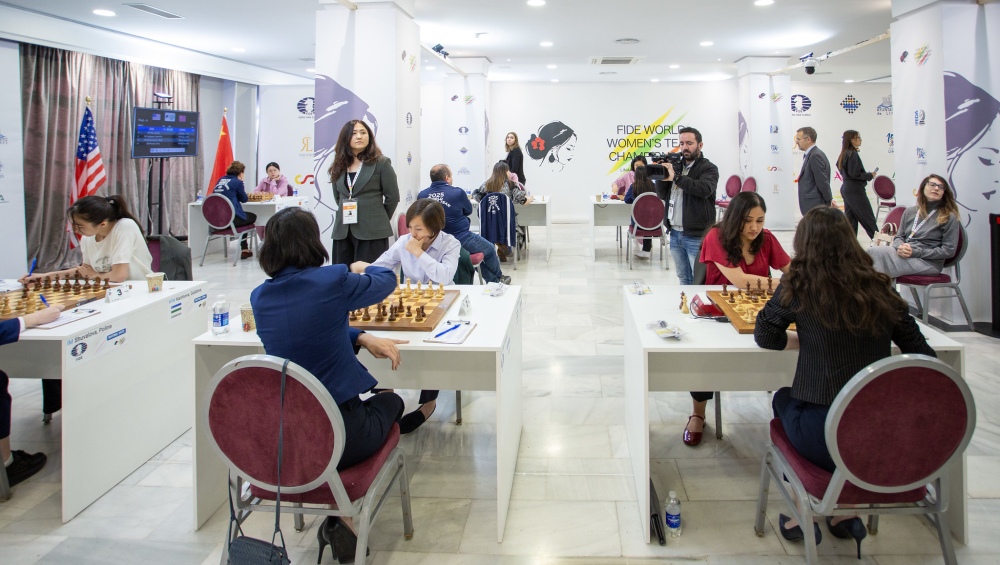
Azerbaijan and Kazakhstan join them after dramatic victories on one of the most thrilling knockout days yet As the knockout stage began in Linares, the Women’s World Team Championship entered its most thrilling phase. The quarterfinals brought with them a blend of precise preparation, fighting spirit, and bold creativity, producing a memorable day in which favourites were tested, rising stars shone, and several duels remained undecided until the very last move. China survived a nail-biter against the USA, Team FIDE swept past Uzbekistan with authority, Azerbaijan stunned the higher-rated Georgians, and Kazakhstan edged India in a heart-stopping blitz finish. By sunset, four teams had emerged from the chaos, each carrying a story worthy of the semi-final stage. Let’s look at how the afternoon unfolded in greater detail in each pool. The gong ceremony to open each of the rounds was performed María Auxiliadora del Olmo Ruíz (Mayor of Linares) and Raúl Caro-Accino (Deputy Mayor of Linares). Duel 1: Team FIDE vs. Team Uzbekistan The most lopsided quarterfinal duel ended decisively in favour of team FIDE, who not only fielded considerably stronger players on every board but also made effective use of their deep bench by bringing in one of their elite reserves. With this victory, they advanced to face China tomorrow in what could easily be described as an anticipated final. A double 3.5–0.5 sweep left no doubt about their superiority: FIDE has issued a clear statement that they are the team to beat for anyone hoping to claim the title in Linares. All five players performed superbly this afternoon, but if one had to be singled out, the standout was unquestionably GM Kateryna Lagno (2517), who defeated rising Uzbek talent WIM Umida Omonova (2289) in impressive technical fashion. Omonova, one of Uzbekistan’s brightest young prospects, is already decorated with multiple medals from Asian Youth and World Youth Championships. In Linares, she further cemented her ascent by crossing the rating threshold to earn her WGM title, a major milestone despite today’s tough pairing. Duel 2: Team USA vs. Team China Team China advanced to the semi-finals, where they will face team FIDE, after defeating team USA in a hard-fought and dramatic duel. On paper, China held a slight rating edge thanks to GM Hou Yifan’s towering presence on board one, but team USA brought significantly more experience, especially given the youthful composition of the Chinese squad. The first classical match ended 3–1 in favour of the USA, putting them in a strong position heading into the second set. Although China was leading the second match overall, a major twist occurred: IM Carissa Yip (2459) scored a stunning win with Black over GM Hou Yifan (2620), while simultaneously IM Anna M. Sargsyan (2377) had IM Song Yuxin (2448) under severe pressure. A 2–2 draw in the second classical set would have sent the USA to the semi-finals, but it wasn’t to be. Song engineered a resourceful and tricky comeback, saving the game and forcing a tiebreak. In the deciding 3+2 blitz match, China dominated completely, delivering a crushing 3.5–0.5 victory to clinch their spot in the final four. A key moment in the classical portion came from board three, where Bent Larsen’s famous maxim “Long variation, wrong variation” proved prophetic, as overcalculation in a complicated line turned the tide at a critical moment. Playing with Black, IM Lu Miaoyi (2440) was gradually outplaying her opponent, IM Tatev Abrahamyan (2391), on board three. In the diagrammed position, both the solid 22…Rd8 and the more ambitious 22…e5 would have been excellent choices. Instead, the Chinese prodigy erred with 22…Nxd4? The idea behind the move is clear: if 23.Nxd4, then 23…Rxf2 gives Black strong counterplay. However, Abrahamyan found the much stronger resource 23.Ne5!, a powerful fork hitting both the queen and the rook. After 23…dxe4 24.Rxe4 Qh5, Lu Miaoyi was relying on the pressure against the rook on d1 to keep the position balanced. But Tatev, well known for her sharp, fighting style, pressed forward with the brilliant 25.Nxf7! After 25…Qxd1, White had just one winning move, but it was spectacular: 26.Nxh6+! gxh6 27.Rg4+ Kf7 28.Qh7+ Kf6 29.Qg7#, an elegant checkmate that concluded one of the most memorable tactical sequences of the round. Even though the match finished quite late, I was able to gather the full team and their coaches for a quick post-match interview. https://www.youtube.com/watch?v=VEq8RbTMYl4 Duel 3: Team Azerbaijan vs Team Georgia Although Georgia appeared to be the clear favourite on paper, Azerbaijan produced the upset of the afternoon by defeating one of the top contenders for the title. With this remarkable victory, the Azerbaijani team earned their spot in the semi-finals, where they will face Kazakhstan for a place in the championship match. The first match was a thrilling affair, ending in a lively 2–2 scoreline, with all four boards producing decisive results. The fighting spirit on both sides set the tone for what would become one of the most dramatic duels of the day, as neither team showed any interest in quiet, risk-free play. The game appeared roughly balanced, with no immediate signs that anything could go seriously wrong for Black. However, IM Khanim Balajayeva (2350) demonstrated excellent tactical alertness and produced one of the biggest surprises of the round: an upset that allowed Azerbaijan to tie the first match of the duel against Georgia. Balajayeva struck with 27.cxd5, and the experienced GM Bella Khotenashvili (2424) faltered by replying with 27…Rxd5? (the simple 27…exd5 would have held the balance). This oversight allowed White to unveil the powerful resource 28.Rc1!, simultaneously attacking the queen and—more importantly—exploiting the loose knight behind it. After 28…Qd6 29.Ne4!, Black’s position collapsed: the knight on c6 under attack, and if it moves, a decisive fork on f6 ends the game immediately. A crisp tactical finish by Balajayeva at a critical moment of the match. In the second set, a single win by WGM Govhar Beydullayeva (2358) ultimately sealed the deal for Azerbaijan, who secured a 2.5–0.5 victory and advanced to the semi-finals. Even though IM
FIDE World Rapid and Blitz Championship: Dress code requirements
FIDE is pleased to publish the dress code for the FIDE World Rapid and Blitz Championships 2025 in Doha, Qatar: Dress code requirements The dress code is strictly observed for the tournament and all the official events and press-conferences. Clothing allowed for men: Suit Dark business casual trousers, including classic, non-distressed jeans (blue, black, and grey) Unicoloured shirt (with minor deviations allowed, e.g. checkered or striped) Dress shoes and loafers with closed toes Unicoloured sneakers (soles can be a different colour) Clothing allowed for women: Skirt suit, pantsuit, dress suit Dress Dark business casual trousers, including classic, non-distressed jeans (dark blue, black and grey) Shirt/blouse Dress shoes and loafers Unicoloured sneakers (soles can be a different colour) The clothes and shoes shall be neat and free of offensive slogans, tears, or rips. No players with t-shirts, shorts, baseball caps or inappropriate dress are allowed in the playing venue. Any requests to wear national or traditional dress shall be approved by GSC. Sanctions for dress code violations Minor Infringements Minor infringements are those committed without specific intent. Examples include a sloppy or unkempt appearance, wrinkled clothing, or other minor deviations from the standard. First Infringement will result in a financial penalty of 5% of the player’s total prize money earned in the two events, but not less than €300 for open events and €150 for women’s events. The player is allowed to complete the current day and is not obliged to change immediately. Further InfringementsSubsequent infringements will result in exclusion from the pairings for the next round. Major Infringements Major infringements are those demonstrating disregard for or denial of the dress code rules as a whole, or showing disrespect toward FIDE, the opponent, or their countries and national symbols. Examples include, but are not limited to, wearing shorts, beachwear, sleeveless shirts (for men), or clothing/footwear with offensive content or logos of prohibited sponsors (e.g., betting companies, alcohol, tobacco). Each infringement will result in a financial penalty of 10% of the player’s total prize money earned in the two events, but not less than €1,000 for open events and €500 for women’s events.The player will also be excluded from the pairings for the next round. Official website: worldrapidandblitz2025.fide.com/
FIDE World Cup semifinals open with hard-fought draws
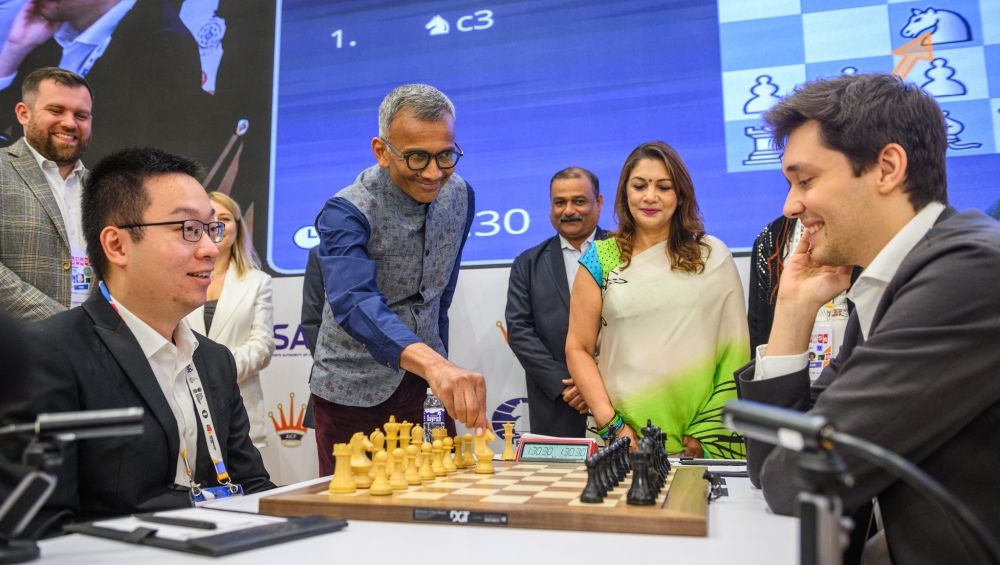
After a quiet rest day yesterday, the players returned to the hall where they have been competing for the last twenty days. A new stage setup elevated the boards, symbolic and fitting for the spectacle that the final rounds of the FIDE World Cup promise to bring. Today marked game one of the semifinals, and although both matches, Wei Yi vs Andrey Esipenko and Nodirbek Yakubboev vs Javokhir Sindarov, ended in draws, they were anything but uneventful. Deep preparation, opening surprises, time pressure and several only-move moments defined the day. Grandmaster Wei Yi, as has become routine, was the first to arrive, followed shortly by his opponent Grandmaster Andrey Esipenko. With a few minutes to spare before the round began, both sat quietly at the board, focused and still. Grandmaster Nodirbek Yakubboev arrived next, carrying his usual five bottles of water. Just before the clocks were started, the ceremonial first move took place, and moments later a slightly flustered and narrowly on-time Javokhir Sindarov entered the hall and took his seat opposite his Uzbek teammate. Today’s first move on the board between Wei Yi and Esipenko was made by Mr. Anup Shah, Managing Director of Resort Rio Goa, and Mrs. Alpa Shah, Director of Resort Rio Goa, two people who have led the wonderful hospitality provided to us throughout the last month. This month of remarkable chess has brought us to these intense final stages. As Grandmaster Fabiano Caruana, the first qualifier to the 2026 FIDE Candidates, stated online, the World Cup is an incredibly difficult tournament and regardless of how well one performs, only three participants leave truly happy: the three Candidates qualifiers. Watching the field shrink after every round has been bittersweet. With players departing every few days, the dining hall has grown quieter. And knowing that one of these four semifinalists, after fighting so hard to reach this point, will soon join the list of 202 eliminated players feels equally, if not more, bittersweet. Still, this is the nature of the event. Success here demands skill, stamina and a measure of luck. Semifinals Game 1 results: Wei Yi ½ – ½ Andrey Esipenko Nodirbek Yakubboev ½ – ½ Javokhir Sindarov Wei Yi (2752) vs Andrey Esipenko (2693) The first surprise of the day came immediately when Esipenko met Wei Yi’s 1.e4 with 1…e6. It was the same French Defense that the Chinese number one had successfully employed in his first quarterfinal game against Arjun Erigaisi. With a rest day available for preparation, unexpected choices made strategic sense, and Esipenko’s decision became even more logical when it became clear that he was not heading into a main line, but the Rubinstein Variation: 1.e4 e6 2.d4 d5 3.Nc3 dxe4 followed by 4.Nxe4 Nd7. It was reasonable to assume that Wei Yi may not have deep practical experience here. Although initially caught off guard after anticipating what he considered a guaranteed Italian, our commentators Grandmasters Peter Leko and Jan Gustafsson quickly agreed that this was a clever and well-timed choice by Black. Wei Yi appeared taken aback by the opening and took his time before committing to a structure and a plan. Esipenko essentially won the opening phase, reaching a slightly better position with two bishops and holding a significant time advantage. Wei Yi, on the other hand, found himself struggling to find chances for activity while also feeling the growing pressure of the clock. Then, suddenly, everything turned. A critical nuance required Black to play 27…Qf5 to remove White’s queen from the center before taking the pawn on h5. That line would have left White with an inferior but holdable position – requiring accuracy. Instead, Esipenko played the immediate 27…Qxh5, and after several minutes of calculation, Wei Yi unleashed the stunning 28.Bxa6! The bishop cannot be taken because the Black king would be exposed to decisive threats. The game continued 28…e5 29.Rd8 Rxd8 30.Rxd8 Ka7. Black attacked the bishop and threatened with 31…Bf5 but another incredible only-move followed instantly: 31.Qa4! which drew applause in the studio from Peter Leko. The game then concluded with 31…bxa6 32.Rd7+ Bxd7 33.Qxd7+ Kb6, after which the players agreed to a draw due to an unavoidable three-fold repetition. Being caught in deep preparation and finding yourself worse as White in a World Cup semifinal is never easy, but Wei Yi once again showed why he is one of the strongest performers of the event. He held his nerve, calculated with precision under extreme pressure, and found the correct moment to strike. Esipenko has previously said that luck is a necessary ingredient for success in the World Cup, and today it was his opponent who had that combination of accuracy and good fortune. Nodirbek Yakubboev (2689) vs Javokhir Sindarov (2721) Despite arriving slightly late, Sindarov seemed relaxed and confident. This was evident not only from his quick early moves and usual pacing around the hall, but also from the enthusiastic high-five he exchanged with his board neighbour Andrey Esipenko as they crossed paths in the opening minutes. Yakubboev, who arrived with the benefit of two consecutive rest days after avoiding quarterfinal tiebreaks, came armed with strong preparation against Sindarov’s Semi-Slav, the same opening they had played in their last two classical encounters. White opted for a sideline with 5.Qd3, but Black appeared completely prepared and unfazed, blitzing out correct theory as if he had predicted it. Soon, in fact, it was Yakkuboev who seemed surprised, spending 23 minutes on his 11th move despite Black having played only natural, expected moves. Despite this sharp start, nothing complicated emerged. Once both players were out of theory, the position settled, and they navigated it with great accuracy. After trading down to an even endgame, where only White could really push for something, Black offered a draw on move 30, which Yakubboev accepted. It was a calm and unsurprising beginning for two players who know each other deeply and have faced each other many times. Notably, both played with great accuracy, with respective scores of 99% and 100%. Tomorrow
A Move for Freedom and Redemption in El Salvador

A powerful and emotional moment unfolded at the Estadio Nacional Jorge “El Mágico” González, where inmates participating in El Salvador’s Plan Cero Ocio were brought out of the prison system to receive public recognition for their achievements in the 5th FIDE Intercontinental Online Chess Championship for Prisoners. The ceremony brought together leaders from FIDE, FIDE America, INDES, and the national prison authorities — a testament to the strength of this collaborative rehabilitation effort. Among the distinguished guests were: José Carrillo Pujol, President of FIDE Americas Dana Reizniece, Deputy Chair of FIDE Management Board Dinora Acevedo, INDES (National Institute of Sports of El Salvador) Samuel Diaz, Director of the Santa Ana Penitentiary Industrial Complex Erick Hernandez, Treasurer of FIDE Americas Saul Montoya, Vice President of Salvadoran Chess Federation Their presence underscored both national and international commitment to the transformative power of chess. Plan Cero Ocio: Building skills and discipline As part of Plan Cero Ocio, participants receive chess training five times a week, providing structure, focus, emotional control, and the opportunity to develop skills that support reintegration. Their dedication led to extraordinary success at the 5th Intercontinental Chess Championship for Prisoners: Gold — Women’s Team Silver — Men’s Team These achievements are supported by the tireless work of INDES’ Inclusive Sports Department which coordinates technical support with the Salvadoran Chess Federation. Special mention goes to International Master Roberto Calderin, who coached the teams for four months, guiding and advising the players daily. Regional coordination and long-term development are further strengthened by the support of FIDE Americas. Voices from the inside The most powerful words came from the participants themselves: “Chess gives me structure. Training every day helps me stay focused and calm. It’s the first time in years I feel like I’m improving at something.” “When I play, I feel free. It reminds me that my mind still belongs to me — and that I can make better decisions, one move at a time.” These reflections capture the essence of what Chess for Freedom aims to achieve: discipline, dignity, hope, and the ability to think forward — on the board and in life. FIDE’s commitment in the 2025 Year of Social Chess As part of the 2025 Year of Social Chess, FIDE is proud to stand with El Salvador in advancing programs that use chess as a bridge to education, rehabilitation, and social inclusion. This ceremony was not just about medals — it was about human transformation. Chess changes lives. And on this occasion, these players proved it on a national and global stage.
FIDE World Women’s Team Championship: Quarterfinals set with rising stars and tactical fireworks at Linares
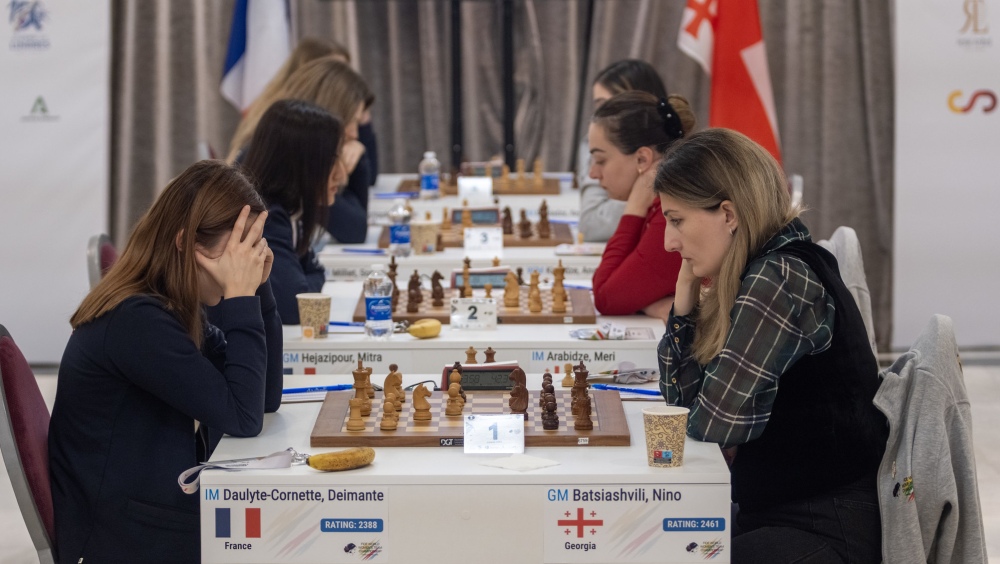
Georgia fields reserves while France scores a last-round triumph. With the qualifying rounds concluded, the quarterfinal line-up is finalized, showcasing a mix of powerhouse teams and emerging contenders. Azerbaijan, China, and other top seeds demonstrated both depth and precision, while prodigious talents like Lu Miaoyi and Ulviyya Fataliyeva reminded the chess world of their rising potential. The upcoming duels will test strategy, resilience, and nerves under pressure. Eight teams move forward, each carrying hopes, ambitions, and the scars of previous battles. Every quarterfinal match promises intense battles, where experience meets ambition, and every move could decide the fate of a championship run. Let’s look at how the afternoon unfolded in greater detail in each pool. The afternoon of chess began with Javier Ochoa de Echagüen, President of the Spanish Chess Federation and of the Ibero-American Chess Federation and FIDE Adviser, opening the round with the ceremonial gong. Pool A Azerbaijan prevailed in their crucial clash against the host nation, Spain. The final result — a convincing 3.5–0.5 — leaves no room for doubt and secured the Azeri team a spot in the quarterfinals, while simultaneously eliminating the Spaniards from the competition. One of the key victories came on board one, where IM Ulviyya Fataliyeva (2420) outplayed IM Sarasadat Khademalsharieh (2429). European U-14 and U-18 champion, Fataliyeva also won the 2024 European Women’s Individual Chess Championship. In this middlegame position, Fataliyeva enjoys more space, and her pieces are harmoniously placed for an attack. Until this moment, Khademalsharieh had defended accurately, striving to keep the position as closed as possible. However, her last move – 21…Qd7? instead of the stronger 21…0–0–0 – allowed the Azeri player to break through with a classical piece sacrifice, beginning with 22.f5! gxf5 23.Bxf5! exf5 24.e6! fxe6 25.Nxe6 The knight on e6 prevents Black from castling and threatens multiple discovered checks. Spain’s top board tried to block with 25…Be7, but after 26.Qe5! the rook on h8 came under direct fire. Khademalsharieh replied with 26…Rg8, yet 27.Qxf5 (threatening 28.Qxh5#) only intensified the pressure. Following 27…Qc6, the precise 28.Qf7+ forced immediate resignation, as 28…Kd7 29.Nc5+ Kd6 30.Bf4 leads to checkmate. A fantastic attacking masterpiece by IM Ulviyya Fataliyeva! https://www.youtube.com/watch?v=TtM3R5DTm8g In the other afternoon encounters, team FIDE completed the qualifying stage with a perfect 100% score, delivering a dominant 3.5–0.5 victory over Peru. Meanwhile, Kazakhstan produced the upset of the round, defeating team USA by the same margin and securing second place in the group. POOL A FINAL STANDINGS Pool B The match between Uzbekistan and India was fiercely contested. Although a draw would have been enough to qualify both teams, a decisive win on the fourth board by WGM Srija Seshadri secured a 2.5–1.5 victory for India and third place in the group standings. Meanwhile, China cruised past Ukraine with a convincing 3–1 score. The match highlighted IM Lu Miaoyi (2440) as a future contender for the highest honors in women’s chess. Born in 2010, Lu Miaoyi is a rising Chinese chess prodigy and one of the strongest young female players in the world. She is known for her aggressive style, rapid rating ascent, and record-setting achievements at a remarkably young age. Under severe time pressure, IM Nataliya Buksa (2400) finally cracked and played 18.Qe1? (the correct move was 18.Qe2, which would have maintained equality), allowing a neat tactical opportunity. Lu Miaoyi thought for seven minutes to calculate the lines and played 18…Nxe3! After 19.Rxe3, she followed up with 19…Qd5!, threatening mate on g2. At this point, 20.Nf3 would have fallen to 20…Qxd3, while 20.Bf1 loses to 20…Bxe3+ 21.Qxe3 Rc2!, winning immediately. Buksa chose 20.Qf1, giving up the exchange after 20…Bxe3. Although the game continued until move thirty-seven, the result was never in doubt, with Lu Miaoyi firmly in control. Already qualified in first place, Georgia decided to field their two reserve players, Kirtadze and Mgeladze, providing a well-deserved rest for the starting lineup. Despite putting up a strong fight, they went down 3–1 against France, who will leave Linares with mixed feelings – elimination from contention but a final-round victory against the group leaders. POOL B FINAL STANDINGS With these results, the quarterfinals are set. According to the regulations, each duel consists of two matches with the same time control as the qualifying stage: 45 minutes per player for the entire game, plus a 30-second increment per move starting from move 1. In the event of a drawn duel – either if each team wins one match, or both matches are drawn – board points will not be used as a tiebreaker. Instead, blitz matches will determine the winner. The first quarterfinal matches will start on November 21 at 1:30 PM local time. The action can be followed live on the FIDE YouTube Channel, featuring expert commentary by GMs Antoaneta Stefanova and Ivan Cheparinov. Official website: worldwomenteams2025.fide.com/ Written by IM Michael Rahal Photos: Raúl Martínez / Pavel Dvorkovich
FIDE announces the list of players for the 2025 World Rapid and Blitz: A stellar lineup in Doha
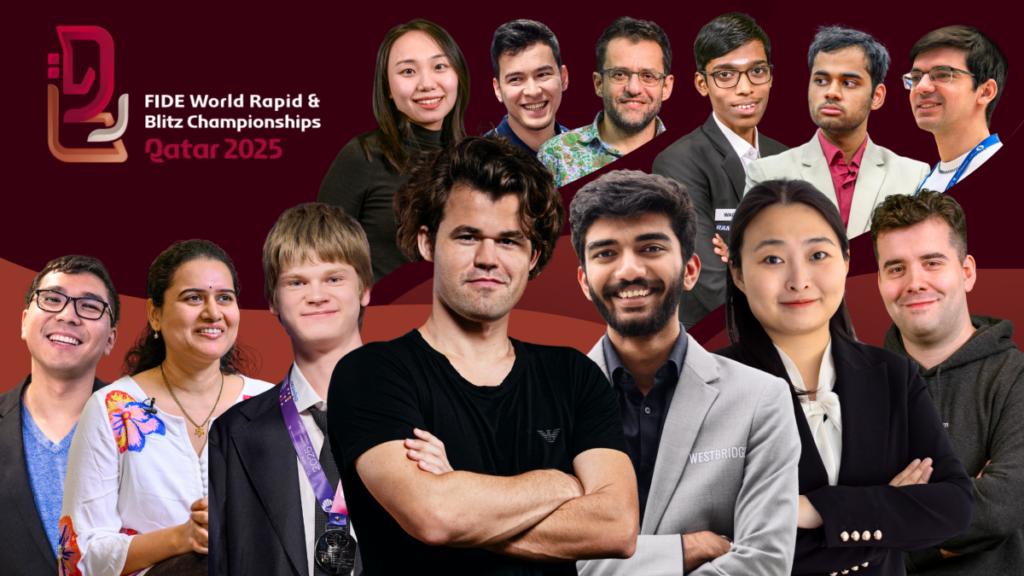
World Champion Gukesh D and Magnus Carlsen join over 360 players who have confirmed their participation in the FIDE World Rapid & Blitz Chess Championship in Doha. The event, which will take place from December 25 to 30, brings together a field featuring multiple world champions, most of the sport’s highest-rated competitors, and rising stars. A total of 233 players registered for the Blitz Open and 230 for the Rapid. After missing out on the crown in the Rapid and sharing gold in the Blitz in the previous edition in New York, Magnus Carlsen – who this year became a father – returns to the FIDE World Rapid & Blitz. He will try to unseat the 2024 World Rapid champion, Volodar Murzin, who has had strong tournament performances throughout the year. Photo: Lennart Ootes World Champion Gukesh D has also confirmed his attendance. His participation is expected to draw a lot of interest from the public. In particular, his superb result in Zagreb earlier this year indicates he will be one of the favorites in Rapid. Many seasoned elite players such as 2024 World Blitz co-champion Ian Nepomniachtchi, Fabiano Caruana, Anish Giri, Wesley So, and Levon Aronian have also confirmed their participation. Challenging them will be a new generation of contenders seeking to disrupt established hierarchies: Vincent Keymer, Arjun Erigaisi, Nodirbek Abdusattorov, Praggnanandhaa R, Yagiz Kaan Erdogmus, and Ediz Gürel to name just a few. Photo: Michal Walusza And of course, the public will be delighted to see legendary players like Alexander Grischuk, and Vasyl Ivanchuk, who actually won the World Rapid in Doha, back in 2016. FIDE Women’s Rapid and Blitz will also see the best in the world taking part. Headlined by Women’s World Champion Ju Wenjun, the competition will see 130 players, including heavyweights Zhu Jiner, Lei Tingjie, Aleksandra Goryachkina, Humpy Koneru and more. Anna Muzychuk – who won both the Women’s Rapid and Blitz in Doha in 2016 – will also be there, together with her sister, Mariya. Photo: Anna Shtourman “The lineup shows the immense strength and magnetism of the World Rapid & Blitz,” FIDE President Arkady Dvorkovich said. “We are pleased to see so many strong players in both the Open and the Women’s competition confirming they will take part. The FIDE World Rapid & Blitz is traditionally one of the most exciting and most watched chess events in the year, and we expect that tradition to continue. I’d like to thank the local organizing committee for sparing no effort in making it a great event,” Dvorkovich added. “The field is tremendously strong, and it is going to be a real chess feast. Once again, FIDE managed to gather nearly all the world’s best players, and I am looking forward to a great sportive drama, fascinated both in my FIDE capacity, and as a life-time chess fan,” says FIDE CEO Emil Sutovsky. “Doha is now the only city to host the World Rapid & Blitz Championship twice, a milestone for chess and for sports in Qatar. It reflects our deep passion for the game and our commitment to delivering excellence. We are proud to welcome the world’s greatest players back to Doha, where ambition, tradition, and the future of our sport meet,” said Mohd Al-Mudahka, President of Qatar Chess Federation. Taking place in Doha (Qatar) from December 25 to 30, the FIDE World Rapid & Blitz Chess Championship has a prize fund of over €1,000,000 spread across both the Open and the Women’s competitions. Doha last hosted the championship in 2016, when Vasyl Ivanchuk claimed the title in the Rapid section and Sergey Karjakin became the Blitz World Champion. About the event The FIDE World Rapid & Blitz Championships 2025 is taking place in Doha, Qatar from December 25 to 30, bringing together the world’s elite chess talent for a thrilling end-of-year showdown. Held at the Sports and Events Complex, Qatar University, this edition features both Open and Women’s events in Rapid and Blitz formats, with a total prize fund of over €1,000,000. Doha returns as host after nine years, underscoring Qatar’s growing stature in the chess world. The full list of registered players can be found here: Rapid Open: worldrapidandblitz2025.fide.com/participants-rapid-open/ Rapid Women: worldrapidandblitz2025.fide.com/participants-rapid-women/ Blitz Open: worldrapidandblitz2025.fide.com/participants-blitz-open/ Blitz Women: worldrapidandblitz2025.fide.com/participants-blitz-women/ For more information about the event, including media registration, please visit: https://worldrapidandblitz2025.fide.com/
2025 FIDE Women’s World Team Championship: Hou Yifan debuts as team FIDE dominates
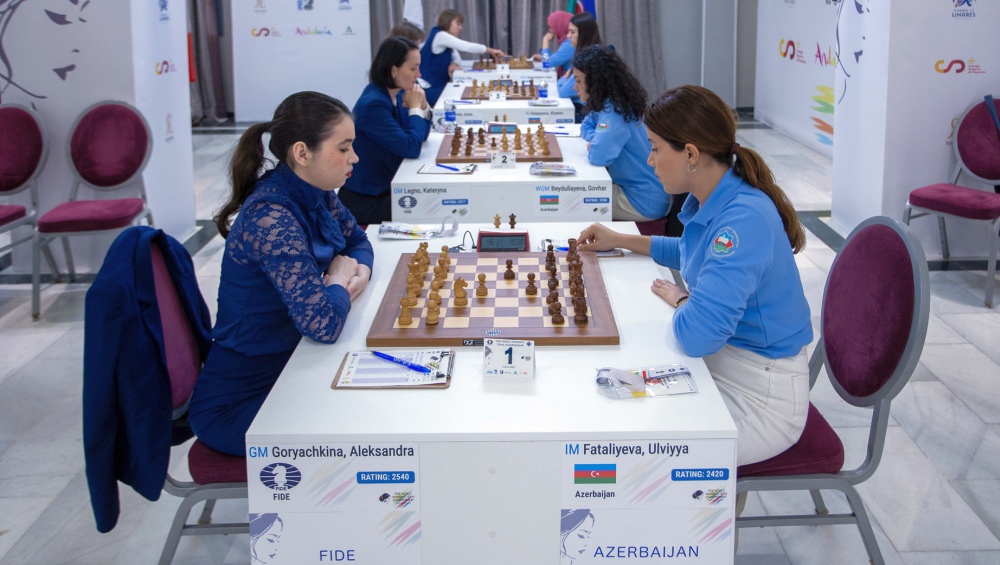
The second day of the 2025 FIDE Women’s World Team Championship in Linares delivered high drama and top-class chess across both pools. All eyes were on China’s top board, as four-time Women’s World Champion Hou Yifan made her long-awaited debut, marking it with a precise and elegant victory that immediately set the tone for Pool B. Meanwhile, Team FIDE continued to dominate Pool A, sweeping past Spain and Azerbaijan with commanding performances and edging closer to a perfect group-stage record. Beyond the headline performances, several teams found themselves embroiled in tense qualification battles. Every match carried high stakes, with narrow margins and critical tiebreak scenarios deciding which teams would advance to the quarterfinals. From the tight race for second and fourth in Pool A to the dramatic fight for the last knockout spots in Pool B, the competition was fierce, and the tension palpable. Linares has once again proven why it is one of the most exciting stages in international women’s chess. Mariola Rus Rufino, General Director of the Department of Sports Values and Systems for the Junta de Andalucía, opened the round with the ceremonial gong. Let’s look at how the afternoon unfolded in greater detail in each pool. Pool A Team FIDE continued to sweep through their opponents with emphatic victories over Spain (3.5–0.5) and Azerbaijan (3–1), securing a commanding lead at the top of Pool A. With such a margin over the chasing teams, their qualification in first place is virtually guaranteed. Barring an extremely unlikely collapse tomorrow – they face Peru, who have lost all four of their matches – Team FIDE should finish the group stage on a perfect 100% score and advance confidently to the quarterfinals. Behind them, Kazakhstan and the USA share second place with three wins and one loss each, both having been defeated only by Team FIDE. Their direct clash in the final round will determine who finishes second and who must settle for third place. The most dramatic final-round showdown, however, will decide the last qualifying spot for the quarterfinals. Spain and Azerbaijan are currently tied for fourth place – even level on game points – and will face each other in a decisive head-to-head encounter. In the event of a 2–2 draw, Sonneborn-Berger system will be the tiebreaker, meaning the results of other teams may ultimately determine who advances. Pool A- Round 5 pairings A neat tactical shot appeared on board four in the match between Spain and Team FIDE. Playing with the Black pieces, GM Olga Girya (2390) showed excellent awareness in the late middlegame against WGM Mónica Calzetta Ruiz (2194). With both players entering their final five minutes, Girya spotted a hidden tactical idea and chose the energetic advance 26…d4. Calzetta had several ways to keep the balance – for instance, 27.cxd4 cxb4 28.d5!, which should hold, or the calmer 27.Nc2 dxc3 28.Rxc3, where a draw remains the most likely outcome. Instead, Calzetta opted for 27.Ng4?, aiming to simplify quickly, but the move loses immediately to 27…Nxg4 28.hxg4 and now the powerful blow 28…dxc3!!. The rook on d7 is untouchable due to the decisive …c2 promotion idea, so White was forced to play 29.Rxc3, the simple 29…cxb4 left Girya with a completely winning position. The rest was smooth sailing for Black. Pool B Georgia have powered through Pool B with four convincing victories and have already secured first place with a round to spare. Across sixteen individual games, they remain undefeated on every board – an outstanding achievement for the team led by captain Salome Melia. China sit just behind them, having conceded a draw to India and suffering a loss to Georgia today. Even so, with five match points, they are already mathematically assured of a spot in the quarterfinals. The real drama is unfolding in the race for third and fourth place. Uzbekistan (check out an interview with the team below) and India are level on four points, while Ukraine trail with two. https://www.youtube.com/watch?v=HCMRuFtA-W0 Ukraine must defeat China tomorrow – and by as wide a margin as possible – to keep their qualification hopes alive. They also need a decisive result in the match between Uzbekistan and India; a 2–2 draw in that encounter would eliminate Ukraine regardless of their own performance. The final round promises unparalleled excitement – tension at its peak. Leading Team China, former four-time Women’s World Champion GM Hou Yifan (2620) made her Linares debut this afternoon with a clean technical masterpiece against IM Padmini Rout (2337), India’s first board. With only two minutes remaining, Padmini missed the chance to put up stubborn resistance with 44…Kg8, and instead blocked the check with her rook – 44…Rg6? Sensing the end was near, Hou Yifan calmly played 45.Rg3!, introducing several dangerous threats. After 45…Kg7, the precise 46.f4! exf4 47.Nxf4 followed, and the rook on g6 was completely trapped. The game continued 47…Rf6 48.Nh5+ Kf7 49.Nxf6, and the extra exchange was more than enough advantage for Hou Yifan to convert and score a crucial point, securing a 2–2 draw for China. Pool B – Round 5 pairings Round 5 will start on November 20 at 1:30 PM local time. The action can be followed live on the FIDE YouTube Channel, featuring expert commentary by GMs Antoaneta Stefanova and Ivan Cheparinov. Official website: worldwomenteams2025.fide.com/ Written by IM Michael Rahal Photos: Raúl Martínez / Pavel Dvorkovich
FIDE World Cup: Heartbreak for India as Arjun eliminated; Wei Yi, Esipenko, and Sindarov join Yakubboev in the semifinals
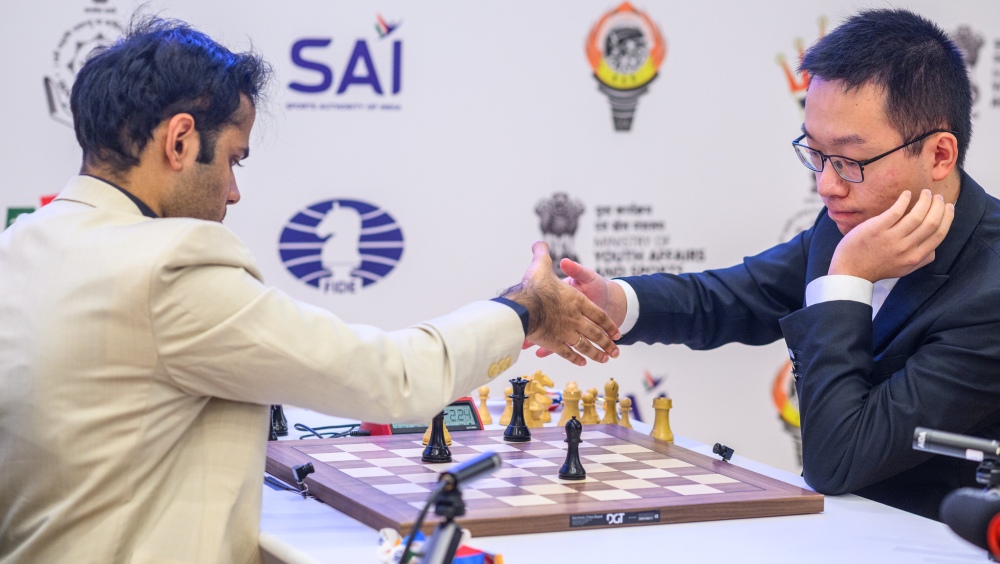
Four draws yesterday left three semi-final spots undecided and brought six players to what may be the most stressful point of the World Cup so far. With everything riding on the rapid and blitz tiebreaks, the atmosphere in the hall was tense long before the clocks started. Spectators filled the room early, aware that today would determine who would keep their Candidates hopes alive. When the day concluded, Wei Yi, Javokhir Sindarov and Andrey Esipenko all won their matches, joining Nodirbek Yakubboev who had qualified the previous day. It was also a heartbreaking afternoon for Indian fans as Arjun Erigaisi, the last remaining home player, was knocked out by Wei Yi. Before play began, the ceremonial first move was made on Board 1 of Martínez vs. Sindarov by Mr. Jayant Chaudhary, Union Minister of Skill Development and Entrepreneurship and Minister of State for Education, Government of India. With pressure high across all boards, here is how the quarterfinal tiebreak battles unfolded. QuarterfinalsTiebreak Results Arjun Erigaisi ½-1½ Wei Yi José Eduardo Martínez Alcántara 1½ -2½ Javokhir Sindarov Andrey Esipenko 3-1 Sam Shankland Wei Yi (2752) vs Arjun Erigaisi (2773)After yesterday’s classical game, in which the Chinese Grandmaster missed key moves and gave his opponent a chance to strike, Wei Yi made sure not to allow Arjun Erigaisi the same opportunity again. Arriving first to the hall today, he looked composed and focused, not a single leg shake, and ready to fight from game one. In the Steinitz Variation of the French Defense, Wei Yi, with the White pieces, launched an early kingside assault, steering the game into the kind of sharp tactical battle that suits his style and attacking instincts. The position was easy for Black to mishandle, and Arjun did exactly that after spending six minutes (a significant amount of time in rapid) selecting the worst move: Black has just played 10…f6?, allowing White to ignore the threat on the knight and play the immediate 11.Qh5!, followed by capturing on c5 and planting the queen on g6 for a direct assault on the king. Instead, Wei Yi chose 11.exf6, and after 11…Rxf6, Black remained worse, but the attack was at least more manageable. Eventually, White picked up the exchange on move 14, although, according to chess engines castling long first offered him the decisive advantage. Still, Wei Yi played with impressive accuracy up to a certain point but let his advantage slip away in time pressure. With the bishop pair, Arjun managed to simplify into equality and save the game with a draw. It was already a nerve-wracking start, and then came game two. A Petroff Defense where both players appeared well prepared led to a queenless middlegame. Though the young Indian Grandmaster seemed to be faring better than in the first encounter, he overpressed and struggled to coordinate his pieces. Indian fans may have felt relieved when the position liquidated into a stable endgame, until a critical moment unfolded and one lost tempo tilted the balance decisively: Here, Erigaisi played 41.Rf2+?, allowing 41…Bf5 42.Rb2 a6 43.d6 Ke6 44.Rd2 Bd3. The check was unnecessary; better was 41.Rb2 immediately, followed by 41…a6 42.d6 Bf5 43.Rd2. If 42…Ke6, then 43.Bb7 holds, as Black’s rook checks are harmless due to the bishop on d3. Another key moment, and Arjun’s final chance to save the game, came just a few moves later. Here Wei Yi erred with 46…Rh7? (when 46…Kd7 was stronger, as it freezes White’s pieces entirely). Arjun, playing with less than a minute, needed to find 47.Rd5, keeping the rook active and defending the pawn. Instead, he played 47.Bc6?, allowing 47…Rh3+ 48.Bf3 Bd3, leaving the White rook shut out of the game. Black collected the d-pawn and eventually created a passed pawn on the queenside. After rooks were exchanged, the resulting bishop endgame was hopeless for White. Still, they played all the way to checkmate. In the post-game interview, when asked whether he considered himself the favourite in tiebreaks (especially given his strong rapid rating of 2758 compared to Arjun’s 2708), Wei Yi was humble. He pointed out that one cannot assume superiority over Arjun in any format because he is so strong. Now the highest-rated player remaining in the event, Wei stated that he would prepare and approach the upcoming games normally, as any semifinal opponent would have to be strong to reach this stage. https://www.youtube.com/watch?v=U04jf-HzV7Q Javokhir Sindarov (2721) vs José Eduardo Martínez Alcántara (2644) The match between these two rising stars began with an unexpected twist when Martínez, with the White pieces, opened with 1.b3. Sindarov, visibly surprised and shaking his leg in his chair, took a moment before responding, entering a structure he seemed unhappy with, made worse by falling behind on the clock. A critical moment appeared when Black, already slightly worse, played the losing move 35…Rf7? Keeping the rook on the back rank with 35…Re8 would have been better. Placed awkwardly and with the e2-bishop unprotected while White threatened Nd8, Black’s the position quickly deteriorated. Following a forced sequence, Martínez emerged an exchange up. Jose Eduardo was in full control in resulting endgame, with a dominant queen and rook duo on the 7th rank. A checkmate was soon inevitable, and Sindarov resigned, putting himself in a must-win situation. In his post-match interview, Sindarov admitted he was very upset with himself after the first game and gave himself a pep talk to play well in the second, and he delivered. Game two featured a symmetrical English Opening where the early phase already favoured the Uzbek talent. Martínez played aggressively and sacrificed a pawn, creating some activity on the kingside, but Sindarov handled the pressure, converted his material advantage, and eventually wove a mating net to equalize the score. https://www.youtube.com/watch?v=Tbha_64yGZc Their first 10+10 rapid game, while drawn, was far from dull. Martínez launched a queenside pawn storm, while Sindarov countered on the kingside. Sindarov missed a chance to gain a clear advantage by shifting focus to defense instead of pushing his own attack. The game equalized once
Rising stars and surprises: Highlights from Rounds 1–2 of the FIDE Women’s World Team Championship
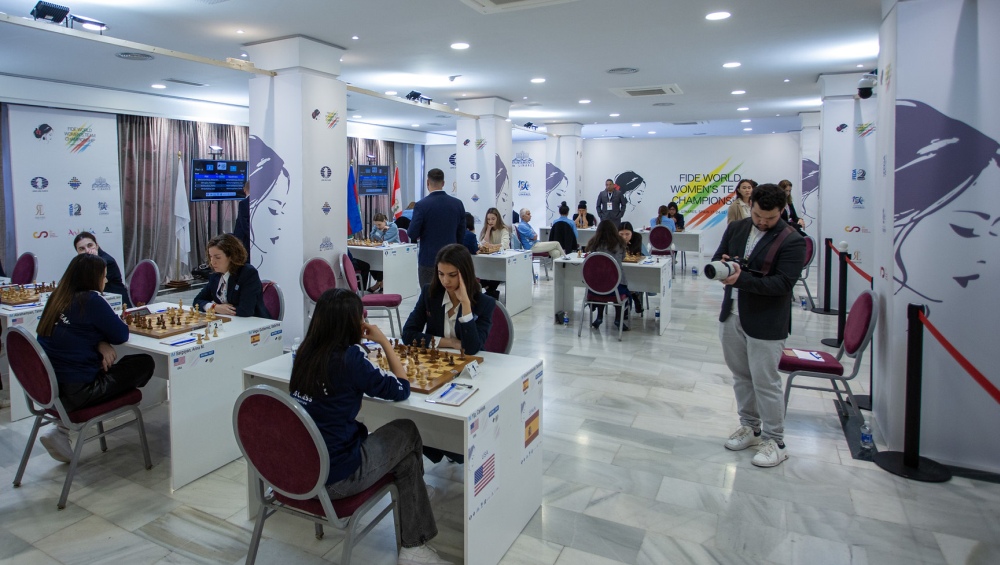
Savitha Shri B and Zhai Mo Shine with tactical brilliance while fast classical debut sparks excitement. Linares was one of the strongest chess tournaments in the world from the late 1980s through the 2000s, attracting Garry Kasparov, Anatoly Karpov, and many other elite players. At the start of each round of the Super-Tournament a large ceremonial gong was struck by a guest of honour to officially begin play. This ritual became one of Linares’s most memorable trademarks. It originated as part of the organizers’ effort to give the event a distinctive identity and elevate it to true world-class status. FIDE President Arkady Dvorkovich and FIDE Deputy President – and former five-time World Champion – Viswanathan Anand opened both rounds of the 2025 FIDE Women’s World Team Championship, reviving one of the most recognisable symbols of that earlier era. Each of the two pools in the event, A and B, features six teams that face one another in a round-robin format over five rounds. The top four teams from each pool will advance to the knockout stage, beginning with the quarterfinals. Most of today’s matches – played with the debuting 45 + 30 “fast classical” time control – were dominated by the rating favourites, though several encounters were decided by narrow 2.5–1.5 margins. After the first two rounds, Team FIDE has taken a commanding lead in Pool A, scoring convincing victories over the USA and Kazakhstan, while four teams sit just behind on 50%. Peru currently trails the group after losing both of today’s matches, against Azerbaijan and Spain, though not without putting up a resilient fight. On the other side of the hall, Pool B is led by China – playing without GM Hou Yifan – and Georgia, with India and Ukraine close behind. Great excitement is expected on day two, as rounds three and four are likely to determine the fate of several teams. One of the relative surprises of the day came in round one, where India defeated Ukraine despite being outrated by nearly 100 points. Although the current Olympic champions did not travel with their top lineup, they still field a young, cohesive, and ambitious team capable of challenging any opponent. On board three, IM Savitha Shri B (2319), playing White, controlled her game against GM Natalia Zhukova (2322) from early on, steadily building pressure on the kingside. Savitha is one of the brightest rising stars in Indian women’s chess, already progressing rapidly through high-level norms. Although White had several winning continuations, the Indian player struck decisively with 34.Rxf6!, tearing apart Black’s defensive structure. Zhukova replied with 34…Bc6+ (as 34…Qxf6 loses immediately to 35.Qxd7), but after 35.Qxc6! Rxc6 36.Rxf7, the former two-time European Women’s Champion had no choice but to resign. A clean and elegant tactical finish. Team captain GM Swayams Mishra and two of the players from the match later joined me in the interview area for a brief post-game assessment of their performance and of the new “fast classical” time control making its debut at this event. https://www.youtube.com/watch?v=d6R0GDyJOKk Meanwhile, the Chinese squad secured two convincing wins and, alongside Georgia, now leads their pool. On board four in their second-round match, WGM Zhai Mo (2384) delivered a spectacular miniature against WCM Madinabonu Khalilova (2228). Zhai Mo is a former Girls U12 World Champion and the 2018 Chinese Women’s Chess Champion. Black had just played 15…Bg7-f8, attacking the rook on d6 and attempting to provoke exchanges that might relieve the pressure. However, Zhai Mo responded aggressively with 16.Ng5!, sacrificing the exchange. After 16…Bxd6 17.exd6 Qd7 18.Ne4!, the weaknesses around the black king quickly became apparent. The decisive threat 19.Nf6+ was temporarily parried by 18…Kg7, but 19.Bb5! highlighted another vulnerability on e5. After 19…Bb7, White unleashed the final tactic: 20.Nf6!!, attacking the queen. Black resigned, as 20…Kxf6 21.Bxc6! Qxc6 22.Qe5 leads to an inevitable checkmate. A brilliant and clean finish from Zhai Mo. After the first two rounds of the tournament, the standings in both pools are as follows: Round three tomorrow at 1:30 pm promises some exciting encounters. In Pool A, the most intriguing match will be USA vs. Azerbaijan, as both teams vie for second place in the group. Close behind, Spain will aim to secure at least a draw against the formidable Team FIDE. https://youtu.be/nb8LA9s-K48?si=TA6AHrw7JvAJQ35Z In Pool B, the dramatic clash between France and Uzbekistan will provide both teams with a final chance to avoid elimination and potentially catch up with the leading teams. Round 3 begins on November 19 at 1:30 PM local time. The action can be followed live on the FIDE YouTube Channel, featuring expert commentary by GMs Antoaneta Stefanova and Ivan Cheparinov. Official website: worldwomenteams2025.fide.com/ Written by IM Michael Rahal (Linares, España) Photos: Raúl Martínez / Pavel Dvorkovich